KnowledgeBoat Logo
|
OPEN IN APP

Chapter 20

Representing 3-D in 2-D

Class - 7 RS Aggarwal Mathematics Solutions


Exercise 20(A)

Question 1

State whether true (T) or false (F) :

(i) A cube has 8 edges.

(ii) A cuboid has more edges than vertices.

(iii) A cube has all edges equal.

(iv) A cone has only one face.

(v) A cylinder has only one vertex.

(vi) A cylinder has two flat faces.

Answer

(i) False
Reason — A cube has 12 edges, not 8. It has 8 vertices.

(ii) True
Reason — A cuboid has 12 edges and 8 vertices. Since 12 is greater than 8, this statement is correct.

(iii) True
Reason — By definition, a cube is a 3D shape in which every face is a square. Therefore, all 12 edges are equal in length.

(iv) False
Reason — A cone has two faces: one flat circular face (the base) and one curved surface.

(v) False
Reason — A cylinder has no vertices. It has two circular edges, but no sharp corners or points where edges meet.

(vi) True
Reason — A cylinder has two identical flat circular faces (the top and the bottom) and one curved surface connecting them.

Question 2

Give two examples of each one of :

(i) a cuboid

(ii) a cube

(iii) a cylinder

(iv) a cone

Answer

(i) a cuboid

Examples: Brick, Matchbox.

(ii) a cube

Examples: Dice, Sugar cube.

(iii) a cylinder

Examples: Gas cylinder, Tubelight.

(iv) a cone

Examples: Ice-cream cone, Conical tent.

Question 3

Fill in the blanks :

(i) A cuboid has ............... lateral faces.

(ii) The number of edges in a cube is ............... .

(iii) A cylinder has ............... faces. The number of flat faces is ............... and that of curved faces is ............... .

(iv) A cylinder has ............... edges.

(v) A cone has one ............... face and one ............... face.

(vi) A cuboid has six ............... faces.

Answer

(i) A cuboid has 4 lateral faces.

(ii) The number of edges in a cube is 12.

(iii) A cylinder has 3 faces. The number of flat faces is 2 and that of curved faces is 1.

(iv) A cylinder has 2 edges.

(v) A cone has one curved face and one flat face.

(vi) A cuboid has six rectangular faces.

Question 4

Draw any four possible nets for a cube.

Answer

Any four possible nets of a cube are shown below:

Net 1:
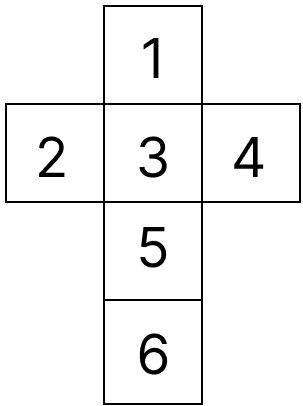
Draw any four possible nets for a cube. Representing 3-D in 2-D, Foundation Mathematics R.S. Aggarwal ICSE Class 7.

When this net is folded to form a cube:

1 lies opposite 5; 2 lies opposite 4; 3 lies opposite 6;

Net 2:
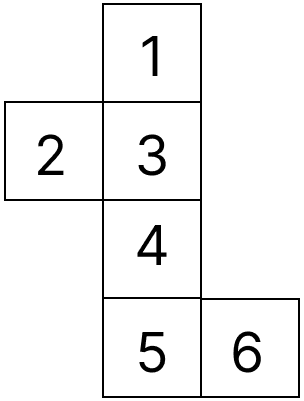
Draw any four possible nets for a cube. Representing 3-D in 2-D, Foundation Mathematics R.S. Aggarwal ICSE Class 7.

When this net is folded to form a cube:

1 lies opposite 4; 2 lies opposite 6; 3 lies opposite 5;

Net 3:
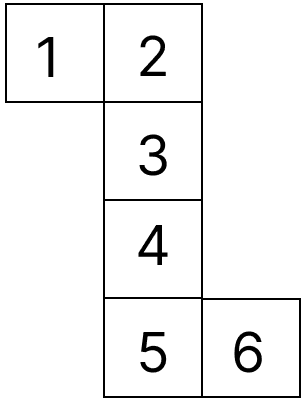
Draw any four possible nets for a cube. Representing 3-D in 2-D, Foundation Mathematics R.S. Aggarwal ICSE Class 7.

When this net is folded to form a cube:

1 lies opposite 6; 2 lies opposite 4; 3 lies opposite 5;

Net 4:
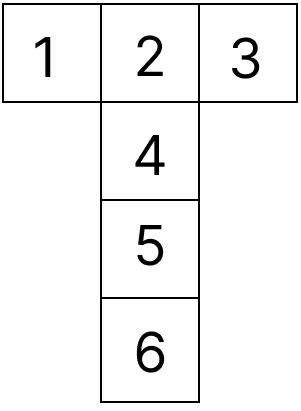
Draw any four possible nets for a cube. Representing 3-D in 2-D, Foundation Mathematics R.S. Aggarwal ICSE Class 7.

When this net is folded to form a cube:

1 lies opposite 3; 2 lies opposite 5; 4 lies opposite 6;

Question 5

Analyse the following nets of cubes and fill in the blanks :
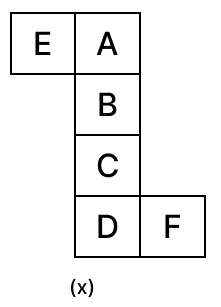
Analyse the following nets of cubes and fill in the blanks : Representing 3-D in 2-D, Foundation Mathematics R.S. Aggarwal ICSE Class 7.
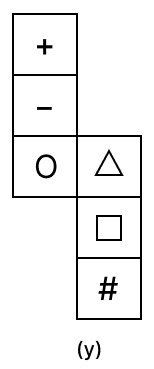

When Net (X) is folded to form a cube :

(i) A lies opposite ...............

(ii) F lies opposite ...............

When Net (Y) is folded to form a cube :

(i) △ lies opposite ...............

(ii) □ lies opposite ...............

Answer

When Net (X) is folded to form a cube :

(i) A lies opposite C

(ii) F lies opposite E

When Net (Y) is folded to form a cube :

(i) △ lies opposite #

(ii) □ lies opposite -

Explanation

In Net (X) :

(i) A is separated from C by one square (B). So, A is opposite C.

(ii) Once the central column is folded, the wings E and F will fold up to face each other. So, F is opposite E.

In Net (Y) :

(i) △ is the wing on one side and # is at the bottom of the fold. When folded, the Triangle will face the #.

(ii) – is separated from the Square symbol by one square (O). So, – is opposite the Square symbol.

Exercise 20(B)

Question 1

Draw a map to guide your friend telling him the way from his home to the venue of your birthday party. Use suitable symbols.

Answer

The map showing the way my friend's home to the venue of my birthday party is shown below:

Draw a map to guide your friend telling him the way from his home to the venue of your birthday party. Use suitable symbols. Representing 3-D in 2-D, Foundation Mathematics R.S. Aggarwal ICSE Class 7.

Question 2

Draw a map of the post office near your house.

Answer

Map of the post office is shown below:

Draw a map of the post office near your house. Representing 3-D in 2-D, Foundation Mathematics R.S. Aggarwal ICSE Class 7.

Question 3

Draw a map of the ground floor of your school.

Answer

Map of the ground floor of my school is shown below:

Draw a map of the ground floor of your school. Representing 3-D in 2-D, Foundation Mathematics R.S. Aggarwal ICSE Class 7.

Exercise 20(B) - Assertions and Reasons

Question 1

Assertion: A rectangular pyramid has 5 rectangular faces.

Reason: A pyramid is named according to its polygonal base.

  1. Both Assertion (A) and Reason (R) are true and Reason (R) is the correct explanation of Assertion (A).
  2. Both Assertion (A) and Reason (R) are true and Reason (R) is not the correct explanation of Assertion (A).
  3. Assertion (A) is true but Reason (R) is false.
  4. Assertion (A) is false but Reason (R) is true.

Answer

Assertion (A) is false but Reason (R) is true.

Explanation

A rectangular pyramid has only one rectangular face, which is its base. The other 4 faces are triangular and meet at a common vertex (the apex). Thus, it has 5 faces in all, but they are not all rectangular.

So, Assertion (A) is false.

A pyramid is named according to the shape of its base, such as triangular pyramid, rectangular pyramid, or pentagonal pyramid.

So, Reason (R) is true.

Hence, option 4 is the correct option.

Question 2

Assertion: A cone is not a polyhedron.

Reason: A solid shape made up of polygonal regions, which are its faces, is called a polyhedron.

  1. Both Assertion (A) and Reason (R) are true and Reason (R) is the correct explanation of Assertion (A).
  2. Both Assertion (A) and Reason (R) are true and Reason (R) is not the correct explanation of Assertion (A).
  3. Assertion (A) is true but Reason (R) is false.
  4. Assertion (A) is false but Reason (R) is true.

Answer

Both Assertion (A) and Reason (R) are true and Reason (R) is the correct explanation of Assertion (A).

Explanation

A cone is not a polyhedron because it has a curved surface.

So, Assertion (A) is true.

The definition of a polyhedron is a solid bounded by flat polygonal faces (like squares, triangles, or rectangles).

So, Reason (R) is true.

Hence, option 1 is the correct option.

PrevNext