
Answer the following questions:
(i) How many end points does a line segment AB have?
(ii) How many end points does a ray AB have?
(iii) How many end points does a line AB have?
Answer
(i) A line segment AB is a fixed portion of a line. It starts at point A and stops at point B.

∴ A line segment AB has 2 end points.
(ii) How many end points does a ray AB have?
A ray AB has a fixed starting point (the endpoint A) but extends infinitely in the direction of point B.

∴ A ray AB has one endpoint.
(iii) How many end points does a line AB have?
A line AB extends infinitely in both directions. Since it never stops, it has no starting or ending points.

∴ A line AB has no end points.
Which of the following has a definite length?
(i)
(ii)
(iii)
Answer
(i)
A ray starts at point A and extends infinitely in the direction of B. Because it never ends, we cannot measure its total length.
∴ It does not have a definite length.
(ii)
A line extends infinitely in both directions and it has no beginning and no end.
∴ It does not have a definite length.
(iii)
A line segment is the part of a line that connects two specific points (A and B). Because it is bounded by these two endpoints, it has a fixed, measurable distance.
∴ It has a definite length.
How many lines can be drawn to pass through two given fixed points P and Q?
Answer
There is exactly one unique line that can connect two distinct fixed points. If we try to draw another straight line through both P and Q, it will simply lie directly on top of the first one.
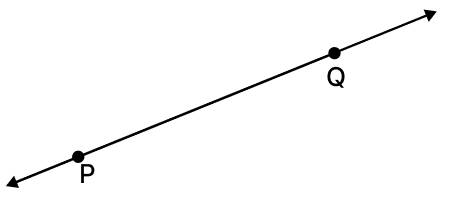
∴ Only one line can be drawn to pass through two given fixed points P and Q.
How many lines can be drawn to pass through a given point?
Answer
A single point acts like a center or a pivot. We can draw lines through it in every possible direction (360°) and since there is no second point to "lock" the line's direction, we can keep drawing them forever.
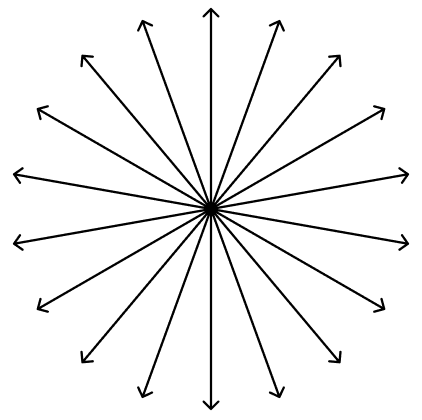
∴ Infinitely many lines can be drawn to pass through a given point.
A fixed point P is given. How many rays can be drawn with P as initial point?
Answer
If P is our initial point, we can shoot a ray out from it in any direction since there are an infinite number of directions in a plane.
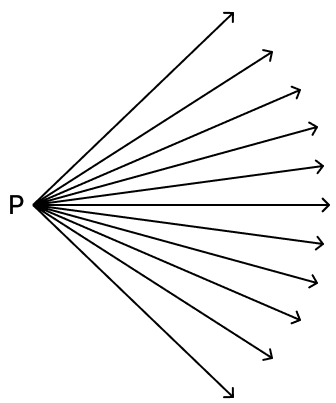
∴ Infinitely many rays can be drawn with P as initial point.
Draw a line segment of length 5.3 cm.
Answer
To draw this line segment, place a ruler on a piece of paper. Mark a point A at 0 cm and another point B at the third small division after the 5 cm mark. Connect these two points with a straight line.

∴ AB = 5.3 cm.
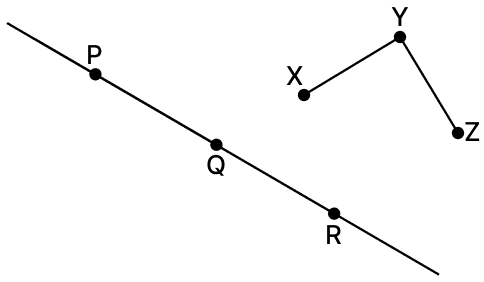
Mark six points P, Q, R, X, Y, Z such that P, Q, R are collinear and X, Y, Z are not collinear.
Answer
Collinear (P, Q, R): Draw a single straight line and place points P, Q, and R anywhere along that same line.
Non-collinear (X, Y, Z): Place points X and Y on a line, but place point Z somewhere else so it does not sit on the line connecting X and Y. These points will form a triangle if connected.
How many lines can be drawn through three:
(i) collinear points?
(ii) non-collinear points?
Answer
(i) By definition, collinear points are points that lie on the same straight line.
∴ One line can be drawn through three collinear points.
(ii) Non-collinear points are a set of three or more points that do not lie on the same straight line.
∴ Three lines can be drawn through three non-collinear points not on the same line.
What is the maximum and minimum number of points of intersection of three lines drawn in a plane?
Answer
Maximum is 3.
This occurs when no two lines are parallel and all three lines do not pass through the same point. Each line intersects the other two at two distinct points, forming a triangle.
Minimum is 0.
This occurs when all three lines are parallel to each other (L1 || L2 || L3). Since they never cross, there are zero points of intersection.
∴ Maximum points = 3, Minimum points = 0.