
What is colonialism?
Answer
Colonialism is the practice in which one country takes control of another region, establishes settlements there, and imposes its political, economic and cultural systems on the people of that region.
What drew European powers to India?
Answer
European powers were attracted to India because:
- India was a wealthy and prosperous country with a strong economy and flourishing trade.
- Indian goods such as spices, cotton, ivory, gems, sandalwood, teakwood and wootz steel were highly valued in Europe.
- India had well-developed manufacturing, diverse agricultural production and extensive internal and external trade networks.
- European powers wanted access to India’s natural resources, markets and profitable trade routes.
- Political competition among European countries encouraged them to expand their territories and influence in India.
- Some European powers also wanted to spread Christianity among the local population.
- Scientific exploration and the desire to gain knowledge about new lands were additional motives.
What was India’s economic and geopolitical standing before and during the colonial period?
Answer
Before Colonial Rule:
- India was one of the richest and most prosperous regions of the world. It contributed about one-fourth of the world GDP and ranked among the world’s largest economies.
- India had flourishing industries, especially textiles, along with iron, steel, paper and other manufactures.
- Indian goods were in high demand in foreign markets, and the country had extensive internal and external trade networks.
- India also had well-organised systems of local self-governance and strong regional kingdoms.
During Colonial Rule:
- British economic policies weakened Indian industries and increased dependence on British manufactured goods.
- Heavy duties on Indian goods and low tariffs on British imports contributed to the decline of Indian manufacturing.
- Large amounts of wealth were drained from India through taxation and colonial expenditure.
- India’s share of world GDP fell to about 5 per cent by the time of Independence.
- Politically, India lost its independence and became the largest colony of the British Empire, known as the ‘jewel in the Crown’.
How did the British colonial domination of India impact the country?
Answer
The British colonial domination of India impacted the country in the following ways:
Economic Impact
- Harsh revenue collection and colonial policies worsened the effects of famines, causing the deaths of millions of people.
- Large amounts of India’s wealth were drained through taxes and colonial expenditure on railways, telegraphs, administration and wars.
- Indian industries such as textiles, iron, steel and paper declined under British economic policies.
- Many skilled artisans lost their livelihoods and were forced to depend on agriculture.
- India’s share of world GDP declined sharply during the colonial period.
Political and Administrative Impact
- The British dismantled many traditional systems of local self-governance and replaced them with a centralised bureaucracy.
- British laws often ignored customary Indian practices and made the judicial system costly and difficult for ordinary people.
- India lost its political independence and came under British colonial control.
- Resistance movements against colonial rule were often suppressed with severe force.
Educational and Social Impact
- British education policies, especially after Macaulay’s Minute of 1835, promoted English education and reduced the importance of traditional institutions such as pāṭhaśhālās and madrasās.
- English became a language of prestige, creating divisions between the English-educated elite and the wider population.
- Colonial education was also used to prepare Indians for lower-level positions in the British administration.
Cultural and Other Consequences
- The British carried out surveys and documented India’s geography, monuments, art and architecture.
- They helped develop archaeological studies and restored some historical monuments.
- At the same time, many statues, paintings, jewels, manuscripts and other cultural artefacts were taken to Europe.
- Translations of Sanskrit texts introduced Indian classical thought to a wider European audience and influenced Western scholars and thinkers.
What do you think the cartoon (Fig. 4.3) is trying to express? (Keep in mind that the telegraph, which permitted instant communications for the first time, was then a recent invention.) Analyse different elements of the drawing.
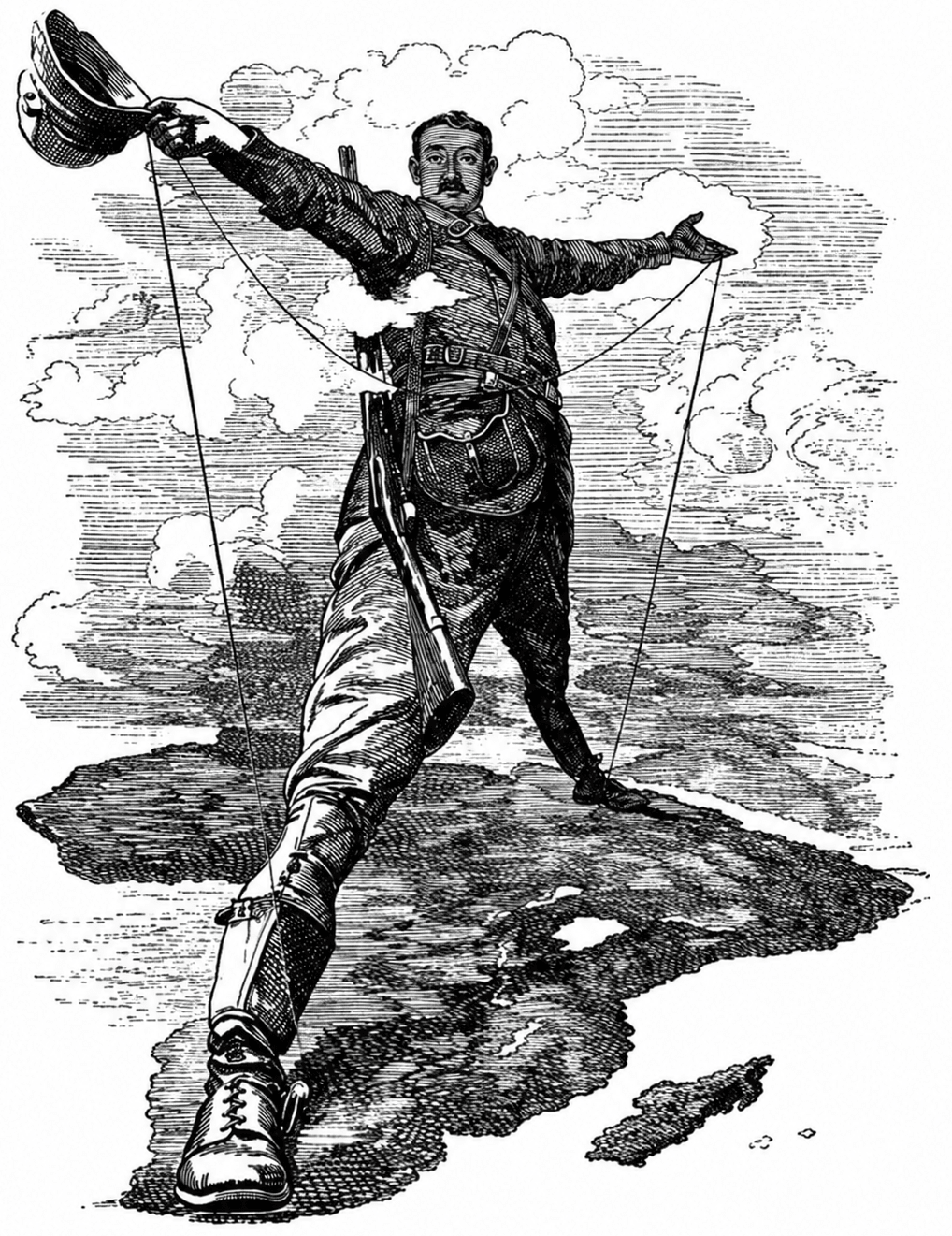
Answer
The cartoon shows a British business magnate standing across Africa, symbolising European colonial domination and control over the continent. His enormous size suggests the power of colonial rulers over African lands and people. The telegraph wire in his hands represents new technology that enabled faster communication and helped colonial powers control distant territories and conduct trade more efficiently. His confident posture suggests that Africa was being treated as a source of wealth, resources and economic profit. Thus, the cartoon highlights how technology, commerce and political power worked together to strengthen colonial rule.
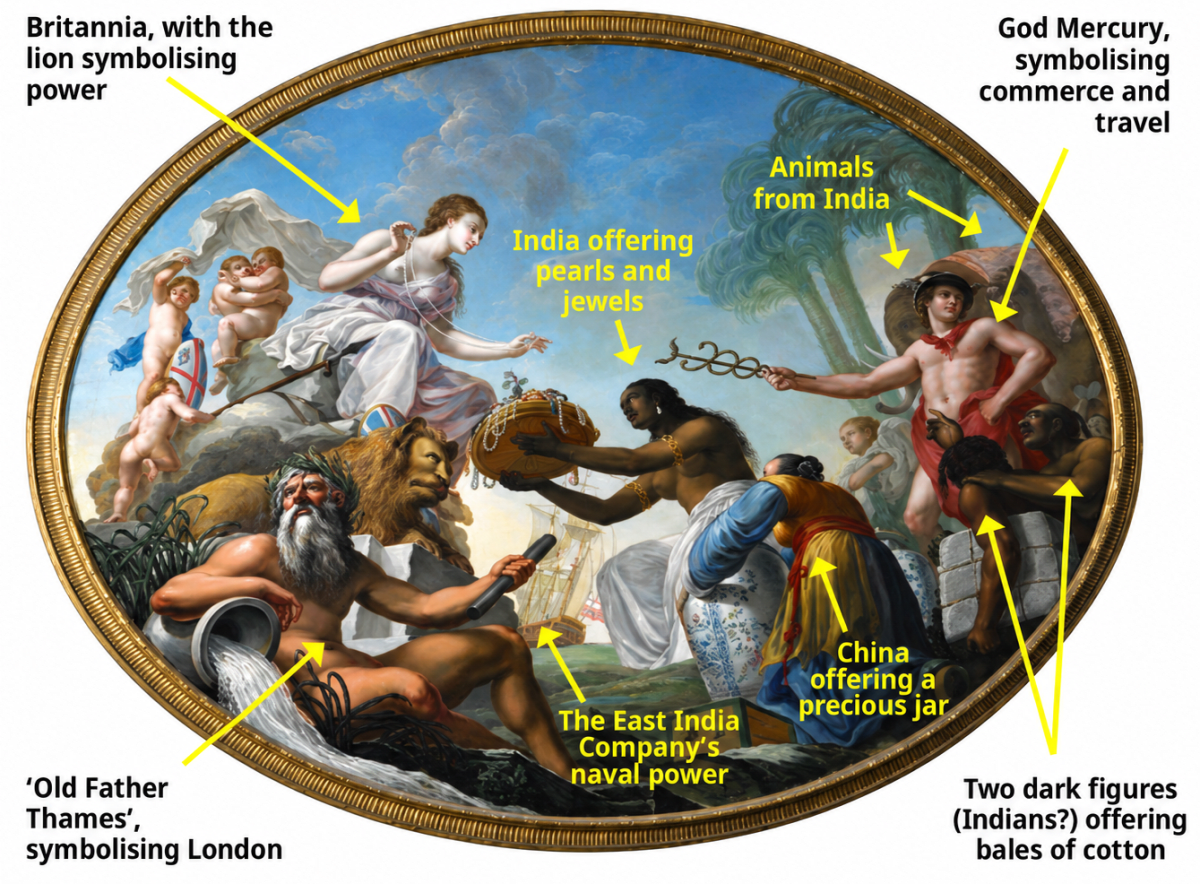
Before you read further, have a good look at the painting on the first page of this chapter. It was specially ordered for the London headquarters of the East India Company and is over three metres long. Observe every aspect of it — the people in it, the objects, the symbols and the attitudes. Form groups of four or five students and let each group present its conclusions as regards the messages the painting conveys.
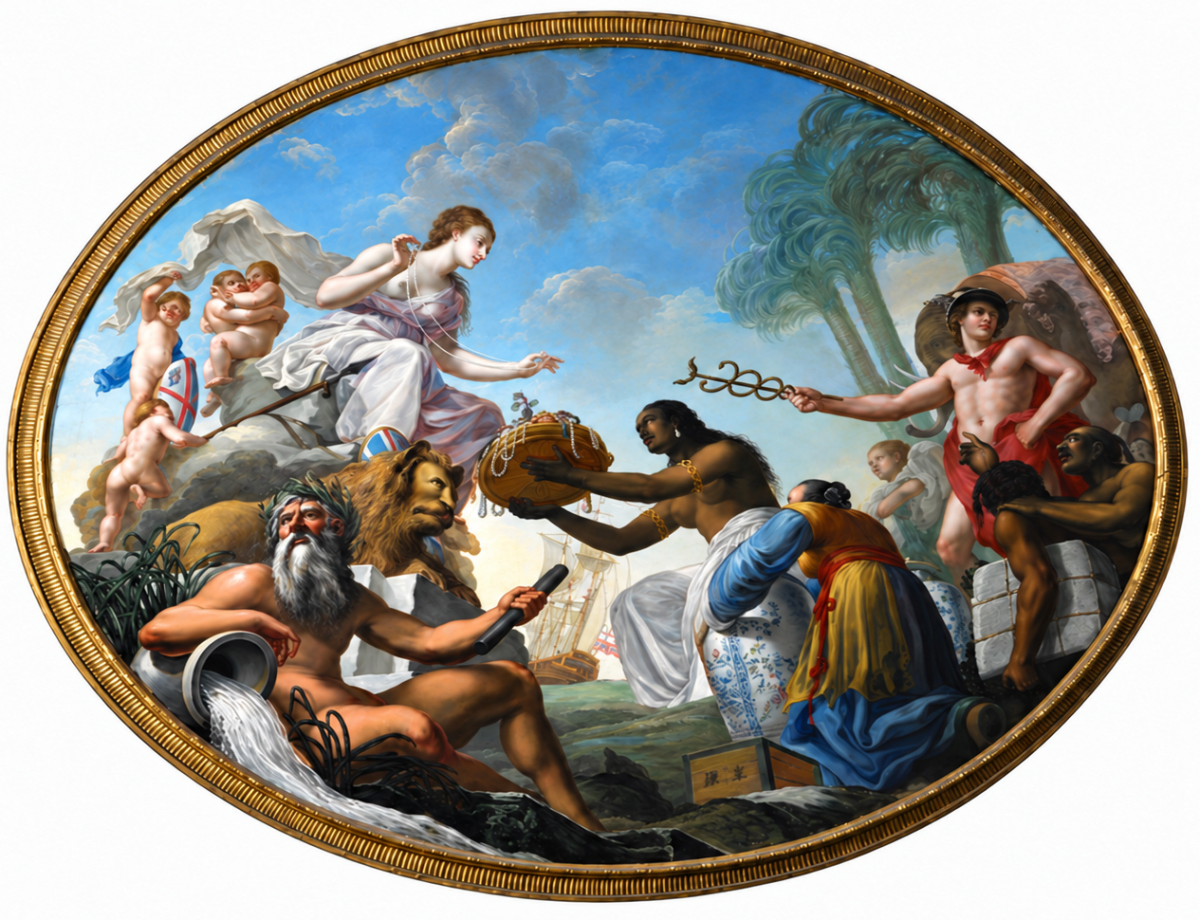
Answer
The painting ‘The East offering its riches to Britannia’ symbolically shows Britain’s power and the colonial exploitation of Asian countries.
- Britannia, representing Britain, is seated at a higher position with a lion, which symbolises strength and power.
- India is shown offering pearls and jewels, while China offers a precious jar and other figures present bales of cotton.
- Mercury, the god of commerce and travel, represents trade, while the ships in the background show the naval power of the East India Company.
- Old Father Thames represents London and links the wealth of the colonies with Britain.
- The colonies are shown in lower and bent postures, while Britannia sits upright, suggesting British superiority over the colonised peoples.
- The painting gives the impression that the colonies willingly offered their wealth, whereas colonial rule actually involved control, exploitation and extraction of resources.
Why do you think Dadabhai Naoroji means by ‘un-British rule in India’? (Hint: he was an MP in the House of Commons in 1892.)
Answer
Dadabhai Naoroji used the phrase ‘un-British rule in India’ to show that British rule in India went against the principles of justice, liberty and fair government that Britain claimed to follow. He argued that the British drained India’s wealth, increased poverty and denied Indians fair treatment and rights. By calling the rule ‘un-British’, he meant that such exploitation was contrary to the values Britain professed at home.
Do you understand all the terms used above to list and describe Indian textiles? If not, form groups of four or five and try to find out more, then compare your findings with the help of your teacher.
Answer
Using standard textile terminology, the main terms can be understood as follows:
- Cotton: A soft natural fibre obtained from the cotton plant and widely used for making cloth.
- Silk: A smooth, fine fibre obtained from silkworm cocoons.
- Wool: A natural fibre obtained mainly from the fleece of sheep and used for warm clothing.
- Jute: A strong plant fibre used for coarse cloth, sacks, ropes and similar products.
- Hemp: A strong plant fibre traditionally used for ropes, cordage and coarse textiles.
- Coir: A fibre obtained from the outer husk of coconuts and used for ropes, mats and other products.
- Muslin: A very fine, lightweight cotton fabric for which India was especially renowned.
- Embossed fabric: Cloth with a raised design that stands out in relief.
Examine the map. What are the main differences with the map of today’s India, in terms both of borders and of names?
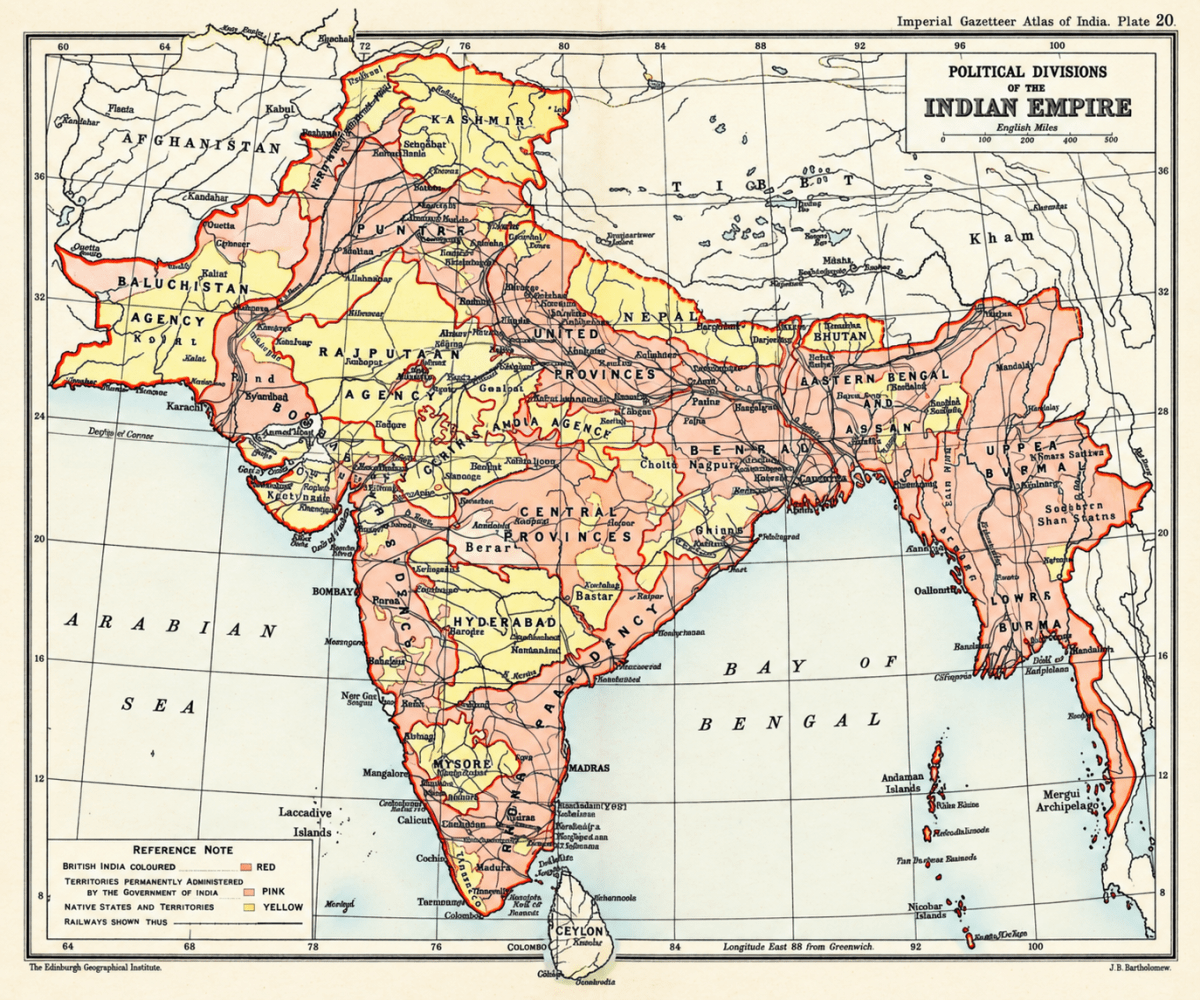
Answer
The map of the British Indian Empire in 1909 differs from the map of present-day India in the following ways:
In terms of borders
- British India covered a much larger part of the Subcontinent than present-day India.
- It included regions that are now part of Pakistan, Bangladesh and Myanmar.
- The map also shows many princely states, which no longer exist as separate political units today.
- The territories directly ruled by the British were organised into large provinces, which were later reorganised into the present-day states of India.
In terms of names
- Several old provincial names, such as United Provinces, Central Provinces, Eastern Bengal and Assam, Rajputana Agency and Baluchistan Agency, are no longer used.
- Many cities have also been renamed, such as Calcutta to Kolkata, Bombay to Mumbai, Madras to Chennai and Bangalore to Bengaluru.
- Burma is now called Myanmar, while Ceylon is now called Sri Lanka.
Note how the Santhals are depicted in the 1856 sketch (Fig. 4.17) drawn from an artist’s imagination: observe their complexion, dress, weapons and draw your conclusions as regards the image this depiction would create in the popular mind in Britain.
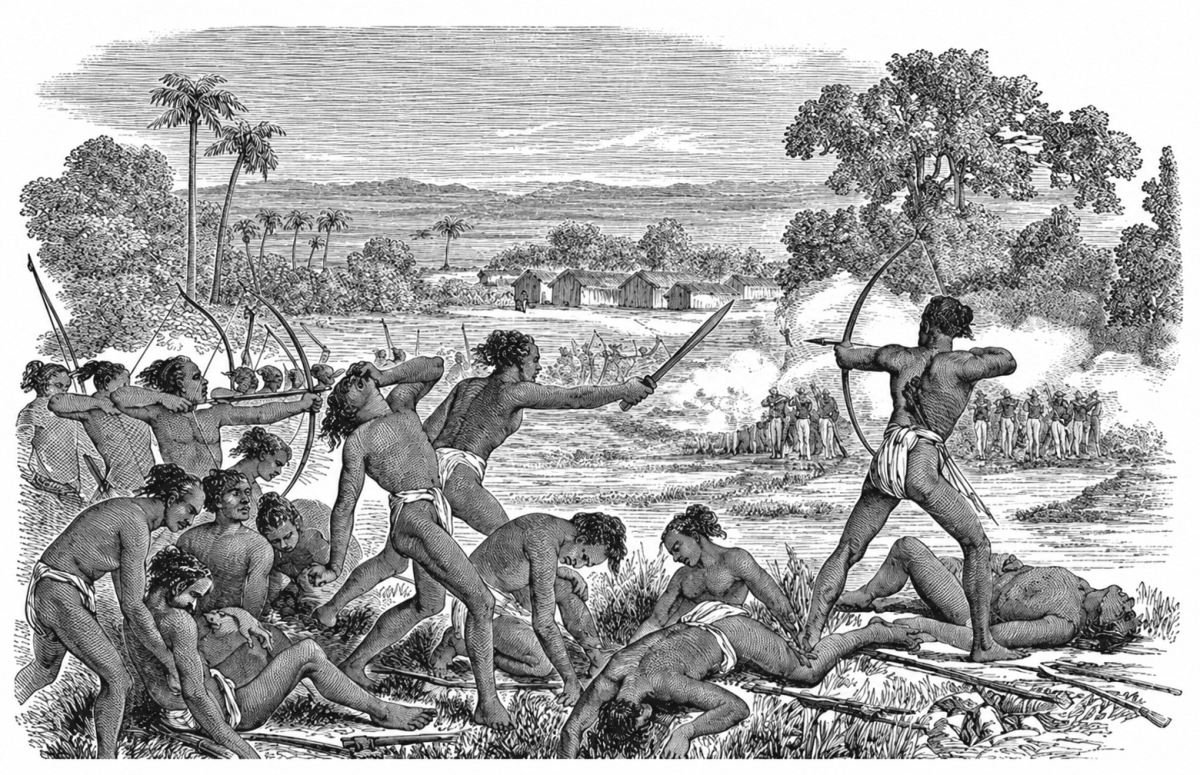
Answer
The sketch depicts the Santhals with dark complexions, simple clothing and traditional weapons such as bows and arrows, while the opposing sepoys are shown with guns and organised military formations. This creates an image of the Santhals as primitive, poorly equipped and uncivilised, while the colonial forces appear more disciplined and technologically advanced. Such a representation could have encouraged the British public to view tribal resistance as backward or disorderly and helped justify colonial rule and repression.
Indigo is a natural deep blue pigment used in dyeing. Can you think of other natural substances that have been traditionally used in India to dye cloth?
Answer
Yes, several natural substances have traditionally been used in India for dyeing cloth. Turmeric, safflower and marigold were used for yellow and orange shades, while madder roots and lac produced red colours. Catechu, pomegranate rind and myrobalan were used for brown and ochre shades, and henna gave reddish-brown tones. These natural dyes are still used in some traditional handloom and craft practices.
Why do you think was the term ‘Sepoy Mutiny’ rejected after Indian Independence? Write one paragraph explaining your reasons.
Answer
The term ‘Sepoy Mutiny’ was rejected after Indian Independence because the uprising of 1857 was not limited to a rebellion by sepoys against their officers. It spread across large parts of northern and central India and involved rulers and other sections of society who were dissatisfied with British policies. Therefore, the term ‘Great Rebellion of 1857’ better reflects the wider nature of the uprising against British colonial rule.
In the sentence “It opened (or re-opened) India to the world and the world to India”, why do you think we added ‘re-opened’?
Answer
‘Re-opened’ is used because India already had strong connections with the wider world before European colonial rule. India had traded with the Greeks and Romans more than two thousand years ago, and Indian goods were highly sought after in the Mediterranean world. India also had extensive internal and external trading networks.
Some argue that stolen cultural heritage has been better preserved abroad than it would have been in India. What is your view on its repatriation? Discuss in groups.
Answer
Thousands of Indian statues, paintings, jewels, manuscripts and other cultural objects were taken abroad during colonial rule. They are an important part of India’s heritage, so their repatriation is justified.
Although foreign museums have preserved these objects and promoted Indian art, this does not change how they were acquired. India can preserve them in its own museums and share them with the world through exhibitions and museum exchanges.
Let us return to this painting (Fig. 4.14), but now with some clues to its symbolism. Note how Britannia (a symbolic figure for Britain) sits higher than the colonies, pointing to her superior power; contrast with the lower position and bent posture of the colonies. Did they really ‘offer’ their wealth? Or did Britain seize it by force or ruse? Note also the Indians’ dark complexion (in contrast with that of Britannia), reflecting the belief in the superiority of white people over the dark-skinned ‘natives’.
Answer
The painting shows the colonies as willingly offering their wealth to Britain, but in reality much of it was obtained through force, political manipulation and economic exploitation. By the time the painting was made, the East India Company had already gained an important victory at Plassey through its conspiracy with Mir Jafar and had secured the right to collect revenue in Bengal, Bihar and Odisha. Thus, the painting hides colonial extraction behind the idea of a voluntary “offering.”
The figures also show British dominance. Britannia sits higher with a lion symbolising power, while the colonies appear lower and submissive. The difference in complexion reflects colonial ideas of white superiority. Overall, the painting glorifies British power and presents exploitation as noble and acceptable.
What exactly did Macaulay mean when he wrote that “a single shelf of a good European library was worth the whole native literature of India and Arabia”? And why should he want to make Indians “English in taste, in opinions, in morals, and in intellect”? How does this relate to the ‘civilising mission’ mentioned at the start of the chapter? Ask your teacher to guide a class debate on these questions.
Answer
Macaulay meant that he considered European literature and knowledge superior to the traditional learning of India and Arabia, despite admitting that he did not know Sanskrit or Arabic.
He wanted to create Indians who were “English in taste, in opinions, in morals, and in intellect” to act as intermediaries between the British rulers and the Indian population. This also promoted English education over traditional Indian systems.
This was linked to the British idea of a “civilising mission”, the belief that European culture and education were superior and that British rule would bring ‘progress’ to India.
What is meant by “the sun never sets on the British Empire”? Do you think this was a correct statement?
Answer
The phrase “the sun never sets on the British Empire” meant that the British Empire was spread across so many parts of the world that, at any given time, the sun was shining on at least one of its territories. In this geographical sense, the statement was largely correct because Britain controlled colonies in different continents and time zones.
What is colonialism? Give three different definitions based on the chapter or on your knowledge.
Answer
Colonialism can be understood in the following three ways:
- Political control: It is the practice in which one country takes control of another region and imposes its political authority over it.
- Economic exploitation: It is a system in which the colonising power uses the land, resources, labour and markets of the colonised region for its own benefit.
- Cultural domination: It is a process in which the colonising country imposes its own cultural values, institutions and ways of life on the people it rules.
Colonial rulers often claimed that their mission was to ‘civilise’ the people they ruled. Based on the evidence in this chapter, do you think this was true in the case of India? Why or why not?
Answer
No, the claim of a ‘civilising mission’ was largely a justification for British colonial rule rather than its main purpose. India already had established traditions of education, industries, local governance and culture before British rule.
- Heavy land revenues and inadequate famine relief caused widespread suffering.
- British trade policies weakened Indian industries and affected many artisans.
- Colonial administration restricted traditional systems of local governance and forest rights.
- Railways and telegraphs mainly served British commercial and military interests, though they also benefited India.
- English education was promoted partly to create a class of Indians who could assist in colonial administration.
Thus, British rule brought some developments, but the ‘civilising mission’ cannot be separated from colonial control and economic exploitation.
How was the British approach to colonising India different from earlier European powers like the Portuguese or the French?
Answer
The British approach to colonising India differed from that of the earlier European powers in the following ways:
| Earlier European Powers — Portuguese and French | British |
|---|---|
| The Portuguese focused strongly on maritime trade, strategic ports and the spice trade. | The British began as traders and gradually transformed the East India Company into an imperial power. |
| The Portuguese used the cartaz system to control sea trade and monopolise the spice trade. | The British established trading centres at Surat, Madras, Bombay and Calcutta and initially presented themselves as mere traders. |
| Portuguese rule also involved religious persecution, forced conversions and the Goa Inquisition. | The British focused more on political control and economic exploitation. |
| The French, especially under Dupleix, trained Indian sepoys and tried to influence succession disputes through puppet rulers. | The British adopted and expanded such methods by interfering in Indian political rivalries and using the policy of ‘divide and rule’. |
| French political ambitions were checked during the Carnatic Wars, leaving them mainly with Pondicherry and a few smaller enclaves. | The British extended their control through the Doctrine of Lapse, subsidiary alliances and military conquest. |
| Neither the Portuguese nor the French succeeded in controlling most of the Subcontinent. | The British eventually established domination over large parts of the Indian Subcontinent for nearly two centuries. |
“Indians funded their own subjugation.” What does this mean in the context of British infrastructure projects in India like the railway and telegraph networks?
Answer
The phrase “Indians funded their own subjugation” means that Indians paid, through taxes, for the very infrastructure and administration that helped the British control and exploit India.
The railways were designed mainly to move raw materials to ports, distribute British manufactured goods and move armies quickly. The telegraph network served similar colonial purposes. Most of the railway construction was paid for by Indian tax revenue, as were the costs of the telegraph network and the colonial administration.
What does the phrase ‘divide and rule’ mean? Give examples of how this was used by the British in India?
Answer
‘Divide and rule’ meant using divisions and rivalries among Indian rulers and communities to increase British power.
- The Company offered military support to some Indian rulers against their rivals.
- It used rivalries between regional rulers and succession disputes within ruling families for its own benefit.
- The British also identified and encouraged tensions between religious communities.
- The Battle of Plassey is an important example. Robert Clive made a conspiracy with Mir Jafar and promised to install him as Nawab in return for his betrayal. Mir Jafar’s forces stood aside, helping the British win.
- After the Great Rebellion of 1857, the Indian Army was reorganised to prevent unified resistance in the future.
Choose one area of Indian life, such as agriculture, education, trade, or village life. How was it affected by colonial rule? Can you find any signs of those changes still with us today? Express your ideas through a short essay, a poem, a drawing, or a painting.
Answer
Education under Colonial Rule
Before British rule, India had diverse educational traditions, including pāṭhaśhālās, madrasās, vihāras and apprenticeship learning. After Macaulay’s 1835 Minute, English education was promoted to create Indians who could serve in the lower ranks of the colonial administration.
Traditional schools gradually declined, while English became a language of prestige. This created lasting divisions between the English-educated elite and the wider population. A sign of this colonial legacy that remains today is the continuing prestige associated with English education and the lasting social divide linked to access to English education.
Imagine you are a reporter in 1857. Write a brief news report on Rani Lakshmibai’s resistance at Jhansi. Include a timeline or storyboard showing how the rebellion began, spread, and ended, highlighting key events and leaders.
Answer
THE RANI HOLDS JHANSI
Special report, Central India, June 1858
Rani Lakshmibai of Jhansi fought against British annexation during the Great Rebellion of 1857. Assisted by Tatia Tope, Nana Saheb’s military adviser, she escaped from besieged Jhansi and later conquered the Gwalior fort, taking its treasury and arsenal. She was killed on the battlefield on 18 June 1858.
Timeline of the Rebellion
- Early 1857: Rumours about cartridges greased with cow and pig fat angered Hindu and Muslim sepoys; Mangal Pandey attacked British officers at Barrackpore.
- May 1857: Sepoys at Meerut rebelled and marched to Delhi.
- Delhi: The rebels proclaimed Bahadur Shah Zafar as their leader.
- Spread of rebellion: The uprising spread to Kanpur, Lucknow and Jhansi, with leaders such as Nana Saheb, Rani Lakshmibai and Begum Hazrat Mahal taking part.
- 1858: Rani Lakshmibai escaped from Jhansi, joined Tatia Tope and captured Gwalior fort. She died fighting on 18 June 1858.
- Aftermath: The rebellion was suppressed, and in 1858 the British Crown took direct control of India from the East India Company.
Imagine an alternate history where India was never colonised by European powers. Write a short story of about 300 words exploring how India might have developed on its own path.
Answer
A Different Road
In this imagined history, European powers came to India only for trade and never established colonial rule. Indian rulers continued to control their own territories and welcomed foreign merchants on their own terms.
India’s industries, especially cotton, silk, muslin, iron, steel and paper, continued to grow. Artisans kept their traditional occupations, and Indian goods remained in demand in world markets. Since there was no colonial drain of wealth, more revenue stayed within the country and could be used for local development.
Village councils continued to manage roads, irrigation and local disputes. Traditional institutions such as pāṭhaśhālās, madrasās and vihāras also continued to develop, gradually adding new subjects and knowledge from other parts of the world.
India would still have faced its own problems, such as droughts, conflicts and social inequalities, but these challenges would have been dealt with through its own institutions and policies. European science and Indian knowledge could have influenced each other through peaceful exchange rather than colonial domination.
Thus, in this alternate history, India followed its own path of political, economic and cultural development without losing its independence to European powers.
Role-play: Enact a historical discussion between a British official and an Indian personality like Dadabhai Naoroji on the British colonial rule in India.
Answer
A Discussion on British Rule in India
An imagined role-play between Dadabhai Naoroji and Lord Lytton, former Viceroy of India
Lord Lytton: Mr Naoroji, British rule has given India railways, telegraphs and a modern administration.
Dadabhai Naoroji: These developments did connect different parts of India, but much of their cost was paid from Indian tax revenue. The railways mainly helped carry raw materials to ports, distribute British goods and move troops quickly.
Lord Lytton: The government also needed revenue to maintain administration and order.
Dadabhai Naoroji: But harsh revenue policies placed a heavy burden on Indians. During severe famines, millions suffered while grain continued to be exported.
Lord Lytton: British rule also introduced new institutions and systems of education.
Dadabhai Naoroji: Yet Indian industries declined, traditional institutions were weakened and enormous wealth was drained from India. That is why I described colonial rule as ‘un-British’, because it did not match the principles of justice and fair government that Britain claimed to uphold.
Lord Lytton: Then you believe British policies in India need major change?
Dadabhai Naoroji: Yes. India’s wealth and resources should be used for the welfare of its own people, and Indians should receive fair treatment and a greater role in governing their country.
Explore a local resistance movement (tribal, peasant, or princely) from your state or region during the colonial period. Prepare a report or poster describing:
- What was the specific trigger, if any?
- Who led the movement?
- What were their demands?
- How did the British respond?
- How is this event remembered today (e.g., local festivals, songs, monuments)?
Answer
Report: The Santhal Rebellion (1855–1856)
Trigger
- The Santhals rose against moneylenders and landlords who were taking away their ancestral lands with British support.
- Their access to forests and forest produce was restricted, and cash taxes were imposed on them.
- Many Santhals were also trapped in debt and their traditional councils were replaced by the British legal system.
Leaders
- The rebellion was led by the brothers Sidhu Murmu and Kanhu Murmu.
- They mobilised the Santhals to resist colonial exploitation.
Demands
- The Santhals wanted an end to exploitation by moneylenders and landlords.
- They sought the protection of their ancestral lands and traditional way of life.
- They declared their own government and attempted to free themselves from colonial control.
British Response
- The British suppressed the rebellion with severe military force.
- Entire villages were burned and thousands of Santhals were killed.
- The rebel leaders were also eventually killed.
How the Rebellion is Remembered
- The Santhal Rebellion is remembered as an important tribal resistance movement against colonial rule.
- It inspired other tribal communities to resist British authority.
- Sidhu and Kanhu Murmu are remembered as heroes of tribal resistance.