
How many different ways can you divide a square into 4 parts of equal area?
Answer
A square can be divided into 4 parts of equal area in infinitely many ways.
For example, divide the square into 4 equal parts. Then, in each part, compress the area along one edge and expand it along another edge by the same amount. Since the compression and expansion are equal, the area of each part remains unchanged.
By making different such alterations, we can obtain infinitely many divisions of the square into 4 parts of equal area.
Hence, a square can be divided into 4 parts of equal area in infinitely many ways.
Try to think of different creative ways to divide a square into 4 parts of equal area.
Answer
There are many creative ways to divide a square into 4 parts of equal area.
Some possible ways are:
(i) Four equal vertical (or horizontal) strips, each of width one-fourth of the side.
(ii) Four small squares formed by joining the midpoints of opposite sides — each part is one quarter of the original square.
(iii) Both diagonals drawn together — they split the square into 4 triangles of equal area.
(iv) A pinwheel division — join the centre of the square to the four sides so that each part is a congruent four-sided "windmill" piece of equal area.
Hence, a square can be divided into 4 equal parts in many creative ways, as shown above.
Why do we count the number of unit squares to assign measures for area? Couldn't we have just used the perimeter of a region, i.e., the length of its boundary as a measure of its area?
Answer
No, perimeter cannot be used as a measure of area.
Area measures the surface covered by a region, whereas perimeter measures only the length of its boundary. Two figures can have the same perimeter but different areas.
For example, a 1 × 6 rectangle and a 3 × 4 rectangle:
Perimeter of 1 × 6 rectangle = 2(1 + 6) = 14 units, Area = 6 sq. units
Perimeter of 3 × 4 rectangle = 2(3 + 4) = 14 units, Area = 12 sq. units
Thus, both rectangles have the same perimeter but different areas.
Therefore, perimeter does not reliably indicate how much space a region covers. Counting unit squares directly measures the surface covered by the region and hence gives its area.
Hence, we use unit squares to measure area and not the perimeter of the region.
Find two rectangles that are examples of such regions [two regions where one has a larger perimeter than the other but a smaller area]. If needed, use a grid paper (given at the end of the book) for this.
Answer
Consider the following two rectangles.
Rectangle 1: length = 10 units, breadth = 1 unit
Perimeter = 2(10 + 1) = 22 units
Area = 10 × 1 = 10 sq. units
Rectangle 2: length = 4 units, breadth = 3 units
Perimeter = 2(4 + 3) = 14 units
Area = 4 × 3 = 12 sq. units
Comparing the two:
Rectangle 1 has the larger perimeter (22 units > 14 units), but the smaller area (10 sq. units < 12 sq. units).
Hence, Rectangle 1 has a larger perimeter but a smaller area than Rectangle 2.
Also give an example of two regions of other shapes, where the region with the larger perimeter has the smaller area! This property should be visually clear in your example.
Answer
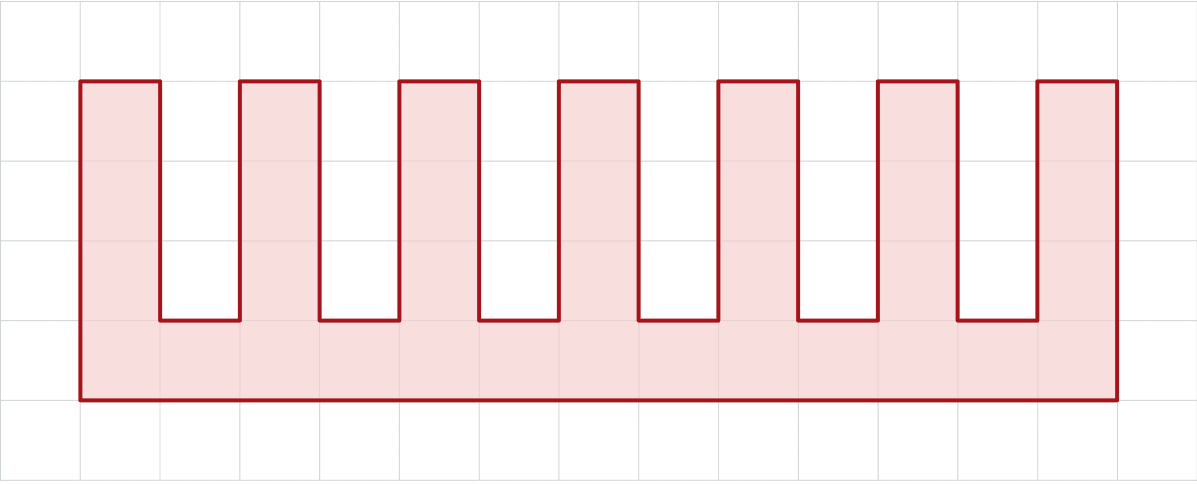
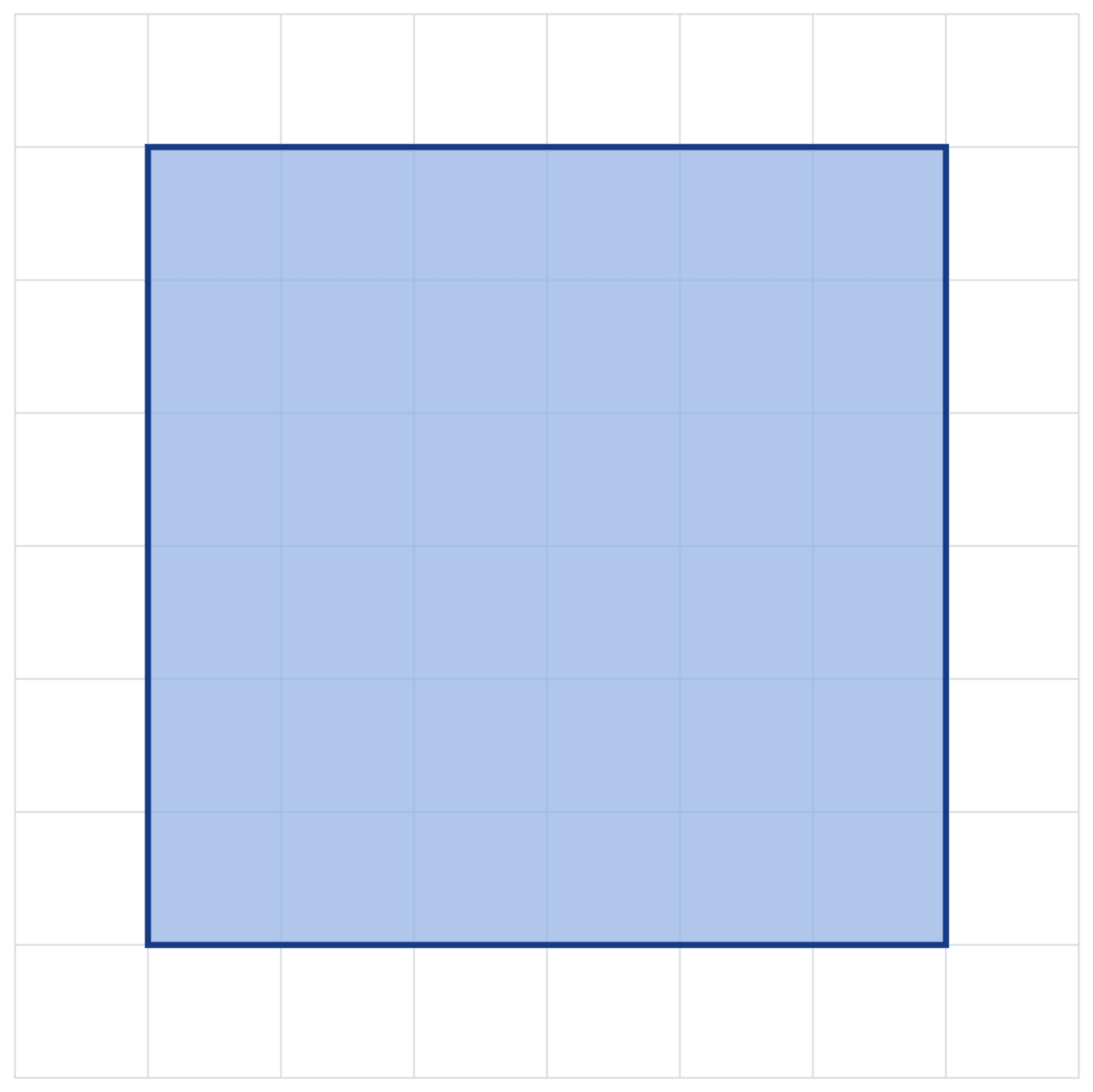
Consider the comb-shaped region and the square shown on the grid.
For the comb-shaped region:
Area of the bottom strip = 13 × 1 = 13 sq. units
Area of the 7 vertical strips above it = 7 × (1 × 3) = 21 sq. units
Total area = 13 + 21 = 34 sq. units
Its boundary contains many inward and outward turns, and its perimeter is 70 units.
For the square:
Side = 6 units
Area = 6 × 6 = 36 sq. units
Perimeter = 4 × 6 = 24 units
Thus, the comb-shaped region has a larger perimeter but a smaller area than the square.
Hence, a region with a larger perimeter can have a smaller area.
Identify the missing sidelengths.
Answer
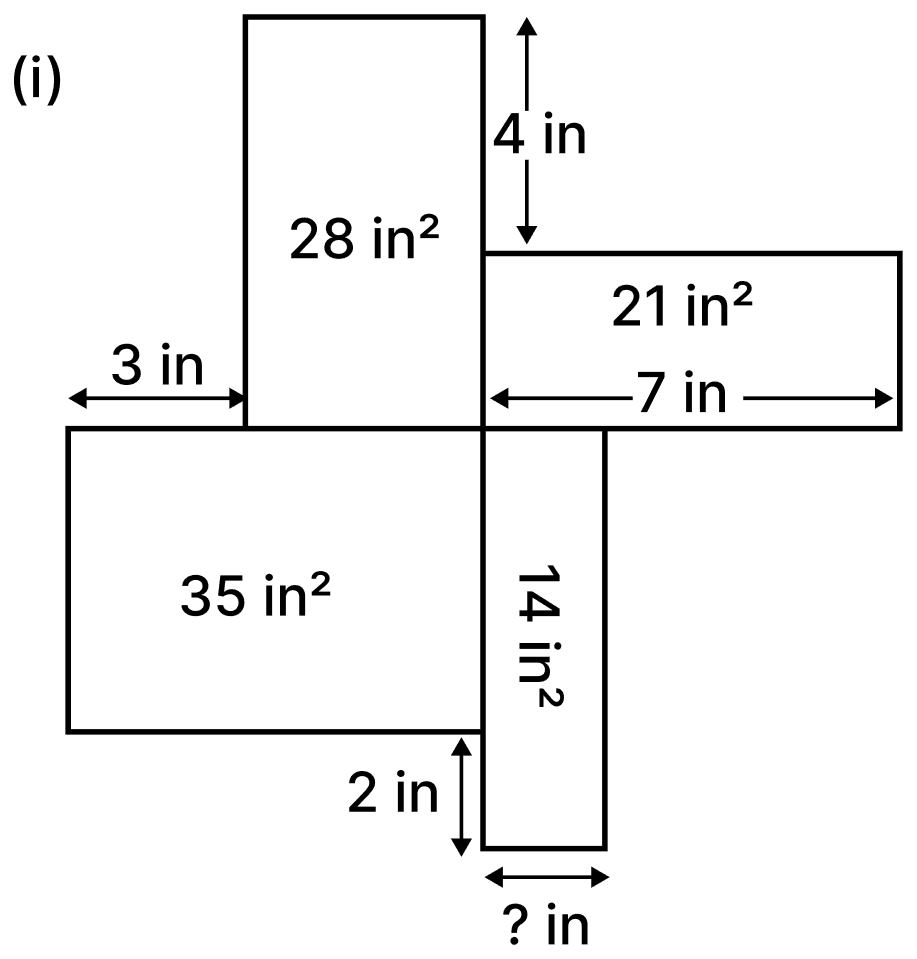
The four rectangles are arranged in a pinwheel pattern, and their areas are 28, 21, 35 and 14 square inches. We find the missing lengths of one rectangle at a time.
Consider the rectangle of area 21 in2.
Given width = 7 in.
Height = ?
Height =
=
= 3 in
For the rectangle of area 28 in2
Height = 3 in + 4 in = 7 in.
Width = ?
Width =
=
= 4 in
For the rectangle of area 35 in2
Width = 4 in + 3 in = 7 in.
Height = ?
Height =
=
= 5 in
For the rectangle of area 14 in2
Height = 5 in + 2 in = 7 in.
Width = ?
Width =
=
= 2 in
Hence, the missing sidelength is 2 in.
Identify the missing sidelengths.
Answer
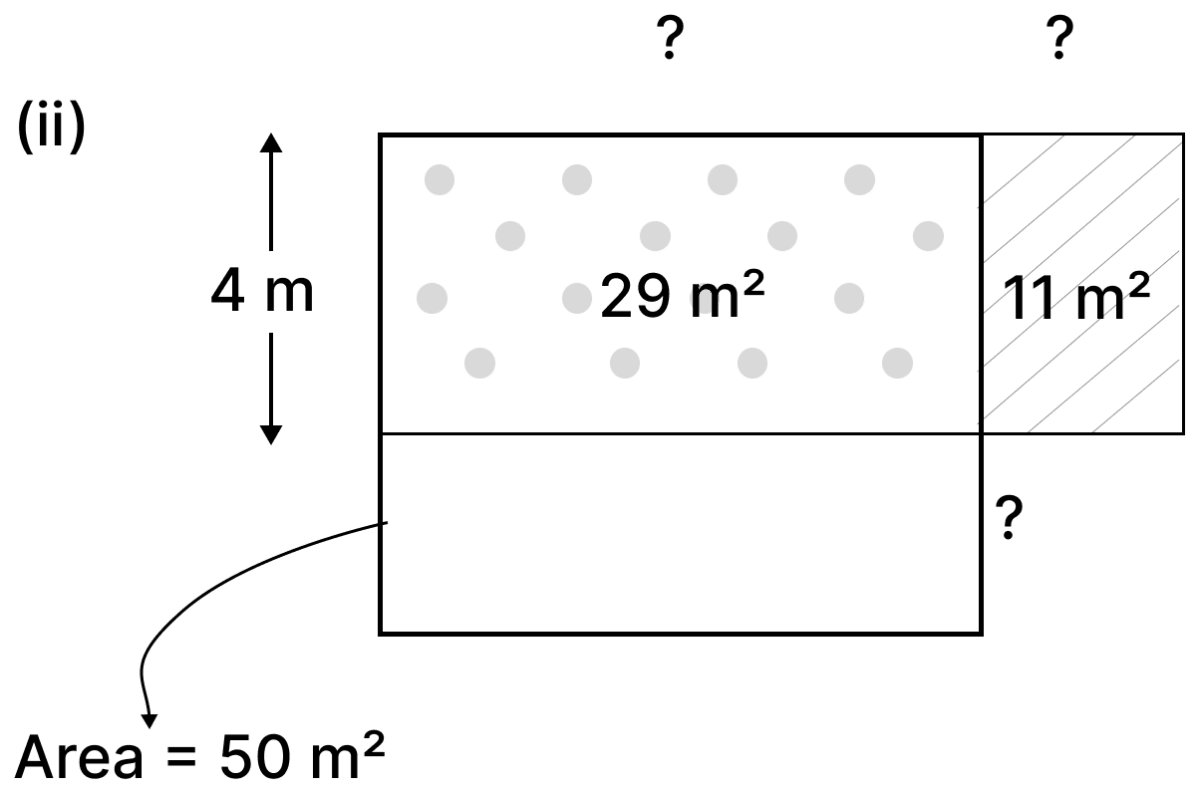
The top-left rectangle has area 29 m2 and height 4 m.
Width = ?
The top-right rectangle has area 11 m2 and the same height 4 m.
Width = ?
Total area of the outer rectangle = 50 m2.
The area of top portion = 29 m2
Therefore, the area of bottom rectangle = 50 m2 - 29 m2 = 21 m2
The width of this rectangle is same as the width of 29 m2 rectangle, i.e., m.
Height = ?
Hence, the missing lengths are m, m and m.
The figure shows a path (the shaded portion) laid around a rectangular park EFGH.
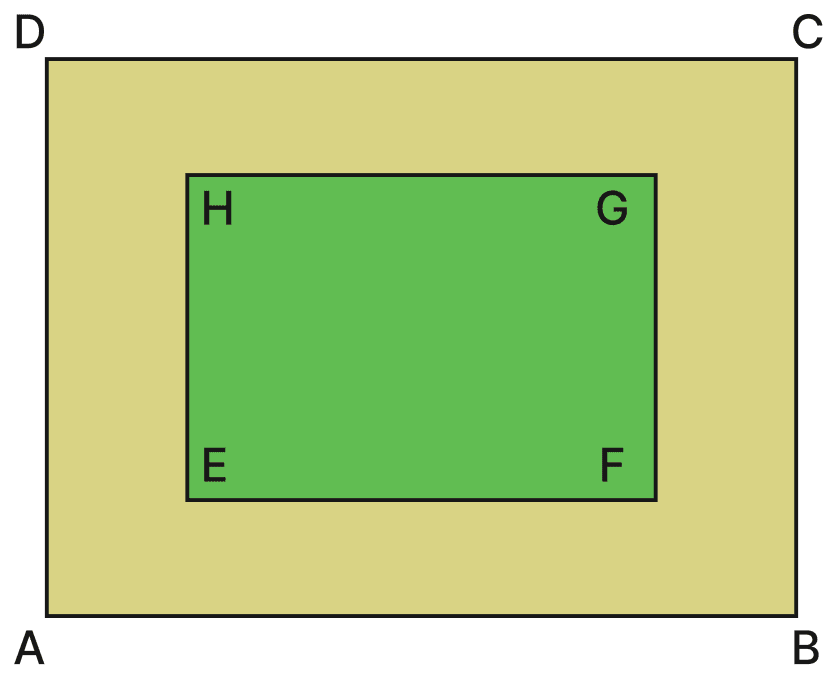
(i) What measurements do you need to find the area of the path? Once you identify the lengths to be measured, assign possible values of your choice to these measurements and find the area of the path. Give a formula for the area. An example of a formula — Area of a rectangle = length × width. [Hint: There is a relation between the areas of EFGH, the path, and ABCD.]
(ii) If the width of the path along each side is given, can you find its area? If not, what other measurements do you need? Assign values of your choice to these measurements and find the area of the path. Give a formula for the area using these measurements. [Hint: Break the path into rectangles.]
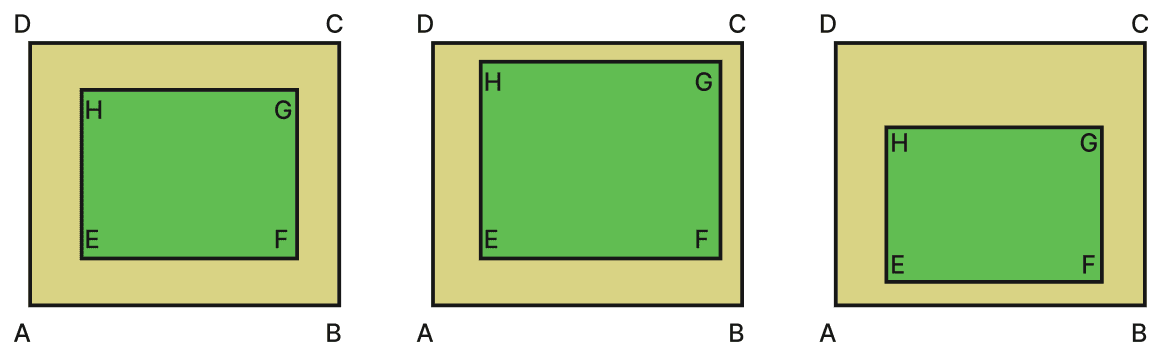
(iii) Does the area of the path change when the outer rectangle is moved while keeping the inner rectangular park EFGH inside it, as shown?
Answer
(i)
The path is the region lying between the outer rectangle ABCD and the inner rectangular park EFGH. So the area of the path is the area left over after removing the park from the outer rectangle.
The measurements needed are:
the length and width of the outer rectangle ABCD, and
the length and width of the inner park EFGH.
Let us assign values. Suppose ABCD has length 10 m and width 8 m, and EFGH has length 6 m and width 4 m.
Area of ABCD = 10 × 8 = 80 m2
Area of EFGH = 6 × 4 = 24 m2
Area of path = Area of ABCD − Area of EFGH = 80 − 24 = 56 m2
The formula is:
Area of path = (L x W) - (l x w)
where L, W are the length and width of ABCD and l, w are the length and width of EFGH.
Hence, with the chosen values the area of the path is 56 m2, given by (L × W) − (l × w).
(ii)
Knowing only the width of the path along each side is not enough by itself; we also need the dimensions of the inner park EFGH (its length l and width w).
With the inner dimensions and a uniform path width t, break the path into rectangles around the park — two strips along the longer sides, two strips along the shorter sides, and four corner squares.
Let us take l = 6 m, w = 4 m and path width t = 1 m.
Area of the two strips along the length = 2 × (l × t) = 2 × (6 × 1) = 12 m2
Area of the two strips along the width = 2 × (w × t) = 2 × (4 × 1) = 8 m2
Area of the four corner squares = 4 × (t × t) = 4 × 1 = 4 m2
Total area of path = 12 + 8 + 4 = 24 m2
The formula is:
Area of path = 2t(l + w) + 4t2
(Check: outer rectangle = (6 + 2)(4 + 2) = 8 × 6 = 48 m2, and 48 − 24 = 24 m2, which agrees.)
Hence, the width alone is not enough; with the inner dimensions the path area is 2t(l + w) + 4t2 = 24 m2.
(iii)
No, the area of the path does not change.
The area of the path is always the area of the outer rectangle minus the area of the inner park, that is (L × W) − (l × w).
When the outer rectangle is moved while keeping the park inside it, neither the outer rectangle's area nor the park's area changes. Only how the path is distributed among the four sides changes.
Hence, the area of the path stays the same; only its distribution along the sides changes.
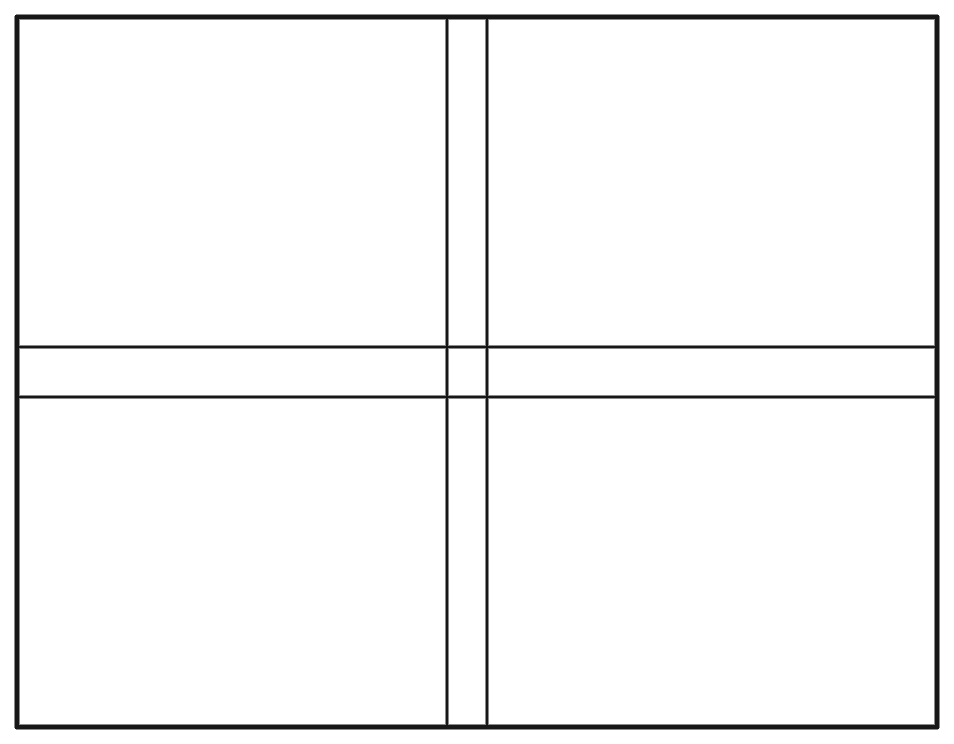
The figure shows a plot with sides 14 m and 12 m, and with a crosspath. What other measurements do you need to find the area of the crosspath? Once you identify the lengths to be measured, assign some possible values of your choice and find the area of the path. Give a formula for the area based on the measurements you choose.
Answer
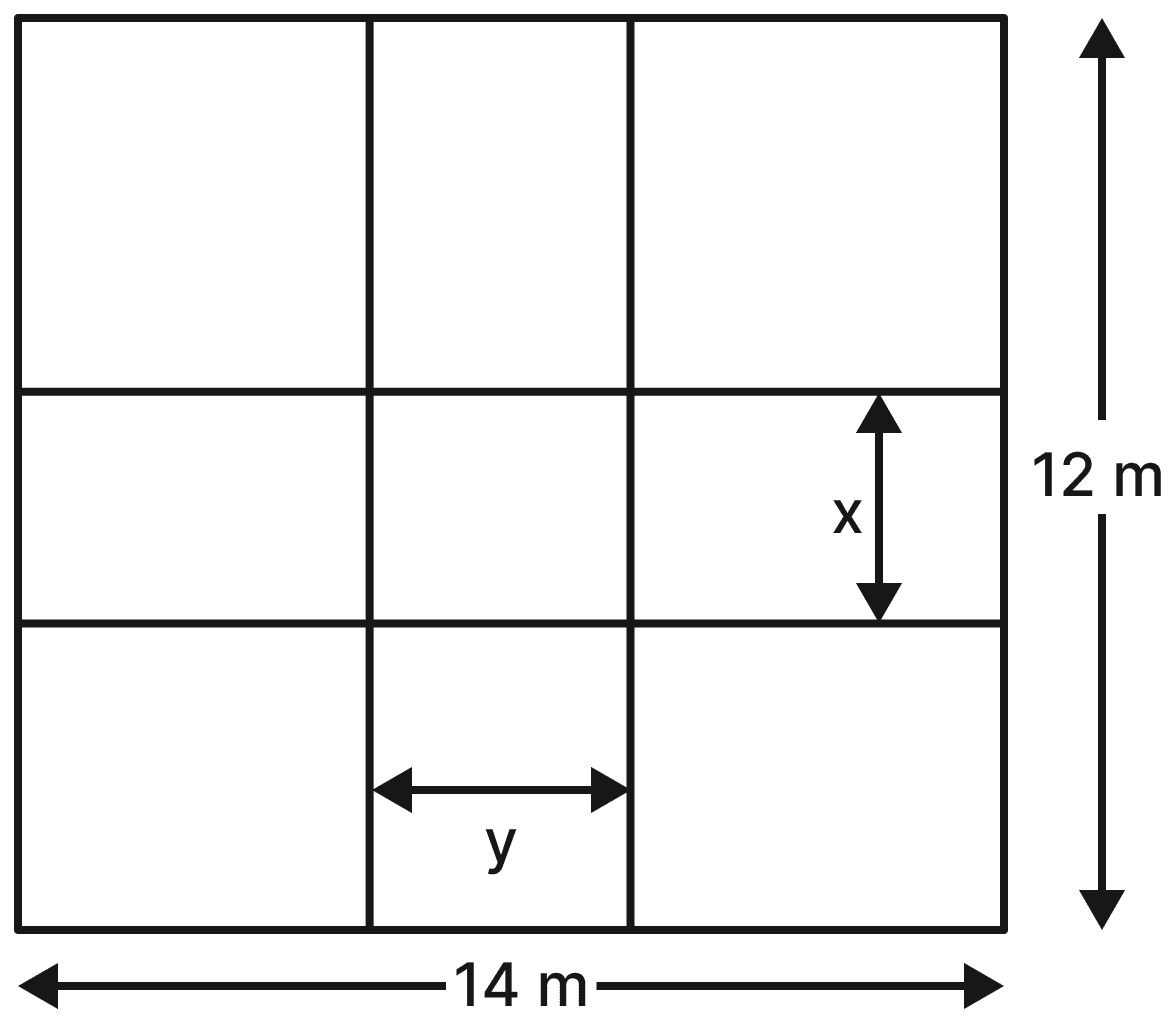
To find the area of the crosspath, we need the widths of the two paths.
Let width of the horizontal path = x m
Let width of the vertical path = y m
The horizontal path is a rectangle of length 14 m and width x m.
Area of horizontal path = 14x
The vertical path is a rectangle of length 12 m and width y m.
Area of vertical path = 12y
The rectangle where the two paths cross has area = xy
This part is counted twice, so we subtract it once.
∴ Area of crosspath = 14x + 12y − xy
Let x = 2 m and y = 2 m
Area of crosspath = 14(2) + 12(2) − 2(2)
= 28 + 24 − 4
= 48 m2
Hence, the area of the crosspath is 48 m2.
Find the area of the spiral tube shown in the figure. The tube has the same width throughout.
![Find the area of the spiral tube shown in the figure. The tube has the same width throughout. [Hint: There are different ways of finding the area. Here is one method.] What should be the length of the straight tube if it is to have the same area as the bent tube on the left? Area, NCERT Class 8 Ganita Prakash Mathematics CBSE Solutions.](https://cdn1.knowledgeboat.com/img/ncert-8/q4-figure-out-1-1-ganita-prakash-2-cbse-class-8-c7-202608191832-1200x1100.png)
[Hint: There are different ways of finding the area. Here is one method.]
![Find the area of the spiral tube shown in the figure. The tube has the same width throughout. [Hint: There are different ways of finding the area. Here is one method.] What should be the length of the straight tube if it is to have the same area as the bent tube on the left? Area, NCERT Class 8 Ganita Prakash Mathematics CBSE Solutions.](https://cdn1.knowledgeboat.com/img/ncert-8/q4-figure-out-1-2-ganita-prakash-2-cbse-class-8-c7-202608191832-856x820.png)
What should be the length of the straight tube if it is to have the same area as the bent tube on the left?
Answer
The tube has a uniform width of 1 unit throughout.
A convenient way to find its area is to imagine the spiral tube being straightened into a single straight tube of the same width. Since rearranging the tube does not change its area, the area of the spiral tube will be equal to the area of the straight tube.
The lengths marked in the figure are:
20, 20, 20, 15, 15, 10, 10, 5, 5
Sum of these lengths:
20 + 20 + 20 + 15 + 15 + 10 + 10 + 5 + 5 = 120
At each bend of the tube, a 1 × 1 square is common to two adjoining strips and gets counted twice. There are 8 such overlaps.
∴ Length of straight tube = 120 − 8 = 112 units
Since the width of the tube is 1 unit,
Area of spiral tube = 112 × 1 = 112 sq. units
Hence, the area of the spiral tube is 112 sq. units.
For the bent tube shown in the hint:
The two arms have lengths 5 units and 5 units, and the width is 1 unit.
Area of bent tube = 5 × 1 + 5 × 1 − 1 × 1
= 5 + 5 − 1
= 9 sq. units
Let the length of the straight tube be l units.
Since its width is 1 unit,
l × 1 = 9
l = 9
Hence, the straight tube must be 9 units long to have the same area as the bent tube.
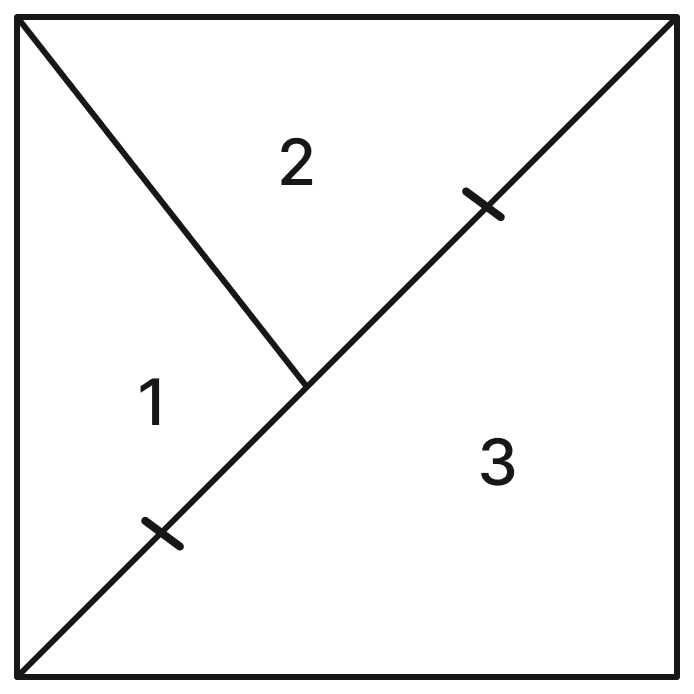
In this figure, if the sidelength of the square is doubled, what is the increase in the areas of the regions 1, 2 and 3? Give reasons.
Answer
Let the side of the original square be s units.
The diagonal divides the square into two equal-area triangles. The marked point is the midpoint of the diagonal, so the segment drawn to it divides the upper triangle into two equal-area triangles.
Therefore,
Area of Region 1 = Area of Region 2 =
and
Area of Region 3 = .
When the side is doubled to 2s, every length is multiplied by 2. Hence, every area is multiplied by 22 = 4.
Thus,
New area of Region 1 = s2
New area of Region 2 = s2
New area of Region 3 = 2s2
The increases are
Increase in Region 1 =
Increase in Region 2 =
Increase in Region 3 =
Therefore, the new area of each region is 4 times its original area, so the increase is 3 times the original area, or 300%.
Hence, the areas of Regions 1, 2 and 3 increase by , and respectively.
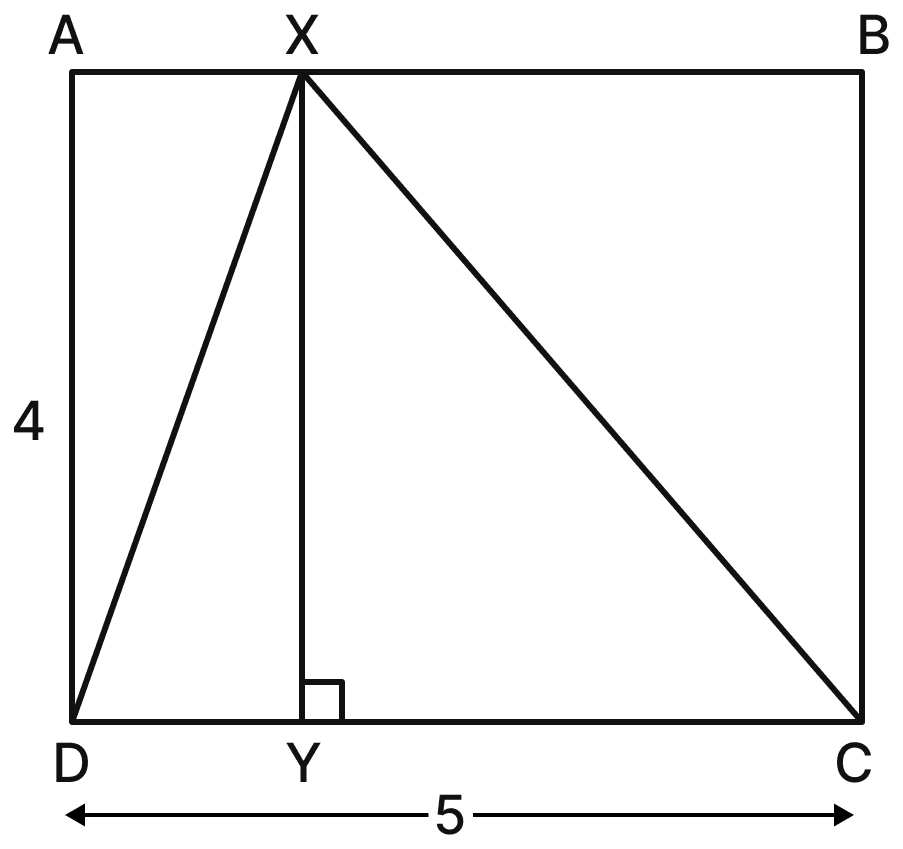
Find the area of ∆ XDC.
Answer
From Fig. 7.1, the triangle XDC has:
Base = DC = 5 units
Height = XY = 4 units (XY is the perpendicular distance from X to DC)
Area of ∆XDC = × base × height
Hence, the area of ∆XDC = 10 sq. units.
To find the area of a triangle, what measurements do we need?
Answer
To find the area of a triangle, we need its base and the corresponding height (the perpendicular distance from the opposite vertex to that base).
Using these measurements,
Area of a triangle = × base × height
Hence, the measurements required are the base and the corresponding height of the triangle.
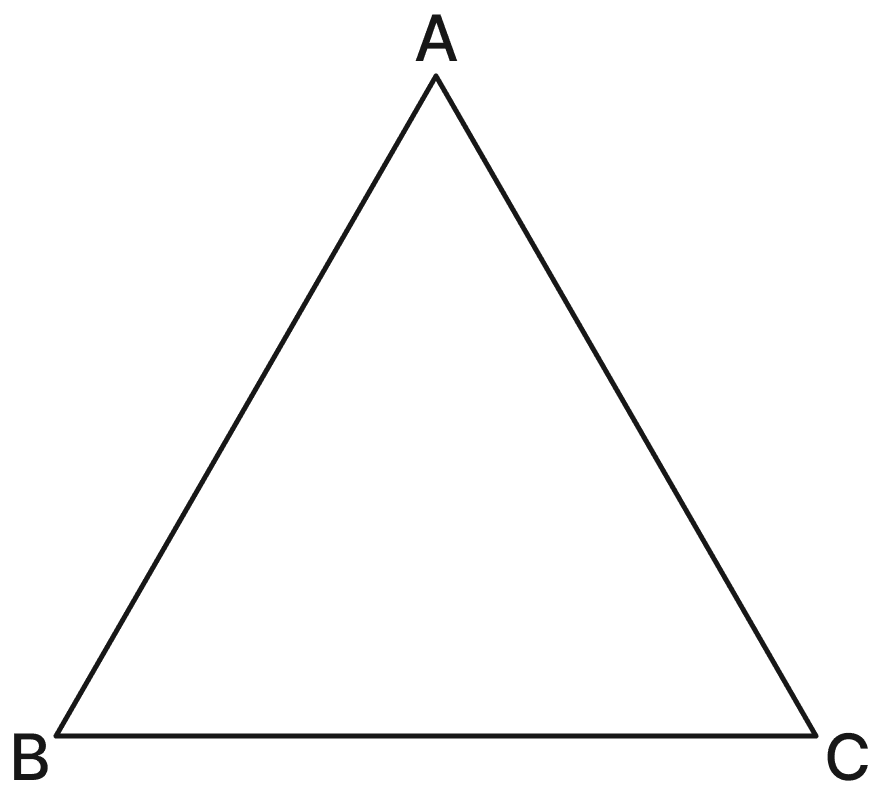
How do we get the outer rectangle from the given triangle?
Answer
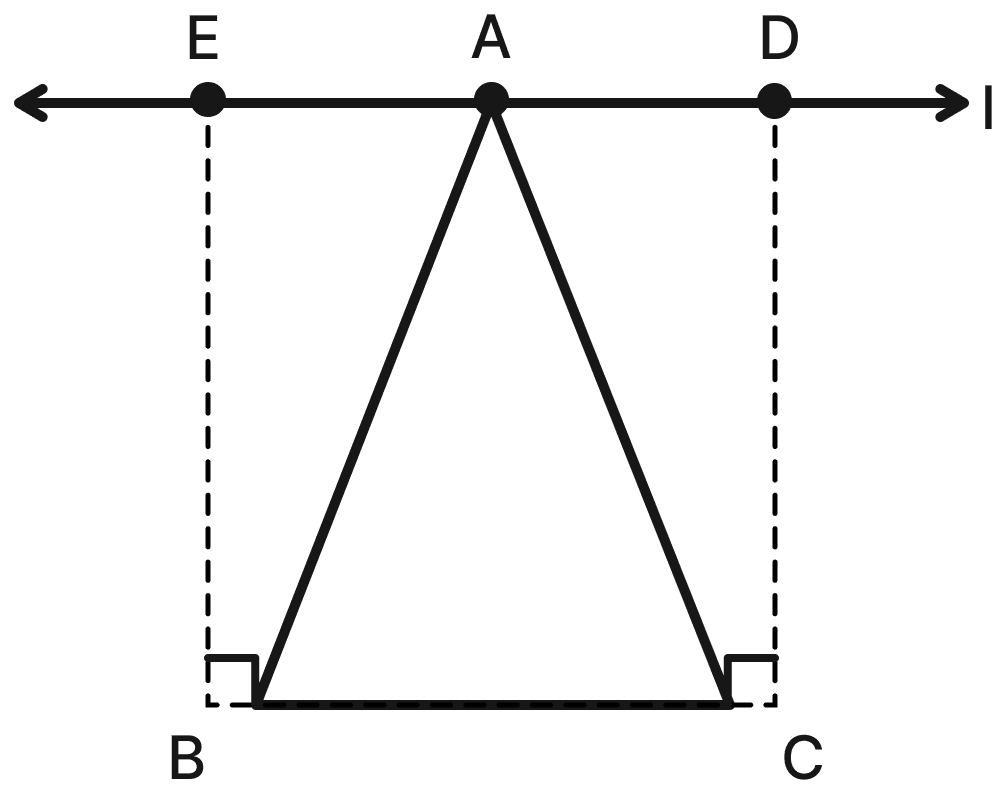
To obtain the outer rectangle from the given triangle ABC:
- Draw a line l through the vertex A parallel to the base BC.
- Through B and C, draw lines perpendicular to BC.
- Let these perpendiculars meet the line l at E and D respectively.
Then BCDE is a rectangle.
In this rectangle:
- BC is the base of the rectangle as well as the base of the triangle.
- The distance between the parallel lines l and BC is the height of the rectangle.
- This distance is also the height of △ABC.
Thus, the triangle is enclosed in the rectangle BCDE, and the rectangle has the same base and height as the triangle.
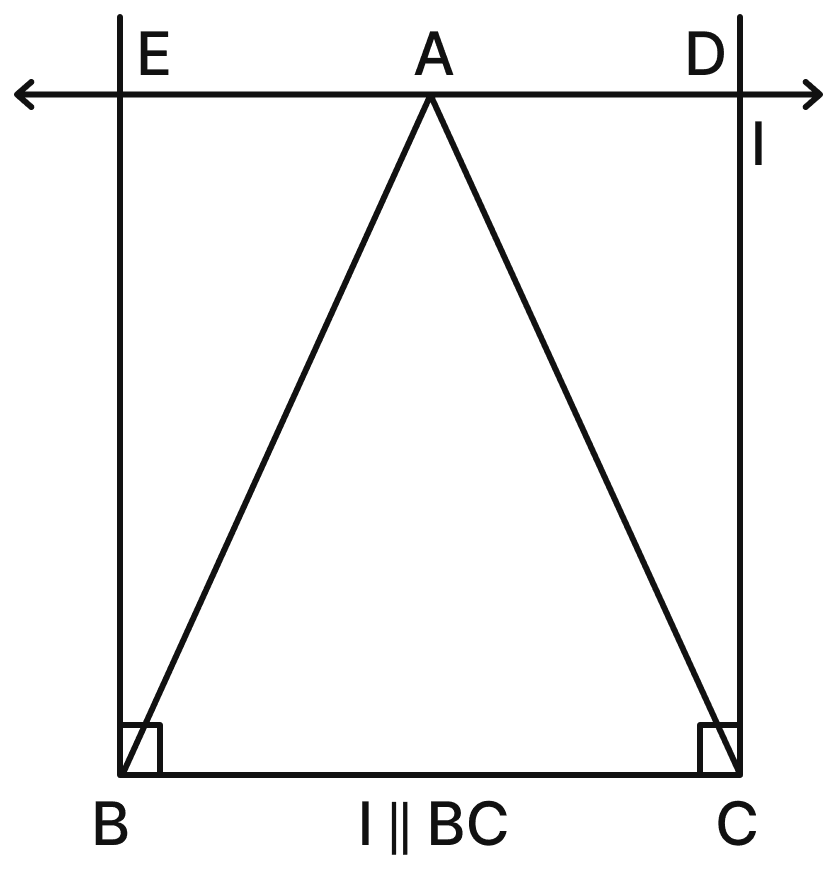
Hence, by drawing a line through A parallel to BC and drawing perpendiculars from B and C to meet this line, we obtain the outer rectangle BCDE.
Line l ∥ BC. Consider the different triangles that have BC as their base, and with their third vertex lying anywhere on l.
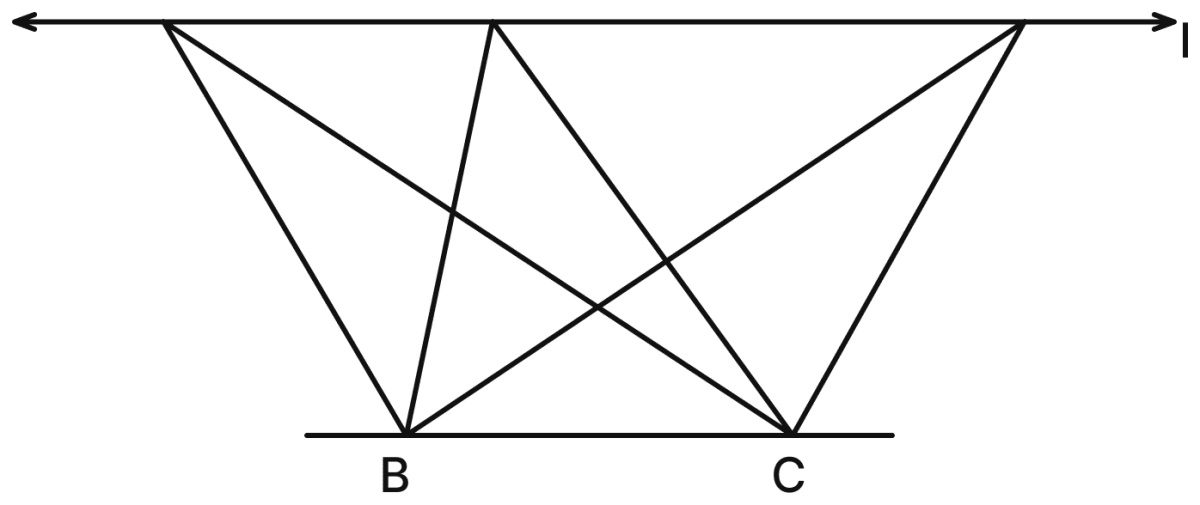
(i) Which of these triangles has the maximum area, and which has the minimum area?
(ii) Which of these triangles has the maximum perimeter, and which has the minimum perimeter?
Answer
(i) Area of the triangles
All the triangles have the same base BC.
Since l ∥ BC, the perpendicular distance from any point on l to BC is the same. Therefore, all the triangles have the same height.
∴ Area of each triangle = × BC × (constant height)
which is the same for all the triangles.
So all these triangles have equal areas. None of them has a strictly maximum or a strictly minimum area.
Hence, all the triangles have equal areas. Therefore, there is neither a maximum nor a minimum area.
(ii) Perimeter of the triangles
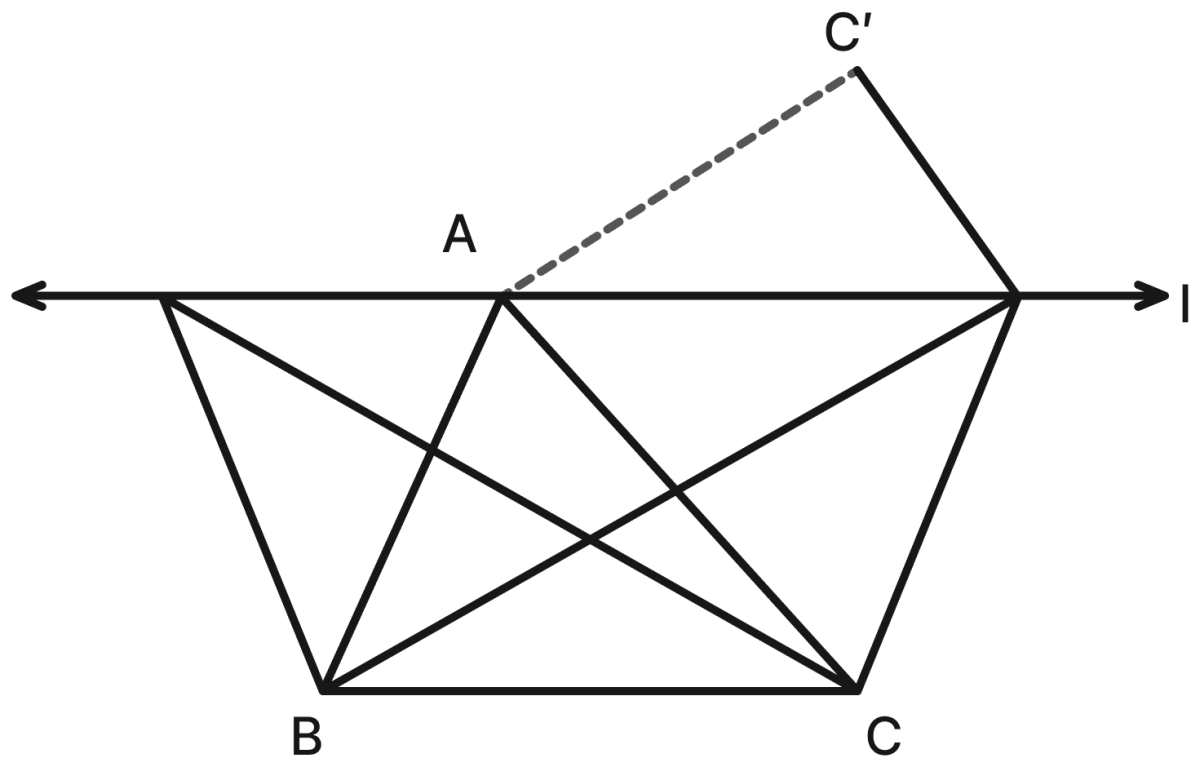
In all these triangles, BC is a common side. Therefore, the perimeter depends on the sum AB + AC.
Reflect the point C in the line l to obtain C' Then
AC = AC'.
So,
AB + AC = AB + AC'
Thus, finding the triangle with the smallest perimeter is the same as finding the point A on l for which the path B → A → C' is shortest.
The shortest distance between two points is a straight line. Therefore, AB + AC' is minimum when A lies on the straight line BC'.
Hence, the corresponding triangle has the minimum perimeter. This triangle is isosceles (AB = AC).
As the vertex A moves farther and farther away along the line l, the lengths AB and AC increase, so the perimeter keeps increasing.
Hence, the triangle whose vertex lies on the line BC' has the minimum perimeter, and there is no maximum perimeter since the perimeter can be made arbitrarily large.
Analyse whether A lies on the perpendicular bisector of BC.
Answer
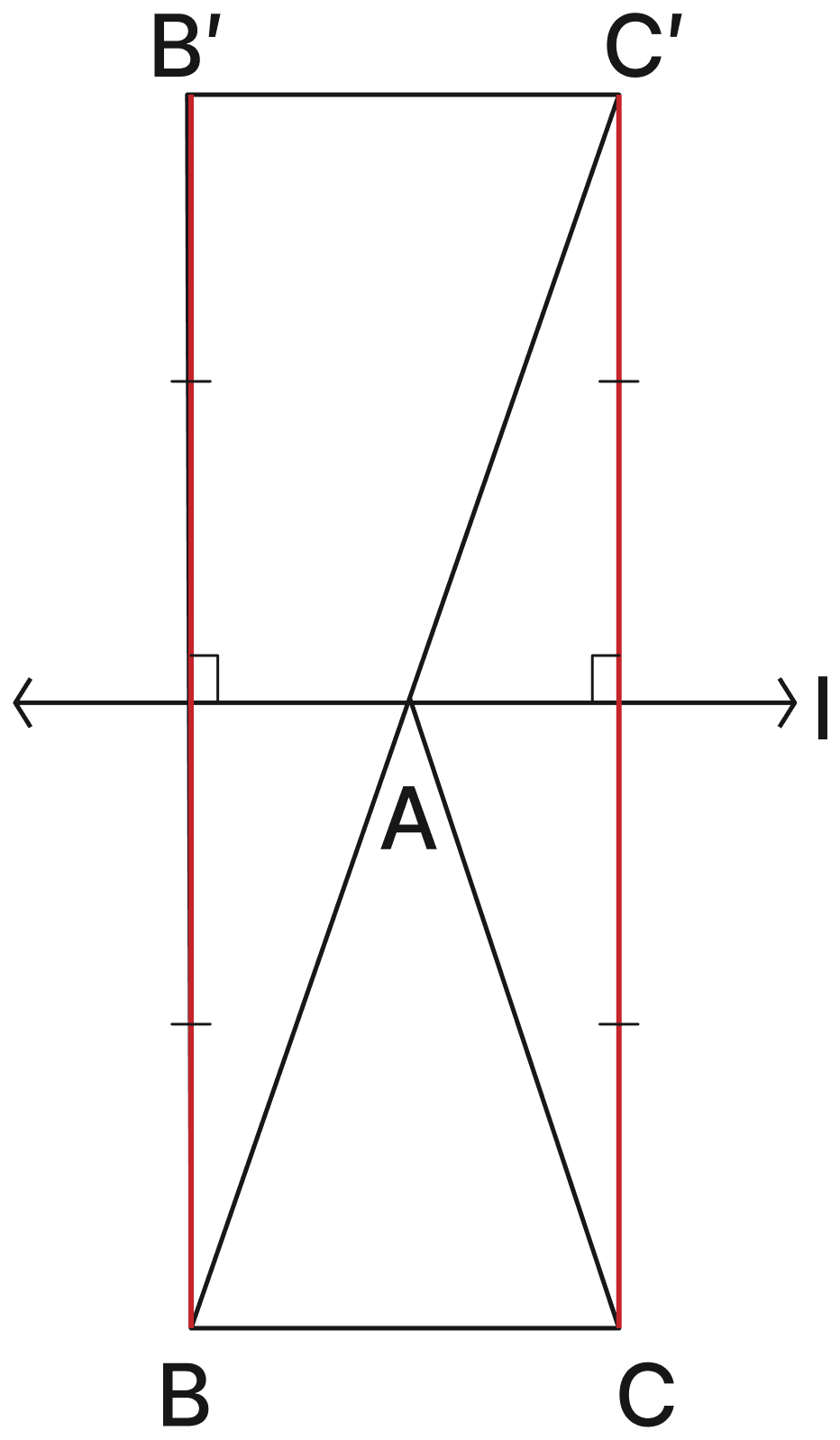
Let B' and C' be the reflections of B and C respectively in the line l.
Since l ∥ BC and the reflected points are at equal perpendicular distances from l, the quadrilateral BB'C'C is a rectangle.
From the minimum-perimeter construction, A is the point where the diagonal BC' meets the line l.
The line l passes through the midpoints of BB' and CC'. Hence, in the rectangle BB'C'C, it passes through the centre of the rectangle. The diagonal BC' also passes through this centre. Therefore, A is the centre of the rectangle.
The centre of a rectangle lies on the perpendicular bisector of each pair of opposite vertices and, in particular, on the perpendicular bisector of the side BC. Thus,
AB = AC
Hence, A lies on the perpendicular bisector of BC.
Find the area of the following triangle:
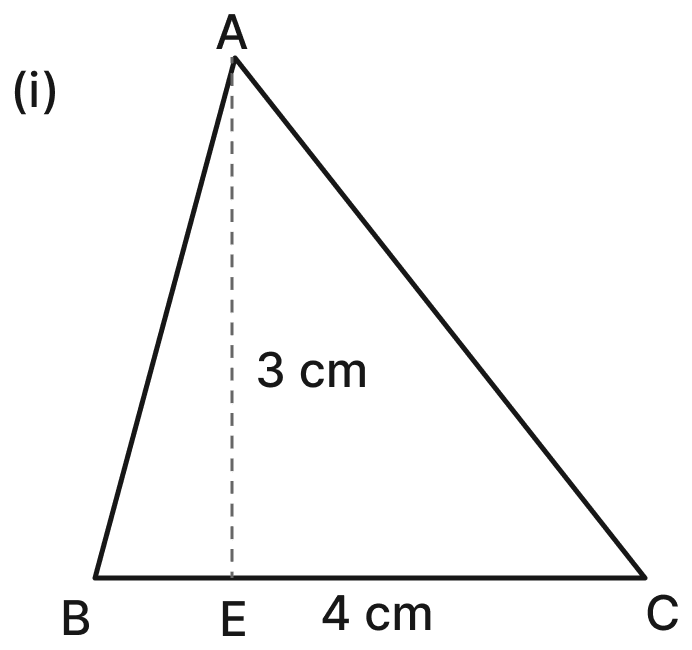
Answer
In ∆ABC, AE is perpendicular to the base BC.
Base = BC = 4 cm
Height = AE = 3 cm
Area of ∆ABC = × base × height
Area of triangle = 6 cm2.
Find the area of the following triangle:
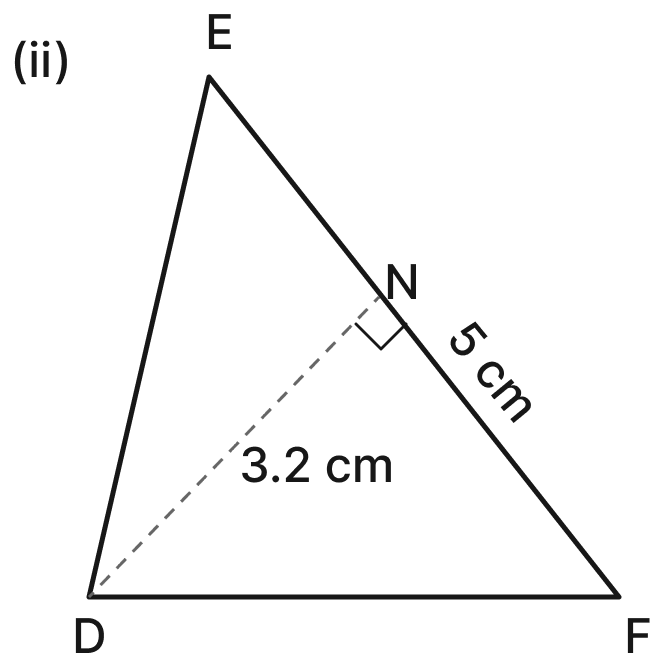
Answer
In ∆DEF, DN is perpendicular to the side EF.
Base = EF = 5 cm
Height = DN = 3.2 cm
Area of ∆DEF = × base × height
Area of triangle = 8 cm2.
Find the area of the following triangle:
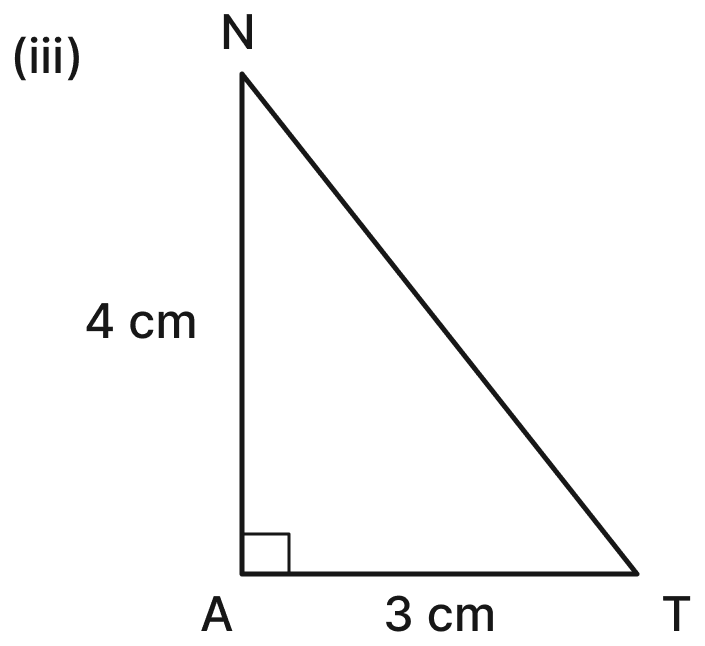
Answer
∆NAT is right-angled at A, so the two legs NA and AT can be taken as the height and the base.
Base = AT = 3 cm
Height = NA = 4 cm
Area of ∆NAT = × base × height
Area of triangle = 6 cm2.
Find the length of the altitude BY.
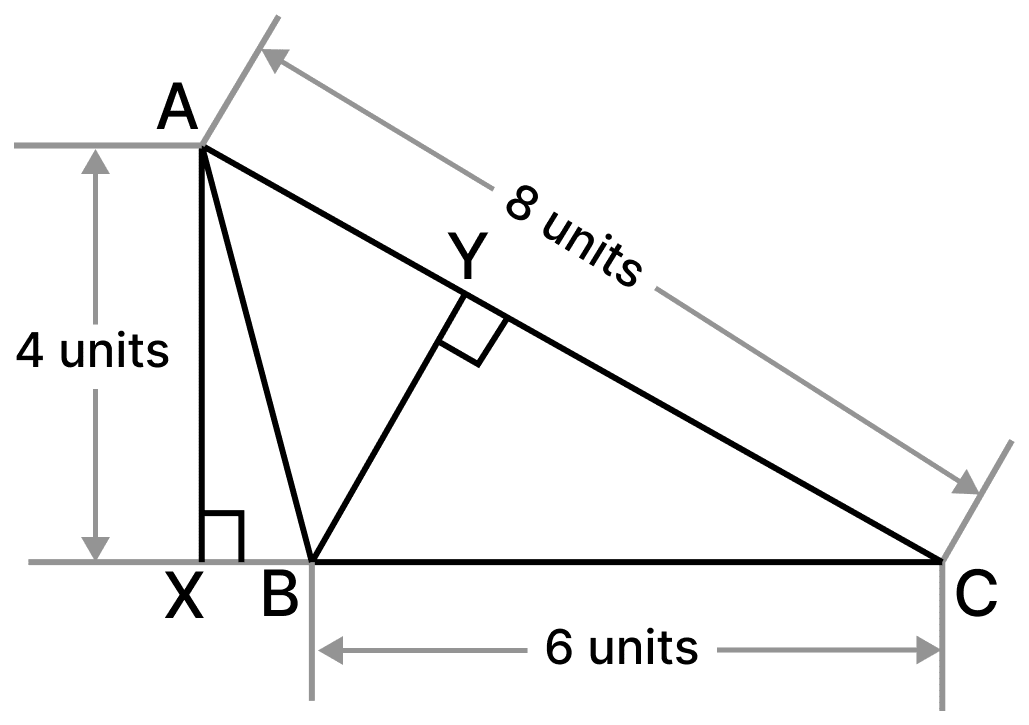
Answer
From the figure, in ∆ABC:
BC = 6 units, AX = 4 units and AX ⊥ BC
∴ Area of ∆ABC = × BC × AX
Also, BY ⊥ AC and AC = 8 units.
Hence, Area of ∆ABC = × AC × BY
Hence, the length of the altitude BY = 3 units.
Find the area of ∆SUB, given that it is isosceles, SE is perpendicular to UB, and the area of ∆SEB is 24 sq. units.
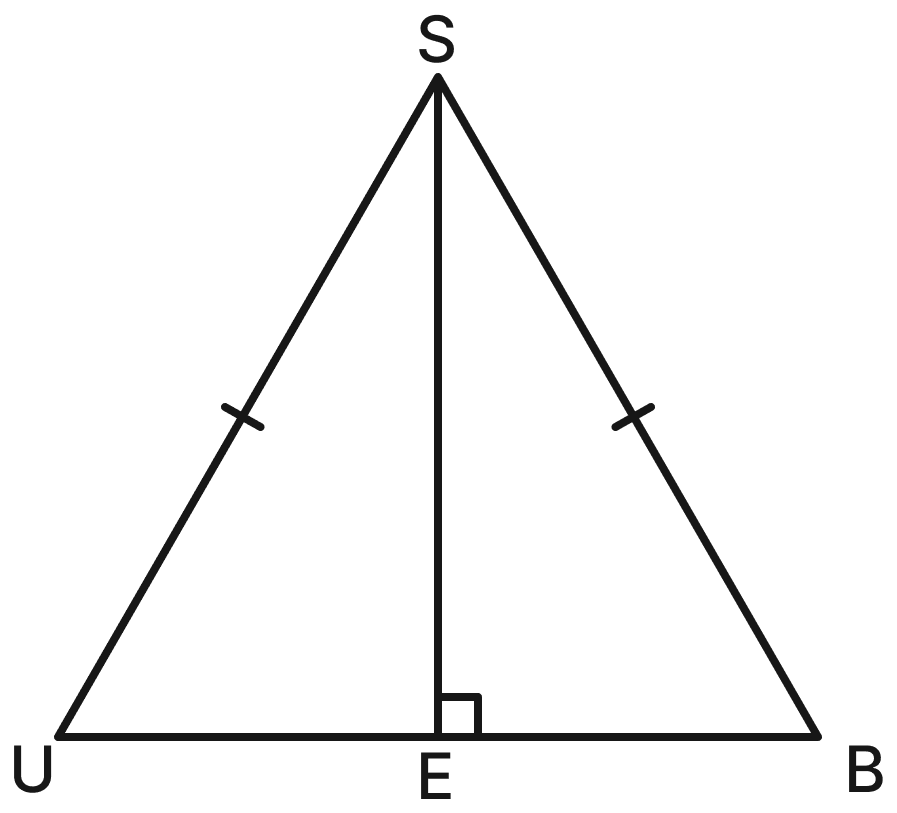
Answer
In ∆SUB, SU = SB, so it is an isosceles triangle.
Since SE ⊥ UB, the perpendicular from the vertex to the base bisects the base.
∴ UE = EB
Hence, △SEU and △SEB have the same base and the same height, so they have equal areas.
Area(∆SEB) = 24 sq. units
Therefore,
Area(∆SEU) = 24 sq. units
Area of ∆SUB = Area(∆SEU) + Area(∆SEB)
= 24 sq. units + 24 sq. units
= 48 sq. units
Hence, the area of ∆SUB = 48 sq. units.
[Śulba-Sūtras] Give a method to transform a rectangle into a triangle of equal area.
Answer
Let ABCD be the given rectangle.
- Choose one side of the rectangle, say BC, as the base.
- Produce the sides AB and CD beyond A and D respectively so that AP = AB and DQ = DC.
Join P and Q. Then PQ is parallel to BC, and the distance between PQ and BC is twice the height of the rectangle.
Take any point T on the line PQ.
Join TB and TC.
Then △TBC has the same base BC as the rectangle and twice its height.
![[Śulba-Sūtras] Give a method to transform a rectangle into a triangle of equal area. Area, NCERT Class 8 Ganita Prakash Mathematics CBSE Solutions.](https://cdn1.knowledgeboat.com/img/ncert-8/q4-figure-out-2-ans-1-ganita-prakash-2-cbse-class-8-c7-202608191832-1200x827.png)
If the rectangle has base b and height h, then
Area of rectangle = b × h,
while, Area of △TBC = × b × 2h = b × h.
Thus, the triangle and the rectangle have equal areas.
Hence, a rectangle can be transformed into a triangle of equal area by keeping the same base and doubling the height.
[Śulba-Sūtras] Give a method to transform a triangle into a rectangle of equal area.
Answer
![[Śulba-Sūtras] Give a method to transform a triangle into a rectangle of equal area. Area, NCERT Class 8 Ganita Prakash Mathematics CBSE Solutions.](https://cdn1.knowledgeboat.com/img/ncert-8/q5-figure-out-2-ans-1-ganita-prakash-2-cbse-class-8-c7-202608191832-912x848.png)
Let ABC be the given triangle with base BC and height h.
Mark D and E as the midpoints of AB and AC respectively, and join DE. Then
DE ∥ BC and DE = .
Cut the triangle along DE. This gives the small triangle △ADE and the trapezium BDEC.
Rotate △ADE through 180° about D. Since D is the midpoint of AB, A moves to B. Let E move to E'. Place the rotated triangle beside the trapezium. The two pieces form the parallelogram E'ECB.
This parallelogram has base BC and height .
Now convert the parallelogram into a rectangle by cutting off a triangular piece from one end and shifting it to the other end.
The resulting rectangle has base BC and height .
Hence, the triangle can be transformed into a rectangle of equal area by first rearranging it into a parallelogram and then converting that parallelogram into a rectangle.
ABCD, BCEF, and BFGH are identical squares.
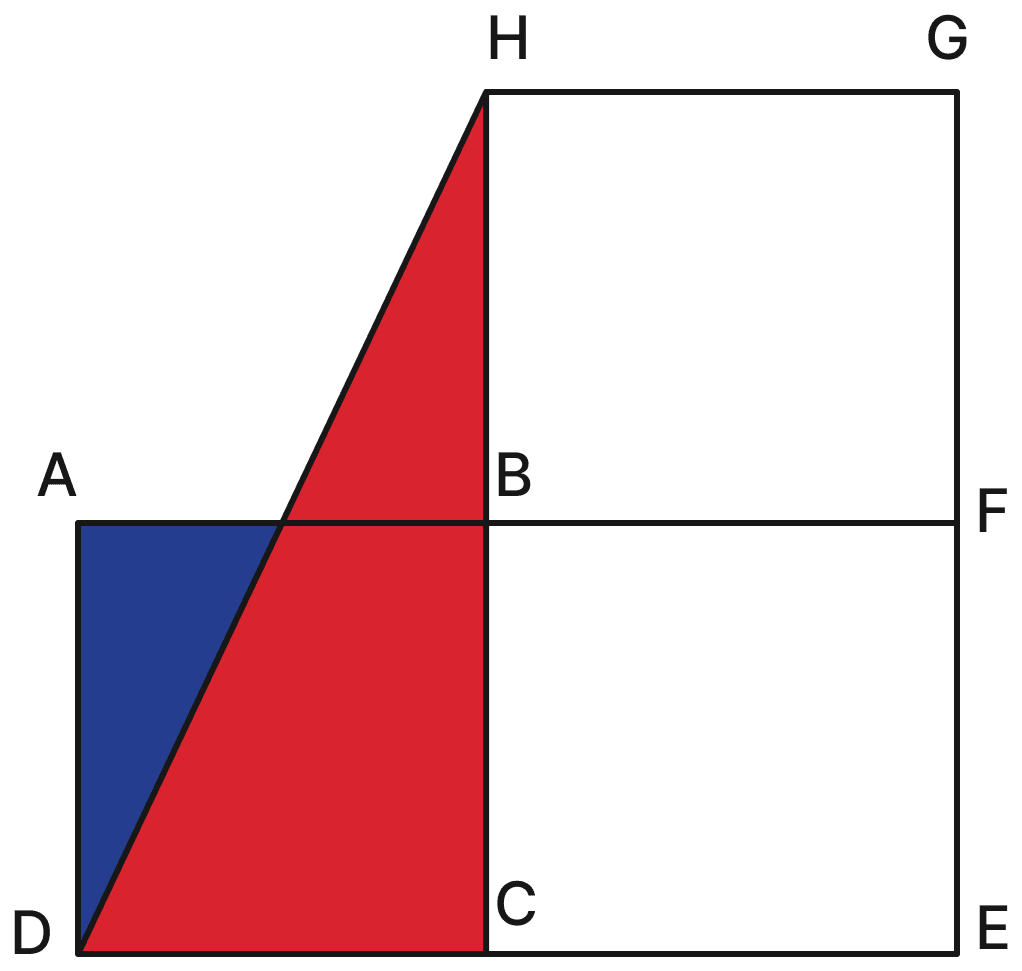
(i) If the area of the red region is 49 sq. units, then what is the area of the blue region?
(ii) In another version of this figure, if the total area enclosed by the blue and red regions is 180 sq. units, then what is the area of each square?
Answer
ABCD, BCEF and BFGH are identical squares.
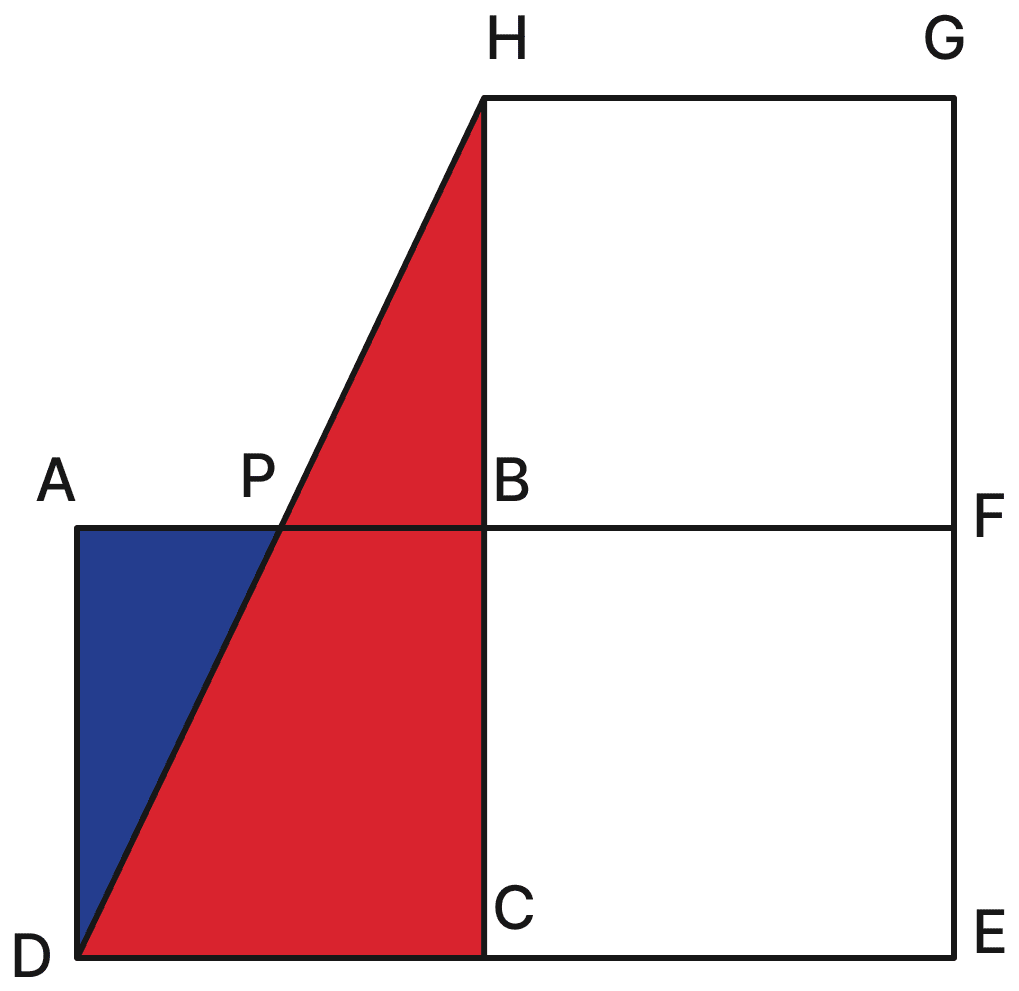
Let the side of each square be a units.
The red region is the ∆DHC.
Here, DC = a
HC = HB + BC = a + a = 2a
Red region is ∆DHC
Also, the line DH joins the opposite corners of a rectangle of width a and height 2a. Hence it cuts AB at its midpoint P. Therefore,
AP = PB =
Blue region is ∆APD
So the red region is 4 times the blue region; equivalently, the blue region is of the red region.
(i) Given area of red region = 49 sq. units.
Red region = a2 = 49
Blue region =
Area of the blue region = 12.25 sq. units.
(ii)
Given
Blue area + Red area = 180 sq. units.
Hence, the area of each square is 144 sq. units.
If M and N are the midpoints of XY and XZ, what fraction of the area of ∆XYZ is the area of ∆XMN? [Hint: Join NY]
![If M and N are the midpoints of XY and XZ, what fraction of the area of ∆XYZ is the area of ∆XMN? [Hint: Join NY]. Area, NCERT Class 8 Ganita Prakash Mathematics CBSE Solutions.](https://cdn1.knowledgeboat.com/img/ncert-8/q7-figure-out-2-1-ganita-prakash-2-cbse-class-8-c7-202608191832-1009x862.png)
Answer
Join NY, as suggested in the hint.
![If M and N are the midpoints of XY and XZ, what fraction of the area of ∆XYZ is the area of ∆XMN? [Hint: Join NY]. Area, NCERT Class 8 Ganita Prakash Mathematics CBSE Solutions.](https://cdn1.knowledgeboat.com/img/ncert-8/q7-figure-out-2-ans-1-ganita-prakash-2-cbse-class-8-c7-202608191832-1025x1028.png)
Since N is the midpoint of XZ, YN is a median of △XYZ.
We know that a median divides a triangle into two triangles of equal areas.
∴ Area(△XYN) =
Now consider ∆XYN.
Since M is the midpoint of XY, MN is a median of △XYN.
∴ NM divides ∆XYN into two triangles of equal area:
Again, a median divides a triangle into two triangles of equal areas.
Hence,
Hence, the area of ∆XMN is of the area of ∆XYZ.
Gopal needs to carry water from the river to his water tank. He starts from his house. What is the shortest path he can take from his house to the river and then to the water tank? Roughly recreate the map in your notebook and trace the shortest path.
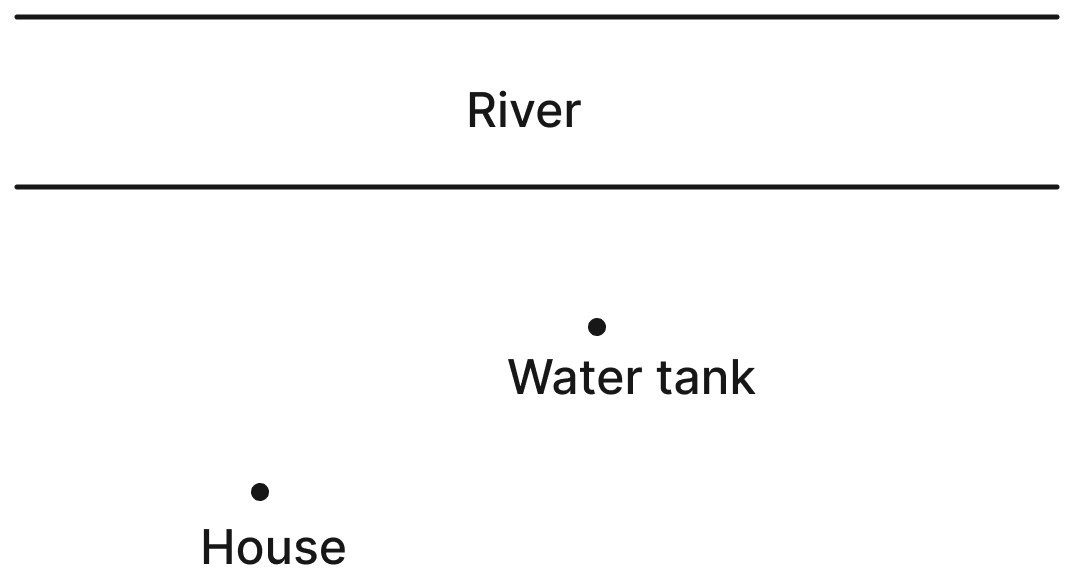
Answer
Gopal must start at his house (H), touch the river (the straight line ), and then reach the water tank (T). Both the house and the tank lie on the same side of the river. We need the point P on the river for which the total path H → P → T is the shortest.
Use the mirror (reflection) method discussed earlier in the chapter:
Treat the river line as a mirror, and reflect the water tank T across to obtain its image T′.
Since the reflection keeps distances unchanged, for any point P on the river, PT = PT′.
Therefore the path H → P → T has the same length as the path H → P → T′.
The shortest path from H to T′ is the straight line HT′. So the best point P is where the straight line HT′ crosses the river.
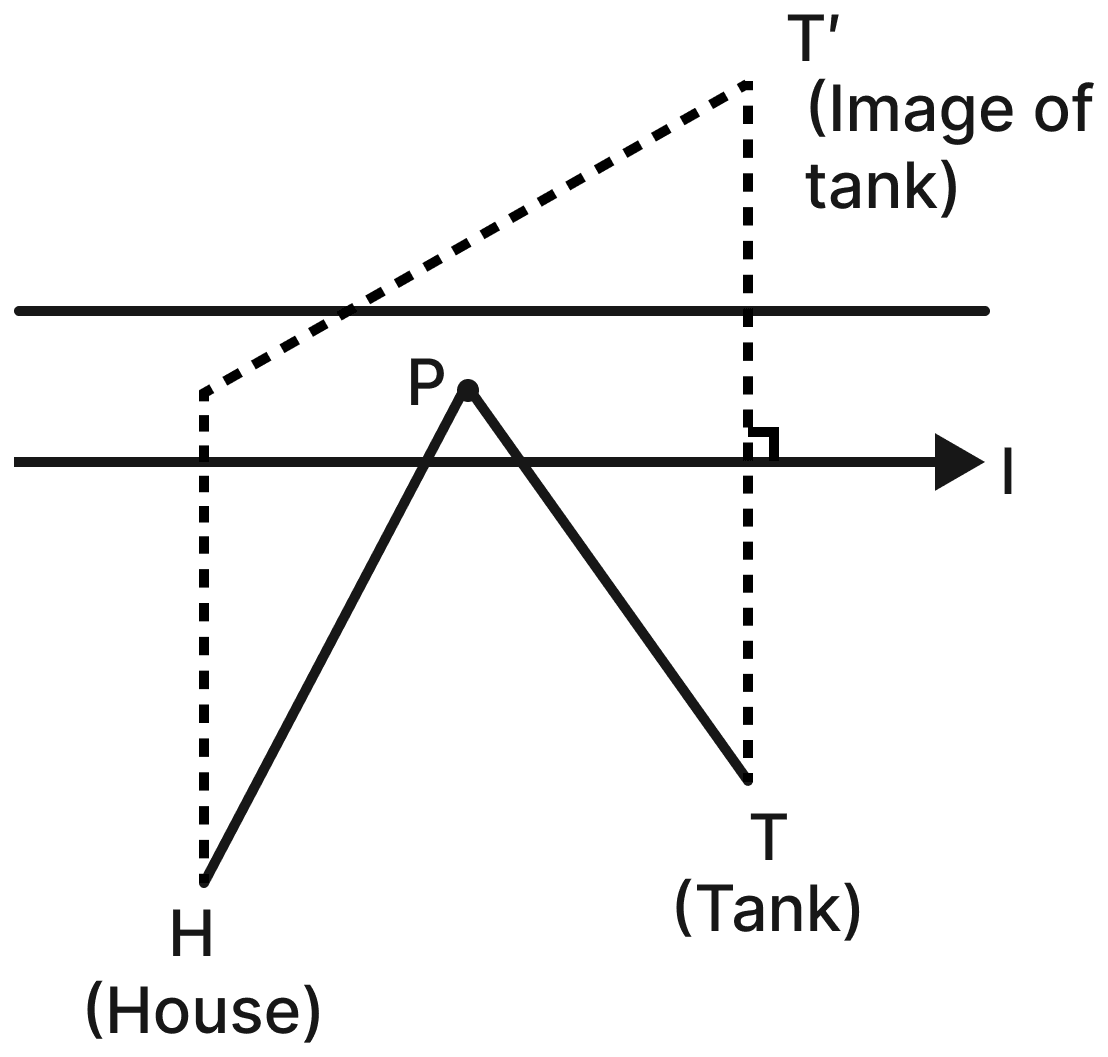
The required shortest path is then H → P → T, where P is the intersection of the straight line HT′ with the river.
Hence, the shortest path is obtained by reflecting the water tank across the river, drawing the straight line from the house to this image, and taking the point where it meets the river — Gopal should go from his house straight to that point on the river, and from there straight to the water tank.
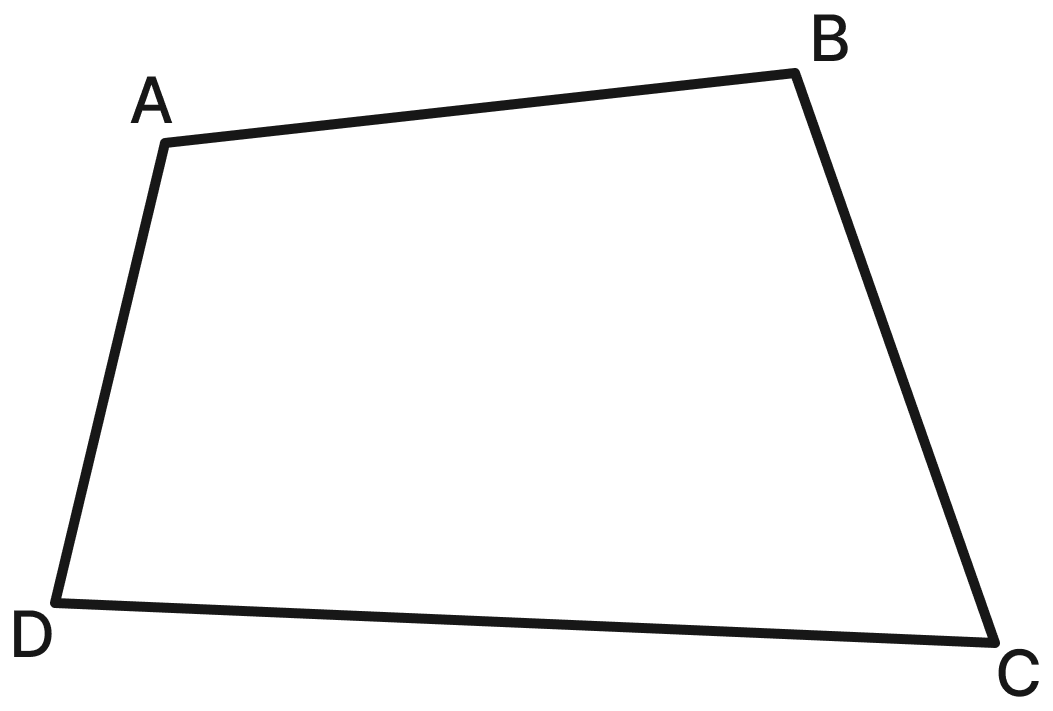
How do we find the area of this quadrilateral? What measurements do we need for this?
Answer
If we join the diagonal BD, the quadrilateral ABCD gets divided into two triangles, ∆ABD and ∆CBD. By finding the area of each triangle and adding them, we get the area of the quadrilateral:
Area(ABCD) = Area(△ABD) + Area(△CBD)
For this we need the following measurements:
the length of the diagonal BD (which acts as the common base of both triangles), and
the perpendicular distances (heights) from the vertices A and C to the diagonal BD.
Hence, the area of the quadrilateral is found by joining a diagonal and adding the areas of the two triangles formed, for which we need the length of the diagonal and the perpendicular distances of the opposite two vertices from it.
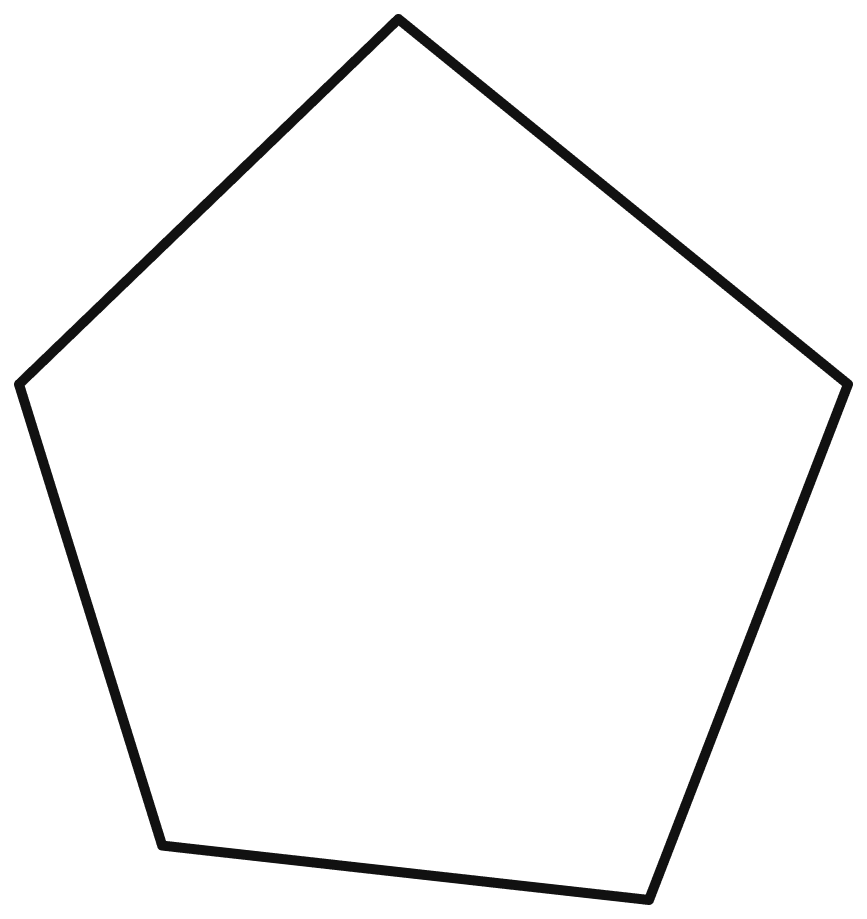
How do we find the area of this pentagon?
Answer
Draw diagonals from any one vertex of the pentagon to all the non-adjacent vertices.
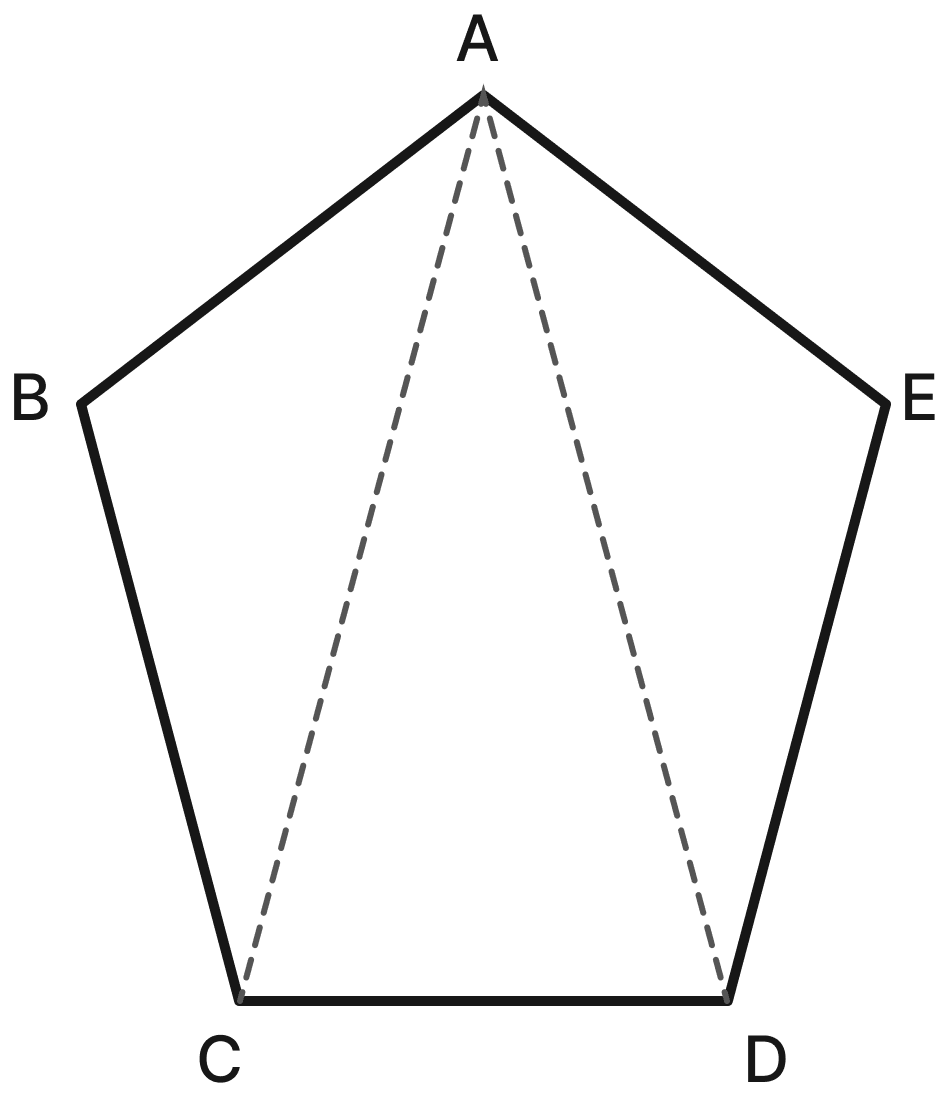
This divides the pentagon into three triangles.
Find the area of each triangle using the formula:
Area of a triangle = × base × height
Then add the areas of the three triangles.
Area of pentagon = Area of Triangle 1 + Area of Triangle 2 + Area of Triangle 3.
Thus, the area of the pentagon can be found by dividing it into triangles and adding their areas.
Area of pentagon = Sum of the areas of the three triangles.
Hence, the area of the pentagon is obtained by drawing diagonals from one vertex to divide it into three triangles and then adding the areas of those triangles.
Can any polygon be divided into triangles?
Answer
Yes. Any polygon can be divided into triangles by drawing suitable diagonals inside it.
Once the polygon is divided into triangles, we can find the area of each triangle using the formula
Area of a triangle = × base × height.
The area of the polygon is then obtained by adding the areas of all the triangles.
Area of polygon = Sum of the areas of the triangles.
Hence, any polygon can be divided into triangles, and so the area of any polygon can be found by adding the areas of these triangles.
Find the area of the quadrilateral ABCD given that AC = 22 cm, BM = 3 cm, DN = 3 cm, BM is perpendicular to AC, and DN is perpendicular to AC.
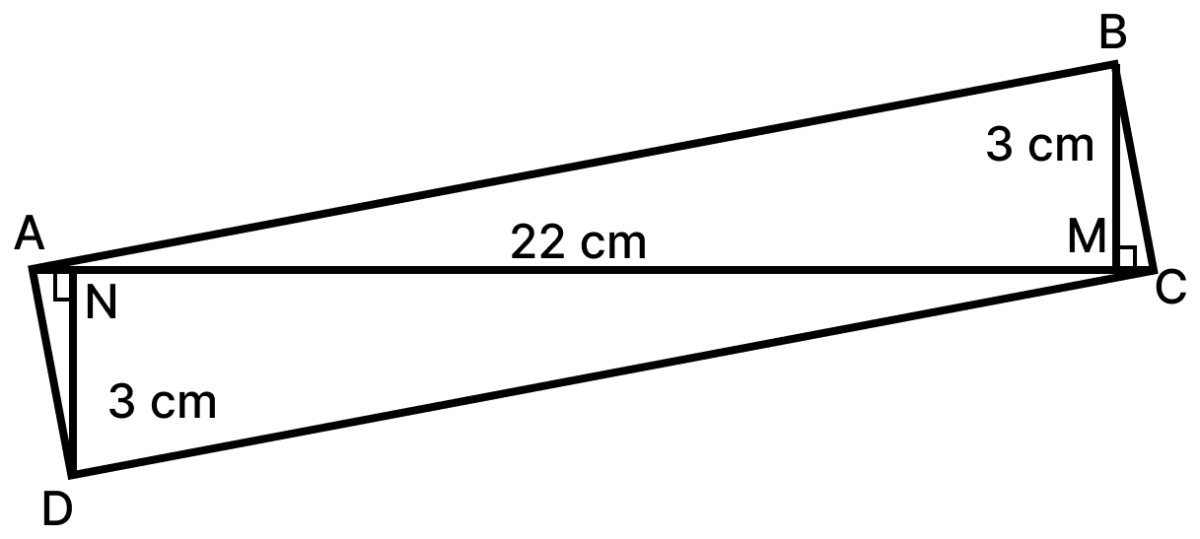
Answer
The diagonal AC divides the quadrilateral ABCD into two triangles, ∆ABC and ∆ACD.
Here AC = 22 cm is the common base.
BM = 3 cm is the height of ∆ABC (since BM ⊥ AC).
DN = 3 cm is the height of ∆ACD (since DN ⊥ AC).
Area of ∆ABC
Area of ∆ACD
∴ Area of quadrilateral ABCD = Area(ΔABC) + Area(ΔACD)
= (33 + 33) cm2
= 66 cm2
Hence, the area of the quadrilateral ABCD = 66 cm2.
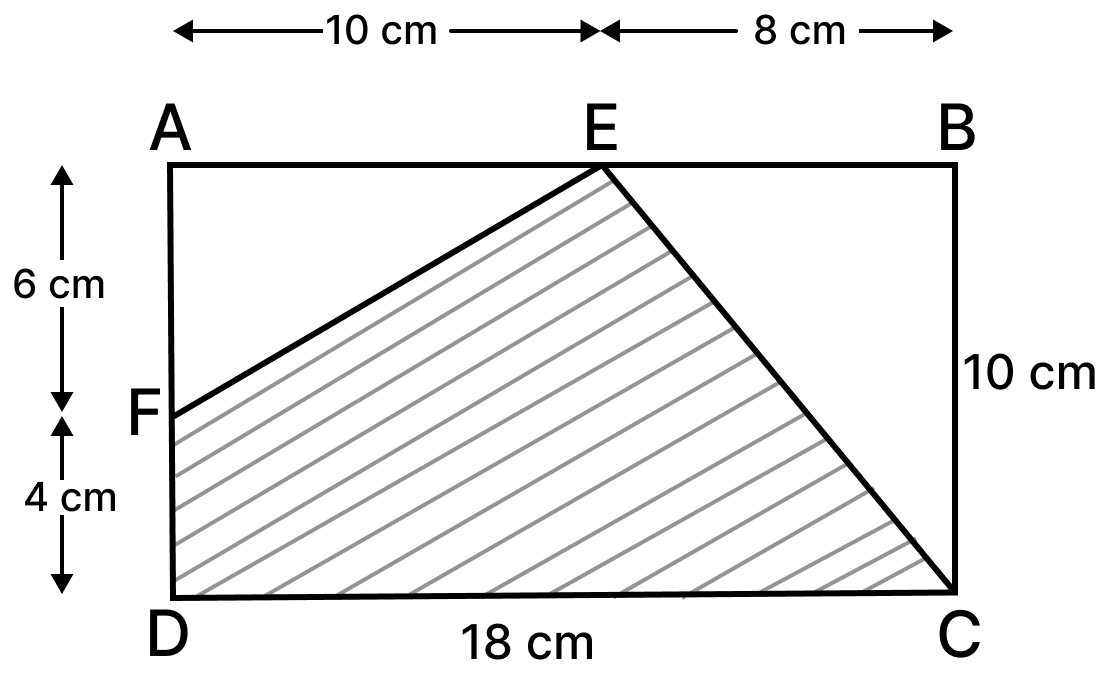
Find the area of the shaded region given that ABCD is a rectangle.
Answer
From the figure, ABCD is a rectangle with:
Length AB = DC = (10 + 8) cm = 18 cm
Breadth AD = BC = (6 + 4) cm = 10 cm
The point E lies on AB with AE = 10 cm and EB = 8 cm.
The point F lies on AD with AF = 6 cm and FD = 4 cm.
The shaded region is the quadrilateral DFEC, obtained by removing the two unshaded triangles ∆AFE and ∆EBC from the rectangle.
Area of rectangle ABCD
= AB × AD
= 18 × 10 cm2
= 180 cm2
Area of ∆AFE
Area of ∆EBC
∴ Area of shaded region = Area(ABCD) − Area(∆AFE) − Area(ΔEBC)
= (180 - 30 - 40) cm2
= 110 cm2
Hence, the area of the shaded region = 110 cm2.
What measurements would you need to find the area of a regular hexagon?
Answer
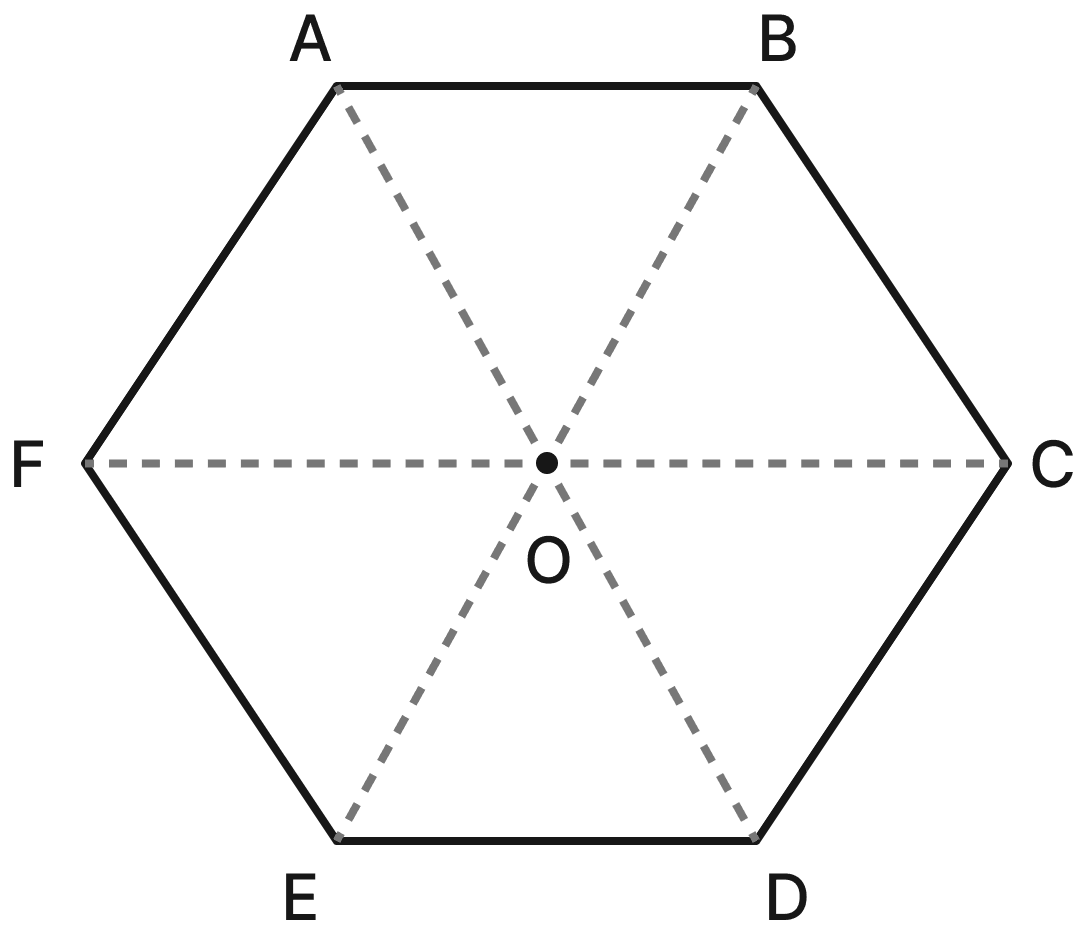
A regular hexagon can be divided into 6 congruent triangles by joining its centre to all six vertices.
To find the area of each triangle, we need:
- the length of a side of the hexagon (which acts as the base of the triangle), and
- the perpendicular distance from the centre of the hexagon to that side (the height of the triangle).
Then, Area of one triangle = × base × height
Adding the areas of all six triangles gives the area of the hexagon.
Area of regular hexagon =
Hence, to find the area of a regular hexagon, we need the length of a side of the hexagon and the perpendicular distance from the centre to a side.
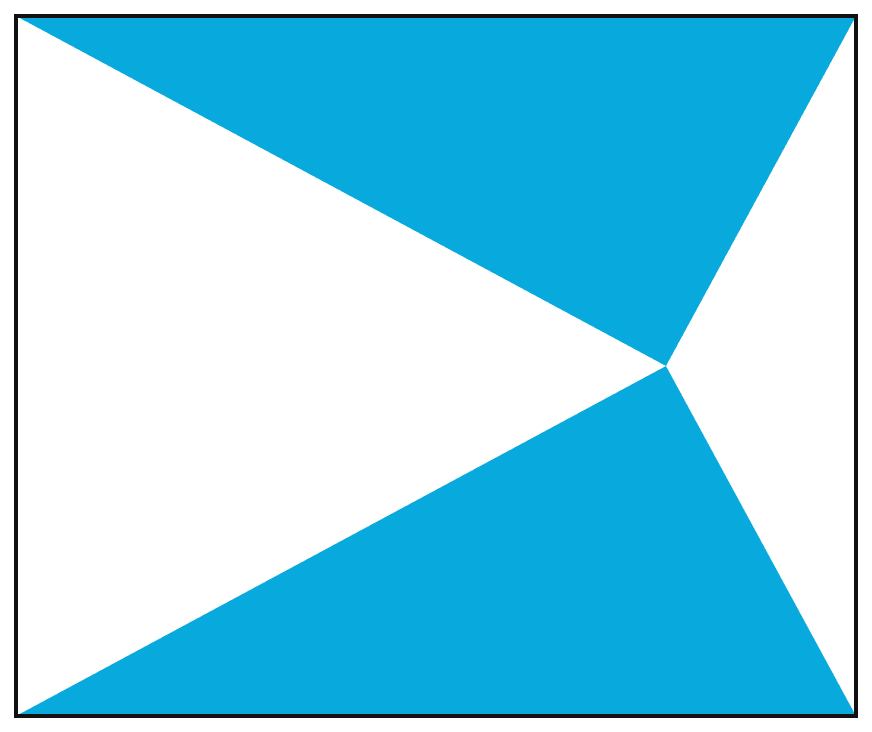
What fraction of the total area of the rectangle is the area of the blue region?
Answer
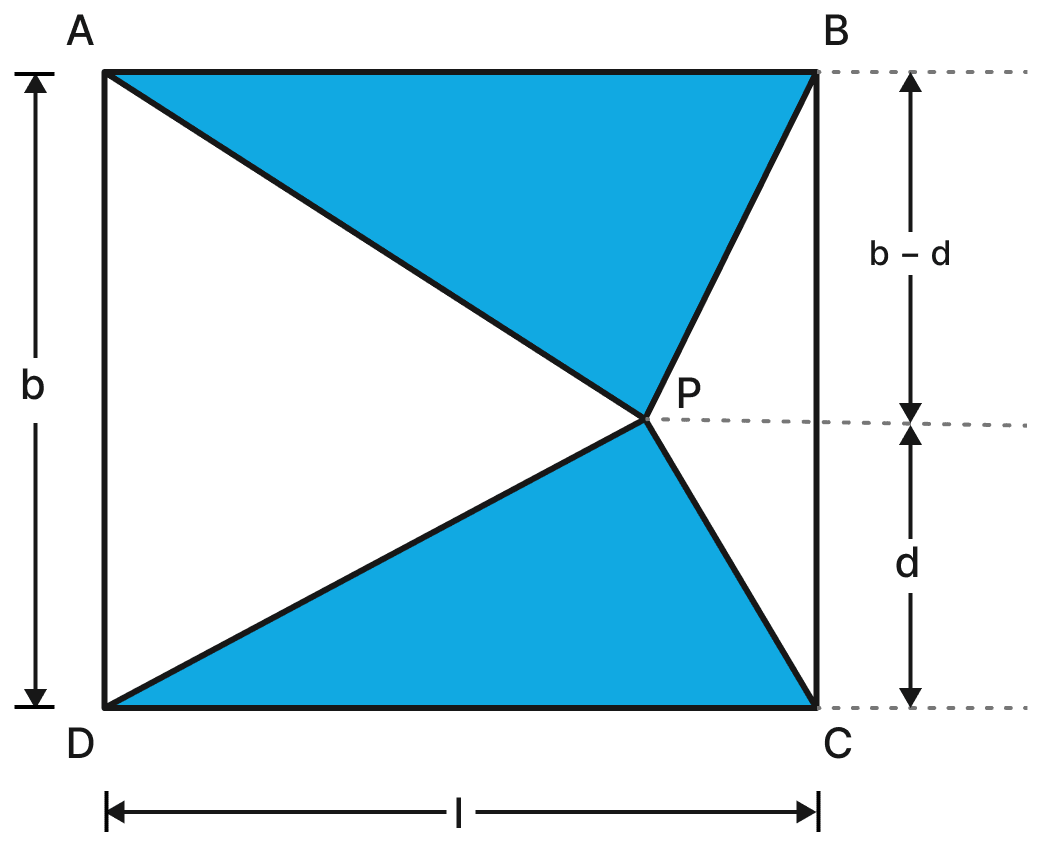
Let the length and breadth of the rectangle be l and b respectively.
Let the common vertex of the two blue triangles be P. Suppose P is at a distance d from the bottom side of the rectangle. Then its distance from the top side is b − d.
Area of the upper blue triangle =
Area of the lower blue triangle =
But, Area of the rectangle = l × b
Hence,
Notice that the position of the point P does not matter — the two heights always add up to the full breadth b, so the blue area is always exactly half of the rectangle.
Hence, the blue region is of the total area of the rectangle.
Give a method to obtain a quadrilateral whose area is half that of a given quadrilateral.
Answer
Method (joining the midpoints of the sides):
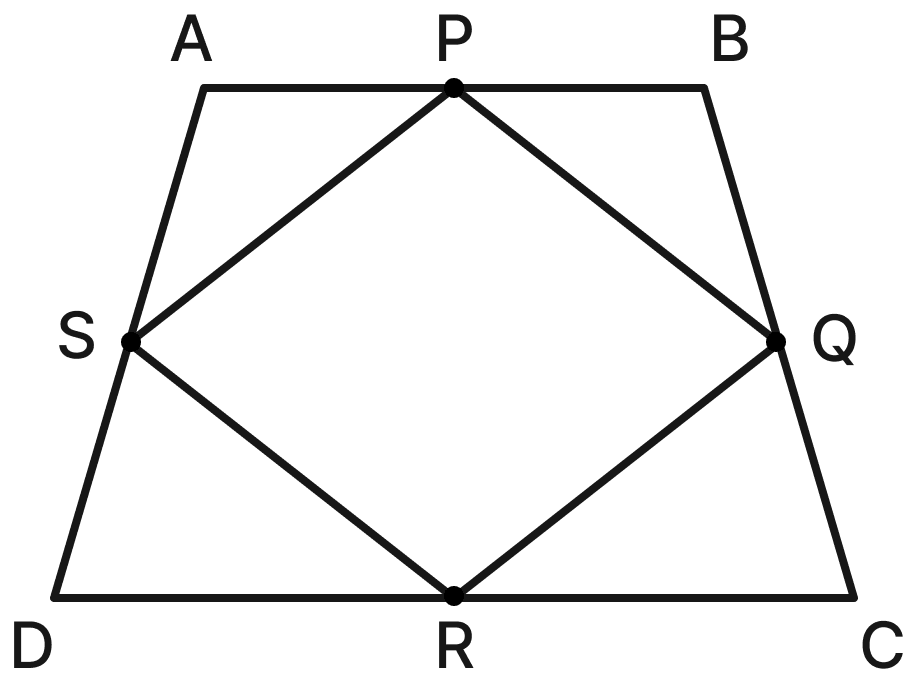
Let ABCD be the given quadrilateral.
- Mark the midpoints P, Q, R and S of the sides AB, BC, CD and DA respectively.
- Join P, Q, R and S in order.
The quadrilateral PQRS obtained in this way is a parallelogram.
It can be shown that the area of this parallelogram is exactly half the area of the original quadrilateral ABCD.
Area(PQRS) = Area(ABCD)
Hence, joining the midpoints of the sides of a quadrilateral gives a quadrilateral whose area is half that of the original quadrilateral.
Give a method to convert a parallelogram into a rectangle of equal area. You can try this using a cut-out of a parallelogram.
Answer
Method (dissection):
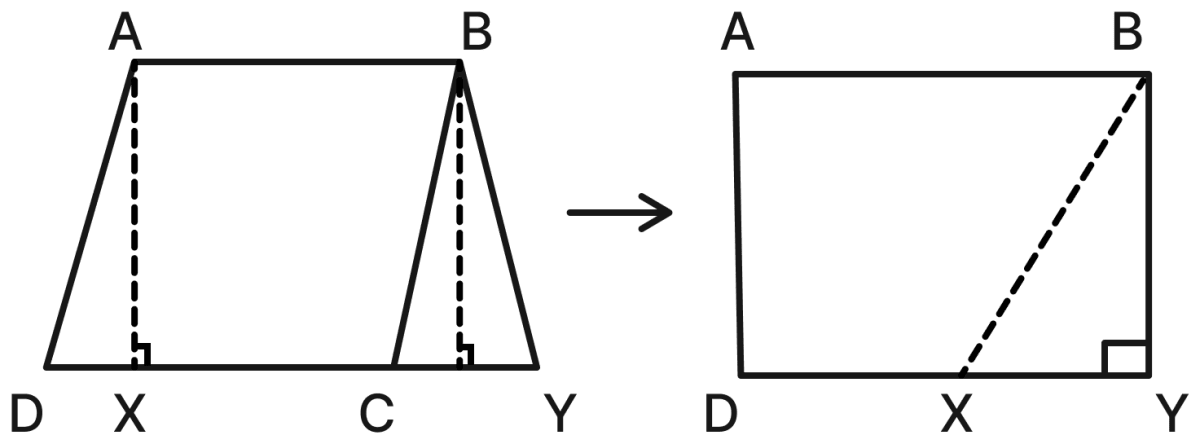
Take the parallelogram ABCD with DC as the base.
Step 1: From vertex A, draw AX perpendicular to the base DC (AX ⊥ DC). The length AX is a height of the parallelogram.
Step 2: Cut along AX. This separates the parallelogram into the right triangle ΔAXD and the trapezium ABCX.
Step 3: Extend XC to the right and draw a perpendicular to XC through B, meeting it at Y. The triangle ΔBYC is exactly the piece needed to complete ABCX into the rectangle ABYX.
Step 4: Slide the triangle ΔAXD across and place it over ΔBYC. They match perfectly, because:
BY = AX (opposite sides of rectangle ABYX)
∠BYC = ∠AXD = 90°
BC = AD (opposite sides of parallelogram ABCD)
⇒ ΔBYC ≅ ΔAXD (RHS congruency criterion)
So ΔAXD fits exactly over the region of ΔBYC, turning the parallelogram into the rectangle ABYX without changing the area.
Since DX = CY, adding the common part XC gives DC = XY. So the rectangle has the same base and height as the parallelogram:
Area of parallelogram ABCD = Area of rectangle ABYX = base × height
Hence, a parallelogram can be converted into a rectangle of equal area by cutting off the right triangle at one end (along a height) and shifting it to the other end — giving Area = base × height.
Observe the parallelograms in the figure below.
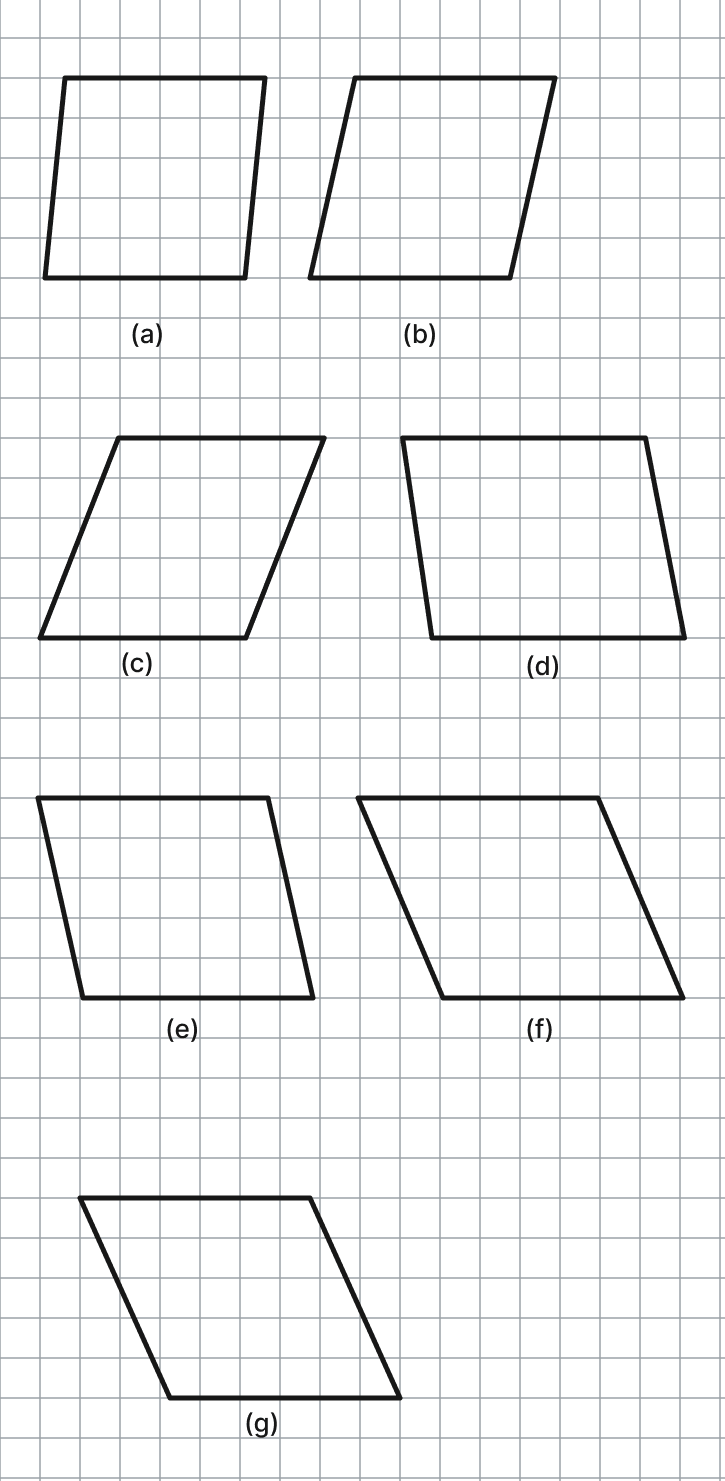
(i) What can we say about the areas of all these parallelograms?
(ii) What can we say about their perimeters? Which figure appears to have the maximum perimeter, and which has the minimum perimeter?
Answer
(i) Every parallelogram in the figure is drawn on the same grid with the same base and the same height (each one stands between the same pair of parallel lines, on a base of equal length).
Since Area of a parallelogram = base × height, and both the base and the height are the same for all of them:
Hence, all the parallelograms have equal areas.
(ii) Although the bases are equal, the slanting (oblique) sides are not. As a parallelogram is sheared more and more to one side, its base and height stay the same but its slanting sides become longer. A longer slant side means a larger perimeter.
So the parallelograms have different perimeters:
The figure that is the most slanted has the longest slanting sides, so it has the maximum perimeter — this is figure (g).
The figure that is the most upright (closest to a rectangle) has the shortest slanting sides, so it has the minimum perimeter — this is figure (a).
Hence, all the parallelograms have the same area, but different perimeters; figure (g) appears to have the maximum perimeter and figure (a) the minimum perimeter.
Find the areas of the following parallelograms:
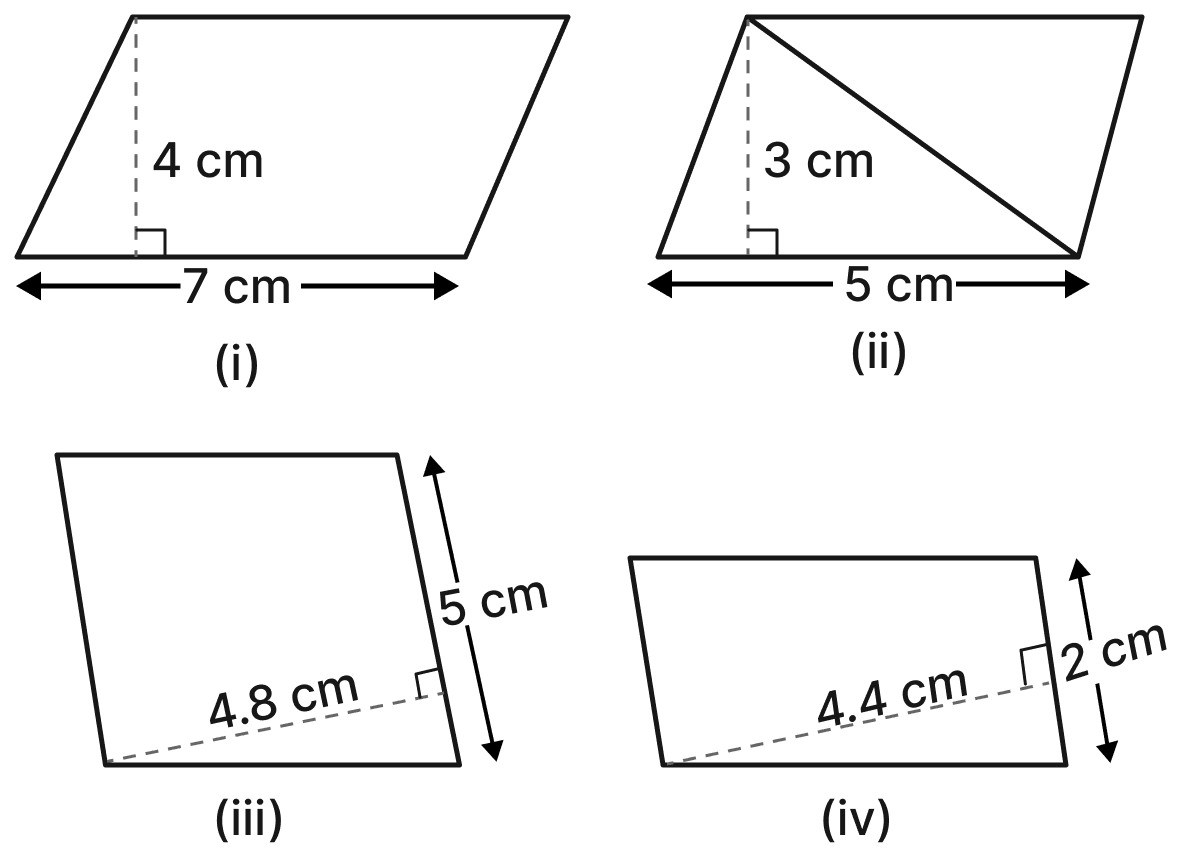
Answer
Area of parallelogram = base × height
(i) Base = 7 cm, height = 4 cm
Area = 7 × 4 cm2
= 28 cm2
Hence, the area is 28 cm2.
(ii) Base = 5 cm, height = 3 cm
Area = 5 × 3 cm2
= 15 cm2
Hence, the area is 15 cm2.
(iii) Base = 4.8 cm, height = 5 cm
Area = 4.8 × 5 cm2
= 24 cm2
Hence, the area is 24 cm2.
(iv) Base = 4.4 cm, height = 2 cm
Area = 4.4 × 2 cm2
= 8.8 cm2
Hence, the area is 8.8 cm2.
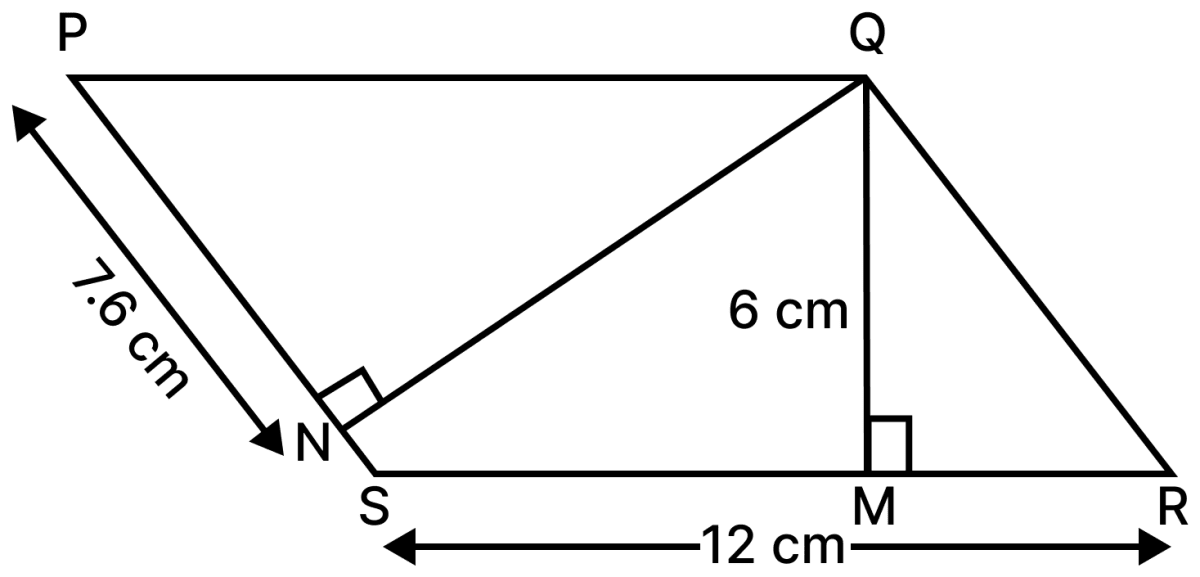
Find QN.
Answer
PQRS is a parallelogram in which:
SR = 12 cm with corresponding height QM = 6 cm (QM ⊥ SR)
PS = 7.6 cm with corresponding height QN (QN ⊥ PS)
The area of a parallelogram is the same whichever side we choose as the base.
Taking SR as the base:
Area = SR × QM
= 12 × 6 cm2
= 72 cm2
Taking PS as the base:
Area = PS × QN
= 7.6 × QN
Since both give the same area:
Hence, QN = cm ≈ 9.47 cm.
Consider a rectangle and a parallelogram of the same sidelengths: 5 cm and 4 cm. Which has the greater area? [Hint: Imagine constructing them on the same base.]
![Consider a rectangle and a parallelogram of the same sidelengths: 5 cm and 4 cm. Which has the greater area? [Hint: Imagine constructing them on the same base.]. Area, NCERT Class 8 Ganita Prakash Mathematics CBSE Solutions.](https://cdn1.knowledgeboat.com/img/ncert-8/q4-figure-out-4-1-ganita-prakash-2-cbse-class-8-c7-202608191832-1148x827.png)
Answer
Construct the rectangle and the parallelogram on the same base of 5 cm.
Rectangle: the 4 cm sides stand straight up (perpendicular to the base), so the height of the rectangle is exactly 4 cm.
Area of rectangle = base × height
= 5 × 4 cm2
= 20 cm2
Parallelogram: the 4 cm sides are slanted, so the perpendicular height h is less than the slant side:
h < 4 cm
Area of parallelogram = base × height
= 5 × h, and since h < 4,
Area of parallelogram = 5 × h < 5 × 4 = 20 cm2
Thus, the area of the parallelogram is less than the area of the rectangle.
Hence, the rectangle has the greater area.
Give a method to obtain a rectangle whose area is twice that of a given triangle. What are the different methods that you can think of?
Answer
Let the given triangle have base b and height h
Since Area of triangle = × b × h,
a rectangle of area b × h will have twice the area of the triangle.
Method 1 — same base, same height:
Construct a rectangle having:
- the same base b as the triangle, and
- the same height h as the triangle.
Area of rectangle = b × h
= 2 ×
So the rectangle has twice the area of the triangle.
Method 2 — using two copies of the triangle:
Take the triangle and a second copy of it. Rotate the copy through 180° about the midpoint of one side and place it against the original.
The two triangles together form a parallelogram whose area is twice that of the triangle.
Now convert this parallelogram into a rectangle (cut a right triangle from one end and shift it to the other).
The rectangle has area = b × h = twice the triangle.
Method 3 — half the base or half the height:
A rectangle with base b and height has area — that is equal to the triangle, so doubling either side (base 2b and height , or base b and height h) again gives twice the triangle.
Hence, a rectangle on the same base and same height as the triangle (area = base × height) has twice the area of the triangle; the same result can be reached by joining two copies of the triangle into a parallelogram and squaring it off into a rectangle.
[Śulba-Sūtras] Give a method to obtain a rectangle of the same area as a given triangle.
Answer
![[Śulba-Sūtras] Give a method to obtain a rectangle of the same area as a given triangle. Area, NCERT Class 8 Ganita Prakash Mathematics CBSE Solutions.](https://cdn1.knowledgeboat.com/img/ncert-8/q6-figure-out-4-ans-1-ganita-prakash-2-cbse-class-8-c7-202608191832-1200x411.png)
Let ABC be the given triangle.
- Mark the midpoints D and E of the sides AB and AC respectively.
- Join DE.
Since D and E are the midpoints of two sides of a triangle, DE ∥ BC.
Cut the triangle along DE. This separates the small triangle △ADE from the rest of the figure.
Rotate △ADE through 180° and place it beside the remaining part. The two pieces fit together to form a parallelogram.
The parallelogram has:
- base BC,
- height equal to half the height of the original triangle.
Now convert the parallelogram into a rectangle by cutting off the triangular portion at one end and moving it to the other end.
The rectangle obtained has the same area as the parallelogram, and therefore the same area as the original triangle.
If the triangle has base b and height h, then the rectangle has base b and height .
Area of rectangle = = Area of triangle.
Hence, a triangle can be transformed into a rectangle of equal area by first converting it into a parallelogram and then converting the parallelogram into a rectangle.
[Śulba-Sūtras] An isosceles triangle can be converted into a rectangle by dissection in a simpler way. Can you find out how to do it? [Hint: Show that triangles ∆ADB and ∆ADC can be made into halves of a rectangle. Figure out how they should be assembled to get a rectangle. Use cut-outs if necessary.]
![[Śulba-Sūtras] An isosceles triangle can be converted into a rectangle by dissection in a simpler way. Can you find out how to do it? [Hint: Show that triangles ∆ADB and ∆ADC can be made into halves of a rectangle. Figure out how they should be assembled to get a rectangle. Use cut-outs if necessary.]. Area, NCERT Class 8 Ganita Prakash Mathematics CBSE Solutions.](https://cdn1.knowledgeboat.com/img/ncert-8/q7-figure-out-4-1-ganita-prakash-2-cbse-class-8-c7-202608191832-767x823.png)
Answer
Let ABC be an isosceles triangle with AB = AC.
Draw the altitude AD from A to the base BC.
Since ABC is isosceles,
AD ⊥ BC
and D is the midpoint of BC.
∴ BD = DC =
The altitude divides the triangle into two congruent right triangles, △ADB and △ADC.
Each of these right triangles is half of a rectangle whose sides are:
AD and
Take the two congruent right triangles and place them together so that they form this rectangle.
The resulting rectangle has:
length = AD,
breadth =
Therefore,
Area of rectangle =
But Area of △ABC = × BC × AD
Hence, Area of rectangle = Area of △ABC.
Thus, an isosceles triangle can be converted into a rectangle by cutting along the altitude and rearranging the two congruent right triangles.
[Śulba-Sūtras] Give a method to convert a rectangle into an isosceles triangle by dissection.
Answer
![[Śulba-Sūtras] Give a method to convert a rectangle into an isosceles triangle by dissection. Area, NCERT Class 8 Ganita Prakash Mathematics CBSE Solutions.](https://cdn1.knowledgeboat.com/img/ncert-8/q8-figure-out-4-ans-1-ganita-prakash-2-cbse-class-8-c7-202608191832-1103x984.png)
Let the given rectangle be ABCD with length AB = CD = l and breadth BC = AD = b.
Method:
Let ABCD be the given rectangle.
Draw the diagonal BD. This divides the rectangle into two congruent right triangles, △ABD and △CDB.
Cut the rectangle along the diagonal BD.
Now rearrange the two triangles so that the sides of length b coincide. The sides of length l then form a single straight base of length 2l.
The two equal hypotenuses become the two equal sides of the new triangle. Therefore, the resulting triangle is isosceles.
The isosceles triangle has:
base = 2l and height = b.
Its area is
which is equal to the area of the rectangle.
Hence, a rectangle can be converted into an isosceles triangle of equal area by cutting it along a diagonal and rearranging the two congruent right triangles.
Which has greater area — an equilateral triangle or a square of the same sidelength as the triangle? Which has greater area — two identical equilateral triangles together or a square of the same sidelength as the triangle? Give reasons.
Answer
Let the common sidelength of the square and the equilateral triangle be a
The square has area a2.
Now take two identical equilateral triangles of side a.
Join them along a common side. They form a rhombus whose diagonals are:
one diagonal = a,
the other diagonal =
∴ Area of the rhombus =
This is the area of two equilateral triangles together.
Since
Hence, the square has a greater area than two identical equilateral triangles together.
Since one equilateral triangle has only half the area of these two triangles,
Area of one equilateral triangle = ,
which is also less than a2.
Therefore, the square has a greater area than a single equilateral triangle as well.
Hence, in both comparisons the square has the greater area: a single equilateral triangle has area and two such triangles together have area , both of which are less than the square's area a2.
Simplify the expression to show that we get the same formula for the area of a rhombus in terms of its diagonals.
Answer
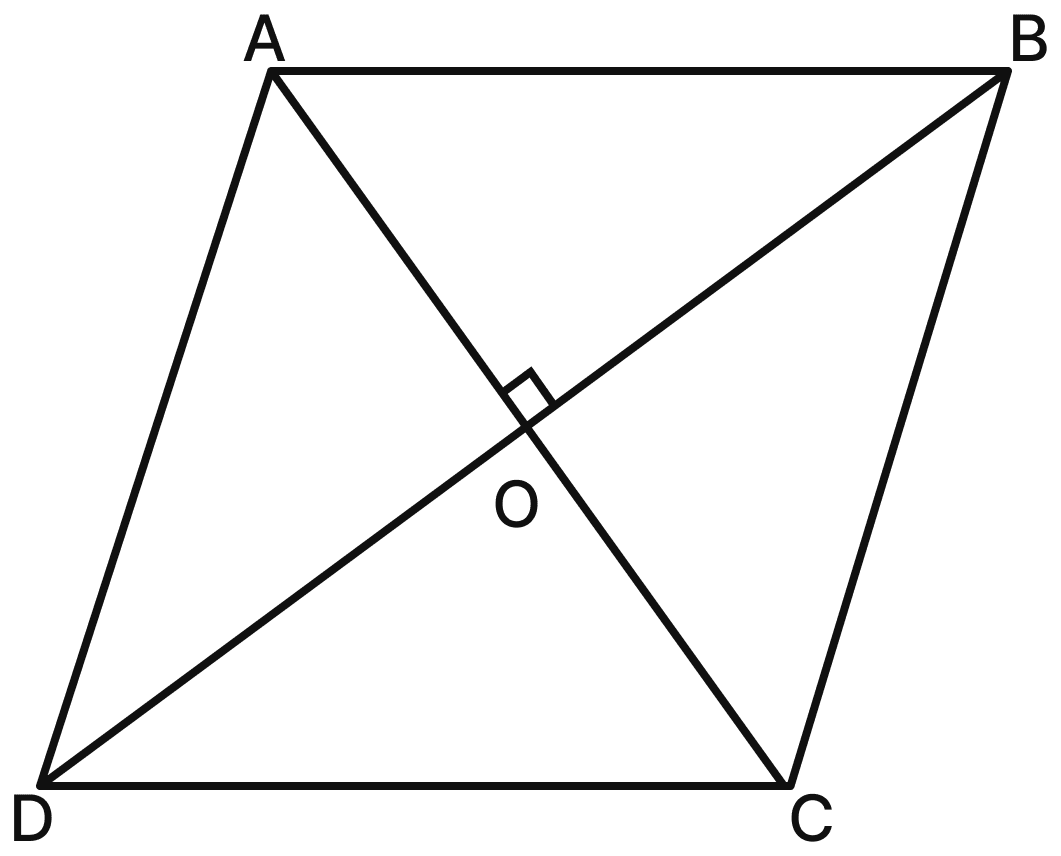
The diagonals AC and BD of the rhombus ABCD intersect at O.
Since the diagonals of a rhombus are perpendicular to each other,
AO ⊥ BD and CO ⊥ BD.
Therefore, AO and CO are the heights of △ADB and △CDB respectively on the common base BD.
So,
Area (∆ADB) = × AO × BD
Area (∆CDB) = × CO × BD
Hence,
Area of rhombus ABCD = Area (∆ADB) + Area (∆CDB)
Hence, Area of a rhombus = × product of its diagonals, the same formula as before.
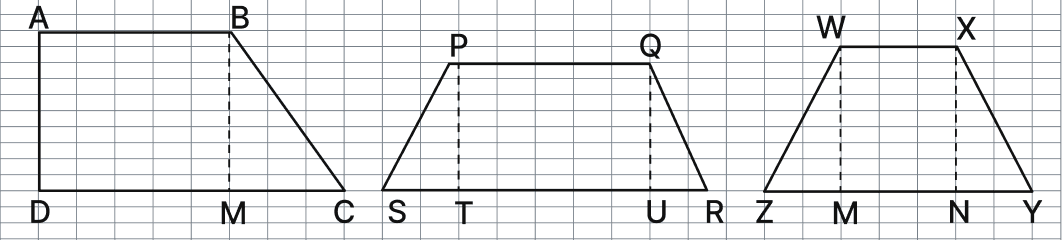
Find the areas of the following trapeziums by breaking them into figures whose areas can be computed.
Answer
Each small square of the grid has sidelength 1 unit. Reading the lengths from the grid:
Trapezium ABCD:
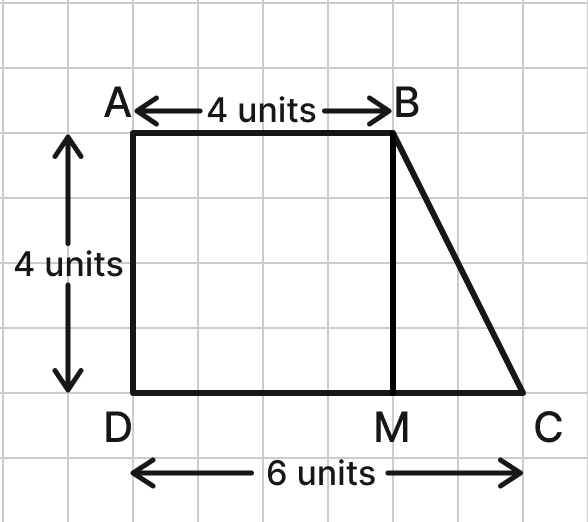
Parallel sides AB = 4 units and DC = 6 units, height AD = 4 units.
Breaking it into rectangle ABMD and right triangle BMC
Area of rectangle ABMD = AB × AD
= 4 × 4
= 16 sq. units
Area of triangle BMC = × base × height
= × MC × BM
= × 2 × 4
= 4 sq. units
Area of trapezium = Area of rectangle + Area of triangle
= 16 sq. units + 4 sq. units
= 20 sq. units
Hence, the area of the trapezium is 20 sq. units.
Trapezium SPQR:
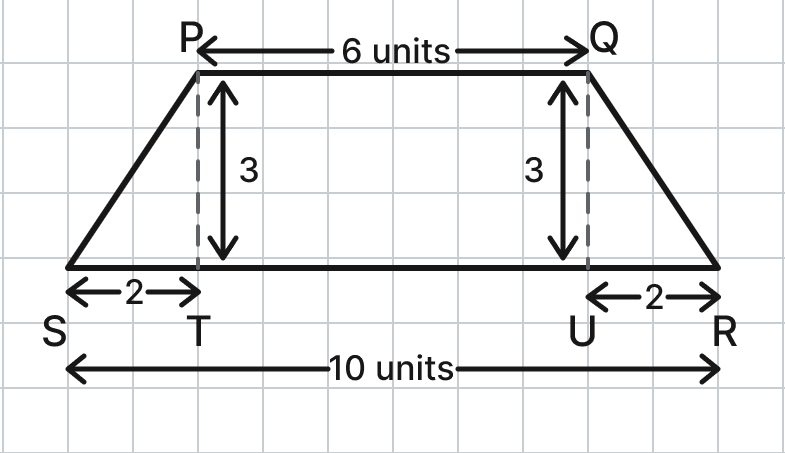
Parallel sides PQ = 6 units and SR = 10 units, ST = UR = 2 units, PT = QU = 3 units.
Breaking it into rectangle PQUT and two right triangles SPT and QUR:
Area of rectangle PQUT = PQ × PT
= 6 × 3
= 18 sq. units.
Area of △SPT = × base × height
= × ST × PT
= × 2 × 3
= 3 sq. units
Area of △QUR = × base × height
= × UR × QU
= × 2 × 3
= 3 sq. units
Area(SPQR) = Area(PQUT) + Area(△SPT) + Area(△QUR)
= 18 sq. units + 3 sq. units + 3 sq. units
= 24 sq. units
Hence, the area of the trapezium is 24 sq. units.
Trapezium ZWXY:
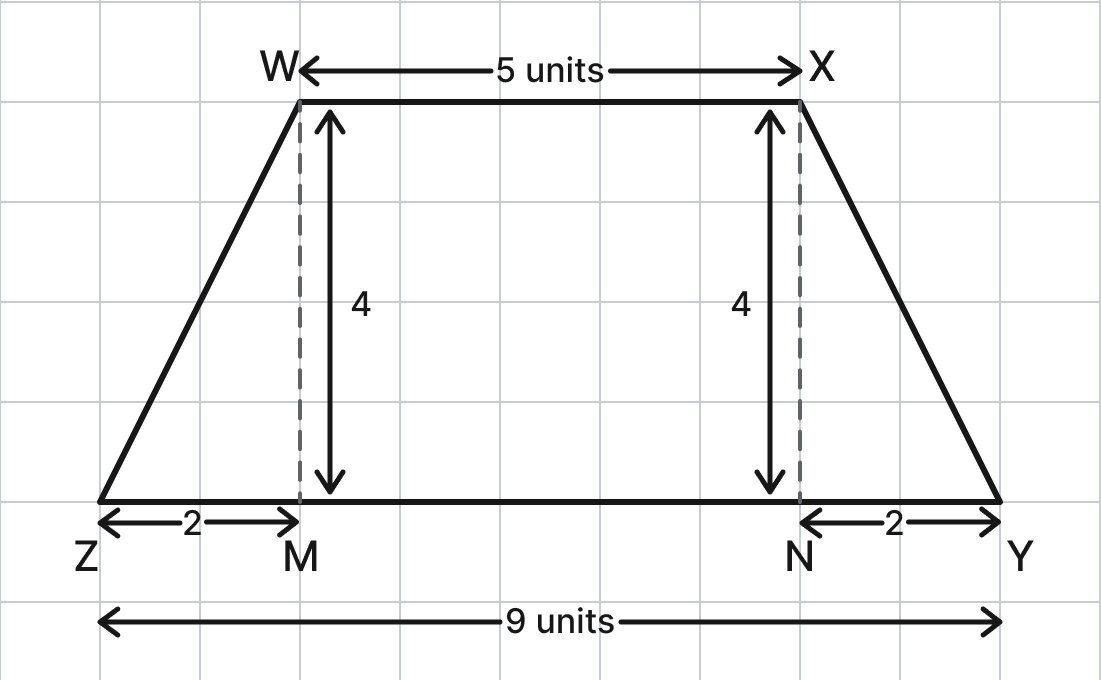
Parallel sides WX = 5 units and ZY = 9 units, ZM = NY = 2 units, WM = XN = 4 units.
Breaking it into rectangle WXNM and two right triangles ZWM and NXY:
Area of rectangle WXNM = WX × WM
= 5 × 4
= 20 sq. units
Area of △ZWM = × base × height
= × ZM × WM
= × 2 × 4
= 4 sq. units
Area of △NXY = × base × height
= × NY × XN
= × 2 × 4
= 4 sq. units
Area(ZWXY) = Area(WXNM) + Area(△ZWM) + Area(△NXY)
= 20 sq. units + 4 sq. units + 4 sq. units
= 28 sq. units
Hence, the area of the trapezium is 28 sq. units.
Will the formula Area of a trapezium = × height × sum of the parallel sides hold for a trapezium that looks like this? There are different ways of approaching this, which are sketched below (Approach 1: Rectangle and Triangles; Approach 2: Parallelogram and Triangle). Complete the arguments.
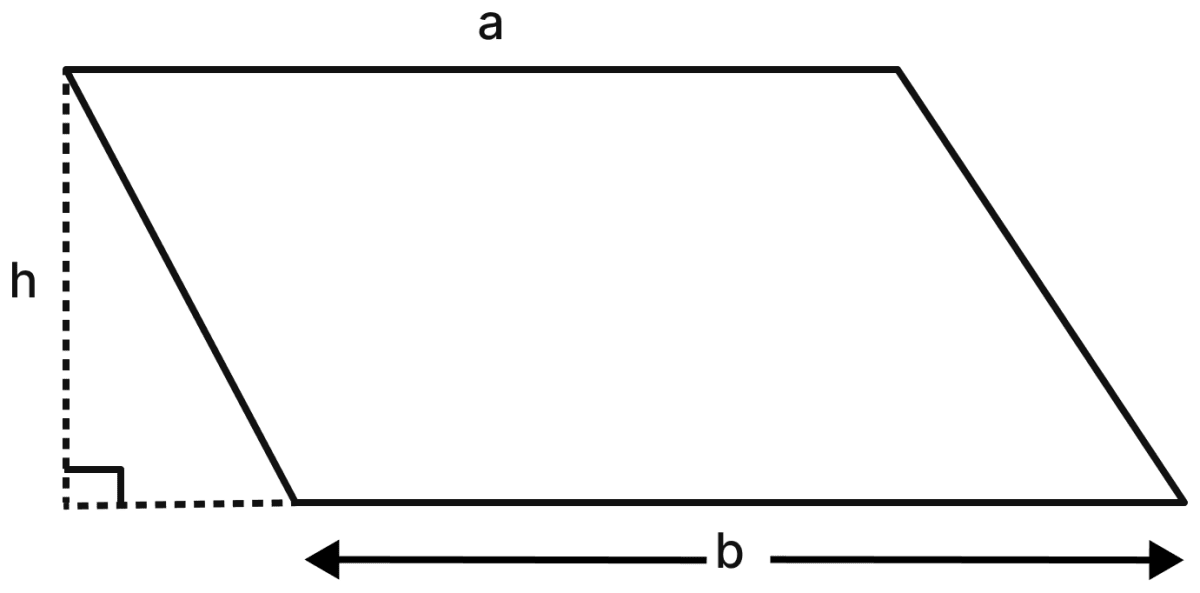
(i) Will Approach 2 work for any type of trapezium?
Answer
Yes, the formula still holds.
Let the parallel sides be AB = a and DC = b, and let the height (perpendicular distance between them) be h.
Approach 1: Rectangle and Triangles
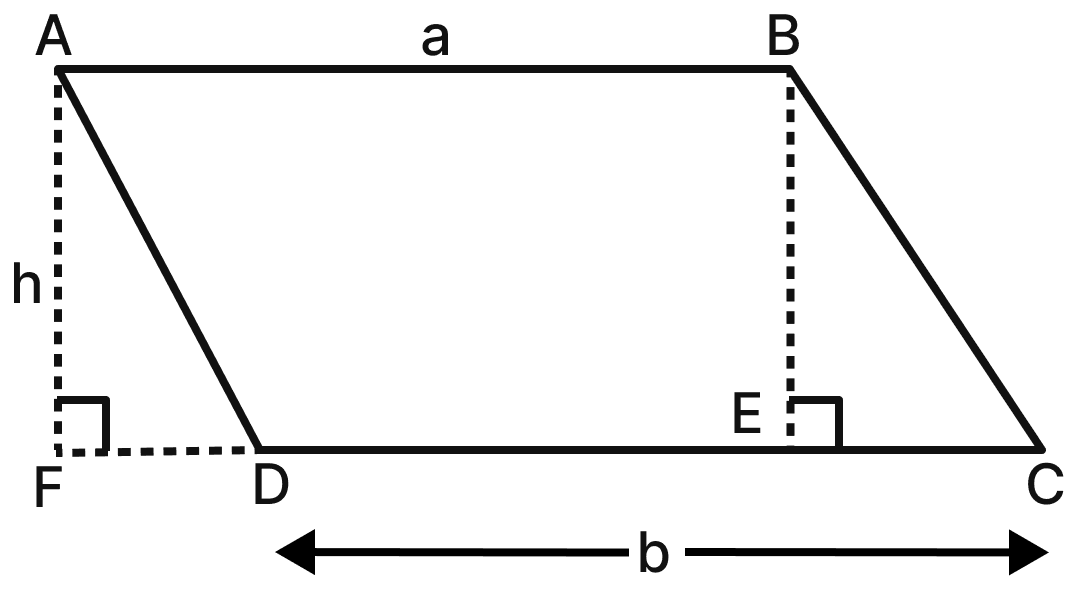
Drop perpendiculars AF and BE onto the line DC (extended if needed), so that AF = BE = h.
Then ABEF is a rectangle with FE = AB = a.
Let FD = x.
Since FE = a, we get DE = a − x.
As DC = b we have,
EC = DC − DE = b − (a − x) = b − a + x.
Now,
Area ABED = Area ABEF − Area ∆AFD
= (AB × AF) - × base × height
= (a × h) - × x × h
= ah - xh
∴ Area ABCD = Area ABED + Area ∆BEC
Approach 2: Parallelogram and Triangle
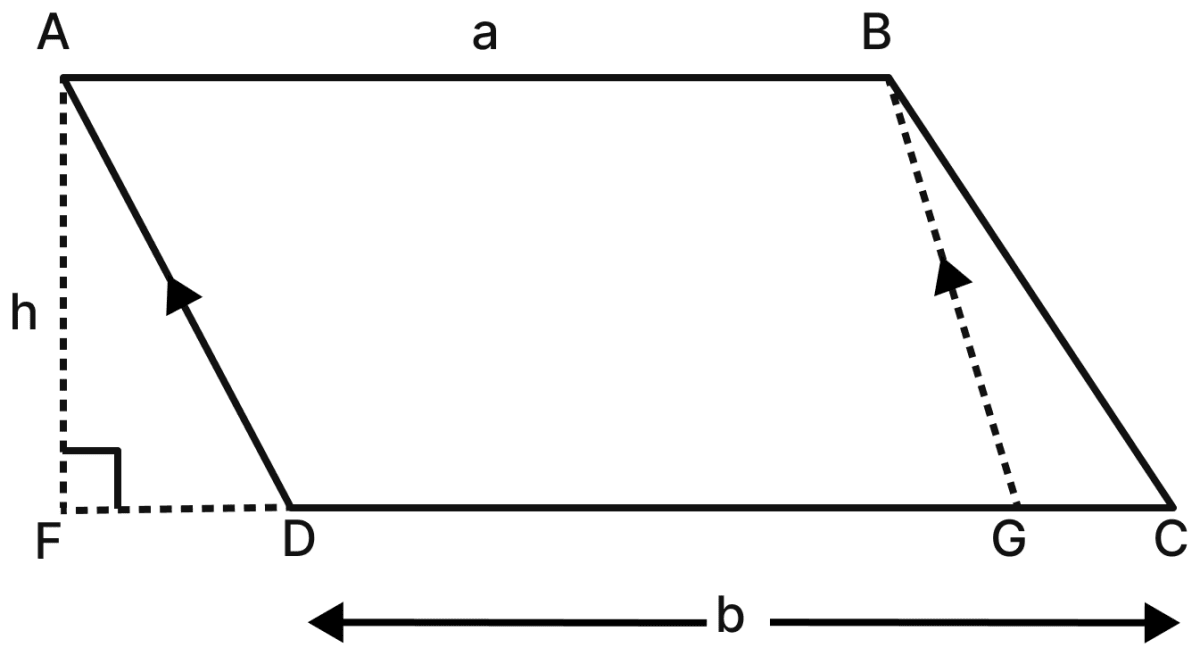
Through B, draw BG ∥ AD, meeting DC at G.
Then ABGD is a parallelogram with DG = AB = a.
The height of the parallelogram is h.
Area of ABGD = base × height
= a × h.
Also GC = DC − DG = b − a
Area ∆BGC = × GC × BG
= × (b - a) × h
∴ Area ABCD = Area ABGD + Area ∆BGC
Hence, by both approaches the area works out to × height × sum of the parallel sides, so the formula holds for this kind of trapezium too.
(i)
Yes. Approach 2 can be used for any trapezium.
Let the parallel sides of the trapezium be a and b, and let the height be h.
Draw a line through one end of the shorter parallel side parallel to the adjacent slant side. This divides the trapezium into:
- a parallelogram of base a and height h, and
- a triangle of base b − a and height h.
∴ Area of trapezium = Area of parallelogram + Area of triangle
Thus,
Area of trapezium = × height × sum of the parallel sides
Since this construction uses only parallel lines and does not depend on the shape of the trapezium, it works for all trapeziums.
Hence, Approach 2 works for any type of trapezium.
Find the area of a rhombus whose diagonals are 20 cm and 15 cm.
Answer
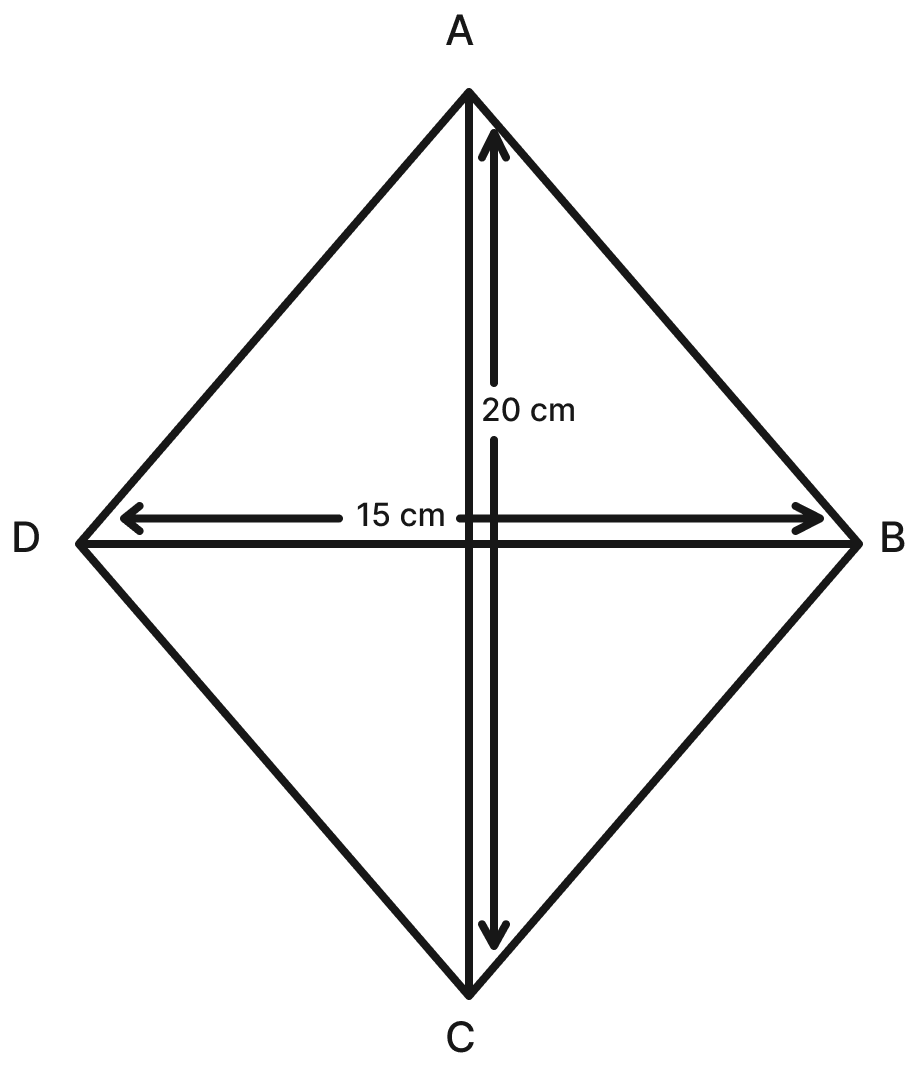
Given:
Diagonals d1 = 20 cm and d2 = 15 cm.
We know that,
Area of a rhombus = × product of its diagonals
Hence, the area of the rhombus is 150 cm2.
Give a method to convert a rectangle into a rhombus of equal area using dissection.
Answer
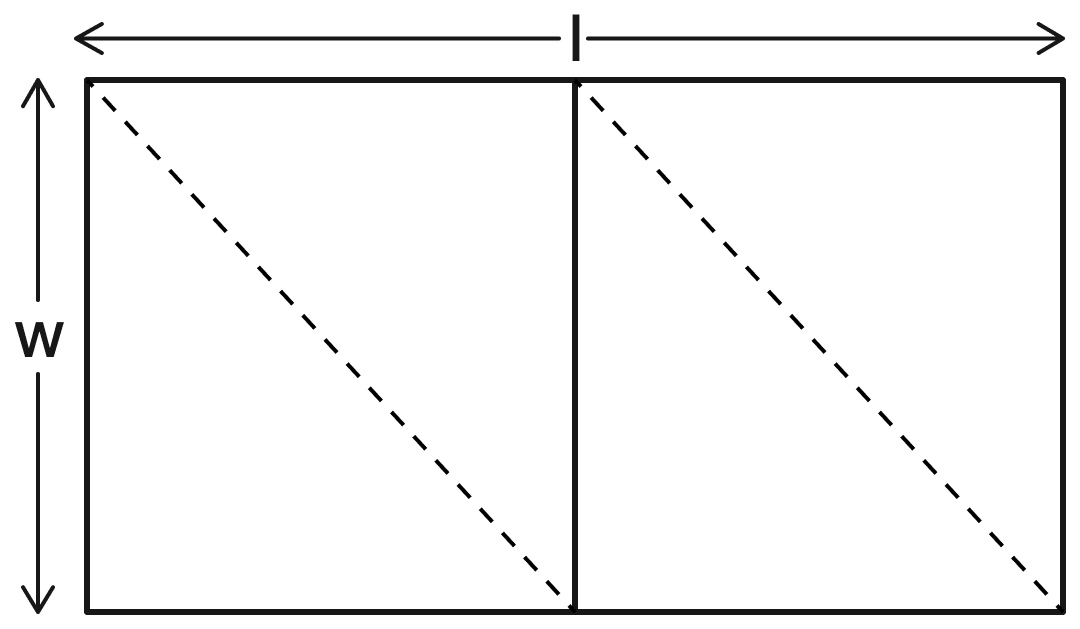
Let the given rectangle have length l and breadth w.
Step 1: Draw a line joining the midpoints of the two longer sides of the rectangle. This divides the rectangle into two equal rectangles, each of dimensions
Step 2: Cut each smaller rectangle along a diagonal. This gives four congruent right triangles.
Step 3: Rearrange these four triangles so that their hypotenuses form the boundary of a rhombus.
The diagonals of the rhombus are l and 2w.
Step 4: Area of the rhombus = = Area of the original rectangle.
Therefore, the rhombus and the rectangle have equal areas.
Hence, a rectangle can be converted into a rhombus of equal area by dissecting it into triangles and rearranging them to form a rhombus.
Find the area of the following figure:
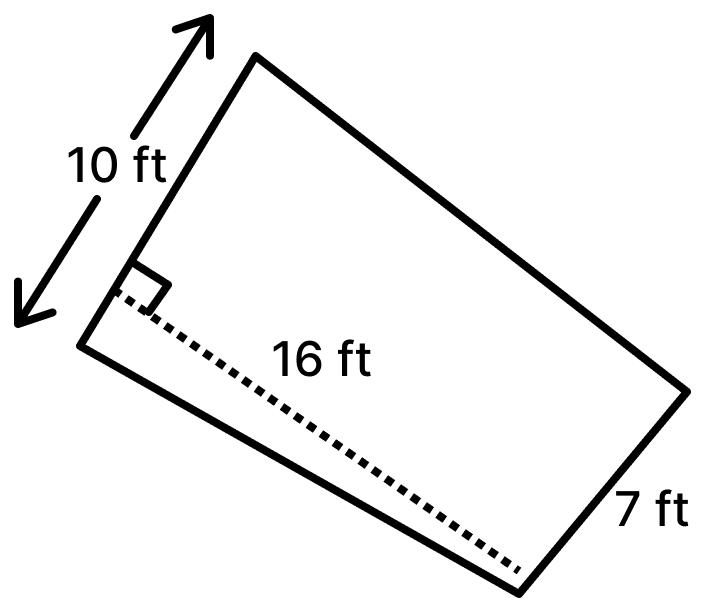
Answer
Parallel sides = 10 ft and 7 ft, height = 16 ft.
Area of trapezium = × height × (sum of parallel sides)
Hence, the area of the figure is 136 ft2.
Find the area of the following figure:
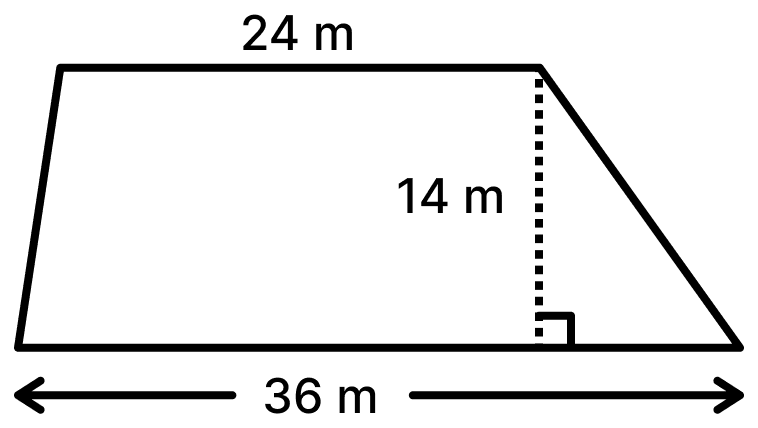
Answer
Parallel sides = 24 m and 36 m, height = 14 m.
Area of trapezium = × height × (sum of parallel sides)
Hence, the area of the figure is 420 m2.
Find the area of the following figure:
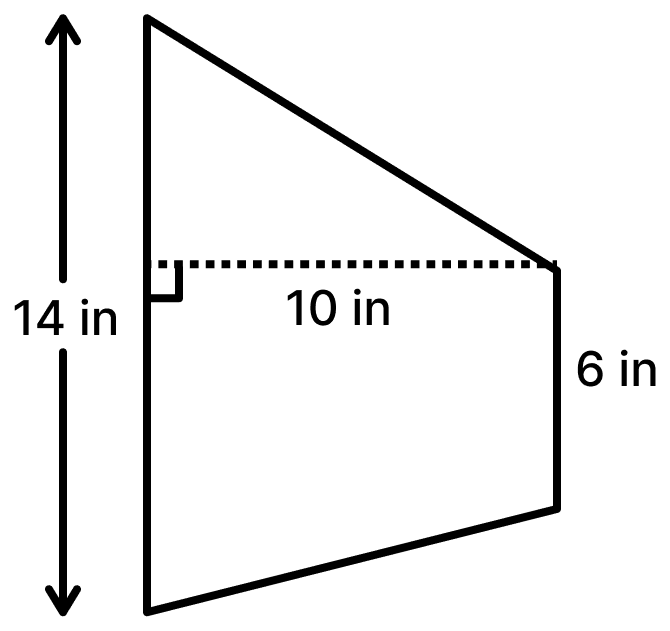
Answer
The two parallel sides are 14 in and 6 in, and the distance between them (height) = 10 in.
Area of trapezium = × height × (sum of parallel sides)
Hence, the area of the figure is 100 in2.
Find the area of the following figure:
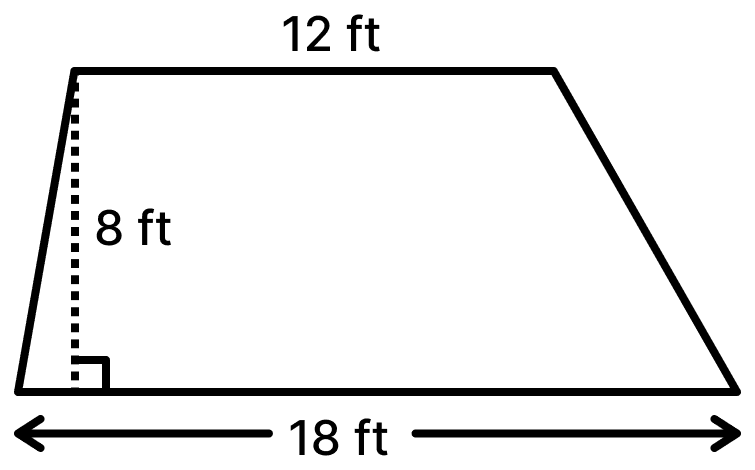
Answer
Parallel sides = 12 ft and 18 ft, height = 8 ft.
Area of trapezium = × height × (sum of parallel sides)
Hence, the area of the figure is 120 ft2.
[Śulba-Sūtras] Give a method to convert an isosceles trapezium to a rectangle using dissection.
Answer
![[Śulba-Sūtras] Give a method to convert an isosceles trapezium to a rectangle using dissection. Area, NCERT Class 8 Ganita Prakash Mathematics CBSE Solutions.](https://cdn1.knowledgeboat.com/img/ncert-8/q4-figure-out-5-ans-1-ganita-prakash-2-cbse-class-8-c7-202608191832-1187x757.png)
Let ABCD be an isosceles trapezium with AB ‖ DC, where AB is the shorter parallel side, DC is the longer parallel side, and the non-parallel sides AD = BC.
Let AB = a, DC = b, and let the height (perpendicular distance between the parallel sides) be h.
Method of dissection:
From A and B, drop perpendiculars AM and BN onto the longer side DC.
Then ABNM is a rectangle of length a and height h, and the two end pieces ∆ADM and ∆BCN are right-angled triangles.
Since the trapezium is isosceles:
AD = BC
∠ADM = ∠BCN
∠AMD = ∠BNC = 90°
⇒ ∆ADM ≅ ∆BCN (by the RHS / AAS congruency criterion)
Now, cut off the two equal triangles ∆ADM and ∆BCN. Join them along their equal hypotenuses AD and BC. Two congruent right-angled triangles joined along the hypotenuse form a rectangle whose sides are the two legs, namely h and DM, where
DM =
Place this small rectangle, of size h × , alongside the rectangle ABNM.
The pieces now fit together to form a single rectangle of height h and base
Verification of equal area:
Hence, an isosceles trapezium can be converted into a rectangle of base and height h, having the same area, by dropping perpendiculars from the ends of the shorter side and rearranging the two equal corner triangles.
Here is one of the ways to convert trapezium ABCD into a rectangle EFGH of equal area.
![Here is one of the ways to convert trapezium ABCD into a rectangle EFGH of equal area. Given the trapezium ABCD, how do we find the vertices of the rectangle EFGH? [Hint: If ∆AHI ≅ ∆DGI and ∆BEJ ≅ ∆CFJ, then the trapezium and rectangle have equal areas.]. Area, NCERT Class 8 Ganita Prakash Mathematics CBSE Solutions.](https://cdn1.knowledgeboat.com/img/ncert-8/q5-figure-out-5-1-ganita-prakash-2-cbse-class-8-c7-202608191832-1061x579.png)
Given the trapezium ABCD, how do we find the vertices of the rectangle EFGH?
[Hint: If ∆AHI ≅ ∆DGI and ∆BEJ ≅ ∆CFJ, then the trapezium and rectangle have equal areas.]
Answer
Let ABCD be the trapezium with AB ‖ DC, where AB is the shorter parallel side and DC is the longer parallel side.
Finding the vertices of the rectangle:
(1) Mark I and J as the midpoints of AD and BC respectively.
(2) Through I, draw a line perpendicular to AB and DC. Let it meet the line AB at H and DC at G.
(3) Through J, draw another perpendicular to AB and DC. Let it meet the line AB at E and DC at F.
Then EFGH is the required rectangle.
Why the areas are equal:
Since I is the midpoint of AD, we have AI = DI.
Also, ∠AHI = ∠DGI = 90°
Hence, ∆AHI ≅ ∆DGI
Similarly, since J is the midpoint of BC we have,
BJ = CJ
∠BEJ = ∠CFJ = 90°
∴ ∆BEJ ≅ ∆CFJ
Thus, the triangles removed from the top of the trapezium are exactly equal to the triangles added at the bottom. Hence no area is lost or gained.
∴ Area of trapezium ABCD = Area of rectangle EFGH.
Thus, the triangular parts removed from the trapezium are exactly equal to the triangular parts added to form the rectangle. Hence, no area is lost or gained.
The rectangle has the same height as the trapezium and length
HE =
Hence, the vertices E, F, G and H are obtained by drawing perpendiculars through the midpoints of the non-parallel sides of the trapezium.
Using the idea of converting a trapezium into a rectangle of equal area, and vice versa, construct a trapezium of area 144 cm2.
Answer
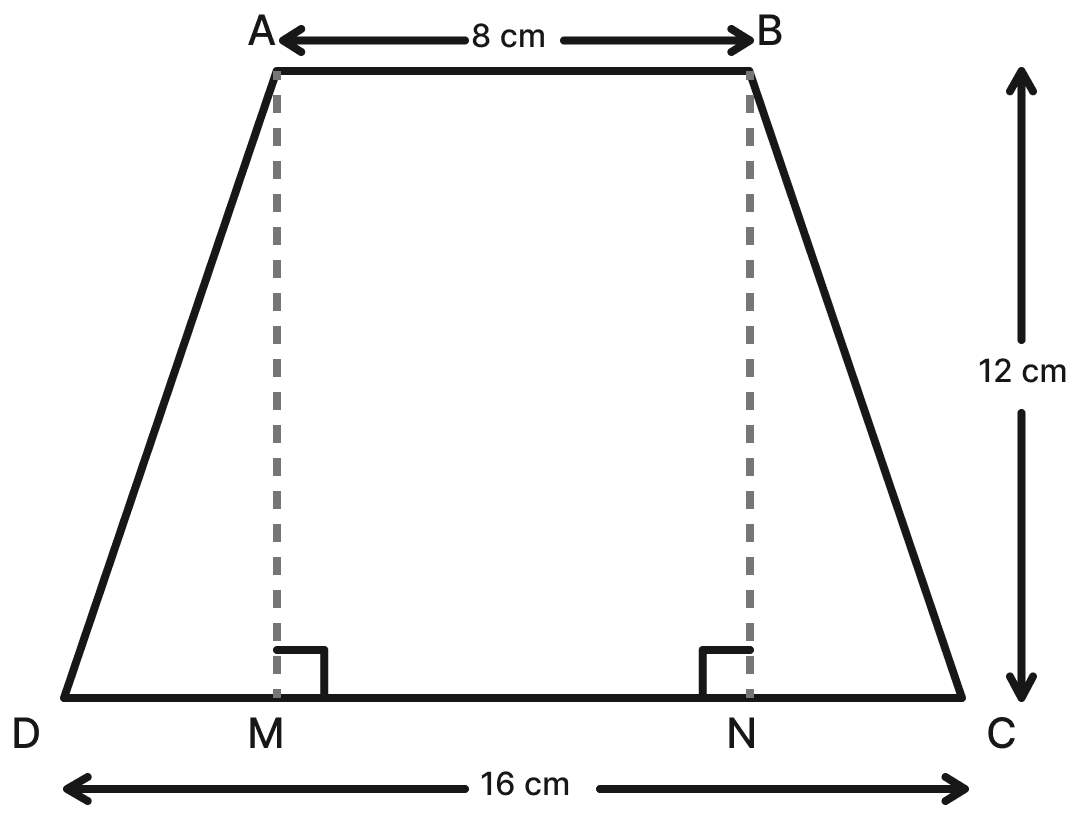
A trapezium and a rectangle of equal area satisfy
Area of trapezium =
Step 1 — Start with a rectangle of area 144 cm2.
Choose a rectangle of size 12 cm × 12 cm, so that
Area = 12 cm × 12 cm = 144 cm2
Take the height h = 12 cm and the mid-segment = 12 cm.
⇒ a + b = 24 cm
Step 2 — Pick the two parallel sides.
Any pair of parallel sides whose sum is 24 cm will work. Choose
a = 8 cm (shorter parallel side)
b = 16 cm (longer parallel side)
Step 3 — Construct the trapezium.
Draw the base DC = 16 cm.
At a perpendicular distance of 12 cm from DC, draw a line parallel to DC.
On this parallel line mark AB = 8 cm (placed symmetrically for an isosceles trapezium).
Then join AD and BC.
Verification:
Hence, a trapezium with parallel sides 8 cm and 16 cm and height 12 cm has area 144 cm2.
A regular hexagon is divided into a trapezium, an equilateral triangle, and a rhombus, as shown. Find the ratio of their areas.

Answer
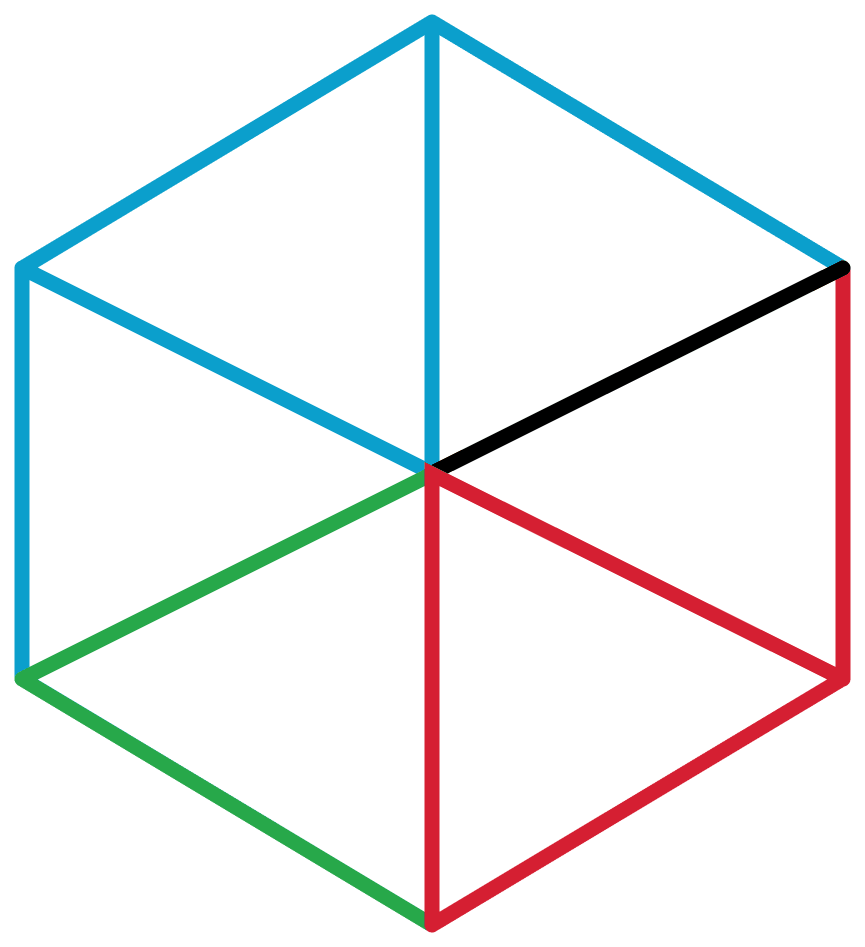
Join the centre of the regular hexagon to all its vertices. The hexagon is divided into 6 congruent equilateral triangles.
Let the area of each small equilateral triangle be T.
From the figure:
- the trapezium consists of 3 such triangles,
- the equilateral triangle consists of 1 such triangle,
- the rhombus consists of 2 such triangles.
Hence,
Area of trapezium = 3T,
Area of equilateral triangle = T,
Area of rhombus = 2T.
∴ Trapezium : Triangle : Rhombus = 3T : T : 2T = 3 : 1 : 2.
Hence, the ratio of the areas of the trapezium, the equilateral triangle, and the rhombus is 3 : 1 : 2.
ZYXW is a trapezium with ZY ‖ WX. A is the midpoint of XY. Show that the area of the trapezium ZYXW is equal to the area of ∆ZWB.
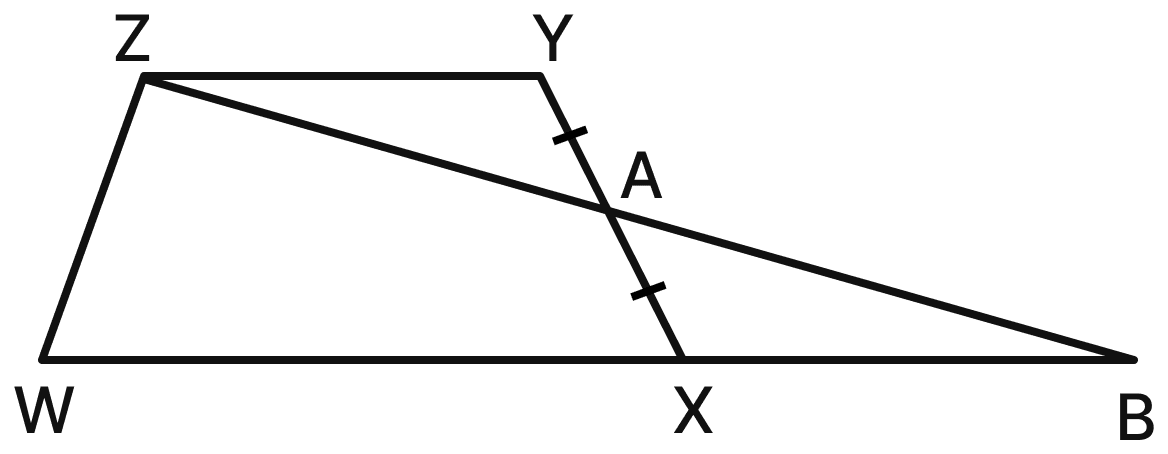
Answer
Given: ZYXW is a trapezium with ZY ‖ WX, and A is the midpoint of the slant side XY.
The line ZA is produced to meet WX produced at B.
To show: Area of trapezium ZYXW = Area of ∆ZWB.
Step 1 — Prove ∆AYZ ≅ ∆AXB.
In ∆AYZ and ∆AXB:
AY = AX (A is the midpoint of XY)
∠YAZ = ∠XAB (vertically opposite angles)
∠AYZ = ∠AXB (alternate interior angles, since ZY ‖ WX and XY is a transversal)
⇒ ∆AYZ ≅ ∆AXB (by the ASA congruency criterion)
∴ Area (∆AYZ) = Area (∆AXB)
Step 2 — Compare the two regions.
The segment ZA divides the trapezium ZYXW into the quadrilateral ZWXA and the triangle ∆AYZ:
Area (trapezium ZYXW) = Area (quad. ZWXA) + Area (∆AYZ)
Since Z, A, B lie on one straight line and W, X, B lie on another, the same quadrilateral ZWXA together with ∆AXB makes up ∆ZWB:
Area (∆ZWB) = Area (quad. ZWXA) + Area (∆AXB)
Step 3 — Conclude.
From Step 1, Area (∆AYZ) = Area (∆AXB).
So both the trapezium and ∆ZWB are equal to the area of quadrilateral ZWXA plus the area of one of these equal triangles.
∴ Area (trapezium ZYXW) = Area (∆ZWB)
Hence, the area of the trapezium ZYXW is equal to the area of ∆ZWB.
What do you think is the area of an A4 sheet? Its sidelengths are 21 cm and 29.7 cm. Now find its area.
Answer
An A4 sheet is a rectangle.
Length = 29.7 cm
Width = 21 cm
Area of a rectangle = length × width
= 29.7 cm × 21 cm
= 623.7 cm2
Hence, the area of an A4 sheet = 623.7 cm2.
Express the following lengths in centimeters:
(i) 5 in
(ii) 7.4 in
Answer
(i) 5 in
We know that,
1 in = 2.54 cm
∴ 5 in = 5 × 2.54 cm
= 12.7 cm
Hence, 5 in = 12.7 cm.
(ii) 7.4 in
1 in = 2.54 cm
∴ 7.4 in = 7.4 × 2.54 cm
= 18.796 cm
Hence, 7.4 in = 18.796 cm.
Express the following lengths in inches:
(i) 5.08 cm
(ii) 11.43 cm
Answer
We use 1 in = 2.54 cm
∴ 1 cm = in.
(i) 5.08 cm
Hence, 5.08 cm = 2 in.
(ii) 11.43 cm
Hence, 11.43 cm = 4.5 in.
Convert 161.29 cm2 to in2, and evaluate the quotient.
Answer
We know that,
1 in = 2.54 cm
⇒ 1 in2 = (2.54)2 cm2 = 6.4516 cm2
So every 6.4516 cm2 makes up 1 in2.
Hence, 161.29 cm2 = 25 in2.
How many in2 is 1 ft2?
Answer
We know that,
1 ft = 12 in
∴ 1 ft2 = (12 in)2
= 12 in × 12 in
= 144 in2
Hence, 1 ft2 = 144 in2.
How many m2 is a km2?
Answer
We know that,
1 km = 1000 m
∴ 1 km2 = (1000 m)2
= 1000 m × 1000 m
= 1,000,000 m2
Hence, 1 km2 = 1,000,000 m2 (that is, 106 m2).
How many times is your village/town/city bigger than your school?
Answer
First express the area of the village, town or city and the area of the school in the same unit.
Then calculate
For example, if a town has an area of 50 km2 and a school has an area of 0.008 km2, then
So, in this hypothetical example, the town is 6250 times as large as the school.
Hence, divide the area of the village, town or city by the area of the school, using the same unit for both areas.