
Pollen is produced in the :
- Filament
- Style
- Pistil
- Anther
Answer
Anther
Reason — The anther consists of four sac-like structures that produce pollen for pollination.
Filament supports the anther. Style is part of the female structure (connects stigma to ovary). Pistil is female reproductive part (does not produce pollen).
Reproductive whorls of a flower are:
- Stamens and carpels
- Sepals and petals
- Sepals and stamens
- Petals and carpels
Answer
Stamens and Carpels
Reason — Stamens are the male reproductive parts of the flower.
Carpels are the female reproductive parts of the flower.
Sepals and petals are non-reproductive (accessory) whorls.
Grafting is a method of :
- Artificial vegetative propagation
- Sexual reproduction
- Artificial pollination
- Cross-pollination
Answer
Artificial vegetative propagation
Reason — Grafting is a process of joining two plants together to grow as one and is one of the methods of Artificial vegetative propagation.
It is not sexual reproduction (no gametes involved). It is not pollination (no transfer of pollen).
Sanjay, a research scholar wants to develop a desired variety of Guava in his orchard. Which of the following methods of vegetative propagation will be the most suitable for him?
- Cutting
- Grafting
- Layering
- Micropropagation
Answer
Grafting
Reason — Grafting is the most suitable method for developing a desired variety of guava as it can combine desirable qualities of two plants of the same or related species.
Cutting is not very reliable for guava. Layering is possible but less efficient for large-scale improvement. Micropropagation is advanced and costly, mainly used in labs.
Flowers borne on the shoot system of a plant serve as reproductive part. Which of the following reasons supports this statement ?
P. Flowers bear stamens and carpels.
Q. Flowers make the plant attractive.
R. Flowers produce fruits with seeds.
- Only P
- Only Q
- Only P and R
- Only Q and R
Answer
Only P and R
Reason — Flowers contain stamens (male reproductive organs) and carpels (female reproductive organs) which are essential for fertilisation. Flowers develop into fruits after fertilisation, and these fruits contain seeds, which are the next generation of plants.
Flowers indeed make the plant look attractive, but this does not serve the purpose of being the reproductive part of a plant.
Mamta is curious to study different kinds of pollination among flowers present in her garden. She has performed artificial pollination in the following ways :
P. Pollination within a flower.
Q. Pollination between flowers of same plant.
R. Pollination between two flowers of two different plants of same species.
S. Pollination between two flowers of two different plants of the different species.
Which of the ways given above explains 'cross-pollination'?
- Only R
- Only P, Q and S
- Only P, R and S
- Only P and S
Answer
Only R
Reason — Cross-pollination occurs between two flowers on different plants of the same species.
Pollination within a flower is called self-pollination. Pollination between flowers of the same plant is also called self-pollination. Pollination between flowers of different species is not cross-pollination within the same species and normally does not result in fertilisation.
Cross-pollination is considered better than self-pollination because it produces healthier and more viable seeds. But it cannot occur by itself. Cross-pollination occurs with the help of certain agents like wind, water, insects, etc. Which of the following features of flowers are not suitable for insect-pollination ?
P. Flowers are usually small and of dull colours.
Q. Flowers are not scented and do not produce nectar.
R. Flowers produce sticky pollen grains.
- Only Q
- Only Q and R
- Only P and R
- Only P and Q
Answer
Only P and Q
Reason — Insect-pollinated flowers are usually large, brightly coloured, scented and nectar-producing. They also produce sticky pollen grains so that the pollen can stick to the body of insects.
Small and dull-coloured flowers are not suitable because insects are not attracted to them. Flowers with no scent and no nectar are also not suitable because they do not attract insects.
Assertion (A): Carrot is a biennial plant which stores food material in its roots in the first year.
Reason (R): This food is utilized in the second year to produce flowers and viable seeds, i.e. to reproduce sexually.
- Both A and R are true and R is the correct explanation of A.
- Both A and R are true but R is not the correct explanation of A.
- A is true but R is false.
- A is false but R is true.
Answer
Both A and R are true and R is the correct explanation of A.
Explanation — A is true as carrot is a biennial plant, meaning it completes its life cycle in two years.
R is true as in the first year, it stores food in its roots, which is then used in the second year for flowering and seed production, enabling sexual reproduction.
Therefore, Both A and R are true and R is the correct explanation of A is the correct option.
Assertion (A): Calyx is the outermost whorl of a flower which consists of large, fragrant and brightly coloured petals.
Reason (R): As petals are brightly coloured and fragrant, they can be noticed by insects easily and help in cross pollination.
- Both A and R are true and R is the correct explanation of A.
- Both A and R are true but R is not the correct explanation of A.
- A is true but R is false.
- A is false but R is true.
Answer
A is false and R is true.
Explanation — A is false as calyx, the outermost whorl of a flower consists of tiny leaf-like green structures called sepals, for providing the inner parts of flower with necessary protection.
R is true as corolla, the second inner whorl of the flower is made up of petals that are large, fragrant and brightly coloured. They can be noticed by insects easily and help in cross pollination.
Therefore, A is false and R is true is the correct option.
Assertion (A): Micropropagation is the propagation or multiplication of plants by a special technique called 'tissue culture'.
Reason (R): It is called 'micropropagation' because this technique is applicable to micro-organisms only.
- Both A and R are true and R is the correct explanation of A.
- Both A and R are true but R is not the correct explanation of A.
- A is true but R is false.
- A is false but R is true.
Answer
A is true and R is false.
Explanation — A is true as micropropagation involves growing plant cells, tissues, or organs in a laboratory setting to produce plantlets. These plantlets are then transferred to the soil.
R is false because micropropagation is not applicable to micro-organisms only. It is called micropropagation because plants are multiplied from very small plant parts or tissues under tissue culture conditions.
Therefore, A is true and R is false is the correct option.
Assertion (A): Vallisneria shows a special adaptation for hydrophilous pollination.
Reason (R): Its male flowers get detached from the plant and float freely until they reach and make physical contact with the female flowers at the water surface.
- Both A and R are true and R is the correct explanation of A.
- Both A and R are true but R is not the correct explanation of A.
- A is true but R is false.
- A is false but R is true.
Answer
Both A and R are true and R is the correct explanation of A.
Explanation — A is true as Vallisneria shows a special adaptation for hydrophilous (water-mediated) pollination.
R is true as its male flowers get detached from the plant and float freely until they reach and make physical contact with the female flowers at the water surface.
Therefore, Both A and R are true and R is the correct explanation of A is the correct option.
Fill in the blanks by selecting suitable words:
(unisexual, fertilisation, fruit, stamen, anther, bisexual, pollination, seed, ovary)
A flower that bears both the male and the female parts is known as ............... flower.
A flower bearing only male or female parts is known as ............... flower.
Transfer of pollen grains from the anther to the stigma is known as ...............
Fusion of male cell with female cell is called ...............
The ovule develops into a ...............
The ovary of the flower develops into a ...............
Answer
A flower that bears both the male and the female parts is known as bisexual flower.
A flower bearing only male or female parts is known as unisexual flower.
Transfer of pollen grains from the anther to the stigma is known as pollination.
Fusion of male cell with female cell is called fertilisation.
The ovule develops into a seed.
The ovary of the flower develops into a fruit.
Name the flower part that:
(a) develops into a fruit
(b) develops into a seed
(c) produces pollen grains
(d) attracts insects for pollination
(e) connects stigma to the ovary
Answer
(a) develops into a fruit — Ovary
(b) develops into a seed — Ovule
(c) produces pollen grains — Anther
(d) attracts insects for pollination — Petals
(e) connects stigma to the ovary — Style
Define Vegetative reproduction
Answer
Reproduction in plants wherein a new plant can arise from a vegetative part such as root, stem or leaf without the help of any reproductive organ is called vegetative reproduction.
Define Pollination
Answer
Pollination is the process in which the pollen grains from the anthers are transferred to the stigma of a flower of the same species.
Define Grafting
Answer
Grafting is an artificial vegetative propagation method in which a shoot or bud called the scion is fixed on another plant called the stock so that both grow together.
Define Micro-propagation
Answer
Micropropagation is the process of rapid propagation of plants by tissue culture techniques.
Define Fertilisation
Answer
The process of fusion of male and female gametes to form a zygote is called fertilisation.
Write two ways in which pollination may occur in plants.
Answer
Two ways in which pollination may occur in plants are —
- Self-pollination
- Cross-pollination
Give two features of flowers which favour pollination by insects.
Answer
Two features of flowers which favour pollination by insects are —
- These flowers are large with coloured petals, to attract insects.
- These are scented so that insects locate the flowers by the smell.
State two characteristics of flowers in which pollination occurs by wind.
Answer
Two characteristics of flowers in which pollination occurs by wind are —
- They are usually small and are of dull colours.
- They generally have long anthers protruding out of the flowers so that pollen grains may get blown off easily.
Name the 5 kinds of asexual reproduction
Answer
5 kinds of asexual reproduction are:
- Binary fission
- Budding
- Fragmentation
- Spore formation
- Vegetative reproduction
Name the 4 kinds of artificial vegetative propagation
Answer
4 kinds of artificial vegetative propagation are:
- Cutting
- Layering
- Grafting
- Micro-propagation
Name the 3 main pollinating agents
Answer
3 main pollinating agents are:
- Insects
- Wind
- Water
Name the 2 kinds of unisexual flowers
Answer
2 kinds of unisexual flowers are:
- Staminate (male flower)
- Pistillate (female flower)
Name the 4 whorls of a bisexual flower
Answer
4 whorls of a bisexual flower are:
- Calyx
- Corolla
- Androecium
- Gynoecium
Give reasons — Gardeners prefer to grow certain plants vegetatively.
Answer
Gardeners prefer to grow certain crops by the vegetative method because of the following reasons:
- Reproduction by vegetative parts takes place in a shorter time.
- New plants, thus produced, spread very fast in a small area.
- It is a surer method of propagation.
- All the good characters of the mother plant are retained by the daughter plants.
Give reasons — Artificial pollination is useful to plant breeders.
Answer
Artificial pollination is practised by plant breeders for developing new varieties. The breeders select two different varieties of a crop plant with desired characteristics. For example, one variety may be high-yielding while the other may be disease-resistant. Cross-breeding between them is done by artificial pollination. Many high-yielding varieties of rice, wheat, maize, etc. have been produced by this process.
Distinguish between the following pairs on the basis of the information in the brackets.
Self pollination and Cross pollination (definition)
Answer
Difference between Self pollination and Cross pollination on the basis of definition:
| Property | Self-pollination | Cross-pollination |
|---|---|---|
| Definition | The transfer of pollen grains from the anther to the stigma of the same flower, or another flower of the same plant, is called self-pollination. | The transfer of pollen grains from the anther of one flower to the stigma of a flower on another plant of the same species is called cross-pollination. |
Distinguish between the following pairs on the basis of the information in the brackets.
Pollen grain and Ovule (location in the flower)
Answer
Difference between Pollen grain and Ovule on the basis of location in the flower:
| Property | Pollen grain | Ovule |
|---|---|---|
| Location in the flower | Located in anther (androecium) | Located in ovary (gynoecium) |
Distinguish between the following pairs on the basis of the information in the brackets.
Sepals and Petals (function)
Answer
Difference between Sepals and Petals on the basis of function:
| Property | Sepals | Petals |
|---|---|---|
| Function | They protect the flower in the bud stage. | They attract insects for pollination. |
Distinguish between the following pairs on the basis of the information in the brackets.
Chlorella and Spirogyra (mode of asexual reproduction)
Answer
Difference between Chlorella and Spirogyra on the basis of mode of asexual reproduction:
| Property | Chlorella | Spirogyra |
|---|---|---|
| Mode of asexual reproduction | Multiple fission | Fragmentation |
Distinguish between the following pairs on the basis of the information in the brackets.
Vallisneria and Trapa (kind of pollinating agent)
Answer
Difference between Vallisneria and Trapa on the basis of kind of pollinating agent:
| Property | Vallisneria | Trapa |
|---|---|---|
| Kind of pollinating agent | Water | Insects |
Draw a neat and labelled diagram of the section of a typical flower. From the parts labelled by you, name the parts matching the description given below :
(a) This part attaches the flower to the shoot.
(b) The flattened part of the pedicel.
(c) The outermost whorl of the flower.
(d) The male reproductive organ of the flower.
(e) The part of carpel which receives pollen grains.
Answer
Below labelled diagram shows the section of a typical flower:
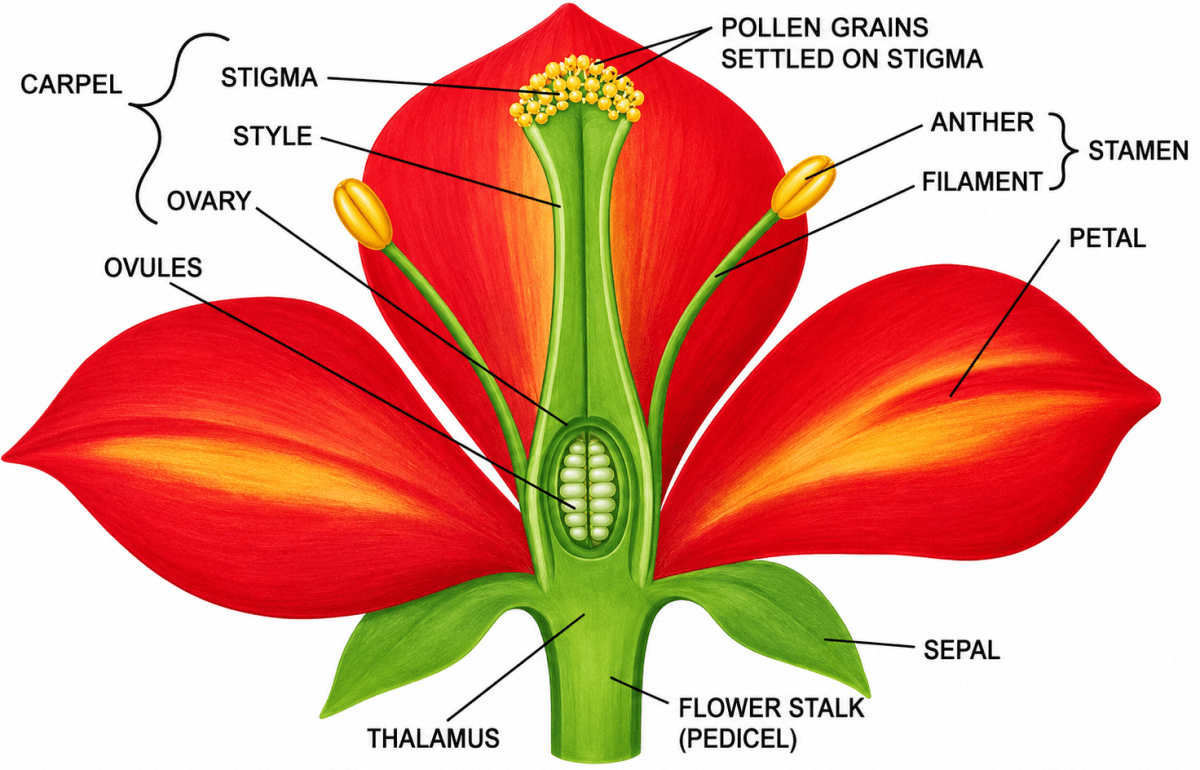
(a) This part attaches the flower to the shoot — Pedicel
(b) The flattened part of the pedicel — Thalamus
(c) The outermost whorl of the flower — Calyx
(d) The male reproductive organ of the flower — Androecium
(e) The part of carpel which receives pollen grains — Stigma
Aarav's mother bought a sack of potatoes because she planned to prepare several potato dishes for a family get-together. But the party got cancelled, so she stored the potatoes in a dark corner of the kitchen. After 2 weeks, Aarav noticed that several potatoes had developed small outgrowths that looked like tiny horns. Curious, he asked his mother if the potatoes have "gone bad". His mother told him that the potatoes have sprouted and they are actually starting to grow new plants from these outgrowths. This is a type of vegetative reproduction and these outgrowths are called buds or new shoots.
(a) Potatoes are underground, swollen parts of a plant. Do you consider them as root, fruit or stem ? Give reason in support of your answer.
(b) Aarav decided to plant one of the sprouted potatoes in the garden. Before planting, he cut the potato into smaller pieces. Will each piece grow into a new plant ? What must each piece contain in order to grow into a new plant ?
(c) Which of the following plants does not undergo vegetative propagation ?
(i) Ginger
(ii) Sugarcane
(iii) Mango
(iv) Strawberry
Answer
(a) Potatoes are modified stems, not roots or fruits because they have “eyes” (buds) on their surface, and buds are a characteristic feature of stems. These buds can sprout into new shoots, which shows that potato is an underground stem (specifically, a tuber).
(b) Not every piece of the cut potato will grow into a new plant. Each piece must contain at least one “eye” (bud). The bud has meristematic tissue that can develop into a new shoot and eventually form a complete plant. Pieces without eyes cannot grow.
(c) Ginger, sugarcane and strawberry undergo vegetative propagation. Ginger reproduces by its rhizome, sugarcane by stem cuttings, and strawberry by runners.
Mango, however, is usually propagated through seeds. Therefore, it does not naturally undergo vegetative propagation like the other plants given in the options.