
Read the two statements given below about the Lok Sabha. Select the option that shows the correct relationship between (A) and (R).
Assertion (A): The Lok Sabha is known as the House of the People.
Reason (R): The term of the Lok Sabha is five years.
- (R) contradicts (A)
- (R) is the reason for (A)
- (A) is true but (R) is false
- (A) and (R) are independent of each other
Answer
(A) and (R) are independent of each other
Explanation — The Lok Sabha represents the people of India directly, hence it is called the House of the People. The normal term of the Lok Sabha is indeed five years unless dissolved earlier.
Identify the features of the Rajya Sabha.
P: Tenure is six years
Q: One third of its members retire after every two years
R: The House can be dissolved before its term
S: Maximum strength of the House is 550.
- P and Q
- R and S
- P and R
- Q and S
Answer
P and Q
Sabnam is preparing a project on 'The Union Legislature' of India. Which of the following Houses, she is MOST LIKELY to highlight?
- The Lok Sabha
- The Rajya Sabha
- The Reserve Bank of India
- Both (1) and (2)
Answer
Both (1) and (2)
Which of the following aspects is being depicted by the given picture?
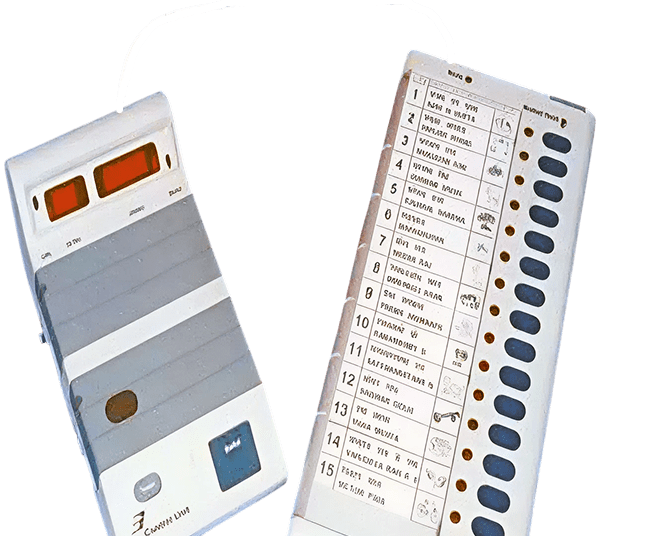
- Symbol of the Parliament of India
- Symbol of the Election Commission of India
- Promotion of Ballot Paper system
- Replacement of Ballot Paper system
Answer
Replacement of Ballot Paper system
Identify the ODD ONE out of the following main qualifications to become the member of the Lok Sabha.
- He must be a citizen of India
- He should not be less than 30 years of age
- He should be mentally sound
- He should not hold an office of profit under the central and state government
Answer
He should not be less than 30 years of age
Consider the statements given below and choose the correct answer.
Statement I: The members of political parties who are not the members of ruling party or the government are together called opposition.
Statement II: No business can be transacted in either House unless 25 percent of the total members of the House are present.
- Statement (I) is correct and statement (II) is incorrect.
- Statement (I) is incorrect and statement (II) is correct.
- Both statements (I) and (II) are incorrect.
- Both statements (I) and (II) are correct
Answer
Statement (I) is correct and statement (II) is incorrect.
Which of the following statements is incorrect?
- It is the Prime Minister who presides over the working of the Lok Sabha.
- The Rajya Sabha approves constitutional amendments.
- The Vice President of India is the ex-officio Chairman of the Rajya Sabha.
- The Union Parliament has control on the national finance.
Answer
It is the Prime Minister who presides over the working of the Lok Sabha.
The Parliament along with the State Legislature can pass laws on the 47 subjects of the
- State List
- Residuary List
- Concurrent List
- Union List
Answer
Concurrent List
Which among the following institutions in India is the highest Law making body?
- Election Commission of India
- The Law Commission of India
- Supreme Court of India
- The Parliament
Answer
The Parliament
A ............... is an area comprising a certain number of people who are represented by a member to the Lok Sabha or to the State Assembly?
- colony
- constituency
- block
- field
Answer
constituency
Fill in the blanks.
The elections to the Lok Sabha are held by ............... ballot.
A person should have acquired the age of ............... to become a Member of the Lok Sabha.
The maximum strength of the members of the Lok Sabha is ............... .
The Rajya Sabha is the ............... House of the Parliament.
The President can nominate ............... members in the Rajya Sabha.
Answer
secret
25 years
550
Upper
twelve
Match Column A with Column B.
| Column A | Column B |
|---|---|
| 1. The Speaker | (a) Presides over the Rajya Sabha |
| 2. The Vice President | (b) The legislative organ of the Union Government |
| 3. The Rajya Sabha | (c) The House of People |
| 4. The Parliament | (d) Presiding Officer of the Lok Sabha |
| 5. The Lok Sabha | (e) Permanent House |
Answer
| Column A | Column B |
|---|---|
| 1. The Speaker | (d) Presiding Officer of the Lok Sabha |
| 2. The Vice President | (a) Presides over the Rajya Sabha |
| 3. The Rajya Sabha | (e) Permanent House |
| 4. The Parliament | (b) The legislative organ of the Union Government |
| 5. The Lok Sabha | (c) The House of People |
State whether the following statements are True or False.
The Rajya Sabha is presided over by the Vice President of India.
A money bill has to be moved first in the Lok Sabha.
The Parliament meets at least twice a year.
The members of the Rajya Sabha are elected for a term of six years.
Answer
True
True
True
True
Name the two Houses of the Parliament.
Answer
The two Houses of the Parliament are —
- Lok Sabha (or House of the People)
- Rajya Sabha (or Council of States)
How are the members to the Lok Sabha elected?
Answer
The Lok Sabha can have a maximum strength of 550. Out of these, 530 members are elected from the states and upto 20 members represent the Union territories. The members of this House are elected directly by the citizens. The whole country is divided into several territorial constituencies.
- Candidates are elected through a secret ballot.
- Every adult citizen of the age 18 years and above has a right to vote. This is called universal adult franchise.
- No distinction is made on grounds of religion, colour, caste, creed, etc.
- The elections are organised by the Election Commission of India.
What is a bicameral legislature?
Answer
A bicameral legislature is a law-making body that has two separate Houses. The Indian Parliament is bicameral because it has two Houses — the Lok Sabha and the Rajya Sabha.
Mention the essential qualifications for a person to be a member of the Lok Sabha.
Answer
The essential qualifications required for a person to be a member of the Lok Sabha are:
- He must be a citizen of India.
- He should not be less than 25 years of age.
- He should be mentally sound.
- He should not be an insolvent, i.e., he should not be in debt and should have the ability to meet his financial commitments.
- He should not hold an office of profit under the central or state government.
- He should not be a member of some other legislature at the same time.
What is the composition of the Rajya Sabha?
Answer
The strength of the Rajya Sabha is 245 members. Of these, 233 are elected by the elected members of the State Legislative Assemblies. The remaining 12 members are nominated by the President of India from among men of repute in various spheres of life, e.g., science, technology, art, literature and social work.
What are the functions of the Lok Sabha?
Answer
The functions of the Lok Sabha are given below:
- Legislative Functions: They pass bills and make laws. Any bill regarding subjects in the Union or the Concurrent List of the Constitution may be moved in this House.
- Financial Powers: The House of People controls the treasury. No budget or government expenditure can be made without the permission of the House. A money bill has to be moved only in the Lok Sabha.
- Control over the Council of Ministers: The Council of Ministers is responsible to the Lok Sabha. It may remain in power only so long as it enjoys the confidence of the Lok Sabha.
Describe the law making functions of the Parliament.
Answer
The law making functions of the Parliament are given below:
- It frames new laws and amends or cancels them, if necessary, on all the 99 subjects of the Union List and all the remainder subjects which have not found a place in any of the Lists — called the Residuary list.
- In certain cases, it can make laws on the subjects of the State List also.
- The Parliament along with the State Legislature can pass laws on the 47 subjects of the Concurrent List.
- The Union Parliament has the sole right to amend the Constitution, although in certain cases, these amendments need to be ratified by a majority of the states.
How does the Parliament exercise control over the Government?
Answer
The most important function of the Parliament is to exercise control over the government.
- The government is directly responsible to the Parliament for its acts of omission and commission. The government can be voted out of office by passing a vote of no confidence against the Prime Minister or the Ministry or any of its members.
- The Members of the Parliament can also move adjournment motions. An adjournment motion is tabled when there is an urgent matter that needs the immediate attention of the government. If admitted, a time is set aside from normal business of the house for discussing the matters of urgent public importance.
- The members can ask any question relating to the administration of the state and the ministers are obliged to answer them. In this way, they can keep a check on the functioning of the various departments under different ministers.
- The Parliament can also hold the strings of the government tight by voting a cut in the annual budget.
Assertion (A): Indian President is the head of state.
Reason (R): Indian Parliament consists of the President, Lok Sabha and Rajya Sabha.
- Both Assertion (A) and Reason (R) are correct and Reason (R) is the correct explanation of Assertion (A).
- Both Assertion (A) and Reason (R) are correct but Reason (R) is not the correct explanation of Assertion (A).
- Assertion (A) is true, but Reason (R) is false.
- Assertion (A) is false, but Reason (R) is true.
Answer
Both Assertion (A) and Reason (R) are correct but Reason (R) is not the correct explanation of Assertion (A).
Explanation — The President of India is the constitutional head of the country, and a part of the Parliament. However, the fact that the President is part of Parliament does not explain that they are the head of state.
Assertion (A): India has a parliamentary form of government.
Reason (R): Indian Parliament comprises of two Houses.
- Both Assertion (A) and Reason (R) are correct and Reason (R) is the correct explanation of Assertion (A).
- Both Assertion (A) and Reason (R) are correct but Reason (R) is not the correct explanation of Assertion (A).
- Assertion (A) is true, but Reason (R) is false.
- Assertion (A) is false, but Reason (R) is true.
Answer
Both Assertion (A) and Reason (R) are correct but Reason (R) is not the correct explanation of Assertion (A).
Explanation — India has a parliamentary government, where the executive is accountable to the legislature. The Parliament is bicameral, with the Lok Sabha and Rajya Sabha. Though both statements are true, having two Houses does not explain why India follows a parliamentary system.
On the basis of the given picture answer the following questions.
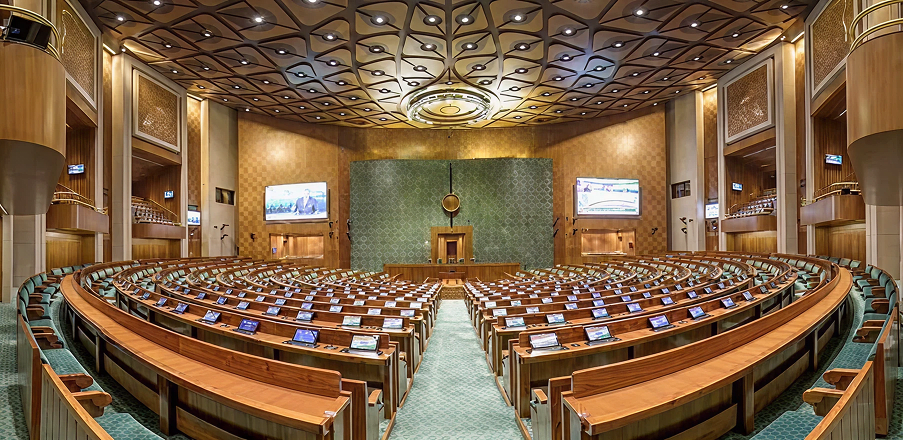
(i) What is the strength of the House?
(ii) How many members represent the States?
(iii) How many representatives come from Union Territories?
Answer
(i) The given picture depicts the inside view of the Lok Sabha. The Lok Sabha can have a maximum strength of 550 members.
(ii) Out of 550 members, 530 members represent the States.
(iii) Out of 550 members, upto 20 members represent the Union Territories.