
Arrange the following in chronological order:
(i) Regulating Act changed the function of the English East India company from a trading company to an administrative body.
(ii) The Battle of Plassey transformed the British from a trading community to a political power.
(iii) Annexation of Awadh on the pretext of misgovernance.
Options:
- (iii), (i) and (ii)
- (iii), (ii) and (i)
- (ii), (iii) and (i)
- (ii), (i) and (iii)
Answer
(ii), (i) and (iii)
Read the two statements given below about the Battle of Buxar (1764). Select the option that shows the correct relationship between (A) and (R).
Assertion (A): The British emerged victorious.
Reason (R): The British made Mir Jafar the Nawab of Bengal for the second time.
- (R) contradicts (A)
- (R) is the reason for (A)
- (A) is true but (R) is false
- (A) and (R) are independent of each other
Answer
(A) and (R) are independent of each other
Explanation — The British East India Company won the Battle of Buxar in 1764, solidifying their control over Bengal and the surrounding regions. After the battle, the British did indeed reinstall Mir Jafar as Nawab of Bengal, but this decision was part of the post-battle political settlement, not the cause of the victory itself.
Identify the methods used by Lord Dalhousie to expand British rule in India.
P: Dual government
Q: Doctrine of Lapse
R: Subsidiary Alliance
S: Maladministration
- P and Q
- R and S
- P and R
- Q and S
Answer
Q and S
Priyanka is doing a project on Subsidiary Alliance. Which of the following Indian rulers, she is MOST LIKELY to highlight?
- Ruler of Panipat
- Ruler of Ajmer
- Nizam of Hyderabad
- Rajputana States
Answer
Nizam of Hyderabad
Identify the ODD one out of the following provinces annexed under the Doctrine of lapse.
- Bengal
- Jhansi
- Nagpur
- Satara
Answer
Bengal
Which of the following aspects is being depicted by the given map.

- Division of Atlantic Ocean
- Division of African continent
- Discovery of Europe through sea route
- Discovery of India through sea route
Answer
Discovery of India through sea route
Madhu is preparing a speech on the Anglo-French rivalry. Which of the following wars she MUST mention in her speech?
- Battle of Buxar
- Battle of Chanderi
- Battle of Panipat
- Battle of Wandiwash
Answer
Battle of Wandiwash
Consider the statements given below and choose the correct answer.
Statement I: With the help of Battle of Plassey the British were transformed from a trading community to a political power.
Statement II: Shah Alam was made Nawab of Bengal after the Battle of Plassey.
- Statement (I) is correct and statement (II) is incorrect.
- Statement (I) is incorrect and statement (II) is correct.
- Both statements (I) and (II) are incorrect.
- Both statements (I) and (II) are correct.
Answer
Statement (I) is correct and statement (II) is incorrect.
Which among the following statements is incorrect?
- The victory at Buxar made the English the supreme power in India.
- The Dual system was characterised by the rule of two - the Nawab and the Company.
- Warren Hastings abolished the Dual Government
- The Regulating Act of 1783 is very significant in the history of modern India.
Answer
The Regulating Act of 1783 is very significant in the history of modern India.
The corruption and inefficiency of the Dual Government was exposed when
- terrible famine struck Bengal in 1760 whereby one-fourth of the entire population lost their lives.
- terrible famine struck Bengal in 1770, whereby one-third of the entire population lost their lives.
- Massive earthquake took place in Bengal in 1770, whereby one-third of the entire population lost their lives.
- Massive earthquake took place in Bengal in 1770 whereby one-fourth of the entire population lost their lives.
Answer
terrible famine struck Bengal in 1770, whereby one-third of the entire population lost their lives.
Fill in the blanks.
Elizabeth I was the Queen of ............... .
The French company set up its headquarters at ............... .
The first Englishman to meet Emperor Jahangir was ............... .
The wars between the English and the French companies in India are known as ............... .
Answer
England
Pondicherry
Sir Thomas Roe
Carnatic Wars
Match Column A with Column B:
| Column A | Column B |
|---|---|
| 1. Shuja-ud-Daulah | (a) Nawab of Bengal |
| 2. Shah Alam II | (b) Ruler of Punjab |
| 3. Siraj-ud-Daulah | (c) Mughal Emperor |
| 4. Ranjit Singh | (d) Nawab of Awadh |
Answer
| Column A | Column B |
|---|---|
| 1. Shuja-ud-Daulah | (d) Nawab of Awadh |
| 2. Shah Alam II | (c) Mughal Emperor |
| 3. Siraj-ud-Daulah | (a) Nawab of Bengal |
| 4. Ranjit Singh | (b) Ruler of Punjab |
State whether the following statements are True or False.
Calcutta (now Kolkata) was the centre of the English East India Company's power in India for many years.
Mir Qasim from the very beginning had very cordial relations with the English.
Mir Jafar hatched a conspiracy with the English against Siraj-ud-Daulah.
Robert Clive rose to fame after his success in the Second Carnatic War.
The Battle of Buxar led to the foundation of British empire in India.
Answer
True
False
Correct Statement — Mir Qasim from the very beginning did not have very cordial relations with the English.True
False
Correct Statement — Robert Clive rose to fame after his success in the Battle of Plassey.True
When and how was the English East India Company formed?
Answer
The English East India Company was formed in 1600 by a group of English merchants. It was granted a Charter (a written statement) from Queen Elizabeth I of England, which gave the company the exclusive right to trade with the East. This charter effectively eliminated competition from other English trading bodies.
What were the main reasons for Anglo-French rivalry in India?
Answer
The Anglo-French rivalry was primarily driven by both the English and French East India Companies competing for control over trade and political influence in India. Both companies sought to dominate the lucrative trade routes and establish territorial control in regions such as Tamil Nadu.
The rivalry escalated into three wars, known as the Carnatic Wars, which were fought between the English and the French East India Companies over nearly two decades. These wars were part of the broader competition for monopoly over Indian trade and political power in the region.
Thus, the main reason for the rivalry was the competition for dominance in trade and territorial control in India.
What were the causes of conflict between Siraj-ud-Daulah and the English?
Answer
The conflict between Siraj-ud-Daulah and the English East India Company arose due to the Company's fortification of its settlements in Bengal, which Siraj saw as a threat to his authority. Despite his repeated requests to stop, the English ignored his demands. This growing power of the English led Siraj to attack and occupy Fort William in Calcutta in 1756, triggering the conflict. Clive was immediately sent to Calcutta, and the Nawab was forced to vacate Calcutta and to pay indemnity to the British.
Describe the circumstances that led to the Battle of Buxar. What were its results?
Answer
The Battle of Buxar (1764) was caused by tensions between the English East India Company and Mir Qasim, the Nawab of Bengal. Mir Qasim was unhappy with the Company’s interference in administration and its heavy financial demands, leading him to challenge British power. He formed an alliance with Shuja-ud-Daula (Nawab of Awadh) and Shah Alam II (Mughal Emperor) to fight the British at Buxar.
The British won the battle, leading to Mir Jafar being reinstated as Nawab of Bengal. Shah Alam II and Shuja-ud-Daula surrendered to the British. The victory made the British the supreme power in India.
Following the battle, the Treaty of Allahabad (1765) was signed. The Mughal Emperor granted the British the right of Diwani (land revenue collection) in Bengal, Bihar, and Orissa in exchange for an annual payment of Rs 26 lakhs. This marked the British East India Company’s direct involvement in the administration of Bengal and solidified their control over the region.
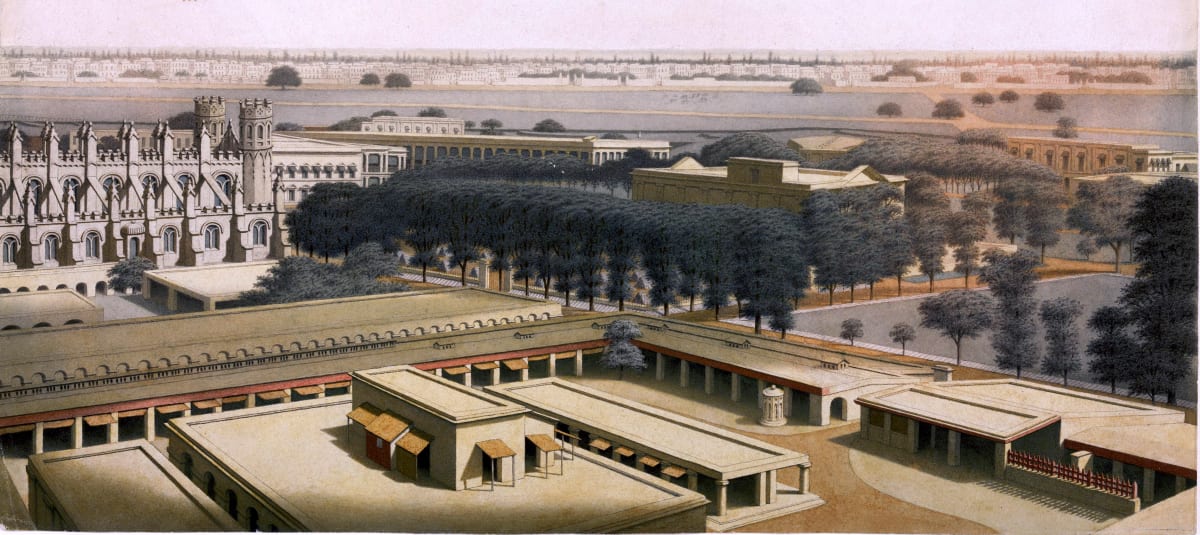
Identify the fort.
When was it built?
This fortification resulted into a battle. Mention the battle and its results.
Answer
The given picture depicts Fort William in Kolkata.
Fort William was first established in 1696 by the British East India Company.
The fortification of Fort William led to the Battle of Plassey in 1757. The battle resulted in the victory of the British East India Company over Siraj-ud-Daulah, the Nawab of Bengal. The victory led to the British gaining control over Bengal and establishing their dominance in India. The battle also marked the beginning of the decline of the Nawab’s power and the rise of British colonial rule.