
Which of the following is not a 2-dimensional shape?
Triangle
Circle
Sphere
Rectangle
Answer
A triangle, a circle and a rectangle are plane figures, so each of them is a 2-dimensional shape.
A sphere is a solid figure, so it is a 3-dimensional shape.
Hence, option 3 is the correct option.
Which of the following is a 3-dimensional shape?
Parallelogram
Cylinder
Square
none of these
Answer
A parallelogram and a square are plane figures, so each of them is a 2-dimensional shape.
A cylinder is a solid figure, so it is a 3-dimensional shape.
Hence, option 2 is the correct option.
How many parallel and congruent faces does a cylinder have?
4
3
2
none
Answer
A cylinder has two circular ends, which are parallel and congruent to each other.
So, the number of parallel and congruent faces of a cylinder = 2
Hence, option 3 is the correct option.
How many pairs of congruent parallel faces does a rectangular prism have?
8
6
4
3
Answer
A rectangular prism is also known as a cuboid. It has 6 rectangular faces and its opposite faces are parallel and congruent to each other.
So, the number of pairs of congruent parallel faces = 6 ÷ 2 = 3
Hence, option 4 is the correct option.
How many congruent isosceles triangle does a square pyramid have?
2
4
6
8
Answer
A square pyramid has a square as its base and 4 lateral faces, which are congruent isosceles triangles meeting at a common vertex.
So, the number of congruent isosceles triangles = 4
Hence, option 2 is the correct option.
Which amongst the following is not a polyhedron?
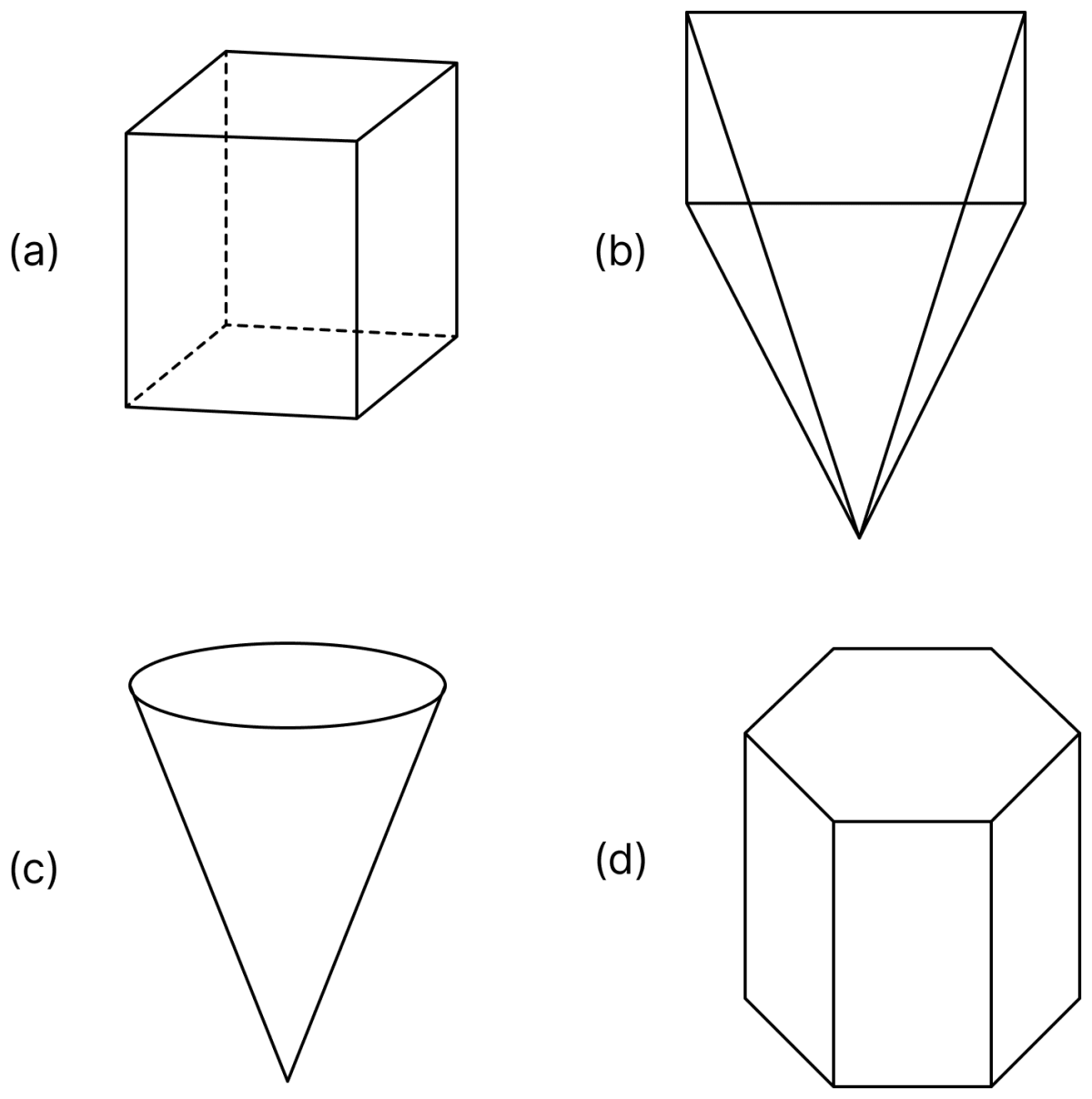
Answer
A polyhedron is a solid made up of polygonal regions.
The solid given in option 3 is a cone. It has a circular base and a curved surface, so it is not made up of polygonal regions.
So, the solid given in option 3 is not a polyhedron.
Hence, option 3 is the correct option.
Which of the following is not a prism?
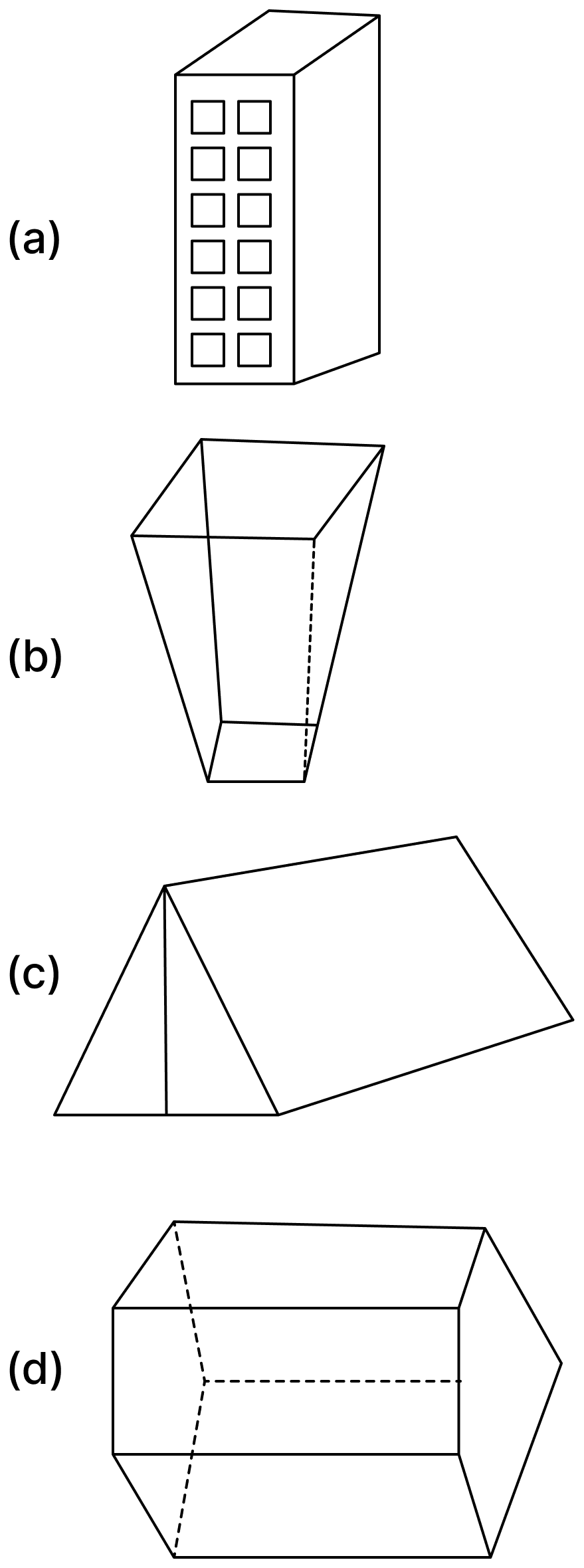
Answer
A prism is a polyhedron whose base and top are congruent polygons and whose lateral faces are parallelograms in shape.
The solid given in option 2 tapers downwards, so its base and top are not congruent polygons.
So, the solid given in option 2 is not a prism.
Hence, option 2 is the correct option.
The number of triangular faces of a triangular prism are
2
3
4
5
Answer
A triangular prism has 5 faces in all. Its base and top are congruent triangles and its 3 lateral faces are rectangles.
So, the number of triangular faces of a triangular prism = 2
Hence, option 1 is the correct option.
The number of edges in a pentagonal pyramid are
5
10
15
20
Answer
In a pentagonal pyramid, the number of sides of the polygonal base is 5.
Number of edges in a pyramid is twice the number of sides of the polygonal base.
Number of edges = 5 × 2 = 10
Hence, option 2 is the correct option.
The number of rectangular faces in a hexagonal prism are
6
8
10
12
Answer
In a hexagonal prism, the number of sides of the polygonal base is 6.
Its base and top are congruent hexagons and it has one rectangular lateral face along each side of the base.
So, the number of rectangular faces = 6
Hence, option 1 is the correct option.
In a polyhedron E = 15, V = 10, then F is
3
5
7
9
Answer
Given:
E = 15, V = 10
According to Euler's formula,
F + V = E + 2
⇒ F + 10 = 15 + 2
⇒ F + 10 = 17
⇒ F = 17 - 10
⇒ F = 7
Hence, option 3 is the correct option.
In a polyhedron F = 5, E = 8, then V is
3
5
7
9
Answer
Given:
F = 5, E = 8
According to Euler's formula,
F + V = E + 2
⇒ 5 + V = 8 + 2
⇒ 5 + V = 10
⇒ V = 10 - 5
⇒ V = 5
Hence, option 2 is the correct option.
In a polyhedron F = 17, V = 30, then E is
30
45
60
none of these
Answer
Given:
F = 17, V = 30
According to Euler's formula,
F + V = E + 2
⇒ 17 + 30 = E + 2
⇒ 47 = E + 2
⇒ E = 47 - 2
⇒ E = 45
Hence, option 2 is the correct option.
A polyhedron have 4 faces, 4 vertices and 6 edges. Name the polyhedron.
A rectangular prism
A triangular prism
A rectangular pyramid
A triangular pyramid
Answer
A triangular pyramid has a triangle as its base and 3 triangles as its lateral faces, so F = 4.
Its base has 3 vertices and it has one more vertex at the apex, so V = 4.
It has 3 edges along its base and 3 more edges joining the vertices of the base to the apex, so E = 6.
So, the polyhedron having 4 faces, 4 vertices and 6 edges is a triangular pyramid.
Hence, option 4 is the correct option.