
Identify all the quadrilaterals that have
(i) four sides of equal length
(ii) four right angles.
Answer
(i) Four sides of equal length
A square has all its four sides equal in length and a rhombus also has all its four sides equal in length.
Hence, a square and a rhombus have four sides of equal length.
(ii) Four right angles
A square has all its four angles equal to 90° and a rectangle also has all its four angles equal to 90°.
Hence, a square and a rectangle have four right angles.
Explain how a square is
(i) a quadrilateral
(ii) a parallelogram
(iii) a rhombus
(iv) a rectangle.
Answer
(i) A quadrilateral
A quadrilateral is a polygon bounded by four line segments.
A square is a polygon bounded by four line segments.
Hence, a square is a 4-sided polygon, so it is a quadrilateral.
(ii) A parallelogram
A parallelogram is a quadrilateral in which both the pairs of opposite sides are parallel.
In a square, both the pairs of opposite sides are parallel.
Hence, a square has its opposite sides parallel, so it is a parallelogram.
(iii) A rhombus
A rhombus is a parallelogram in which all the four sides are equal.
In a square, all the four sides are equal.
Hence, a square is a parallelogram with all the 4 sides equal, so it is a rhombus.
(iv) A rectangle
A rectangle is a parallelogram in which each angle is a right angle.
In a square, each angle is a right angle.
Hence, a square is a parallelogram with each angle a right angle, so it is a rectangle.
Name the quadrilaterals whose diagonals
(i) bisect each other
(ii) are perpendicular bisectors of each other
(iii) are equal.
Answer
(i) The diagonals of a parallelogram bisect each other. As a rhombus, a rectangle and a square are all parallelograms, their diagonals also bisect each other.
Hence, the quadrilaterals are parallelogram, rhombus, square and rectangle.
(ii) The diagonals of a rhombus bisect each other at right angles. As a square is also a rhombus, its diagonals are also perpendicular bisectors of each other.
Hence, the quadrilaterals are rhombus and square.
(iii) The diagonals of a rectangle are equal in length. As a square is also a rectangle, its diagonals are also equal in length.
Hence, the quadrilaterals are rectangle and square.
One of the diagonals of a rhombus and its sides are equal. Find the angles of the rhombus.
Answer
It is given that one of the diagonals of a rhombus and its sides are equal.
Let ABCD be the rhombus in which the diagonal AC is equal to each of its sides.
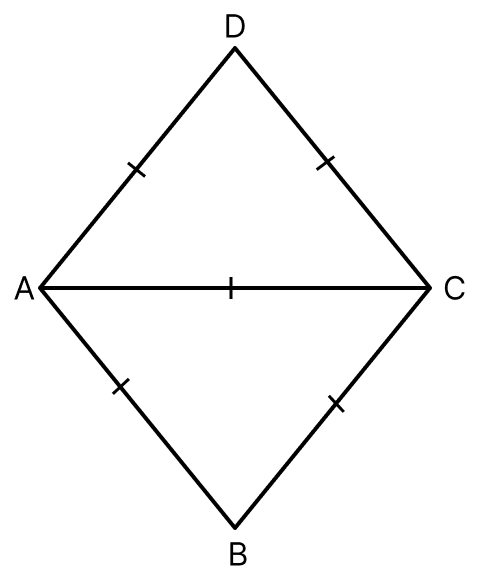
So, AB = BC = CD = DA = AC
In ΔABC,
AB = BC = AC
As all the three sides are equal, ΔABC is an equilateral triangle.
So, ∠BAC = ∠ABC = ∠BCA = 60°
Similarly, in ΔACD,
AC = CD = DA
As all the three sides are equal, ΔACD is an equilateral triangle.
So, ∠CAD = ∠ACD = ∠ADC = 60°
Thus, the angles of the rhombus are:
⇒ ∠A = ∠BAC + ∠CAD = 60° + 60° = 120°
⇒ ∠B = ∠ABC = 60°
⇒ ∠C = ∠BCA + ∠ACD = 60° + 60° = 120°
⇒ ∠D = ∠ADC = 60°
Hence, the angles of the rhombus are 60°, 120°, 60° and 120°.
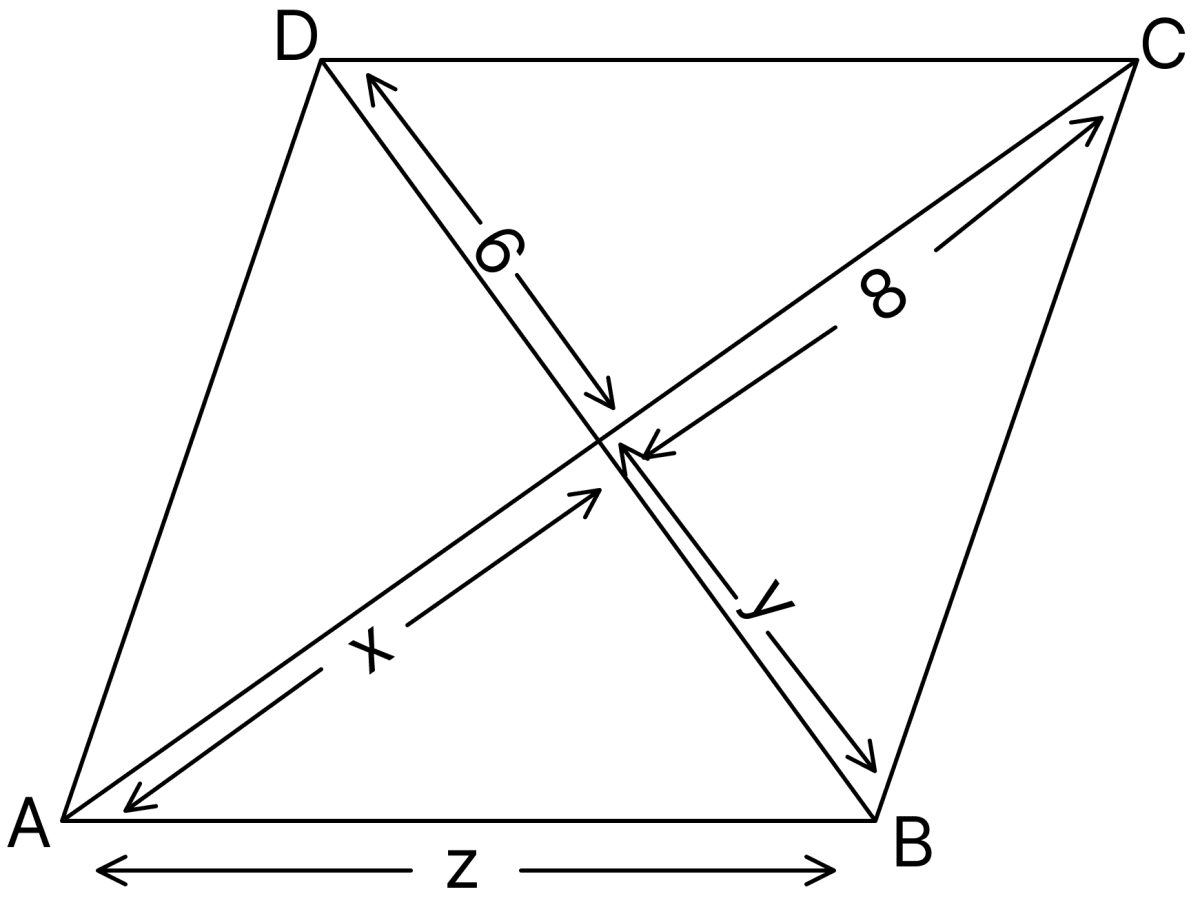
In the adjoining figure ABCD is a rhombus, find the values of x, y and z.
Answer
It is given that ABCD is a rhombus in which the diagonals AC and BD intersect at O, with DO = 6, OC = 8, AO = x, OB = y and AB = z.
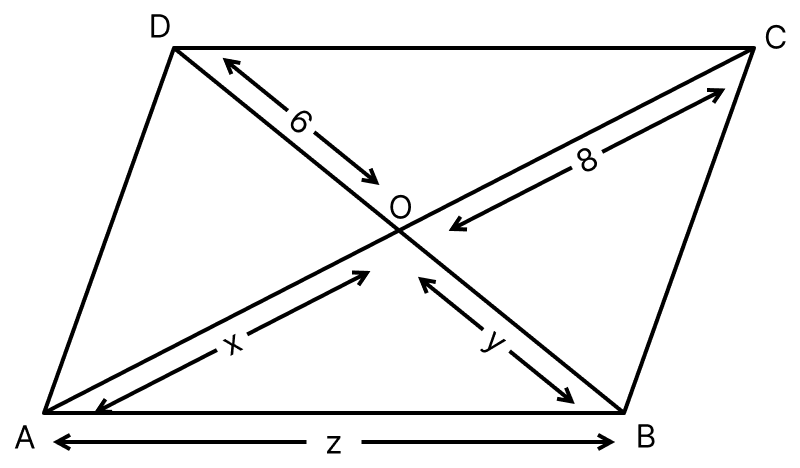
As the diagonals of a rhombus bisect each other,
AO = OC
⇒ x = 8
Also,
OB = DO
⇒ y = 6
As the diagonals of a rhombus intersect at right angles, ∠AOB = 90°.
So, ΔAOB is a right angled triangle.
By Pythagoras theorem,
⇒ AB2 = AO2 + OB2
⇒ z2 = 82 + 62
⇒ z2 = 64 + 36
⇒ z2 = 100
⇒ z =
⇒ z = 10
Hence, x = 8, y = 6 and z = 10.
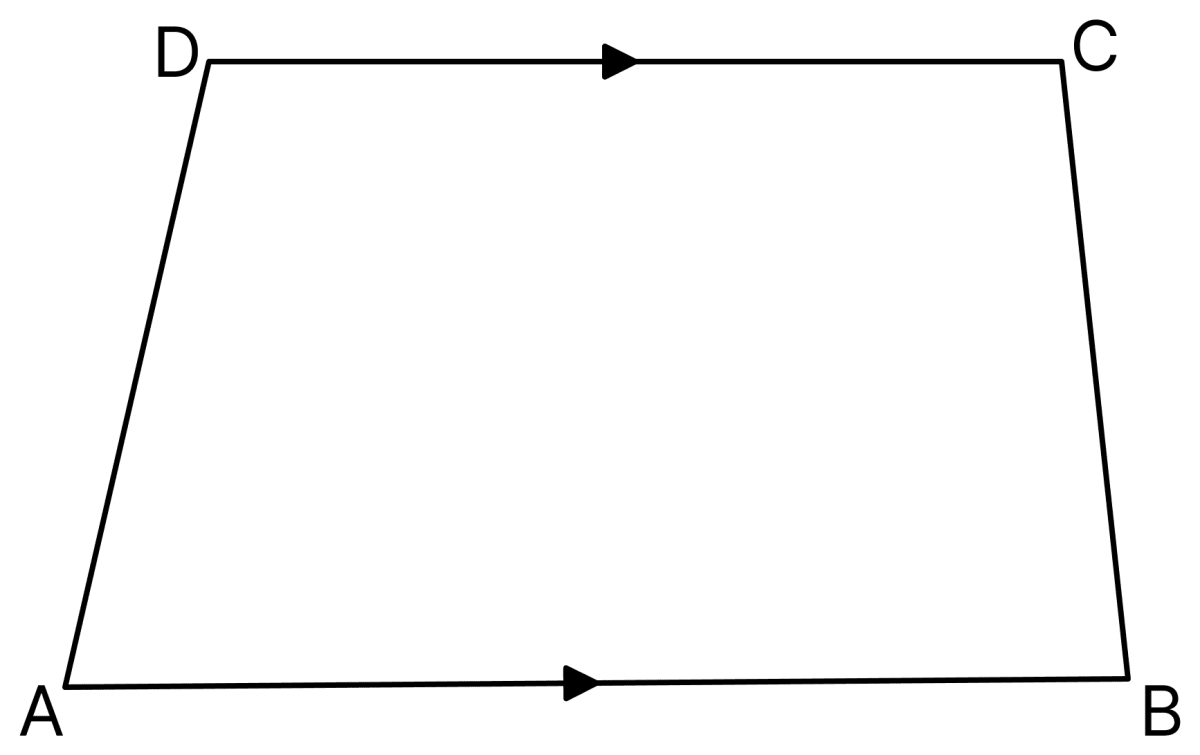
In the adjoining figure, ABCD is a trapezium. If ∠A : ∠D = 5 : 7, ∠B = (3x + 11)° and ∠C = (5x - 31)°, then find all the angles of the trapezium.
Answer
It is given that ABCD is a trapezium in which AB ∥ DC, ∠A : ∠D = 5 : 7, ∠B = (3x + 11)° and ∠C = (5x - 31)°.
As AB ∥ DC and AD is a transversal, the co-interior angles ∠A and ∠D are supplementary.
⇒ ∠A + ∠D = 180°
Let the common factor of ∠A and ∠D be a. So, ∠A = 5a and ∠D = 7a.
⇒ 5a + 7a = 180°
⇒ 12a = 180°
⇒ a =
⇒ a = 15°
Thus,
∠A = 5a = 5 x 15° = 75°
∠D = 7a = 7 x 15° = 105°
As AB ∥ DC and BC is a transversal, the co-interior angles ∠B and ∠C are supplementary.
⇒ ∠B + ∠C = 180°
⇒ (3x + 11)° + (5x - 31)° = 180°
⇒ 3x° + 11° + 5x° - 31° = 180°
⇒ 8x° - 20° = 180°
⇒ 8x° = 180° + 20°
⇒ 8x° = 200°
⇒ x° =
⇒ x = 25
Thus,
∠B = (3x + 11)° = (3 x 25 + 11)° = (75 + 11)° = 86°
∠C = (5x - 31)° = (5 x 25 - 31)° = (125 - 31)° = 94°
Hence, ∠A = 75°, ∠B = 86°, ∠C = 94° and ∠D = 105°.
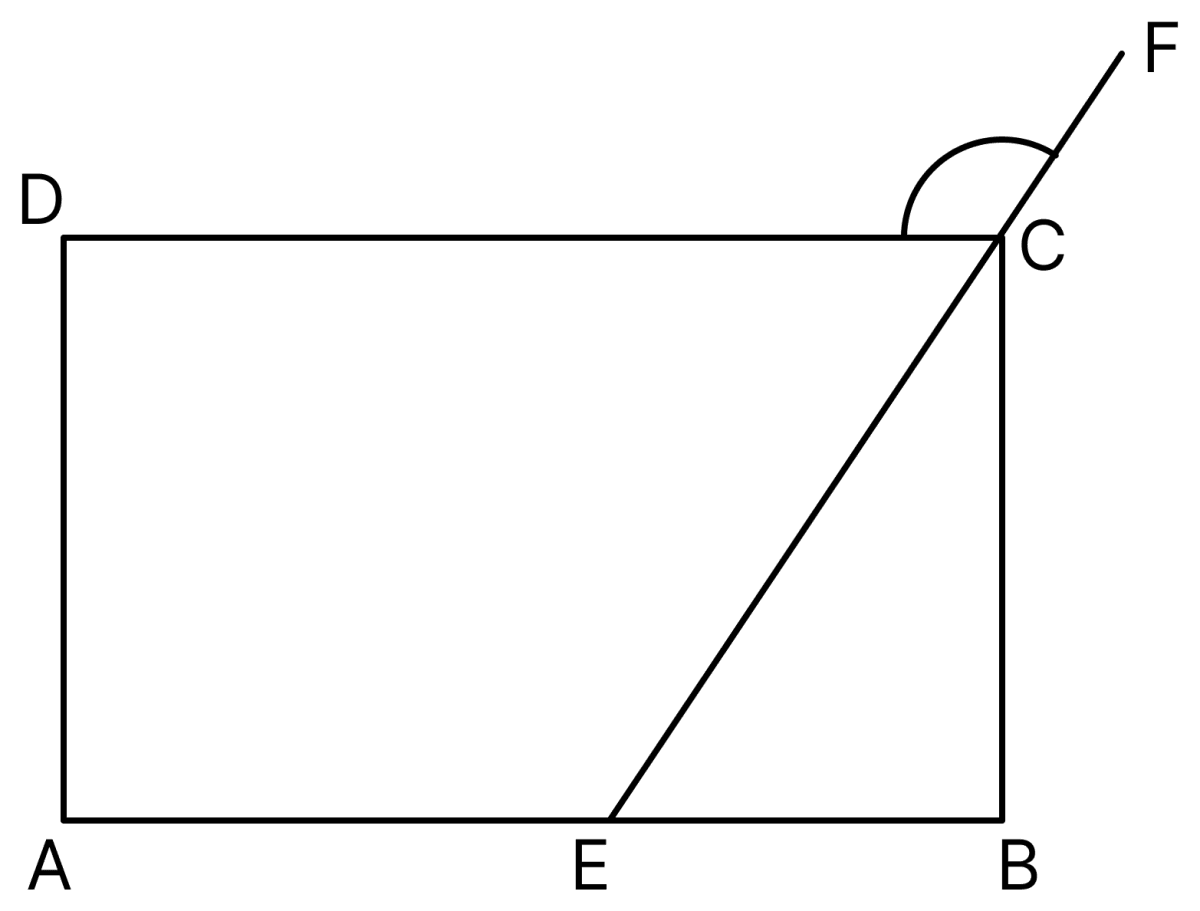
In the adjoining figure, ABCD is a rectangle. If ∠CEB : ∠ECB = 3 : 2, find
(i) ∠CEB
(ii) ∠DCF
Answer
It is given that ABCD is a rectangle and ∠CEB : ∠ECB = 3 : 2.
(i) As ABCD is a rectangle, each of its angles is 90°.
So, ∠ABC = 90°, which means ∠EBC = 90°.
Let the common factor be a. So, ∠CEB = 3a and ∠ECB = 2a.
In ΔEBC, the sum of all the angles of a triangle is 180°.
⇒ ∠CEB + ∠ECB + ∠EBC = 180°
⇒ 3a + 2a + 90° = 180°
⇒ 5a = 180° - 90°
⇒ 5a = 90°
⇒ a =
⇒ a = 18°
Thus,
∠CEB = 3a = 3 x 18° = 54°
Hence, ∠CEB = 54°.
(ii) ∠ECB = 2a = 2 x 18° = 36°
As ABCD is a rectangle, ∠DCB = 90°.
From the figure,
⇒ ∠DCE = ∠DCB - ∠ECB
⇒ ∠DCE = 90° - 36°
⇒ ∠DCE = 54°
As EC is produced to F, ∠DCE and ∠DCF form a linear pair.
⇒ ∠DCF + ∠DCE = 180°
⇒ ∠DCF + 54° = 180°
⇒ ∠DCF = 180° - 54°
⇒ ∠DCF = 126°
Hence, ∠DCF = 126°.
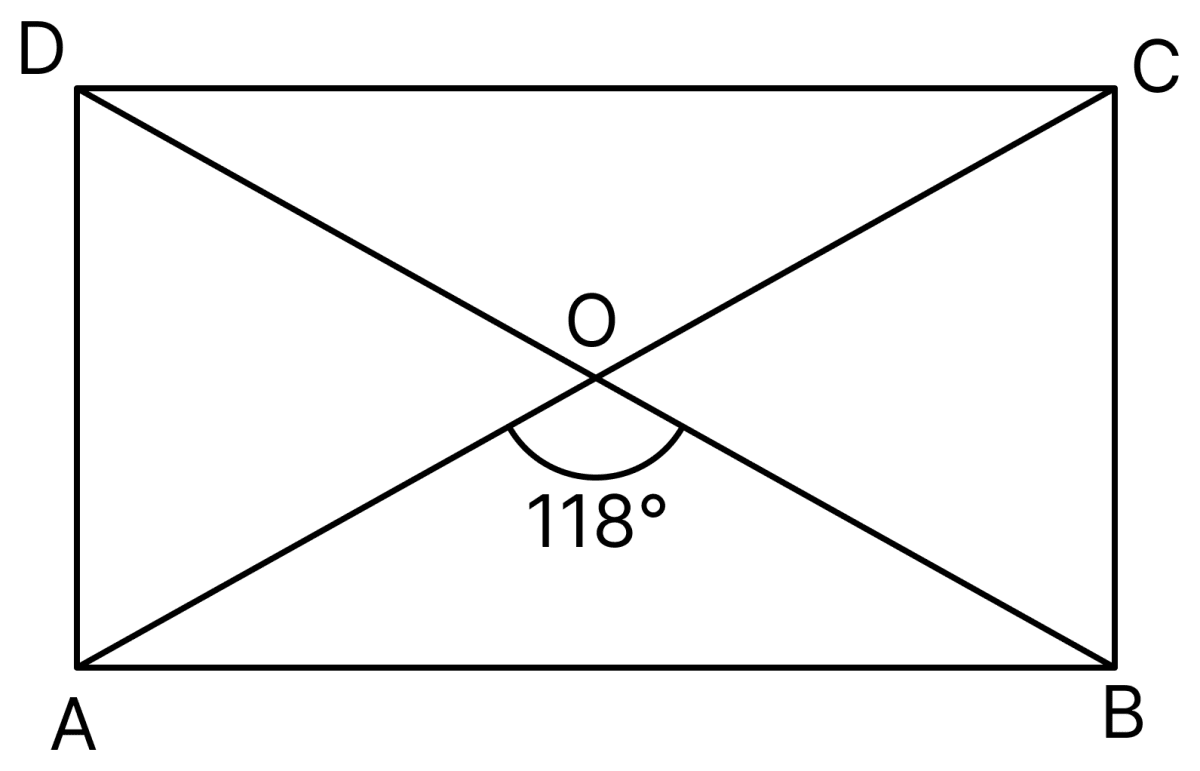
In the adjoining figure, ABCD is a rectangle and diagonals intersect at O. If ∠AOB = 118°, find
(i) ∠ABO
(ii) ∠ADO
(iii) ∠OCB
Answer
It is given that ABCD is a rectangle whose diagonals intersect at O and ∠AOB = 118°.
As the diagonals of a rectangle are equal and bisect each other,
OA = OB = OC = OD
(i) In ΔAOB, OA = OB, so ΔAOB is an isosceles triangle.
So, ∠ABO = ∠BAO (angles opposite to equal sides are equal)
As the sum of all the angles of a triangle is 180°,
⇒ ∠ABO + ∠BAO + ∠AOB = 180°
⇒ 2∠ABO + 118° = 180°
⇒ 2∠ABO = 180° - 118°
⇒ 2∠ABO = 62°
⇒ ∠ABO =
⇒ ∠ABO = 31°
Hence, ∠ABO = 31°.
(ii) As ∠AOB and ∠AOD form a linear pair,
⇒ ∠AOD = 180° - 118° = 62°
In ΔAOD, OA = OD, so ΔAOD is an isosceles triangle.
So, ∠ADO = ∠DAO (angles opposite to equal sides are equal)
As the sum of all the angles of a triangle is 180°,
⇒ ∠ADO + ∠DAO + ∠AOD = 180°
⇒ 2∠ADO + 62° = 180°
⇒ 2∠ADO = 180° - 62°
⇒ 2∠ADO = 118°
⇒ ∠ADO =
⇒ ∠ADO = 59°
Hence, ∠ADO = 59°.
(iii) In ΔAOD, OA = OD, so ∠OAD = ∠ADO = 59°.
As AD ∥ BC and AC is a transversal,
∠OCB = ∠OAD (alternate angles are equal) In the adjoining isosceles trapezium ABCD, ∠C = 102°. Find all the remaining angles of the trapezium.
⇒ ∠OCB = 59°
Hence, ∠OCB = 59°.
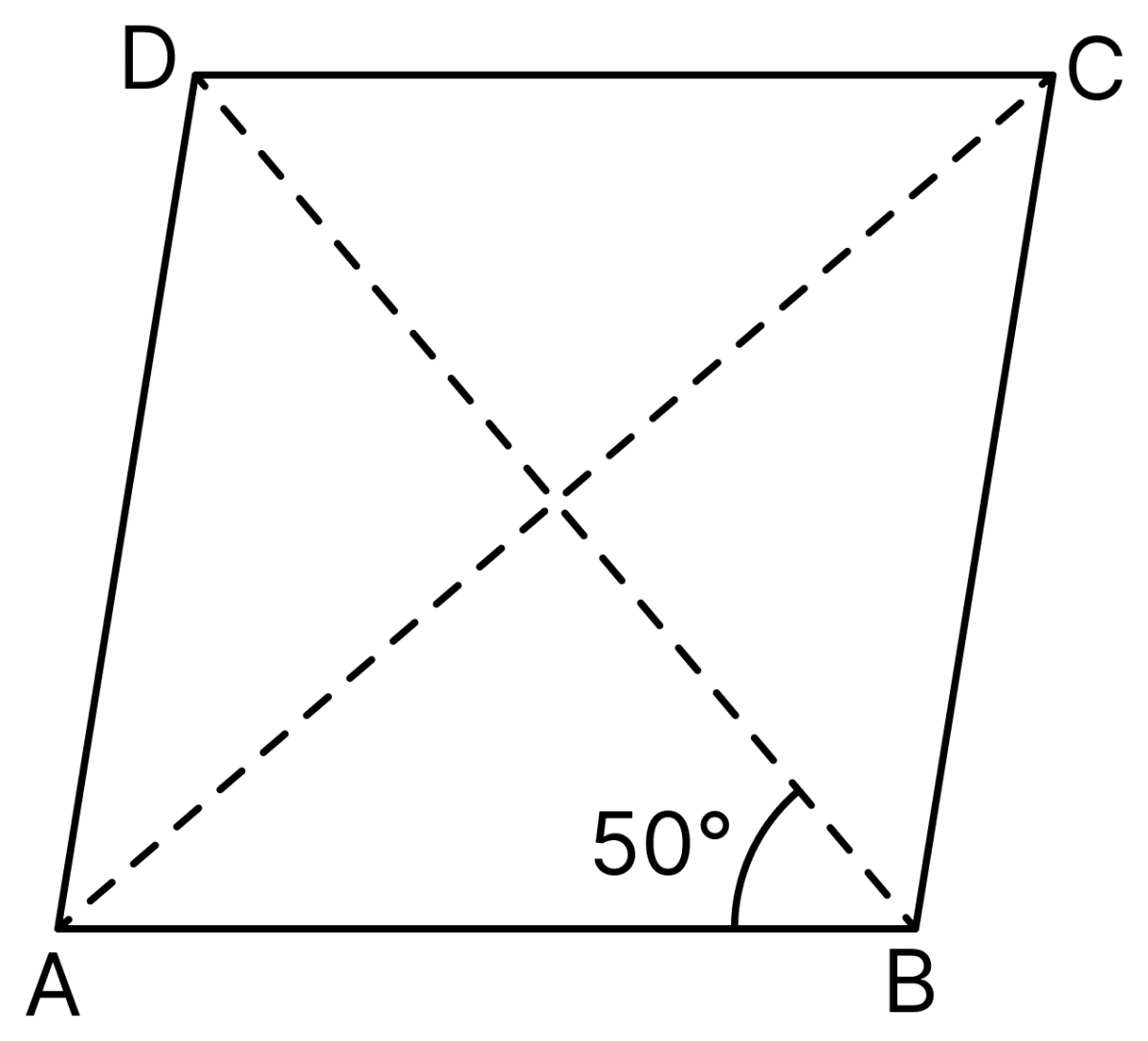
In the adjoining figure, ABCD is a rhombus and ∠ABD = 50°. Find
(i) ∠CAB
(ii) ∠BCD
(iii) ∠ADC
Answer
It is given that ABCD is a rhombus and ∠ABD = 50°.
Let the diagonals AC and BD intersect at O.
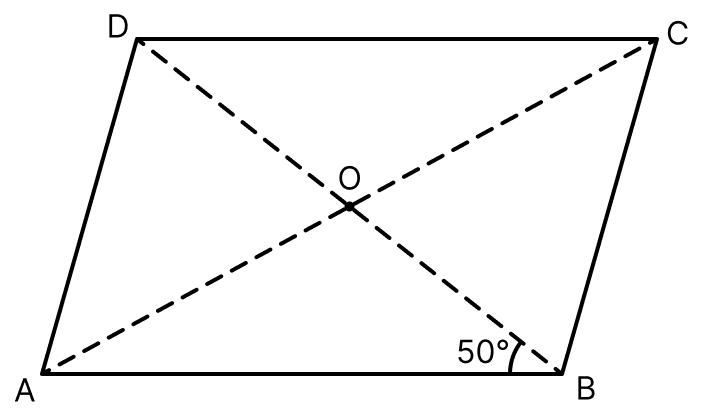
As the diagonals of a rhombus intersect at right angles,
∠AOB = 90°
(i) In ΔAOB, the sum of all the angles of a triangle is 180°.
⇒ ∠CAB + ∠ABO + ∠AOB = 180°
⇒ ∠CAB + 50° + 90° = 180°
⇒ ∠CAB + 140° = 180°
⇒ ∠CAB = 180° - 140°
⇒ ∠CAB = 40°
Hence, ∠CAB = 40°.
(ii) As the diagonals of a rhombus bisect the angles of the rhombus, the diagonal BD bisects ∠ABC.
⇒ ∠ABC = 2 x ∠ABD
⇒ ∠ABC = 2 x 50°
⇒ ∠ABC = 100°
As the adjacent angles of a rhombus are supplementary,
⇒ ∠BCD + ∠ABC = 180°
⇒ ∠BCD + 100° = 180°
⇒ ∠BCD = 180° - 100°
⇒ ∠BCD = 80°
Hence, ∠BCD = 80°.
(iii) As the opposite angles of a rhombus are of equal measure,
∠ADC = ∠ABC = 100°
Hence, ∠ADC = 100°.
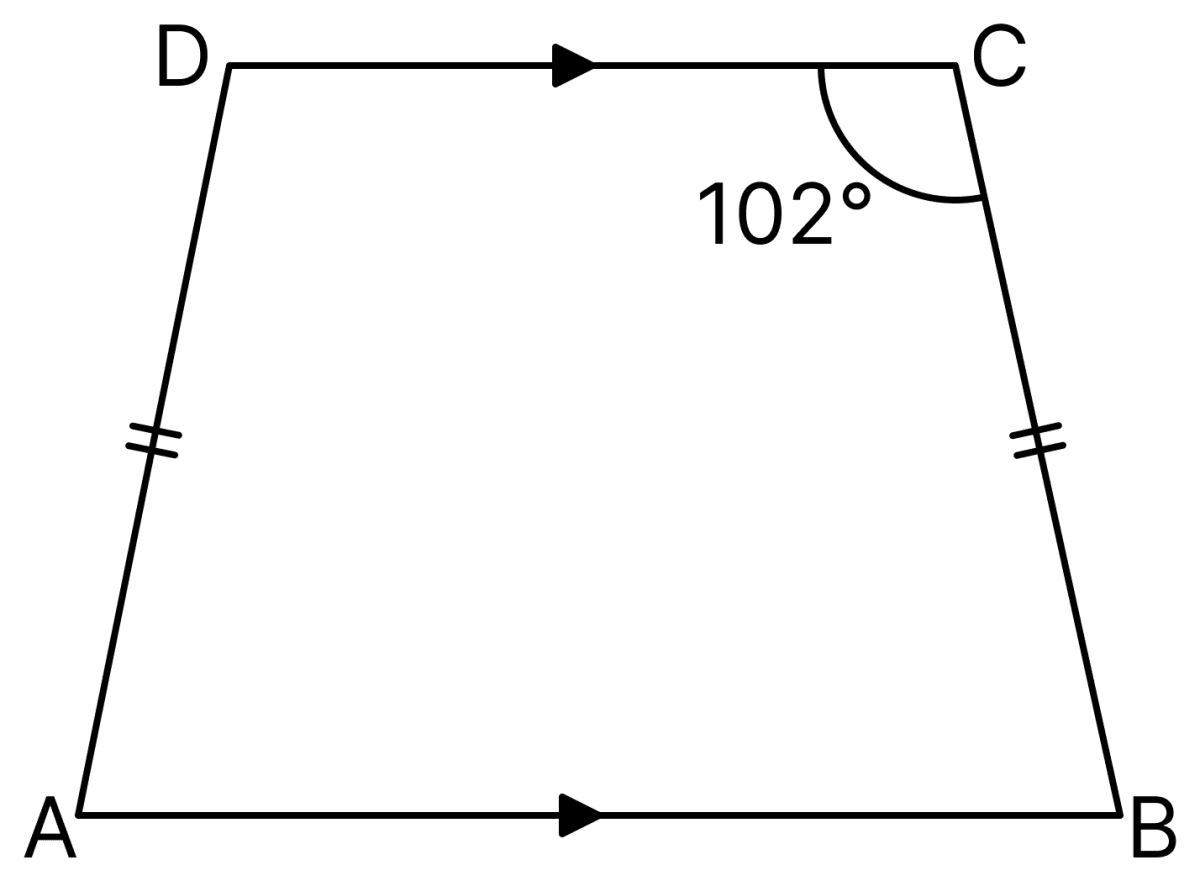
In the adjoining isosceles trapezium ABCD, ∠C = 102°. Find all the remaining angles of the trapezium.
Answer
It is given that ABCD is an isosceles trapezium in which AB ∥ DC, AD = BC and ∠C = 102°.
As the angles on the same base of an isosceles trapezium are equal,
∠D = ∠C = 102°
As AB ∥ DC and BC is a transversal, the co-interior angles ∠B and ∠C are supplementary.
⇒ ∠B + ∠C = 180°
⇒ ∠B + 102° = 180°
⇒ ∠B = 180° - 102°
⇒ ∠B = 78°
As the angles on the same base of an isosceles trapezium are equal,
∠A = ∠B = 78°
Hence, ∠A = 78°, ∠B = 78° and ∠D = 102°.
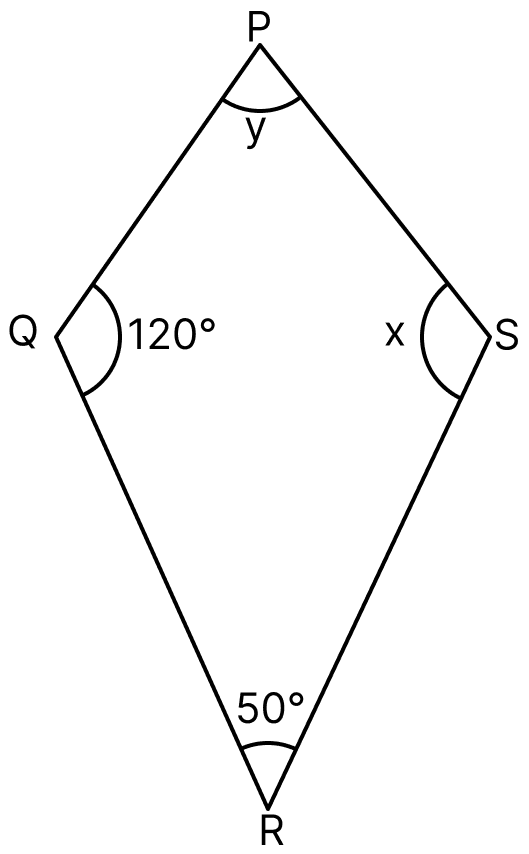
In the adjoining figure PQRS is a kite. Find the values of x and y.
Answer
It is given that PQRS is a kite in which ∠Q = 120°, ∠R = 50°, ∠P = y and ∠S = x.
In kite PQRS, PQ = PS and RQ = RS.
So, the angles included between the pairs of unequal sides are equal.
⇒ ∠S = ∠Q
⇒ x = 120°
As we know, the sum of all the interior angles of a quadrilateral is 360°.
⇒ ∠P + ∠Q + ∠R + ∠S = 360°
⇒ y + 120° + 50° + 120° = 360°
⇒ y + 290° = 360°
⇒ y = 360° - 290°
⇒ y = 70°
Hence, x = 120° and y = 70°.