
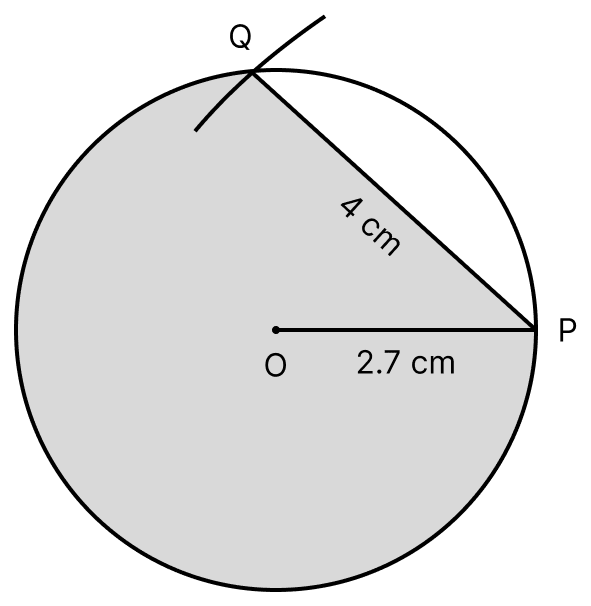
Draw a circle of radius 2.7 cm. Draw a chord PQ of length 4 cm of this circle. Shade the major segment of this circle.
Answer
Steps of construction:
Mark a point O and with O as centre and radius 2.7 cm, draw a circle.
Take any point P on the circle.
With P as centre and radius 4 cm, draw an arc to meet the circle at Q.
Join P and Q. PQ is the required chord.
Shade the segment which contains the centre O. It is the major segment of the circle.
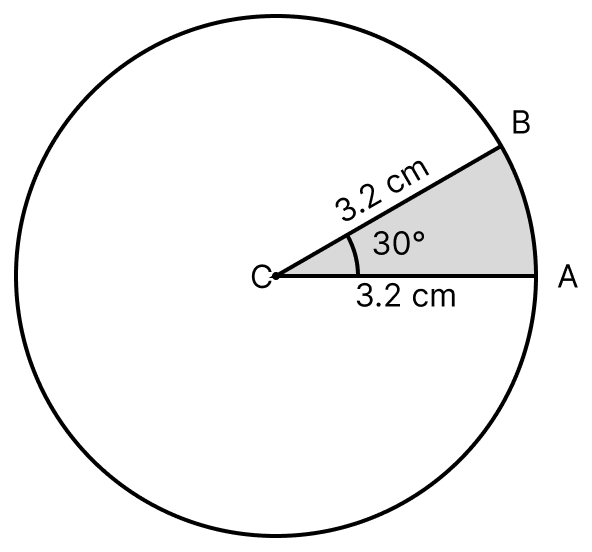
Draw a circle of radius 3.2 cm and in it make a sector of angle 30°. Draw the diagram and shade the sector.
Answer
Steps of construction:
Mark a point C and with C as centre and radius 3.2 cm, draw a circle.
Draw a radius CA of the circle.
Draw another radius CB such that ∠ACB = 30°.
Shade the sector ACB.
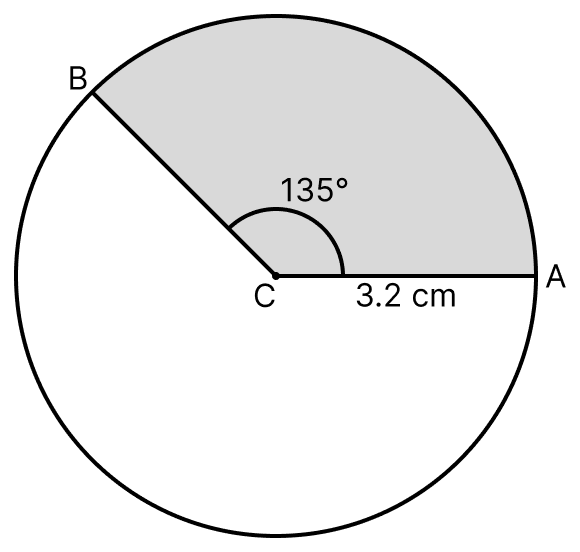
Draw a circle of radius 3.2 cm and in it make a sector of angle 135°. Draw the diagram and shade the sector.
Answer
Steps of construction:
Mark a point C and with C as centre and radius 3.2 cm, draw a circle.
Draw a radius CA of the circle.
Draw another radius CB such that ∠ACB = 135°.
Shade the sector ACB.
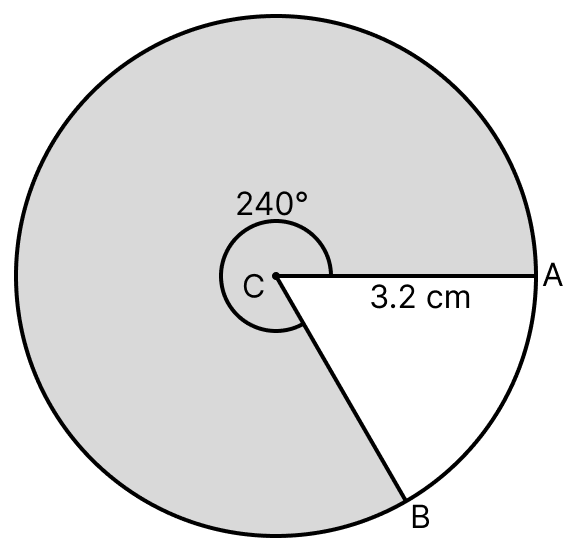
Draw a circle of radius 3.2 cm and in it make a sector of angle right angles. Draw the diagram and shade the sector.
Answer
We know that,
1 right angle = 90°.
⇒ Angle of the sector =
Steps of construction:
Mark a point C and with C as centre and radius 3.2 cm, draw a circle.
Draw a radius CA of the circle.
Draw another radius CB such that the angle ACB measured in the anticlockwise direction is 240°.
Shade the sector ACB.
Draw a line segment PQ = 6.4 cm. Construct a circle on PQ as diameter. Take any point R on this circle and measure ∠PRQ
Answer
Steps of construction:
Draw a line segment PQ = 6.4 cm.
Draw the perpendicular bisector of PQ, which cuts PQ at the point O.
With O as centre and radius OP, draw a circle. It passes through P as well as through Q.
Take any point R on the circle and join PR and QR.
Measure ∠PRQ.
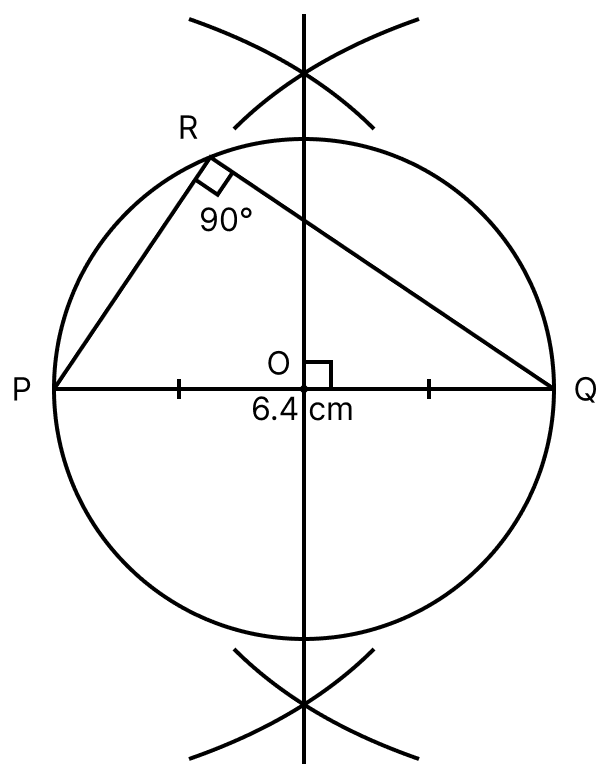
On measuring, we get ∠PRQ = 90°.
This is because PQ is a diameter of the circle and the angle in a semicircle is a right angle.
Hence, ∠PRQ = 90°.
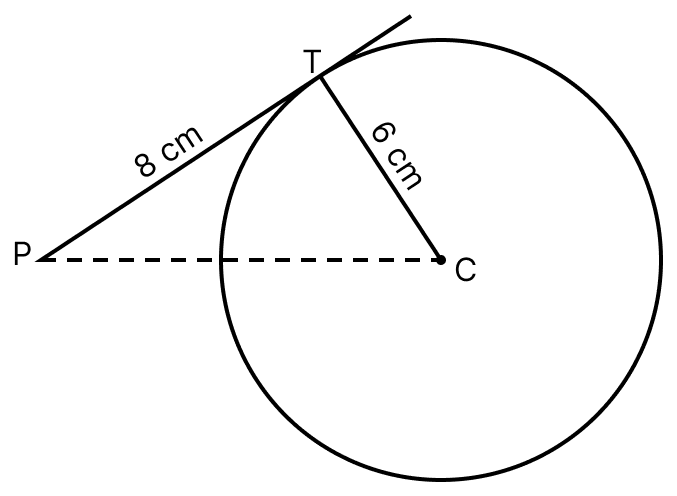
In the adjoining figure, the tangent to a circle of radius 6 cm from an external point P is of length 8 cm. Calculate the distance of the point P from the nearest point of the circumference.
Answer
Given,
CT = 6 cm and PT = 8 cm.
We know that,
The tangent at any point of a circle and the radius through that point are perpendicular to each other.
⇒ ∠CTP = 90°
So, ∆CTP is a right angled triangle with CP as the hypotenuse.
Using Pythagoras theorem,
⇒ CP2 = CT2 + PT2
⇒ CP2 = 62 + 82
⇒ CP2 = 36 + 64
⇒ CP2 = 100
⇒ CP =
⇒ CP = 10 cm
Let R be the nearest point of the circumference from the point P.
From figure,
⇒ PR = CP - CR
As, CR = CT = 6 cm
⇒ PR = 10 - 6
⇒ PR = 4 cm
Hence, the distance of the point P from the nearest point of the circumference = 4 cm.
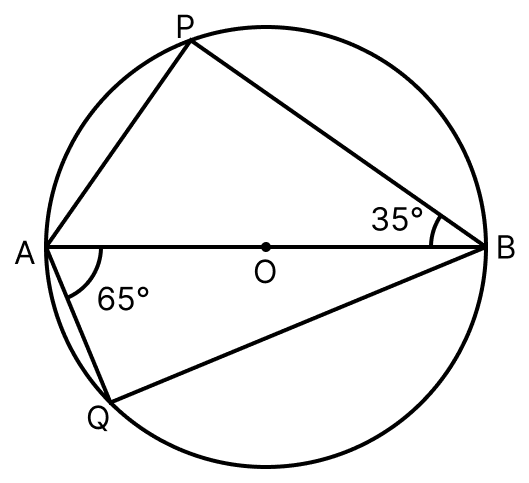
In the adjoining figure, O is the centre of the circle. If ∠ABP = 35° and ∠BAQ = 65°, find
(i) ∠PAB
(ii) ∠QBA
Answer
From figure,
AB is the diameter of the circle with centre O, ∠ABP = 35° and ∠BAQ = 65°.
(i) We know that,
Angle in a semicircle is a right angle.
⇒ ∠APB = 90°
In ∆APB, using angle sum property,
⇒ ∠PAB + ∠ABP + ∠APB = 180°
⇒ ∠PAB + 35° + 90° = 180°
⇒ ∠PAB + 125° = 180°
⇒ ∠PAB = 180° - 125°
⇒ ∠PAB = 55°
Hence, ∠PAB = 55°.
(ii) We know that,
Angle in a semicircle is a right angle.
⇒ ∠AQB = 90°
In ∆AQB, using angle sum property,
⇒ ∠BAQ + ∠QBA + ∠AQB = 180°
⇒ 65° + ∠QBA + 90° = 180°
⇒ ∠QBA + 155° = 180°
⇒ ∠QBA = 180° - 155°
⇒ ∠QBA = 25°
Hence, ∠QBA = 25°.