
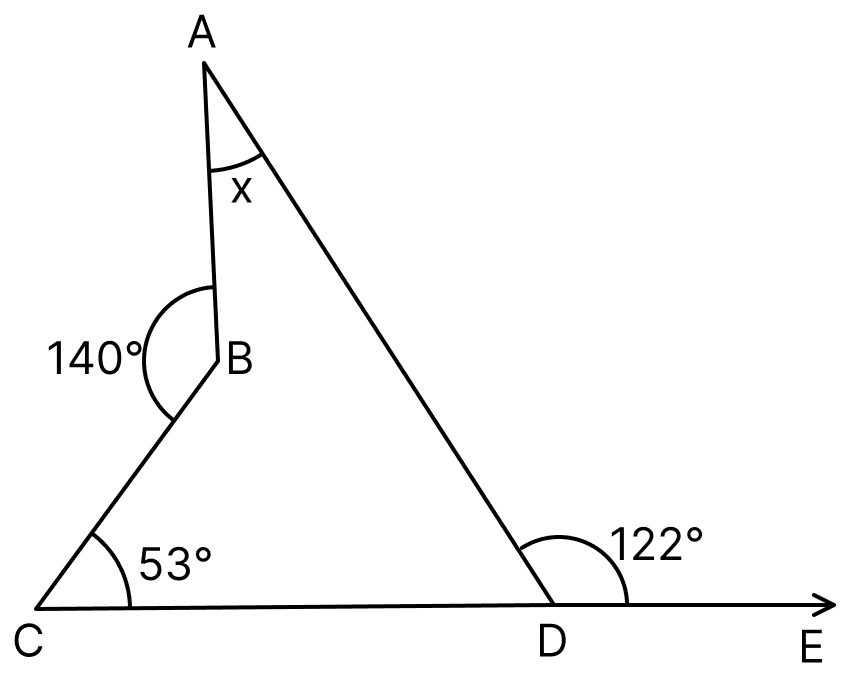
From the adjoining diagram, find the value of x.
Answer
From the figure,
ABCD is a quadrilateral in which the angle at B is a reflex angle, ∠BCD = 53° and the side CD has been produced to E so that the exterior angle at D is 122°.
The angle marked 140° at B is the angle outside quadrilateral ABCD.
So, the reflex angle at B is:
= 360° - 140°
= 220°
As ∠ADC and ∠ADE form a linear pair,
⇒ ∠ADC + 122° = 180°
⇒ ∠ADC = 180° - 122°
⇒ ∠ADC = 58°
As we know, the sum of all the interior angles of a quadrilateral is 360°.
⇒ x + 220° + 53° + 58° = 360°
⇒ x + 331° = 360°
⇒ x = 360° - 331°
⇒ x = 29°
Hence, the value of x is 29°.
If two angles of a quadrilateral are 77° and 57°, and out of the remaining two angles, one angle is 10° smaller than the other, find these angles.
Answer
It is given that two angles of a quadrilateral are 77° and 57°, and out of the remaining two angles, one angle is 10° smaller than the other.
Let the greater of the remaining two angles be a. So, the other angle is (a - 10°).
As we know, the sum of all the interior angles of a quadrilateral is 360°.
⇒ 77° + 57° + a + (a - 10°) = 360°
⇒ 77° + 57° + a + a - 10° = 360°
⇒ 2a + 124° = 360°
⇒ 2a = 360° - 124°
⇒ 2a = 236°
⇒ a =
⇒ a = 118°
Thus, the angles are:
a = 118°
a - 10° = 118° - 10° = 108°
Hence, the remaining two angles are 108° and 118°.
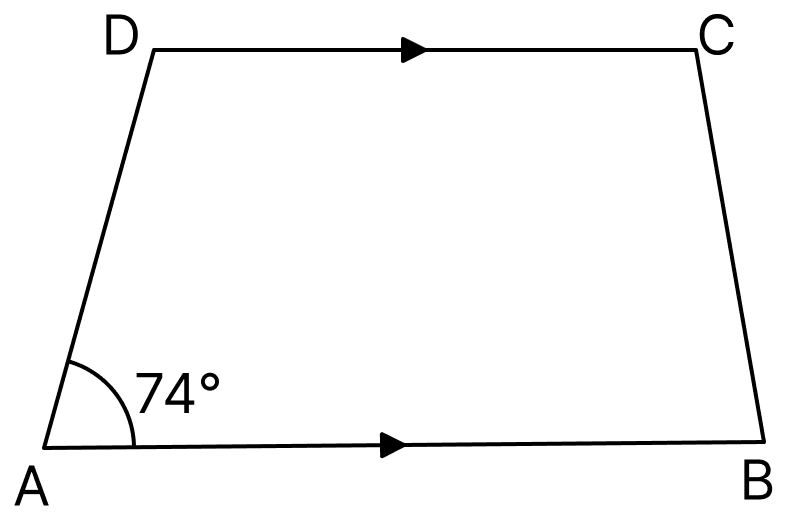
In the adjoining figure, AB ∥ DC, ∠A = 74° and ∠B : ∠C = 4 : 5. Find
(i) ∠D
(ii) ∠B
(iii) ∠C
Answer
It is given that in the figure, AB ∥ DC, ∠A = 74° and ∠B : ∠C = 4 : 5.
(i) As AB ∥ DC and AD is a transversal, the co-interior angles ∠A and ∠D are supplementary.
⇒ ∠A + ∠D = 180°
⇒ 74° + ∠D = 180°
⇒ ∠D = 180° - 74°
⇒ ∠D = 106°
Hence, ∠D = 106°.
(ii) As AB ∥ DC and BC is a transversal, the co-interior angles ∠B and ∠C are supplementary.
⇒ ∠B + ∠C = 180°
Let the common factor be a. So, ∠B = 4a and ∠C = 5a.
⇒ 4a + 5a = 180°
⇒ 9a = 180°
⇒ a =
⇒ a = 20°
Thus,
∠B = 4a = 4 x 20° = 80°
Hence, ∠B = 80°.
(iii) ∠C = 5a = 5 x 20° = 100°
Hence, ∠C = 100°.
In quadrilateral ABCD, ∠A : ∠B : ∠C : ∠D = 3 : 4 : 6 : 7. Find all the angles of the quadrilateral. Hence, prove that AB and DC are parallel. Is BC also parallel to AD?
Answer
It is given that in quadrilateral ABCD, ∠A : ∠B : ∠C : ∠D = 3 : 4 : 6 : 7.
Let the common factor of the angles be a. So, ∠A = 3a, ∠B = 4a, ∠C = 6a and ∠D = 7a.
As we know, the sum of all the interior angles of a quadrilateral is 360°.
⇒ ∠A + ∠B + ∠C + ∠D = 360°
⇒ 3a + 4a + 6a + 7a = 360°
⇒ 20a = 360°
⇒ a =
⇒ a = 18°
Thus, the angles are:
∠A = 3a = 3 x 18° = 54°
∠B = 4a = 4 x 18° = 72°
∠C = 6a = 6 x 18° = 108°
∠D = 7a = 7 x 18° = 126°
Now, ∠A + ∠D = 54° + 126° = 180°
As ∠A and ∠D are co-interior angles formed by the transversal AD, and their sum is 180°, the lines AB and DC are parallel.
Also, ∠A + ∠B = 54° + 72° = 126°
As ∠A and ∠B are co-interior angles formed by the transversal AB, and their sum is not 180°, the lines AD and BC are not parallel.
Hence, the angles of the quadrilateral are 54°, 72°, 108° and 126°; AB and DC are parallel but BC is not parallel to AD.
One angle of a parallelogram is two-third of the other. Find the angles of the parallelogram.
Answer
It is given that one angle of a parallelogram is two-third of the other.
Let the parallelogram be ABCD and let ∠A and ∠B be its adjacent angles.
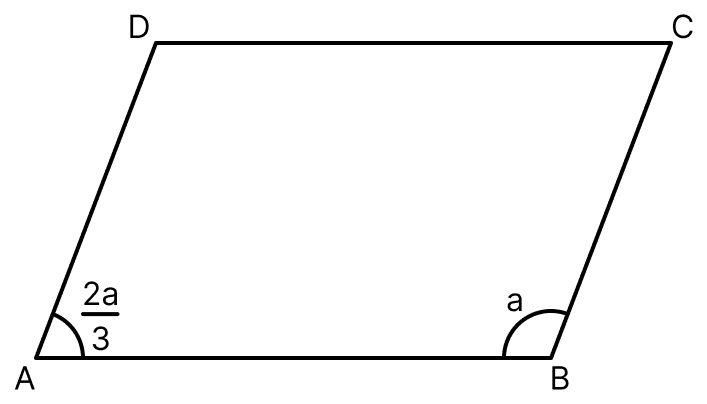
Let ∠B = . So, ∠A = .
As the adjacent angles of a parallelogram are supplementary,
Thus,
∠B = 108°
∠A = × 108° = 72°
As the opposite angles of a parallelogram are of equal measure,
∠C = ∠A = 72° and ∠D = ∠B = 108°
Hence, the angles of the parallelogram are 72°, 108°, 72° and 108°.
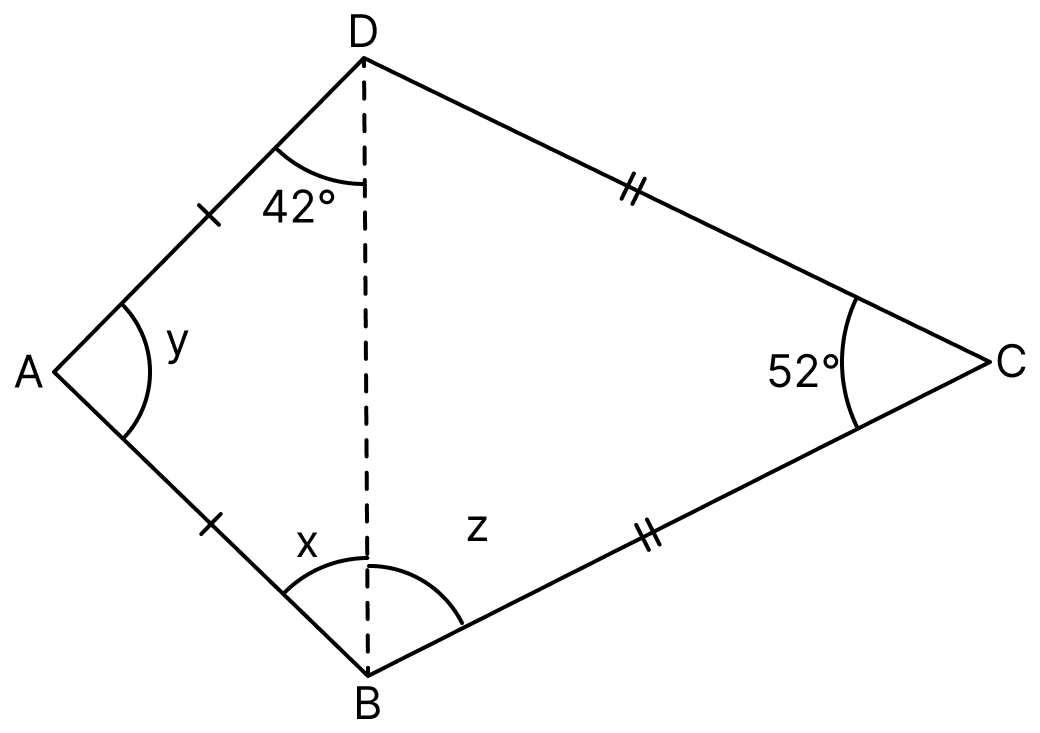
In the adjoining figure, ABCD is a kite. If ∠BCD = 52° and ∠ADB = 42°, find the values of x, y and z.
Answer
It is given that ABCD is a kite in which AD = AB and CD = CB, ∠BCD = 52° and ∠ADB = 42°.
In ΔABD, AD = AB, so ΔABD is an isosceles triangle.
⇒ x = ∠ABD = ∠ADB = 42° (angles opposite to equal sides are equal)
In ΔABD, the sum of all the angles of a triangle is 180°.
⇒ y + ∠ADB + ∠ABD = 180°
⇒ y + 42° + 42° = 180°
⇒ y + 84° = 180°
⇒ y = 180° - 84°
⇒ y = 96°
In ΔCBD, CD = CB, so ΔCBD is an isosceles triangle.
⇒ z = ∠CDB (angles opposite to equal sides are equal)
In ΔCBD, the sum of all the angles of a triangle is 180°.
⇒ z + ∠CDB + ∠BCD = 180°
⇒ 2z + 52° = 180°
⇒ 2z = 180° - 52°
⇒ 2z = 128°
⇒ z =
⇒ z = 64°
Hence, x = 42°, y = 96° and z = 64°.
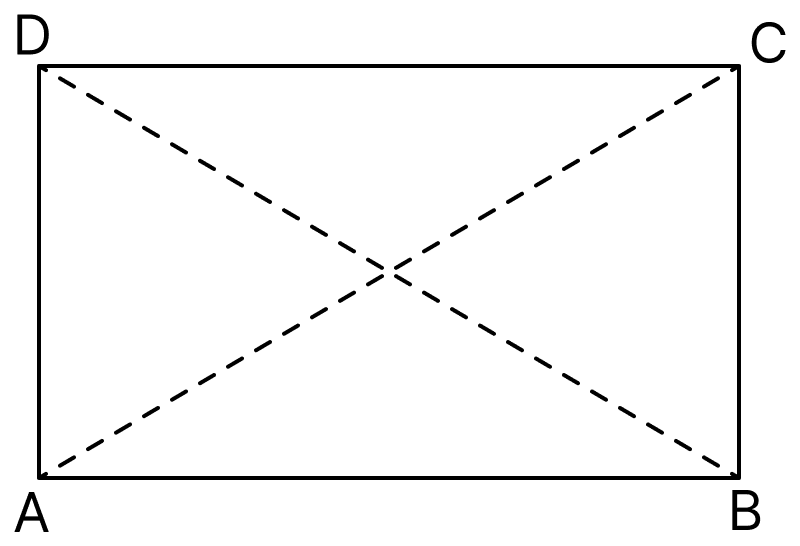
In the adjoining figure, ABCD is a rectangle. Prove that AC = BD.
Answer
From figure,
In ΔABC and ΔBAD,
AB = BA (common side)
∠ABC = ∠BAD = 90° (each angle of a rectangle is a right angle)
BC = AD (opposite sides of a rectangle are equal)
Therefore, by the S.A.S. congruence rule,
ΔABC ≅ ΔBAD
As the corresponding parts of congruent triangles are equal,
AC = BD
Hence, proved that AC = BD.
In the adjoining figure, ABCD is a rhombus and EDC is an equilateral triangle. If ∠DAB = 48°, find
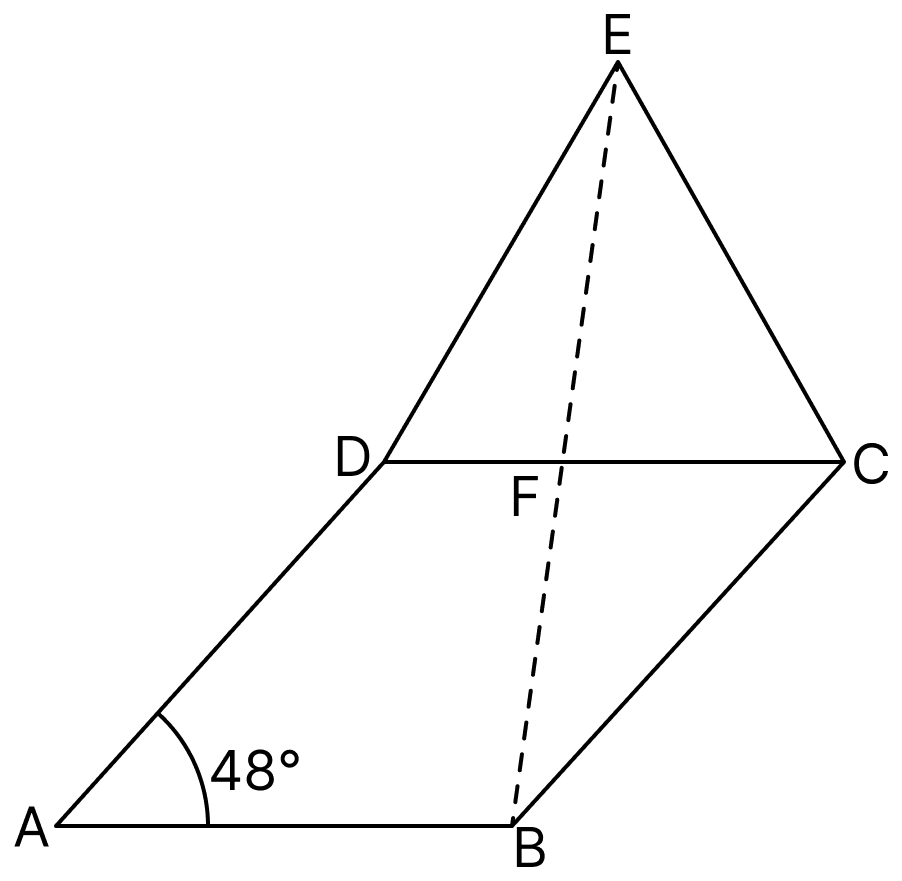
(i) ∠BEC
(ii) ∠DEB
(iii) ∠BFC
Answer
It is given that ABCD is a rhombus, EDC is an equilateral triangle and ∠DAB = 48°.
As the opposite angles of a rhombus are of equal measure,
∠BCD = ∠DAB = 48°
As EDC is an equilateral triangle, each of its angles is 60° and all its sides are equal.
So, ∠DCE = 60° and ED = DC = CE
Also, as ABCD is a rhombus, BC = CD.
So, BC = CE ...............(1)
From the figure,
∠BCE = ∠BCD + ∠DCE
= 48° + 60°
= 108°
(i) In ΔBCE, BC = CE, so ΔBCE is an isosceles triangle.
⇒ ∠BEC = ∠EBC (angles opposite to equal sides are equal)
In ΔBCE, the sum of all the angles of a triangle is 180°.
⇒ ∠BEC + ∠EBC + ∠BCE = 180°
⇒ 2∠BEC + 108° = 180°
⇒ 2∠BEC = 180° - 108°
⇒ 2∠BEC = 72°
⇒ ∠BEC =
⇒ ∠BEC = 36°
Hence, ∠BEC = 36°.
(ii) As EDC is an equilateral triangle, ∠DEC = 60°.
From the figure,
∠DEB = ∠DEC - ∠BEC
= 60° - 36°
= 24°
Hence, ∠DEB = 24°.
(iii) In ΔBFC,
∠FCB = ∠BCD = 48° and ∠FBC = ∠EBC = ∠BEC = 36°
As the sum of all the angles of a triangle is 180°,
⇒ ∠BFC + ∠FCB + ∠FBC = 180°
⇒ ∠BFC + 48° + 36° = 180°
⇒ ∠BFC + 84° = 180°
⇒ ∠BFC = 180° - 84°
⇒ ∠BFC = 96°
Hence, ∠BFC = 96°.
Find the number of sides of a regular polygon if each of its interior angle is 168°.
Answer
It is given that each interior angle of a regular polygon is 168°.
As the sum of an interior angle and its adjacent exterior angle is 180°,
Each exterior angle = 180° - 168° = 12°
According to the properties of a polygon, if each exterior angle of a regular polygon is , then the number of sides in the regular polygon is .
Number of sides =
= 30
Hence, the number of sides is 30.
If the sum of interior angles of a polygon is 3780°, find the number of sides.
Answer
It is given that the sum of interior angles of a polygon is 3780°.
According to the properties of a polygon, if a polygon has n sides, then the sum of measures of all its interior angles is (n - 2) × 180°.
⇒ (n - 2) × 180° = 3780°
⇒ n - 2 =
⇒ n - 2 = 21
⇒ n = 21 + 2
⇒ n = 23
Hence, the number of sides is 23.
The angles of a hexagon are (2x + 5)°, (3x - 5)°, (x + 40)°, (2x + 20)°, (2x + 25)° and (2x + 35)°. Find the value of x.
Answer
It is given that the angles of a hexagon are (2x + 5)°, (3x - 5)°, (x + 40)°, (2x + 20)°, (2x + 25)° and (2x + 35)°.
According to the properties of a polygon, if a polygon has n sides, then the sum of measures of all its interior angles is (n - 2) × 180°.
A hexagon has 6 sides, so n = 6.
Sum of interior angles = (6 - 2) x 180°
= 4 x 180°
= 720°
So,
⇒ (2x + 5)° + (3x - 5)° + (x + 40)° + (2x + 20)° + (2x + 25)° + (2x + 35)° = 720°
⇒ 2x° + 5° + 3x° - 5° + x° + 40° + 2x° + 20° + 2x° + 25° + 2x° + 35° = 720°
⇒ 12x° + 120° = 720°
⇒ 12x° = 720° - 120°
⇒ 12x° = 600°
⇒ x° =
⇒ x = 50
Hence, the value of x is 50.
Two angles of a polygon are right angles and every other angle is 120°. Find the number of sides of the polygon.
Answer
It is given that two angles of a polygon are right angles and every other angle is 120°.
Let the number of sides of the polygon be n.
So, the polygon has 2 angles of 90° each and the remaining (n - 2) angles of 120° each.
According to the properties of a polygon, if a polygon has n sides, then the sum of measures of all its interior angles is (n - 2) × 180°.
So,
⇒ 2 × 90° + (n - 2) × 120° = (n - 2) × 180°
⇒ 180° + 120° n - 240° = 180° n - 360°
⇒ 120° n - 60° = 180° n - 360°
⇒ 180° n - 120° n = 360° - 60°
⇒ 60° n = 300°
⇒ n =
⇒ n = 5
Hence, the number of sides of the polygon is 5.
The sum of interior angles of a regular polygon is twice the sum of its exterior angles. Find the number of sides of the polygon.
Answer
It is given that the sum of interior angles of a regular polygon is twice the sum of its exterior angles.
According to the properties of a polygon, the sum of all the exterior angles of a polygon is 360°.
So, the sum of its interior angles = 2 x 360° = 720°
Also, if a polygon has n sides, then the sum of measures of all its interior angles is (n - 2) × 180°.
⇒ (n - 2) × 180° = 720°
⇒ n - 2 =
⇒ n - 2 = 4
⇒ n = 4 + 2
⇒ n = 6
Hence, the number of sides of the polygon is 6.
An exterior angle of a regular polygon is one-fourth of its interior angle. Find the number of sides in the polygon.
Answer
It is given that an exterior angle of a regular polygon is one-fourth of its interior angle.
Let the interior angle be . So, the exterior angle is .
As the sum of an interior angle and its adjacent exterior angle is 180°,
So, the interior angle is 144° and the exterior angle is:
= 36°
According to the properties of a polygon, if each exterior angle of a regular polygon is , then the number of sides in the regular polygon is .
= 10
Hence, the number of sides in the polygon is 10.
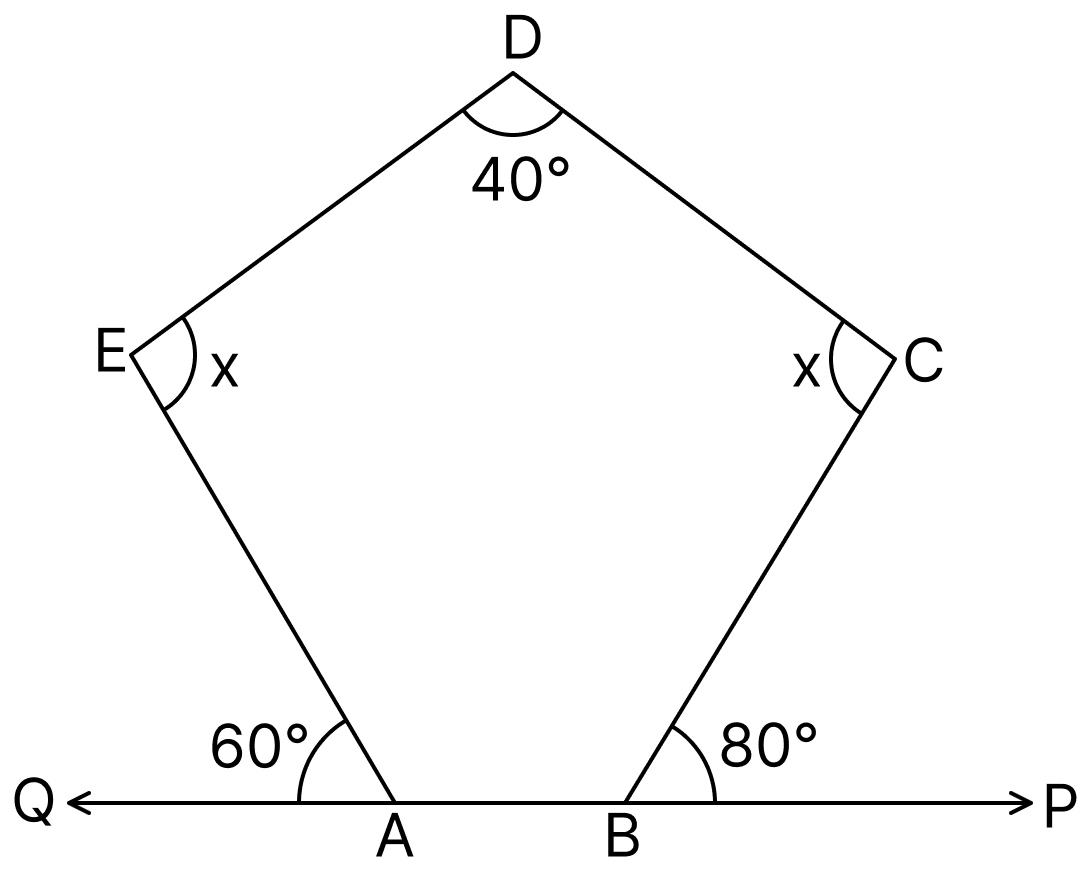
In the adjoining pentagon ABCDE, find the value of x.
Answer
From the figure, in pentagon ABCDE the side AB has been produced on both the sides, so that Q, A, B and P lie on a straight line.
The exterior angle at A is 60° and the exterior angle at B is 80°.
As the sum of an interior angle and its adjacent exterior angle is 180°,
⇒ ∠EAB = 180° - 60° = 120°
⇒ ∠ABC = 180° - 80° = 100°
According to the properties of a polygon, if a polygon has n sides, then the sum of measures of all its interior angles is (n - 2) × 180°.
A pentagon has 5 sides, so n = 5.
Sum of interior angles = (5 - 2) x 180°
= 3 x 180°
= 540°
From the figure, ∠D = 40°, ∠E = x and ∠C = x.
So,
⇒ ∠EAB + ∠ABC + ∠C + ∠D + ∠E = 540°
⇒ 120° + 100° + x + 40° + x = 540°
⇒ 2x + 260° = 540°
⇒ 2x = 540° - 260°
⇒ 2x = 280°
⇒ x =
⇒ x = 140°
Hence, the value of x is 140°.
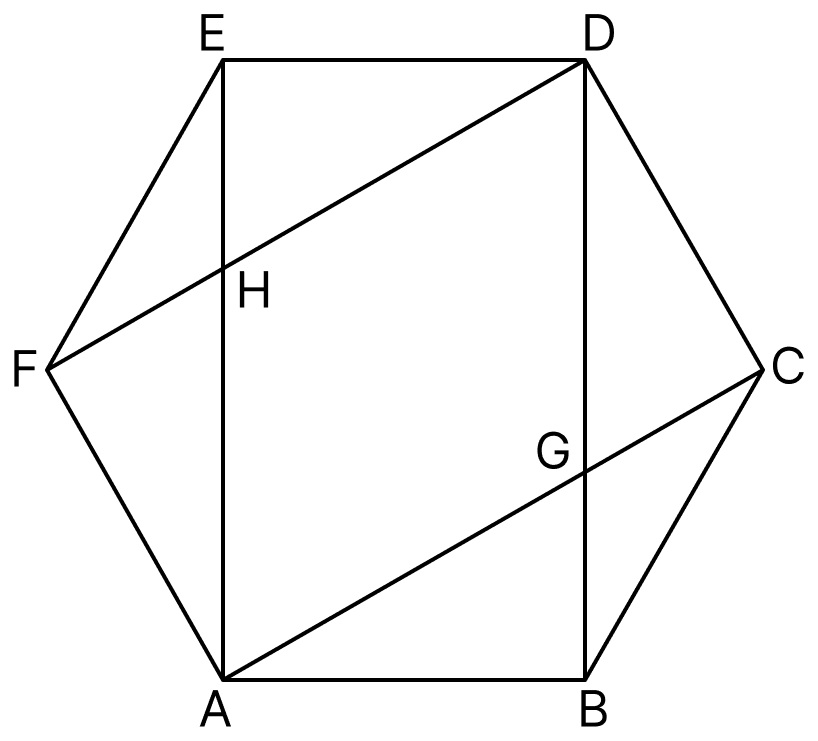
In the adjoining figure ABCDEF is a regular hexagon. Prove that quadrilaterals ABDE and ACDF are parallelograms. Also prove that quadrilateral AGDH is a parallelogram.
Answer
It is given that ABCDEF is a regular hexagon, in which AE and BD meet the lines DF and AC at H and G respectively.
In a regular hexagon, the opposite sides are parallel and equal.
In quadrilateral ABDE,
AB ∥ ED and AB = ED (opposite sides of a regular hexagon)
As one pair of opposite sides is parallel and equal, ABDE is a parallelogram.
Hence, proved that quadrilateral ABDE is a parallelogram.
In quadrilateral ACDF,
AF ∥ CD and AF = CD (opposite sides of a regular hexagon)
As one pair of opposite sides is parallel and equal, ACDF is a parallelogram.
Hence, proved that quadrilateral ACDF is a parallelogram.
Now, in quadrilateral AGDH,
As ABDE is a parallelogram, AE ∥ BD.
The point H lies on AE and the point G lies on BD.
So, AH ∥ GD ...............(1)
As ACDF is a parallelogram, AC ∥ FD.
The point G lies on AC and the point H lies on FD.
So, AG ∥ HD ...............(2)
From equations (1) and (2), both the pairs of opposite sides of quadrilateral AGDH are parallel.
Hence, proved that quadrilateral AGDH is a parallelogram.
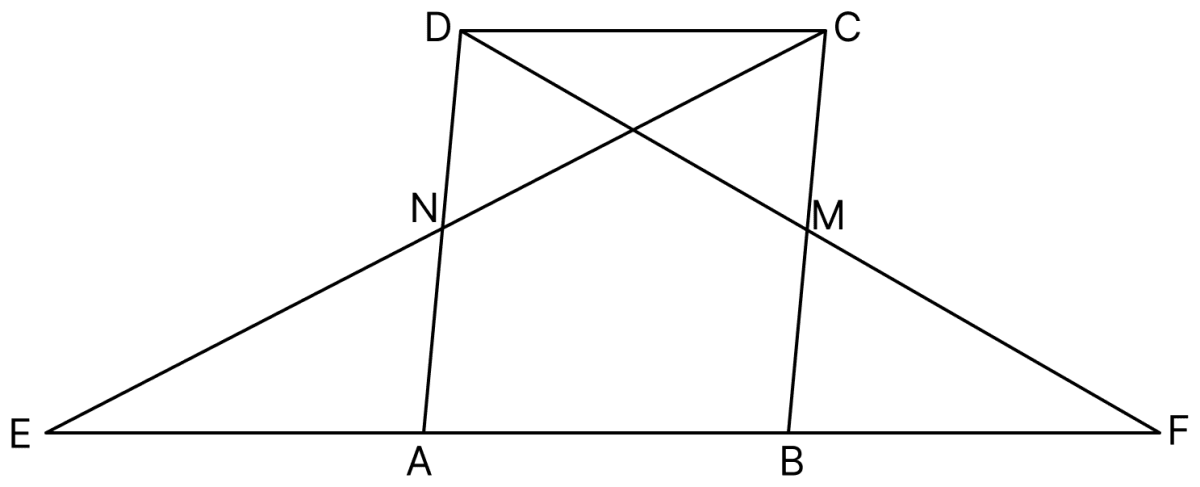
In the adjoining figure ABCD is a parallelogram and M, N are the mid-points of sides BC, AD respectively. Prove that EA = AB = BF.
Answer
As ABCD is a parallelogram, DC ∥ AB, that is DC ∥ EF.
In ΔANE and ΔDNC,
AN = ND (as N is the mid-point of AD)
∠ANE = ∠DNC (vertically opposite angles are equal)
∠NAE = ∠NDC (alternate angles are equal)
Therefore, by the A.S.A. congruence rule,
ΔANE ≅ ΔDNC
As the corresponding parts of congruent triangles are equal,
EA = DC ...............(1)
In ΔBMF and ΔCMD,
BM = MC (as M is the mid-point of BC)
∠BMF = ∠CMD (vertically opposite angles are equal)
∠MBF = ∠MCD (alternate angles are equal)
Therefore, by the A.S.A. congruence rule,
ΔBMF ≅ ΔCMD
As the corresponding parts of congruent triangles are equal,
BF = CD ...............(2)
Also, as the opposite sides of a parallelogram are equal,
AB = DC ...............(3)
From equations (1), (2) and (3),
EA = AB = BF
Hence, proved that EA = AB = BF.
Prove that the quadrilateral formed by joining the mid-points of the adjacent sides of a rectangle is a parallelogram.
Answer
Let ABCD be a rectangle and let P, Q, R and S be the mid-points of the sides AB, BC, CD and DA respectively.
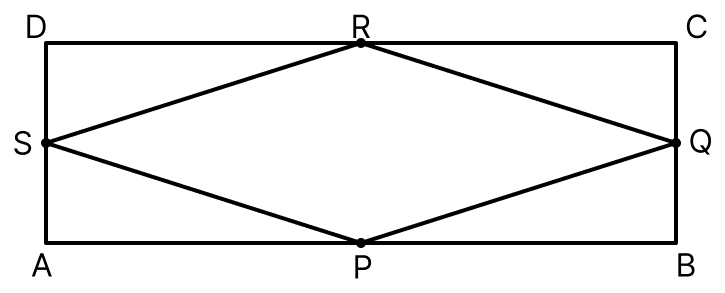
Join PQ, QR, RS and SP.
As each interior angle of a rectangle is a right angle,
∠A = ∠B = ∠C = ∠D = 90°
As the opposite sides of a rectangle are equal,
AB = CD and BC = DA
As P, Q, R and S are the mid-points of AB, BC, CD and DA respectively,
AP = PB = AB
CR = RD = CD
As AB = CD, we get
AP = PB = CR = RD ...............(1)
Also,
BQ = QC = BC
DS = SA = DA
As BC = DA, we get
BQ = QC = DS = SA ...............(2)
In ΔAPS and ΔBPQ,
AP = BP (from equation (1))
∠A = ∠B = 90° (each angle of a rectangle is a right angle)
SA = QB (from equation (2))
Therefore, by the S.A.S. congruence rule,
ΔAPS ≅ ΔBPQ
As the corresponding parts of congruent triangles are equal,
PS = PQ ...............(3)
In ΔCRQ and ΔDRS,
CR = DR (from equation (1))
∠C = ∠D = 90° (each angle of a rectangle is a right angle)
QC = SD (from equation (2))
Therefore, by the S.A.S. congruence rule,
ΔCRQ ≅ ΔDRS
As the corresponding parts of congruent triangles are equal,
RQ = RS ...............(4)
In ΔAPS and ΔCRQ,
AP = CR (from equation (1))
∠A = ∠C = 90° (each angle of a rectangle is a right angle)
SA = QC (from equation (2))
Therefore, by the S.A.S. congruence rule,
ΔAPS ≅ ΔCRQ
As the corresponding parts of congruent triangles are equal,
PS = RQ ...............(5)
From equations (3), (4) and (5),
PQ = QR = RS = SP
So, in quadrilateral PQRS,
PQ = RS and QR = SP
As both the pairs of opposite sides of quadrilateral PQRS are equal, PQRS is a parallelogram.
Hence, proved that the quadrilateral formed by joining the mid-points of the adjacent sides of a rectangle is a parallelogram.