
If P and Q are any two points on a circle, then the line segment PQ is called a
radius of the circle
diameter of the circle
chord of the circle
secant of the circle
Answer
We know that,
A chord of a circle is a line segment with its end points on the circle.
Here, P and Q are two points lying on the circle.
∴ The line segment PQ is a chord of the circle.
Hence, option 3 is the correct option.
If P is a point in the interior of a circle with centre O and radius r, then
OP = r
OP > r
OP ≥ r
OP < r
Answer
We know that,
A point lies in the interior of a circle if its distance from the centre is less than the radius of the circle.
Here, P lies in the interior of the circle with centre O and radius r.
∴ OP < r
Hence, option 4 is the correct option.
If AB = 12 cm, BC = 16 cm and AB is perpendicular to BC, then the radius of the circle passing through the points A, B and C is
6 cm
8 cm
10 cm
20 cm
Answer
Given, AB = 12 cm, BC = 16 cm and AB ⊥ BC.
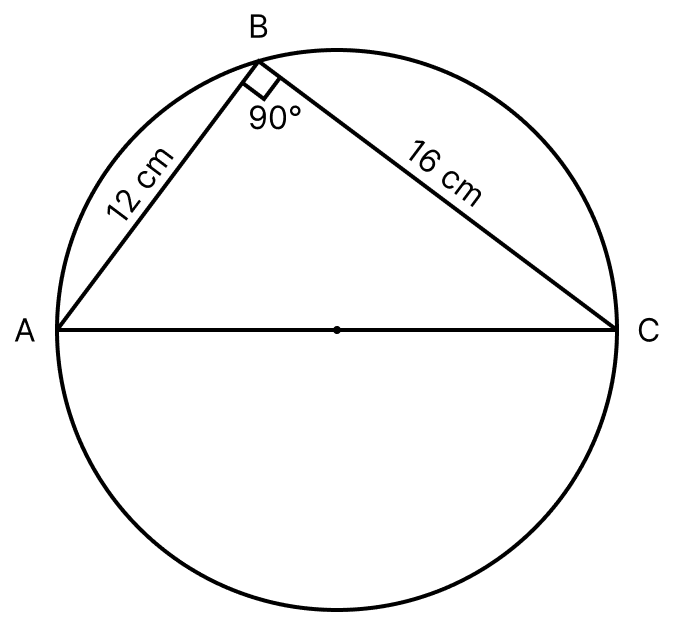
Since, ∠ABC = 90°, the chord AC subtends a right angle at the point B of the circle.
So, AC is the diameter of the circle passing through the points A and C.
In ∆ABC, using Pythagoras theorem,
⇒ AC2 = AB2 + BC2
⇒ AC2 = 122 + 162
⇒ AC2 = 144 + 256
⇒ AC2 = 400
⇒ AC =
⇒ AC = 20 cm
As we know that radius is half of the diameter.
⇒ Radius =
⇒ Radius = 10 cm
Hence, option 3 is the correct option.
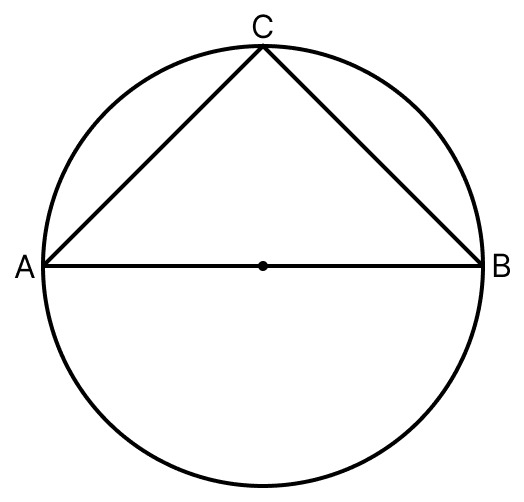
In the adjoining figure, AB is a diameter of the circle. If AC = BC, then ∠CAB is equal to
30°
45°
60°
90°
Answer
Given, AB is a diameter of the circle and AC = BC.
⇒ ∠CAB = ∠CBA [Angles opposite to equal sides of a triangle are always equal]
We know that,
Angle in a semicircle is a right angle.
⇒ ∠ACB = 90°
In ∆ACB, using angle sum property,
⇒ ∠CAB + ∠CBA + ∠ACB = 180°
⇒ ∠CAB + ∠CAB + 90° = 180°
⇒ 2∠CAB = 180° - 90°
⇒ 2∠CAB = 90°
⇒ ∠CAB =
⇒ ∠CAB = 45°
Hence, option 2 is the correct option.