
Sum of all interior angles of a 11-sided polygon is
1620°
1440°
1260°
none of these
Answer
According to the properties of a polygon, if a polygon has n sides, then the sum of measures of all its interior angles is (n - 2) × 180°.
Here, n = 11.
Sum of all interior angles = (11 - 2) x 180°
= 9 x 180°
= 1620°
Hence, option 1 is the correct option.
If each interior angle of a regular polygon is 144°, then number of sides of polygon is
8
9
10
11
Answer
It is given that each interior angle of a regular polygon is 144°.
As the sum of an interior angle and its adjacent exterior angle is 180°,
Each exterior angle = 180° - 144° = 36°
According to the properties of a polygon, if each exterior angle of a regular polygon is , then the number of sides in the regular polygon is .
Number of sides =
= 10
Hence, option 3 is the correct option.
If the sum of all interior angles of a polygon is 1260°, then number of sides of polygon is
6
7
8
9
Answer
It is given that the sum of all interior angles of a polygon is 1260°.
According to the properties of a polygon, if a polygon has n sides, then the sum of measures of all its interior angles is (n - 2) × 180°.
⇒ (n - 2) × 180° = 1260°
⇒ n - 2 =
⇒ n - 2 = 7
⇒ n = 7 + 2
⇒ n = 9
Hence, option 4 is the correct option.
The sum of all exterior angles of a pentagon is
590°
360°
180°
none of these
Answer
According to the properties of a polygon, the sum of all the exterior angles of a polygon is always 360°.
A pentagon is a polygon of 5 sides, so the sum of all its exterior angles is also 360°.
Hence, option 2 is the correct option.
If the ratio between an exterior and interior angle of a regular polygon is 1 : 5, then the number of sides of regular polygon is
11
12
13
14
Answer
It is given that the ratio between an exterior and interior angle of a regular polygon is 1 : 5.
Let the common factor be a. So, the exterior angle is a and the interior angle is 5a.
As the sum of an interior angle and its adjacent exterior angle is 180°,
⇒ a + 5a = 180°
⇒ 6a = 180°
⇒ a =
⇒ a = 30°
So, each exterior angle is 30°.
According to the properties of a polygon, if each exterior angle of a regular polygon is , then the number of sides in the regular polygon is .
Number of sides =
= 12
Hence, option 2 is the correct option.
In the adjoining figure, the value of x is
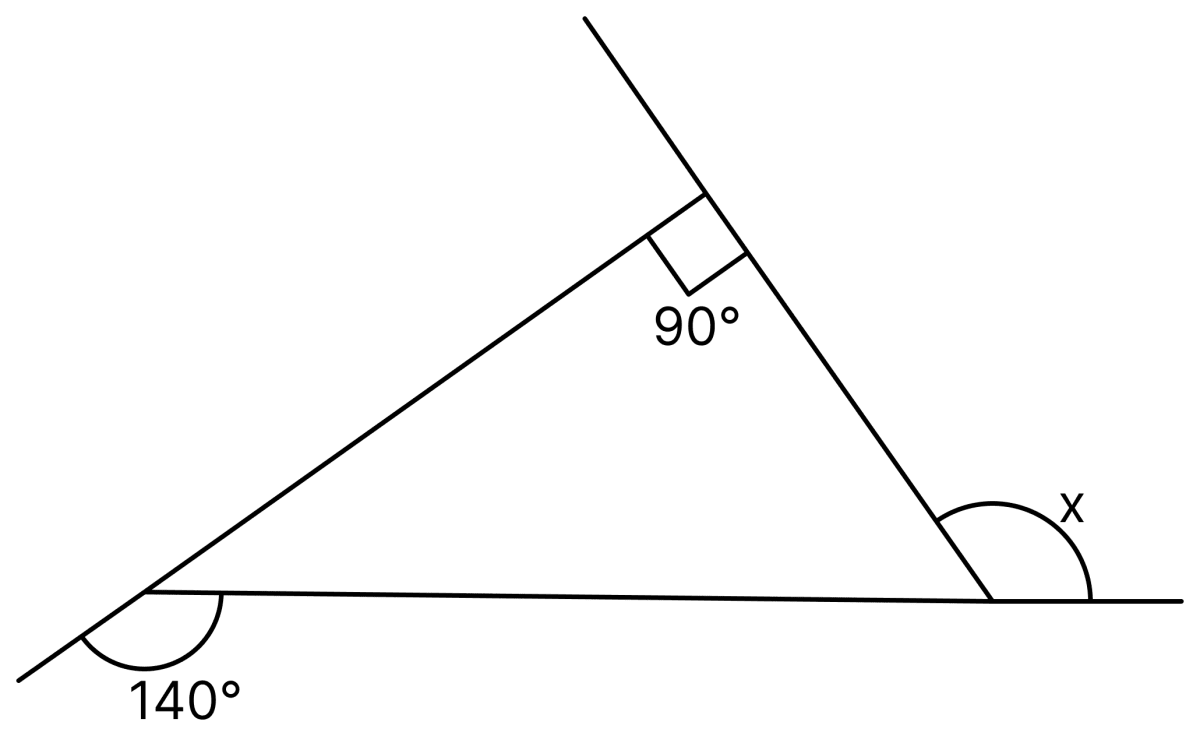
140°
50°
130°
40°
Answer
From the figure, the sides of the triangle have been produced in order, so 140°, 90° and x are the exterior angles of the triangle.
According to the properties of a polygon, the sum of all the exterior angles of a polygon is 360°.
⇒ 140° + 90° + x = 360°
⇒ 230° + x = 360°
⇒ x = 360° - 230°
⇒ x = 130°
Hence, option 3 is the correct option.
In the adjoining figure, the value of x is
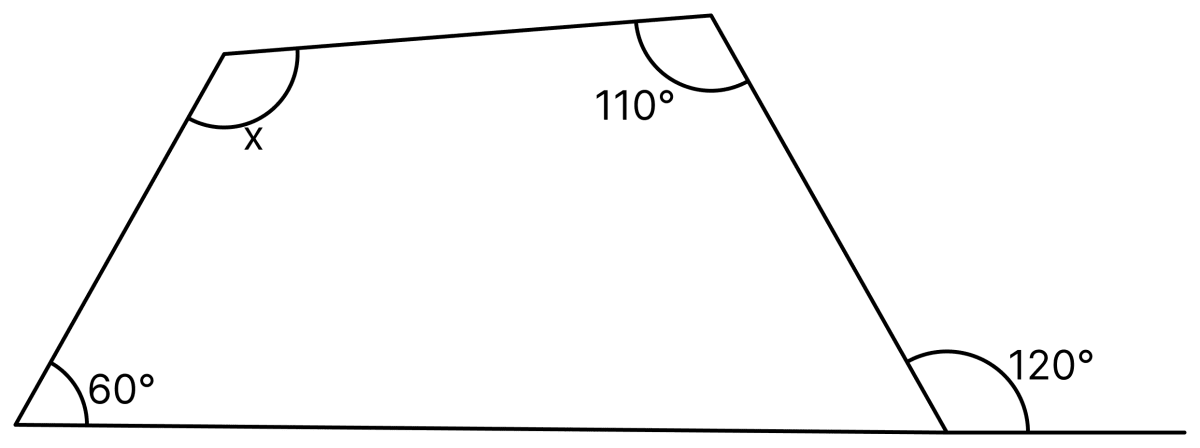
120°
130°
140°
150°
Answer
From the figure, the side of the quadrilateral has been produced and the exterior angle so formed is 120°.
As the sum of an interior angle and its adjacent exterior angle is 180°,
Interior angle at that vertex = 180° - 120° = 60°
As we know, the sum of all the interior angles of a quadrilateral is 360°.
⇒ 60° + x + 110° + 60° = 360°
⇒ 230° + x = 360°
⇒ x = 360° - 230°
⇒ x = 130°
Hence, option 2 is the correct option.
In the adjoining figure, the value of x + y + z + w is
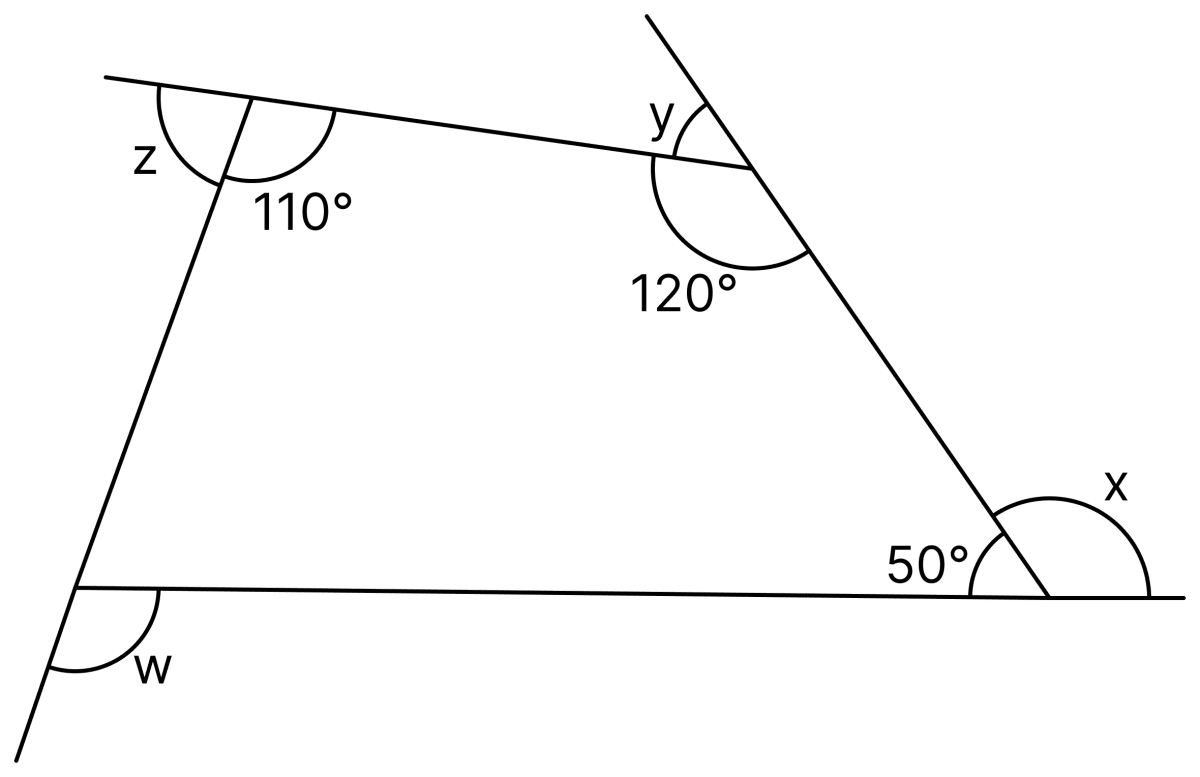
180°
270°
300°
360°
Answer
From the figure, the sides of the quadrilateral have been produced in order, so x, y, z and w are the exterior angles of the quadrilateral.
According to the properties of a polygon, the sum of all the exterior angles of a polygon is always 360°.
So, x + y + z + w = 360°
Hence, option 4 is the correct option.
In the adjoining figure, the value of x + y is
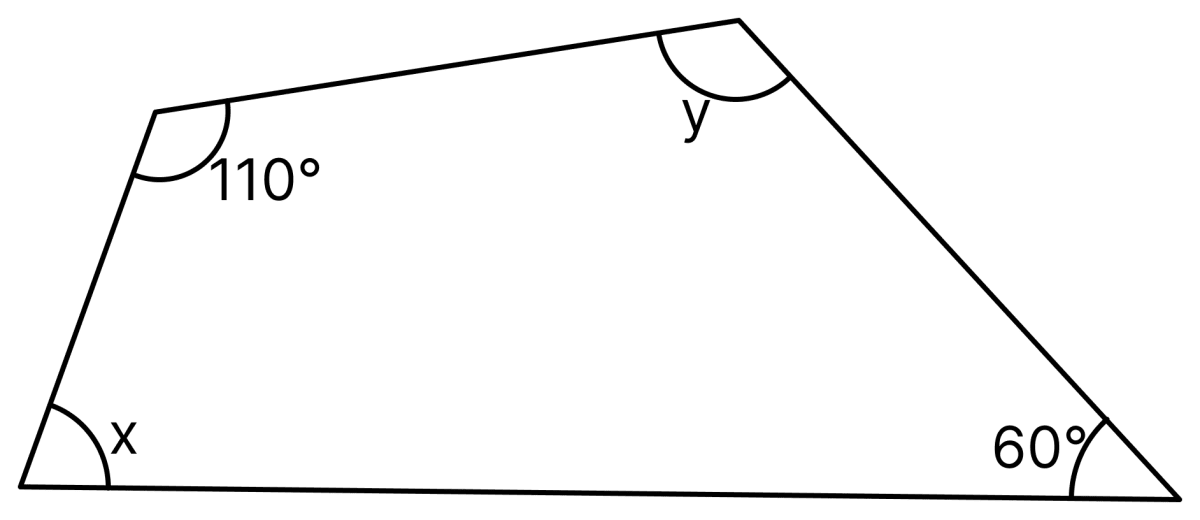
180°
190°
170°
160°
Answer
From the figure, 110°, y, 60° and x are the interior angles of the quadrilateral.
As we know, the sum of all the interior angles of a quadrilateral is 360°.
⇒ 110° + y + 60° + x = 360°
⇒ x + y + 170° = 360°
⇒ x + y = 360° - 170°
⇒ x + y = 190°
Hence, option 2 is the correct option.
The lengths of two adjacent sides of a parallelogram are in the ratio 1 : 2. If the perimeter of parallelogram is 60 cm, then length of its sides are
6 cm, 12 cm
8 cm, 16 cm
9 cm, 18 cm
10 cm, 20 cm
Answer
It is given that the lengths of two adjacent sides of a parallelogram are in the ratio 1 : 2 and the perimeter of the parallelogram is 60 cm.
Let the common factor be a. So, the adjacent sides are a cm and 2a cm.
As the opposite sides of a parallelogram are of equal length,
Perimeter = a + 2a + a + 2a
⇒ 60 = 6a
⇒ a =
⇒ a = 10
Thus, the sides are:
a = 10 cm
2a = 2 x 10 = 20 cm
Hence, option 4 is the correct option.
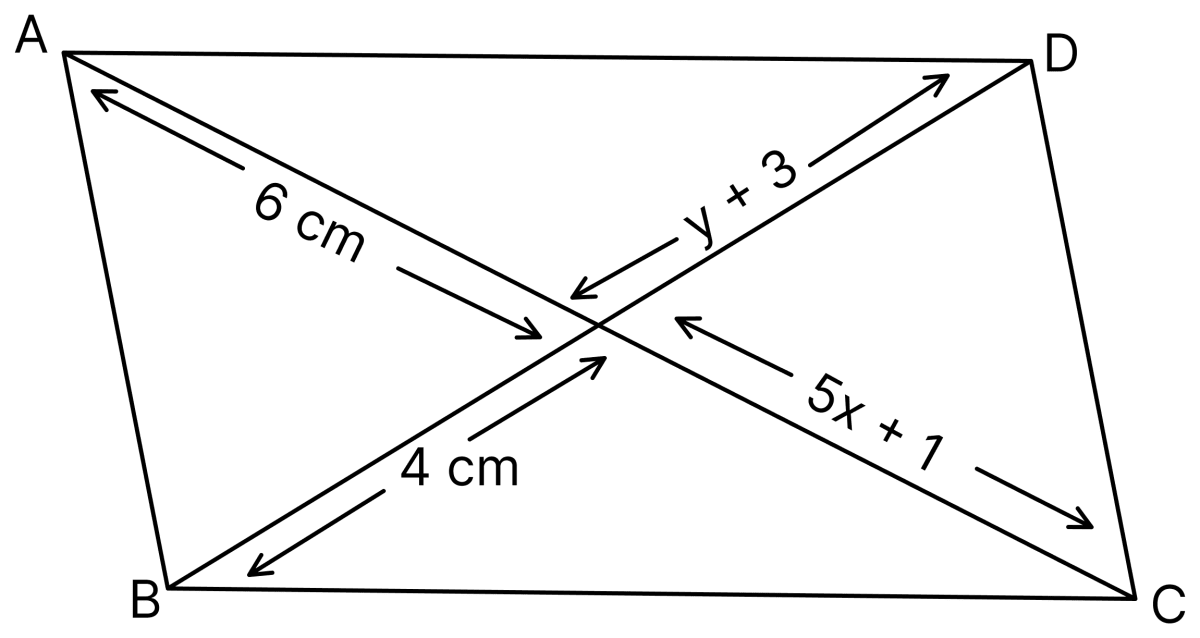
In the adjoining figure ABCD is a parallelogram, the values of x and y respectively are
1 cm, 1 cm
2 cm, 1 cm
1 cm, 2 cm
2 cm, 2 cm
Answer
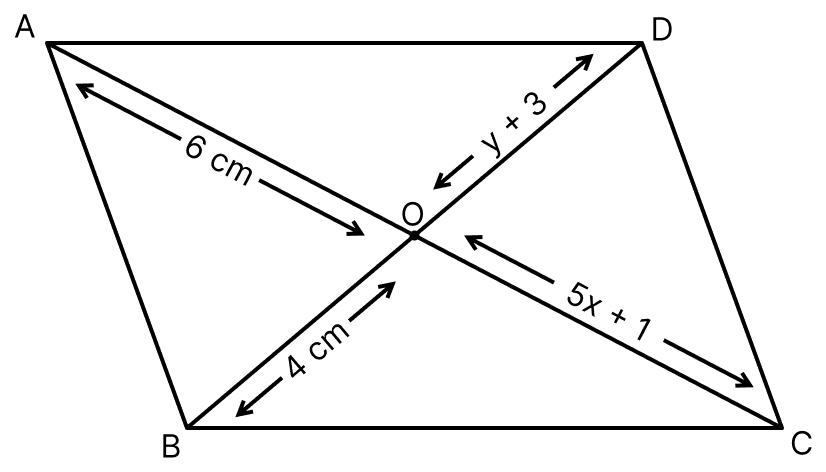
From the figure, in parallelogram ABCD the diagonals AC and BD intersect at O, where AO = 6 cm, OC = 5x + 1, BO = 4 cm and OD = y + 3.
As the diagonals of a parallelogram bisect each other,
OC = AO
⇒ 5x + 1 = 6
⇒ 5x = 6 - 1
⇒ 5x = 5
⇒ x =
⇒ x = 1
Also,
OD = BO
⇒ y + 3 = 4
⇒ y = 4 - 3
⇒ y = 1
Hence, option 1 is the correct option.
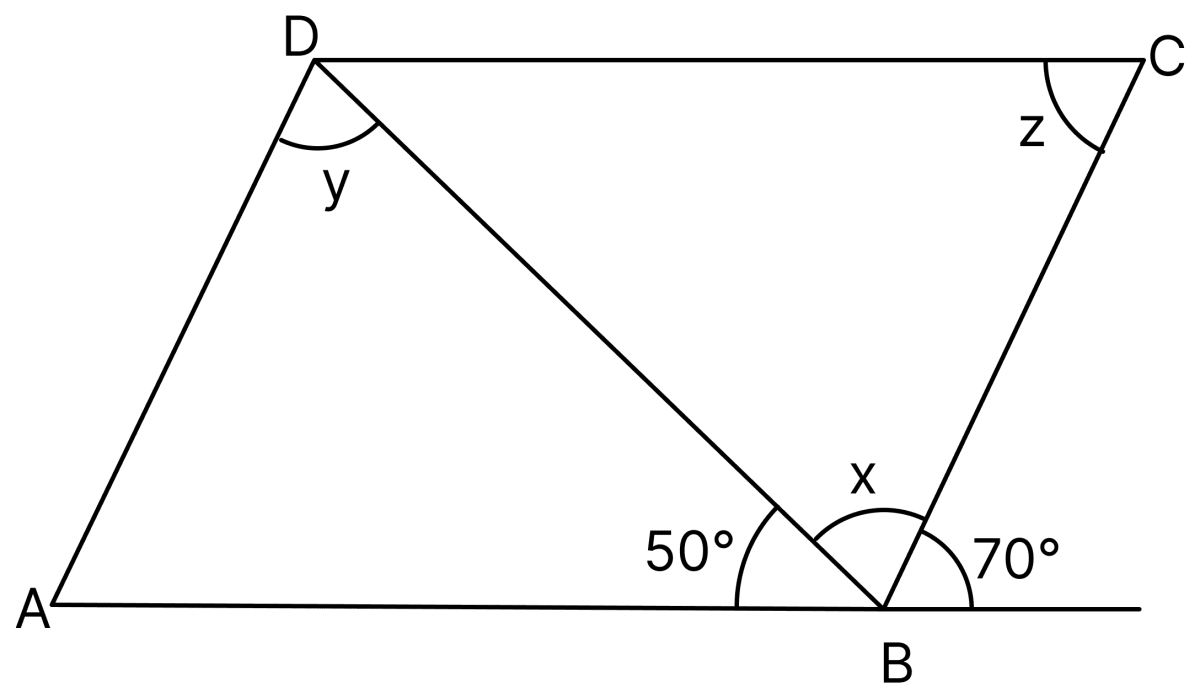
In the adjoining figure ABCD is a parallelogram, the values of x, y and z respectively are
60°, 60°, 70°
60°, 70°, 60°
70°, 60°, 60°
none of these
Answer
From the figure, in parallelogram ABCD the side AB has been produced beyond B and the exterior angle so formed is 70°.
As the sum of an interior angle and its adjacent exterior angle is 180°,
⇒ ∠ABC + 70° = 180°
⇒ ∠ABC = 180° - 70°
⇒ ∠ABC = 110°
From the figure,
⇒ 50° + x = ∠ABC
⇒ 50° + x = 110°
⇒ x = 110° - 50°
⇒ x = 60°
As AD ∥ BC and BD is a transversal,
y = ∠ADB = ∠DBC = x = 60° (alternate angles are equal)
As the opposite angles of a parallelogram are of equal measure,
z = ∠BCD = ∠DAB
As the adjacent angles of a parallelogram are supplementary,
⇒ ∠DAB = 180° - ∠ABC
⇒ ∠DAB = 180° - 110°
⇒ ∠DAB = 70°
So, z = 70°
Hence, option 1 is the correct option.
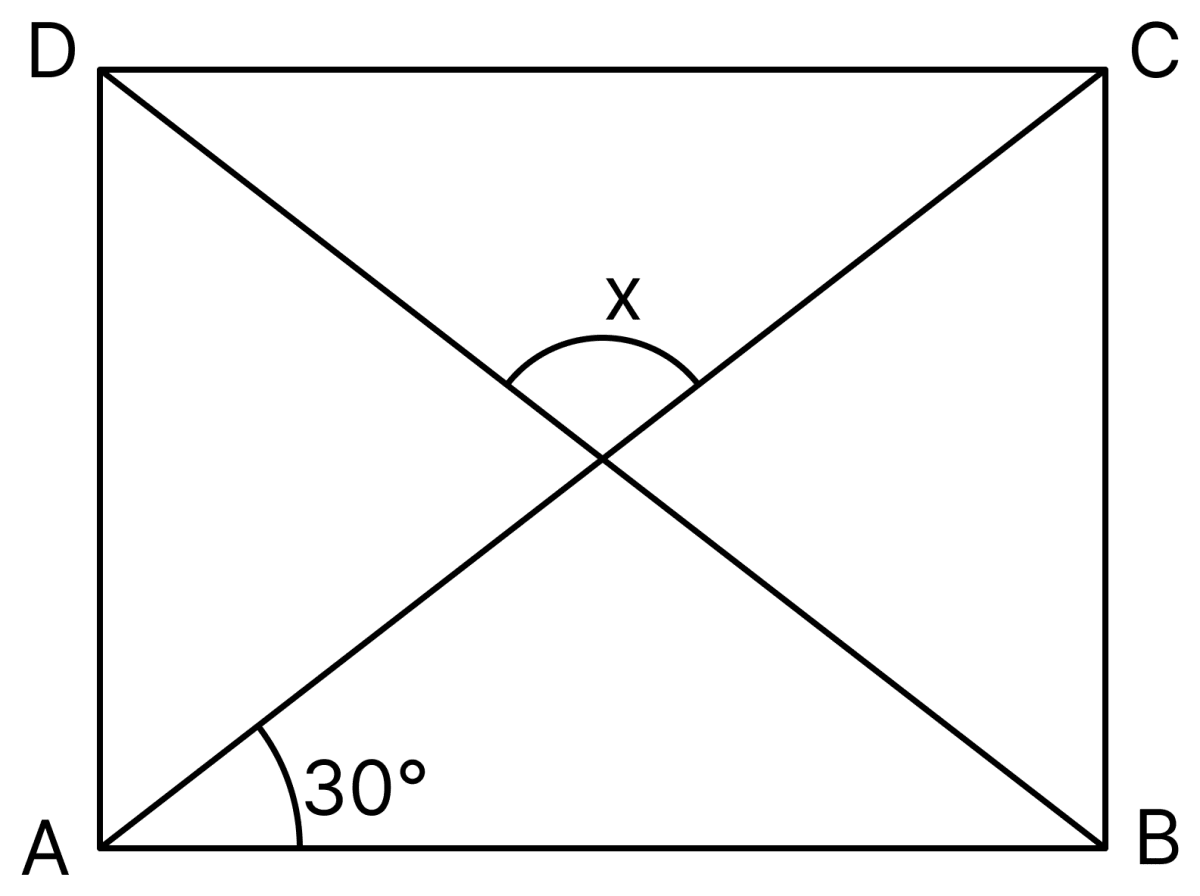
In the adjoining figure ABCD is a rectangle, the value of angle x is
60°
90°
120°
none of these
Answer
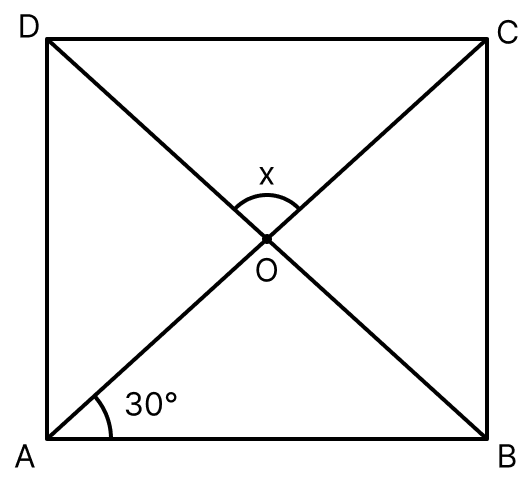
From the figure, in rectangle ABCD the diagonals intersect at O and ∠OAB = 30°.
As the diagonals of a rectangle are equal and bisect each other,
OA = OB
So, ΔAOB is an isosceles triangle.
⇒ ∠OBA = ∠OAB = 30° (angles opposite to equal sides are equal)
In ΔAOB, the sum of all the angles of a triangle is 180°.
⇒ ∠OAB + ∠OBA + ∠AOB = 180°
⇒ 30° + 30° + ∠AOB = 180°
⇒ 60° + ∠AOB = 180°
⇒ ∠AOB = 180° - 60°
⇒ ∠AOB = 120°
As x and ∠AOB are vertically opposite angles,
x = ∠AOB = 120°
Hence, option 3 is the correct option.
In a rhombus ABCD, diagonals AC and BD are respectively 8 cm and 6 cm, the length of each side of rhombus is
7 cm
5 cm
6 cm
8 cm
Answer
It is given that in rhombus ABCD, the diagonals AC and BD are respectively 8 cm and 6 cm.
Let the diagonals intersect at O.
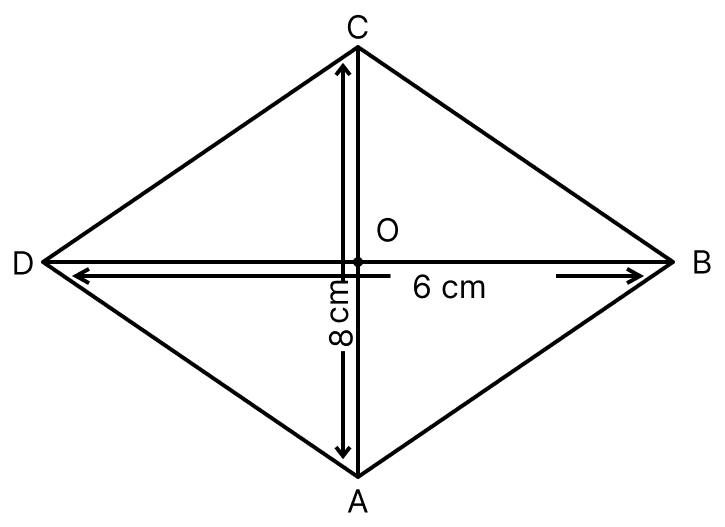
As the diagonals of a rhombus bisect each other,
AO = = 4 cm
BO = = 3 cm
As the diagonals of a rhombus intersect at right angles, ∠AOB = 90°.
So, ΔAOB is a right angled triangle.
By Pythagoras theorem,
⇒ AB2 = AO2 + BO2
⇒ AB2 = 42 + 32
⇒ AB2 = 16 + 9
⇒ AB2 = 25
⇒ AB =
⇒ AB = 5 cm
Hence, option 2 is the correct option.
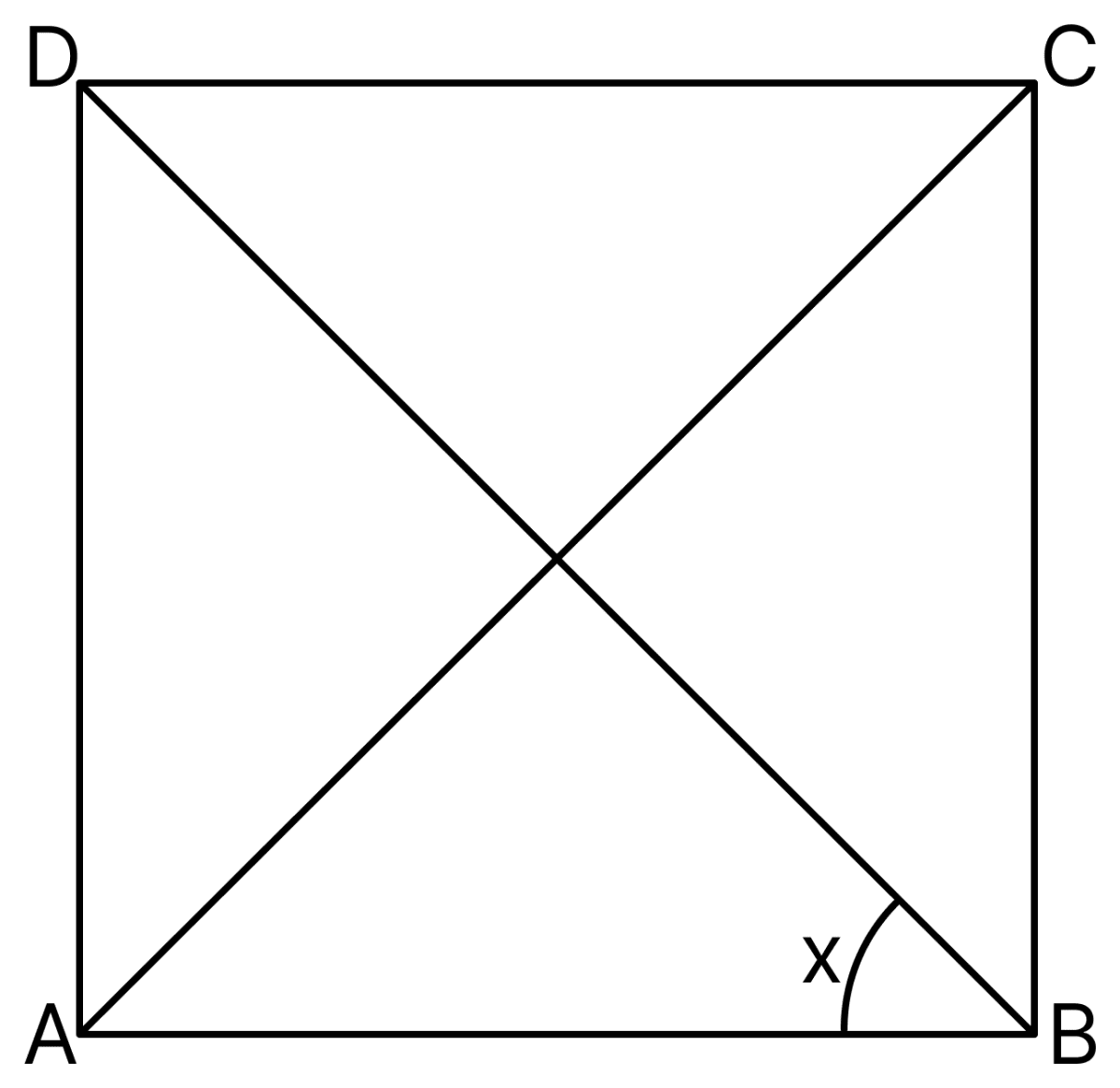
In the adjoining figure ABCD is a square, the value of angle is
30°
45°
60°
not possible to find
Answer
From the figure, in square ABCD the diagonals AC and BD are drawn and = ∠ABD.
As we know, the diagonals of a square bisect the angles of the square.
So, the diagonal BD bisects ∠ABC.
Hence, option 2 is the correct option.
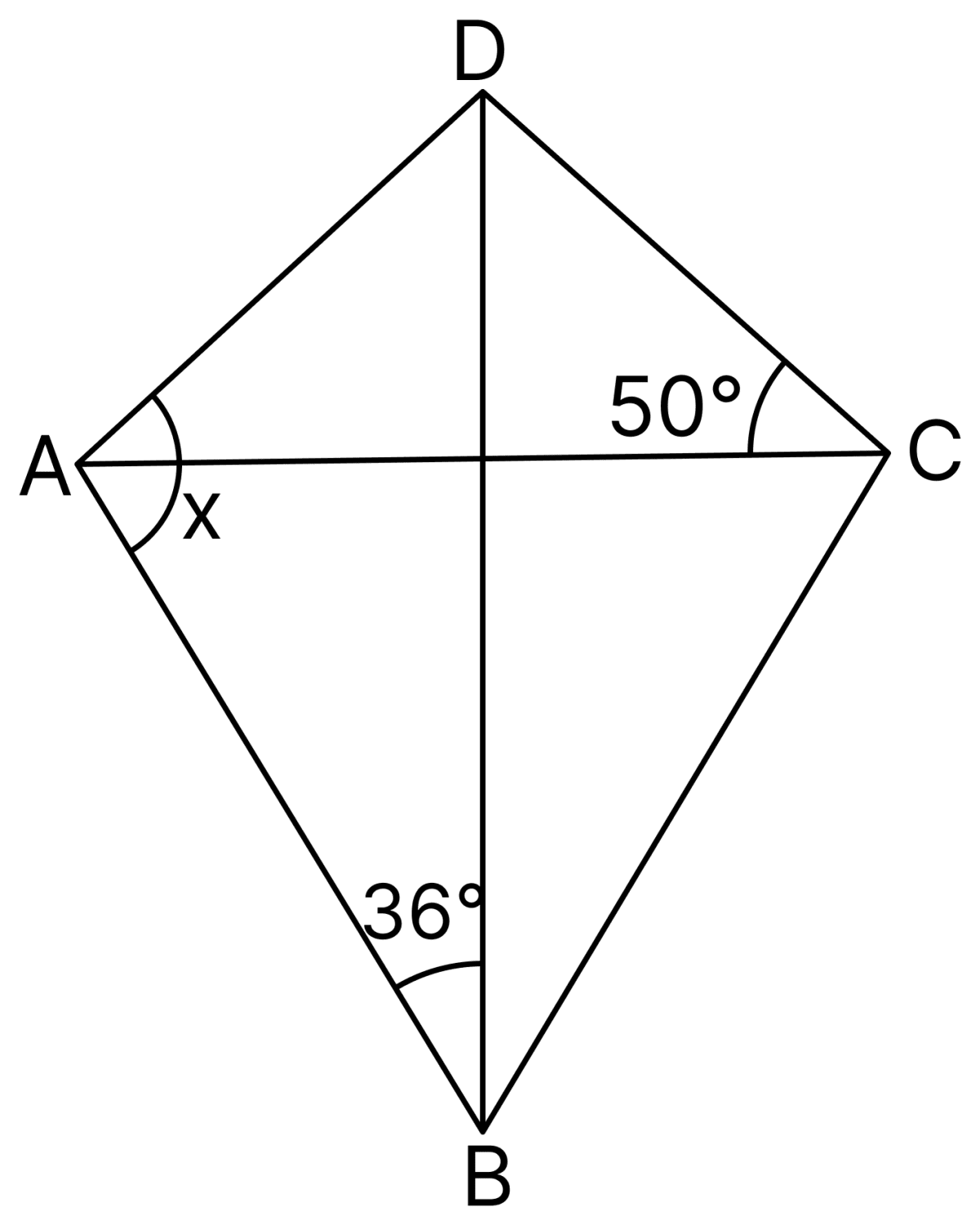
In the adjoining figure, ABCD is a kite, the value of angle x is
86°
100°
104°
none of these
Answer
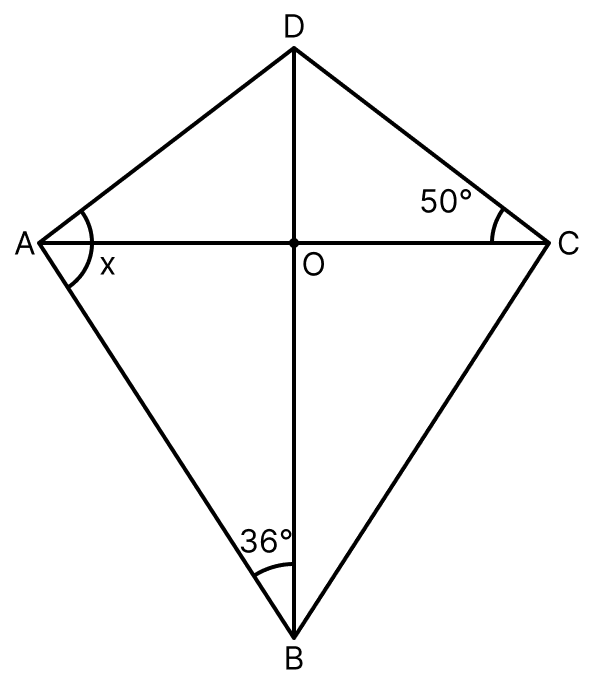
From the figure, in kite ABCD, AD = DC and AB = BC, the diagonals AC and BD intersect at O, ∠DCA = 50° and ∠ABD = 36°.
In ΔADC, AD = DC, so ΔADC is an isosceles triangle.
⇒ ∠DAC = ∠DCA = 50° (angles opposite to equal sides are equal)
As the diagonals of a kite intersect at right angles,
∠AOB = 90°
In ΔAOB, the sum of all the angles of a triangle is 180°.
⇒ ∠OAB + ∠ABO + ∠AOB = 180°
⇒ ∠OAB + 36° + 90° = 180°
⇒ ∠OAB + 126° = 180°
⇒ ∠OAB = 180° - 126°
⇒ ∠OAB = 54°
From the figure,
x = ∠DAB = ∠DAC + ∠OAB
⇒ x = 50° + 54°
⇒ x = 104°
Hence, option 3 is the correct option.
In the adjoining figure, ABCD is an isosceles trapezium, the values of x, y and z respectively are
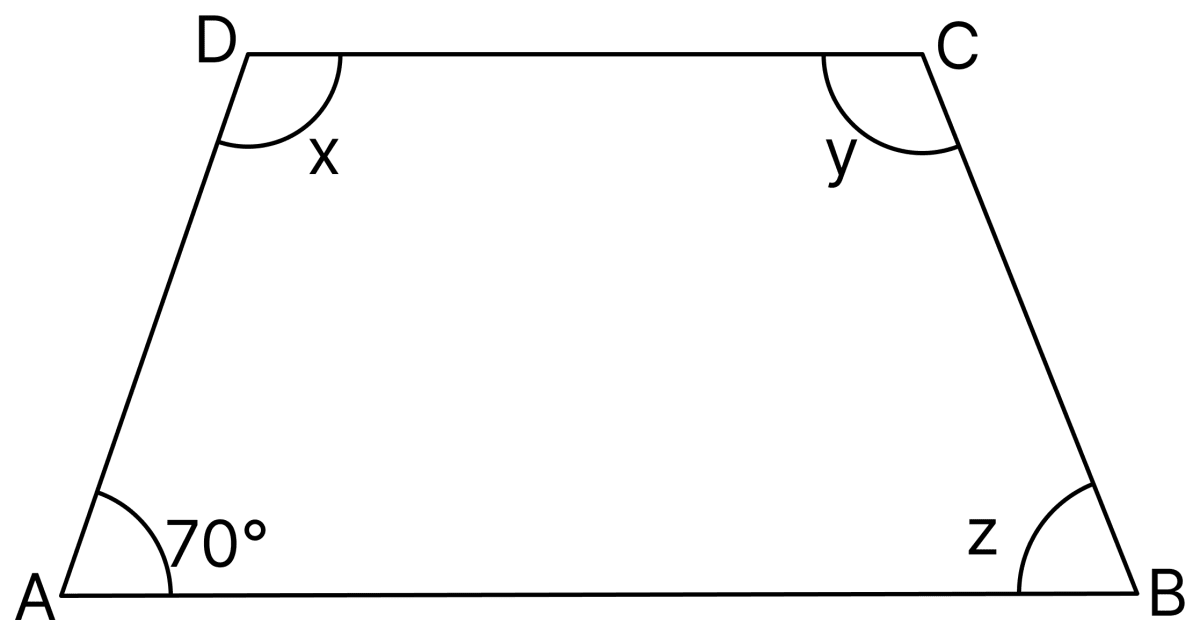
110°, 110°, 70°
110°, 70°, 110°
70°, 110°, 110°
none of these.
Answer
From the figure, ABCD is an isosceles trapezium in which AB ∥ DC, AD = BC and ∠A = 70°.
As the angles on the same base of an isosceles trapezium are equal,
z = ∠B = ∠A = 70°
As AB ∥ DC and AD is a transversal, the co-interior angles ∠A and ∠D are supplementary.
⇒ x + ∠A = 180°
⇒ x + 70° = 180°
⇒ x = 180° - 70°
⇒ x = 110°
As the angles on the same base of an isosceles trapezium are equal,
y = ∠C = ∠D = x = 110°
Hence, option 1 is the correct option.