Show that 1089 is a perfect square. Also find the number whose square is 1089.
Answer
Finding prime factors of 1089
3 1089 3 363 11 121 11 11 1 \begin{array}{l|r} 3 & 1089 \\ \hline 3 & 363 \\ \hline 11 & 121 \\ \hline 11 & 11 \\ \hline & 1 \\ \end{array} 3 3 11 11 1089 363 121 11 1
1089 = (3 × 3) × (11 × 11)
Since 1089 can be expressed as the product of pairs of equal prime factors, so 1089 is a perfect square.
1089 = (3)2 × (11)2
⇒ 1089 = (3 × 11)2
⇒ 1089 = (33)2
Hence, 1089 is a perfect square and 33 is the number whose square is 1089.
Find the smallest number which should be multiplied by 3675 to make it a perfect square. Also find the square root of this perfect square.
Answer
Finding prime factors of 3675
3 3675 5 1225 5 245 7 49 7 7 1 \begin{array}{l|r} 3 & 3675 \\ \hline 5 & 1225 \\ \hline 5 & 245 \\ \hline 7 & 49 \\ \hline 7 & 7 \\ \hline & 1 \\ \end{array} 3 5 5 7 7 3675 1225 245 49 7 1
3675 = (5 × 5) × (7 × 7) × 3
Since the prime factor 3 is left unpaired, so 3675 should be multiplied by 3.
⇒ 3675 × 3 = 11025 ⇒ 11025 = ( 3 × 3 ) × ( 5 × 5 ) × ( 7 × 7 ) ⇒ 11025 = 3 × 5 × 7 ⇒ 11025 = 105 \Rightarrow 3675 \times 3 = 11025\\[1em] \Rightarrow 11025 = (3 \times 3) \times (5 \times 5) \times (7 \times 7)\\[1em] \Rightarrow \sqrt{11025} = 3 \times 5 \times 7\\[1em] \Rightarrow \sqrt{11025} = 105 ⇒ 3675 × 3 = 11025 ⇒ 11025 = ( 3 × 3 ) × ( 5 × 5 ) × ( 7 × 7 ) ⇒ 11025 = 3 × 5 × 7 ⇒ 11025 = 105
Hence, 3675 should be multiplied by 3 and 11025 = 105 \mathbf{\sqrt{11025} = 105} 11025 = 105
Express 144 as the sum of 12 odd numbers.
Answer
As we know that, the sum of first n odd natural numbers = n2 .
144 = 122
So, 144 is the sum of the first 12 odd natural numbers.
Hence, 144 = 1 + 3 + 5 + 7 + 9 + 11 + 13 + 15 + 17 + 19 + 21 + 23.
How many numbers lie between 992 and 1002 ?
Answer
We know that there are 2n non-square numbers between the squares of two consecutive numbers n and (n + 1).
Here, n = 99
Numbers between 992 and 1002 = 2 × 99
= 198
Hence, there are 198 numbers between 992 and 1002 .
Write a Pythagorean triplet whose one number is 17.
Answer
We know that for any natural number m > 1, (2m, m2 - 1, m2 + 1) is a Pythagorean triplet.
Let 2m = 17
⇒ m = 8.5, which is not a natural number.
Let m2 - 1 = 17
⇒ m2 = 18, so m is not a natural number.
Let m2 + 1 = 17
⇒ m2 = 16
⇒ m = 4
∴ 2m = 2 × 4 = 8 and m2 - 1 = 16 - 1 = 15
Hence, (8, 15, 17) is a Pythagorean triplet whose one number is 17.
Find the smallest square number which is divisible by each of the numbers 6, 8, 9.
Answer
LCM of 6, 8 and 9 is 2 × 2 × 2 × 3 × 3 = 72.
So, the smallest number divisible by each one of 6, 8 and 9 is 72.
2 72 2 36 2 18 3 9 3 3 1 \begin{array}{l|r} 2 & 72 \\ \hline 2 & 36 \\ \hline 2 & 18 \\ \hline 3 & 9 \\ \hline 3 & 3 \\ \hline & 1 \\ \end{array} 2 2 2 3 3 72 36 18 9 3 1
72 = (2 × 2) × (3 × 3) × 2
Since the prime factor 2 is left unpaired, so 72 should be multiplied by 2.
Required square number = 72 × 2
= 144
Hence, the smallest square number divisible by 6, 8 and 9 is 144.
In an auditorium the number of rows is equal to number of chairs in each row. If the capacity of the auditorium is 1764. Find the number of chairs in each row.
Answer
Let the number of chairs in each row be x x x
The number of rows = the number of chairs in each row = x x x
Finding prime factors of 1764
2 1764 2 882 3 441 3 147 7 49 7 7 1 \begin{array}{l|r} 2 & 1764 \\ \hline 2 & 882 \\ \hline 3 & 441 \\ \hline 3 & 147 \\ \hline 7 & 49 \\ \hline 7 & 7 \\ \hline & 1 \\ \end{array} 2 2 3 3 7 7 1764 882 441 147 49 7 1
⇒ x × x = 1764 ⇒ x 2 = 1764 ⇒ x = 1764 ⇒ x = ( 2 × 2 ) × ( 3 × 3 ) × ( 7 × 7 ) ⇒ x = 2 × 3 × 7 ⇒ x = 42 \Rightarrow x \times x = 1764\\[1em] \Rightarrow x^2 = 1764\\[1em] \Rightarrow x = \sqrt{1764}\\[1em] \Rightarrow x = \sqrt{(2 \times 2) \times (3 \times 3) \times (7 \times 7)}\\[1em] \Rightarrow x = 2 \times 3 \times 7\\[1em] \Rightarrow x = 42 ⇒ x × x = 1764 ⇒ x 2 = 1764 ⇒ x = 1764 ⇒ x = ( 2 × 2 ) × ( 3 × 3 ) × ( 7 × 7 ) ⇒ x = 2 × 3 × 7 ⇒ x = 42
Hence, the number of chairs in each row is 42.
Find the length of diagonal of a rectangle whose length and breadth are 12 m and 5 m respectively.
Answer
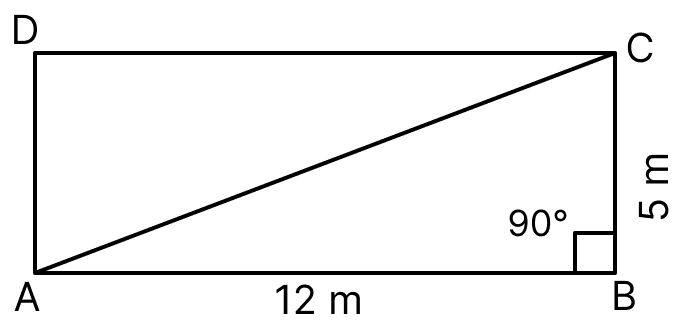
Let ABCD be the rectangle with length AB = 12 m and breadth BC = 5 m.
In right triangle ABC, ∠B = 90°.
By Pythagoras theorem,
⇒ A C 2 = A B 2 + B C 2 ⇒ A C 2 = 12 2 + 5 2 ⇒ A C 2 = 144 + 25 ⇒ A C 2 = 169 ⇒ A C = 169 ⇒ A C = 13 \Rightarrow AC^2 = AB^2 + BC^2\\[1em] \Rightarrow AC^2 = 12^2 + 5^2\\[1em] \Rightarrow AC^2 = 144 + 25\\[1em] \Rightarrow AC^2 = 169\\[1em] \Rightarrow AC = \sqrt{169}\\[1em] \Rightarrow AC = 13 ⇒ A C 2 = A B 2 + B C 2 ⇒ A C 2 = 1 2 2 + 5 2 ⇒ A C 2 = 144 + 25 ⇒ A C 2 = 169 ⇒ A C = 169 ⇒ A C = 13
Hence, the length of the diagonal of the rectangle is 13 m.
Find the square root of following numbers by prime factorisation:
5625
Answer
Finding prime factors of 5625
3 5625 3 1875 5 625 5 125 5 25 5 5 1 \begin{array}{l|r} 3 & 5625 \\ \hline 3 & 1875 \\ \hline 5 & 625 \\ \hline 5 & 125 \\ \hline 5 & 25 \\ \hline 5 & 5 \\ \hline & 1 \\ \end{array} 3 3 5 5 5 5 5625 1875 625 125 25 5 1
Solving,
⇒ 5625 = ( 3 × 3 ) × ( 5 × 5 ) × ( 5 × 5 ) ⇒ 5625 = 3 × 5 × 5 ⇒ 5625 = 75 \Rightarrow 5625 = (3 \times 3) \times (5 \times 5) \times (5 \times 5)\\[1em] \Rightarrow \sqrt{5625} = 3 \times 5 \times 5\\[1em] \Rightarrow \sqrt{5625} = 75 ⇒ 5625 = ( 3 × 3 ) × ( 5 × 5 ) × ( 5 × 5 ) ⇒ 5625 = 3 × 5 × 5 ⇒ 5625 = 75
Hence, 5625 = 75 \mathbf{\sqrt{5625} = 75} 5625 = 75
Find the square root of following numbers by prime factorisation:
1521
Answer
Finding prime factors of 1521
3 1521 3 507 13 169 13 13 1 \begin{array}{l|r} 3 & 1521 \\ \hline 3 & 507 \\ \hline 13 & 169 \\ \hline 13 & 13 \\ \hline & 1 \\ \end{array} 3 3 13 13 1521 507 169 13 1
Solving,
⇒ 1521 = ( 3 × 3 ) × ( 13 × 13 ) ⇒ 1521 = 3 × 13 ⇒ 1521 = 39 \Rightarrow 1521 = (3 \times 3) \times (13 \times 13)\\[1em] \Rightarrow \sqrt{1521} = 3 \times 13\\[1em] \Rightarrow \sqrt{1521} = 39 ⇒ 1521 = ( 3 × 3 ) × ( 13 × 13 ) ⇒ 1521 = 3 × 13 ⇒ 1521 = 39
Hence, 1521 = 39 \mathbf{\sqrt{1521} = 39} 1521 = 39
Find the square root of following numbers by division method:
21904
Answer
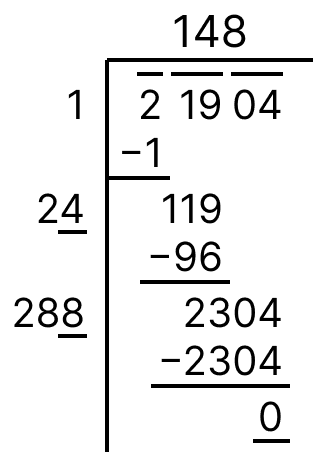
Square root of 21904 by division method:
Hence, 21904 = 148 \mathbf{\sqrt{21904} = 148} 21904 = 148
Find the square root of following numbers by division method:
108241
Answer
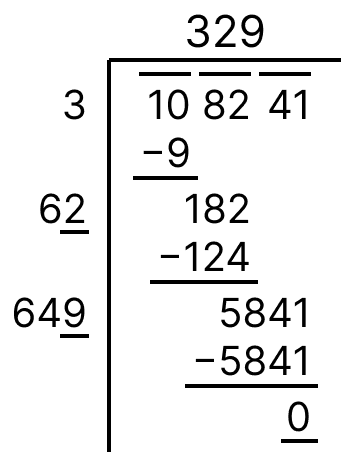
Square root of 108241 by division method:
Hence, 108241 = 329 \mathbf{\sqrt{108241} = 329} 108241 = 329
Find the square root of following decimal numbers:
17.64
Answer
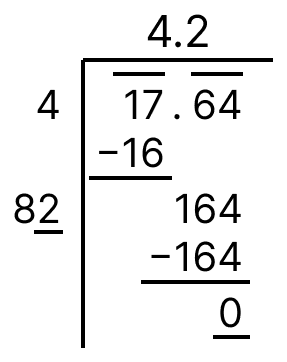
Square root of 17.64 by division method:
Hence, 17.64 = 4.2 \mathbf{\sqrt{17.64} = 4.2} 17.64 = 4.2
Find the square root of following decimal numbers:
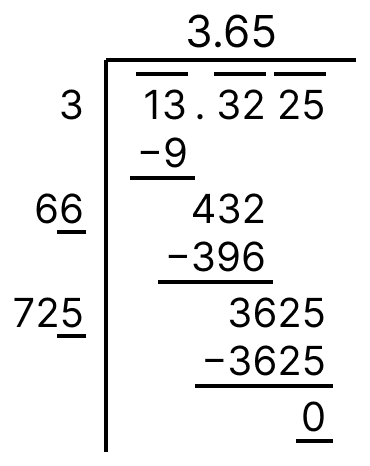
13.3225
Answer
Square root of 13.3225 by division method:
Hence, 13.3225 = 3.65 \mathbf{\sqrt{13.3225} = 3.65} 13.3225 = 3.65
Find the square root of following fractions:
1 25 144 1\dfrac{25}{144} 1 144 25
Answer
Converting mixed fraction into improper fraction.
⇒ 1 25 144 ⇒ 169 144 ⇒ 169 144 ⇒ 13 × 13 12 × 12 ⇒ 13 12 ⇒ 1 1 12 \Rightarrow \sqrt{1\dfrac{25}{144}}\\[1em] \Rightarrow \sqrt{\dfrac{169}{144}}\\[1em] \Rightarrow \dfrac{\sqrt{169}}{\sqrt{144}}\\[1em] \Rightarrow \dfrac{\sqrt{13 \times 13}}{\sqrt{12 \times 12}}\\[1em] \Rightarrow \dfrac{13}{12}\\[1em] \Rightarrow 1\dfrac{1}{12} ⇒ 1 144 25 ⇒ 144 169 ⇒ 144 169 ⇒ 12 × 12 13 × 13 ⇒ 12 13 ⇒ 1 12 1
Hence, 1 25 144 = 1 1 12 \mathbf{\sqrt{1\dfrac{25}{144}} = 1\dfrac{1}{12}} 1 144 25 = 1 12 1
Find the square root of following fractions:
11 225 576 11\dfrac{225}{576} 11 576 225
Answer
Converting mixed fraction into improper fraction.
⇒ 11 225 576 ⇒ 6561 576 ⇒ 6561 576 ⇒ 81 × 81 24 × 24 ⇒ 81 24 ⇒ 27 8 ⇒ 3 3 8 \Rightarrow \sqrt{11\dfrac{225}{576}}\\[1em] \Rightarrow \sqrt{\dfrac{6561}{576}}\\[1em] \Rightarrow \dfrac{\sqrt{6561}}{\sqrt{576}}\\[1em] \Rightarrow \dfrac{\sqrt{81 \times 81}}{\sqrt{24 \times 24}}\\[1em] \Rightarrow \dfrac{81}{24}\\[1em] \Rightarrow \dfrac{27}{8}\\[1em] \Rightarrow 3\dfrac{3}{8} ⇒ 11 576 225 ⇒ 576 6561 ⇒ 576 6561 ⇒ 24 × 24 81 × 81 ⇒ 24 81 ⇒ 8 27 ⇒ 3 8 3
Hence, 11 225 576 = 3 3 8 \mathbf{\sqrt{11\dfrac{225}{576}} = 3\dfrac{3}{8}} 11 576 225 = 3 8 3
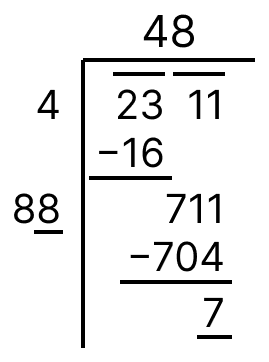
Find the least number which must be subtracted from 2311 to make it a perfect square.
Answer
Using division method:
Clearly, if 7 is subtracted from 2311, the remainder will be a perfect square.
Since, 2311 - 7 = 2304
and, 2304 = 48 \sqrt{2304} = 48 2304 = 48
Hence, 7 should be subtracted from 2311.
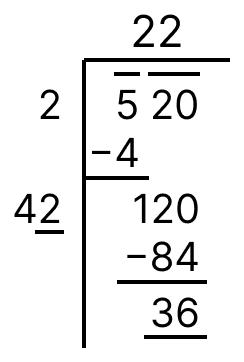
Find the least number which must be added to 520 to make it a perfect square.
Answer
Using division method:
Clearly, 520 is greater than 222 .
∴ On adding the required number to 520, we shall be getting 232 i.e, 529.
So, the required number = 529 - 520 = 9.
Hence, 9 should be added to 520.
Find the greatest number of 5 digits which is a perfect square.
Answer
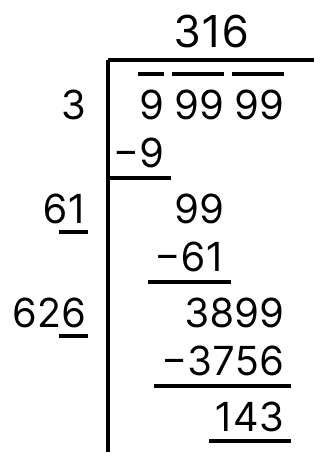
The greatest five digit number = 99999
Using division method:
We get the remainder = 143
It means (316)2 is less than 99999 by 143.
∴ If we subtract 143 from 99999, we get (316)2 which is a perfect square number.
So, the required perfect square number = 99999 - 143 = 99856.
Hence, the greatest five digit number which is a perfect square is 99856.
A square field is to be ploughed. Ramu ploughed in ₹34560 at the rate of ₹15 per sq. m. Find the length of side of square field.
Answer
⇒ Area of the square field = Total cost Rate per sq. m ⇒ 34560 15 ⇒ 2304 sq. m \Rightarrow \text{Area of the square field} = \dfrac{\text{Total cost}}{\text{Rate per sq. m}}\\[1em] \Rightarrow \dfrac{34560}{15}\\[1em] \Rightarrow 2304 \text{ sq. m} ⇒ Area of the square field = Rate per sq. m Total cost ⇒ 15 34560 ⇒ 2304 sq. m
Let the length of side of the square field be x x x
Finding prime factors of 2304
2 2304 2 1152 2 576 2 288 2 144 2 72 2 36 2 18 3 9 3 3 1 \begin{array}{l|r} 2 & 2304 \\ \hline 2 & 1152 \\ \hline 2 & 576 \\ \hline 2 & 288 \\ \hline 2 & 144 \\ \hline 2 & 72 \\ \hline 2 & 36 \\ \hline 2 & 18 \\ \hline 3 & 9 \\ \hline 3 & 3 \\ \hline & 1 \\ \end{array} 2 2 2 2 2 2 2 2 3 3 2304 1152 576 288 144 72 36 18 9 3 1
Solving,
⇒ x 2 = 2304 ⇒ x = 2304 ⇒ x = ( 2 × 2 ) × ( 2 × 2 ) × ( 2 × 2 ) × ( 2 × 2 ) × ( 3 × 3 ) ⇒ x = 2 × 2 × 2 × 2 × 3 ⇒ x = 48 \Rightarrow x^2 = 2304\\[1em] \Rightarrow x = \sqrt{2304}\\[1em] \Rightarrow x = \sqrt{(2 \times 2) \times (2 \times 2) \times (2 \times 2) \times (2 \times 2) \times (3 \times 3)}\\[1em] \Rightarrow x = 2 \times 2 \times 2 \times 2 \times 3\\[1em] \Rightarrow x = 48 ⇒ x 2 = 2304 ⇒ x = 2304 ⇒ x = ( 2 × 2 ) × ( 2 × 2 ) × ( 2 × 2 ) × ( 2 × 2 ) × ( 3 × 3 ) ⇒ x = 2 × 2 × 2 × 2 × 3 ⇒ x = 48
Hence, the length of side of the square field is 48 m.
If 2025 + 0.0612 + x \sqrt{2025} + \sqrt{0.0612 + x} 2025 + 0.0612 + x
Answer
Solving,
⇒ 2025 + 0.0612 + x = 45.25 ⇒ 45 + 0.0612 + x = 45.25 ⇒ 0.0612 + x = 45.25 − 45 ⇒ 0.0612 + x = 0.25 ⇒ 0.0612 + x = ( 0.25 ) 2 ⇒ 0.0612 + x = 0.0625 ⇒ x = 0.0625 − 0.0612 ⇒ x = 0.0013 \Rightarrow \sqrt{2025} + \sqrt{0.0612 + x} = 45.25\\[1em] \Rightarrow 45 + \sqrt{0.0612 + x} = 45.25\\[1em] \Rightarrow \sqrt{0.0612 + x} = 45.25 - 45\\[1em] \Rightarrow \sqrt{0.0612 + x} = 0.25\\[1em] \Rightarrow 0.0612 + x = (0.25)^2\\[1em] \Rightarrow 0.0612 + x = 0.0625\\[1em] \Rightarrow x = 0.0625 - 0.0612\\[1em] \Rightarrow x = 0.0013 ⇒ 2025 + 0.0612 + x = 45.25 ⇒ 45 + 0.0612 + x = 45.25 ⇒ 0.0612 + x = 45.25 − 45 ⇒ 0.0612 + x = 0.25 ⇒ 0.0612 + x = ( 0.25 ) 2 ⇒ 0.0612 + x = 0.0625 ⇒ x = 0.0625 − 0.0612 ⇒ x = 0.0013
Hence, x = 0.0013.
Find the square root of 5, correct to 2 decimal places. Hence, find the value of 3 + 5 3 − 5 \sqrt{\dfrac{3 + \sqrt{5}}{3 - \sqrt{5}}} 3 − 5 3 + 5
Answer
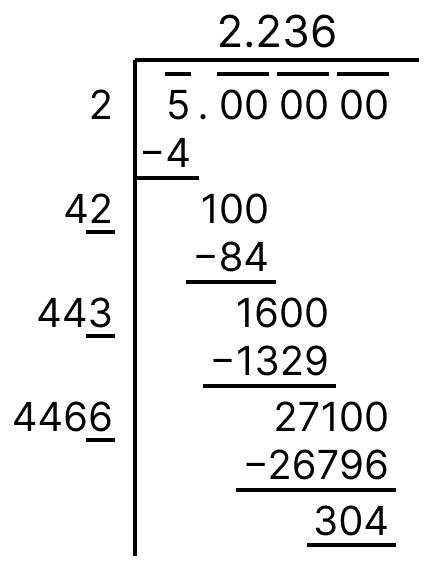
Square root of 5 correct to two decimal places by division method:
5 = 2.236 ≈ 2.24 \sqrt{5} = 2.236 \approx 2.24 5 = 2.236 ≈ 2.24
⇒ 3 + 5 3 − 5 ⇒ ( 3 + 5 ) ( 3 + 5 ) ( 3 − 5 ) ( 3 + 5 ) ⇒ ( 3 + 5 ) 2 3 2 − ( 5 ) 2 ⇒ ( 3 + 5 ) 2 9 − 5 ⇒ ( 3 + 5 ) 2 4 ⇒ 3 + 5 2 \Rightarrow \sqrt{\dfrac{3 + \sqrt{5}}{3 - \sqrt{5}}}\\[1em] \Rightarrow \sqrt{\dfrac{(3 + \sqrt{5})(3 + \sqrt{5})}{(3 - \sqrt{5})(3 + \sqrt{5})}}\\[1em] \Rightarrow \sqrt{\dfrac{(3 + \sqrt{5})^2}{3^2 - (\sqrt{5})^2}}\\[1em] \Rightarrow \sqrt{\dfrac{(3 + \sqrt{5})^2}{9 - 5}}\\[1em] \Rightarrow \sqrt{\dfrac{(3 + \sqrt{5})^2}{4}}\\[1em] \Rightarrow \dfrac{3 + \sqrt{5}}{2} ⇒ 3 − 5 3 + 5 ⇒ ( 3 − 5 ) ( 3 + 5 ) ( 3 + 5 ) ( 3 + 5 ) ⇒ 3 2 − ( 5 ) 2 ( 3 + 5 ) 2 ⇒ 9 − 5 ( 3 + 5 ) 2 ⇒ 4 ( 3 + 5 ) 2 ⇒ 2 3 + 5
Putting the value of 5 \sqrt{5} 5
⇒ 3 + 2.24 2 ⇒ 5.24 2 ⇒ 2.62 \Rightarrow \dfrac{3 + 2.24}{2}\\[1em] \Rightarrow \dfrac{5.24}{2}\\[1em] \Rightarrow 2.62 ⇒ 2 3 + 2.24 ⇒ 2 5.24 ⇒ 2.62
Hence, 5 = 2.24 \mathbf{\sqrt{5} = 2.24} 5 = 2.24 3 + 5 3 − 5 = 2.62 \mathbf{\sqrt{\dfrac{3 + \sqrt{5}}{3 - \sqrt{5}}} = 2.62} 3 − 5 3 + 5 = 2.62
Aryan has some chocolates. He distributed these chocolates among 13 children in such a way that he gave one chocolate to first child, 3 chocolates to second child, 5 chocolates to third and so on. Find the number of chocolates Aryan had.
Answer
The chocolates given to the 13 children are 1, 3, 5, 7, ..... which are the first 13 odd natural numbers.
As we know that, the sum of first n odd natural numbers = n2 .
Total chocolates = 1 + 3 + 5 + ..... + 25
= 132
= 169
Hence, Aryan had 169 chocolates.