KnowledgeBoat Logo
|
OPEN IN APP

Chapter 1

Rational Numbers — Exercise 1.5

Class - 8 ML Aggarwal Understanding ICSE Mathematics


Exercise 1.5

Question 1(i)

Represent the following rational number on the number line:

114\dfrac{11}{4}

Answer

Convert the improper fraction into a mixed fraction to find the two integers between which it lies.

⇒114⇒234⇒2+34\Rightarrow \dfrac{11}{4} \\[1em] \Rightarrow 2\dfrac{3}{4} \\[1em] \Rightarrow 2 + \dfrac{3}{4}

So, 114\dfrac{11}{4} lies between 2 and 3.

Divide the line segment between 2 and 3 into four equal parts. The third point of division from 2 represents 114\dfrac{11}{4}.

Represent the following rational number on the number line: 11/4. Rational Number, ML Aggarwal Understanding Mathematics Solutions ICSE Class 8

Hence, the point marked on the number line represents 114\mathbf{\dfrac{11}{4}}

Question 1(ii)

Represent the following rational number on the number line:

4354\dfrac{3}{5}

Answer

The given number is already a mixed fraction, so we can directly find the two integers between which it lies.

⇒435=235⇒4+35\Rightarrow 4\dfrac{3}{5} = \dfrac{23}{5} \\[1em] \Rightarrow 4 + \dfrac{3}{5}

So, 4354\dfrac{3}{5} lies between 4 and 5.

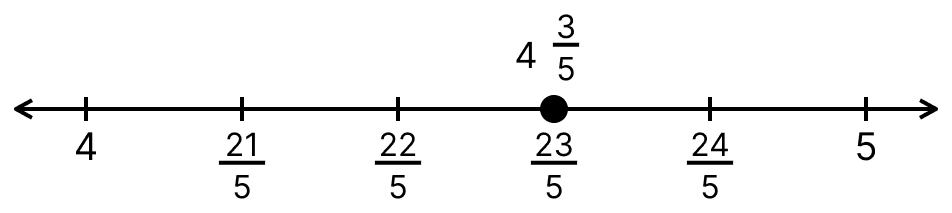
Divide the line segment between 4 and 5 into five equal parts. The third point of division from 4 represents 4354\dfrac{3}{5}.

Represent the following rational number on the number line: 43/5. Rational Number, ML Aggarwal Understanding Mathematics Solutions ICSE Class 8

Hence, the point marked on the number line represents 435\mathbf{4\dfrac{3}{5}}

Question 1(iii)

Represent the following rational number on the number line:

−97\dfrac{-9}{7}

Answer

Convert the improper fraction into a mixed fraction to find the two integers between which it lies.

⇒−97⇒−127⇒−1+(−27)\Rightarrow \dfrac{-9}{7} \\[1em] \Rightarrow -1\dfrac{2}{7} \\[1em] \Rightarrow -1 + \left(\dfrac{-2}{7}\right)

So, −97\dfrac{-9}{7} lies between -1 and -2.

Divide the line segment between -1 and -2 into seven equal parts. The second point of division to the left of -1 represents −97\dfrac{-9}{7}.

Represent the following rational number on the number line: -9/7. Rational Number, ML Aggarwal Understanding Mathematics Solutions ICSE Class 8

Hence, the point marked on the number line represents −97\mathbf{\dfrac{-9}{7}}

Question 1(iv)

Represent the following rational number on the number line:

−2−5\dfrac{-2}{-5}

Answer

First express the rational number with a positive denominator.

⇒−2−5⇒−2×(−1)−5×(−1)⇒25\Rightarrow \dfrac{-2}{-5} \\[1em] \Rightarrow \dfrac{-2 \times (-1)}{-5 \times (-1)} \\[1em] \Rightarrow \dfrac{2}{5}

As 25\dfrac{2}{5} is a positive proper fraction, it lies between 0 and 1.

Divide the line segment between 0 and 1 into five equal parts. The second point of division from 0 represents 25\dfrac{2}{5}.

Represent the following rational number on the number line: -2/-5. Rational Number, ML Aggarwal Understanding Mathematics Solutions ICSE Class 8

Hence, the point marked on the number line represents 25\mathbf{\dfrac{2}{5}}

Question 2(i)

Write the rational numbers for each point labelled with a letter:

Write the rational numbers for each point labelled with a letter:. Rational Number, ML Aggarwal Understanding Mathematics Solutions ICSE Class 8

Answer

The line segment between each pair of consecutive integers has been divided into seven equal parts, so each division represents 17\dfrac{1}{7}.

Counting the divisions from 0, the marked points are the 3rd, 7th, 8th, 12th and 13th points of division.

⇒A=37⇒B=77=1⇒C=87⇒D=127⇒E=137\Rightarrow A = \dfrac{3}{7} \\[1em] \Rightarrow B = \dfrac{7}{7} = 1 \\[1em] \Rightarrow C = \dfrac{8}{7} \\[1em] \Rightarrow D = \dfrac{12}{7} \\[1em] \Rightarrow E = \dfrac{13}{7}

Hence, A=37,B=1,C=87,D=127 and E=137\mathbf{A = \dfrac{3}{7}, B = 1, C = \dfrac{8}{7}, D = \dfrac{12}{7} \text{ and } E = \dfrac{13}{7}}

Question 2(ii)

Write the rational numbers for each point labelled with a letter:

Write the rational numbers for each point labelled with a letter:. Rational Number, ML Aggarwal Understanding Mathematics Solutions ICSE Class 8

Answer

The line segment between each pair of consecutive integers has been divided into eight equal parts, so each division represents 18\dfrac{1}{8}.

Writing the marked values with denominator 8, we have

⇒−54=−108⇒−1=−88⇒−34=−68\Rightarrow \dfrac{-5}{4} = \dfrac{-10}{8} \\[1em] \Rightarrow -1 = \dfrac{-8}{8} \\[1em] \Rightarrow \dfrac{-3}{4} = \dfrac{-6}{8}

Counting the divisions to the left of 0, the marked points are the 12th, 11th, 7th, 4th and 3rd points of division.

⇒T=−128=−32⇒S=−118⇒R=−78⇒Q=−48=−12⇒P=−38\Rightarrow T = \dfrac{-12}{8} = \dfrac{-3}{2} \\[1em] \Rightarrow S = \dfrac{-11}{8} \\[1em] \Rightarrow R = \dfrac{-7}{8} \\[1em] \Rightarrow Q = \dfrac{-4}{8} = \dfrac{-1}{2} \\[1em] \Rightarrow P = \dfrac{-3}{8}

Hence, T=−32,S=−118,R=−78,Q=−12 and P=−38\mathbf{T = \dfrac{-3}{2}, S = \dfrac{-11}{8}, R = \dfrac{-7}{8}, Q = \dfrac{-1}{2} \text{ and } P = \dfrac{-3}{8}}

Question 3

Which of the two rational numbers is greater in each of the following pairs?

(i) −12,4−5\dfrac{-1}{2}, \dfrac{4}{-5}

(ii) −913,−11−17\dfrac{-9}{13}, \dfrac{-11}{-17}

(iii) −511,13−17\dfrac{-5}{11}, \dfrac{13}{-17}

Answer

(i) First write each rational number with a positive denominator, then write them with a common denominator and compare the numerators.

4−5=4×(−1)−5×(−1)=−45\dfrac{4}{-5} = \dfrac{4 \times (-1)}{-5 \times (-1)} = \dfrac{-4}{5}

L.C.M. of 2 and 5 = 10

⇒−12=(−1)×52×5=−510⇒−45=(−4)×25×2=−810\Rightarrow \dfrac{-1}{2} = \dfrac{(-1) \times 5}{2 \times 5} = \dfrac{-5}{10} \\[1em] \Rightarrow \dfrac{-4}{5} = \dfrac{(-4) \times 2}{5 \times 2} = \dfrac{-8}{10}

As -8 < -5, so −810<−510\dfrac{-8}{10} \lt \dfrac{-5}{10}

Hence, −12 is greater.\mathbf{\dfrac{-1}{2} \text{ is greater.}}

(ii) First write each rational number with a positive denominator.

−11−17=−11×(−1)−17×(−1)=1117\dfrac{-11}{-17} = \dfrac{-11 \times (-1)}{-17 \times (-1)} = \dfrac{11}{17}

Here 1117\dfrac{11}{17} is a positive rational number and −913\dfrac{-9}{13} is a negative rational number.

Every positive rational number is greater than every negative rational number.

Hence, −11−17\mathbf{\dfrac{-11}{-17}} is greater.

(iii) First write each rational number with a positive denominator, then write them with a common denominator and compare the numerators.

13−17=13×(−1)−17×(−1)=−1317\dfrac{13}{-17} = \dfrac{13 \times (-1)}{-17 \times (-1)} = \dfrac{-13}{17}

L.C.M. of 11 and 17 = 187

⇒−511=(−5)×1711×17=−85187⇒−1317=(−13)×1117×11=−143187\Rightarrow \dfrac{-5}{11} = \dfrac{(-5) \times 17}{11 \times 17} = \dfrac{-85}{187} \\[1em] \Rightarrow \dfrac{-13}{17} = \dfrac{(-13) \times 11}{17 \times 11} = \dfrac{-143}{187}

As -143 < -85, so −143187\dfrac{-143}{187} < −85187\dfrac{-85}{187}

Hence, −511\mathbf{\dfrac{-5}{11}} is greater.

Question 4

Arrange the following rational numbers in ascending order:

−23,1−4,−57,211\dfrac{-2}{3}, \dfrac{1}{-4}, \dfrac{-5}{7}, \dfrac{2}{11}

Answer

First write each rational number with a positive denominator.

1−4=1×(−1)−4×(−1)=−14\dfrac{1}{-4} = \dfrac{1 \times (-1)}{-4 \times (-1)} = \dfrac{-1}{4}

So, the given rational numbers are −23,−14,−57,211\dfrac{-2}{3}, \dfrac{-1}{4}, \dfrac{-5}{7}, \dfrac{2}{11}

Now write each rational number with the LCM of the denominators as the common denominator.

[ LCM of 3,4,7 and 11=924]⇒−23=(−2)×3083×308=−616924⇒−14=(−1)×2314×231=−231924⇒−57=(−5)×1327×132=−660924⇒211=2×8411×84=168924[\text{ LCM of } 3, 4, 7 \text{ and } 11 = 924] \\[1em] \Rightarrow \dfrac{-2}{3} = \dfrac{(-2) \times 308}{3 \times 308} = \dfrac{-616}{924} \\[1em] \Rightarrow \dfrac{-1}{4} = \dfrac{(-1) \times 231}{4 \times 231} = \dfrac{-231}{924} \\[1em] \Rightarrow \dfrac{-5}{7} = \dfrac{(-5) \times 132}{7 \times 132} = \dfrac{-660}{924} \\[1em] \Rightarrow \dfrac{2}{11} = \dfrac{2 \times 84}{11 \times 84} = \dfrac{168}{924}

As -660 < -616 < -231 < 168

so −660924\dfrac{-660}{924} < −616924\dfrac{-616}{924} < −231924\dfrac{-231}{924} < 168924\dfrac{168}{924}

⇒−57\Rightarrow \dfrac{-5}{7} < −23\dfrac{-2}{3} < −14\dfrac{-1}{4} < 211\dfrac{2}{11}

Hence, the given rational numbers in ascending order are −57,−23,1−4,211\mathbf{\dfrac{-5}{7}, \dfrac{-2}{3}, \dfrac{1}{-4}, \dfrac{2}{11}}

Question 5

Arrange the following rational numbers in descending order:

−310,−23,4−5,0,78\dfrac{-3}{10}, \dfrac{-2}{3}, \dfrac{4}{-5}, 0, \dfrac{7}{8}

Answer

First write each rational number with a positive denominator.

4−5=4×(−1)−5×(−1)=−45\dfrac{4}{-5} = \dfrac{4 \times (-1)}{-5 \times (-1)} = \dfrac{-4}{5}

So, the given rational numbers are −310,−23,−45,0,78\dfrac{-3}{10}, \dfrac{-2}{3}, \dfrac{-4}{5}, 0, \dfrac{7}{8}

Now write each rational number with the LCM of the denominators as the common denominator.

[ LCM of 10,3,5 and 8=120]⇒−310=(−3)×1210×12=−36120⇒−23=(−2)×403×40=−80120⇒−45=(−4)×245×24=−96120⇒0=0120⇒78=7×158×15=105120[\text{ LCM of } 10, 3, 5 \text{ and } 8 = 120] \\[1em] \Rightarrow \dfrac{-3}{10} = \dfrac{(-3) \times 12}{10 \times 12} = \dfrac{-36}{120} \\[1em] \Rightarrow \dfrac{-2}{3} = \dfrac{(-2) \times 40}{3 \times 40} = \dfrac{-80}{120} \\[1em] \Rightarrow \dfrac{-4}{5} = \dfrac{(-4) \times 24}{5 \times 24} = \dfrac{-96}{120} \\[1em] \Rightarrow 0 = \dfrac{0}{120} \\[1em] \Rightarrow \dfrac{7}{8} = \dfrac{7 \times 15}{8 \times 15} = \dfrac{105}{120}

As 105 > 0 > -36 > -80 > -96

so 105120>0120>−36120>−80120>−96120\dfrac{105}{120} \gt \dfrac{0}{120} \gt \dfrac{-36}{120} \gt \dfrac{-80}{120} \gt \dfrac{-96}{120}

⇒78>0>−310>−23>−45\Rightarrow \dfrac{7}{8} \gt 0 \gt \dfrac{-3}{10} \gt \dfrac{-2}{3} \gt \dfrac{-4}{5}

Hence, the given rational numbers in descending order are 78,0,−310,−23,4−5\mathbf{\dfrac{7}{8}, 0, \dfrac{-3}{10}, \dfrac{-2}{3}, \dfrac{4}{-5}}

Question 6

Find three rational numbers between -2 and -1.

Answer

To insert 3 rational numbers between -2 and -1, multiply both the numerator and denominator of each rational number by 3 + 1 i.e. 4.

⇒−2=−2×41×4=−84⇒−1=−1×41×4=−44\Rightarrow -2 = \dfrac{-2 \times 4}{1 \times 4} = \dfrac{-8}{4} \\[1em] \Rightarrow -1 = \dfrac{-1 \times 4}{1 \times 4} = \dfrac{-4}{4}

As -8 < -7 < -6 < -5 < -4

∴−84\therefore \dfrac{-8}{4} < −74\dfrac{-7}{4} < −64\dfrac{-6}{4} < −54\dfrac{-5}{4} < −44\dfrac{-4}{4}

Hence, three rational numbers between -2 and -1 are −74,−32 and −54\mathbf{\dfrac{-7}{4}, \dfrac{-3}{2} \text{ and } \dfrac{-5}{4}}

Question 7

Write five rational numbers which are smaller than -4.

Answer

Every rational number lying to the left of -4 on the number line is smaller than -4.

As -9 < -8 < -7 < -6 < -5 < -4, each of these numbers is smaller than -4.

There are infinitely many such rational numbers; for example −92,−133,−174\dfrac{-9}{2}, \dfrac{-13}{3}, \dfrac{-17}{4} are also smaller than -4.

Hence, five rational numbers smaller than -4 are -5, -6, -7, -8 and -9.

Question 8

Find twenty rational numbers between −37 and 23\dfrac{-3}{7} \text{ and } \dfrac{2}{3}

Answer

The given rational numbers have different denominators, so first write them with a common denominator.

[ LCM of 7 and 3=21]⇒−37=−3×37×3=−921⇒23=2×73×7=1421[\text{ LCM of } 7 \text{ and } 3 = 21] \\[1em] \Rightarrow \dfrac{-3}{7} = \dfrac{-3 \times 3}{7 \times 3} = \dfrac{-9}{21} \\[1em] \Rightarrow \dfrac{2}{3} = \dfrac{2 \times 7}{3 \times 7} = \dfrac{14}{21}

We note that -8, -7, -6, …, 12, 13 are the integers between -9 and 14

i.e. -9 < -8 < -7 < -6 < … < 12 < 13 < 14

Hence, twenty rational numbers between −37 and 23\mathbf{\dfrac{-3}{7} \text{ and } \dfrac{2}{3}} are

−821,−721,−621,−521,−421,−321,−221,−121,021,121,221,321,421,521,621,721,821,921,1021,1121\mathbf{\dfrac{-8}{21}, \dfrac{-7}{21}, \dfrac{-6}{21}, \dfrac{-5}{21}, \dfrac{-4}{21}, \dfrac{-3}{21}, \dfrac{-2}{21}, \dfrac{-1}{21}, \dfrac{0}{21}, \dfrac{1}{21}, \dfrac{2}{21}, \dfrac{3}{21}, \dfrac{4}{21}, \dfrac{5}{21}, \dfrac{6}{21}, \dfrac{7}{21}, \dfrac{8}{21}, \dfrac{9}{21}, \dfrac{10}{21}, \dfrac{11}{21}}.

Question 9

Find six rational numbers between −12 and 54\dfrac{-1}{2} \text{ and } \dfrac{5}{4}

Answer

The given rational numbers have different denominators, so first write them with a common denominator.

[ LCM of 2 and 4=4]⇒−12=−1×22×2=−24⇒54=54[\text{ LCM of } 2 \text{ and } 4 = 4] \\[1em] \Rightarrow \dfrac{-1}{2} = \dfrac{-1 \times 2}{2 \times 2} = \dfrac{-2}{4} \\[1em] \Rightarrow \dfrac{5}{4} = \dfrac{5}{4}

We note that -1, 0, 1, 2, 3, 4 are the integers between -2 and 5

i.e. -2 < -1 < 0 < 1 < 2 < 3 < 4 < 5

Hence, six rational numbers between −12 and 54\mathbf{\dfrac{-1}{2} \text{ and } \dfrac{5}{4}} are −14,0,14,12,34 and 1\mathbf{\dfrac{-1}{4}, 0, \dfrac{1}{4}, \dfrac{1}{2}, \dfrac{3}{4} \text{ and } 1}

Question 10

Identify the rational number which is different from the other three. Explain your reasoning

−511,−12,−49,−73\dfrac{-5}{11}, \dfrac{-1}{2}, \dfrac{-4}{9}, \dfrac{-7}{3}

Answer

Compare each rational number with -1 to see where it lies on the number line.

−511,−12 and −49\dfrac{-5}{11}, \dfrac{-1}{2} \text{ and } \dfrac{-4}{9} are all proper fractions with a negative sign, so each of them lies between -1 and 0 on the number line.

But −73=−213\dfrac{-7}{3} = -2\dfrac{1}{3} is an improper fraction with a negative sign, and it lies between -3 and -2 on the number line.

Hence, −73\mathbf{\dfrac{-7}{3}} is different from the other three.

PrevNext