Represent the following rational number on the number line:
411
Answer
Convert the improper fraction into a mixed fraction to find the two integers between which it lies.
⇒411⇒243⇒2+43
So, 411 lies between 2 and 3.
Divide the line segment between 2 and 3 into four equal parts. The third point of division from 2 represents 411.
Hence, the point marked on the number line represents 411
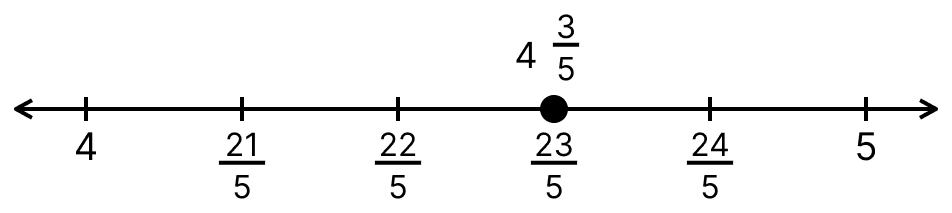
Represent the following rational number on the number line:
453
Answer
The given number is already a mixed fraction, so we can directly find the two integers between which it lies.
⇒453=523⇒4+53
So, 453 lies between 4 and 5.
Divide the line segment between 4 and 5 into five equal parts. The third point of division from 4 represents 453.
Hence, the point marked on the number line represents 453
Represent the following rational number on the number line:
7−9
Answer
Convert the improper fraction into a mixed fraction to find the two integers between which it lies.
⇒7−9⇒−172⇒−1+(7−2)
So, 7−9 lies between -1 and -2.
Divide the line segment between -1 and -2 into seven equal parts. The second point of division to the left of -1 represents 7−9.
Hence, the point marked on the number line represents 7−9
Represent the following rational number on the number line:
−5−2
Answer
First express the rational number with a positive denominator.
⇒−5−2⇒−5×(−1)−2×(−1)⇒52
As 52 is a positive proper fraction, it lies between 0 and 1.
Divide the line segment between 0 and 1 into five equal parts. The second point of division from 0 represents 52.
Hence, the point marked on the number line represents 52
Write the rational numbers for each point labelled with a letter:
Answer
The line segment between each pair of consecutive integers has been divided into seven equal parts, so each division represents 71.
Counting the divisions from 0, the marked points are the 3rd, 7th, 8th, 12th and 13th points of division.
⇒A=73⇒B=77=1⇒C=78⇒D=712⇒E=713
Hence, A=73,B=1,C=78,D=712 and E=713
Write the rational numbers for each point labelled with a letter:
Answer
The line segment between each pair of consecutive integers has been divided into eight equal parts, so each division represents 81.
Writing the marked values with denominator 8, we have
⇒4−5=8−10⇒−1=8−8⇒4−3=8−6
Counting the divisions to the left of 0, the marked points are the 12th, 11th, 7th, 4th and 3rd points of division.
⇒T=8−12=2−3⇒S=8−11⇒R=8−7⇒Q=8−4=2−1⇒P=8−3
Hence, T=2−3,S=8−11,R=8−7,Q=2−1 and P=8−3
Which of the two rational numbers is greater in each of the following pairs?
(i) 2−1,−54
(ii) 13−9,−17−11
(iii) 11−5,−1713
Answer
(i) First write each rational number with a positive denominator, then write them with a common denominator and compare the numerators.
−54=−5×(−1)4×(−1)=5−4
L.C.M. of 2 and 5 = 10
⇒2−1=2×5(−1)×5=10−5⇒5−4=5×2(−4)×2=10−8
As -8 < -5, so 10−8<10−5
Hence, 2−1 is greater.
(ii) First write each rational number with a positive denominator.
−17−11=−17×(−1)−11×(−1)=1711
Here 1711 is a positive rational number and 13−9 is a negative rational number.
Every positive rational number is greater than every negative rational number.
Hence, −17−11 is greater.
(iii) First write each rational number with a positive denominator, then write them with a common denominator and compare the numerators.
−1713=−17×(−1)13×(−1)=17−13
L.C.M. of 11 and 17 = 187
⇒11−5=11×17(−5)×17=187−85⇒17−13=17×11(−13)×11=187−143
As -143 < -85, so 187−143 < 187−85
Hence, 11−5 is greater.
Arrange the following rational numbers in ascending order:
3−2,−41,7−5,112
Answer
First write each rational number with a positive denominator.
−41=−4×(−1)1×(−1)=4−1
So, the given rational numbers are 3−2,4−1,7−5,112
Now write each rational number with the LCM of the denominators as the common denominator.
[ LCM of 3,4,7 and 11=924]⇒3−2=3×308(−2)×308=924−616⇒4−1=4×231(−1)×231=924−231⇒7−5=7×132(−5)×132=924−660⇒112=11×842×84=924168
As -660 < -616 < -231 < 168
so 924−660 < 924−616 < 924−231 < 924168
⇒7−5 < 3−2 < 4−1 < 112
Hence, the given rational numbers in ascending order are 7−5,3−2,−41,112
Arrange the following rational numbers in descending order:
10−3,3−2,−54,0,87
Answer
First write each rational number with a positive denominator.
−54=−5×(−1)4×(−1)=5−4
So, the given rational numbers are 10−3,3−2,5−4,0,87
Now write each rational number with the LCM of the denominators as the common denominator.
[ LCM of 10,3,5 and 8=120]⇒10−3=10×12(−3)×12=120−36⇒3−2=3×40(−2)×40=120−80⇒5−4=5×24(−4)×24=120−96⇒0=1200⇒87=8×157×15=120105
As 105 > 0 > -36 > -80 > -96
so 120105>1200>120−36>120−80>120−96
⇒87>0>10−3>3−2>5−4
Hence, the given rational numbers in descending order are 87,0,10−3,3−2,−54
Find three rational numbers between -2 and -1.
Answer
To insert 3 rational numbers between -2 and -1, multiply both the numerator and denominator of each rational number by 3 + 1 i.e. 4.
⇒−2=1×4−2×4=4−8⇒−1=1×4−1×4=4−4
As -8 < -7 < -6 < -5 < -4
∴4−8 < 4−7 < 4−6 < 4−5 < 4−4
Hence, three rational numbers between -2 and -1 are 4−7,2−3 and 4−5
Write five rational numbers which are smaller than -4.
Answer
Every rational number lying to the left of -4 on the number line is smaller than -4.
As -9 < -8 < -7 < -6 < -5 < -4, each of these numbers is smaller than -4.
There are infinitely many such rational numbers; for example 2−9,3−13,4−17 are also smaller than -4.
Hence, five rational numbers smaller than -4 are -5, -6, -7, -8 and -9.
Find twenty rational numbers between 7−3 and 32
Answer
The given rational numbers have different denominators, so first write them with a common denominator.
[ LCM of 7 and 3=21]⇒7−3=7×3−3×3=21−9⇒32=3×72×7=2114
We note that -8, -7, -6, …, 12, 13 are the integers between -9 and 14
i.e. -9 < -8 < -7 < -6 < … < 12 < 13 < 14
Hence, twenty rational numbers between 7−3 and 32 are
21−8,21−7,21−6,21−5,21−4,21−3,21−2,21−1,210,211,212,213,214,215,216,217,218,219,2110,2111.
Find six rational numbers between 2−1 and 45
Answer
The given rational numbers have different denominators, so first write them with a common denominator.
[ LCM of 2 and 4=4]⇒2−1=2×2−1×2=4−2⇒45=45
We note that -1, 0, 1, 2, 3, 4 are the integers between -2 and 5
i.e. -2 < -1 < 0 < 1 < 2 < 3 < 4 < 5
Hence, six rational numbers between 2−1 and 45 are 4−1,0,41,21,43 and 1
Identify the rational number which is different from the other three. Explain your reasoning
11−5,2−1,9−4,3−7
Answer
Compare each rational number with -1 to see where it lies on the number line.
11−5,2−1 and 9−4 are all proper fractions with a negative sign, so each of them lies between -1 and 0 on the number line.
But 3−7=−231 is an improper fraction with a negative sign, and it lies between -3 and -2 on the number line.
Hence, 3−7 is different from the other three.