
Find the values of the letters in the following and give reasons for the steps involved:
Answer
Given,
Firstly, we will find the value of A.
Clearly, A + 5 is a number whose ones digit is 2.
⇒ A + 5 = 2, A + 5 = 12, A + 5 = 22; and so on.
⇒ A = 2 - 5, A = 12 - 5, A = 22 - 5; and so on.
⇒ A = -3, A = 7, A = 17; and so on.
Since, A is a digit.
⇒ A = 7.
Now, we will find the value of B.
1 + 4 + 3 = B
⇒ B = 8
Hence, A = 7 and B = 8.
Find the values of the letters in the following and give reasons for the steps involved:
Answer
Given,
Firstly, we will find the value of A.
Clearly, A + 9 is a number whose ones digit is 3.
⇒ A + 9 = 3, A + 9 = 13, A + 9 = 23; and so on.
⇒ A = 3 - 9, A = 13 - 9, A = 23 - 9; and so on.
⇒ A = -6, A = 4, A = 14; and so on.
Since, A is a digit. ∴ A = 4.
Secondly, we will find the values of B and C.
1 + 5 + 7 = CB
⇒ CB = 13
⇒ B = 3 and C = 1
Hence, A = 4, B = 3 and C = 1.
Find the values of the letters in the following and give reasons for the steps involved:
Answer
Given,
Clearly, A + 5 is a number whose ones digit is 2.
⇒ A + 5 = 2, A + 5 = 12, A + 5 = 22; and so on.
⇒ A = 2 - 5, A = 12 - 5, A = 22 - 5; and so on.
⇒ A = -3, A = 7, A = 17; and so on.
Since, A is a digit. ∴ A = 7.
Checking with A = 7:
Ones column: 7 + 5 = 12, write 2 and 1 is carried over to ten's column.
Ten's column: 2 + 7 + 1 = 10, write 0 and 1 is carried over to hundred's column.
Hundred's column: 4 + 2 + 1 = 7 = A, which is correct.
Hence, A = 7.
Find the values of the letters in the following and give reasons for the steps involved:
Answer
Given,
Clearly, A + A is a number whose ones digit is 8.
⇒ 2A = 8 or 2A = 18
⇒ A = 4 or A = 9
Let's take A = 4:
44 + 44 = 88, which is a 2-digit number. But the sum BA8 is a 3-digit number. Hence, A ≠ 4.
Let's take A = 9:
99 + 99 = 198, which is of the form BA8 with B = 1 and A = 9.
Hence, A = 9 and B = 1.
Find the values of the letters in the following and give reasons for the steps involved:
Answer
Given,
Firstly, we will find the value of A.
Clearly, A + 7 is a number whose ones digit is 2.
⇒ A + 7 = 2, A + 7 = 12, A + 7 = 22; and so on.
⇒ A = 2 - 7, A = 12 - 7, A = 22 - 7; and so on.
⇒ A = -5, A = 5, A = 15; and so on.
Since, A is a digit. ∴ A = 5 and 1 is carried over to ten's column.
Secondly, we will find the value of B.
Ten's column: 8 + 5 + 1 = 14, write 4 and 1 is carried over to hundred's column.
⇒ B = 4
Lastly, we will find the value of C.
Hundred's column: 1 + B + 1 = 1 + 4 + 1 = 6
⇒ C = 6
Hence, A = 5, B = 4 and C = 6.
Find the values of the letters in the following and give reasons for the steps involved:
Answer
Given,
Firstly, we will find the value of B.
Clearly, B + B is a number whose ones digit is 6.
⇒ 2B = 6 or 2B = 16
⇒ B = 3 or B = 8
Let's take B = 3:
Ones column: 3 + 3 = 6, no carry over.
Ten's column: 1 + A is a number whose ones digit is 9 ⇒ A = 8.
Thousand's column: A + 1 = B ⇒ 8 + 1 = 9 ≠ 3. Hence, B ≠ 3.
Let's take B = 8:
Ones column: 8 + 8 = 16, write 6 and 1 is carried over to ten's column.
Ten's column: 1 + A + 1 is a number whose ones digit is 9 ⇒ A + 2 = 9 ⇒ A = 7, no carry over.
Hundred's column: 2 + C is a number whose ones digit is 4 ⇒ C = 2, no carry over.
Thousand's column: A + 1 = 7 + 1 = 8 = B, which is correct.
Hence, A = 7, B = 8 and C = 2.
Find the values of the letters in the following and give reasons for the steps involved:
Answer
Given,
Firstly, we will find the value of A.
Clearly, 5 + A is a number whose ones digit is 2.
⇒ 5 + A = 2, 5 + A = 12, 5 + A = 22; and so on.
⇒ A = 2 - 5, A = 12 - 5, A = 22 - 5; and so on.
⇒ A = -3, A = 7, A = 17; and so on.
Since, A is a digit. ∴ A = 7 and 1 is carried over to ten's column.
Secondly, we will find the value of B.
Ten's column: 4 + B + 1 is a number whose ones digit is A i.e. 7.
⇒ B + 5 = 7 or B + 5 = 17
⇒ B = 2 or B = 12
Since, B is a digit. ∴ B = 2.
Hundred's column: 3 + 9 = 12, whose ones digit is 2 = B, which is correct, and 1 is carried over to thousand's column.
Lastly, we will find the value of C.
Thousand's column: B + C + 1 = 8
⇒ 2 + C + 1 = 8
⇒ C = 5
Hence, A = 7, B = 2 and C = 5.
Find the values of the letters in the following and give reasons for the steps involved:
Answer
Given,
Firstly, we will find the value of A.
Clearly, A - 9 is a number whose ones digit is 9.
As it is not possible to subtract 9 from any digit A to get 9, borrowing 1 from ten's digit gives 10 + A - 9.
⇒ 10 + A - 9 = 9
⇒ A + 1 = 9
⇒ A = 8
Since, A is a digit. ∴ A = 8 and 1 is borrowed from ten's digit.
Secondly, we will find the value of B.
Ten's column: After borrowing, 6 - 1 = 5 and 5 - B is a number whose ones digit is 8.
As it is not possible to subtract B from 5 to get 8, borrowing 1 from hundred's digit gives 15 - B.
⇒ 15 - B = 8
⇒ B = 15 - 8
⇒ B = 7
Since, B is a digit. ∴ B = 7 and 1 is borrowed from hundred's digit.
Thirdly, we will find the value of C.
Hundred's column: After borrowing, 7 - 1 = 6 and 6 - 2 = 4
⇒ C = 4
Lastly, we will find the value of D.
Thousand's column: 4 - D = 1
⇒ D = 4 - 1
⇒ D = 3
Hence, A = 8, B = 7, C = 4 and D = 3.
Find the values of the letters in the following and give reasons for the steps involved:
Answer
Given,
Clearly, A × A is a number whose ones digit is A.
0 × 0 = 0
1 × 1 = 1
5 × 5 = 25
6 × 6 = 36
So, possible values of A = 0, 1, 5 or 6.
Let's take A = 0: 20 × 30 = 600, which is not of the form B7A.
Let's take A = 1: 21 × 31 = 651, which is not of the form B7A.
Let's take A = 5: 25 × 35 = 875, which is of the form B7A with B = 8 and A = 5.
Let's take A = 6: 26 × 36 = 936, which is not of the form B7A.
Hence, A = 5 and B = 8.
Find the values of the letters in the following and give reasons for the steps involved:
Answer
Given,
Clearly, AB × AB = 6AB, i.e. the square of the 2-digit number AB is a 3-digit number lying between 600 and 699.
Now,
242 = 576
252 = 625
262 = 676
272 = 729
So, AB can be 25 or 26.
Let's take AB = 25:
25 × 25 = 625, which is of the form 6AB with A = 2 and B = 5.
Let's take AB = 26:
26 × 26 = 676. Here, 6AB with A = 2 and B = 6 gives 626 ≠ 676. Hence, AB ≠ 26.
Hence, A = 2 and B = 5.
Find the values of the letters in the following and give reasons for the steps involved:
Answer
Given,
Clearly, A × A is a number whose ones digit is 4.
2 × 2 = 4
8 × 8 = 64
So, possible values of A = 2 or 8.
Let's take A = 2: 22 × 42 = 924, which is of the form 9A4 with A = 2.
Let's take A = 8: 88 × 48 = 4224, which is a 4-digit number, but 9A4 is a 3-digit number. Hence, A ≠ 8.
Hence, A = 2.
Find the values of the letters in the following and give reasons for the steps involved:
Answer
Given,
In the first step of division, A × 5 = 30
⇒ A = 30 ÷ 5
⇒ A = 6
Now, 3B - 30 = 5
⇒ 3B = 35
⇒ B = 5
On bringing down C, we get 5C.
Since the remainder is 0, A × D = 5C
⇒ 6 × D = 5C
Now, 6 × 9 = 54
⇒ D = 9 and C = 4
Checking:
Hence, A = 6, B = 5, C = 4 and D = 9.
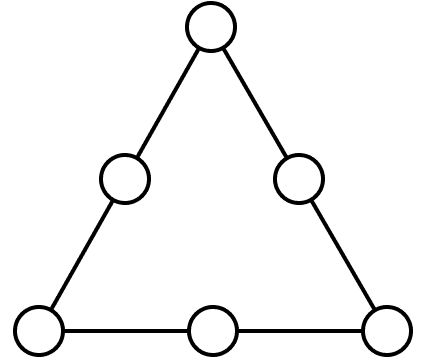
In figure given below, fill in the numbers from 1 to 6 (without repetition) so that each side of the magic triangle adds up to 12.
Answer
Place 4 at the top vertex, 5 at the bottom left vertex and 6 at the bottom right vertex. Place 3 at the middle of the left side, 2 at the middle of the right side and 1 at the middle of the bottom side.
Then,
Left side: 4 + 3 + 5 = 12
Right side: 4 + 2 + 6 = 12
Bottom side: 5 + 1 + 6 = 12
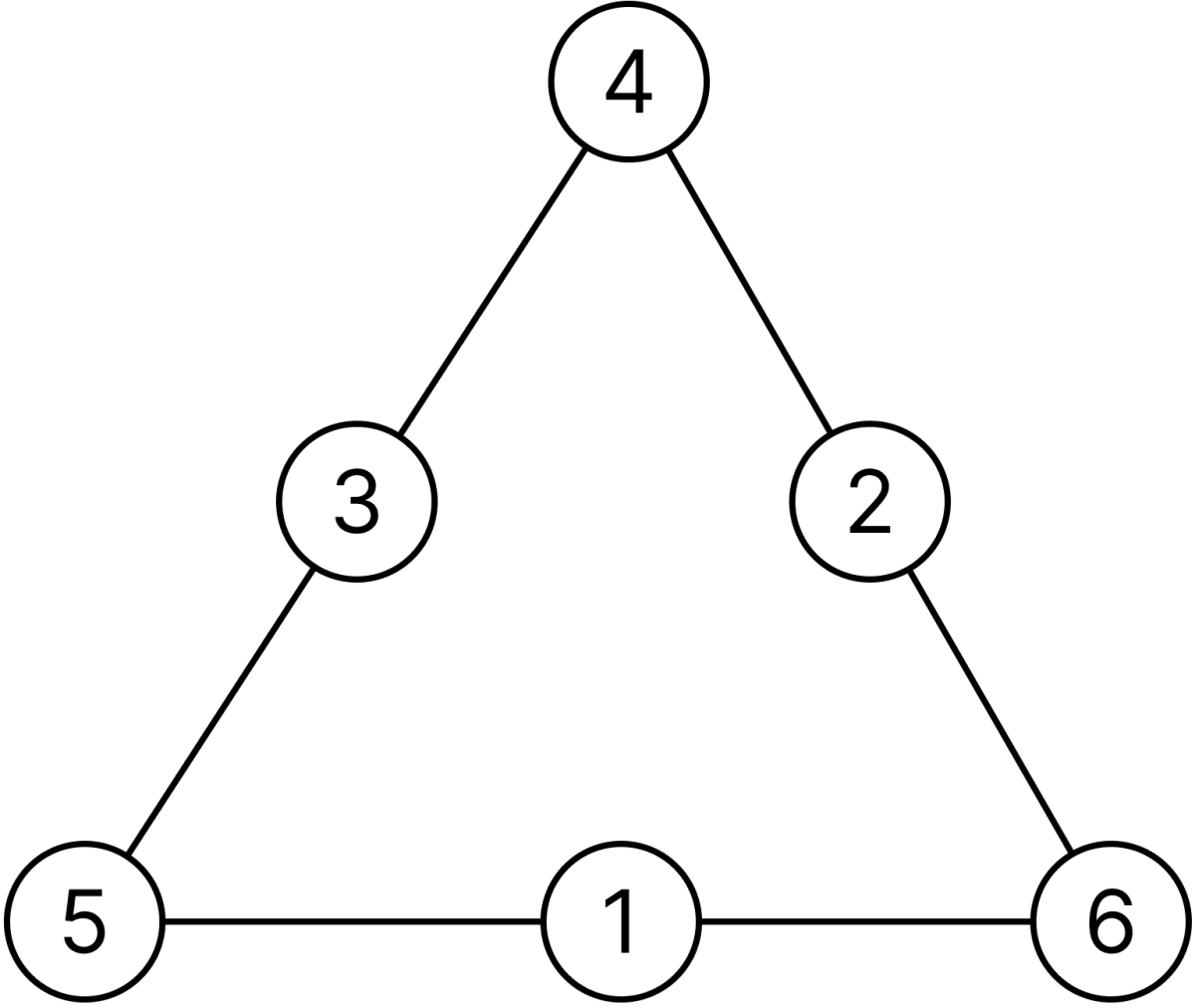
Hence, each side of the magic triangle adds up to 12.
In figure given below, complete the magic square using number 0, 1, 2, 3, ..... 15 (only once), so that sum along each row, column and diagonal is 30.
Answer
Using variables to represent the missing numbers and determining their values:
First complete the first row.
3 + 14 + x + 0 = 30 ⇒ x = 13
Now complete the first column.
3 + 8 + 4 + y = 30 ⇒ y = 15
Complete the fourth column.
0 + p + 7 + 12 = 30 ⇒ p = 11
Complete the diagonal starting from 0.
0 + 6 + q + 15 = 30 ⇒ q = 9
Complete the second row.
8 + r + 6 + 11 = 30 ⇒ r = 5
Complete the diagonal starting from 3.
3 + 5 + s + 12 = 30 ⇒ s = 10
Complete the fourth row.
15 + t + 1 + 12 = 30 ⇒ t = 2
Now, third row: 4 + 9 + 10 + 7 = 30, second column: 14 + 5 + 9 + 2 = 30 and third column: 13 + 6 + 10 + 1 = 30, which are all correct.
Hence, the magic square can be completed as: