KnowledgeBoat Logo
|
OPEN IN APP

Chapter 3

Squares and Square Roots — Exercise 3.4

Class - 8 ML Aggarwal Understanding ICSE Mathematics


Exercise 3.4

Question 1(i)

Find the square root of the following by division method:

2401

Answer

Square root of 2401 by division method:
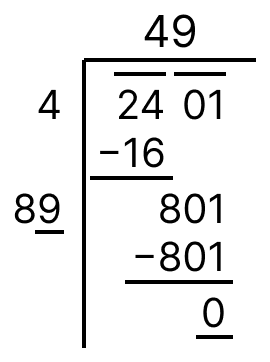
Find the square root of the following by division method: 2401. Squares & Square Roots, ML Aggarwal Understanding Mathematics Solutions ICSE Class 8

Hence, 2401=49\mathbf{\sqrt{2401} = 49}

Question 1(ii)

Find the square root of the following by division method:

4489

Answer

Square root of 4489 by division method:
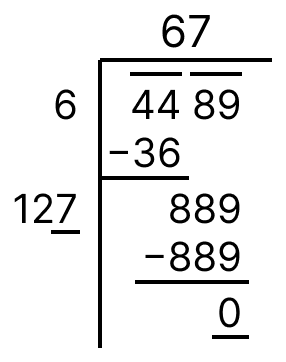
Find the square root of the following by division method: 4489. Squares & Square Roots, ML Aggarwal Understanding Mathematics Solutions ICSE Class 8

Hence, 4489=67\mathbf{\sqrt{4489} = 67}

Question 1(iii)

Find the square root of the following by division method:

106929

Answer

Square root of 106929 by division method:
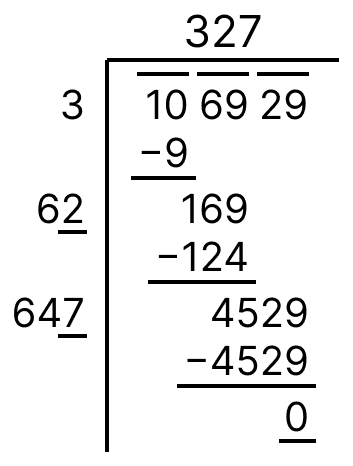
Find the square root of the following by division method: 106929. Squares & Square Roots, ML Aggarwal Understanding Mathematics Solutions ICSE Class 8

Hence, 106929=327\mathbf{\sqrt{106929} = 327}

Question 1(iv)

Find the square root of the following by division method:

167281

Answer

Square root of 167281 by division method:
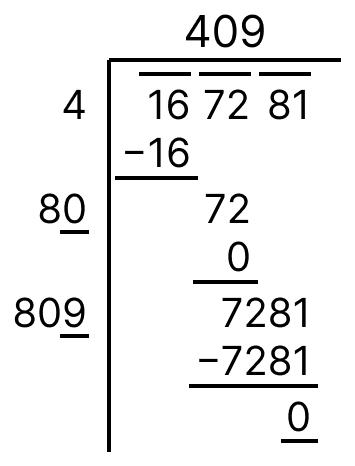
Find the square root of the following by division method: 167281. Squares & Square Roots, ML Aggarwal Understanding Mathematics Solutions ICSE Class 8

Hence, 167281=409\mathbf{\sqrt{167281} = 409}

Question 1(v)

Find the square root of the following by division method:

53824

Answer

Square root of 53824 by division method:
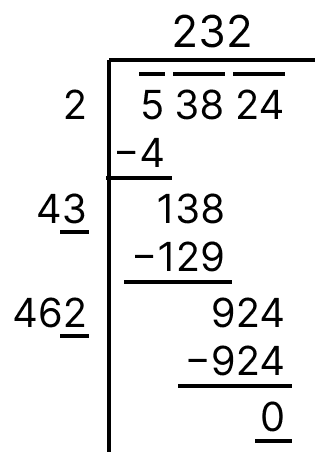
Find the square root of the following by division method: 53824. Squares & Square Roots, ML Aggarwal Understanding Mathematics Solutions ICSE Class 8

Hence, 53824=232\mathbf{\sqrt{53824} = 232}

Question 1(vi)

Find the square root of the following by division method:

213444

Answer

Square root of 213444 by division method:
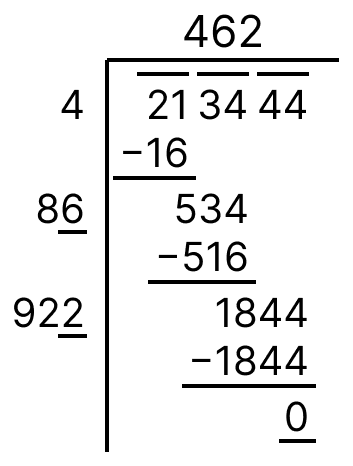
Find the square root of the following by division method: 213444. Squares & Square Roots, ML Aggarwal Understanding Mathematics Solutions ICSE Class 8

Hence, 213444=462\mathbf{\sqrt{213444} = 462}

Question 2(i)

Find the square root of the following decimal numbers by division method:

51.84

Answer

Square root of 51.84 by division method:
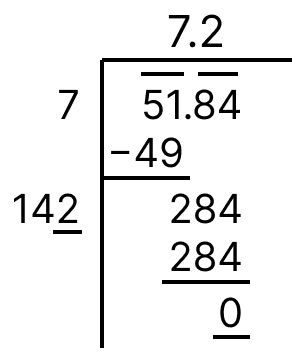
Find the square root of the following decimal numbers by division method: 51.84. Squares & Square Roots, ML Aggarwal Understanding Mathematics Solutions ICSE Class 8

Hence, 51.84=7.2\mathbf{\sqrt{51.84} = 7.2}

Question 2(ii)

Find the square root of the following decimal numbers by division method:

42.25

Answer

Square root of 42.25 by division method:
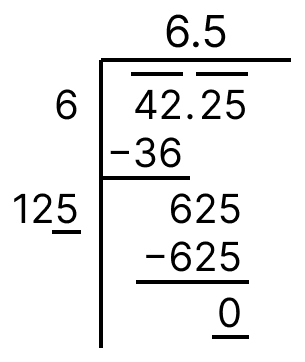
Find the square root of the following decimal numbers by division method: 42.25. Squares & Square Roots, ML Aggarwal Understanding Mathematics Solutions ICSE Class 8

Hence, 42.25=6.5\mathbf{\sqrt{42.25} = 6.5}

Question 2(iii)

Find the square root of the following decimal numbers by division method:

18.4041

Answer

Square root of 18.4041 by division method:
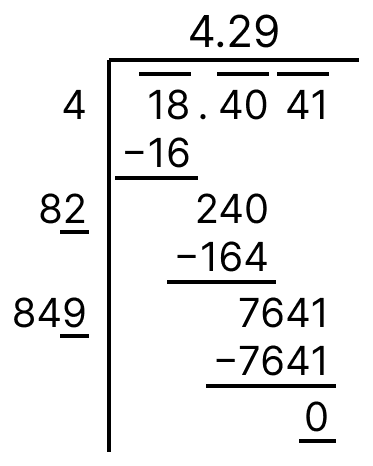
Find the square root of the following decimal numbers by division method: 18.4041. Squares & Square Roots, ML Aggarwal Understanding Mathematics Solutions ICSE Class 8

Hence, 18.4041=4.29\mathbf{\sqrt{18.4041} = 4.29}

Question 2(iv)

Find the square root of the following decimal numbers by division method:

5.774409

Answer

Square root of 5.774409 by division method:
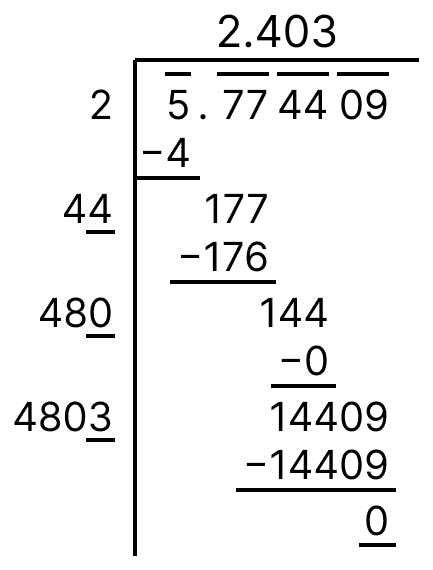
Find the square root of the following decimal numbers by division method: 5.774409. Squares & Square Roots, ML Aggarwal Understanding Mathematics Solutions ICSE Class 8

Hence, 5.774409=2.403\mathbf{\sqrt{5.774409} = 2.403}

Question 3(i)

Find the square root of the following numbers correct to two decimal places:

645.8

Answer

Square root of 645.8 correct to two decimal places by division method:
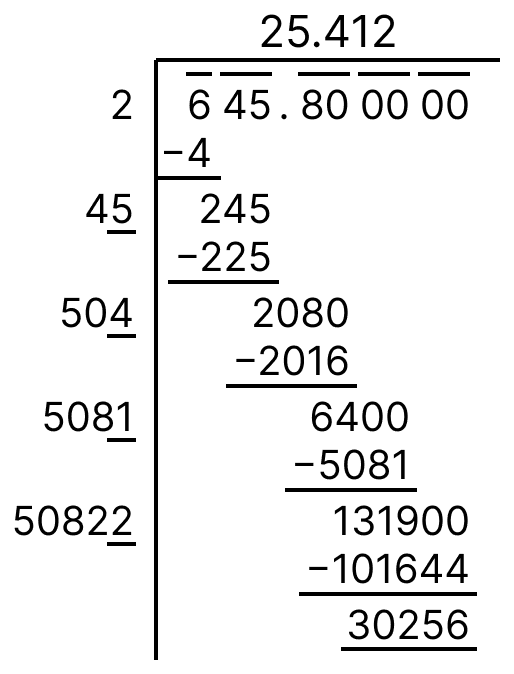
Find the square root of the following numbers correct to two decimal places: 645.8. Squares & Square Roots, ML Aggarwal Understanding Mathematics Solutions ICSE Class 8

645.8=25.412≈25.41\sqrt{645.8} = 25.412 \approx 25.41

Hence, 645.8=25.41\mathbf{\sqrt{645.8} = 25.41}

Question 3(ii)

Find the square root of the following numbers correct to two decimal places:

107.45

Answer

Square root of 107.45 correct to two decimal places by division method:
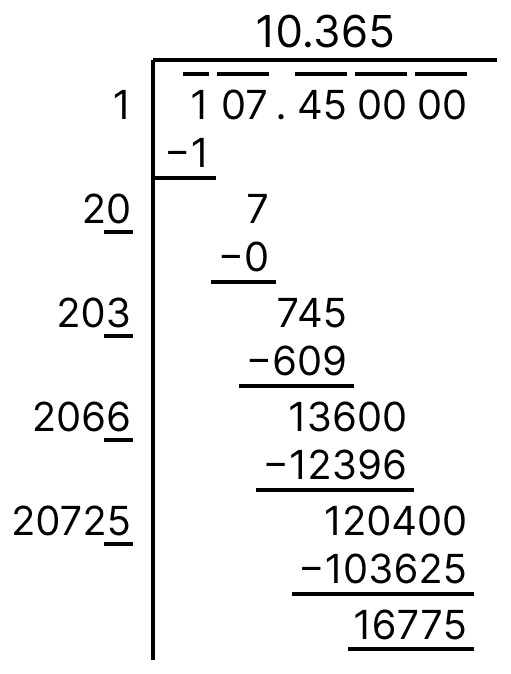
Find the square root of the following numbers correct to two decimal places: 107.45. Squares & Square Roots, ML Aggarwal Understanding Mathematics Solutions ICSE Class 8

107.45=10.365≈10.36\sqrt{107.45} = 10.365 \approx 10.36

Hence, 107.45=10.36\mathbf{\sqrt{107.45} = 10.36}

Question 3(iii)

Find the square root of the following numbers correct to two decimal places:

5.462

Answer

Square root of 5.462 correct to two decimal places by division method:
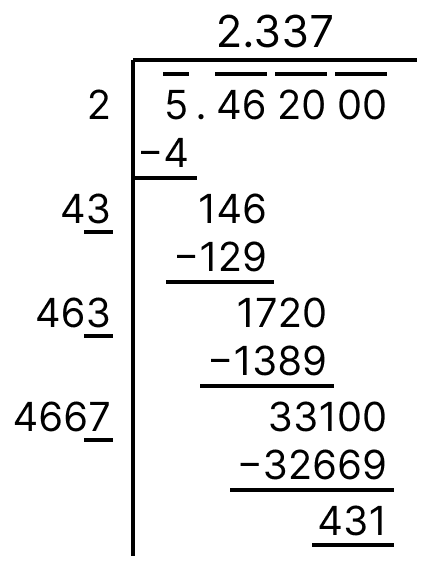
Find the square root of the following numbers correct to two decimal places: 5.462. Squares & Square Roots, ML Aggarwal Understanding Mathematics Solutions ICSE Class 8

5.462=2.337≈2.34\sqrt{5.462} = 2.337 \approx 2.34

Hence, 5.462=2.34\mathbf{\sqrt{5.462} = 2.34}

Question 3(iv)

Find the square root of the following numbers correct to two decimal places:

2

Answer

Square root of 2 correct to two decimal places by division method:
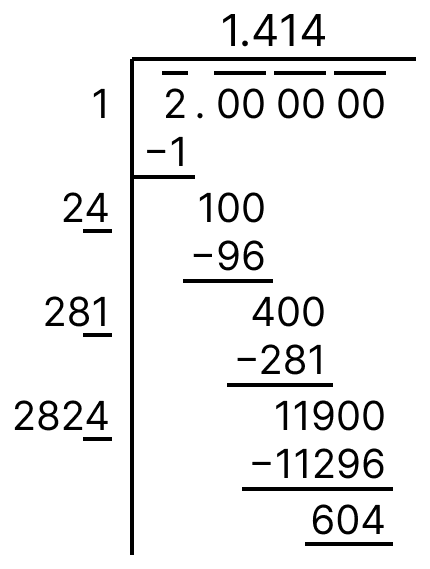
Find the square root of the following numbers correct to two decimal places: 2. Squares & Square Roots, ML Aggarwal Understanding Mathematics Solutions ICSE Class 8

2=1.414≈1.41\sqrt{2} = 1.414 \approx 1.41

Hence, 2=1.41\mathbf{\sqrt{2} = 1.41}

Question 3(v)

Find the square root of the following numbers correct to two decimal places:

3

Answer

Square root of 3 correct to two decimal places by division method:
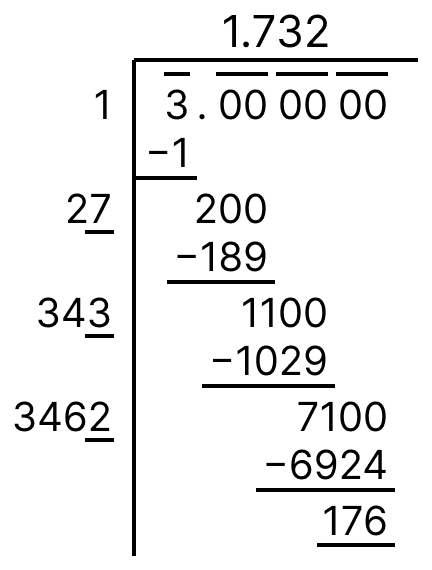
Find the square root of the following numbers correct to two decimal places: 3. Squares & Square Roots, ML Aggarwal Understanding Mathematics Solutions ICSE Class 8

3=1.732≈1.73\sqrt{3} = 1.732 \approx 1.73

Hence, 3=1.73\mathbf{\sqrt{3} = 1.73}

Question 4(i)

Find the square root of the following fractions correct to two decimal places:

113811\dfrac{3}{8}

Answer

Converting mixed fraction into decimal:

⇒1138⇒918⇒11.375\Rightarrow \sqrt{11\dfrac{3}{8}}\\[1em] \Rightarrow \sqrt{\dfrac{91}{8}}\\[1em] \Rightarrow \sqrt{11.375}

Square root of 11.375 correct to two decimal places by division method:
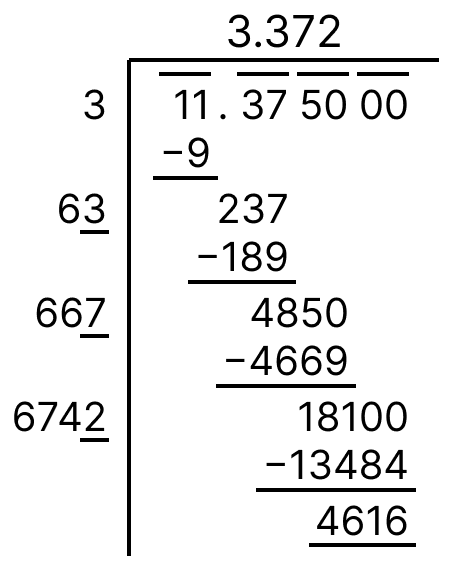
Find the square root of the following fractions correct to two decimal places: 113/8. Squares & Square Roots, ML Aggarwal Understanding Mathematics Solutions ICSE Class 8

11.375=3.372≈3.37\sqrt{11.375} = 3.372 \approx 3.37

Hence, 1138=3.37\mathbf{\sqrt{11\dfrac{3}{8}} = 3.37}

Question 4(ii)

Find the square root of the following fractions correct to two decimal places:

55115\dfrac{5}{11}

Answer

Converting mixed fraction into decimal:

⇒5511⇒6011⇒5.4545\Rightarrow \sqrt{5\dfrac{5}{11}}\\[1em] \Rightarrow \sqrt{\dfrac{60}{11}}\\[1em] \Rightarrow \sqrt{5.4545}

Square root of 5.4545 correct to two decimal places by division method:
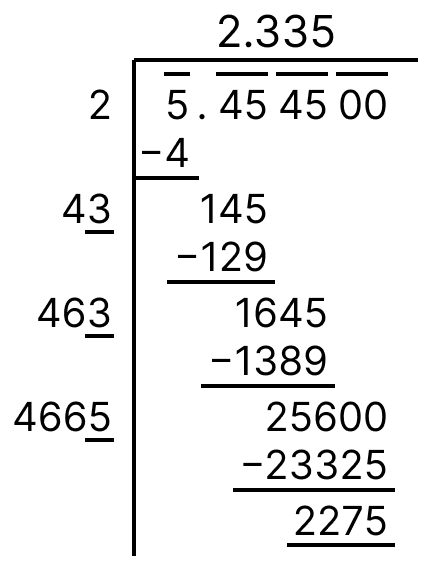
Find the square root of the following fractions correct to two decimal places: 55/11. Squares & Square Roots, ML Aggarwal Understanding Mathematics Solutions ICSE Class 8

5.4545=2.335≈2.34\sqrt{5.4545} = 2.335 \approx 2.34

Hence, 5511=2.34\mathbf{\sqrt{5\dfrac{5}{11}} = 2.34}

Question 4(iii)

Find the square root of the following fractions correct to two decimal places:

7137\dfrac{1}{3}

Answer

Converting mixed fraction into decimal:

⇒713⇒223⇒7.3333\Rightarrow \sqrt{7\dfrac{1}{3}}\\[1em] \Rightarrow \sqrt{\dfrac{22}{3}}\\[1em] \Rightarrow \sqrt{7.3333}

Square root of 7.3333 correct to two decimal places by division method:
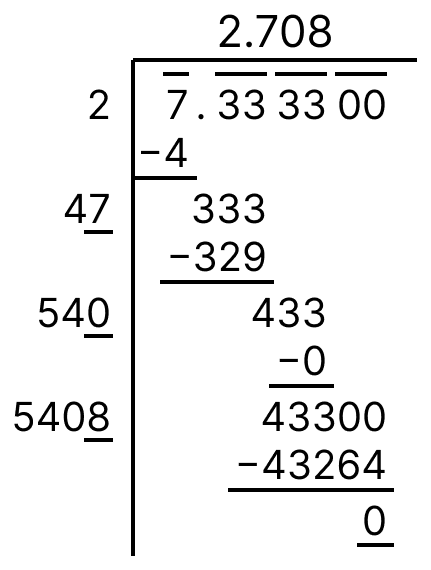
Find the square root of the following fractions correct to two decimal places: 71/3. Squares & Square Roots, ML Aggarwal Understanding Mathematics Solutions ICSE Class 8

7.3333=2.708≈2.71\sqrt{7.3333} = 2.708 \approx 2.71

Hence, 713=2.71\mathbf{\sqrt{7\dfrac{1}{3}} = 2.71}

Question 5(i)

Find the least number which must be subtracted from the following number to make it a perfect square. Also find the square root of the perfect square number so obtained:

2000

Answer

Using division method:
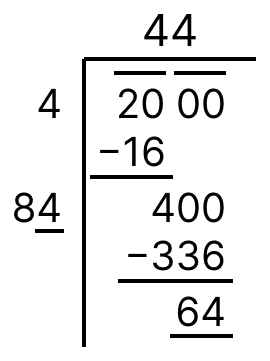
Find the least number which must be subtracted from the following number to make it a perfect square. Also find the square root of the perfect square number so obtained: 2000. Squares & Square Roots, ML Aggarwal Understanding Mathematics Solutions ICSE Class 8

Clearly, if 64 is subtracted from 2000, the remainder will be a perfect square.

Since, 2000 - 64 = 1936

and, 1936=44\sqrt{1936} = 44

Hence, 64 should be subtracted from 2000 and 1936=44\mathbf{\sqrt{1936} = 44}.

Question 5(ii)

Find the least number which must be subtracted from the following number to make it a perfect square. Also find the square root of the perfect square number so obtained:

984

Answer

Using division method:
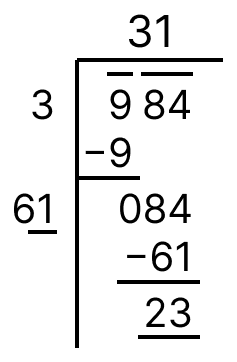
Find the least number which must be subtracted from the following number to make it a perfect square. Also find the square root of the perfect square number so obtained: 984. Squares & Square Roots, ML Aggarwal Understanding Mathematics Solutions ICSE Class 8

Clearly, if 23 is subtracted from 984, the remainder will be a perfect square.

Since, 984 - 23 = 961

and, 961=31\sqrt{961} = 31

Hence, 23 should be subtracted from 984 and 961=31\mathbf{\sqrt{961} = 31}.

Question 5(iii)

Find the least number which must be subtracted from the following number to make it a perfect square. Also find the square root of the perfect square number so obtained:

8934

Answer

Using division method:
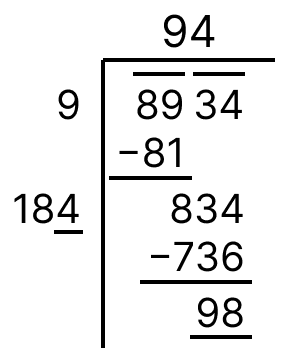
Find the least number which must be subtracted from the following number to make it a perfect square. Also find the square root of the perfect square number so obtained: 8934. Squares & Square Roots, ML Aggarwal Understanding Mathematics Solutions ICSE Class 8

Clearly, if 98 is subtracted from 8934, the remainder will be a perfect square.

Since, 8934 - 98 = 8836

and, 8836=94\sqrt{8836} = 94

Hence, 98 should be subtracted from 8934 and 8836=94\mathbf{\sqrt{8836} = 94}.

Question 5(iv)

Find the least number which must be subtracted from the following number to make it a perfect square. Also find the square root of the perfect square number so obtained:

11021

Answer

Using division method:
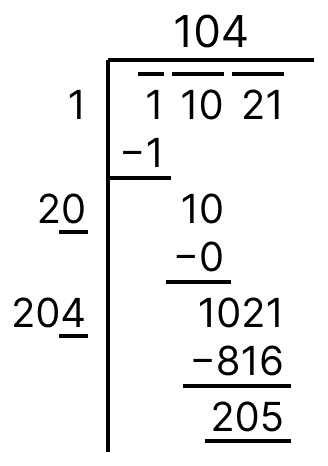
Find the least number which must be subtracted from the following number to make it a perfect square. Also find the square root of the perfect square number so obtained: 11021. Squares & Square Roots, ML Aggarwal Understanding Mathematics Solutions ICSE Class 8

Clearly, if 205 is subtracted from 11021, the remainder will be a perfect square.

Since, 11021 - 205 = 10816

and, 10816=104\sqrt{10816} = 104

Hence, 205 should be subtracted from 11021 and 10816=104\mathbf{\sqrt{10816} = 104}.

Question 6(i)

Find the least number which must be added to the following number to make it a perfect square. Also find the square root of the perfect square number so obtained:

1750

Answer

Using division method:
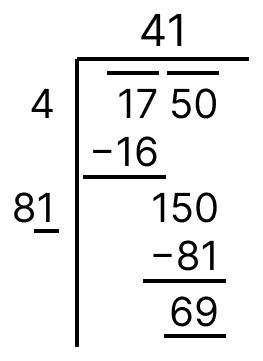
Find the least number which must be added to the following number to make it a perfect square. Also find the square root of the perfect square number so obtained: 1750. Squares & Square Roots, ML Aggarwal Understanding Mathematics Solutions ICSE Class 8

Clearly, 1750 is greater than 412.

∴ On adding the required number to 1750, we shall be getting 422 i.e, 1764.

So, the required number = 1764 - 1750 = 14.

and, 1764=42\sqrt{1764} = 42

Hence, 14 should be added to 1750 and 1764=42\mathbf{\sqrt{1764} = 42}.

Question 6(ii)

Find the least number which must be added to the following number to make it a perfect square. Also find the square root of the perfect square number so obtained:

6412

Answer

Using division method:
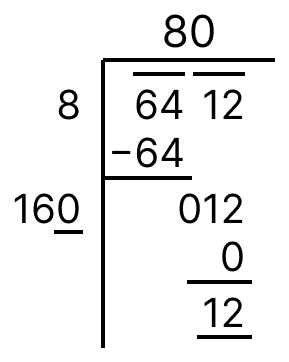
Find the least number which must be added to the following number to make it a perfect square. Also find the square root of the perfect square number so obtained: 6412. Squares & Square Roots, ML Aggarwal Understanding Mathematics Solutions ICSE Class 8

Clearly, 6412 is greater than 802.

∴ On adding the required number to 6412, we shall be getting 812 i.e, 6561.

So, the required number = 6561 - 6412 = 149.

and, 6561=81\sqrt{6561} = 81

Hence, 149 should be added to 6412 and 6561=81\mathbf{\sqrt{6561} = 81}.

Question 6(iii)

Find the least number which must be added to the following number to make it a perfect square. Also find the square root of the perfect square number so obtained:

6598

Answer

Using division method:
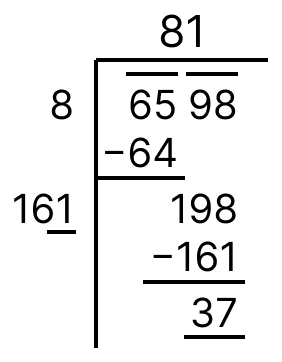
Find the least number which must be added to the following number to make it a perfect square. Also find the square root of the perfect square number so obtained: 6598. Squares & Square Roots, ML Aggarwal Understanding Mathematics Solutions ICSE Class 8

Clearly, 6598 is greater than 812.

∴ On adding the required number to 6598, we shall be getting 822 i.e, 6724.

So, the required number = 6724 - 6598 = 126.

and, 6724=82\sqrt{6724} = 82

Hence, 126 should be added to 6598 and 6724=82\mathbf{\sqrt{6724} = 82}.

Question 6(iv)

Find the least number which must be added to the following number to make it a perfect square. Also find the square root of the perfect square number so obtained:

8000

Answer

Using division method:
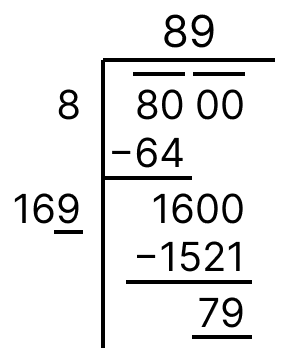
Find the least number which must be added to the following number to make it a perfect square. Also find the square root of the perfect square number so obtained: 8000. Squares & Square Roots, ML Aggarwal Understanding Mathematics Solutions ICSE Class 8

Clearly, 8000 is greater than 892.

∴ On adding the required number to 8000, we shall be getting 902 i.e, 8100.

So, the required number = 8100 - 8000 = 100.

and, 8100=90\sqrt{8100} = 90

Hence, 100 should be added to 8000 and 8100=90\mathbf{\sqrt{8100} = 90}.

Question 7

Find the smallest four digit number which is a perfect square.

Answer

The smallest four digit number = 1000

Using division method:
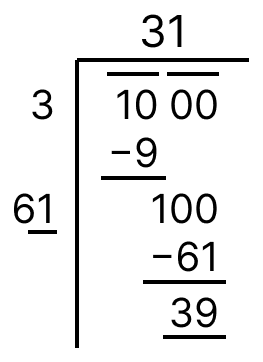
Find the smallest four digit number which is a perfect square. Squares & Square Roots, ML Aggarwal Understanding Mathematics Solutions ICSE Class 8

As we can see 1000 is not a perfect square.

Clearly, 1000 is greater than 312.

∴ On adding the required number to 1000, we shall be getting 322 i.e, 1024.

So, the required number = 1024 - 1000 = 24.

1000 + 24 = 1024 is a perfect square.

Hence, the smallest four digit number which is a perfect square is 1024.

Question 8

Find the greatest number of six digits which is a perfect square.

Answer

The greatest six digit number = 999999

Using division method:
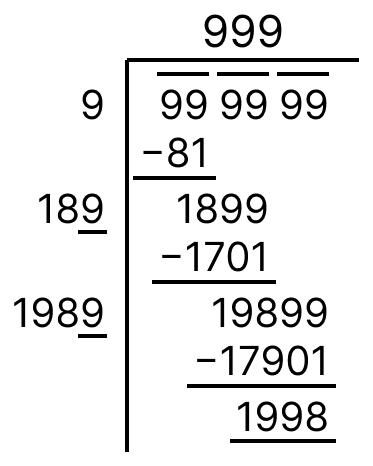
Find the greatest number of six digits which is a perfect square. Squares & Square Roots, ML Aggarwal Understanding Mathematics Solutions ICSE Class 8

We get the remainder = 1998

It means (999)2 is less than 999999 by 1998.

∴ If we subtract 1998 from 999999, we get (999)2 which is a perfect square number.

So, the required perfect square number = 999999 - 1998 = 998001.

Hence, the greatest six digit number which is a perfect square is 998001.

Question 9(i)

In a right triangle ABC, ∠B = 90°.

If AB = 14 cm, BC = 48 cm, find AC

Answer
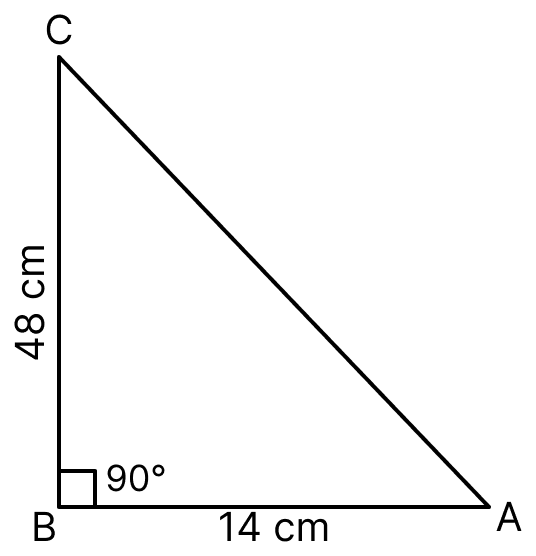
In a right triangle ABC, ∠B = 90°. If AB = 14 cm, BC = 48 cm, find AC. Squares & Square Roots, ML Aggarwal Understanding Mathematics Solutions ICSE Class 8

In right triangle ABC, ∠B = 90°.

By Pythagoras theorem,

⇒AC2=AB2+BC2⇒AC2=142+482⇒AC2=196+2304⇒AC2=2500⇒AC=2500⇒AC=50\Rightarrow AC^2 = AB^2 + BC^2\\[1em] \Rightarrow AC^2 = 14^2 + 48^2\\[1em] \Rightarrow AC^2 = 196 + 2304\\[1em] \Rightarrow AC^2 = 2500\\[1em] \Rightarrow AC = \sqrt{2500}\\[1em] \Rightarrow AC = 50

Hence, AC = 50 cm.

Question 9(ii)

In a right triangle ABC, ∠B = 90°.

If AC = 37 cm, BC = 35 cm, find AB.

Answer
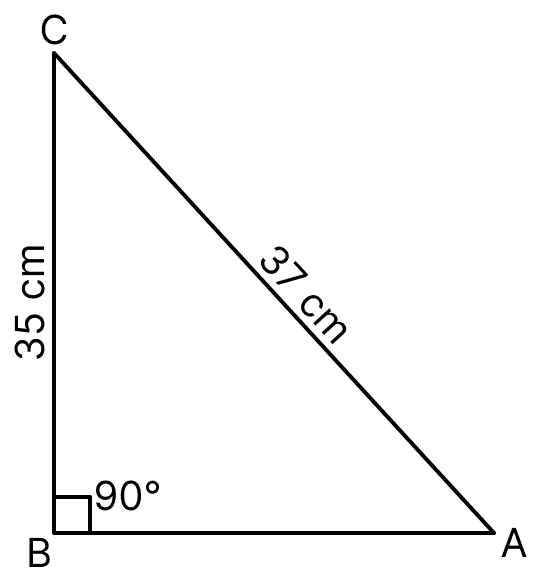
In a right triangle ABC, ∠B = 90°. If AC = 37 cm, BC = 35 cm, find AB. Squares & Square Roots, ML Aggarwal Understanding Mathematics Solutions ICSE Class 8

In right triangle ABC, ∠B = 90°.

By Pythagoras theorem,

⇒AC2=AB2+BC2⇒AB2=AC2−BC2⇒AB2=372−352⇒AB2=1369−1225⇒AB2=144⇒AB=144⇒AB=12\Rightarrow AC^2 = AB^2 + BC^2\\[1em] \Rightarrow AB^2 = AC^2 - BC^2\\[1em] \Rightarrow AB^2 = 37^2 - 35^2\\[1em] \Rightarrow AB^2 = 1369 - 1225\\[1em] \Rightarrow AB^2 = 144\\[1em] \Rightarrow AB = \sqrt{144}\\[1em] \Rightarrow AB = 12

Hence, AB = 12 cm.

Question 10

A gardener has 1400 plants. He wants to plant these in such a way that the number of rows and number of columns remains same. Find the minimum number of plants he needs more for this.

Answer

Using division method:
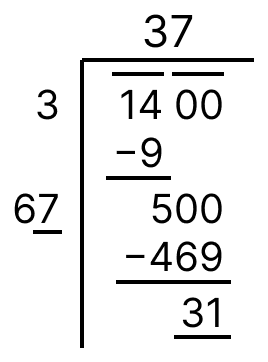
A gardener has 1400 plants. He wants to plant these in such a way that the number of rows and number of columns remains same. Find the minimum number of plants he needs more for this. Squares & Square Roots, ML Aggarwal Understanding Mathematics Solutions ICSE Class 8

Clearly, 1400 is greater than 372.

∴ On adding the required number to 1400, we shall be getting 382 i.e, 1444.

So, the required number = 1444 - 1400 = 44.

Hence, the gardener needs 44 more plants.

Question 11

There are 1000 children in a school. For a P.T. drill they have to stand in such a way that the number of rows is equal to number of columns. How many children would be left out in this arrangement?

Answer

Using division method:
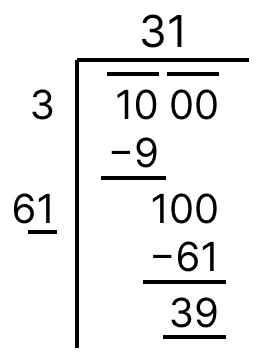
There are 1000 children in a school. For a P.T. drill they have to stand in such a way that the number of rows is equal to number of columns. How many children would be left out in this arrangement? Squares & Square Roots, ML Aggarwal Understanding Mathematics Solutions ICSE Class 8

We get the remainder = 39

It means (31)2 is less than 1000 by 39.

∴ If 39 children are left out, the remaining 961 children can be arranged in 31 rows and 31 columns.

Hence, 39 children would be left out in this arrangement.

Question 12

Amit walks 16 m south from his house and turns east to walk 63 m to reach his friend's house. While returning, he walks diagonally from his friend's house to reach back to his house. What distance did he walk while returning?

Answer
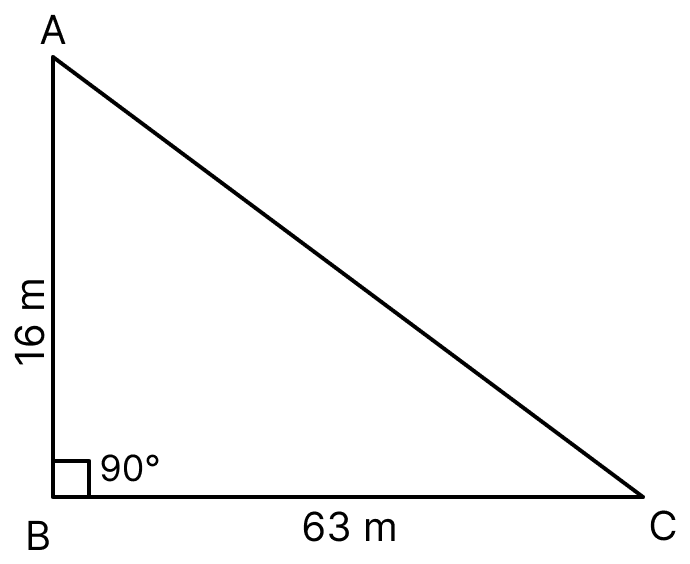
Amit walks 16 m south from his house and turns east to walk 63 m to reach his friends house. While returning, he walks diagonally from his friends house to reach back to his house. What distance did he walk while returning? Squares & Square Roots, ML Aggarwal Understanding Mathematics Solutions ICSE Class 8

Let A be the house of Amit, B the point where he turns east and C be his friend's house.

AB = 16 m, BC = 63 m and ∠B = 90°.

By Pythagoras theorem,

⇒AC2=AB2+BC2⇒AC2=162+632⇒AC2=256+3969⇒AC2=4225⇒AC=4225⇒AC=65\Rightarrow AC^2 = AB^2 + BC^2\\[1em] \Rightarrow AC^2 = 16^2 + 63^2\\[1em] \Rightarrow AC^2 = 256 + 3969\\[1em] \Rightarrow AC^2 = 4225\\[1em] \Rightarrow AC = \sqrt{4225}\\[1em] \Rightarrow AC = 65

Hence, Amit walked a distance of 65 m while returning.

Question 13

A ladder 6 m long leaned against a wall. The ladder reaches the wall to a height of 4.8 m. Find the distance between the wall and the foot of the ladder.

Answer
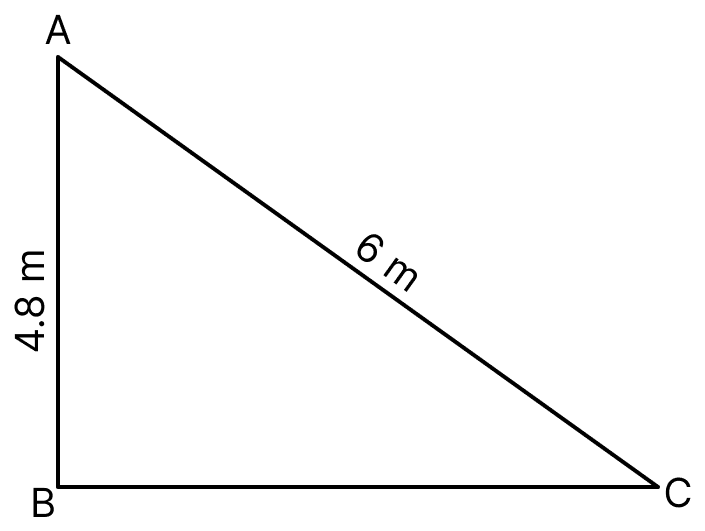
A ladder 6 m long leaned against a wall. The ladder reaches the wall to a height of 4.8 m. Find the distance between the wall and the foot of the ladder. Squares & Square Roots, ML Aggarwal Understanding Mathematics Solutions ICSE Class 8

Let AC be the ladder, AB the wall and BC the distance between the wall and the foot of the ladder.

AC = 6 m, AB = 4.8 m and ∠B = 90°.

By Pythagoras theorem,

⇒AC2=AB2+BC2⇒BC2=AC2−AB2⇒BC2=62−(4.8)2⇒BC2=36−23.04⇒BC2=12.96⇒BC=12.96⇒BC=3.6\Rightarrow AC^2 = AB^2 + BC^2\\[1em] \Rightarrow BC^2 = AC^2 - AB^2\\[1em] \Rightarrow BC^2 = 6^2 - (4.8)^2\\[1em] \Rightarrow BC^2 = 36 - 23.04\\[1em] \Rightarrow BC^2 = 12.96\\[1em] \Rightarrow BC = \sqrt{12.96}\\[1em] \Rightarrow BC = 3.6

Hence, the distance between the wall and the foot of the ladder is 3.6 m.

PrevNext