
Some figures are given below.
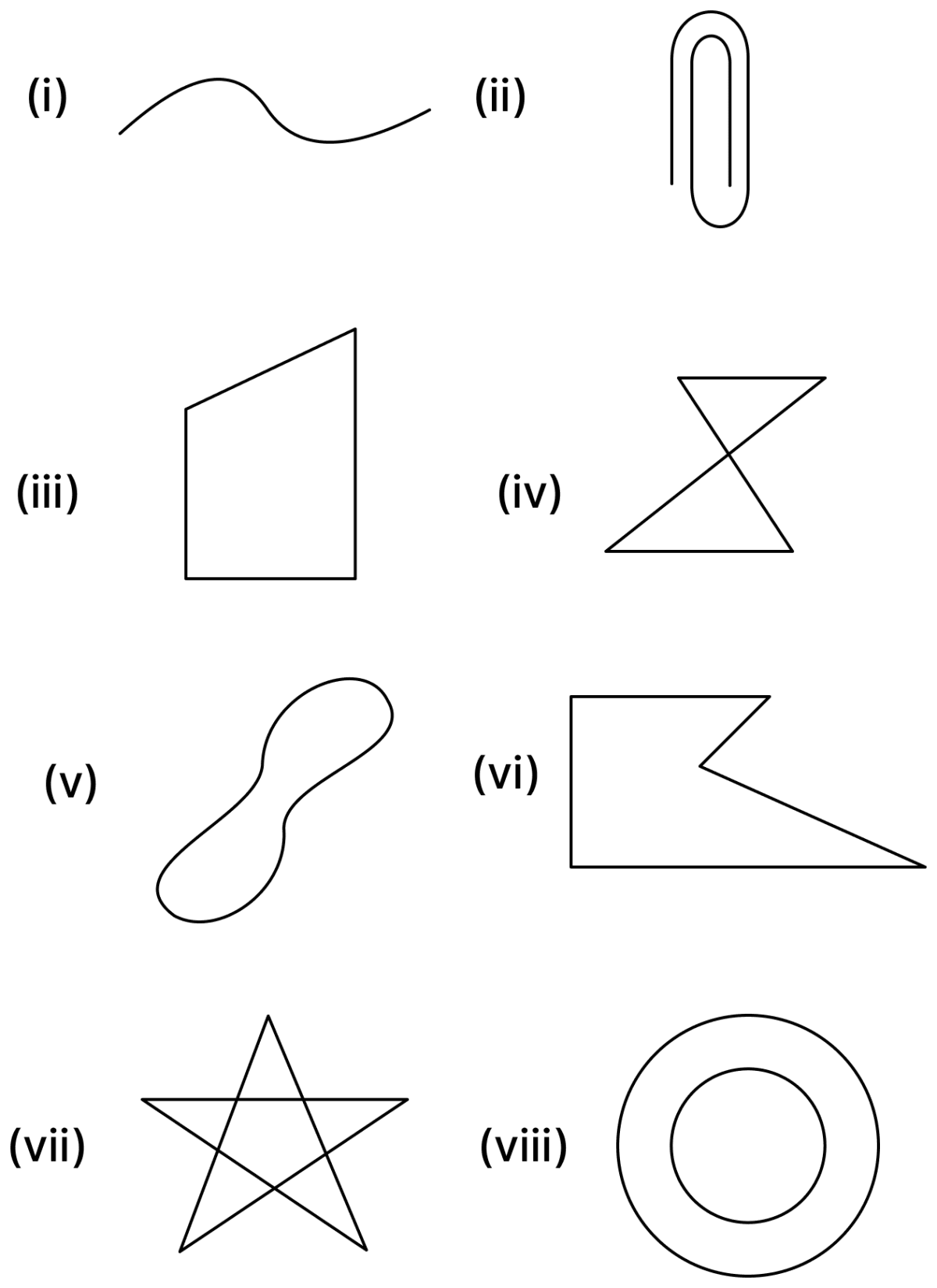
Classify each of them on the basis of the following:
(a) Simple curve
(b) Simple closed curve
(c) Polygon
(d) Convex polygon
(e) Concave polygon
Answer
(a) Simple curve
A curve which does not cross itself at any point is called a simple curve.
Hence, figures (i), (ii), (iii), (v) and (vi) are simple curves.
(b) Simple closed curve
A curve which does not cross itself at any point and has the same beginning and end points is called a simple closed curve.
Hence, figures (iii), (v) and (vi) are simple closed curves.
(c) Polygon
A simple closed curve made up entirely of line segments is called a polygon.
Hence, figures (iii) and (vi) are polygons.
(d) Convex polygon
A polygon in which each interior angle is less than 180° is called a convex polygon.
Hence, figure (iii) is a convex polygon.
(e) Concave polygon
A polygon in which atleast one interior angle is greater than 180° is called a concave polygon.
Hence, figure (vi) is a concave polygon.
How many diagonals does each of the following have?
(a) A convex quadrilateral
(b) A regular hexagon
Answer
According to the properties of a polygon, if a polygon has sides, where is greater than 3, then the number of diagonals of the polygon is .
(a) A convex quadrilateral
A quadrilateral has 4 sides, so = 4.
Hence, a convex quadrilateral has 2 diagonals.
(b) A regular hexagon
A hexagon has 6 sides, so = 6.
Hence, a regular hexagon has 9 diagonals.
Find the sum of measures of all interior angles of a polygon with number of sides:
(i) 8
(ii) 12
Answer
According to the properties of a polygon, if a polygon has n sides, then the sum of measures of all its interior angles is (n - 2) × 180°.
(i) 8
Here, n = 8.
Sum of measures of all interior angles = (8 - 2) x 180°
= 6 x 180°
= 1080°
Hence, the sum of measures of all interior angles is 1080°.
(ii) 12
Here, n = 12.
Sum of measures of all interior angles = (12 - 2) x 180°
= 10 x 180°
= 1800°
Hence, the sum of measures of all interior angles is 1800°.
Find the number of sides of a regular polygon whose each exterior angle has a measure of
(i) 24°
(ii) 60°
(iii) 72°
Answer
According to the properties of a polygon, if each exterior angle of a regular polygon is , then the number of sides in the regular polygon is .
(i) 24°
Number of sides =
= 15
Hence, the number of sides is 15.
(ii) 60°
Number of sides =
= 6
Hence, the number of sides is 6.
(iii) 72°
Number of sides =
= 5
Hence, the number of sides is 5.
Find the number of sides of a regular polygon if each of its interior angle is
(i) 90°
(ii) 108°
(iii) 165°
Also name these polygons according to the number of sides.
Answer
We know that the sum of an interior angle and its adjacent exterior angle is 180°.
Also, if each exterior angle of a regular polygon is , then the number of sides in the regular polygon is .
(i) 90°
Each exterior angle = 180° - 90° = 90°
Number of sides =
= 4
A regular polygon of 4 sides is a square.
Hence, the number of sides is 4 and the polygon is a square.
(ii) 108°
Each exterior angle = 180° - 108° = 72°
Number of sides =
= 5
A regular polygon of 5 sides is a pentagon.
Hence, the number of sides is 5 and the polygon is a pentagon.
(iii) 165°
Each exterior angle = 180° - 165° = 15°
Number of sides =
= 24
A regular polygon of 24 sides is a 24-sided polygon.
Hence, the number of sides is 24 and the polygon is a 24-sided polygon.
Find the number of sides in a polygon if the sum of its interior angles is:
(i) 1260°
(ii) 1980°
(iii) 3420°
Answer
According to the properties of a polygon, if a polygon has n sides, then the sum of measures of all its interior angles is (n - 2) × 180°.
(i) 1260°
⇒ (n - 2) × 180° = 1260°
⇒ n - 2 =
⇒ n - 2 = 7
⇒ n = 7 + 2
⇒ n = 9
Hence, the number of sides is 9.
(ii) 1980°
⇒ (n - 2) × 180° = 1980°
⇒ n - 2 =
⇒ n - 2 = 11
⇒ n = 11 + 2
⇒ n = 13
Hence, the number of sides is 13.
(iii) 3420°
⇒ (n - 2) × 180° = 3420°
⇒ n - 2 =
⇒ n - 2 = 19
⇒ n = 19 + 2
⇒ n = 21
Hence, the number of sides is 21.
If the angles of a pentagon are in the ratio 7 : 8 : 11 : 13 : 15, find the angles.
Answer
It is given that the angles of a pentagon are in the ratio 7 : 8 : 11 : 13 : 15.
Let the common factor of the angles be a. So, the angles are 7a, 8a, 11a, 13a and 15a.
According to the properties of a polygon, if a polygon has n sides, then the sum of measures of all its interior angles is (n - 2) × 180°.
A pentagon has 5 sides, so n = 5.
Sum of interior angles = (5 - 2) x 180°
= 3 x 180°
= 540°
So,
⇒ 7a + 8a + 11a + 13a + 15a = 540°
⇒ 54a = 540°
⇒ a =
⇒ a = 10°
Thus, the angles are:
7a = 7 x 10° = 70°
8a = 8 x 10° = 80°
11a = 11 x 10° = 110°
13a = 13 x 10° = 130°
15a = 15 x 10° = 150°
Hence, the angles of the pentagon are 70°, 80°, 110°, 130° and 150°.
The angles of a pentagon are x°, (x - 10)°, (x + 20)°, (2x - 44)° and (2x - 70)°. Calculate x.
Answer
It is given that the angles of a pentagon are x°, (x - 10)°, (x + 20)°, (2x - 44)° and (2x - 70)°.
According to the properties of a polygon, if a polygon has n sides, then the sum of measures of all its interior angles is (n - 2) × 180°.
A pentagon has 5 sides, so n = 5.
Sum of interior angles = (5 - 2) x 180°
= 3 x 180°
= 540°
So,
⇒ x° + (x - 10)° + (x + 20)° + (2x - 44)° + (2x - 70)° = 540°
⇒ x° + x° - 10° + x° + 20° + 2x° - 44° + 2x° - 70° = 540°
⇒ 7x° - 104° = 540°
⇒ 7x° = 540° + 104°
⇒ 7x° = 644°
⇒ x° =
⇒ x = 92
Hence, the value of x is 92.
The exterior angles of a pentagon are in the ratio 1 : 2 : 3 : 4 : 5. Find all the interior angles of the pentagon.
Answer
It is given that the exterior angles of a pentagon are in the ratio 1 : 2 : 3 : 4 : 5.
Let the common factor of the angles be a. So, the exterior angles are a, 2a, 3a, 4a and 5a.
According to the properties of a polygon, the sum of all the exterior angles of a polygon is 360°.
So,
⇒ a + 2a + 3a + 4a + 5a = 360°
⇒ 15a = 360°
⇒ a =
⇒ a = 24°
Thus, the exterior angles are:
a = 24°
2a = 2 x 24° = 48°
3a = 3 x 24° = 72°
4a = 4 x 24° = 96°
5a = 5 x 24° = 120°
As the sum of an interior angle and its adjacent exterior angle is 180°, the interior angles are obtained by subtracting each exterior angle from 180°.
⇒ 180° - 24° = 156°
⇒ 180° - 48° = 132°
⇒ 180° - 72° = 108°
⇒ 180° - 96° = 84°
⇒ 180° - 120° = 60°
Hence, the interior angles of the pentagon are 156°, 132°, 108°, 84° and 60°.
In a quadrilateral ABCD, AB ∥ DC. If ∠A : ∠D = 2 : 3 and ∠B : ∠C = 7 : 8, find the measure of each angle.
Answer
It is given that in quadrilateral ABCD, AB ∥ DC, ∠A : ∠D = 2 : 3 and ∠B : ∠C = 7 : 8.
As AB ∥ DC and AD is a transversal, the co-interior angles ∠A and ∠D are supplementary.
⇒ ∠A + ∠D = 180°
Let the common factor of ∠A and ∠D be a. So, ∠A = 2a and ∠D = 3a.
⇒ 2a + 3a = 180°
⇒ 5a = 180°
⇒ a =
⇒ a = 36°
Thus,
∠A = 2a = 2 x 36° = 72°
∠D = 3a = 3 x 36° = 108°
As AB ∥ DC and BC is a transversal, the co-interior angles ∠B and ∠C are supplementary.
⇒ ∠B + ∠C = 180°
Let the common factor of ∠B and ∠C be b. So, ∠B = 7b and ∠C = 8b.
⇒ 7b + 8b = 180°
⇒ 15b = 180°
⇒ b =
⇒ b = 12°
Thus,
∠B = 7b = 7 x 12° = 84°
∠C = 8b = 8 x 12° = 96°
Hence, ∠A = 72°, ∠B = 84°, ∠C = 96° and ∠D = 108°.
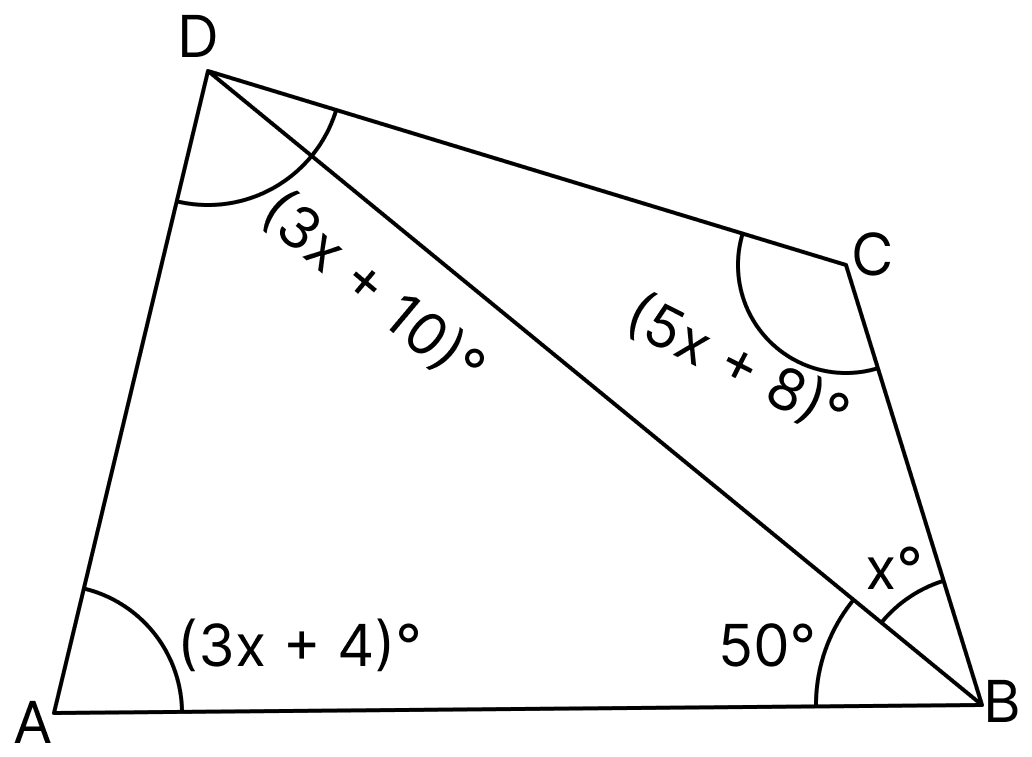
From the adjoining figure, find
(i) x
(ii) ∠DAB
(iii) ∠ADB
Answer
(i) From the figure, in quadrilateral ABCD,
∠DAB = (3x + 4)°, ∠ABC = (50 + x)°, ∠BCD = (5x + 8)° and ∠CDA = (3x + 10)°
As we know, the sum of all the interior angles of a quadrilateral is 360°.
⇒ ∠DAB + ∠ABC + ∠BCD + ∠CDA = 360°
⇒ (3x + 4)° + (50 + x)° + (5x + 8)° + (3x + 10)° = 360°
⇒ 3x° + 4° + 50° + x° + 5x° + 8° + 3x° + 10° = 360°
⇒ 12x° + 72° = 360°
⇒ 12x° = 360° - 72°
⇒ 12x° = 288°
⇒ x° =
⇒ x = 24
Hence, the value of x is 24.
(ii) ∠DAB = (3x + 4)°
= (3 x 24 + 4)°
= (72 + 4)°
= 76°
Hence, ∠DAB = 76°.
(iii) In ΔADB, ∠DAB = 76° and ∠ABD = 50°.
As we know, the sum of all the angles of a triangle is 180°.
⇒ ∠DAB + ∠ABD + ∠ADB = 180°
⇒ 76° + 50° + ∠ADB = 180°
⇒ 126° + ∠ADB = 180°
⇒ ∠ADB = 180° - 126°
⇒ ∠ADB = 54°
Hence, ∠ADB = 54°.
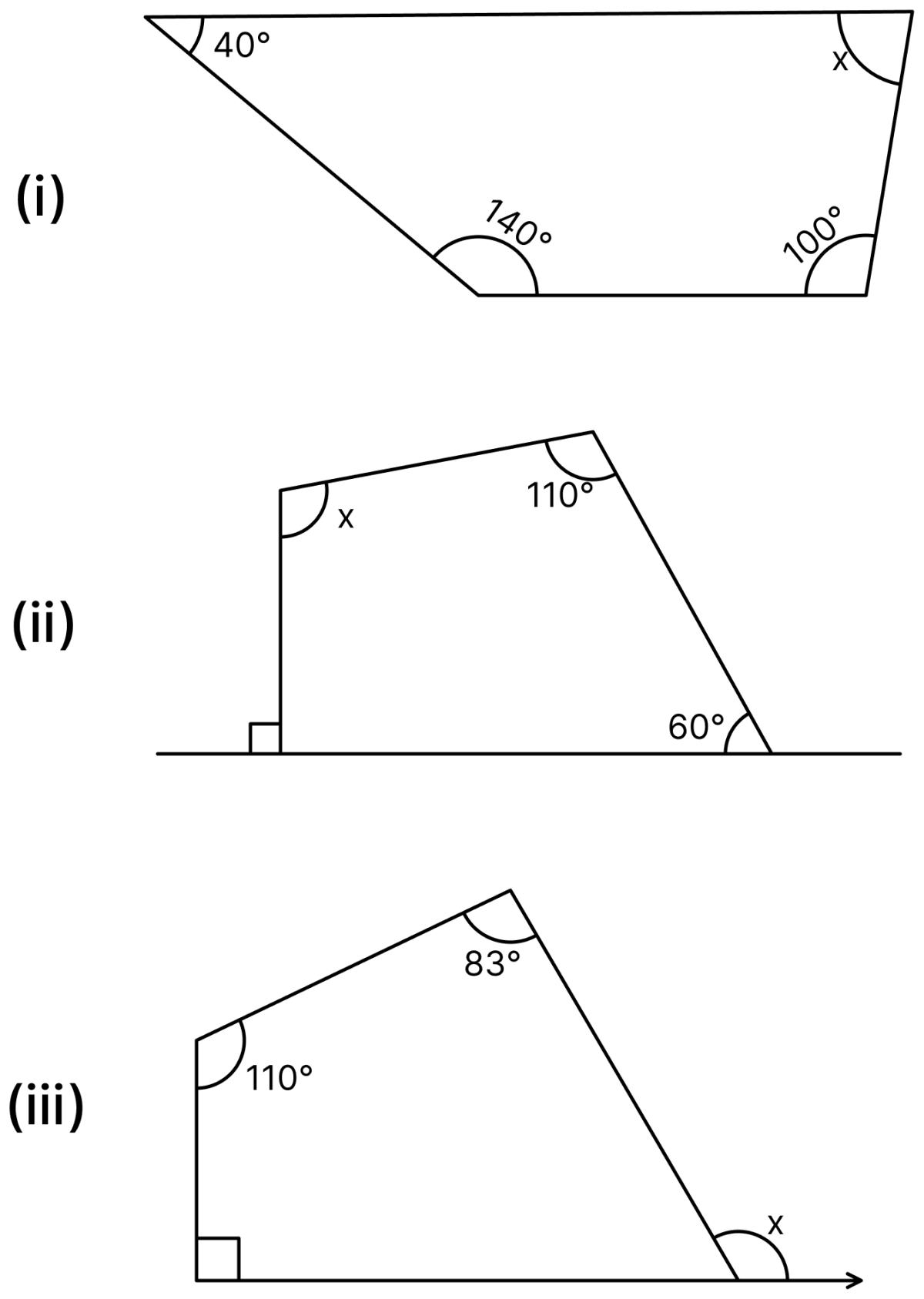
Find the angle measure x in the following figures:
Answer
As we know, the sum of all the interior angles of a quadrilateral is 360°.
(i) From the figure, the interior angles of the quadrilateral are 40°, 140°, 100° and x.
⇒ 40° + 140° + 100° + x = 360°
⇒ 280° + x = 360°
⇒ x = 360° - 280°
⇒ x = 80°
Hence, x = 80°.
(ii) From the figure, the interior angles of the quadrilateral are 90°, x, 110° and 60°.
⇒ 90° + x + 110° + 60° = 360°
⇒ 260° + x = 360°
⇒ x = 360° - 260°
⇒ x = 100°
Hence, x = 100°.
(iii) From the figure, three interior angles of the quadrilateral are 90°, 110° and 83°.
Let the fourth interior angle be a.
⇒ 90° + 110° + 83° + a = 360°
⇒ 283° + a = 360°
⇒ a = 360° - 283°
⇒ a = 77°
As the side is produced, x and a form a linear pair.
⇒ x + a = 180°
⇒ x + 77° = 180°
⇒ x = 180° - 77°
⇒ x = 103°
Hence, x = 103°.
A heptagon has three equal angles each of 120° and four equal angles. Find the size of equal angles.
Answer
It is given that a heptagon has three equal angles each of 120° and four equal angles.
According to the properties of a polygon, if a polygon has n sides, then the sum of measures of all its interior angles is (n - 2) × 180°.
A heptagon has 7 sides, so n = 7.
Sum of interior angles = (7 - 2) x 180°
= 5 x 180°
= 900°
Let the size of each of the four equal angles be a.
So,
⇒ 3 × 120° + 4a = 900°
⇒ 360° + 4a = 900°
⇒ 4a = 900° - 360°
⇒ 4a = 540°
⇒ a =
⇒ a = 135°
Hence, the size of each equal angle is 135°.
The ratio between an exterior angle and the interior angle of a regular polygon is 1 : 5. Find
(i) the measure of each exterior angle
(ii) the measure of each interior angle
(iii) the number of sides in the polygon
Answer
It is given that the ratio between an exterior angle and the interior angle of a regular polygon is 1 : 5.
Let the common factor be a. So, the exterior angle is a and the interior angle is 5a.
As we know, the sum of an interior angle and its adjacent exterior angle is 180°.
⇒ a + 5a = 180°
⇒ 6a = 180°
⇒ a =
⇒ a = 30°
(i) Each exterior angle = a = 30°
Hence, the measure of each exterior angle is 30°.
(ii) Each interior angle = 5a = 5 x 30° = 150°
Hence, the measure of each interior angle is 150°.
(iii) According to the properties of a polygon, if each exterior angle of a regular polygon is , then the number of sides in the regular polygon is .
Number of sides =
= 12
Hence, the number of sides in the polygon is 12.
Each interior angle of a regular polygon is double of its exterior angle. Find the number of sides in the polygon.
Answer
It is given that each interior angle of a regular polygon is double of its exterior angle.
Let the exterior angle be a. So, the interior angle is 2a.
As we know, the sum of an interior angle and its adjacent exterior angle is 180°.
⇒ a + 2a = 180°
⇒ 3a = 180°
⇒ a =
⇒ a = 60°
So, each exterior angle of the regular polygon is 60°.
According to the properties of a polygon, if each exterior angle of a regular polygon is , then the number of sides in the regular polygon is .
Number of sides =
= 6
Hence, the number of sides in the polygon is 6.