
Can a polyhedron have for its faces
(i) 3 triangles?
(ii) 4 triangles?
(iii) a square and four triangles?
Answer
(i) A polyhedron must have at least 4 faces, so it cannot be enclosed by only 3 triangles.
Hence, a polyhedron cannot have 3 triangles for its faces.
(ii) A polyhedron can have 4 triangles as its faces. One of these triangles forms its base and the remaining three form its lateral faces meeting at a common vertex. Such a polyhedron is a triangular pyramid, which is also known as a tetrahedron.
Hence, a polyhedron can have 4 triangles for its faces.
(iii) A polyhedron can have a square and four triangles as its faces. The square forms its base and the four triangles form its lateral faces meeting at a common vertex. Such a polyhedron is a square pyramid.
Hence, a polyhedron can have a square and four triangles for its faces.
Which are prisms among the following?
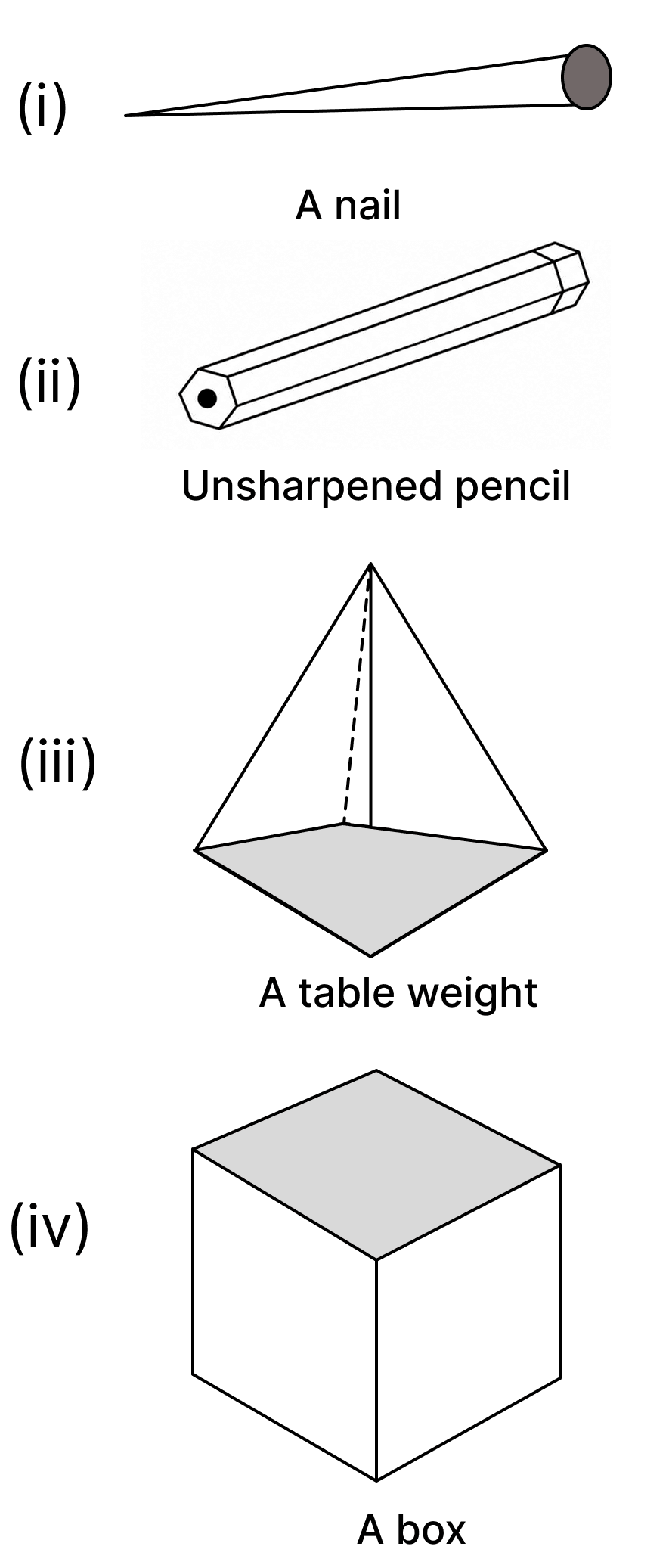
Answer
A prism is a polyhedron whose base and top are congruent polygons and whose lateral faces are parallelograms in shape.
(i) A nail tapers to a pointed end, so its base and top are not congruent polygons. So, a nail is not a prism.
(ii) An unsharpened pencil has congruent hexagons as its base and top and rectangles as its lateral faces. So, an unsharpened pencil is a prism. It is a hexagonal prism.
(iii) A table weight has a square as its base and its lateral faces are triangles meeting at a common vertex. So, a table weight is not a prism. It is a square pyramid.
(iv) A box has congruent rectangles as its base and top and rectangles as its lateral faces. So, a box is a prism. It is a rectangular prism.
Hence, only (ii) and (iv) are prisms.
Verify Euler's formula for this solid:
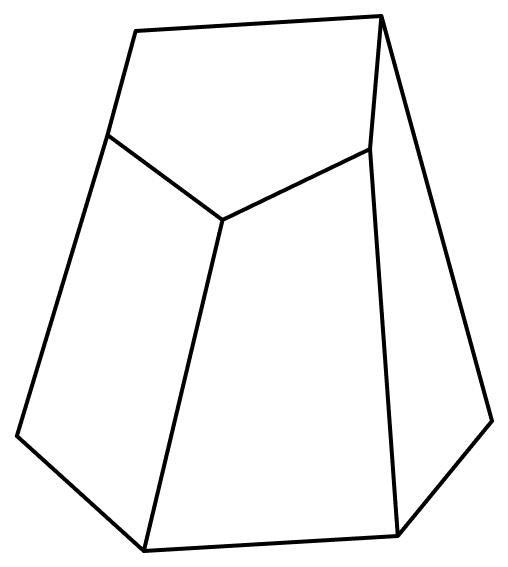
Answer
The given solid has a pentagonal top, a pentagonal base and 5 lateral faces.
From the figure,
F = 7, V = 10, E = 15
According to Euler's formula,
F + V = E + 2
L.H.S. = F + V = 7 + 10 = 17
R.H.S. = E + 2 = 15 + 2 = 17
Since, L.H.S. = R.H.S.
Hence, Euler's formula is verified.
Verify Euler's formula for this solid:
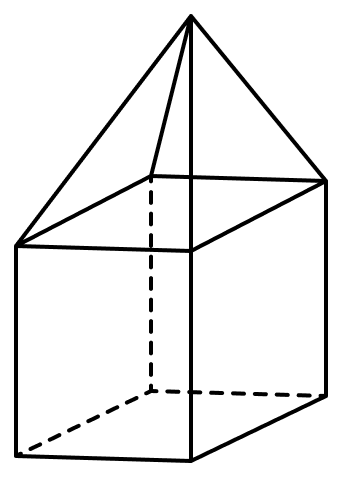
Answer
The given solid is a square prism surmounted by a square pyramid.
From the figure,
F = 9, V = 9, E = 16
According to Euler's formula,
F + V = E + 2
L.H.S. = F + V = 9 + 9 = 18
R.H.S. = E + 2 = 16 + 2 = 18
Since, L.H.S. = R.H.S.
Hence, Euler's formula is verified.
Verify Euler's formula for this solid:
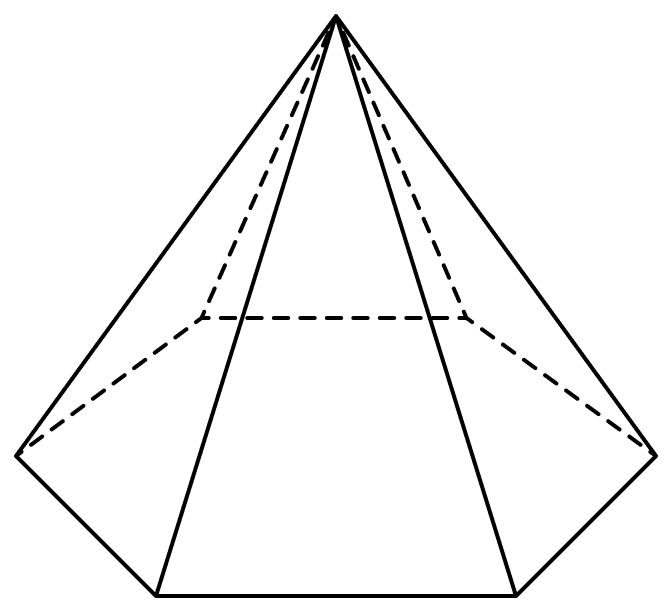
Answer
The given solid is a hexagonal pyramid.
From the figure,
F = 7, V = 7, E = 12
According to Euler's formula,
F + V = E + 2
L.H.S. = F + V = 7 + 7 = 14
R.H.S. = E + 2 = 12 + 2 = 14
Since, L.H.S. = R.H.S.
Hence, Euler's formula is verified.
Verify Euler's formula for this solid:
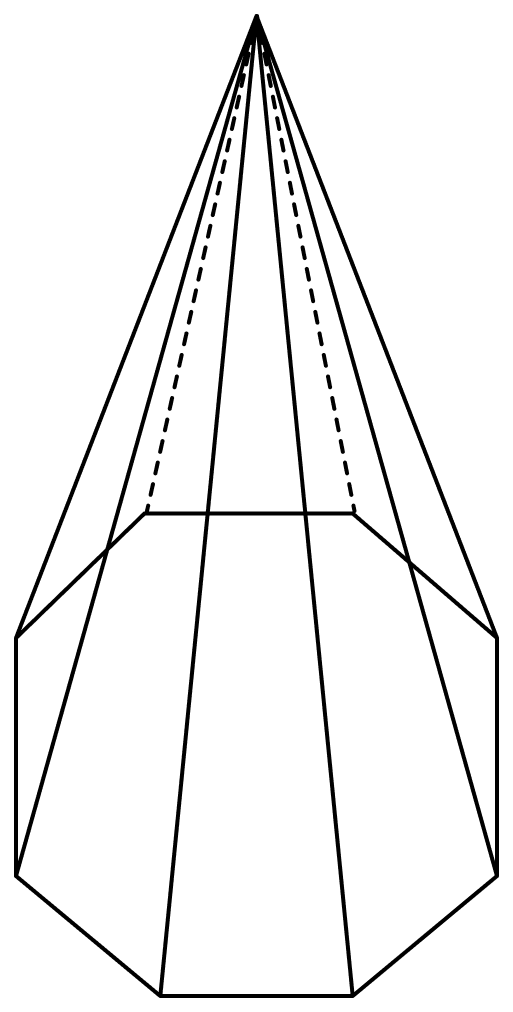
Answer
The given solid is an octagonal pyramid.
From the figure,
F = 9, V = 9, E = 16
According to Euler's formula,
F + V = E + 2
L.H.S. = F + V = 9 + 9 = 18
R.H.S. = E + 2 = 16 + 2 = 18
Since, L.H.S. = R.H.S.
Hence, Euler's formula is verified.
Can a polyhedron have 15 faces, 30 edges and 20 vertices?
Answer
Given:
F = 15, E = 30, V = 20
According to Euler's formula,
F + V = E + 2
L.H.S. = F + V = 15 + 20 = 35
R.H.S. = E + 2 = 30 + 2 = 32
Since, L.H.S. ≠ R.H.S.
Hence, a polyhedron cannot have 15 faces, 30 edges and 20 vertices.
If a polyhedron has 8 faces and 8 vertices, find the number of edges.
Answer
Given:
F = 8, V = 8
According to Euler's formula,
F + V = E + 2
⇒ 8 + 8 = E + 2
⇒ 16 = E + 2
⇒ E = 16 - 2
⇒ E = 14
Hence, the number of edges = 14.
If a polyhedron has 7 faces and 10 vertices, find the number of edges.
Answer
Given:
F = 7, V = 10
According to Euler's formula,
F + V = E + 2
⇒ 7 + 10 = E + 2
⇒ 17 = E + 2
⇒ E = 17 - 2
⇒ E = 15
Hence, the number of edges = 15.
Write the number of faces, vertices and edges in
(i) an octagonal prism
(ii) decagonal pyramid.
Answer
(i) In an octagonal prism, the number of sides of the polygonal base is 8.
Number of faces in a prism is 2 more than the number of sides of the polygonal base.
Number of faces = 8 + 2 = 10
Number of vertices in a prism is twice the number of sides of the polygonal base.
Number of vertices = 8 × 2 = 16
Number of edges in a prism is thrice the number of sides of the polygonal base.
Number of edges = 8 × 3 = 24
Hence, in an octagonal prism, F = 10, V = 16 and E = 24.
(ii) In a decagonal pyramid, the number of sides of the polygonal base is 10.
Number of faces in a pyramid is 1 more than the number of sides of the polygonal base.
Number of faces = 10 + 1 = 11
Number of vertices in a pyramid is 1 more than the number of sides of the polygonal base.
Number of vertices = 10 + 1 = 11
Number of edges in a pyramid is twice the number of sides of the polygonal base.
Number of edges = 10 × 2 = 20
Hence, in a decagonal pyramid, F = 11, V = 11 and E = 20.
Using Euler's formula, complete the following table:
| Faces | Vertices | Edges | |
|---|---|---|---|
| (i) | 6 | — | 12 |
| (ii) | — | 5 | 8 |
| (iii) | 14 | 24 | — |
| (iv) | — | 16 | 30 |
| (v) | 16 | — | 42 |
| (vi) | 19 | 19 | — |
Answer
According to Euler's formula,
F + V = E + 2
(i) Given: F = 6, E = 12
⇒ 6 + V = 12 + 2
⇒ 6 + V = 14
⇒ V = 14 - 6
⇒ V = 8
Hence, V = 8.
(ii) Given: V = 5, E = 8
⇒ F + 5 = 8 + 2
⇒ F + 5 = 10
⇒ F = 10 - 5
⇒ F = 5
Hence, F = 5.
(iii) Given: F = 14, V = 24
⇒ 14 + 24 = E + 2
⇒ 38 = E + 2
⇒ E = 38 - 2
⇒ E = 36
Hence, E = 36.
(iv) Given: V = 16, E = 30
⇒ F + 16 = 30 + 2
⇒ F + 16 = 32
⇒ F = 32 - 16
⇒ F = 16
Hence, F = 16.
(v) Given: F = 16, E = 42
⇒ 16 + V = 42 + 2
⇒ 16 + V = 44
⇒ V = 44 - 16
⇒ V = 28
Hence, V = 28.
(vi) Given: F = 19, V = 19
⇒ 19 + 19 = E + 2
⇒ 38 = E + 2
⇒ E = 38 - 2
⇒ E = 36
Hence, E = 36.
The completed table is shown below:
| Faces | Vertices | Edges | |
|---|---|---|---|
| (i) | 6 | 8 | 12 |
| (ii) | 5 | 5 | 8 |
| (iii) | 14 | 24 | 36 |
| (iv) | 16 | 16 | 30 |
| (v) | 16 | 28 | 42 |
| (vi) | 19 | 19 | 36 |