
Construct a parallelogram ABCD such that AB = 5 cm, BC = 3.2 cm and ∠B = 120°
Answer
Given, in parallelogram ABCD, AB = 5 cm, BC = 3.2 cm and ∠B = 120°.
As the opposite sides of a parallelogram are equal,
⇒ CD = AB = 5 cm and AD = BC = 3.2 cm
Steps of construction :
Draw a line segment AB = 5 cm.
At B, construct ∠ABX = 120°.
From BX, cut off BC = 3.2 cm.
With A as centre and radius 3.2 cm, draw an arc.
With C as centre and radius 5 cm, draw another arc cutting the previous arc at D.
Join AD and CD.
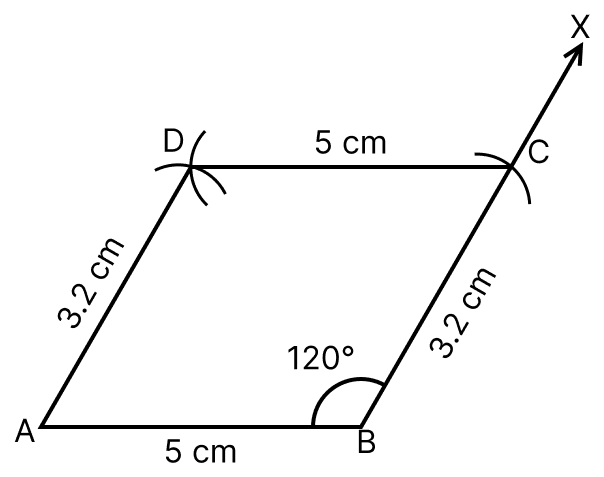
Hence, ABCD is the required parallelogram.
Construct a parallelogram ABCD such that AB = 4.8 cm, BC = 4 cm and diagonal BD = 5.4 cm.
Answer
Given, in parallelogram ABCD, AB = 4.8 cm, BC = 4 cm and diagonal BD = 5.4 cm.
As the opposite sides of a parallelogram are equal,
⇒ CD = AB = 4.8 cm and AD = BC = 4 cm
The diagonal BD divides the parallelogram ABCD into two triangles, ΔABD and ΔBCD, and all the three sides of each of them are known.
Steps of construction :
Draw a line segment AB = 4.8 cm.
With A as centre and radius 4 cm, draw an arc.
With B as centre and radius 5.4 cm, draw another arc cutting the previous arc at D.
Join AD and BD.
With B as centre and radius 4 cm, draw an arc on the side of BD opposite to that of A.
With D as centre and radius 4.8 cm, draw another arc cutting the previous arc at C.
Join BC and CD.
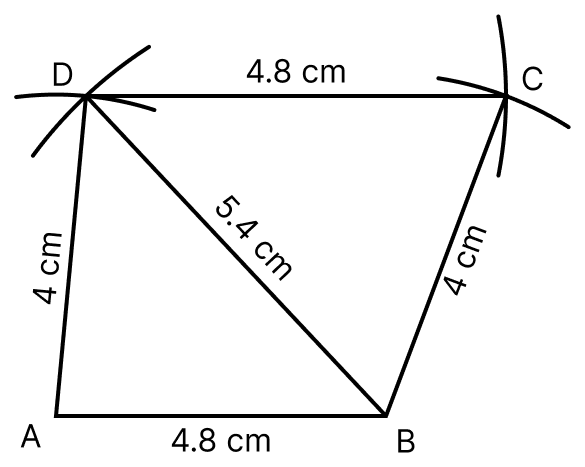
Hence, ABCD is the required parallelogram.
Construct a parallelogram ABCD such that BC = 4.5 cm, BD = 4 cm and AC = 5.6 cm
Answer
Given, in parallelogram ABCD, BC = 4.5 cm, BD = 4 cm and AC = 5.6 cm.
Let the diagonals AC and BD meet at O.
As the diagonals of a parallelogram bisect each other,
⇒ OB = OD = = 2 cm
⇒ OA = OC = = 2.8 cm
So, in ΔOBC, all the three sides BC, OB and OC are known and hence it can be constructed.
Steps of construction :
Draw a line segment BC = 4.5 cm.
With B as centre and radius 2 cm, draw an arc.
With C as centre and radius 2.8 cm, draw another arc cutting the previous arc at O.
Join BO and CO.
Produce BO to D such that OD = OB = 2 cm.
Produce CO to A such that OA = OC = 2.8 cm.
Join AB, AD and CD.
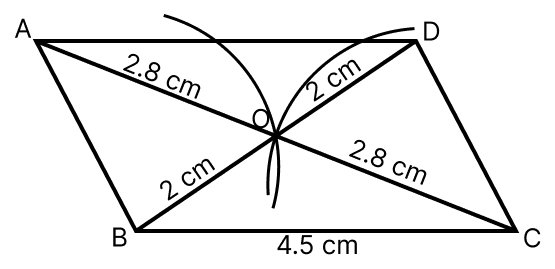
Hence, ABCD is the required parallelogram.
Construct a parallelogram ABCD such that AC = 6 cm, BD = 4.6 cm and angle between them is 45°.
Answer
Given, in parallelogram ABCD, diagonal AC = 6 cm, diagonal BD = 4.6 cm and the angle between them is 45°.
Let the diagonals AC and BD meet at O, so that ∠COD = 45°.
As the diagonals of a parallelogram bisect each other,
⇒ OA = OC = = 3 cm
⇒ OB = OD = = 2.3 cm
Steps of construction :
Draw diagonal AC = 6 cm.
Find the midpoint O of AC (AO = OC = 3 cm).
At point O, construct an angle of 45° with AC and draw a line XY through O in both directions along this angle.
From OX, cut off OD = 2.3 cm and from OY, cut off OB = 2.3 cm. B, O, D are collinear.
Join AB, BC, CD and AD.
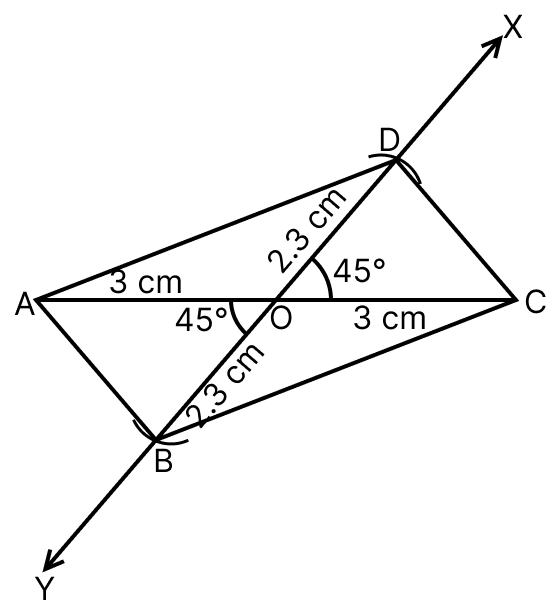
Hence, ABCD is the required parallelogram.
Construct a rectangle whose adjacent sides are 5.6 cm and 4 cm
Answer
Given, the adjacent sides of the rectangle are 5.6 cm and 4 cm.
Let the rectangle be ABCD, where AB = 5.6 cm and BC = 4 cm.
We know that each angle of a rectangle measures 90° and the opposite sides of a rectangle are equal.
⇒ ∠A = ∠B = ∠C = ∠D = 90°
⇒ CD = AB = 5.6 cm and AD = BC = 4 cm
Steps of construction :
Draw a line segment AB = 5.6 cm.
At B, construct ∠ABX = 90°.
From BX, cut off BC = 4 cm.
With C as centre and radius 5.6 cm, draw an arc.
With A as centre and radius 4 cm, draw another arc cutting the previous arc at D.
Join AD and CD.
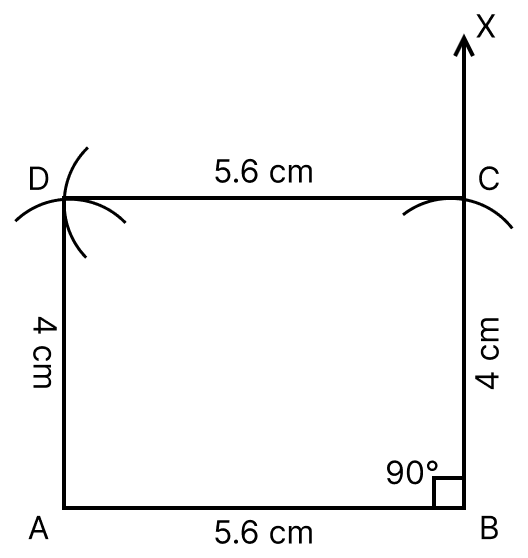
Hence, ABCD is the required rectangle.
Construct a rectangle such that one side is 5 cm and one diagonal is 6.8 cm
Answer
Given, one side of the rectangle is 5 cm and one diagonal is 6.8 cm.
Steps of construction :
Draw a line segment AB = 5 cm.
At A, construct ∠BAX = 90°.
With B as centre and radius 6.8 cm, draw an arc cutting AX at D.
Join BD.
With A as centre and radius 6.8 cm, draw an arc.
With D as centre and radius 5 cm, draw another arc cutting the previous arc at C.
Join BC and CD.
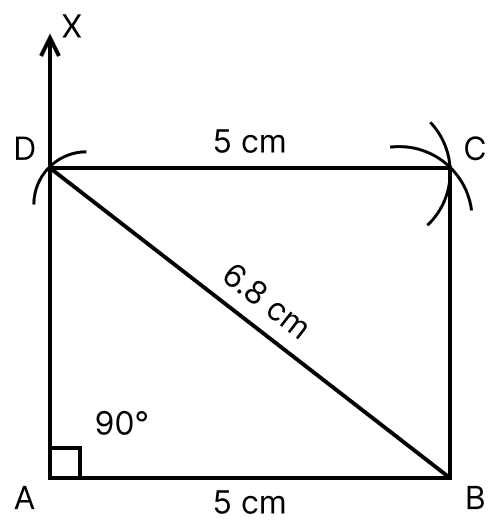
Hence, ABCD is the required rectangle.
Construct a rectangle ABCD such that AB = 4 cm and ∠BAC = 60°
Answer
Given, in rectangle ABCD, AB = 4 cm and ∠BAC = 60°.
Here, AC is a diagonal of the rectangle and it makes an angle of 60° with the side AB.
As each angle of a rectangle measures 90°, ΔABC is right angled at B, so the vertex C is obtained as the point where the arm of ∠BAC meets the perpendicular drawn to AB at B.
As the opposite sides of a rectangle are equal,
⇒ CD = AB = 4 cm and AD = BC
Steps of construction :
Draw a line segment AB = 4 cm.
At B, construct ∠ABX = 90°.
At A, construct ∠BAY = 60° such that AY meets BX at C.
With C as centre and radius 4 cm, draw an arc.
With A as centre and radius = BC, draw another arc cutting the previous arc at D.
Join AD and CD.
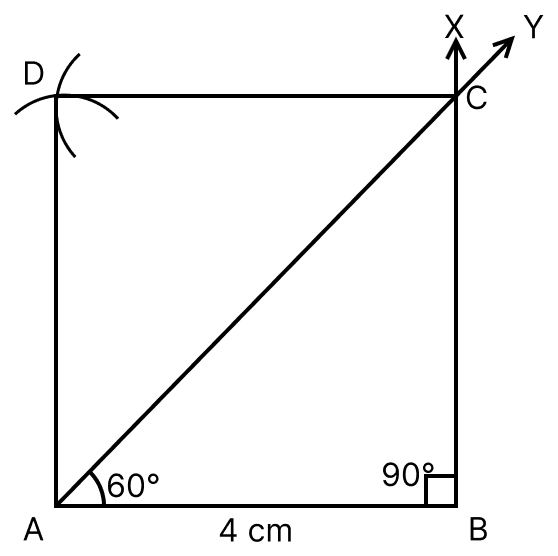
Hence, ABCD is the required rectangle.
Construct a rectangle such that one diagonal is 6.6 cm and an angle between two diagonals is 120°
Answer
Given, one diagonal of the rectangle is 6.6 cm and the angle between the two diagonals is 120°.
Let the rectangle be ABCD, in which the diagonals AC and BD meet at O and ∠COD = 120°.
As the diagonals of a rectangle are equal and bisect each other,
⇒ BD = AC = 6.6 cm
⇒ OA = OB = OC = OD = = 3.3 cm
Steps of construction :
Draw a line segment AO = 3.3 cm and produce AO to C such that OC = OA = 3.3 cm.
At O, construct ∠COX = 120°.
From OX, cut off OD = 3.3 cm.
Produce DO to B such that OB = OD = 3.3 cm.
Join AB, BC, CD and AD.
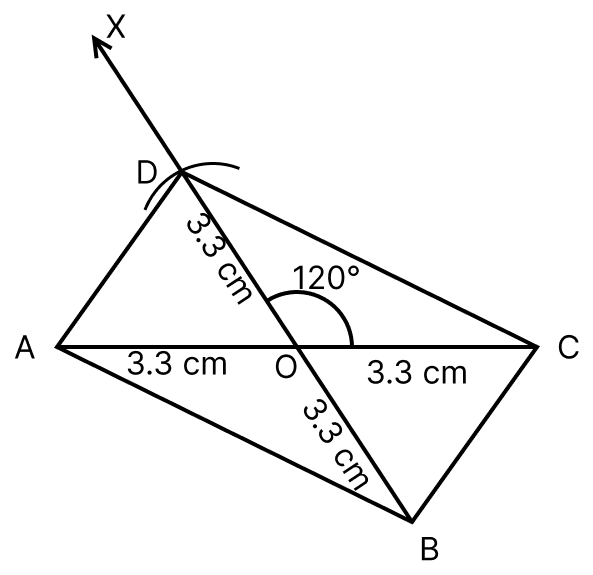
Hence, ABCD is the required rectangle.
Construct a rhombus whose one side is 5 cm and one angle is 45°
Answer
Given, one side of the rhombus is 5 cm and one angle is 45°.
Let the rhombus be ABCD, where AB = 5 cm and ∠A = 45°.
As all the sides of a rhombus are equal,
⇒ AB = BC = CD = AD = 5 cm
Steps of construction :
Draw a line segment AB = 5 cm.
At A, construct ∠BAX = 45°.
From AX, cut off AD = 5 cm.
With B as centre and radius 5 cm, draw an arc.
With D as centre and radius 5 cm, draw another arc cutting the previous arc at C.
Join BC and CD.
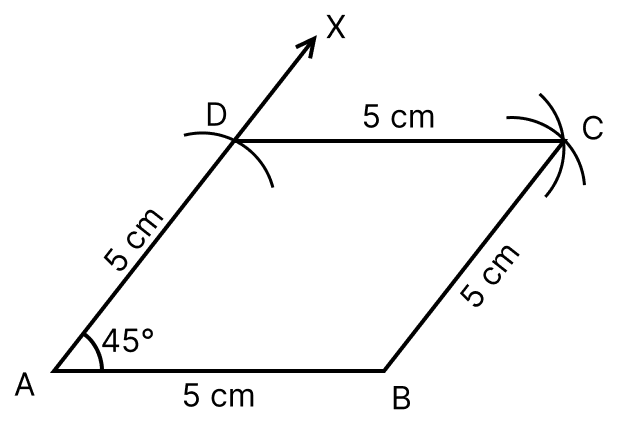
Hence, ABCD is the required rhombus.
Construct a rhombus whose one side is 4.5 cm and one diagonal is 5 cm.
Answer
Given, one side of the rhombus is 4.5 cm and one diagonal is 5 cm.
Let the rhombus be ABCD, where AB = 4.5 cm and the diagonal BD = 5 cm.
As all the sides of a rhombus are equal,
⇒ AB = BC = CD = AD = 4.5 cm
The diagonal BD divides the rhombus ABCD into two triangles, ΔABD and ΔBCD, and all the three sides of each of them are known.
Steps of construction :
Draw a line segment AB = 4.5 cm.
With A as centre and radius 4.5 cm, draw an arc.
With B as centre and radius 5 cm, draw another arc cutting the previous arc at D.
With B as centre and radius 4.5 cm, draw an arc on the side of BD opposite to that of A.
With D as centre and radius 4.5 cm, draw another arc cutting the previous arc at C.
Join AD, BC and CD.
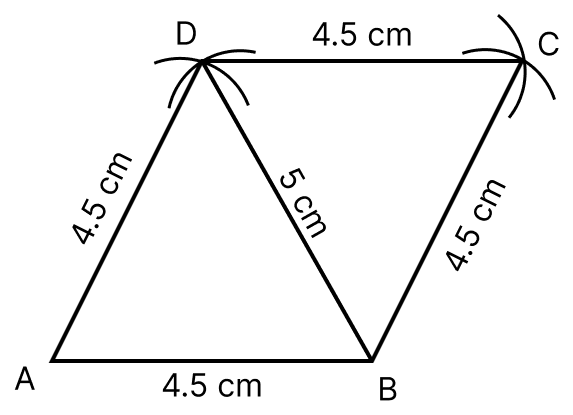
Hence, ABCD is the required rhombus.
Construct a rhombus whose diagonals are 6.8 cm and 5.2 cm
Answer
Given, the diagonals of the rhombus are 6.8 cm and 5.2 cm.
Let the rhombus be ABCD, in which the diagonals AC = 6.8 cm and BD = 5.2 cm meet at O.
As the diagonals of a rhombus bisect each other at right angles,
⇒ OA = OC = = 3.4 cm
⇒ OB = OD = = 2.6 cm
⇒ ∠AOB = 90°
Steps of construction :
Draw a line segment AC = 6.8 cm.
Draw the perpendicular bisector XY of AC, cutting AC at its mid-point O.
From OX, cut off OB = 2.6 cm and from OY, cut off OD = 2.6 cm.
Join AB, BC, CD and AD.
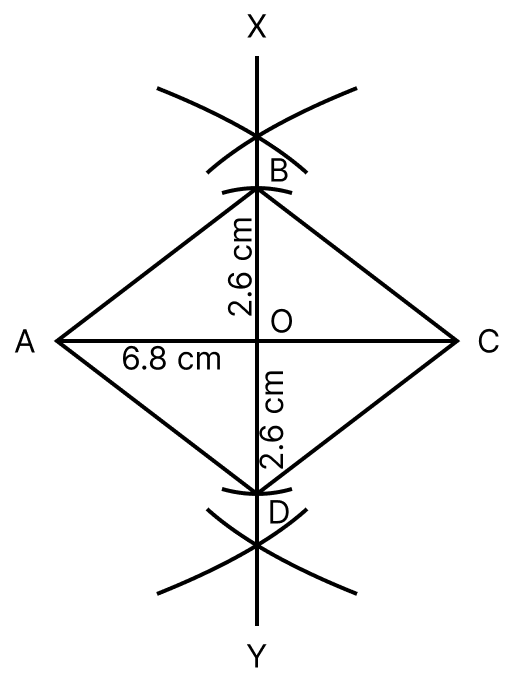
Hence, ABCD is the required rhombus.
Construct a square whose one side is 4.3 cm
Answer
Given, one side of the square is 4.3 cm.
Let the square be ABCD, where AB = 4.3 cm.
We know that all the sides of a square are equal and each of its angles measures 90°.
⇒ AB = BC = CD = AD = 4.3 cm
⇒ ∠A = ∠B = ∠C = ∠D = 90°
Steps of construction :
Draw a line segment AB = 4.3 cm.
At B, construct ∠ABX = 90°.
From BX, cut off BC = 4.3 cm.
With A as centre and radius 4.3 cm, draw an arc.
With C as centre and radius 4.3 cm, draw another arc cutting the previous arc at D.
Join AD and CD.
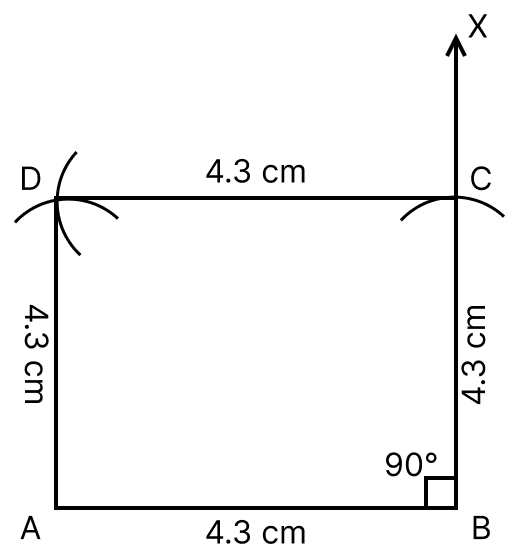
Hence, ABCD is the required square.
Construct a square whose one diagonal is 6.2 cm
Answer
Given, one diagonal of the square is 6.2 cm.
Let the square be ABCD, in which the diagonals AC = 6.2 cm and BD meet at O.
As the diagonals of a square are equal and bisect each other at right angles,
⇒ BD = AC = 6.2 cm
⇒ OA = OB = OC = OD = = 3.1 cm
⇒ ∠AOB = 90°
Steps of construction :
Draw a line segment AC = 6.2 cm.
Draw the perpendicular bisector XY of AC, cutting AC at its mid-point O.
From OX, cut off OB = 3.1 cm and from OY, cut off OD = 3.1 cm.
Join AB, BC, CD and AD.
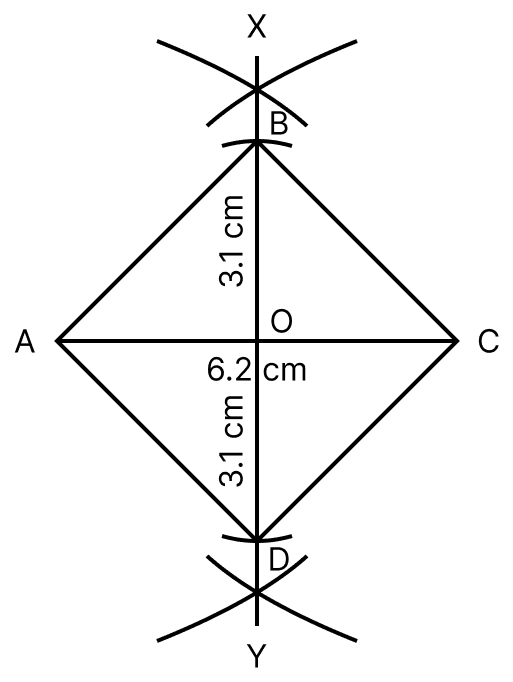
Hence, ABCD is the required square.