KnowledgeBoat Logo
|
OPEN IN APP

Chapter 3

Squares and Square Roots — Multiple Choice Questions

Class - 8 ML Aggarwal Understanding ICSE Mathematics


Objective Type Questions - Multiple Choice Questions

Question 3

How many natural numbers lie between 252 and 262?

  1. 49

  2. 50

  3. 51

  4. 52

Answer

We know that there are 2n non-square numbers between the squares of two consecutive numbers n and (n + 1).

Here, n = 25

Natural numbers between 252 and 262 = 2 × 25

= 50

Hence, option 2 is the correct option.

Question 4

Square of an even number is always

  1. even

  2. odd

  3. even or odd

  4. none of these

Answer

According to the property of square numbers, squares of even natural numbers are even and squares of odd natural numbers are odd.

Hence, option 1 is the correct option.

Question 5

1 + 3 + 5 + 7 + ..... up to n terms is equal to

  1. n2 - 1

  2. (n + 1)2

  3. n2 + 1

  4. n2

Answer

As we know that, the sum of first n odd natural numbers = n2.

Hence, option 4 is the correct option.

Question 6

208+2304\sqrt{208 + \sqrt{2304}} is equal to

  1. 18

  2. 16

  3. 14

  4. 22

Answer

Finding prime factors of 2304

223042115225762288214427223621839331\begin{array}{l|r} 2 & 2304 \\ \hline 2 & 1152 \\ \hline 2 & 576 \\ \hline 2 & 288 \\ \hline 2 & 144 \\ \hline 2 & 72 \\ \hline 2 & 36 \\ \hline 2 & 18 \\ \hline 3 & 9 \\ \hline 3 & 3 \\ \hline & 1 \\ \end{array}

2304 = (2 × 2) × (2 × 2) × (2 × 2) × (2 × 2) × (3 × 3)

⇒2304=2×2×2×2×3=48\Rightarrow \sqrt{2304} = 2 \times 2 \times 2 \times 2 \times 3 = 48

⇒208+2304⇒208+48⇒256⇒16\Rightarrow \sqrt{208 + \sqrt{2304}}\\[1em] \Rightarrow \sqrt{208 + 48}\\[1em] \Rightarrow \sqrt{256}\\[1em] \Rightarrow 16

Hence, option 2 is the correct option.

Question 7

0.0016\sqrt{0.0016} is equal to

  1. 0.04

  2. 0.004

  3. 0.4

  4. none of these

Answer

Converting decimal into proper fraction:

⇒0.0016⇒1610000⇒1610000⇒4100⇒0.04\Rightarrow \sqrt{0.0016}\\[1em] \Rightarrow \sqrt{\dfrac{16}{10000}}\\[1em] \Rightarrow \dfrac{\sqrt{16}}{\sqrt{10000}}\\[1em] \Rightarrow \dfrac{4}{100}\\[1em] \Rightarrow 0.04

Hence, option 1 is the correct option.

Question 8

The smallest number by which 75 should be divided to make it a perfect square is

  1. 1

  2. 2

  3. 3

  4. 4

Answer

Finding prime factors of 75

375525551\begin{array}{l|r} 3 & 75 \\ \hline 5 & 25 \\ \hline 5 & 5 \\ \hline & 1 \\ \end{array}

75 = (5 × 5) × 3

Since the prime factor 3 is not in pair.

The given number should be divided by 3.

Hence, option 3 is the correct option.

Question 9

3625\sqrt{3\dfrac{6}{25}} is equal to

  1. 59\dfrac{5}{9}

  2. 45\dfrac{4}{5}

  3. 95\dfrac{9}{5}

  4. 54\dfrac{5}{4}

Answer

Converting mixed fraction into improper fraction:

⇒3625⇒8125⇒8125⇒95\Rightarrow \sqrt{3\dfrac{6}{25}}\\[1em] \Rightarrow \sqrt{\dfrac{81}{25}}\\[1em] \Rightarrow \dfrac{\sqrt{81}}{\sqrt{25}}\\[1em] \Rightarrow \dfrac{9}{5}

Hence, option 3 is the correct option.

Question 10

The smallest number by which 162 should be multiplied to make it a perfect square is

  1. 4

  2. 3

  3. 2

  4. 1

Answer

Finding prime factors of 162

216238132739331\begin{array}{l|r} 2 & 162 \\ \hline 3 & 81 \\ \hline 3 & 27 \\ \hline 3 & 9 \\ \hline 3 & 3 \\ \hline & 1 \\ \end{array}

162 = (3 × 3) × (3 × 3) × 2

Since the prime factor 2 is not in pair.

The given number should be multiplied by 2.

Hence, option 3 is the correct option.

Question 11

If the area of a square field is 961 unit2, then the length of its side is

  1. 29 units

  2. 41 units

  3. 31 units

  4. 39 units

Answer

Finding prime factors of 961

3196131311\begin{array}{l|r} 31 & 961 \\ \hline 31 & 31 \\ \hline & 1 \\ \end{array}

Area of square field = (side)2

⇒(side)2=961⇒side=961⇒side=31×31⇒side=31\Rightarrow (\text{side})^2 = 961\\[1em] \Rightarrow \text{side} = \sqrt{961}\\[1em] \Rightarrow \text{side} = \sqrt{31 \times 31}\\[1em] \Rightarrow \text{side} = 31

Hence, option 3 is the correct option.

Question 12

The smallest number that should be subtracted from 300 to make it a perfect square is

  1. 11

  2. 12

  3. 13

  4. 14

Answer

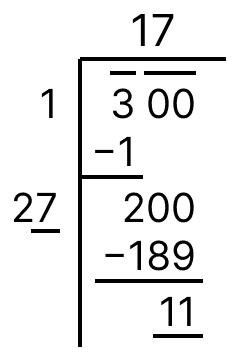
Using division method for 300:
The smallest number that should be subtracted from 300 to make it a perfect square is. Squares & Square Roots, ML Aggarwal Understanding Mathematics Solutions ICSE Class 8

We get the remainder = 11.

It means (17)2 is less than 300 by 11.

So, the perfect square just less than 300 is 289.

Required number = 300 - 289 = 11

Hence, option 1 is the correct option.

Question 13

If one number of Pythagorean triplet is 6, then the triplet is

  1. (4, 5, 6)

  2. (5, 6, 7)

  3. (6, 7, 8)

  4. (6, 8, 10)

Answer

We know that for any natural number m > 1, (2m, m2 - 1, m2 + 1) is a Pythagorean triplet.

Let 2m = 6

⇒ m = 3

∴ m2 - 1 = 9 - 1 = 8 and m2 + 1 = 9 + 1 = 10

So, (6, 8, 10) is a Pythagorean triplet.

Hence, option 4 is the correct option.

Question 14

Given that 1521\sqrt{1521} = 39, the value of 0.1521+15.21\sqrt{0.1521} + \sqrt{15.21} is

  1. 42.9

  2. 4.29

  3. 3.51

  4. 35.1

Answer

Solving,

⇒0.1521+15.21⇒152110000+1521100⇒152110000+1521100⇒39100+3910⇒0.39+3.9⇒4.29\Rightarrow \sqrt{0.1521} + \sqrt{15.21}\\[1em] \Rightarrow \sqrt{\dfrac{1521}{10000}} + \sqrt{\dfrac{1521}{100}}\\[1em] \Rightarrow \dfrac{\sqrt{1521}}{\sqrt{10000}} + \dfrac{\sqrt{1521}}{\sqrt{100}}\\[1em] \Rightarrow \dfrac{39}{100} + \dfrac{39}{10}\\[1em] \Rightarrow 0.39 + 3.9\\[1em] \Rightarrow 4.29

Hence, option 2 is the correct option.

PrevNext