KnowledgeBoat Logo
|
OPEN IN APP

Model Question Paper

Model Question Paper 1

Class - 8 ML Aggarwal Understanding ICSE Mathematics


Model Question Paper 1

Question 1

Sum of rational number 57\dfrac{5}{7} and its additive inverse is

  1. 1

  2. 0

  3. -1

  4. none of these

Answer

Additive inverse of 57\dfrac{5}{7} is −57\dfrac{-5}{7}.

According to the given condition,

⇒57+(−57)⇒5−57⇒07⇒0\Rightarrow \dfrac{5}{7} + \Big(\dfrac{-5}{7}\Big)\\[1em] \Rightarrow \dfrac{5 - 5}{7}\\[1em] \Rightarrow \dfrac{0}{7}\\[1em] \Rightarrow 0

Hence, Option 2 is the correct option.

Question 2

Product of two rational numbers is 1. If one of them is 45\dfrac{4}{5}, then other is

  1. −45\dfrac{-4}{5}

  2. −54\dfrac{-5}{4}

  3. 54\dfrac{5}{4}

  4. 45\dfrac{4}{5}

Answer

Let the other rational number be xx.

⇒45×x=1⇒x=1×54⇒x=54\Rightarrow \dfrac{4}{5} \times x = 1\\[1em] \Rightarrow x = 1 \times \dfrac{5}{4}\\[1em] \Rightarrow x = \dfrac{5}{4}

Hence, Option 3 is the correct option.

Question 3

Find the value of xx for which (49)x×(32)−1=827\left(\dfrac{4}{9}\right)^x \times \left(\dfrac{3}{2}\right)^{-1} = \dfrac{8}{27}

Answer

As we know, (ab)m=ambm,am×an=am+n\Big(\dfrac{a}{b}\Big)^m = \dfrac{a^m}{b^m}, a^m \times a^n = a^{m+n} and an=am⇒n=ma^n = a^m \Rightarrow n = m.

Solving,

⇒(49)x×(32)−1=827⇒(2232)x×23=2333⇒(23)2x×(23)1=(23)3⇒(23)2x+1=(23)3⇒2x+1=3⇒2x=3−1⇒2x=2⇒x=1\Rightarrow \left(\dfrac{4}{9}\right)^x \times \left(\dfrac{3}{2}\right)^{-1} = \dfrac{8}{27}\\[1em] \Rightarrow \left(\dfrac{2^2}{3^2}\right)^x \times \dfrac{2}{3} = \dfrac{2^3}{3^3}\\[1em] \Rightarrow \left(\dfrac{2}{3}\right)^{2x} \times \left(\dfrac{2}{3}\right)^1 = \left(\dfrac{2}{3}\right)^3\\[1em] \Rightarrow \left(\dfrac{2}{3}\right)^{2x + 1} = \left(\dfrac{2}{3}\right)^3\\[1em] \Rightarrow 2x + 1 = 3\\[1em] \Rightarrow 2x = 3 - 1\\[1em] \Rightarrow 2x = 2\\[1em] \Rightarrow x = 1

Hence, x=1\bm{x = 1}.

Question 4

Insert two rational numbers between −12\dfrac{-1}{2} and 23\dfrac{2}{3}

Answer

L.C.M. of 2 and 3 = 6

Converting the given rational numbers into like rational numbers,

−12=−1×32×3=−3623=2×23×2=46\dfrac{-1}{2} = \dfrac{-1 \times 3}{2 \times 3} = \dfrac{-3}{6}\\[1em] \dfrac{2}{3} = \dfrac{2 \times 2}{3 \times 2} = \dfrac{4}{6}

The rational numbers lying between −36\dfrac{-3}{6} and 46\dfrac{4}{6} are:

−26,−16,06,16,26,36\dfrac{-2}{6}, \dfrac{-1}{6}, \dfrac{0}{6}, \dfrac{1}{6}, \dfrac{2}{6}, \dfrac{3}{6}

Taking any two of them, we get 0 and 26=13\dfrac{2}{6} = \dfrac{1}{3}.

Hence, two rational numbers between −12\mathbf{\dfrac{-1}{2}} and 23\mathbf{\dfrac{2}{3}} are 0 and 13\mathbf{\dfrac{1}{3}}.

Question 5

Insert ten rational numbers between −45\dfrac{-4}{5} and 23\dfrac{2}{3}

Answer

L.C.M. of 5 and 3 = 15

Converting the given rational numbers into like rational numbers,

−45=−4×35×3=−121523=2×53×5=1015\dfrac{-4}{5} = \dfrac{-4 \times 3}{5 \times 3} = \dfrac{-12}{15}\\[1em] \dfrac{2}{3} = \dfrac{2 \times 5}{3 \times 5} = \dfrac{10}{15}

Since −1215<−1115<−1015<.....<−215<1015\dfrac{-12}{15} \lt \dfrac{-11}{15} \lt \dfrac{-10}{15} \lt ..... \lt \dfrac{-2}{15} \lt \dfrac{10}{15},

Hence, ten rational numbers between −45\mathbf{\dfrac{-4}{5}} and 23\mathbf{\dfrac{2}{3}} are −1115,−1015,−915,…,−215\mathbf{\dfrac{-11}{15}, \dfrac{-10}{15}, \dfrac{-9}{15}, \ldots, \dfrac{-2}{15}}.

Question 6

Find the cube root of 50653.

Answer

Finding prime factors of 50653 :

375065337136937371\begin{array}{l|r} 37 & 50653 \\ \hline 37 & 1369 \\ \hline 37 & 37 \\ \hline & 1 \\ \end{array}

Thus,

⇒506533⇒37×37×373⇒37\Rightarrow \sqrt[3]{50653}\\[1em] \Rightarrow \sqrt[3]{37 \times 37 \times 37}\\[1em] \Rightarrow 37

Hence, 506533=37\mathbf{\sqrt[3]{50653} = 37}.

Question 7

Find the smallest number by which 3645 should be divided so that quotient is a perfect cube.

Answer

Finding prime factors of 3645 :

336453121534053135345315551\begin{array}{l|r} 3 & 3645 \\ \hline 3 & 1215 \\ \hline 3 & 405 \\ \hline 3 & 135 \\ \hline 3 & 45 \\ \hline 3 & 15 \\ \hline 5 & 5 \\ \hline & 1 \\ \end{array}

3645 = (3 × 3 × 3) × (3 × 3 × 3) × 5

Since 5 is left after grouping the prime factors in triplets, so 3645 should be divided by 5.

3645 ÷ 5 = 729 = (3 × 3 × 3) × (3 × 3 × 3), which is a perfect cube.

Hence, the smallest number by which 3645 should be divided to obtain a perfect cube is 5.

Question 8

If p=−35,q=12,r=−79p = \dfrac{-3}{5}, q = \dfrac{1}{2}, r = \dfrac{-7}{9}, then verify p×(q+r)=p×q+p×rp \times (q + r) = p \times q + p \times r.

Answer

Solving L.H.S.,

⇒p×(q+r)⇒−35×(12+−79)⇒−35×(9−1418)⇒−35×−518⇒1590⇒16\Rightarrow p \times (q + r)\\[1em] \Rightarrow \dfrac{-3}{5} \times \Big(\dfrac{1}{2} + \dfrac{-7}{9}\Big)\\[1em] \Rightarrow \dfrac{-3}{5} \times \Big(\dfrac{9 - 14}{18}\Big)\\[1em] \Rightarrow \dfrac{-3}{5} \times \dfrac{-5}{18}\\[1em] \Rightarrow \dfrac{15}{90}\\[1em] \Rightarrow \dfrac{1}{6}

Solving R.H.S.,

⇒p×q+p×r⇒(−35×12)+(−35×−79)⇒−310+2145⇒−310+715⇒−9+1430⇒530⇒16\Rightarrow p \times q + p \times r\\[1em] \Rightarrow \Big(\dfrac{-3}{5} \times \dfrac{1}{2}\Big) + \Big(\dfrac{-3}{5} \times \dfrac{-7}{9}\Big)\\[1em] \Rightarrow \dfrac{-3}{10} + \dfrac{21}{45}\\[1em] \Rightarrow \dfrac{-3}{10} + \dfrac{7}{15}\\[1em] \Rightarrow \dfrac{-9 + 14}{30}\\[1em] \Rightarrow \dfrac{5}{30}\\[1em] \Rightarrow \dfrac{1}{6}

Since L.H.S. = R.H.S. = 16\dfrac{1}{6},

Hence, p×(q+r)=p×q+p×r\bm{p \times (q + r) = p \times q + p \times r} is verified.

Question 9

Find the square root of 7056 by prime factorisation method.

Answer

Finding prime factors of 7056 :

270562352821764288234413147749771\begin{array}{l|r} 2 & 7056 \\ \hline 2 & 3528 \\ \hline 2 & 1764 \\ \hline 2 & 882 \\ \hline 3 & 441 \\ \hline 3 & 147 \\ \hline 7 & 49 \\ \hline 7 & 7 \\ \hline & 1 \\ \end{array}

7056 = (2 × 2) × (2 × 2) × (3 × 3) × (7 × 7)

⇒7056⇒(2×2)×(2×2)×(3×3)×(7×7)⇒2×2×3×7⇒84\Rightarrow \sqrt{7056}\\[1em] \Rightarrow \sqrt{(2 \times 2) \times (2 \times 2) \times (3 \times 3) \times (7 \times 7)}\\[1em] \Rightarrow 2 \times 2 \times 3 \times 7\\[1em] \Rightarrow 84

Hence, 7056=84\mathbf{\sqrt{7056} = 84}.

Question 10

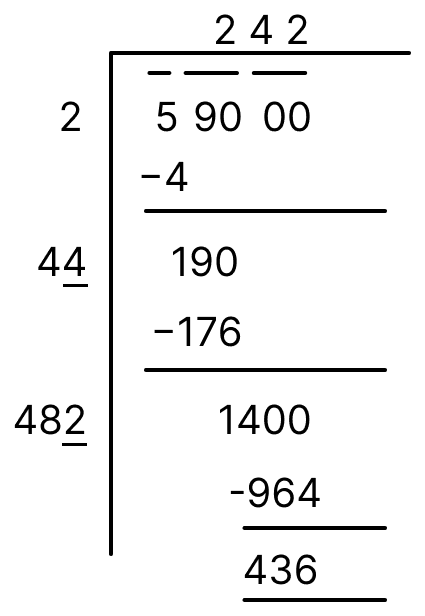
Find the least number which must be added to 59000 to make it a perfect square.

Answer

Find the least number which must be added to 59000 to make it a perfect square. Model Paper 1, ML Aggarwal Understanding Mathematics Solutions ICSE Class 8

Since the remainder is 436, so 59000 is not a perfect square.

Here, (242)2 < 59000 < (243)2

So, the next perfect square after 59000 is (243)2.

(243)2 = 59049

∴ Required number = 59049 - 59000 = 49

Hence, the least number which must be added to 59000 to make it a perfect square is 49.

PrevNext