Sum of rational number 75 and its additive inverse is
1
0
-1
none of these
Answer
Additive inverse of 75 is 7−5.
According to the given condition,
⇒75+(7−5)⇒75−5⇒70⇒0
Hence, Option 2 is the correct option.
Product of two rational numbers is 1. If one of them is 54, then other is
5−4
4−5
45
54
Answer
Let the other rational number be x.
⇒54×x=1⇒x=1×45⇒x=45
Hence, Option 3 is the correct option.
Find the value of x for which (94)x×(23)−1=278
Answer
As we know, (ba)m=bmam,am×an=am+n and an=am⇒n=m.
Solving,
⇒(94)x×(23)−1=278⇒(3222)x×32=3323⇒(32)2x×(32)1=(32)3⇒(32)2x+1=(32)3⇒2x+1=3⇒2x=3−1⇒2x=2⇒x=1
Hence, x=1.
Insert two rational numbers between 2−1 and 32
Answer
L.C.M. of 2 and 3 = 6
Converting the given rational numbers into like rational numbers,
2−1=2×3−1×3=6−332=3×22×2=64
The rational numbers lying between 6−3 and 64 are:
6−2,6−1,60,61,62,63
Taking any two of them, we get 0 and 62=31.
Hence, two rational numbers between 2−1 and 32 are 0 and 31.
Insert ten rational numbers between 5−4 and 32
Answer
L.C.M. of 5 and 3 = 15
Converting the given rational numbers into like rational numbers,
5−4=5×3−4×3=15−1232=3×52×5=1510
Since 15−12<15−11<15−10<.....<15−2<1510,
Hence, ten rational numbers between 5−4 and 32 are 15−11,15−10,15−9,…,15−2.
Find the cube root of 50653.
Answer
Finding prime factors of 50653 :
373737506531369371
Thus,
⇒350653⇒337×37×37⇒37
Hence, 350653=37.
Find the smallest number by which 3645 should be divided so that quotient is a perfect cube.
Answer
Finding prime factors of 3645 :
333333536451215405135451551
3645 = (3 × 3 × 3) × (3 × 3 × 3) × 5
Since 5 is left after grouping the prime factors in triplets, so 3645 should be divided by 5.
3645 ÷ 5 = 729 = (3 × 3 × 3) × (3 × 3 × 3), which is a perfect cube.
Hence, the smallest number by which 3645 should be divided to obtain a perfect cube is 5.
If p=5−3,q=21,r=9−7, then verify p×(q+r)=p×q+p×r.
Answer
Solving L.H.S.,
⇒p×(q+r)⇒5−3×(21+9−7)⇒5−3×(189−14)⇒5−3×18−5⇒9015⇒61
Solving R.H.S.,
⇒p×q+p×r⇒(5−3×21)+(5−3×9−7)⇒10−3+4521⇒10−3+157⇒30−9+14⇒305⇒61
Since L.H.S. = R.H.S. = 61,
Hence, p×(q+r)=p×q+p×r is verified.
Find the square root of 7056 by prime factorisation method.
Answer
Finding prime factors of 7056 :
222233777056352817648824411474971
7056 = (2 × 2) × (2 × 2) × (3 × 3) × (7 × 7)
⇒7056⇒(2×2)×(2×2)×(3×3)×(7×7)⇒2×2×3×7⇒84
Hence, 7056=84.
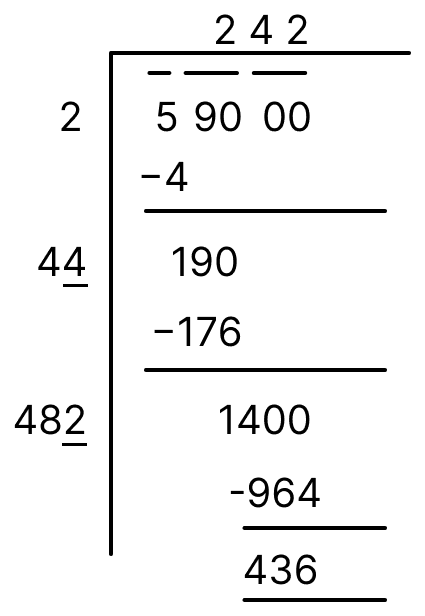
Find the least number which must be added to 59000 to make it a perfect square.
Answer
Since the remainder is 436, so 59000 is not a perfect square.
Here, (242)2 < 59000 < (243)2
So, the next perfect square after 59000 is (243)2.
(243)2 = 59049
∴ Required number = 59049 - 59000 = 49
Hence, the least number which must be added to 59000 to make it a perfect square is 49.