
If x + y = 11 and xy = 24, then x2 + y2 =
121
73
48
none of these
Answer
We know that,
⇒ (x + y)2 = x2 + y2 + 2xy
⇒ x2 + y2 = (x + y)2 - 2xy
Substituting the values, we get :
⇒ x2 + y2 = (11)2 - 2 × 24
⇒ x2 + y2 = 121 - 48
⇒ x2 + y2 = 73
Hence, option 2 is the correct option.
Factors of a3 - 64a are
a(a - 8)2
(a + 8) (a - 8)
a(a + 8) (a - 8)
a(a + 8)2
Answer
Taking a common from the given expression,
⇒ a3 - 64a = a(a2 - 64)
⇒ a3 - 64a = a(a2 - 82)
Using the identity a2 - b2 = (a + b)(a - b), we get :
⇒ a3 - 64a = a(a + 8)(a - 8)
Hence, option 3 is the correct option.
If 3(y - 3) = 5(2y + 1) then y is equal to
3
-3
2
-2
Answer
Solving,
⇒ 3(y - 3) = 5(2y + 1)
⇒ 3y - 9 = 10y + 5
⇒ 3y - 10y = 5 + 9
⇒ -7y = 14
⇒ y =
⇒ y = -2
Hence, option 4 is the correct option.
Point (0, -3) is
on the x-axis
in the second quadrant
on the y-axis
in the fourth quadrant
Answer
A point lies on the y-axis if its x-coordinate (abscissa) is 0.
In the point (0, -3), the x-coordinate is 0 and the y-coordinate is -3.
So, the point (0, -3) lies on the y-axis, at a distance of 3 units below the origin.
Hence, option 3 is the correct option.
A polyhedron have 7 faces, 10 vertices and 15 edges. Name of the polyhedron is
hexagonal prism
pentagonal prism
hexagonal pyramid
none of these
Answer
Given, F = 7, V = 10 and E = 15.
A pentagonal prism has two pentagonal faces and five rectangular faces.
∴ Number of faces of a pentagonal prism = 2 + 5 = 7 = F
Its two pentagonal faces have 5 vertices each.
∴ Number of vertices of a pentagonal prism = 5 + 5 = 10 = V
Its two pentagonal faces have 5 edges each and there are 5 edges joining them.
∴ Number of edges of a pentagonal prism = 5 + 5 + 5 = 15 = E
Hence, option 2 is the correct option.
The base of a triangle is twice its height. If the area of the triangle is 25 cm2, then the base is
10 cm
20 cm
5 cm
25 cm
Answer
Let the height of the triangle be h cm.
Given, the base is twice the height.
∴ Base = 2h cm
We know that,
Area of a triangle = x Base x Height
⇒ 25 = x 2h x h
⇒ 25 = h2
⇒ h =
⇒ h = 5
∴ Base = 2 × 5 = 10 cm
Hence, option 1 is the correct option.
From a well shuffled deck of 52 playing cards, one card is drawn at random then the probability that card drawn is a black jack
Answer
There are 52 playing cards and one card is drawn.
∴ Total number of outcomes = 52
The black suits are spades and clubs, so there are 2 black jacks.
So, the number of favourable outcomes = 2
⇒ P(getting a black jack) =
=
=
Hence, option 2 is the correct option.
Amongst the following digits, the one having exactly one line of symmetry is
0
3
6
8
Answer
The digit 0 has two lines of symmetry — one horizontal and one vertical.
The digit 3 has only one line of symmetry, which is horizontal.
The digit 6 has no line of symmetry.
The digit 8 has two lines of symmetry — one horizontal and one vertical.
Hence, option 2 is the correct option.
Using suitable identity, evaluate (9.7)2.
Answer
Writing 9.7 as 10 - 0.3 and using the identity (a - b)2 = a2 - 2ab + b2,
⇒ (9.7)2 = (10 - 0.3)2
⇒ (9.7)2 = (10)2 - 2 × 10 × 0.3 + (0.3)2
⇒ (9.7)2 = 100 - 6 + 0.09
⇒ (9.7)2 = 94.09
Hence, (9.7)2 = 94.09.
Factorize .
Answer
Expanding the given expression,
Rearranging the terms and grouping them suitably,
Hence, .
Sum of three consecutive odd numbers is 153. Find the numbers.
Answer
Let the three consecutive odd numbers be and .
Given, their sum is 153.
∴ The three numbers are :
and
Hence, the three consecutive odd numbers are 49, 51 and 53.
If each interior angle of a regular polygon is 108°, then find the number of sides of the polygon.
Answer
Let the number of sides of the regular polygon be n.
Given, each interior angle of the regular polygon is 108°.
As an interior angle and its adjacent exterior angle form a linear pair,
Each exterior angle = 180° - 108° = 72°
We know that, the sum of all the exterior angles of a polygon is 360°.
⇒ n x 72° = 360°
⇒ n =
⇒ n = 5
Hence, the polygon has 5 sides.
Verify Euler's formula for decagonal pyramid.
Answer
The base of a decagonal pyramid is a decagon, which has 10 sides and 10 vertices.
A decagonal pyramid has 10 triangular faces standing on the sides of the base, together with the base itself.
∴ Number of faces, F = 10 + 1 = 11
Its vertices are the 10 vertices of the base together with the apex.
∴ Number of vertices, V = 10 + 1 = 11
Its edges are the 10 edges of the base together with the 10 edges joining the vertices of the base to the apex.
∴ Number of edges, E = 10 + 10 = 20
By Euler's formula,
⇒ F + V - E = 11 + 11 - 20
⇒ F + V - E = 22 - 20
⇒ F + V - E = 2
Hence, Euler's formula F + V - E = 2 is verified for a decagonal pyramid.
A cuboid is of dimensions 24 cm × 30 cm × 36 cm. How many small cubes with side 6 cm can be placed in the cuboid?
Answer
Given, the dimensions of the cuboid are 24 cm × 30 cm × 36 cm.
We know that,
Volume of a cuboid = length × breadth × height
⇒ Volume of the cuboid = 24 × 30 × 36
⇒ Volume of the cuboid = 25920 cm3
The side of each small cube = 6 cm.
We know that,
Volume of a cube = side × side × side
⇒ Volume of each small cube = 6 × 6 × 6
⇒ Volume of each small cube = 216 cm3
⇒ Required number of cubes =
⇒ Required number of cubes =
⇒ Required number of cubes = 120
Hence, 120 small cubes of side 6 cm can be placed in the cuboid.
Simplify the following expressions and evaluate it when
Answer
Multiplying the two polynomials term by term,
Adding the remaining terms of the given expression,
Substituting and , we get :
⇒ 3(1)4 + 48(1)3(-1) - 49(1)2(-1)2 + 9(1)(-1)3 + 2(-1)4
⇒ 3 - 48 - 49 - 9 + 2
⇒ -101
Hence, the simplified expression is and its value is -101.
Factorize:
Answer
Let .
∴
Substituting these in the given expression,
⇒ 15(2x - 3y)2 - 4(4x - 6y) - 16
⇒ 15a2 - 4(2a) - 16
⇒ 15a2 - 8a - 16
Splitting the middle term, as 15 × (-16) = -240 and (-20) × 12 = -240 with (-20) + 12 = -8,
⇒ 15a2 - 20a + 12a - 16
⇒ 5a(3a - 4) + 4(3a - 4)
⇒ (5a + 4)(3a - 4)
Substituting back , we get :
Hence, .
Two years ago Sunil was three times as old as his son. Two years later, twice of his age will be equal to the five times that of his son's age. Find their present ages.
Answer
Let the present age of Sunil's son be years.
Two years ago, the son's age was years.
Given, two years ago Sunil was three times as old as his son.
∴ Sunil's age two years ago = years
∴ Sunil's present age = years = years
Two years later, Sunil's age will be years = years and his son's age will be years.
Given, two years later twice of Sunil's age will be equal to five times that of his son's age.
∴ Sunil's present age = 3 × 14 - 4 = 42 - 4 = 38 years
Hence, Sunil's present age is 38 years and his son's present age is 14 years.
In the adjoining figure ABCD is a parallelogram in which ∠DAP = 40°, ∠BAP = 25° and ∠CPD = 105°, find
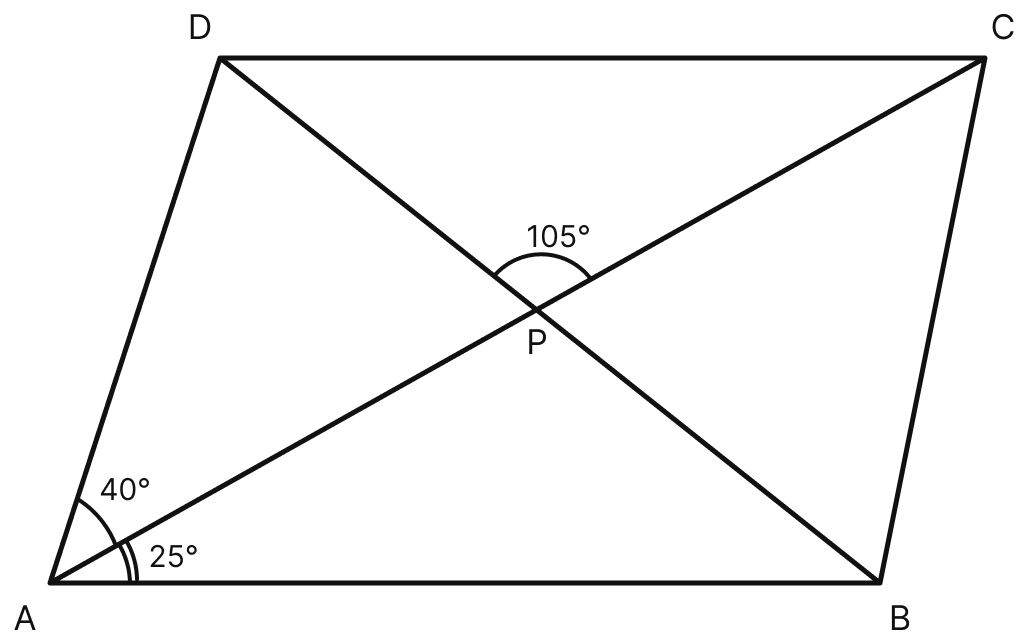
(i) ∠ABP
(ii) ∠PDC
(iii) ∠ACB
(iv) ∠CBD
Answer
Given, ABCD is a parallelogram in which ∠DAP = 40°, ∠BAP = 25° and ∠CPD = 105°, where P is the point of intersection of the diagonals AC and BD.
(i) As ∠APB and ∠CPD are vertically opposite angles,
∠APB = ∠CPD = 105°
In △ABP, by angle sum property of a triangle,
⇒ ∠BAP + ∠APB + ∠ABP = 180°
⇒ 25° + 105° + ∠ABP = 180°
⇒ 130° + ∠ABP = 180°
⇒ ∠ABP = 180° - 130°
⇒ ∠ABP = 50°
Hence, ∠ABP = 50°.
(ii) As ABCD is a parallelogram, AB || DC and BD is a transversal.
⇒ ∠PDC = ∠ABP [Alternate angles are equal]
⇒ ∠PDC = 50°
Hence, ∠PDC = 50°.
(iii) As ABCD is a parallelogram, AD || BC and AC is a transversal.
⇒ ∠ACB = ∠DAC [Alternate angles are equal]
As P lies on AC, ∠DAC = ∠DAP = 40°.
⇒ ∠ACB = 40°
Hence, ∠ACB = 40°.
(iv) As B, P and D are collinear, ∠BPC and ∠CPD form a linear pair.
⇒ ∠BPC + ∠CPD = 180°
⇒ ∠BPC + 105° = 180°
⇒ ∠BPC = 75°
In △BPC, by angle sum property of a triangle,
⇒ ∠PBC + ∠BPC + ∠PCB = 180°
As P lies on AC, ∠PCB = ∠ACB = 40° [From part (iii)]
⇒ ∠PBC + 75° + 40° = 180°
⇒ ∠PBC + 115° = 180°
⇒ ∠PBC = 65°
As P lies on BD, ∠CBD = ∠PBC.
⇒ ∠CBD = 65°
Hence, ∠CBD = 65°.
Construct a rhombus TRUE whose one side TR = 4 cm and diagonal TU = 6.5 cm.
Answer
As all the sides of a rhombus are equal,
TR = RU = UE = ET = 4 cm
Steps of construction:
Draw a line segment TU = 6.5 cm.
With T as centre and radius 4 cm, draw two arcs, one above TU and the other below TU.
With U as centre and radius 4 cm, draw two arcs cutting the previous arcs at R (above TU) and E (below TU).
Join TR, RU, UE and ET.
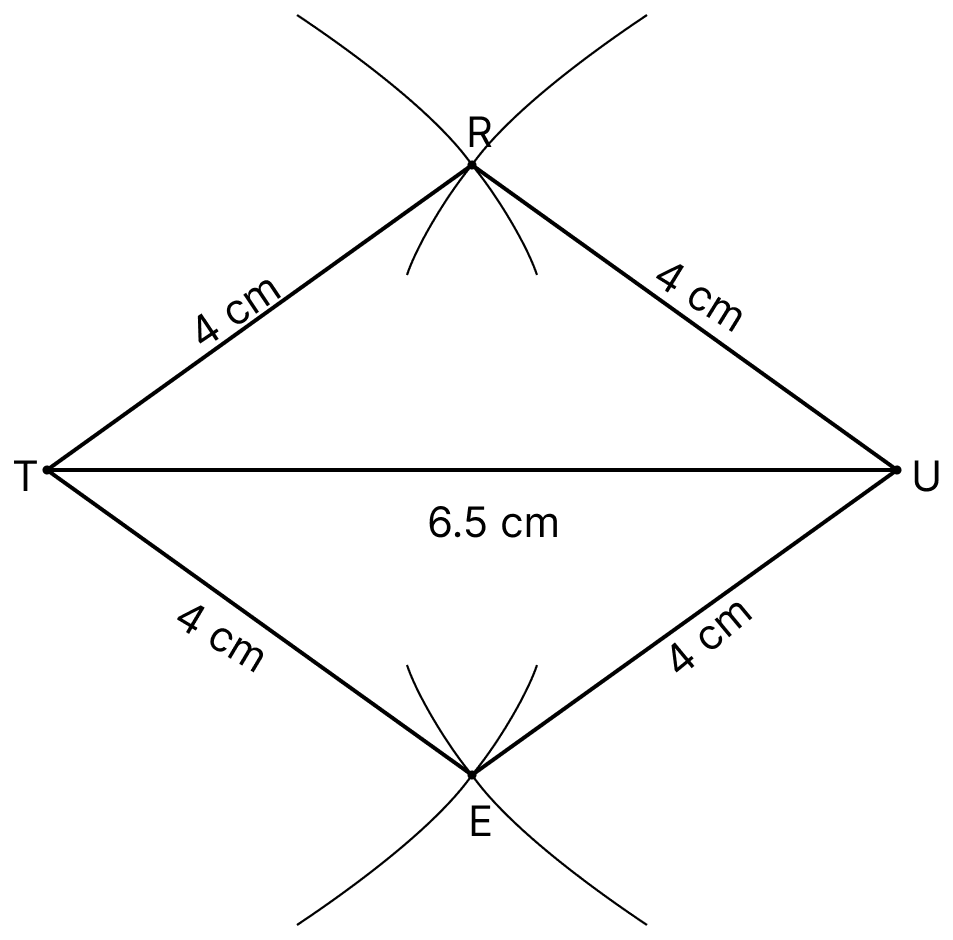
TRUE is the required rhombus.
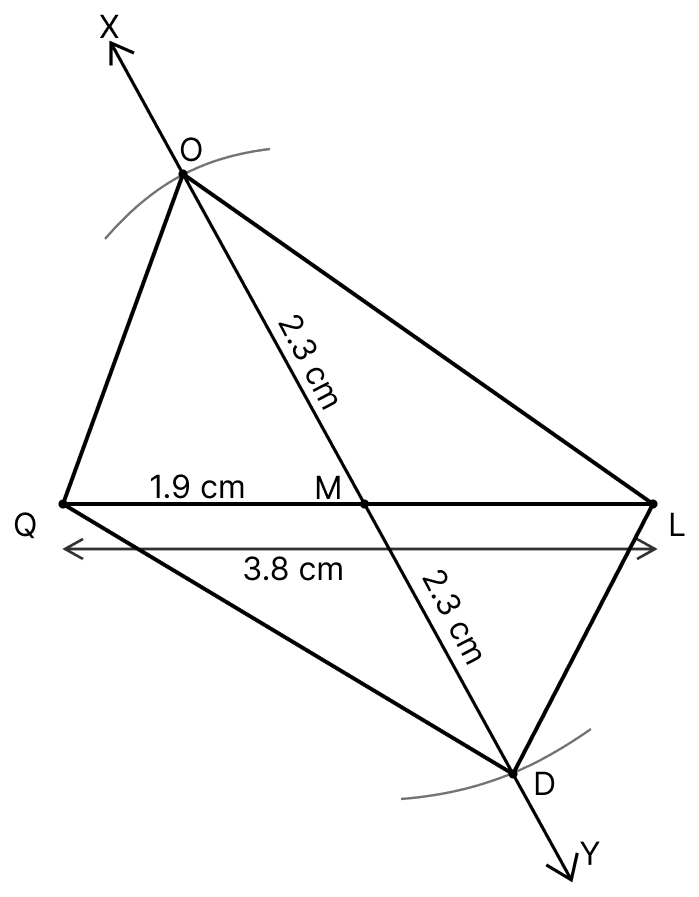
Construct a parallelogram GOLD in which diagonal GL = 3.8 cm, diagonal OD = 4.6 cm and angle between diagonals is 60°.
Answer
We know that the diagonals of a parallelogram bisect each other.
Let the diagonals GL and OD intersect at the point M.
∴ GM = ML = cm = 1.9 cm
∴ OM = MD = cm = 2.3 cm
Steps of construction:
Draw a line segment GL = 3.8 cm.
Mark the point M on GL such that GM = 1.9 cm.
At M, draw a ray MX making an angle of 60° with MG and produce XM to Y, so that XY is a straight line through M.
From M, cut off MO = 2.3 cm along MX and MD = 2.3 cm along MY.
Join GO, OL, LD and DG.
GOLD is the required parallelogram.
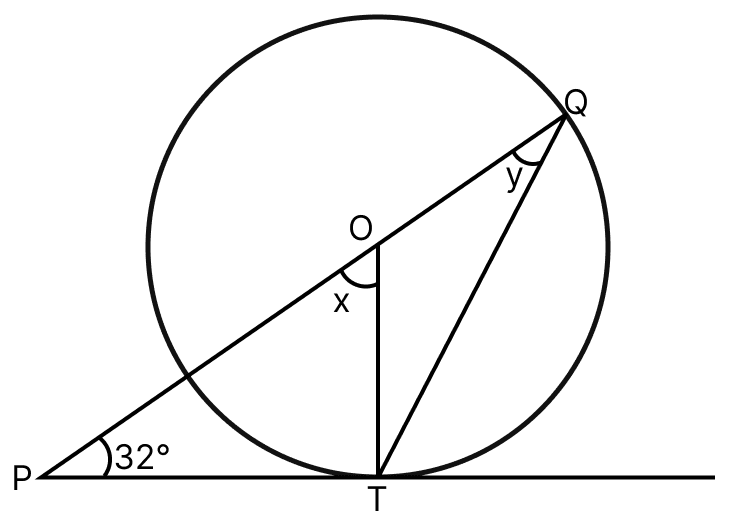
In the adjoining figure, O is the centre of the circle. If PT is tangent to the circle at point T, find the size of each lettered angle.
Answer
Given, O is the centre of the circle and PT is the tangent to the circle at the point T.
As the radius through the point of contact is perpendicular to the tangent,
∠OTP = 90°
In △OTP, by angle sum property of a triangle,
⇒ ∠OPT + ∠OTP + ∠POT = 180°
⇒ 32° + 90° + x = 180°
⇒ 122° + x = 180°
⇒ x = 180° - 122°
⇒ x = 58°
As P, O and Q are collinear, ∠POT and ∠TOQ form a linear pair.
⇒ ∠TOQ + x = 180°
⇒ ∠TOQ + 58° = 180°
⇒ ∠TOQ = 122°
In △OTQ, OT = OQ as both are radii of the same circle.
∴ ∠OQT = ∠OTQ [Angles opposite to equal sides are equal]
⇒ ∠OTQ = y
By angle sum property of a triangle,
⇒ y + y + ∠TOQ = 180°
⇒ 2y + 122° = 180°
⇒ 2y = 58°
⇒ y =
⇒ y = 29°
Hence, x = 58° and y = 29°.
A rectangular sheet of tin foil of size 30 cm × 18 cm can be rolled to form a cylinder in two ways along length and breadth. Find the ratio of volumes of the two cylinders thus formed.
Answer
Case 1 : The sheet is rolled along its length.
Then the length of the sheet becomes the circumference of the base and the breadth becomes the height of the cylinder.
Let the radius of the base be r1 cm and the height be h1 cm.
⇒ 2πr1 = 30
⇒ r1 =
∴ h1 = 18 cm
⇒ V1 = πr12h1
⇒ V1 = π × × 18
⇒ V1 =
Case 2 : The sheet is rolled along its breadth.
Then the breadth of the sheet becomes the circumference of the base and the length becomes the height of the cylinder.
Let the radius of the base be r2 cm and the height be h2 cm.
⇒ 2πr2 = 18
⇒ r2 =
∴ h2 = 30 cm
⇒ V2 = πr22h2
⇒ V2 = π × × 30
⇒ V2 =
⇒ V1 : V2 =
⇒ V1 : V2 = 4050 : 2430
⇒ V1 : V2 = 5 : 3
Hence, the ratio of the volumes of the two cylinders is 5 : 3.
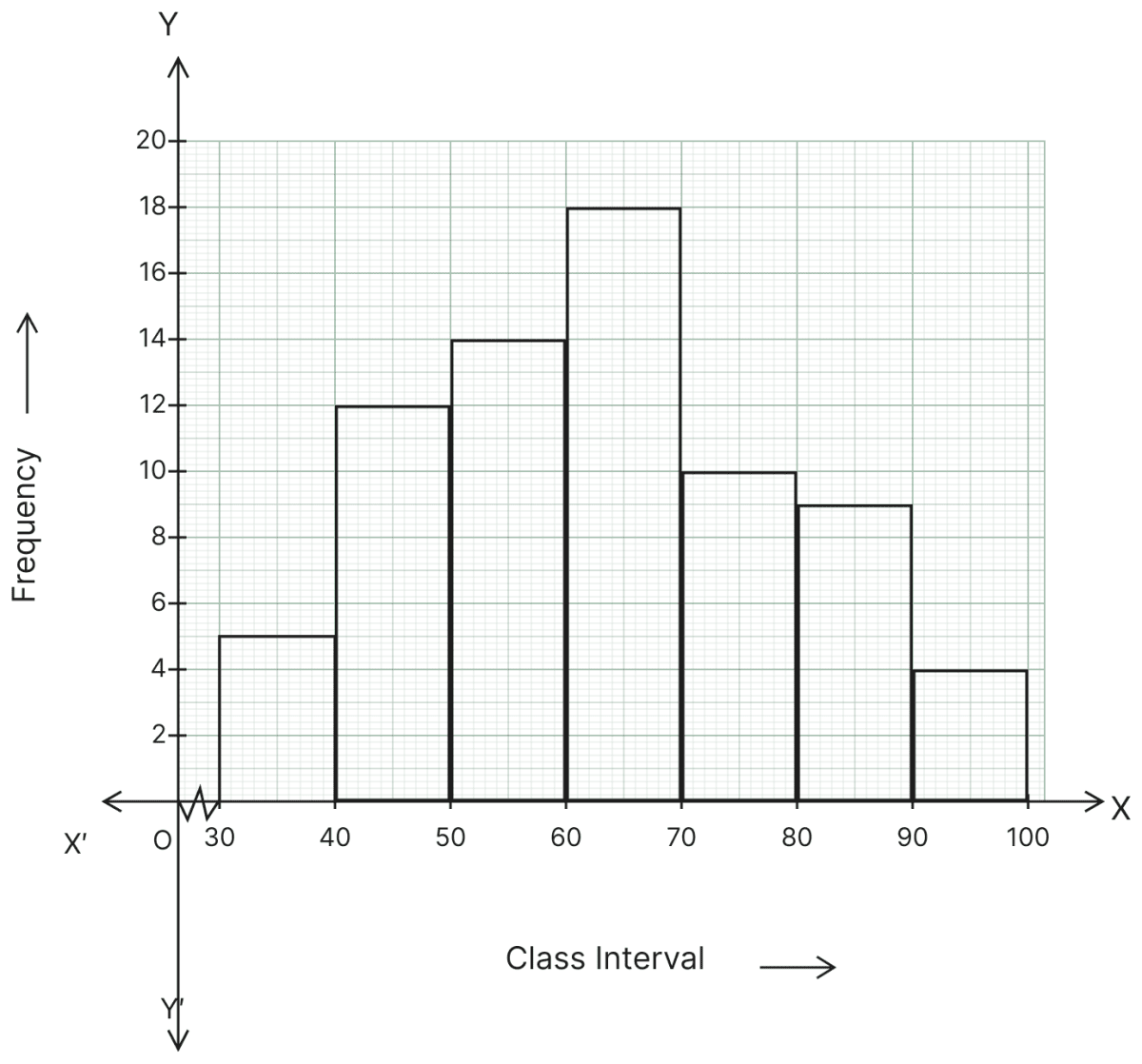
Construct a histogram for the following data:
| Class interval | Frequency |
|---|---|
| 30-40 | 5 |
| 40-50 | 12 |
| 50-60 | 14 |
| 60-70 | 18 |
| 70-80 | 10 |
| 80-90 | 9 |
| 90-100 | 4 |
Answer
Steps:
Since the scale on the x-axis starts at 30, a break (kink) is shown near the origin along the x-axis to indicate that the graph is drawn to scale beginning at 30 and not at the origin itself.
Take 1 cm on the x-axis = 10 units (class interval).
Take 1 cm on the y-axis = 2 units (frequency).
Construct rectangles corresponding to the given data. As the data is grouped, the rectangles are drawn adjacent to one another with no gap in between.
The required histogram is as given below:
Height of a room is half of its length and its breadth is of the height. If the cost of painting its four walls at the rate of ₹35 per m2 is ₹3920, then find the cost of tiling the floor of the room at the rate of ₹170 per m2.
Answer
Let the height of the room be h metre.
Given, the height of the room is half of its length.
∴ Length = 2h metre
Given, the breadth is of the height.
∴ Breadth = m
Given, the cost of painting the four walls at ₹ 35 per metre2 is ₹ 3,920.
Area of the four walls =
Area of the four walls = 112 metre2
We know that,
Area of the four walls = 2(l + b) × h
⇒ 112 = 2(2h + ) × h
⇒ 112 = 2 × × h
⇒ 112 = 7h × h
⇒ 112 = 7h2
⇒ h2 =
⇒ h2 = 16
⇒ h =
⇒ h = 4
∴ Length = 2 × 4 = 8 m and Breadth = = 6 metre
⇒ Area of the floor = l × b
⇒ Area of the floor = 8 × 6
⇒ Area of the floor = 48 metre2
⇒ Cost of tiling the floor = 48 × 170
⇒ Cost of tiling the floor = 8160
Hence, the cost of tiling the floor of the room is ₹ 8,160.
If , then find
(i)
(ii)
Answer
(i) Squaring both the sides of the given equation,
Hence, .
(ii) Squaring both the sides of the result obtained in part (i),
Hence, .
In the adjoining figure, ABCD is a rhombus and DCEF is a square. If ∠ABC = 56°, find:
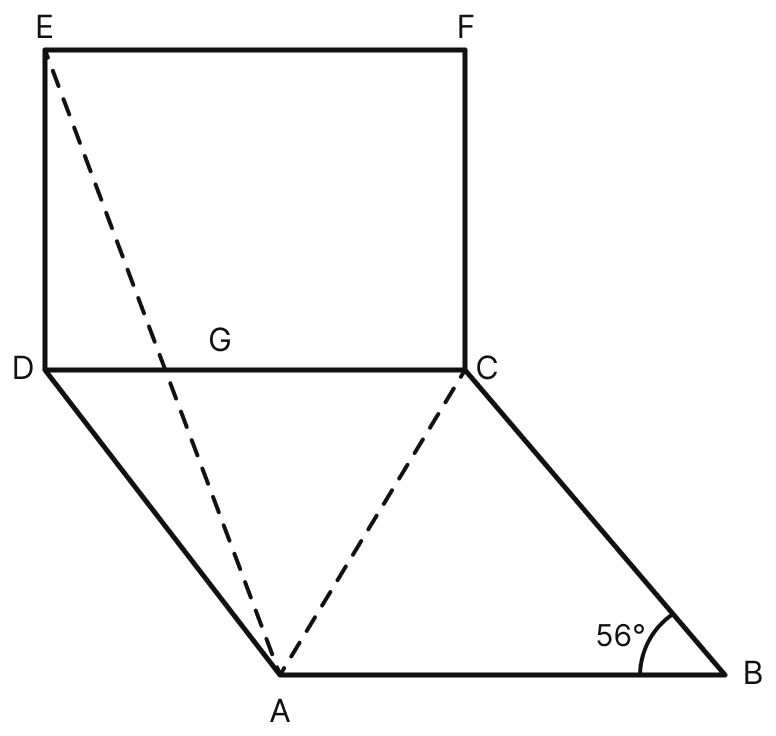
(i) ∠DAG
(ii) ∠FEG
(iii) ∠AGC
Answer
Given, ABCD is a rhombus and DCEF is a square with ∠ABC = 56°, where G is the point at which AE cuts DC.
As ABCD is a rhombus, its opposite angles are equal.
∴ ∠ADC = ∠ABC = 56°
As all the sides of a rhombus are equal and all the sides of a square are equal,
AD = DC and DC = DE
⇒ AD = DE
(i) As DCEF is a square, ∠CDE = 90°.
⇒ ∠ADE = ∠ADC + ∠CDE
⇒ ∠ADE = 56° + 90°
⇒ ∠ADE = 146°
In △ADE, AD = DE.
∴ ∠DAE = ∠DEA [Angles opposite to equal sides are equal]
By angle sum property of a triangle,
⇒ ∠DAE + ∠DEA + ∠ADE = 180°
⇒ 2∠DAE + 146° = 180°
⇒ 2∠DAE = 34°
⇒ ∠DAE =
⇒ ∠DAE = 17°
As G lies on AE, ∠DAG = ∠DAE.
Hence, ∠DAG = 17°.
(ii) As DCEF is a square, ∠DEF = 90°.
From part (i), ∠DEA = ∠DAE = 17°.
⇒ ∠AEF = ∠DEF - ∠DEA
⇒ ∠AEF = 90° - 17°
⇒ ∠AEF = 73°
As G lies on AE, ∠FEG = ∠AEF.
Hence, ∠FEG = 73°.
(iii) In △ADG, ∠ADG = ∠ADC = 56° and ∠DAG = 17°.
By angle sum property of a triangle,
⇒ ∠ADG + ∠DAG + ∠AGD = 180°
⇒ 56° + 17° + ∠AGD = 180°
⇒ 73° + ∠AGD = 180°
⇒ ∠AGD = 107°
As G lies on DC, ∠AGD and ∠AGC form a linear pair.
⇒ ∠AGC + ∠AGD = 180°
⇒ ∠AGC + 107° = 180°
⇒ ∠AGC = 73°
Hence, ∠AGC = 73°.
The figure given alongside shows a field with the measurement given in metres. Find the area of the field.
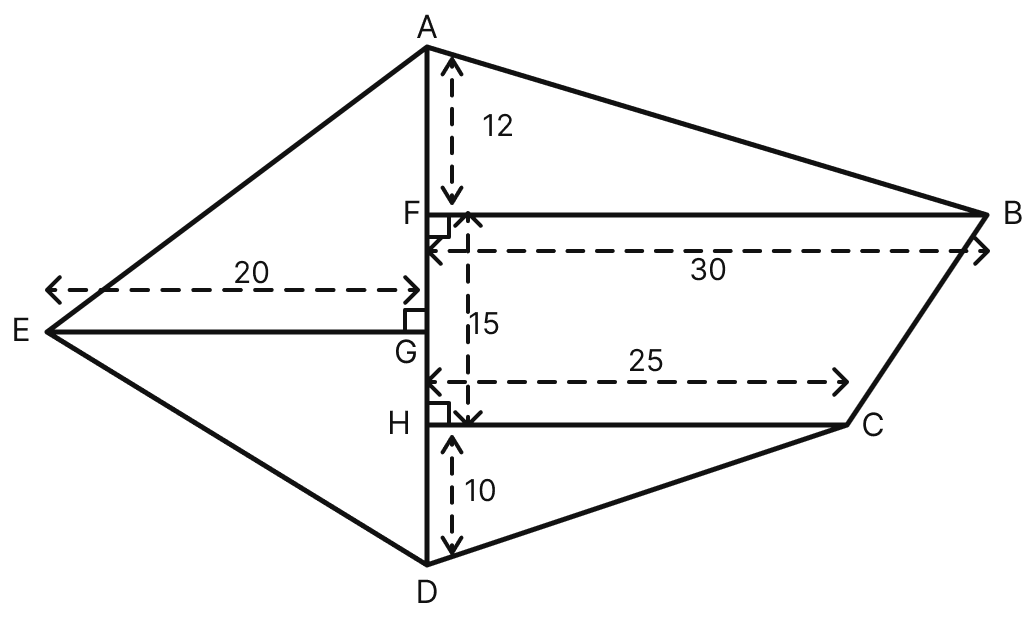
Answer
From the figure, the points F, G and H lie on the diagonal AD, and
AF = 12 m, FH = 15 m and HD = 10 m
⇒ AD = AF + FH + HD
⇒ AD = 12 + 15 + 10
⇒ AD = 37 m
The field is divided into the following four parts :
1. Triangle AFB :
⇒ Area = × AF × FB
⇒ Area = × 12 × 30
⇒ Area = 180 m2
2. Trapezium FBCH :
⇒ Area = × (FB + HC) × FH
⇒ Area = × (30 + 25) × 15
⇒ Area = × 55 × 15
⇒ Area = 412.5 m2
3. Triangle HCD :
⇒ Area = × HD × HC
⇒ Area = × 10 × 25
⇒ Area = 125 m2
4. Triangle AED :
⇒ Area = × AD × EG
⇒ Area = × 37 × 20
⇒ Area = 370 m2
⇒ Area of the field = 180 + 412.5 + 125 + 370
⇒ Area of the field = 1087.5 m2
Hence, the area of the field is 1087.5 m2.
A bag contains 5 red, 6 black and 4 white balls. A ball is drawn at random from the bag. Find the probability that the ball drawn is
(i) white
(ii) not black
(iii) red or black
Answer
Total number of balls in the bag = 5 + 6 + 4 = 15
∴ Total number of outcomes = 15
(i) The event is getting a white ball and the number of white balls in the bag is 4.
So, the number of favourable outcomes = 4
⇒ P(getting a white ball) =
=
Hence, the probability of getting a white ball is .
(ii) The event is getting a ball which is not black and the number of balls which are not black = 5 + 4 = 9.
So, the number of favourable outcomes = 9
⇒ P(getting a ball which is not black) =
=
=
Hence, the probability of getting a ball which is not black is .
(iii) The event is getting a red or a black ball and the number of red or black balls = 5 + 6 = 11.
So, the number of favourable outcomes = 11
⇒ P(getting a red or a black ball) =
=
Hence, the probability of getting a red or a black ball is .
A school decided to award prizes to their students for three values, honesty, punctuality and obedience. The value of prize for punctuality is of the value of prize for honesty and value of prize for obedience is of the value of prize for punctuality. If the total value of the three prizes is ₹1500, find the value of each prize.
Answer
Let the value of the prize for honesty be ₹ .
Given, the value of the prize for punctuality is of the value of the prize for honesty.
∴ Value of the prize for punctuality = ₹
Given, the value of the prize for obedience is of the value of the prize for punctuality.
Value of the prize for obedience =
Value of the prize for obedience =
Given, the total value of the three prizes is ₹ 1,500.
∴ Value of the prize for punctuality = = ₹ 500
∴ Value of the prize for obedience = = ₹ 400
Hence, the prize for honesty is ₹ 600, the prize for punctuality is ₹ 500 and the prize for obedience is ₹ 400.