
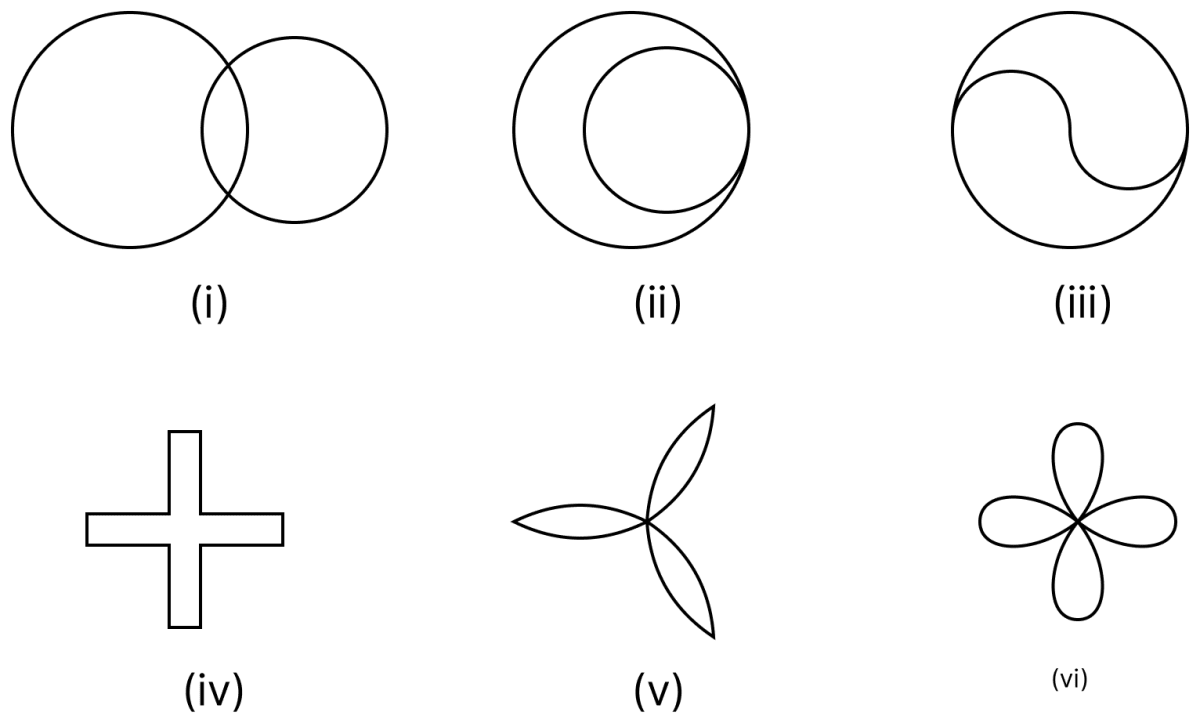
Draw the line or lines of symmetry, if any, of the following shapes and count their number:
Answer
(i) The given shape is made up of two circles of unequal radii. The figure can be folded into two coincident parts only about the line passing through the centres of both the circles.
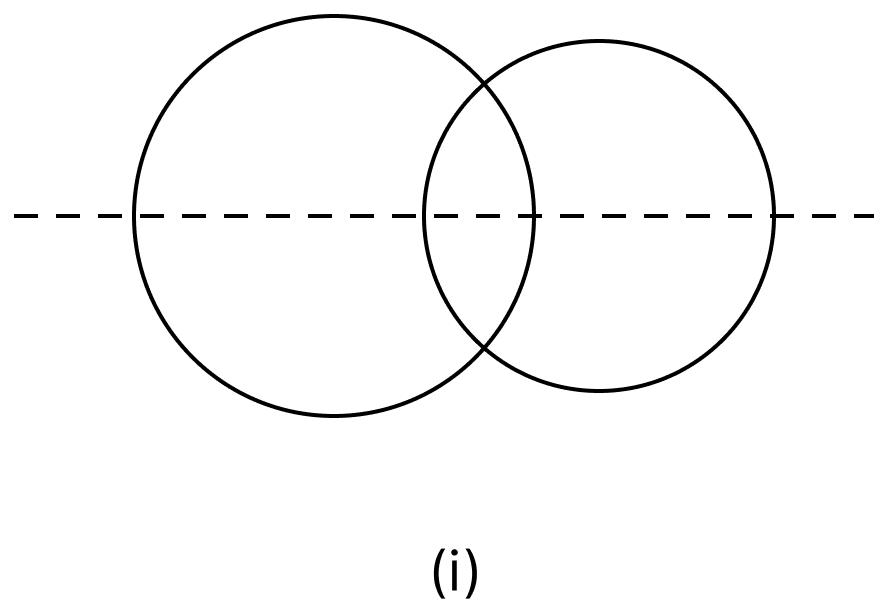
Hence, the given shape has 1 line of symmetry.
(ii) The given shape is made up of a smaller circle lying inside a bigger circle and touching it at one point. The figure can be folded into two coincident parts only about the line passing through the centres of both the circles.
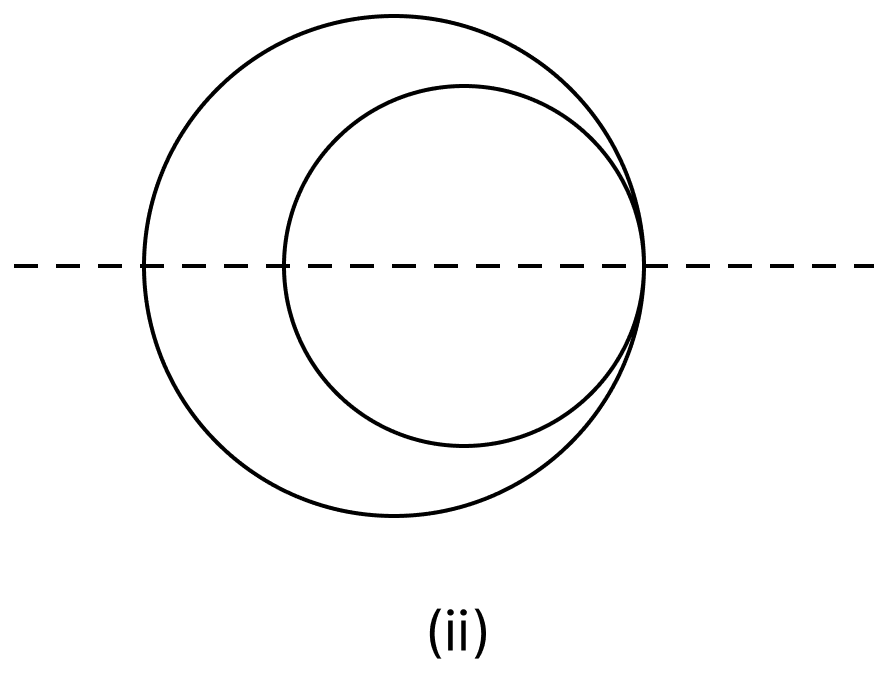
Hence, the given shape has 1 line of symmetry.
(iii) The given shape is a circle divided into two parts by an S-shaped curve. There is no line about which the figure can be folded so that its two parts coincide.
Hence, the given shape has no line of symmetry.
(iv) The given shape is a cross. It can be folded into two coincident parts about each of the two lines joining the mid-points of its opposite arms and about each of the two lines drawn through the centre making an angle of 45° with these arms.
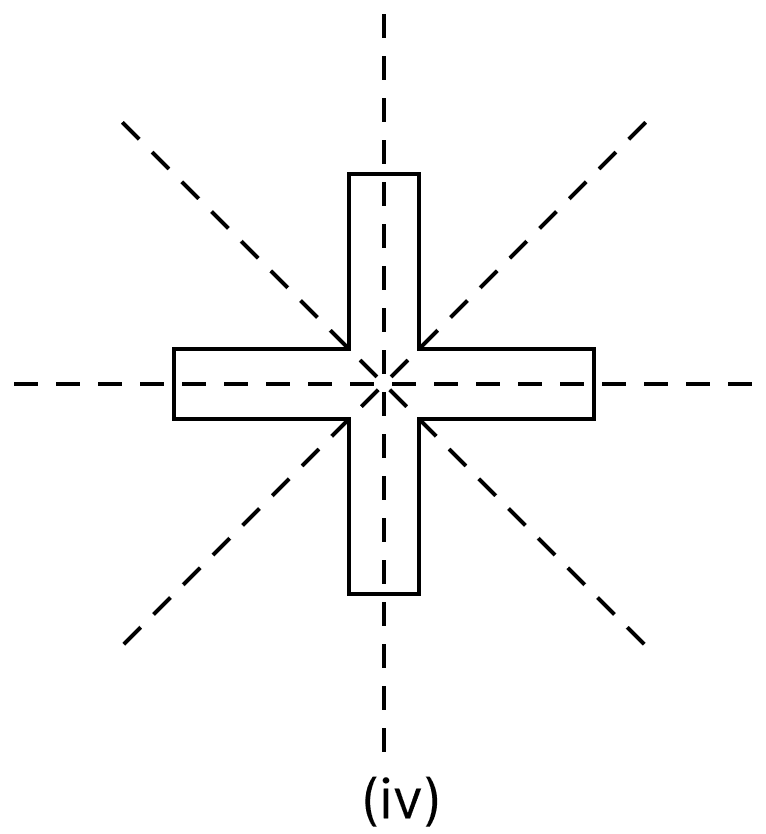
Hence, the given shape has 4 lines of symmetry.
(v) The given shape is made up of three identical petals meeting at a point. It can be folded into two coincident parts about the line drawn along the axis of each petal.
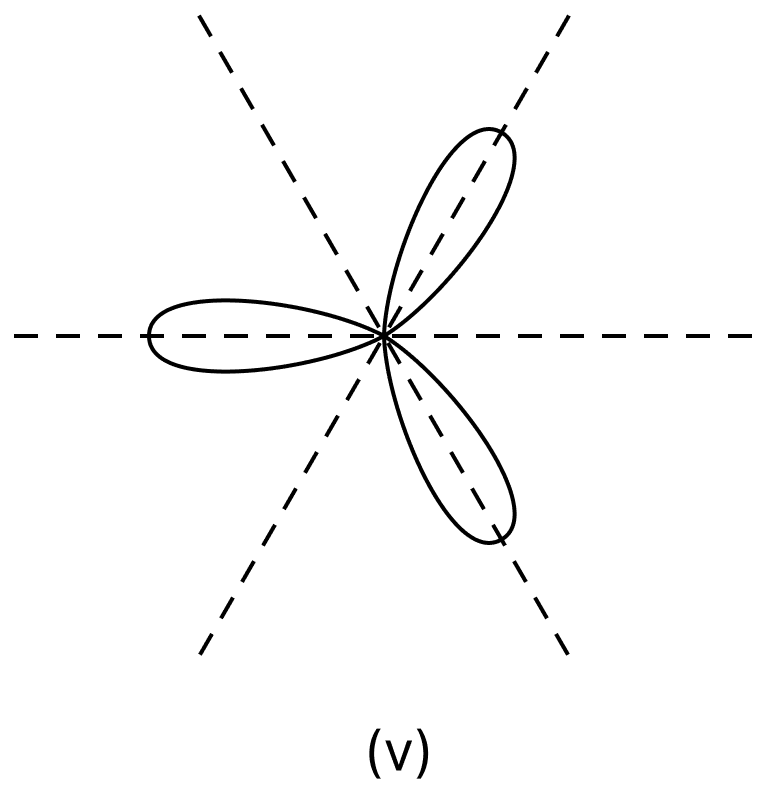
Hence, the given shape has 3 lines of symmetry.
(vi) The given shape is made up of four identical petals meeting at a point. It can be folded into two coincident parts about each of the two lines drawn along the axes of opposite petals and about each of the two lines drawn through the meeting point, bisecting the angles between adjacent petals.
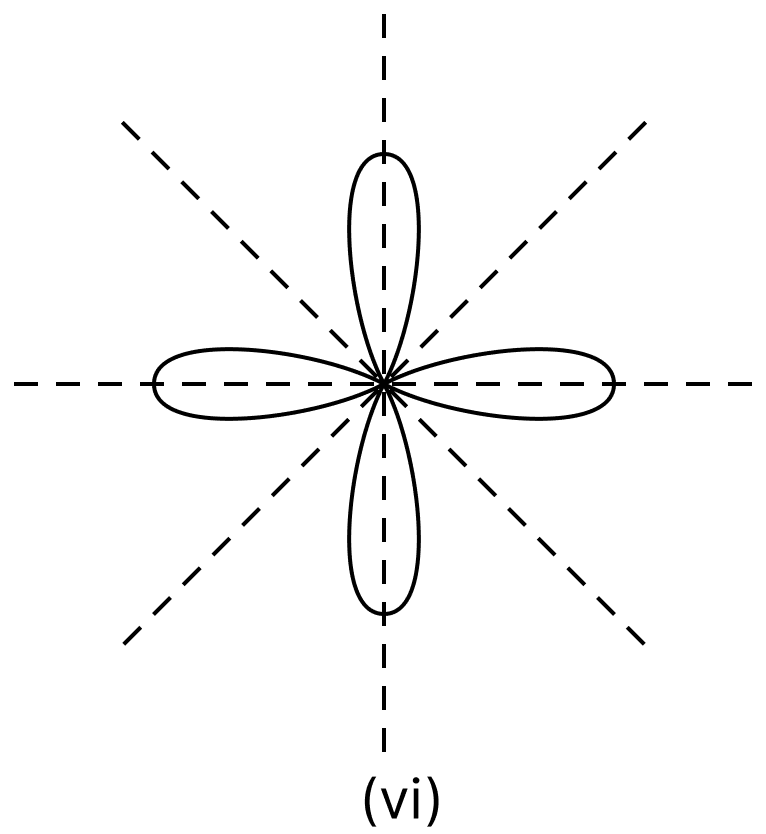
Hence, the given shape has 4 lines of symmetry.
For each of the given shapes in question 1, find the order of the rotational symmetry (if any).
Answer
We know that,
If A° (≤ 180°) is the smallest angle through which a figure can be rotated about a fixed point and still looks the same as in its starting position, then the order of its rotational symmetry = .
(i) The two circles forming the shape are of unequal radii. So, the shape comes back to its starting position only after a complete rotation of 360°.
Hence, the given shape has no rotational symmetry.
(ii) The two circles forming the shape are of unequal radii and they touch each other at one point. So, the shape comes back to its starting position only after a complete rotation of 360°.
Hence, the given shape has no rotational symmetry.
(iii) On rotating the given shape through 180° about the centre of the circle, it looks exactly the same as in its starting position.
Order of rotational symmetry = .
Hence, the given shape has rotational symmetry of order 2.
(iv) On rotating the given shape through 90° about the point of intersection of its arms, it looks exactly the same as in its starting position.
Order of rotational symmetry = .
Hence, the given shape has rotational symmetry of order 4.
(v) On rotating the given shape through 120° about the point where its three petals meet, it looks exactly the same as in its starting position.
Order of rotational symmetry = .
Hence, the given shape has rotational symmetry of order 3.
(vi) On rotating the given shape through 90° about the point where its four petals meet, it looks exactly the same as in its starting position.
Order of rotational symmetry = .
Hence, the given shape has rotational symmetry of order 4.
Construct a rectangle ABCD such that AB = 4.5 cm and BC = 3 cm. Draw its line (or lines) of symmetry.
Answer
Steps of construction:
Draw AB = 4.5 cm.
At B, construct ∠XBA = 90°. From BX cut off BC = 3 cm.
Taking C as centre and radius 4.5 cm, and A as centre and radius 3 cm, draw arcs on the required side to intersect at D.
Join AD and CD.
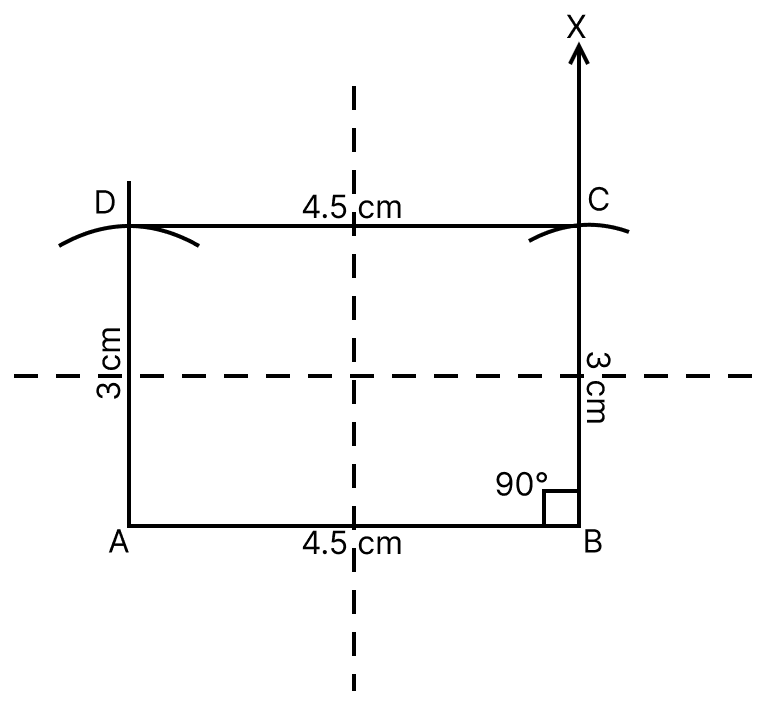
A rectangle has two lines of symmetry — the lines joining the mid-points of its opposite sides. They are shown by the dotted lines in the figure above.
Hence, ABCD is the required rectangle and it has 2 lines of symmetry.
Construct a rhombus ABCD with AB = 5.3 cm and ∠A = 60°. Draw its line (or lines) of symmetry.
Answer
We know that,
All the sides of a rhombus are equal.
∴ AB = BC = CD = DA = 5.3 cm
Steps of construction:
Draw AB = 5.3 cm.
At A, construct ∠XAB = 60°. From AX cut off AD = 5.3 cm.
Taking B and D as centres and radius 5.3 cm, draw arcs to intersect again at C (other than A).
Join BC and DC.
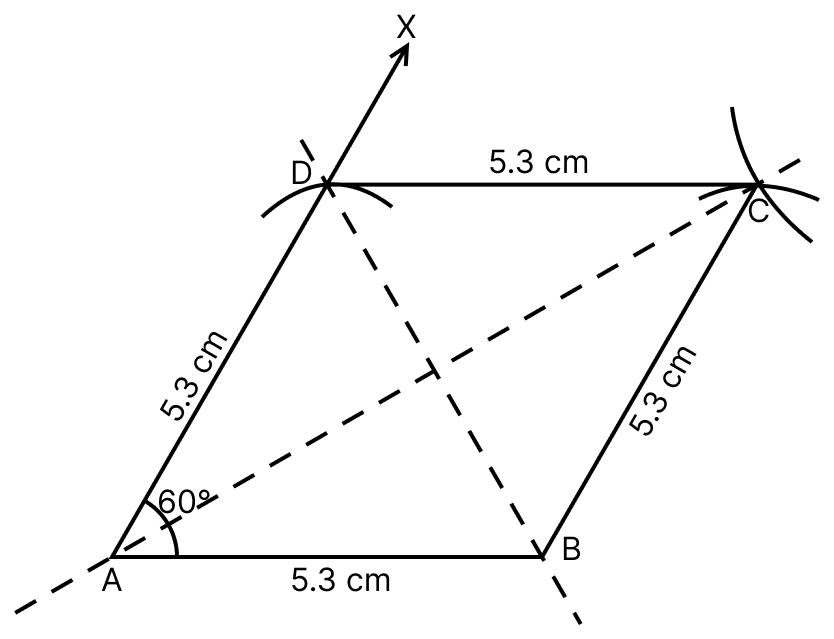
A rhombus has two lines of symmetry — its diagonals AC and BD. They are shown by the dotted lines in the figure above.
Hence, ABCD is the required rhombus and it has 2 lines of symmetry.