
Construct a quadrilateral ABCD such that AB = 4.5 cm, BC = 4 cm, CD = 3.9 cm, AD = 3.2 cm and ∠B = 60°
Answer
Given, in quadrilateral ABCD, AB = 4.5 cm, BC = 4 cm, CD = 3.9 cm, AD = 3.2 cm and ∠B = 60°.
Steps of construction :
Draw a line segment AB = 4.5 cm.
At B, construct ∠ABX = 60°.
From BX, cut off BC = 4 cm.
With A as centre and radius 3.2 cm, draw an arc.
With C as centre and radius 3.9 cm, draw another arc cutting the previous arc at D.
Join AD and CD.
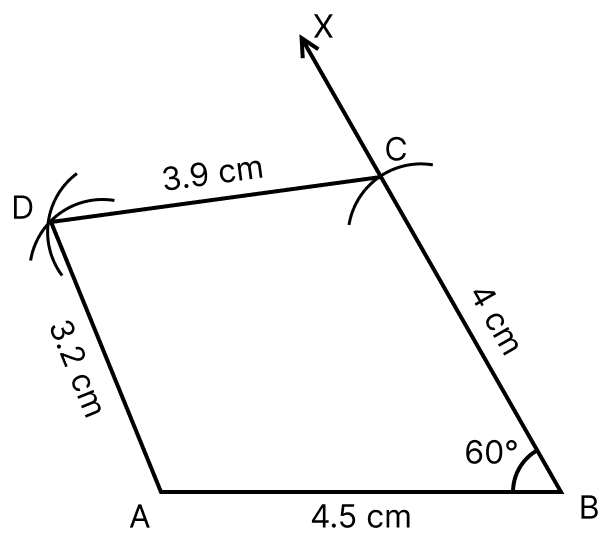
Hence, ABCD is the required quadrilateral.
Construct a quadrilateral ABCD such that AB = 5 cm, BC = 4.2 cm, AD = 3.5 cm, ∠A = 90° and ∠B = 60°
Answer
Given, in quadrilateral ABCD, AB = 5 cm, BC = 4.2 cm, AD = 3.5 cm, ∠A = 90° and ∠B = 60°.
Steps of construction :
Draw a line segment AB = 5 cm.
At A, construct ∠BAX = 90°.
From AX, cut off AD = 3.5 cm.
At B, construct ∠ABY = 60° on the same side of AB as that of D.
From BY, cut off BC = 4.2 cm.
Join CD.
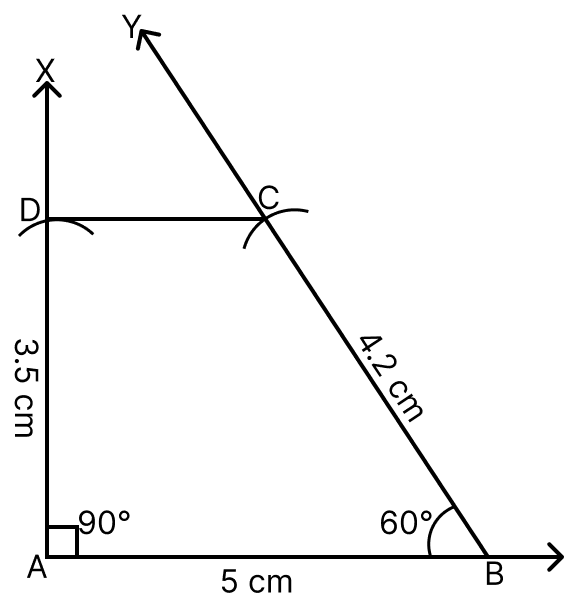
Hence, ABCD is the required quadrilateral.
Construct a quadrilateral ABCD in which AB = 3.5 cm, BC = 5 cm, CD = 5.6 cm, DA = 4 cm and BD = 5.4 cm
Answer
Given, in quadrilateral ABCD, AB = 3.5 cm, BC = 5 cm, CD = 5.6 cm, DA = 4 cm and BD = 5.4 cm.
Steps of construction :
Draw a line segment AB = 3.5 cm.
With A as centre and radius 4 cm, draw an arc.
With B as centre and radius 5.4 cm, draw another arc cutting the previous arc at D.
Join AD and BD.
With B as centre and radius 5 cm, draw an arc on the side of BD opposite to that of A.
With D as centre and radius 5.6 cm, draw another arc cutting the previous arc at C.
Join BC and CD.
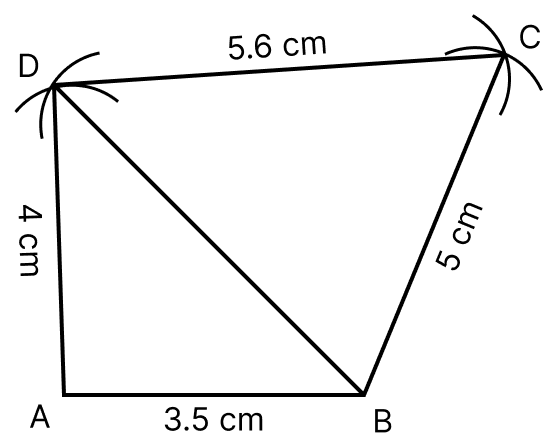
Hence, ABCD is the required quadrilateral.
Construct a quadrilateral PQRS in which PQ = 3 cm, QR = 2.5 cm, PS = 3.5 cm, PR = 4 cm and QS = 5 cm
Answer
Given, in quadrilateral PQRS, PQ = 3 cm, QR = 2.5 cm, PS = 3.5 cm, PR = 4 cm and QS = 5 cm.
Steps of construction :
Draw a line segment PQ = 3 cm.
With P as centre and radius 4 cm, draw an arc.
With Q as centre and radius 2.5 cm, draw another arc cutting the previous arc at R.
Join PR and QR.
With P as centre and radius 3.5 cm, draw an arc on the side of PR opposite to that of Q.
With Q as centre and radius 5 cm, draw another arc cutting the previous arc at S.
Join PS, RS and QS.
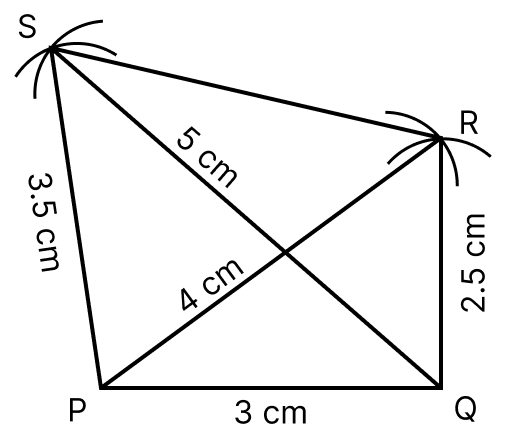
Hence, PQRS is the required quadrilateral.
Construct a quadrilateral ABCD given that BC = 6 cm, CD = 4 cm, ∠B = 45°, ∠C = 90° and ∠D = 120°
Answer
Given, in quadrilateral ABCD, BC = 6 cm, CD = 4 cm, ∠B = 45°, ∠C = 90° and ∠D = 120°.
Steps of construction :
Draw a line segment BC = 6 cm.
At C, construct ∠BCX = 90°.
From CX, cut off CD = 4 cm.
At D, construct ∠CDY = 120°.
At B, construct ∠CBZ = 45° such that BZ meets DY at A.
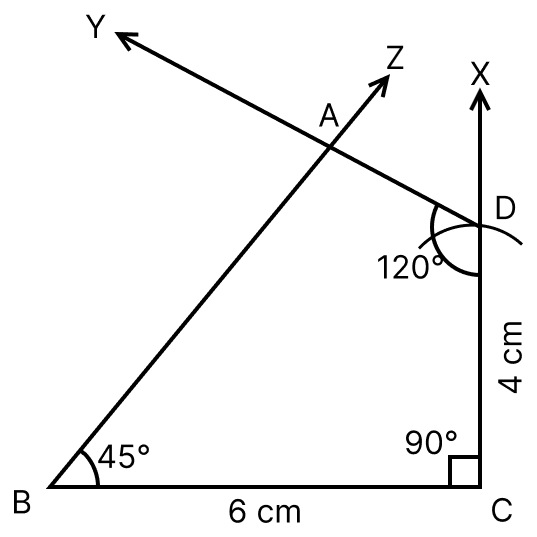
Hence, ABCD is the required quadrilateral.
Construct a parallelogram ABCD in which AB = 5.2 cm, AC = 6.5 cm and BD = 7.8 cm
Answer
Given, in parallelogram ABCD, AB = 5.2 cm, AC = 6.5 cm and BD = 7.8 cm.
Let the diagonals AC and BD meet at O.
As the diagonals of a parallelogram bisect each other,
⇒ OA = OC = = 3.25 cm
⇒ OB = OD = = 3.9 cm
So, in ΔAOB, all the three sides AB, OA and OB are known.
Steps of construction :
Draw a line segment AB = 5.2 cm.
With A as centre and radius 3.25 cm, draw an arc.
With B as centre and radius 3.9 cm, draw another arc cutting the previous arc at O.
Join AO and BO.
Produce AO to C such that OC = OA = 3.25 cm.
Produce BO to D such that OD = OB = 3.9 cm.
Join BC, CD and AD.
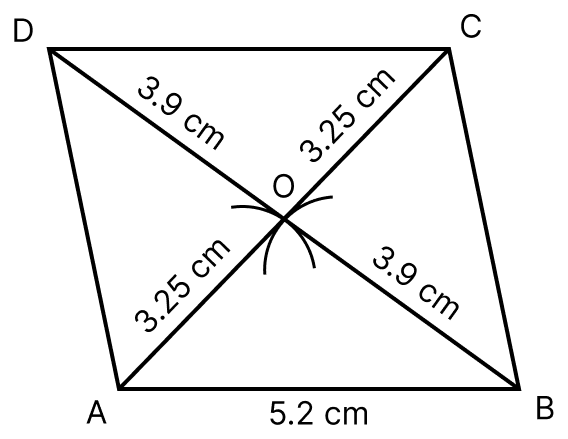
Hence, ABCD is the required parallelogram.
Construct a parallelogram ABCD in which diagonal AC = 4 cm, diagonal BD = 6 cm and angle between diagonals is 75°
Answer
Given, in parallelogram ABCD, diagonal AC = 4 cm, diagonal BD = 6 cm and the angle between the diagonals is 75°.
Let the diagonals AC and BD meet at O, so that ∠COD = 75°.
As the diagonals of a parallelogram bisect each other,
⇒ OA = OC = = 2 cm
⇒ OB = OD = = 3 cm
Steps of construction :
Draw a line segment AO = 2 cm and produce AO to C such that OC = OA = 2 cm.
At O, construct ∠COX = 75°.
From OX, cut off OD = 3 cm.
Produce DO to B such that OB = OD = 3 cm.
Join AB, BC, CD and AD.
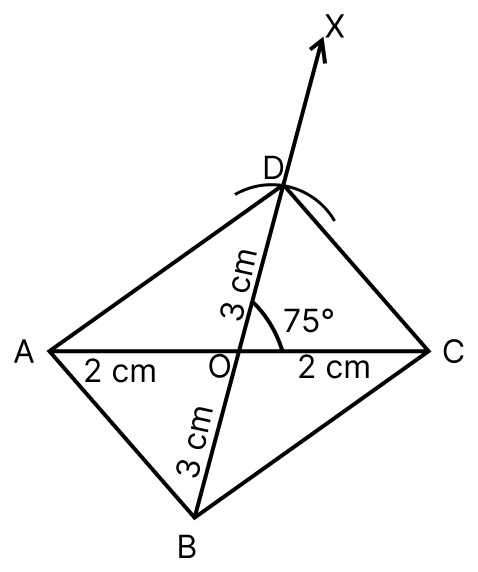
Hence, ABCD is the required parallelogram.
Construct a rectangle PQRS such that PQ = 3.5 cm and ∠RPS = 75°
Answer
Given, in rectangle PQRS, PQ = 3.5 cm and ∠RPS = 75°.
Steps of construction :
Draw a line segment PQ = 3.5 cm.
At P, construct ∠QPZ = 90°.
At Q, construct ∠PQX = 90°.
At P, construct ∠ZPY = 75° such that PY meets QX at R.
With R as centre and radius 3.5 cm, draw an arc cutting PZ at S.
Join RS.
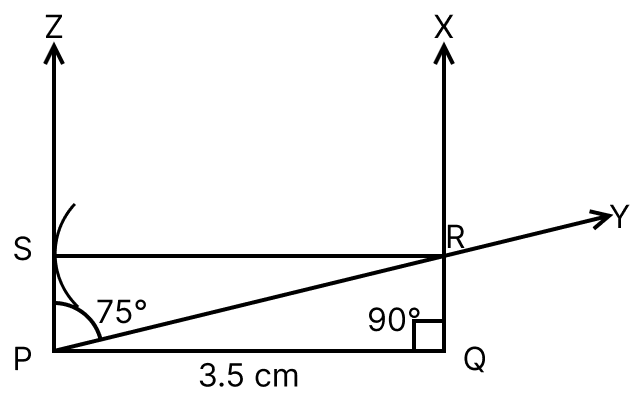
Hence, PQRS is the required rectangle.
Construct a rectangle whose one diagonal is 6.8 cm and an angle between two diagonals is 105°
Answer
Given, one diagonal of the rectangle is 6.8 cm and the angle between the two diagonals is 105°.
Let the rectangle be ABCD, in which the diagonals AC and BD meet at O and ∠COD = 105°.
As the diagonals of a rectangle are equal and bisect each other,
⇒ BD = AC = 6.8 cm
⇒ OA = OB = OC = OD = = 3.4 cm
Steps of construction :
Draw a line segment AO = 3.4 cm and produce AO to C such that OC = OA = 3.4 cm.
At O, construct ∠COX = 105°.
From OX, cut off OD = 3.4 cm.
Produce DO to B such that OB = OD = 3.4 cm.
Join AB, BC, CD and AD.
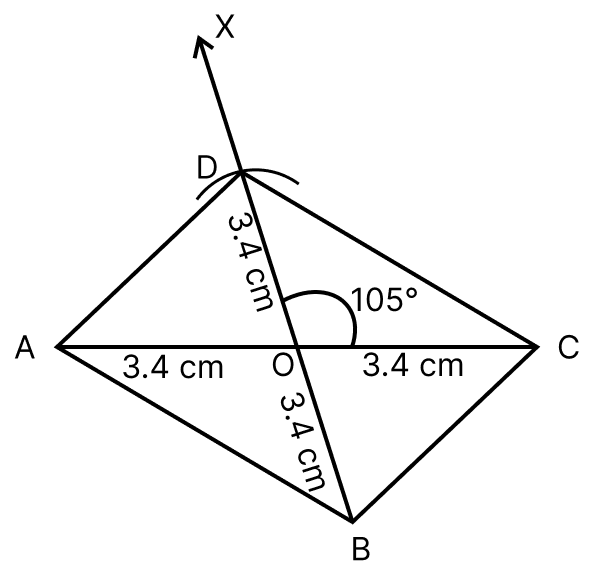
Hence, ABCD is the required rectangle.
Construct a rhombus BEST such that BE = 4.5 cm, ET = 6 cm
Answer
Given, in rhombus BEST, BE = 4.5 cm and ET = 6 cm.
Here, BE is a side and ET is a diagonal of the rhombus.
As all the sides of a rhombus are equal,
⇒ BE = ES = ST = TB = 4.5 cm
Steps of construction :
Draw a line segment BE = 4.5 cm.
With B as centre and radius 4.5 cm, draw an arc.
With E as centre and radius 6 cm, draw another arc cutting the previous arc at T.
With E as centre and radius 4.5 cm, draw an arc on the side of ET opposite to that of B.
With T as centre and radius 4.5 cm, draw another arc cutting the previous arc at S.
Join BT, ES and ST.
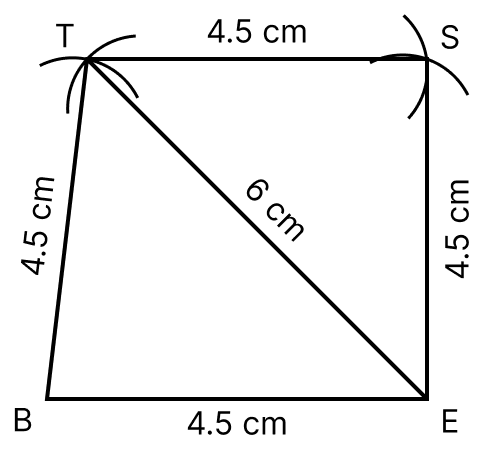
Hence, BEST is the required rhombus.
Construct a rhombus whose diagonals are 7 cm and 5.3 cm
Answer
Given, the diagonals of the rhombus are 7 cm and 5.3 cm.
Let the rhombus be ABCD, in which the diagonals AC = 7 cm and BD = 5.3 cm meet at O.
As the diagonals of a rhombus bisect each other at right angles,
⇒ OA = OC = = 3.5 cm
⇒ OB = OD = = 2.65 cm
⇒ ∠AOB = 90°
Steps of construction :
Draw a line segment AC = 7 cm.
Draw the perpendicular bisector XY of AC, cutting AC at its mid-point O.
From OX, cut off OB = 2.65 cm and from OY, cut off OD = 2.65 cm.
Join AB, BC, CD and AD.
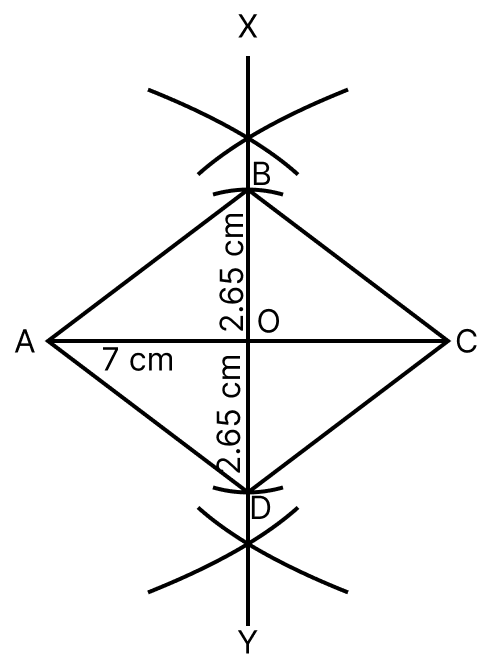
Hence, ABCD is the required rhombus.
Construct a square whose one diagonal is 5.8 cm
Answer
Given, one diagonal of the square is 5.8 cm.
Let the square be ABCD, in which the diagonals AC = 5.8 cm and BD meet at O.
As the diagonals of a square are equal and bisect each other at right angles,
⇒ BD = AC = 5.8 cm
⇒ OA = OB = OC = OD = = 2.9 cm
⇒ ∠AOB = 90°
Steps of construction :
Draw a line segment AC = 5.8 cm.
Draw the perpendicular bisector XY of AC, cutting AC at its mid-point O.
From OX, cut off OB = 2.9 cm and from OY, cut off OD = 2.9 cm.
Join AB, BC, CD and AD.
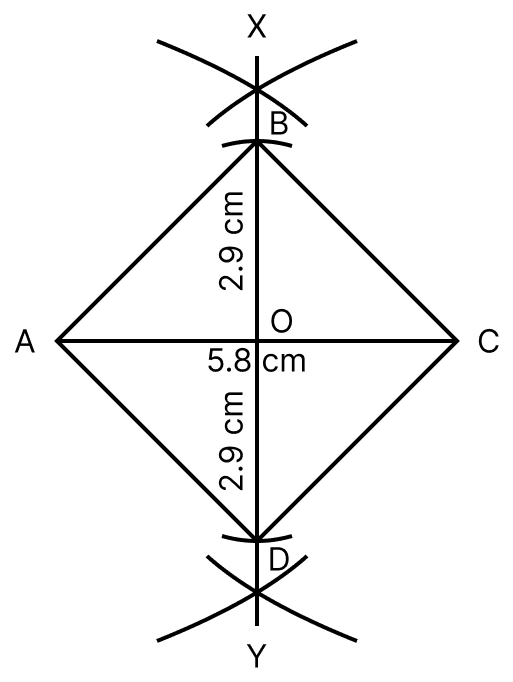
Hence, ABCD is the required square.
Construct a trapezium ABCD in which AB = 7 cm, BC = 4 cm, CD = 3 cm, ∠B = 60° and AB ∥ DC
Answer
Given, in trapezium ABCD, AB = 7 cm, BC = 4 cm, CD = 3 cm, ∠B = 60° and AB ∥ DC.
As AB ∥ DC and BC is a transversal, the co-interior angles ∠B and ∠C are supplementary.
⇒ ∠C = 180° - 60° = 120°
Steps of construction :
Draw a line segment AB = 7 cm.
At B, construct ∠ABX = 60°.
From BX, cut off BC = 4 cm.
At C, construct ∠BCY = 120° such that CY is on the same side of BC as that of A.
From CY, cut off CD = 3 cm.
Join AD.
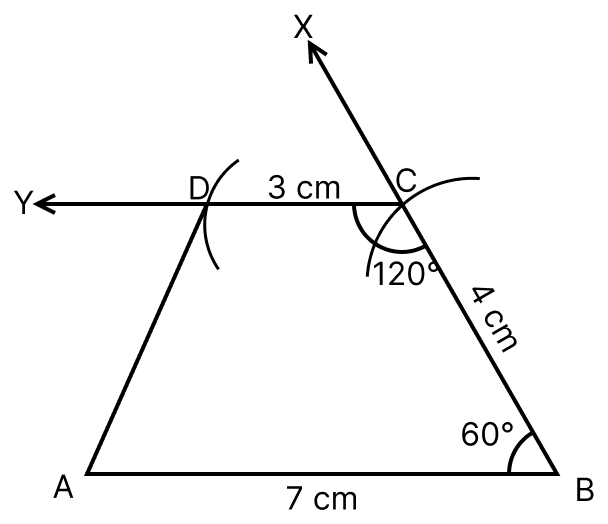
Hence, ABCD is the required trapezium.
Construct a parallelogram PQRS in which PQ = 6 cm, ∠Q = 120° and ∠RPQ = 30°.
Answer
Given, in parallelogram PQRS, PQ = 6 cm, ∠Q = 120° and ∠RPQ = 30°.
As the opposite sides of a parallelogram are equal,
⇒ RS = PQ = 6 cm and PS = QR
Steps of construction :
Draw a line segment PQ = 6 cm.
At Q, construct ∠PQX = 120°.
At P, construct ∠QPY = 30° such that PY meets QX at R.
With R as centre and radius 6 cm, draw an arc.
With P as centre and radius = QR, draw another arc cutting the previous arc at S.
Join PS and RS.
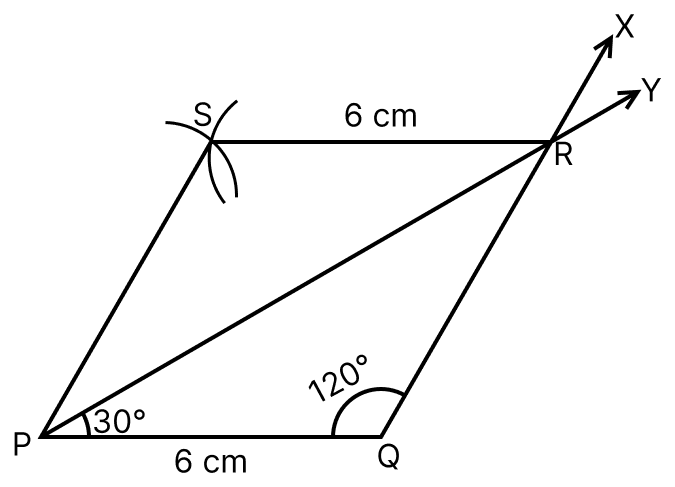
Hence, PQRS is the required parallelogram.
Construct a rectangle ABCD in which diagonal AC = 7 cm and the diagonals BD and AC intersect at O such that ∠BOC = 45°
Answer
Given, in rectangle ABCD, diagonal AC = 7 cm and the diagonals BD and AC intersect at O such that ∠BOC = 45°.
As the diagonals of a rectangle are equal and bisect each other,
⇒ BD = AC = 7 cm
⇒ OA = OB = OC = OD = = 3.5 cm
Steps of construction :
Draw a line segment AO = 3.5 cm and produce AO to C such that OC = OA = 3.5 cm.
At O, construct ∠COX = 45°.
From OX, cut off OB = 3.5 cm.
Produce BO to D such that OD = OB = 3.5 cm.
Join AB, BC, CD and AD.
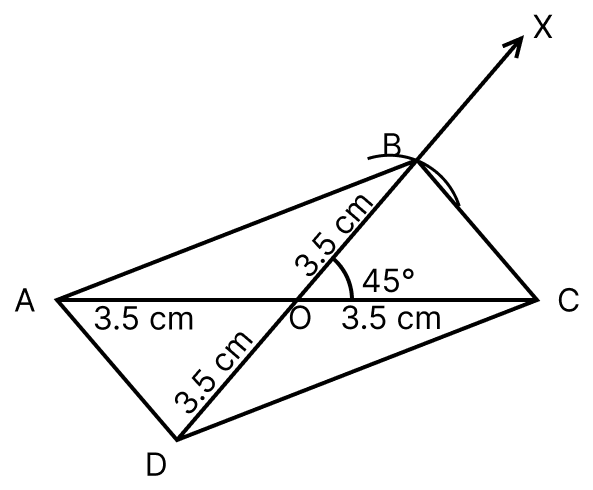
Hence, ABCD is the required rectangle.