
The surface area of a cube is 384 cm2. Find
(i) the length of an edge
(ii) volume of the cube
Answer
Given,
Surface area of the cube = 384 cm2
(i) Let the length of an edge of the cube be a cm.
By formula,
Surface area of a cube = 6 × (edge)2
⇒ 6 × a2 = 384
⇒ a2 =
⇒ a2 = 64
⇒ a =
⇒ a = 8 cm
Hence, the length of an edge of the cube is 8 cm.
(ii) By formula,
Volume of a cube = (edge)3
= (8)3 cm3
= 512 cm3
Hence, the volume of the cube is 512 cm3.
Find the total surface area of a solid cylinder of radius 5 cm and height 10 cm. Leave your answer in terms of π.
Answer
Given,
Radius of the solid cylinder = 5 cm
Height of the solid cylinder = 10 cm
By formula,
Total surface area of a cylinder = 2πr(r + h)
= 2 × π × 5 × (5 + 10) cm2
= 2 × π × 5 × 15 cm2
= 150π cm2
Hence, the total surface area of the solid cylinder is 150π cm2.
An aquarium is in the form of a cuboid whose external measures are 70 cm × 28 cm × 35 cm. The base, side faces and back face are to be covered with coloured paper. Find the area of the paper needed.
Answer
Given,
External measures of the cuboidal aquarium = 70 cm × 28 cm × 35 cm
Here, length = 70 cm, breadth = 28 cm and height = 35 cm.
The paper is needed for the base, the two side faces and the back face.
By formula,
Area of a rectangle = length × breadth
Area of the base = 70 × 28 cm2
= 1960 cm2
Area of the two side faces = 2 × (28 × 35) cm2
= 2 × 980 cm2
= 1960 cm2
Area of the back face = 70 × 35 cm2
= 2450 cm2
Area of the paper needed = 1960 + 1960 + 2450 cm2
= 6370 cm2
Hence, the area of the paper needed is 6370 cm2.
The internal dimensions of rectangular hall are 15 m × 12 m × 4 m. There are 4 windows each of dimension 2 m × 1.5 m and 2 doors each of dimension 1.5 m × 2.5 m. Find the cost of white washing all four walls of the hall, if the cost of white washing is ₹50 per m2. What will be the cost of white washing if the ceiling of the hall is also white washed?
Answer
Given,
Internal dimensions of the rectangular hall = 15 m × 12 m × 4 m
Here, length = 15 m, breadth = 12 m and height = 4 m.
By formula,
Area of four walls = 2(length + breadth) × height
= 2(15 + 12) × 4 m2
= 2 × 27 × 4 m2
= 216 m2
Area of 4 windows = 4 × (2 × 1.5) m2
= 4 × 3 m2
= 12 m2
Area of 2 doors = 2 × (1.5 × 2.5) m2
= 2 × 3.75 m2
= 7.5 m2
Area to be white washed = Area of four walls - Area of windows - Area of doors
= 216 - 12 - 7.5 m2
= 196.5 m2
Cost of white washing the four walls = Area to be white washed × Rate
= 196.5 m2 × ₹50/m2
= ₹9,825
Area of the ceiling = length × breadth
= 15 × 12 m2
= 180 m2
Area to be white washed including the ceiling = 196.5 + 180 m2
= 376.5 m2
Cost of white washing including the ceiling = 376.5 m2 × ₹50/m2
= ₹18,825
Hence, the cost of white washing all four walls is ₹9,825 and the cost of white washing including the ceiling is ₹18,825.
A swimming pool is 50 m in length, 30 m in breadth and 2.5 m in depth. Find the cost of cementing its floor and walls at the rate of ₹120 per square metre.
Answer
Given,
Length of the swimming pool = 50 m
Breadth of the swimming pool = 30 m
Depth of the swimming pool = 2.5 m
By formula,
Area of a rectangle = length × breadth
Area of the floor = 50 × 30 m2
= 1500 m2
By formula,
Area of four walls = 2(length + breadth) × height
Area of the walls = 2(50 + 30) × 2.5 m2
= 2 × 80 × 2.5 m2
= 400 m2
Total area to be cemented = 1500 + 400 m2
= 1900 m2
Cost of cementing = Total area × Rate
= 1900 m2 × ₹120/m2
= ₹2,28,000
Hence, the cost of cementing the floor and the walls of the swimming pool is ₹2,28,000.
The floor of a rectangular hall has a perimeter of 236 m. Its height is 4.5 m. Find the cost of painting its four walls (assume that there are no doors and windows) at the rate of ₹42 per square metre.
Answer
Given,
Perimeter of the floor of the rectangular hall = 236 m
Height of the hall = 4.5 m
By formula,
Area of four walls = perimeter of the floor × height
= 236 × 4.5 m2
= 1062 m2
Cost of painting the four walls = Area of four walls × Rate
= 1062 m2 × ₹42/m2
= ₹44,604
Hence, the cost of painting the four walls of the hall is ₹44,604.
A cuboidal fish tank has a length of 30 cm, a breadth of 20 cm and a height of 20 cm. The tank is placed on a horizontal table and it is three-quarters full of water. Find the area of the tank which is in contact with water.
Answer
Given,
Length of the cuboidal fish tank = 30 cm
Breadth of the cuboidal fish tank = 20 cm
Height of the cuboidal fish tank = 20 cm
The tank is three-quarters full of water.
Height of the water in the tank = x 20 cm
= 15 cm
The water touches the base of the tank and the four walls up to a height of 15 cm.
By formula,
Area of a rectangle = length × breadth
Area of the base = 30 × 20 cm2
= 600 cm2
By formula,
Area of four walls = 2(length + breadth) × height
Area of the walls in contact with water = 2(30 + 20) × 15 cm2
= 2 × 50 × 15 cm2
= 1500 cm2
Area of the tank in contact with water = 600 + 1500 cm2
= 2100 cm2
Hence, the area of the tank which is in contact with water is 2100 cm2.
The volume of a cuboid is 448 cm3. Its height is 7 cm and the base is a square. Find
(i) a side of the square base
(ii) surface area of the cuboid.
Answer
Given,
Volume of the cuboid = 448 cm3
Height of the cuboid = 7 cm
The base of the cuboid is a square.
(i) Let a side of the square base be a cm.
By formula,
Volume of a cuboid = base area × height
⇒ a2 × 7 = 448
⇒ a2 =
⇒ a2 = 64
⇒ a =
⇒ a = 8 cm
Hence, a side of the square base is 8 cm.
(ii) Here, length = 8 cm, breadth = 8 cm and height = 7 cm.
By formula,
Surface area of a cuboid = 2(lb + bh + hl)
= 2(8 × 8 + 8 × 7 + 7 × 8) cm2
= 2(64 + 56 + 56) cm2
= 2 × 176 cm2
= 352 cm2
Hence, the surface area of the cuboid is 352 cm2.
The length, breadth and height of a rectangular solid are in the ratio 5 : 4 : 2. If its total surface area is 1216 cm2, find the volume of the solid.
Answer
Given,
The length, breadth and height of the rectangular solid are in the ratio 5 : 4 : 2.
Total surface area of the solid = 1216 cm2
Let the length, breadth and height of the solid be 5a cm, 4a cm and 2a cm respectively.
By formula,
Total surface area of a cuboid = 2(lb + bh + hl)
⇒ 2(5a × 4a + 4a × 2a + 2a × 5a) = 1216
⇒ 2(20a2 + 8a2 + 10a2) = 1216
⇒ 2 × 38a2 = 1216
⇒ 76a2 = 1216
⇒ a2 =
⇒ a2 = 16
⇒ a =
⇒ a = 4
So, length of the solid = 5a = 5 × 4 cm = 20 cm
Breadth of the solid = 4a = 4 × 4 cm = 16 cm
Height of the solid = 2a = 2 × 4 cm = 8 cm
By formula,
Volume of a cuboid = length × breadth × height
= 20 × 16 × 8 cm3
= 2560 cm3
Hence, the volume of the rectangular solid is 2560 cm3.
A rectangular room is 6 m long, 5 m wide and 3.5 m high. It has 2 doors of size 1.1 m by 2 m and 3 windows of size 1.5 m by 1.4 m. Find the cost of white washing the walls and the ceiling of the room at the rate of ₹40 per square metre.
Answer
Given,
Length of the rectangular room = 6 m
Breadth of the rectangular room = 5 m
Height of the rectangular room = 3.5 m
By formula,
Area of four walls = 2(length + breadth) × height
= 2(6 + 5) × 3.5 m2
= 2 × 11 × 3.5 m2
= 77 m2
Area of the ceiling = length × breadth
= 6 × 5 m2
= 30 m2
Area of 2 doors = 2 × (1.1 × 2) m2
= 2 × 2.2 m2
= 4.4 m2
Area of 3 windows = 3 × (1.5 × 1.4) m2
= 3 × 2.1 m2
= 6.3 m2
Area to be white washed = Area of four walls + Area of the ceiling - Area of doors - Area of windows
= 77 + 30 - 4.4 - 6.3 m2
= 107 - 10.7 m2
= 96.3 m2
Cost of white washing = Area to be white washed × Rate
= 96.3 m2 × ₹40/m2
= ₹3,852
Hence, the cost of white washing the walls and the ceiling of the room is ₹3,852.
A cuboidal block of metal has dimensions 36 cm by 32 cm by 0.25 m. It is melted and recast into cubes with an edge of 4 cm.
(i) How many such cubes can be made?
(ii) What is the cost of silver coating the surfaces of the cubes at the rate of ₹0.75 per square centimetre?
Answer
Given,
Dimensions of the cuboidal block of metal = 36 cm × 32 cm × 0.25 m
Edge of each cube = 4 cm
Converting the height into centimetres,
Height of the block = 0.25 m = 25 cm
(i) By formula,
Volume of a cuboid = length × breadth × height
Volume of the block = 36 × 32 × 25 cm3
= 28800 cm3
By formula,
Volume of a cube = (edge)3
Volume of one cube = (4)3 cm3
= 64 cm3
Number of cubes =
=
= 450
Hence, 450 such cubes can be made.
(ii) By formula,
Surface area of a cube = 6 × (edge)2
Surface area of one cube = 6 × (4)2 cm2
= 6 × 16 cm2
= 96 cm2
Surface area of 450 cubes = 450 × 96 cm2
= 43200 cm2
Cost of silver coating = Total surface area × Rate
= 43200 cm2 × ₹0.75/cm2
= ₹32,400
Hence, the cost of silver coating the surfaces of the cubes is ₹32,400.
Three cubes of silver with edges 3 cm, 4 cm and 5 cm are melted and recast into a single cube. Find the cost of coating the surface of the new cube with gold at the rate of ₹35 per square centimetre.
Answer
Given,
Edges of the three cubes of silver = 3 cm, 4 cm and 5 cm
By formula,
Volume of a cube = (edge)3
Sum of the volumes of the three cubes = (3)3 + (4)3 + (5)3 cm3
= 27 + 64 + 125 cm3
= 216 cm3
Let the edge of the new cube be a cm.
Since the three cubes are melted and recast into a single cube, the volume remains the same.
⇒ a3 = 216
⇒ a =
⇒ a = 6 cm
By formula,
Surface area of a cube = 6 × (edge)2
Surface area of the new cube = 6 × (6)2 cm2
= 6 × 36 cm2
= 216 cm2
Cost of coating with gold = Surface area × Rate
= 216 cm2 × ₹35/cm2
= ₹7,560
Hence, the cost of coating the surface of the new cube with gold is ₹7,560.
The curved surface area of a hollow cylinder is 4375 cm2, it is cut along its height and formed a rectangular sheet of width 35 cm. Find the perimeter of the rectangular sheet.
Answer
Given,
Curved surface area of the hollow cylinder = 4375 cm2
Width of the rectangular sheet = 35 cm
When the cylinder is cut along its height and opened out, the rectangular sheet so formed has the same area as the curved surface area of the cylinder.
Area of the rectangular sheet = 4375 cm2
Let the length of the rectangular sheet be l cm.
By formula,
Area of a rectangle = length × breadth
⇒ l × 35 = 4375
⇒ l =
⇒ l = 125 cm
By formula,
Perimeter of a rectangle = 2(length + breadth)
= 2(125 + 35) cm
= 2 × 160 cm
= 320 cm
Hence, the perimeter of the rectangular sheet is 320 cm.
A road roller has a diameter 0.7 m and its width is 1.2 m. Find the least number of revolutions that the roller must take in order to level a playground of size 120 m × 44 m.
Answer
Given,
Diameter of the road roller = 0.7 m
Width of the road roller = 1.2 m
Size of the playground = 120 m × 44 m
Radius of the road roller = m = 0.35 m
In one complete revolution, the roller levels an area equal to its curved surface area.
By formula,
Curved surface area of a cylinder = 2πrh
Curved surface area of the road roller = 2 × × 0.35 × 1.2 m2
= 2 × 22 × 0.05 × 1.2 m2
= 2.64 m2
So, area levelled in one revolution = 2.64 m2
By formula,
Area of a rectangle = length × breadth
Area of the playground = 120 × 44 m2
= 5280 m2
Number of revolutions =
=
= 2000
Hence, the roller must take at least 2000 revolutions to level the playground.
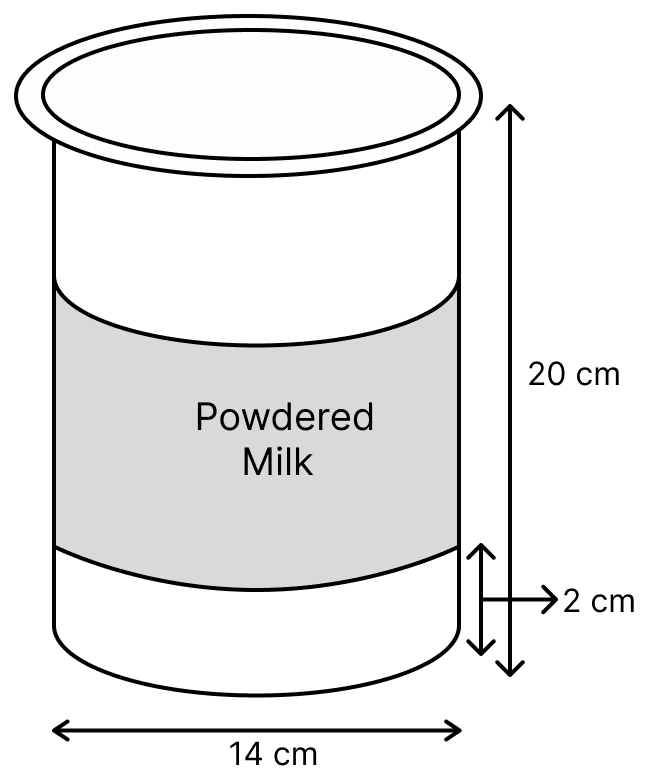
A company packages its milk powder in cylindrical container whose base has a diameter of 14 cm and height 20 cm. Company places a label around the surface of the container (as shown in the figure). If the label is placed 2 cm from top and bottom, what is the area of the label?
Answer
Given,
Diameter of the base of the cylindrical container = 14 cm
Height of the cylindrical container = 20 cm
The label is placed 2 cm from the top and 2 cm from the bottom.
Radius of the base = cm = 7 cm
Height of the label = 20 - 2 - 2 cm = 16 cm
The label goes around the curved surface of the container, so its area is the curved surface area of a cylinder of radius 7 cm and height 16 cm.
By formula,
Hence, the area of the label is 704 cm2.
The sum of the radius and height of a cylinder is 37 cm and the total surface area of the cylinder is 1628 cm2. Find the height and the volume of the cylinder.
Answer
Given,
Sum of the radius and the height of the cylinder = 37 cm
Total surface area of the cylinder = 1628 cm2
Let the radius of the cylinder be r cm and its height be h cm.
So, r + h = 37
By formula,
Total surface area of a cylinder = 2πr(r + h)
So, radius of the cylinder = 7 cm
Since r + h = 37,
⇒ 7 + h = 37
⇒ h = 37 - 7
⇒ h = 30 cm
By formula,
Volume of a cylinder = πr2h
Hence, the height of the cylinder is 30 cm and its volume is 4620 cm3.
The ratio between the curved surface and total surface of a cylinder is 1 : 2. Find the volume of the cylinder, given that its total surface area is 616 cm2.
Answer
Given,
The ratio between the curved surface and the total surface of the cylinder = 1 : 2
Total surface area of the cylinder = 616 cm2
Let the radius of the cylinder be r cm and its height be h cm.
Since the total surface area is 616 cm2,
So, radius of the cylinder = 7 cm and height of the cylinder = 7 cm
By formula,
Volume of a cylinder = πr2h
Hence, the volume of the cylinder is 1078 cm3.
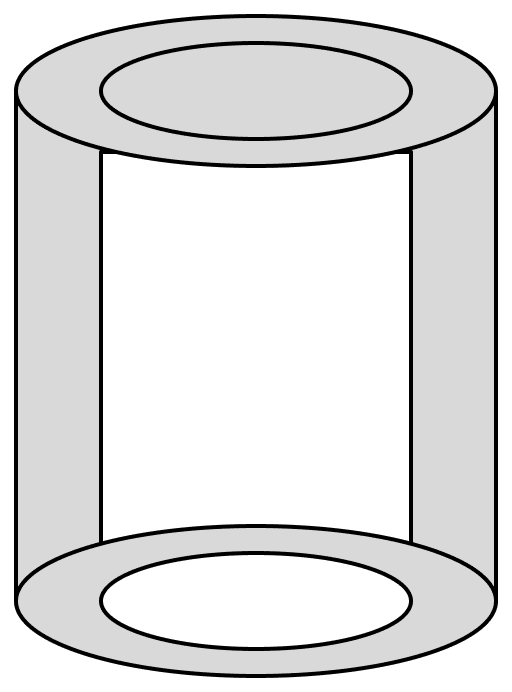
The adjoining figure shows a metal pipe 77 cm long. The inner diameter of cross section is 4 cm and the outer one is 4.4 cm.
Find its
(i) inner curved surface area
(ii) outer curved surface area
(iii) total surface area
Answer
Given,
Length of the metal pipe = 77 cm
Inner diameter of the cross section = 4 cm
Outer diameter of the cross section = 4.4 cm
Inner radius, r = cm = 2 cm
Outer radius, R = cm = 2.2 cm
(i) By formula,
Curved surface area of a cylinder = 2πrh
Hence, the inner curved surface area of the pipe is 968 cm2.
(ii) By formula,
Curved surface area of a cylinder = 2πRh
Outer curved surface area = 2 × × 2.2 × 77 cm2
= 2 × 22 × 2.2 × 11 cm2
= 1064.8 cm2
Hence, the outer curved surface area of the pipe is 1064.8 cm2.
(iii) The two ends of the pipe are rings, each having outer radius 2.2 cm and inner radius 2 cm.
So, area of one ring = 2.64 cm2
Area of the two rings = 2 × 2.64 cm2
= 5.28 cm2
Total surface area of the pipe = Inner curved surface area + Outer curved surface area + Area of the two rings
= 968 + 1064.8 + 5.28 cm2
= 2038.08 cm2
Hence, the total surface area of the pipe is 2038.08 cm2.