
Which of the following points lies in the first quadrant?
(0, 0)
(4, 0)
(0, 3)
(2, 3)
Answer
In the first quadrant, both the abscissa and the ordinate of a point are positive.
The point (0, 0) is the origin, the point (4, 0) lies on the x-axis and the point (0, 3) lies on the y-axis.
Among the given points, only the point (2, 3) has both its abscissa and ordinate positive.
Hence, option 4 is the correct option.
Distance of a point from y-axis is called
abscissa
ordinate
coordinate
none of these
Answer
The perpendicular distance of a point from the y-axis is the absolute value of x-coordinate, which is called the abscissa of the point.
The perpendicular distance of a point from the x-axis is the absolute value of y-coordinate, which is called the ordinate of the point.
Hence, option 1 is the correct option.
The co-ordinates of a point situated on x-axis at a distance of 3 units from y-axis is
(0, 3)
(3, 0)
(3, 3)
(-3, 3)
Answer
The point lies on the x-axis, so its ordinate is zero.
The distance of the point from the y-axis is 3 units, so its abscissa can be 3 (if it lies to the right of the y-axis) or -3 (if it lies to the left of the y-axis).
So, the coordinates of the point can be (3, 0) or (-3, 0).
Among the given options, only (3, 0) is present.
Hence, option 2 is the correct option.
The co-ordinates of a point situated on y-axis at a distance of 6 units from x-axis is
(0, 6)
(6, 0)
(6, 6)
(-6, 6)
Answer
The point lies on the y-axis, so its abscissa is zero.
The distance of the point from the x-axis is 6 units, so its ordinate can be 6 (if it lies above the x-axis) or -6 (if it lies below the x-axis).
So, the coordinates of the point can be (0, 6) or (0, -6).
Among the given options, only (0, 6) is present.
Hence, option 1 is the correct option.
The co-ordinates of a point below x-axis at a distance of 4 units from x-axis but lying on y-axis is
(0, 4)
(-4, 0)
(0, -4)
(4, -4)
Answer
The point lies on the y-axis, so its abscissa is zero.
The point is at a distance of 4 units from the x-axis and it lies below the x-axis, so its ordinate is -4.
So, the coordinates of the point are (0, -4).
Hence, option 3 is the correct option.
In which quadrant does (-4, 3) lie?
I
II
III
IV
Answer
In the point (-4, 3), the abscissa is -4, which is negative, and the ordinate is 3, which is positive.
The abscissa is negative and the ordinate is positive in the second quadrant.
Hence, option 2 is the correct option.
The equation of a line parallel to y-axis and at a distance of 4 units to the right of y-axis, is
x = 4
y = 4
x = 4y
y = 4x
Answer
Every point on a line parallel to the y-axis is at the same distance from the y-axis, that is, each such point has the same abscissa.
Here, each point of the line is at a distance of 4 units to the right of the y-axis, so the abscissa of each of its points is 4.
So, the equation of the line is x = 4.
Hence, option 1 is the correct option.
The equation of a line parallel to y-axis and at a distance of 3 units to the left of y-axis, is
y = -3
x = -3
x + 3y = 0
y + 3x = 0
Answer
Every point on a line parallel to the y-axis has the same abscissa.
Here, each point of the line is at a distance of 3 units to the left of the y-axis, so the abscissa of each of its points is -3.
So, the equation of the line is x = -3.
Hence, option 2 is the correct option.
The equation of a line parallel to x-axis at a distance of 9 units and above x-axis, is
x = 9
y = 9
x = 9y
y = 9x
Answer
Every point on a line parallel to the x-axis is at the same distance from the x-axis, that is, each such point has the same ordinate.
Here, each point of the line is at a distance of 9 units above the x-axis, so the ordinate of each of its points is 9.
So, the equation of the line is y = 9.
Hence, option 2 is the correct option.
The equation of a line parallel to x-axis at a distance of 5 units below x-axis is
x = 5
x = -5
y = -5
y = -5x
Answer
Every point on a line parallel to the x-axis has the same ordinate.
Here, each point of the line is at a distance of 5 units below the x-axis, so the ordinate of each of its points is -5.
So, the equation of the line is y = -5.
Hence, option 3 is the correct option.
Assertion (A): x-coordinate of a point is its distance from the y-axis.
Reason (R): The coordinates of any point on x-axis is of the form (x, 0).
Both Assertion (A) and Reason (R) are true and Reason (R) is the correct explanation of Assertion (A).
Both Assertion (A) and Reason (R) are true and Reason (R) is not the correct explanation of Assertion (A).
Assertion (A) is true but Reason (R) is false.
Assertion (A) is false but Reason (R) is true.
Answer
The x-coordinate of a point is the perpendicular distance of the point from the y-axis, and it is called the abscissa of the point.
So, Assertion (A) is true.
The distance of any point lying on the x-axis from the x-axis is zero, so its ordinate is zero and its coordinates are of the form (x, 0).
So, Reason (R) is also true.
Reason (R) speaks of the coordinates of a point lying on the x-axis, whereas Assertion (A) speaks of the x-coordinate of any point in the plane.
So, Reason (R) is not the correct explanation of Assertion (A).
Hence, option 2 is the correct option.
Assertion (A): In the fourth quadrant, abscissa is positive and ordinate is negative.
Reason (R): The y-coordinate of a point is positive if it is measured below the origin.
Both Assertion (A) and Reason (R) are true and Reason (R) is the correct explanation of Assertion (A).
Both Assertion (A) and Reason (R) are true and Reason (R) is not the correct explanation of Assertion (A).
Assertion (A) is true but Reason (R) is false.
Assertion (A) is false but Reason (R) is true.
Answer
In the fourth quadrant, a point lies to the right of the origin and below it, so its abscissa is positive and its ordinate is negative.
So, Assertion (A) is true.
The y-coordinate of a point is positive if it is measured above the origin and it is negative if it is measured below the origin.
So, Reason (R) is false.
Hence, option 3 is the correct option.
Assertion (A): The point (0, -2) lies on y-axis.
Reason (R): The abscissa of every point on y-axis is 0.
Both Assertion (A) and Reason (R) are true and Reason (R) is the correct explanation of Assertion (A).
Both Assertion (A) and Reason (R) are true and Reason (R) is not the correct explanation of Assertion (A).
Assertion (A) is true but Reason (R) is false.
Assertion (A) is false but Reason (R) is true.
Answer
The distance of any point lying on the y-axis from the y-axis is zero, so the abscissa of every point on the y-axis is 0.
So, Reason (R) is true.
In the point (0, -2), the abscissa is 0, so the point lies on the y-axis at a distance of 2 units below the origin.
So, Assertion (A) is also true, and it follows directly from Reason (R).
So, Reason (R) is the correct explanation of Assertion (A).
Hence, option 1 is the correct option.
The distance of the point A (7, 5) from the x-axis is:
7 units
5 units
(7 + 5) units
units
Answer
The perpendicular distance of a point from the x-axis is its y-coordinate, that is, its ordinate.
In the point A(7, 5), the ordinate is 5.
So, the distance of the point A(7, 5) from the x-axis is 5 units.
Hence, option 2 is the correct option.
The point (-2, 0) lies on:
the x-axis and on the left side of y-axis.
the y-axis and above the x-axis.
the x-axis and on the right side of the y-axis.
the y-axis and below the x-axis.
Answer
In the point (-2, 0), the ordinate is zero, so the point lies on the x-axis.
Also, the abscissa is -2, which is negative, so the point lies to the left of the y-axis.
So, the point (-2, 0) lies on the x-axis and on the left side of the y-axis.
Hence, option 1 is the correct option.
A point which lies on both the axes is:
(0, 1)
(1, 0)
(1, 1)
(0, 0)
Answer
A point lying on the x-axis has its ordinate equal to zero and a point lying on the y-axis has its abscissa equal to zero.
So, a point lying on both the axes has both its abscissa and its ordinate equal to zero, that is, it is the point (0, 0), which is the origin.
Hence, option 4 is the correct option.
In the given figure, the position of the book on the table may be given by:
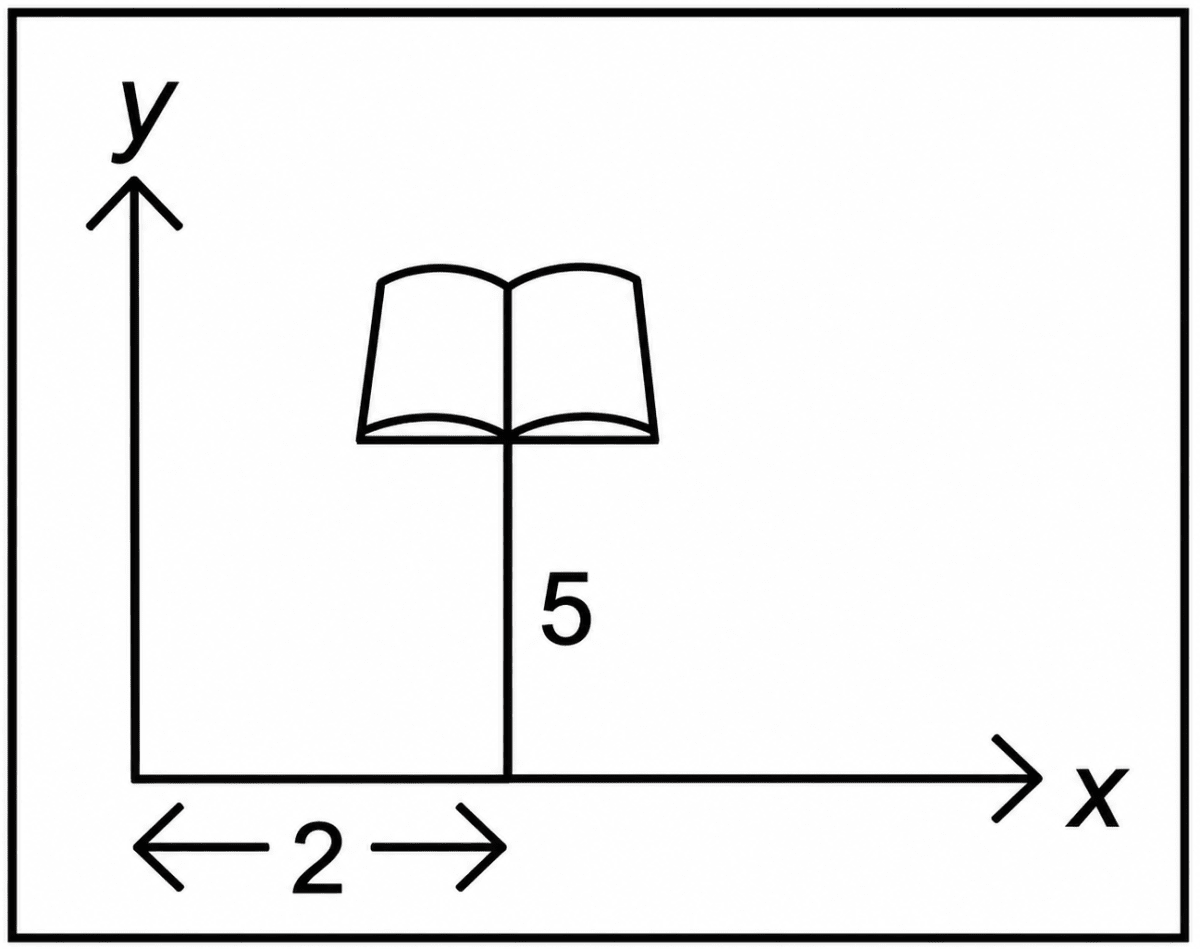
(2, 5)
(5, 2)
(2, 2)
(5, 5)
Answer
From the figure, the book is at a distance of 2 units from the y-axis, so its abscissa is 2.
The book is at a distance of 5 units from the x-axis, so its ordinate is 5.
Since the abscissa precedes the ordinate, the position of the book on the table is given by (2, 5).
Hence, option 1 is the correct option.