
In rolling a die, the probability of getting an even composite number is:
Answer
Total number of possible outcomes = 6 (i.e., 1, 2, 3, 4, 5, 6)
The even numbers on a die are 2, 4 and 6, of which the composite numbers are 4 and 6.
For getting an even composite number, the favourable outcomes are 4 and 6.
Number of favourable outcomes = 2
Hence, option 2 is the correct option.
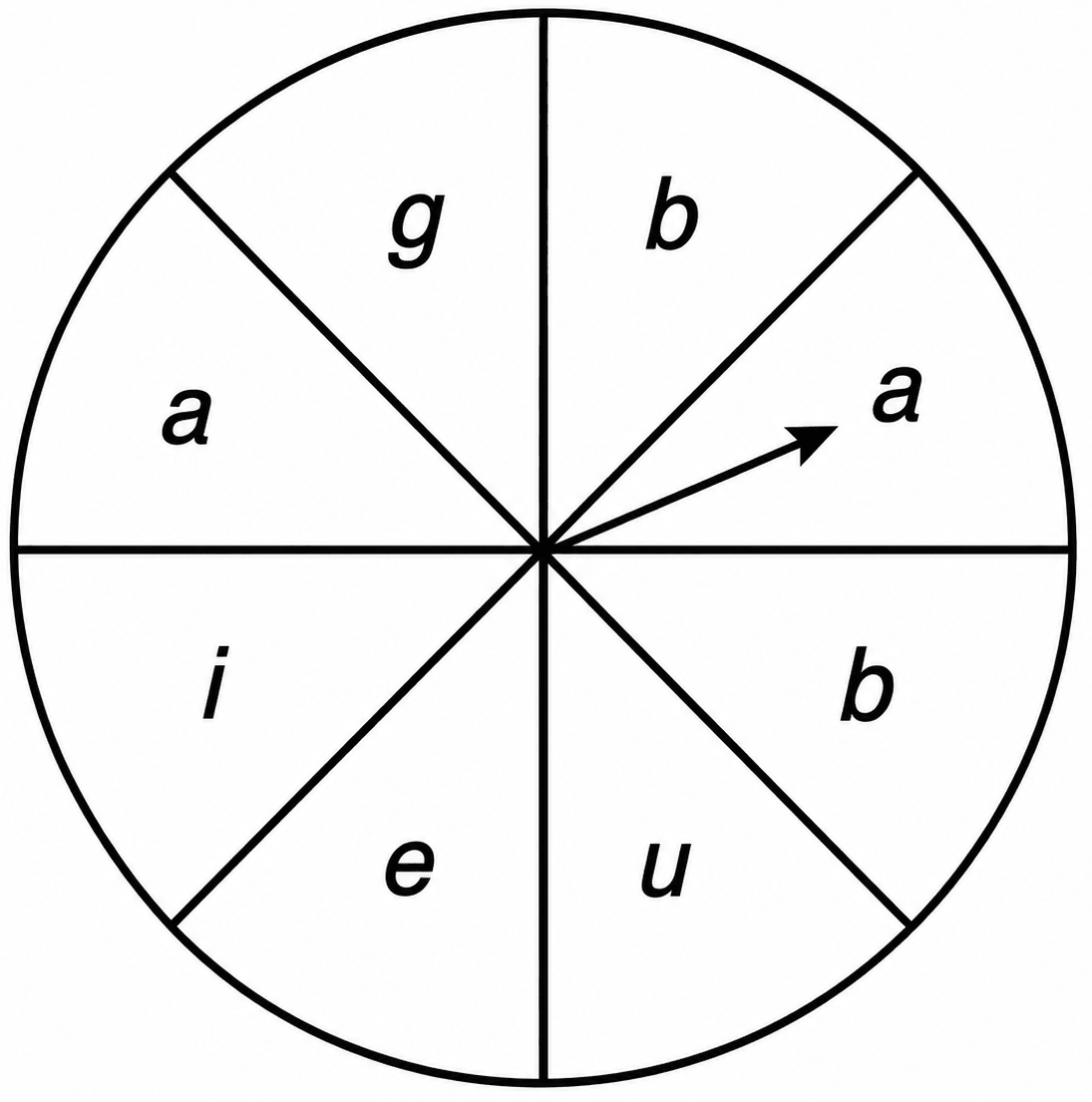
If the adjoining wheel is turned, the probability of getting a vowel is:
Answer
The wheel is divided into 8 equal sectors marked with the letters a, a, b, b, e, g, i and u.
Total number of possible outcomes = 8
For getting a vowel, the favourable outcomes are a, a, e, i and u.
Number of favourable outcomes = 5
Hence, option 4 is the correct option.
There are 35 students in a class, of whom 20 are boys and 15 are girls. From these students, one is chosen at random. What is the probability that the chosen student is a girl?
Answer
Total number of possible outcomes = Total number of students = 35
For choosing a girl, the favourable outcomes are the 15 girls.
Number of favourable outcomes = Number of girls = 15
Hence, option 2 is the correct option.
Two coins are tossed simultaneously. What is the probability of getting one head and one tail?
Answer
In tossing two coins simultaneously, the possible outcomes are HH, HT, TH and TT.
Total number of possible outcomes = 4
For getting one head and one tail, the favourable outcomes are HT and TH.
Number of favourable outcomes = 2
Hence, option 2 is the correct option.
A bag contains 4 black and 6 white balls. One ball is drawn at random. What is the probability that the ball drawn is black?
Answer
Total number of possible outcomes = Total number of balls in the bag
= 4 + 6
= 10
For getting a black ball, the favourable outcomes are the 4 black balls.
Number of favourable outcomes = Number of black balls = 4
Hence, option 3 is the correct option.
The probability that a letter chosen at random from the letters of the word PORCUPINE is a vowel is:
Answer
Total number of possible outcomes = Number of letters in the given word = 9
For getting a vowel, the favourable outcomes are O, U, I and E.
Number of favourable outcomes = Number of vowels in the given word = 4
Hence, option 2 is the correct option.
Ten cards, numbered from 1 to 10, are kept in a box and mixed thoroughly. One card is chosen at random. What is the probability of getting a number less than 7?
Answer
Total number of possible outcomes = Total number of cards = 10
For getting a number less than 7, the favourable outcomes are 1, 2, 3, 4, 5 and 6.
Number of favourable outcomes = 6
Hence, option 3 is the correct option.
One card is drawn from a well-shuffled deck of 52 cards. What is the probability that the card drawn is a 5?
Answer
Total number of possible outcomes = Total number of cards = 52
There is one card numbered 5 in each of the four suits.
For getting a 5, the favourable outcomes are the 4 cards numbered 5.
Number of favourable outcomes = 4
Hence, option 1 is the correct option.
A bag contains 6 red, 8 green, 9 blue and 4 yellow balls. One ball is drawn at random.
The probability that the ball drawn is blue, is:
(a)
(b)
(c)
(d)The probability that the ball drawn is either red or blue, is:
(a)
(b)
(c)
(d)The probability that the ball drawn is non-green, is:
(a)
(b)
(c)
(d)The probability that the ball drawn is non-red, is:
(a)
(b)
(c)
(d)
Answer
Total number of possible outcomes = Total number of balls in the bag
= 6 + 8 + 9 + 4
= 27
1. For getting a blue ball, the favourable outcomes are the 9 blue balls.
Number of favourable outcomes = Number of blue balls = 9
Hence, option (a) is the correct option.
2. For getting a red or a blue ball, the favourable outcomes are the 6 red and 9 blue balls.
Number of favourable outcomes = 6 + 9 = 15
Hence, option (c) is the correct option.
3. For getting a non-green ball, the favourable outcomes are the 6 red, 9 blue and 4 yellow balls.
Number of favourable outcomes = 27 − 8 = 19
Hence, option (c) is the correct option.
4. For getting a non-red ball, the favourable outcomes are the 8 green, 9 blue and 4 yellow balls.
Number of favourable outcomes = 27 − 6 = 21
Hence, option (a) is the correct option.
Assertion (A): The probability of getting a number 6 in a throw of a die is . Similarly, the probability of getting a number 5 is .
Reason (R): The probability of occurrence of an event varies from 0 to 1.
Both Assertion (A) and Reason (R) are true and Reason (R) is the correct explanation of Assertion (A).
Both Assertion (A) and Reason (R) are true and Reason (R) is not the correct explanation of Assertion (A).
Assertion (A) is true but Reason (R) is false.
Assertion (A) is false but Reason (R) is true.
Answer
We know that,
The probability of occurrence of an event is always greater than or equal to 0 and less than or equal to 1.
So, reason (R) is true.
In a throw of a die,
Total number of possible outcomes = 6 (i.e., 1, 2, 3, 4, 5, 6)
For getting the number 6, the favourable outcome is 6.
Number of favourable outcomes = 1
P(Getting the number 6) =
For getting the number 5, the favourable outcome is 5.
Number of favourable outcomes = 1
P(Getting the number 5) =
Since the total number of possible outcomes is 6 in both the cases, the probability of getting the number 5 is and not .
So, assertion (A) is false.
Hence, option 4 is the correct option.
Assertion (A): In a throw of a die, the probability of getting an even number is the same as that of getting an odd number.
Reason (R): Probability of occurrence of an event E is given by
P(E) =
Both Assertion (A) and Reason (R) are true and Reason (R) is the correct explanation of Assertion (A).
Both Assertion (A) and Reason (R) are true and Reason (R) is not the correct explanation of Assertion (A).
Assertion (A) is true but Reason (R) is false.
Assertion (A) is false but Reason (R) is true.
Answer
We know that,
P(E) =
So, reason (R) is true.
In a throw of a die,
Total number of possible outcomes = 6 (i.e., 1, 2, 3, 4, 5, 6)
For getting an even number, the favourable outcomes are 2, 4 and 6.
Number of favourable outcomes = 3
P(Getting an even number) = =
For getting an odd number, the favourable outcomes are 1, 3 and 5.
Number of favourable outcomes = 3
P(Getting an odd number) = =
Since both the probabilities are equal, the probability of getting an even number is the same as that of getting an odd number.
∴ Both Assertion (A) and Reason (R) are true and Reason (R) is the correct explanation of Assertion (A).
Hence, option 1 is the correct option.
An election has 6 candidates. The probability that a voter will vote for candidate number 3 is . The statement is:
True
False
Neither true nor false
None of these
Answer
The formula P(E) = can be applied only when all the possible outcomes are equally likely.
The six candidates are not necessarily equally likely to receive votes. Since their probabilities are not given, we cannot assume that the probability of voting for candidate number 3 is .
∴ The given statement is false.
Hence, option 2 is the correct option.
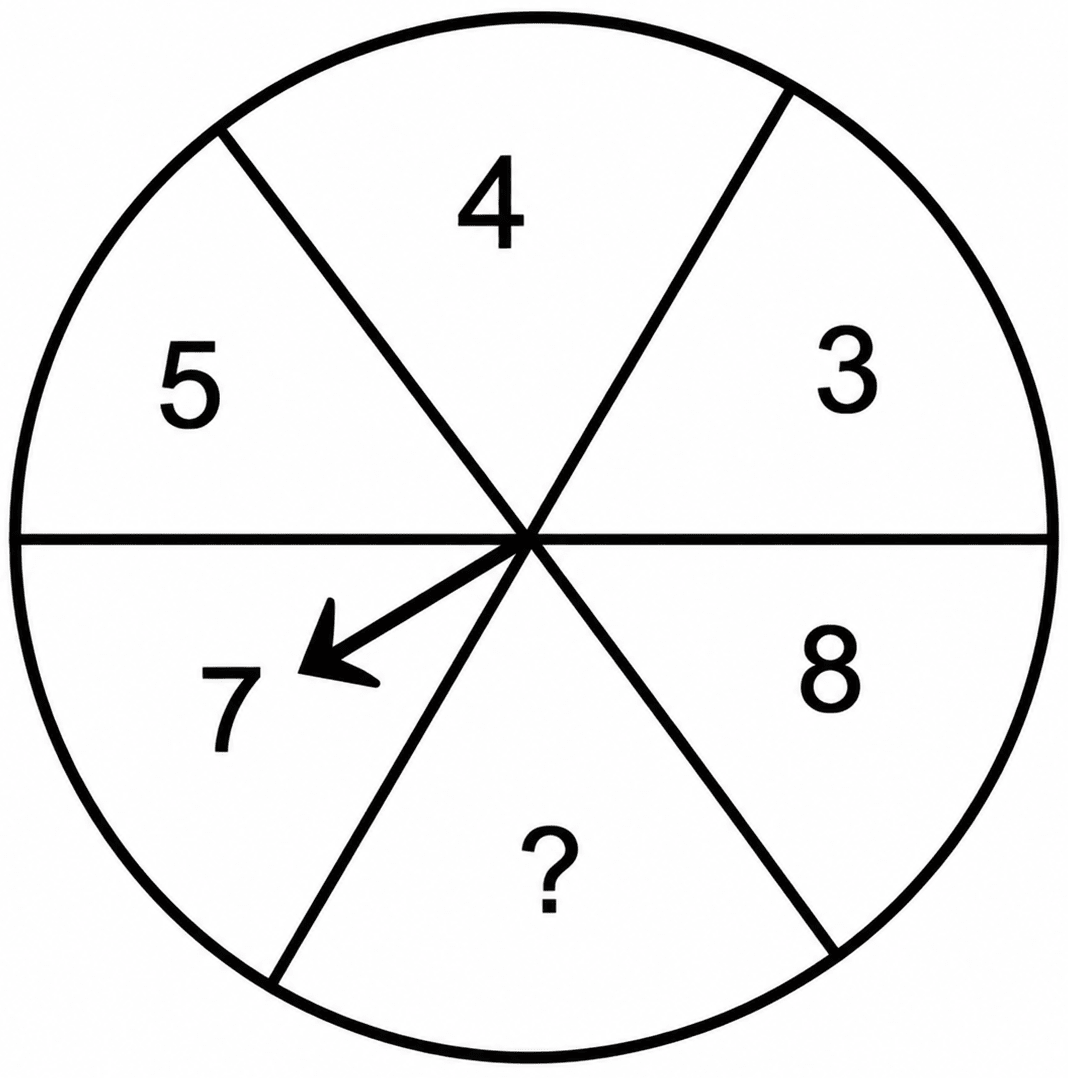
The probability of getting an odd number on spinning the wheel is and that of a prime number is . The missing number on the wheel could be:
1
4
9
2
Answer
The wheel is divided into 6 equal sectors, of which five are marked 3, 4, 5, 7 and 8 and one is missing.
Total number of possible outcomes = 6
Given, P(Getting an odd number) =
∴ Number of odd numbers on the wheel = = 3
The odd numbers among 3, 4, 5, 7 and 8 are 3, 5 and 7, which are already 3 in number.
So, the missing number must be an even number.
Given, P(Getting a prime number) =
∴ Number of prime numbers on the wheel = = 4
The prime numbers among 3, 4, 5, 7 and 8 are 3, 5 and 7, which are 3 in number.
So, the missing number must also be a prime number.
The only number which is both even and prime is 2.
∴ The missing number on the wheel could be 2.
Hence, option 4 is the correct option.
Which of the following cannot be the probability of an event?
5%
0.5
Answer
We know that,
The probability of an event always lies between 0 and 1, both inclusive.
5% = = 0.05, which lies between 0 and 1.
0.5 lies between 0 and 1.
= 2, which is greater than 1.
= 0.2, which lies between 0 and 1.
Since 2 is greater than 1, it cannot be the probability of an event.
Hence, option 3 is the correct option.
A bag contains some green and some red balls. The probability of drawing a red ball from the bag is 0.4. The bag may contain:
4 red balls and 6 green balls
6 red balls and 9 green balls
both (1) and (2)
none of these
Answer
Checking option 1 :
Total number of balls = 4 + 6 = 10
P(Getting a red ball) = = 0.4
So, the bag may contain 4 red balls and 6 green balls.
Checking option 2 :
Total number of balls = 6 + 9 = 15
P(Getting a red ball) = = 0.4
So, the bag may contain 6 red balls and 9 green balls.
Since both the options give the probability 0.4, the bag may contain either of them.
Hence, option 3 is the correct option.
Look at the following experiment "Taking 1 crayon from a box containing 1 red, 1 yellow, 1 blue, 1 brown, 1 black and 1 green crayon."
How many possible outcomes are there for the above experiment?
1
6
0
Answer
The box contains 6 crayons of different colours, namely red, yellow, blue, brown, black and green.
On taking 1 crayon from the box, the crayon drawn may be of any one of these 6 colours.
∴ Total number of possible outcomes = 6
Hence, option 2 is the correct option.
If you bought 10 lottery tickets and a total of 400 were sold, what is the probability, that you win the first prize?
none of these
Answer
Total number of possible outcomes = Total number of tickets sold = 400
For winning the first prize, the favourable outcomes are the 10 tickets bought.
Number of favourable outcomes = Number of tickets bought = 10
Hence, option 3 is the correct option.
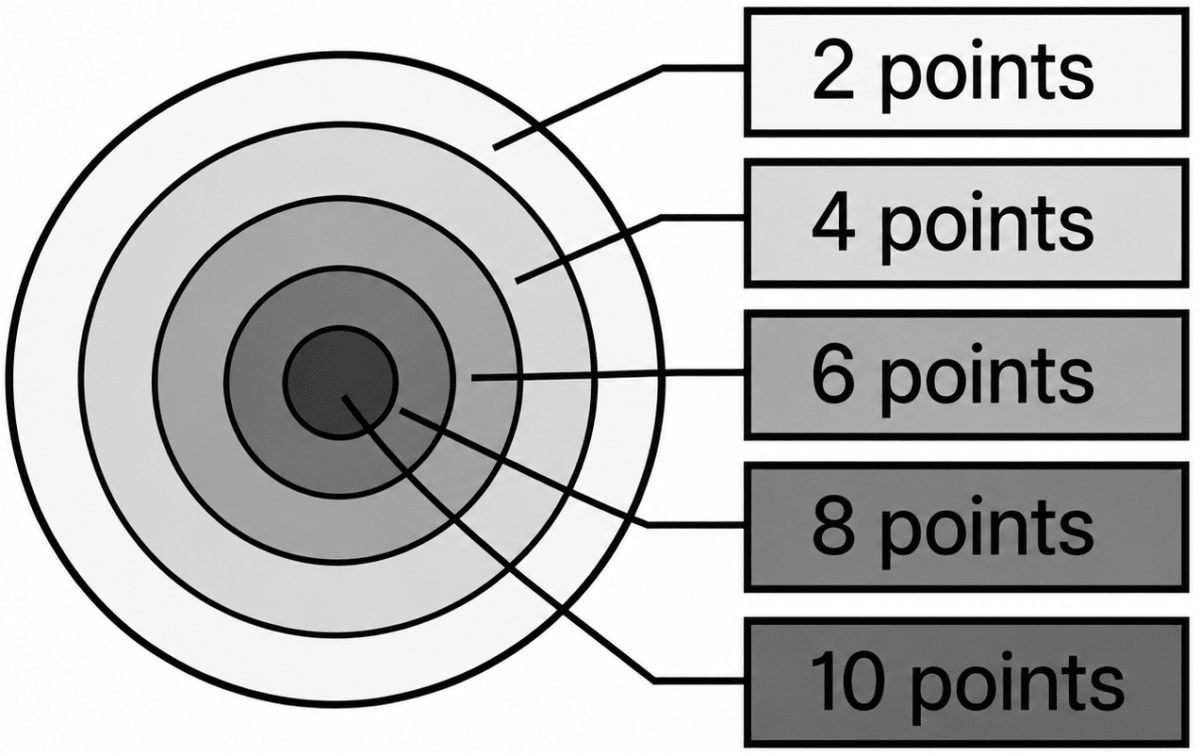
In an archery game, the points awarded for hitting a circular region on the board is shown in the figure below.
No point is given when an arrow misses the board.
What is the probability of getting 6 points in a single shot?
Answer
From the given figure, the circular regions on the board award 2 points, 4 points, 6 points, 8 points and 10 points.
Also, no point is given when an arrow misses the board.
So, in a single shot the possible outcomes are 2 points, 4 points, 6 points, 8 points, 10 points and 0 point (missing the board).
Total number of possible outcomes = 6
For getting 6 points, the favourable outcome is 6 points.
Number of favourable outcomes = 1
Hence, option 2 is the correct option.