
Find the area of the parallelogram whose base = 65 cm and height = 7.8 cm.
Answer
Given:
Base of the parallelogram = 65 cm
Height of the parallelogram = 7.8 cm
By formula,
Area of a parallelogram = base x height
= 65 x 7.8 cm2
= 507 cm2
Hence, the area of the parallelogram is 507 cm2.
Find the area of the parallelogram whose base = 6.4 m and height = 75 cm.
Answer
Given:
Base of the parallelogram = 6.4 m
Height of the parallelogram = 75 cm = m = 0.75 m
By formula,
Area of a parallelogram = base x height
= 6.4 x 0.75 m2
= 4.8 m2
Hence, the area of the parallelogram is 4.8 m2.
The height of a parallelogram is one-third of its base. If the area of the parallelogram is 192 cm2, find the height and the base.
Answer
Given:
Height of the parallelogram = x base
Area of the parallelogram = 192 cm2
Let the base of the parallelogram be b cm.
Then, height of the parallelogram = cm
By formula,
Area of a parallelogram = base x height
⇒ b x = 192
⇒ = 192
⇒ b2 = 192 x 3
⇒ b2 = 576
⇒ b =
⇒ b = 24 cm
So, height of the parallelogram = cm
= 8 cm
Hence, the height and the base of the parallelogram are 8 cm and 24 cm respectively.
PQRS is a parallelogram with PQ = 26 cm and QR = 20 cm. If the distance between its longer sides is 12.5 cm, find
(i) the area of the parallelogram;
(ii) the distance between its shorter sides
Answer
Given:
PQ = 26 cm and QR = 20 cm
Distance between the longer sides = 12.5 cm
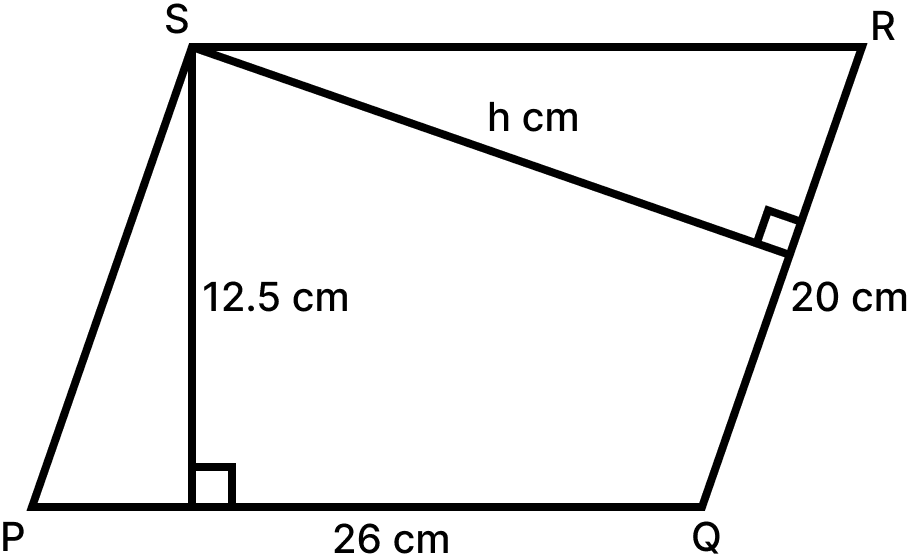
Since PQ = 26 cm > QR = 20 cm, so PQ and SR are the longer sides and QR and PS are the shorter sides.
(i) By formula,
Area of a parallelogram = base x height
Taking PQ as the base,
Area of parallelogram PQRS = 26 x 12.5 cm2
= 325 cm2
Hence, the area of the parallelogram is 325 cm2.
(ii) Let the distance between the shorter sides be h cm.
Taking QR as the base,
Area of parallelogram PQRS = QR x h
⇒ 20 x h = 325
⇒ h =
⇒ h = 16.25 cm
Hence, the distance between the shorter sides is 16.25 cm.
ABCD is a parallelogram having adjacent sides AB = 16 cm and BC = 14 cm. If its area is 168 cm2, find the distance between its longer sides and that between its shorter sides.
Answer
Given:
AB = 16 cm and BC = 14 cm
Area of parallelogram ABCD = 168 cm2
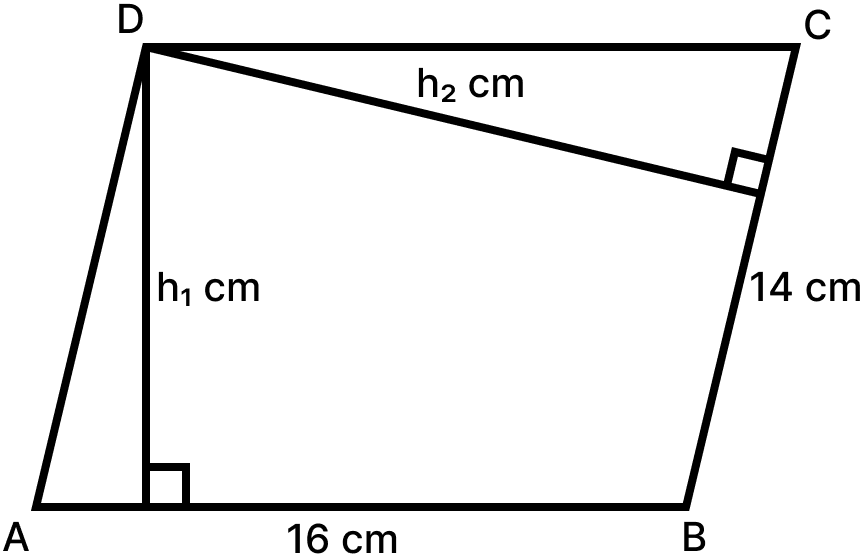
Since AB = 16 cm > BC = 14 cm, so AB and DC are the longer sides and BC and AD are the shorter sides.
By formula,
Area of a parallelogram = base x height
Let the distance between the longer sides be h1 cm.
∴ AB x h1 = 168
⇒ 16 x h1 = 168
⇒ h1 =
⇒ h1 = 10.5 cm
Let the distance between the shorter sides be h2 cm.
∴ BC x h2 = 168
⇒ 14 x h2 = 168
⇒ h2 =
⇒ h2 = 12 cm
Hence, the distance between the longer sides is 10.5 cm and that between the shorter sides is 12 cm.
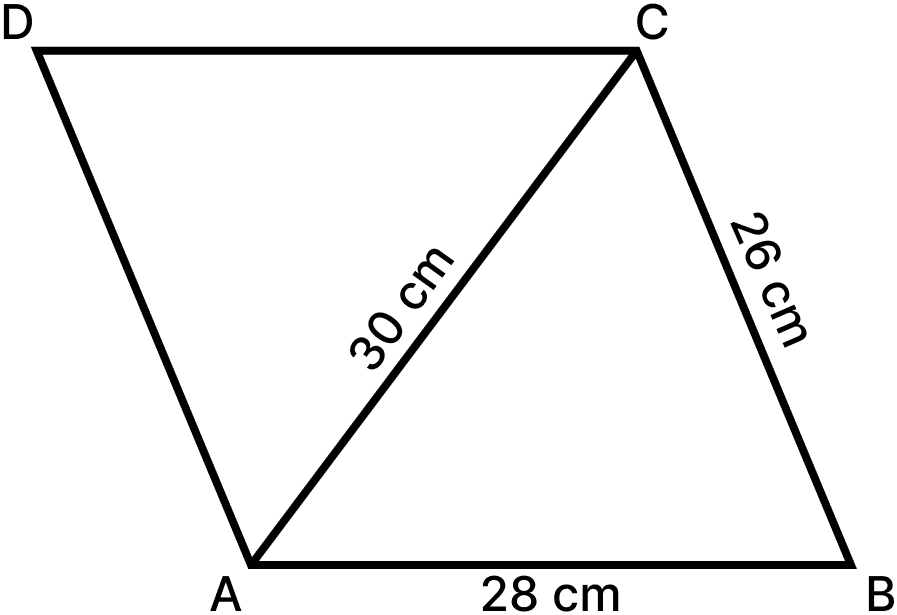
In the adjoining figure, ABCD is a parallelogram in which AB = 28 cm, BC = 26 cm and diagonal AC = 30 cm. Find
(i) the area of parallelogram ABCD;
(ii) the distance between AB and DC;
(iii) the distance between CB and DA.
Answer
Given:
AB = 28 cm, BC = 26 cm and diagonal AC = 30 cm
(i) We know that a diagonal of a parallelogram divides it into two triangles equal in area.
∴ Area of parallelogram ABCD = 2 x (area of ΔABC)
For ΔABC, let a = BC = 26 cm, b = AC = 30 cm and c = AB = 28 cm.
∵ Area of ΔABC =
∴ Area of parallelogram ABCD = 2 x 336 cm2
= 672 cm2
Hence, the area of parallelogram ABCD is 672 cm2.
(ii) Let the distance between AB and DC be h1 cm.
By formula,
Area of a parallelogram = base x height
Taking AB as the base,
AB x h1 = 672
⇒ 28 x h1 = 672
⇒ h1 =
⇒ h1 = 24 cm
Hence, the distance between AB and DC is 24 cm.
(iii) Let the distance between CB and DA be h2 cm.
By formula,
Area of a parallelogram = base x height
Taking CB as the base,
CB x h2 = 672
⇒ 26 x h2 = 672
⇒ h2 =
⇒ h2 = cm
⇒ h2 = 25.84 cm (approx.)
Hence, the distance between CB and DA is cm = 25.84 cm (approx.).
Find the area of a rhombus whose perimeter is 48 cm and altitude is 8.5 cm.
Answer
Given:
Perimeter of the rhombus = 48 cm
Altitude of the rhombus = 8.5 cm
By formula,
Perimeter of a rhombus = 4 x side
⇒ 4 x side = 48
⇒ side =
⇒ side = 12 cm
Since a rhombus is a parallelogram,
Area of the rhombus = base x altitude
= 12 x 8.5 cm2
= 102 cm2
Hence, the area of the rhombus is 102 cm2.
The area of a rhombus is 139.2 cm2 and its altitude is 9.6 cm. Find the perimeter of the rhombus.
Answer
Given:
Area of the rhombus = 139.2 cm2
Altitude of the rhombus = 9.6 cm
By formula,
Area of a rhombus = base x altitude
⇒ base x 9.6 = 139.2
⇒ base =
⇒ base = 14.5 cm
So, side of the rhombus = 14.5 cm
∴ Perimeter of the rhombus = 4 x side
= 4 x 14.5 cm
= 58 cm
Hence, the perimeter of the rhombus is 58 cm.
The area of a rhombus is 184 cm2 and its perimeter is 64 cm. Find its altitude.
Answer
Given:
Area of the rhombus = 184 cm2
Perimeter of the rhombus = 64 cm
By formula,
Perimeter of a rhombus = 4 x side
⇒ 4 x side = 64
⇒ side =
⇒ side = 16 cm
Now, area of the rhombus = base x altitude
⇒ 16 x altitude = 184
⇒ altitude =
⇒ altitude = 11.5 cm
Hence, the altitude of the rhombus is 11.5 cm.
Find the area of rhombus whose diagonals are:
(i) 16 cm, 24 cm
(ii) 14.8 cm, 12.5 cm
Answer
(i) Given:
Diagonals of the rhombus = 16 cm and 24 cm
By formula,
Area of a rhombus = x (product of diagonals)
= x 16 x 24 cm2
= x 384 cm2
= 192 cm2
Hence, the area of the rhombus is 192 cm2.
(ii) Given:
Diagonals of the rhombus = 14.8 cm and 12.5 cm
By formula,
Area of a rhombus = x (product of diagonals)
= x 14.8 x 12.5 cm2
= x 185 cm2
= 92.5 cm2
Hence, the area of the rhombus is 92.5 cm2.
The area of a rhombus is 138 cm2. If one of the diagonals is 11.5 cm long, find the length of the other diagonal.
Answer
Given:
Area of the rhombus = 138 cm2
One diagonal of the rhombus = 11.5 cm
Let the other diagonal of the rhombus be d cm.
By formula,
Area of a rhombus = x (product of diagonals)
⇒ x 11.5 x d = 138
⇒ 11.5 x d = 138 x 2
⇒ 11.5 x d = 276
⇒ d =
⇒ d = 24 cm
Hence, the length of the other diagonal is 24 cm.
Find the area of a rhombus, each side of which measures 20 cm and one of whose diagonals is 24 cm.
Answer
Given:
Each side of the rhombus = 20 cm
One diagonal of the rhombus = 24 cm
Let ABCD be the given rhombus in which AB = 20 cm and diagonal AC = 24 cm.
Let the diagonals AC and BD intersect at O.
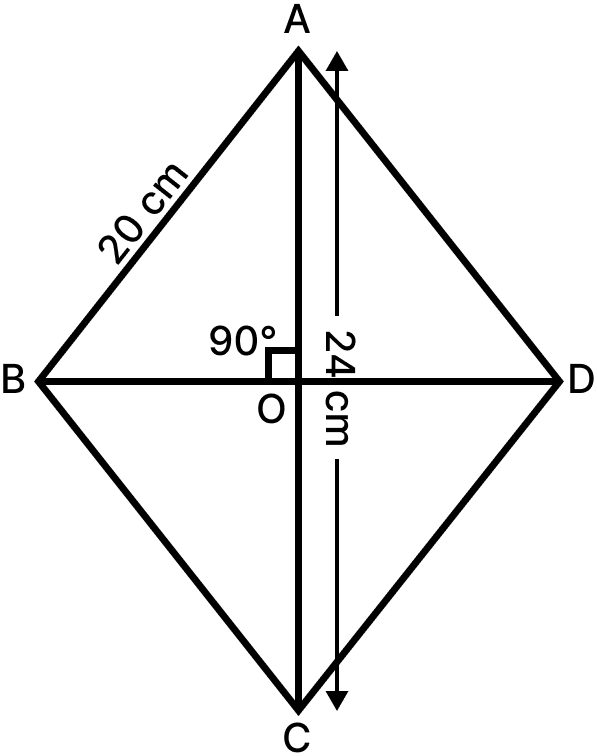
We know that the diagonals of a rhombus bisect each other at right angles.
∴ AO = x AC
= x 24 cm
= 12 cm
and ∠AOB = 90°
Using Pythagoras theorem in right triangle AOB,
AB2 = AO2 + OB2
⇒ OB2 = AB2 - AO2
⇒ OB2 = (20)2 - (12)2
⇒ OB2 = 400 - 144
⇒ OB2 = 256
⇒ OB =
⇒ OB = 16 cm
So, BD = 2 x OB
= 2 x 16 cm
= 32 cm
Now, area of rhombus ABCD = x AC x BD
= x 24 x 32 cm2
= x 768 cm2
= 384 cm2
Hence, the area of the rhombus is 384 cm2.
Find the area of a trapezium whose parallel sides are 23.7 cm and 16.3 cm and the distance between them is 11.4 cm.
Answer
Given:
Parallel sides of the trapezium = 23.7 cm and 16.3 cm
Distance between the parallel sides = 11.4 cm
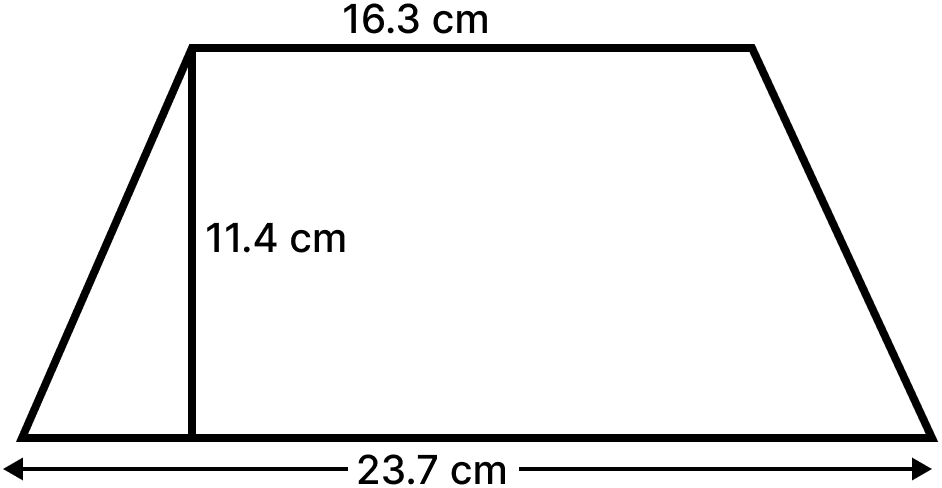
By formula,
Area of a trapezium = x (sum of parallel sides) x (distance between them)
Hence, the area of the trapezium is 228 cm2.
Find the area of a trapezium whose parallel sides are 2.5 m and 1.3 m and the distance between them is 80 cm.
Answer
Given:
Parallel sides of the trapezium = 2.5 m and 1.3 m
Distance between the parallel sides = 80 cm = m = 0.8 m
By formula,
Area of a trapezium = x (sum of parallel sides) x (distance between them)
Hence, the area of the trapezium is 1.52 m2.
The lengths of parallel sides of a trapezium are in the ratio 7 : 5 and the distance between them is 14 cm. If the area of the trapezium is 252 cm2, find the lengths of its parallel sides.
Answer
Given:
Lengths of the parallel sides of the trapezium are in the ratio 7 : 5.
Distance between the parallel sides = 14 cm
Area of the trapezium = 252 cm2
Let the lengths of the parallel sides be 7x centimetres and 5x centimetres.
By formula,
Area of a trapezium = x (sum of parallel sides) x (distance between them)
⇒ x (7x + 5x) x 14 = 252
⇒ x 12x x 14 = 252
⇒ 84x = 252
⇒ x =
⇒ x = 3
So, one parallel side = 7x
= 7 x 3 cm
= 21 cm
And, the other parallel side = 5x
= 5 x 3 cm
= 15 cm
Hence, the lengths of the parallel sides are 21 cm and 15 cm.
The height of a trapezium of area 162 cm2 is 6 cm. If one of the bases is 23 cm, find the other.
Answer
Given:
Area of the trapezium = 162 cm2
Height of the trapezium = 6 cm
One of the bases = 23 cm
Let the other base of the trapezium be b cm.
By formula,
Area of a trapezium = x (sum of parallel sides) x (distance between them)
⇒ x (23 + b) x 6 = 162
⇒ 3 x (23 + b) = 162
⇒ 23 + b =
⇒ 23 + b = 54
⇒ b = 54 - 23
⇒ b = 31 cm
Hence, the other base of the trapezium is 31 cm.
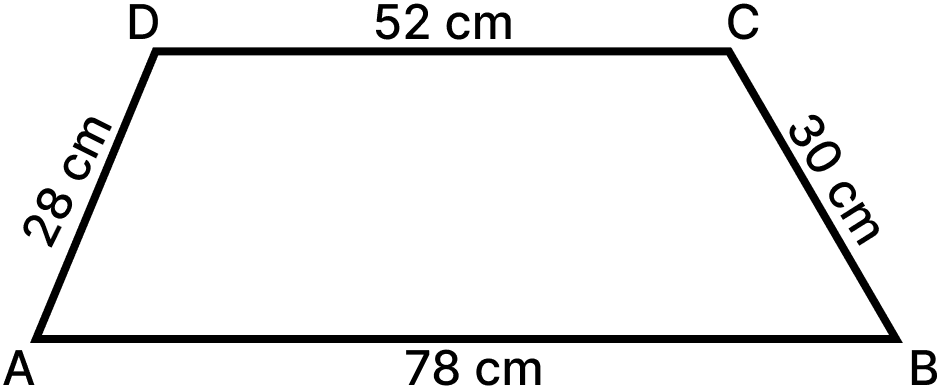
In the adjoining figure, ABCD is a trapezium in which parallel sides are AB = 78 cm, DC = 52 cm and the non-parallel sides are BC = 30 cm and AD = 28 cm. Find the area of the trapezium.
Answer
Given:
AB = 78 cm, DC = 52 cm, BC = 30 cm and AD = 28 cm
Draw CE ∥ DA and CF ⊥ AB.
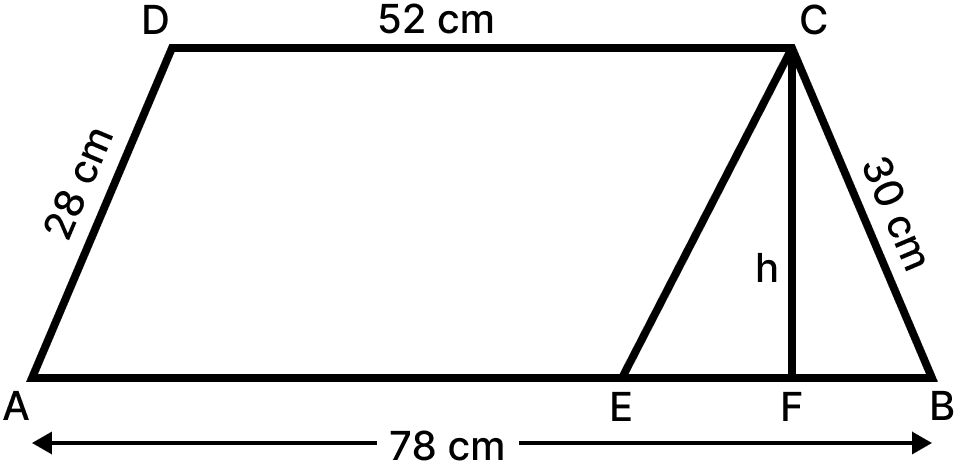
Let CF = h cm. Then,
AE = DC = 52 cm, CE = DA = 28 cm
and EB = (AB - AE) = (78 - 52) cm = 26 cm
First we find the area of ΔCEB.
Let a = CE = 28 cm, b = EB = 26 cm and c = BC = 30 cm.
∵ Area of ΔCEB =
Also, area of ΔCEB = x EB x CF
= x 26 x h cm2
= 13h cm2
∴ 13h = 336
⇒ h = cm
Thus, the distance between the parallel sides = cm
Now, area of trapezium ABCD = x (sum of parallel sides) x (distance between them)
Hence, the area of the trapezium is 1680 cm2.
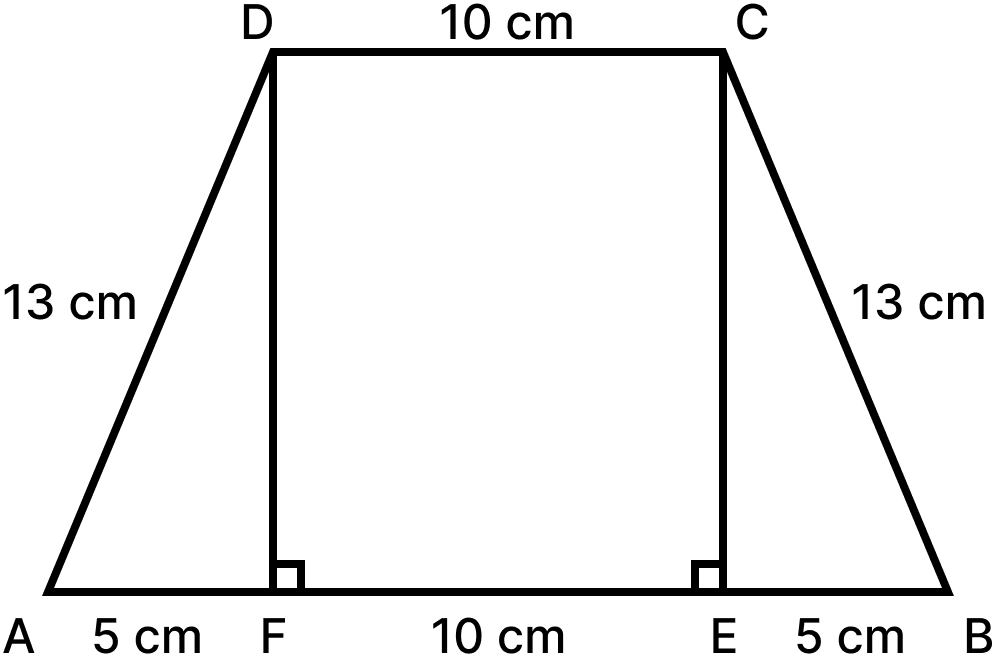
The parallel sides of a trapezium are 20 cm and 10 cm. Its non-parallel sides are both equal, each being 13 cm. Find the area of the trapezium.
Answer
Given:
Parallel sides of the trapezium = 20 cm and 10 cm
Each non-parallel side = 13 cm
Let ABCD be the given trapezium in which AB = 20 cm, DC = 10 cm and AD = BC = 13 cm.
Then, FE = DC = 10 cm
Since the non-parallel sides are equal, AF = BE.
∴ AF = BE =
= cm
= cm
= 5 cm
Using Pythagoras theorem in right triangle ADF,
AD2 = AF2 + DF2
⇒ DF2 = AD2 - AF2
⇒ DF2 = (13)2 - (5)2
⇒ DF2 = 169 - 25
⇒ DF2 = 144
⇒ DF =
⇒ DF = 12 cm
Now, area of trapezium ABCD = x (sum of parallel sides) x (distance between them)
= x (20 + 10) x 12 cm2
= x 30 x 12 cm2
= 180 cm2
Hence, the area of the trapezium is 180 cm2.
The area of a trapezium is 198 cm2 and its height is 9 cm. If one of the parallel sides is longer than the other by 8 cm, find the two parallel sides.
Answer
Given:
Area of the trapezium = 198 cm2
Height of the trapezium = 9 cm
One of the parallel sides is longer than the other by 8 cm.
Let the shorter parallel side be x cm.
Then, the longer parallel side = (x + 8) cm
By formula,
Area of a trapezium = x (sum of parallel sides) x (distance between them)
⇒ x (x + x + 8) x 9 = 198
⇒ (2x + 8) x 9 = 198 x 2
⇒ 2x + 8 =
⇒ 2x + 8 = 44
⇒ 2x = 44 - 8
⇒ 2x = 36
⇒ x = 18
So, the shorter parallel side = 18 cm
And, the longer parallel side = (18 + 8) cm = 26 cm
Hence, the two parallel sides of the trapezium are 18 cm and 26 cm.
In the adjoining figure, ABCD is a rectangle in which AB = 18 cm, BC = 8 cm and DE = 10 cm. Find the area of the shaded region EBCD.
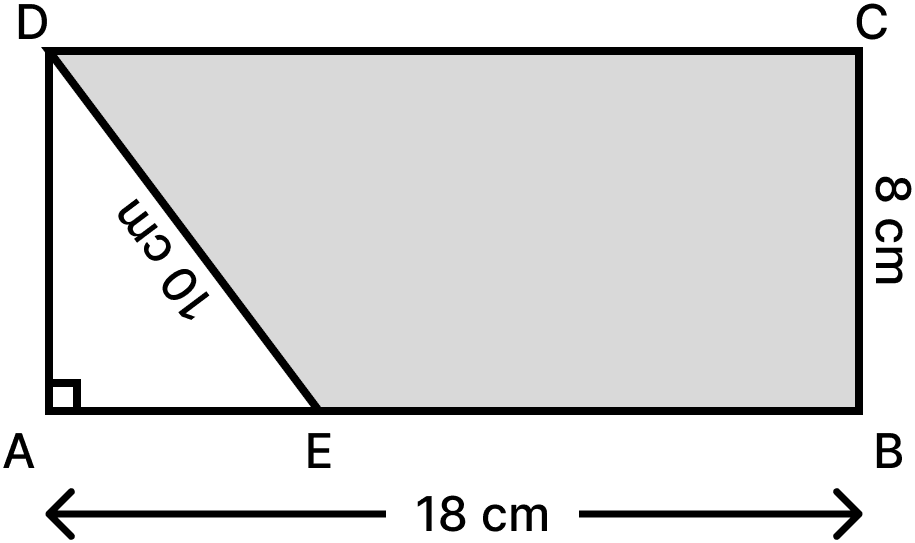
Answer
Given:
ABCD is a rectangle in which AB = 18 cm, BC = 8 cm and DE = 10 cm.
Since ABCD is a rectangle, AD = BC = 8 cm and DC = AB = 18 cm.
Using Pythagoras theorem in right triangle ADE,
DE2 = AD2 + AE2
⇒ AE2 = DE2 - AD2
⇒ AE2 = (10)2 - (8)2
⇒ AE2 = 100 - 64
⇒ AE2 = 36
⇒ AE =
⇒ AE = 6 cm
∴ EB = (AB - AE)
= (18 - 6) cm
= 12 cm
The shaded region EBCD is a trapezium in which DC ∥ EB and BC is the distance between them.
∴ Area of the shaded region EBCD = x (DC + EB) x BC
= x (18 + 12) x 8 cm2
= x 30 x 8 cm2
= 120 cm2
Hence, the area of the shaded region EBCD is 120 cm2.
Find the area of the figure ABCDEFGH, given alongside, it being given that AC = 17 m, BC = 8 m, EF = 9 m, GD = 6 m, GL ⊥ EF and GL = 3.6 m.
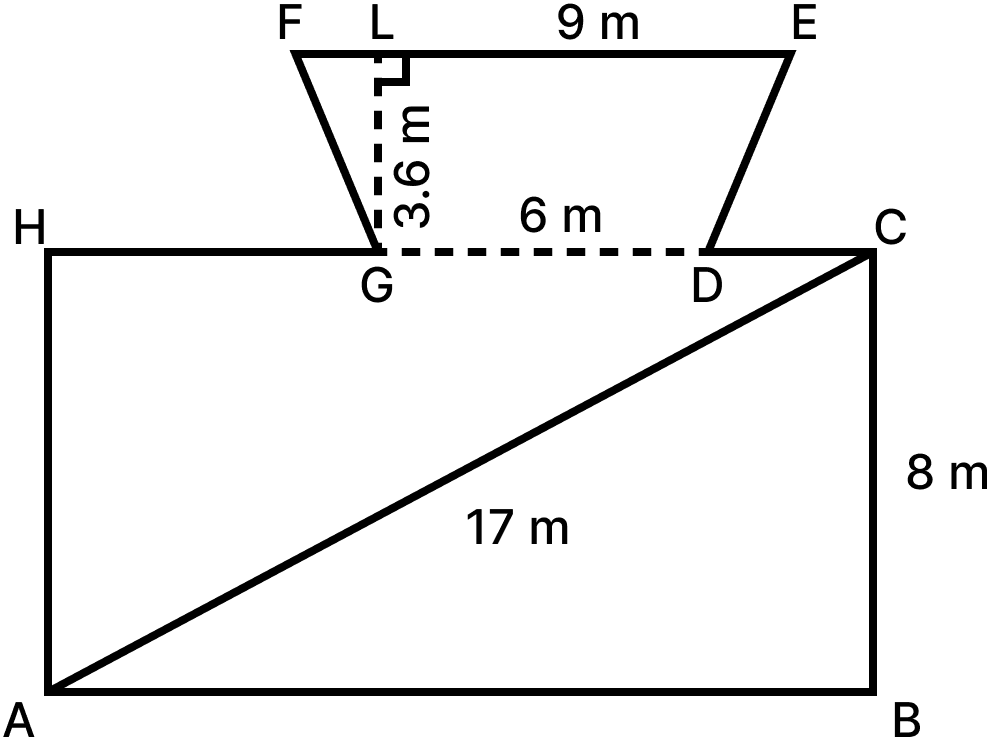
Answer
Given:
AC = 17 m, BC = 8 m, EF = 9 m, GD = 6 m, GL ⊥ EF and GL = 3.6 m
ABCH is a rectangle, so ∠ABC = 90°.
Using Pythagoras theorem in right triangle ABC,
AC2 = AB2 + BC2
⇒ AB2 = AC2 - BC2
⇒ AB2 = (17)2 - (8)2
⇒ AB2 = 289 - 64
⇒ AB2 = 225
⇒ AB =
⇒ AB = 15 m
Area of rectangle ABCH = AB x BC
= 15 x 8 m2
= 120 m2
EFGD is a trapezium in which EF ∥ GD and GL is the distance between them.
Area of trapezium EFGD = x (EF + GD) x GL
= x (9 + 6) x 3.6 m2
= x 15 x 3.6 m2
= 27 m2
∴ Area of the figure ABCDEFGH = Area of rectangle ABCH + Area of trapezium EFGD
= (120 + 27) m2
= 147 m2
Hence, the area of the figure ABCDEFGH is 147 m2.
Find the area of the shaded region in the figure given alongside.
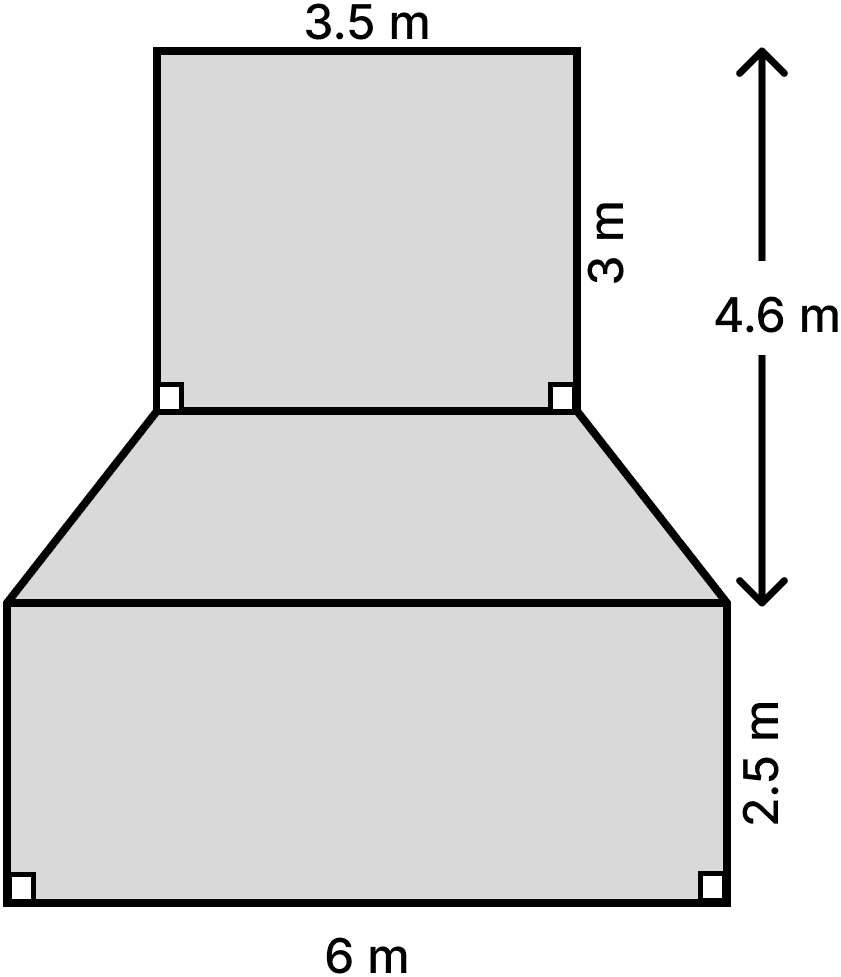
Answer
The given figure can be divided into three parts — a rectangle at the top, a trapezium in the middle and a rectangle at the bottom.
Upper rectangle:
Length = 3.5 m and breadth = 3 m
Area of the upper rectangle = length x breadth
= 3.5 x 3 m2
= 10.5 m2
Middle trapezium:
Parallel sides = 3.5 m and 6 m
Distance between the parallel sides = (4.6 - 3) m = 1.6 m
Area of the trapezium = x (sum of parallel sides) x (distance between them)
= x (3.5 + 6) x 1.6 m2
= x 9.5 x 1.6 m2
= x 15.2 m2
= 7.6 m2
Lower rectangle:
Length = 6 m and breadth = 2.5 m
Area of the lower rectangle = length x breadth
= 6 x 2.5 m2
= 15 m2
∴ Area of the shaded region = (10.5 + 7.6 + 15) m2
= 33.1 m2
Hence, the area of the shaded region is 33.1 m2.
Find the area of the shaded region given below:
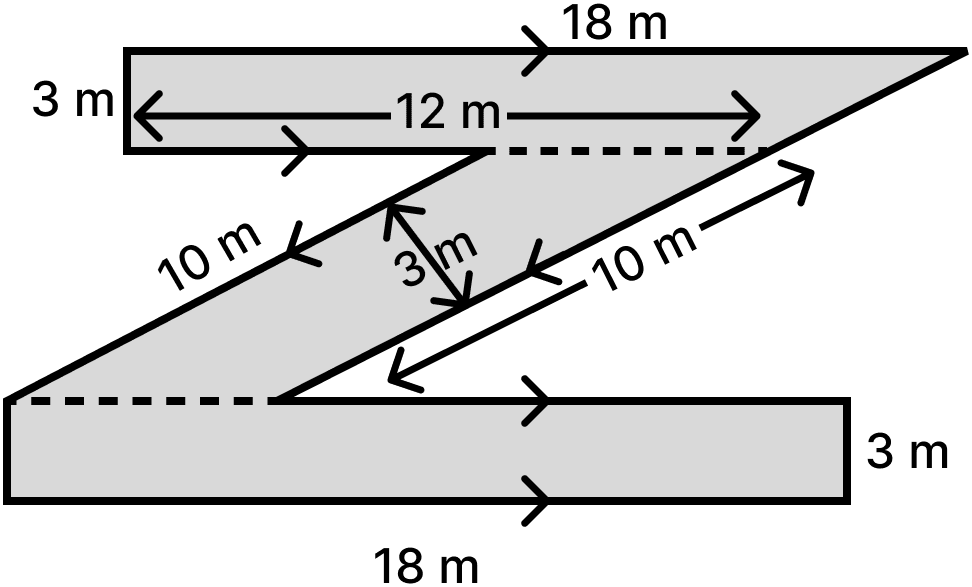
Answer
The given figure can be divided into three parts — a trapezium at the top, a parallelogram in the middle and a rectangle at the bottom.
Upper trapezium:
Parallel sides = 18 m and 12 m
Distance between the parallel sides = 3 m
Area of the upper trapezium = x (sum of parallel sides) x (distance between them)
= x (18 + 12) x 3 m2
= x 30 x 3 m2
= 45 m2
Middle parallelogram:
Base = 10 m and height = 3 m
Area of the middle parallelogram = base x height
= 10 x 3 m2
= 30 m2
Lower rectangle:
Length = 18 m and breadth = 3 m
Area of the lower rectangle = length x breadth
= 18 x 3 m2
= 54 m2
∴ Area of the shaded region = (45 + 30 + 54) m2
= 129 m2
Hence, the area of the shaded region is 129 m2.