
The diagonals of each of the following intersect at right angles except
kite
rectangle
rhombus
square
Answer
The diagonals of a kite intersect each other at right angles.
The diagonals of a rhombus bisect each other at right angles.
The diagonals of a square are equal and bisect each other at right angles.
The diagonals of a rectangle are equal and bisect each other, but they need not intersect at right angles.
Hence, option 2 is the correct option.
Diagonals of each of the following bisect each other except
rectangle
square
rhombus
kite
Answer
A rectangle, a square and a rhombus are all parallelograms and the diagonals of a parallelogram bisect each other.
In a kite, only one of the diagonals is bisected by the other, so its diagonals need not bisect each other.
Hence, option 4 is the correct option.
Diagonals are equal in each of the following except
isosceles trapezium
rectangle
square
rhombus
Answer
The diagonals of an isosceles trapezium are equal in length.
The diagonals of a rectangle are equal and the diagonals of a square are also equal.
The diagonals of a rhombus bisect each other at right angles, but they need not be equal.
Hence, option 4 is the correct option.
If the adjacent angles of a parallelogram are equal, then the parallelogram is a
rectangle
square
rhombus
trapezium
Answer
Let ABCD be a parallelogram in which the adjacent angles ∠A and ∠B are equal.
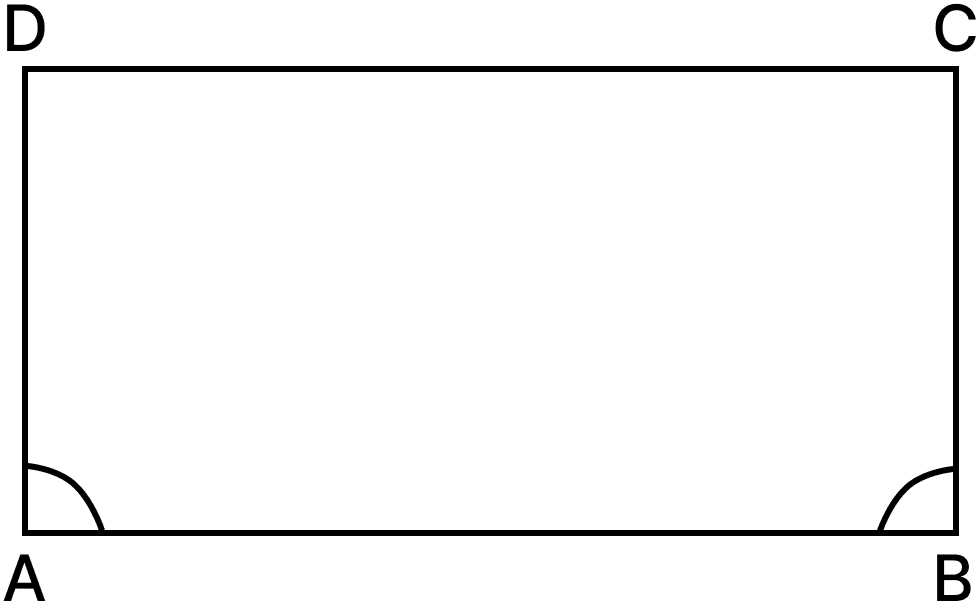
As AD ∥ BC and AB cuts them, we have :
⇒ ∠A + ∠B = 180° [Co-interior angles]
⇒ ∠A + ∠A = 180° [∵ ∠A = ∠B]
⇒ 2∠A = 180°
⇒ ∠A = = 90°
∴ ∠B = ∠A = 90°, ∠C = ∠A = 90° and ∠D = ∠B = 90°
Thus, the parallelogram has each of its angles equal to 90°, so it is a rectangle.
Hence, option 1 is the correct option.
If the adjacent sides of a parallelogram are equal, then the parallelogram is a
rectangle
square
rhombus
kite
Answer
Let ABCD be a parallelogram in which the adjacent sides AB and BC are equal.
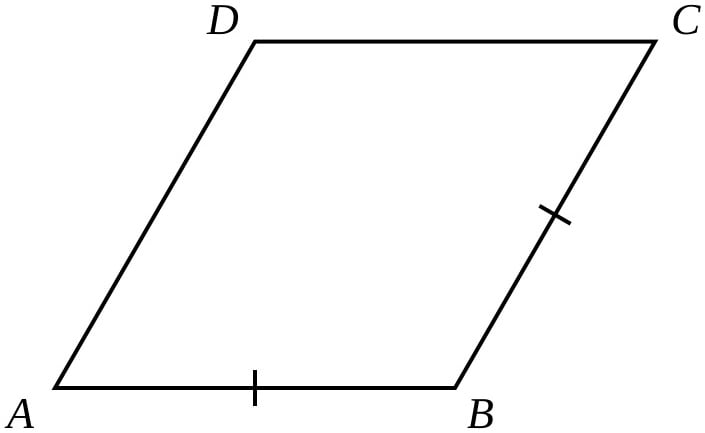
Since the opposite sides of a parallelogram are equal, we have :
⇒ CD = AB and AD = BC
⇒ AB = BC = CD = AD [∵ AB = BC]
Thus, the parallelogram has all its sides equal, so it is a rhombus.
Hence, option 3 is the correct option.
Consider the following statements :
(i) The diagonals of a parallelogram are equal.
(ii) The diagonals of a square are perpendicular to each other.
(iii) If the diagonals of a quadrilateral intersect at right angles, it is not necessarily a rhombus.
(iv) Every quadrilateral is either a trapezium or a parallelogram or a kite.
Which of the above statements is / are correct?
only (ii)
only (iii)
both (ii) and (iii)
(ii), (iii) and (iv)
Answer
(i) The diagonals of a parallelogram bisect each other, but they need not be equal. So, the statement is false.
(ii) The diagonals of a square are equal and bisect each other at right angles, so they are perpendicular to each other. So, the statement is true.
(iii) The diagonals of a kite also intersect at right angles, but a kite need not be a rhombus. So, the statement is true.
(iv) A quadrilateral may have no pair of parallel sides and no pair of equal adjacent sides, so it need not be a trapezium or a parallelogram or a kite. So, the statement is false.
Thus, only the statements (ii) and (iii) are correct.
Hence, option 3 is the correct option.
The angles of a quadrilateral are in the ratio 2 : 3 : 4 : 9. The smallest angle is
20°
30°
36°
40°
Answer
Let the measures of the angles of the quadrilateral be and respectively.
We know that the sum of the angles of a quadrilateral is 360°. Then,
∴ Smallest angle = = (2 × 20)° = 40°
Hence, option 4 is the correct option.
The angles A, B, C and D of a quadrilateral ABCD are in the ratio 1 : 3 : 7 : 9. Then ABCD is a
parallelogram
kite
trapezium with AB ∥ CD
trapezium with BC ∥ AD
Answer
Let the measures of the angles ∠A, ∠B, ∠C and ∠D be and respectively.
We know that the sum of the angles of a quadrilateral is 360°. Then,
∴ ∠A = 18°, ∠B = (3 × 18)° = 54°, ∠C = (7 × 18)° = 126° and ∠D = (9 × 18)° = 162°
Now, ∠A + ∠D = (18° + 162°) = 180°
As ∠A and ∠D are co-interior angles formed by the transversal AD, we get AB ∥ DC.
Also, ∠A + ∠B = (18° + 54°) = 72° ≠ 180°, so BC is not parallel to AD.
Thus, ABCD has exactly one pair of parallel sides, so it is a trapezium with AB ∥ CD.
Hence, option 3 is the correct option.
If two adjacent angles of a parallelogram are and , then the ratio of these angles is
3 : 2
5 : 1
5 : 4
7 : 2
Answer
The adjacent angles of a parallelogram are supplementary.
∴ First angle = (5 × 30 − 10)° = (150 − 10)° = 140° and second angle = (30 + 10)° = 40°
∴ Ratio of these angles = 140 : 40 = 7 : 2
Hence, option 4 is the correct option.
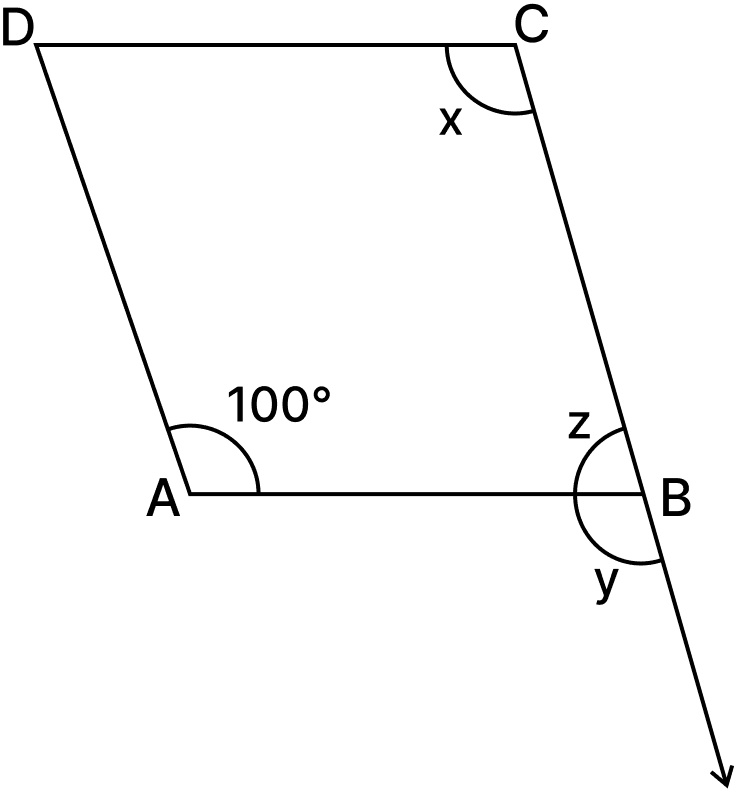
In the given figure, ABCD is a parallelogram. Then the values of x, y and z respectively are
100°, 80°, 100°
100°, 100°, 80°
80°, 100°, 100°
80°, 80°, 100°
Answer
Given,
ABCD is a parallelogram in which ∠A = 100° and the side CB is produced beyond B.
Since the opposite angles of a parallelogram are equal, we have :
⇒ = ∠BCD = ∠A
⇒ = 100°
As AD ∥ BC and AB cuts them, we have :
⇒ ∠A + ∠ABC = 180° [Co-interior angles]
⇒ 100° + = 180° [∵ ∠ABC = z]
⇒ = (180° − 100°) = 80°
As CB is produced beyond B, the angle and ∠ABC form a linear pair.
∴ and
Hence, option 2 is the correct option.
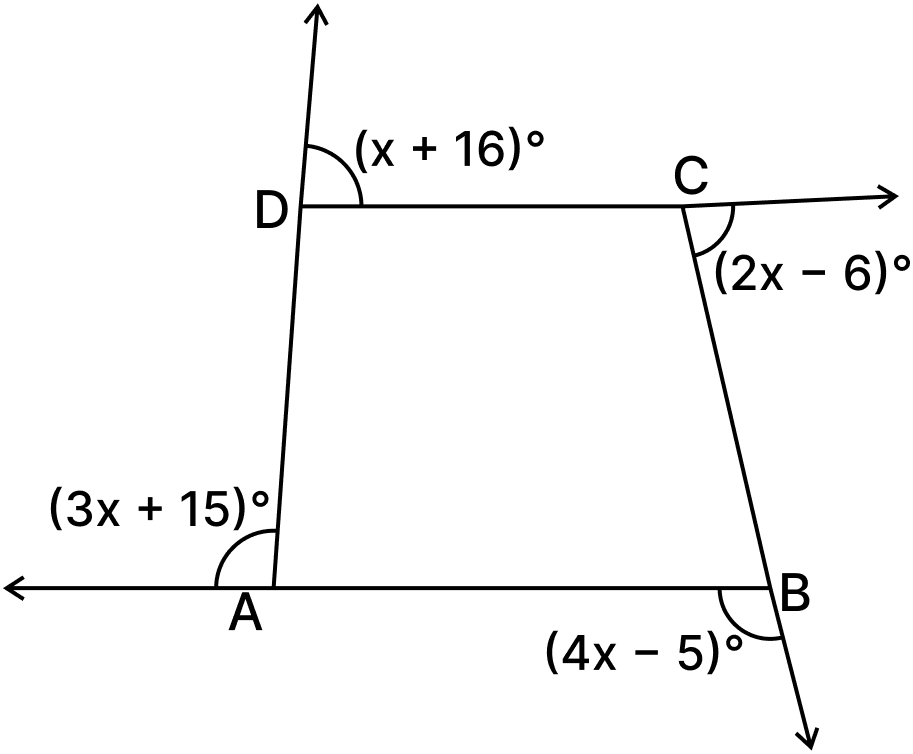
In the adjoining figure, ABCD is a quadrilateral. The smallest angle of quadrilateral ABCD measures
49°
50°
62°
63°
Answer
Given,
and are the exterior angles of quadrilateral ABCD at D, C, A and B respectively.
We know that the sum of the exterior angles of a polygon taken in order is 360°.
∴ Exterior angles = (34 + 16)° = 50°, (2 × 34 − 6)° = (68 − 6)° = 62°, (3 × 34 + 15)° = (102 + 15)° = 117° and (4 × 34 − 5)° = (136 − 5)° = 131°
As each interior angle and the corresponding exterior angle form a linear pair, we have :
⇒ ∠D = (180° − 50°) = 130°
⇒ ∠C = (180° − 62°) = 118°
⇒ ∠A = (180° − 117°) = 63°
⇒ ∠B = (180° − 131°) = 49°
∴ The smallest angle of quadrilateral ABCD = 49°.
Hence, option 1 is the correct option.
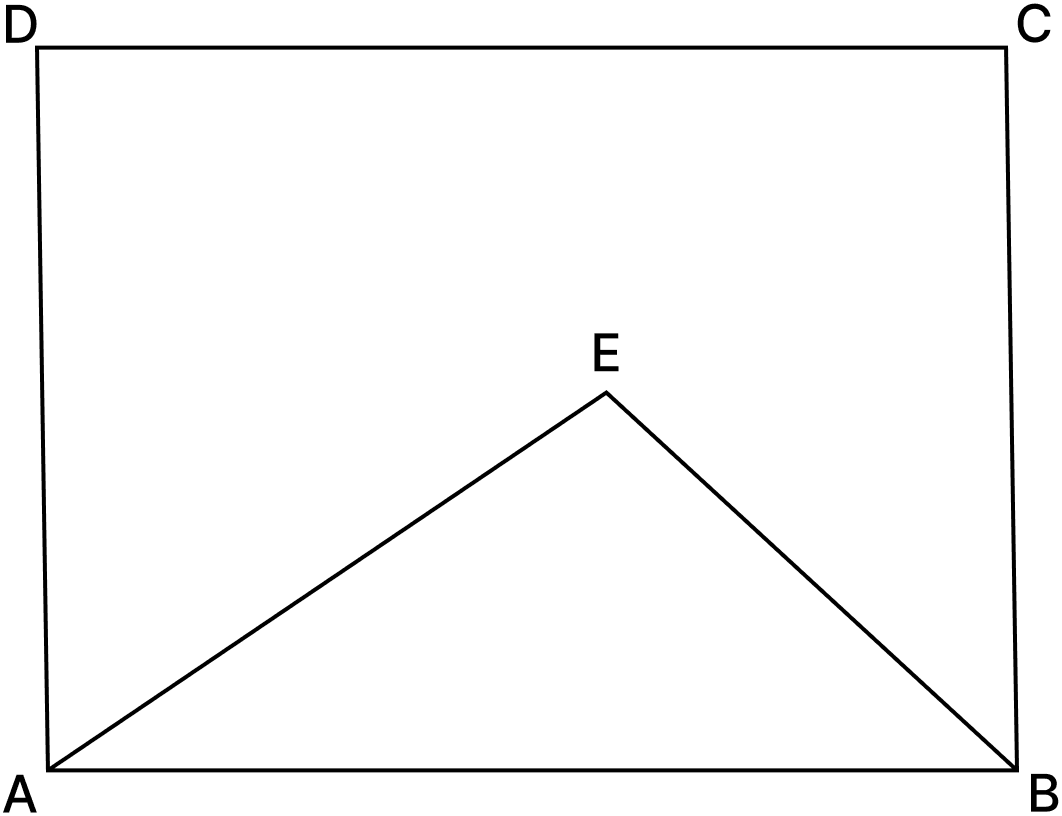
In a parallelogram ABCD, the bisectors of ∠A and ∠B meet at E. Then, ∠AEB = ?
45°
60°
90°
105°
Answer
Given,
In parallelogram ABCD the bisectors of ∠A and ∠B meet at E.
As AD ∥ BC and AB cuts them, we have :
⇒ ∠A + ∠B = 180° [Co-interior angles]
⇒ ∠A + ∠B = 90°
⇒ ∠EAB + ∠EBA = 90°
In ΔAEB, we have :
⇒ ∠EAB + ∠EBA + ∠AEB = 180° [Sum of the angles of a triangle is 180°]
⇒ 90° + ∠AEB = 180°
⇒ ∠AEB = 90°
Hence, option 3 is the correct option.
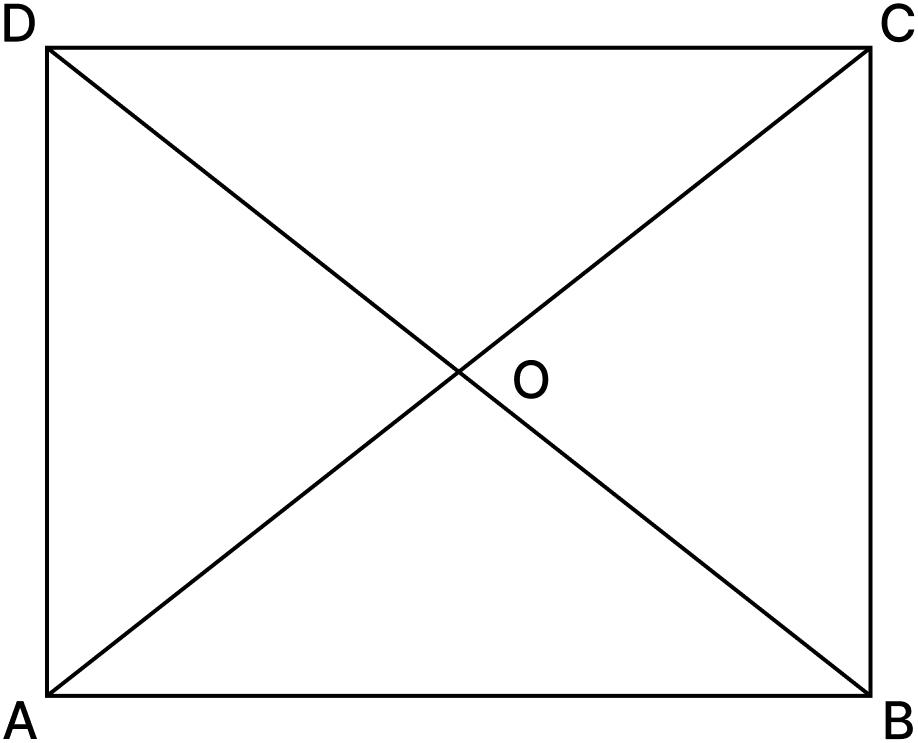
In the figure, ABCD is a rectangle whose diagonals intersect at O. If OD = and OA = , then equals
12
15
16
18
Answer
Given,
ABCD is a rectangle whose diagonals intersect at O, OD = and OA = .
We know that the diagonals of a rectangle are equal and bisect each other. Then, OD = BD and OA = AC.
We have,
⇒ BD = AC
⇒ BD = AC
⇒ OD = OA
Hence, option 4 is the correct option.
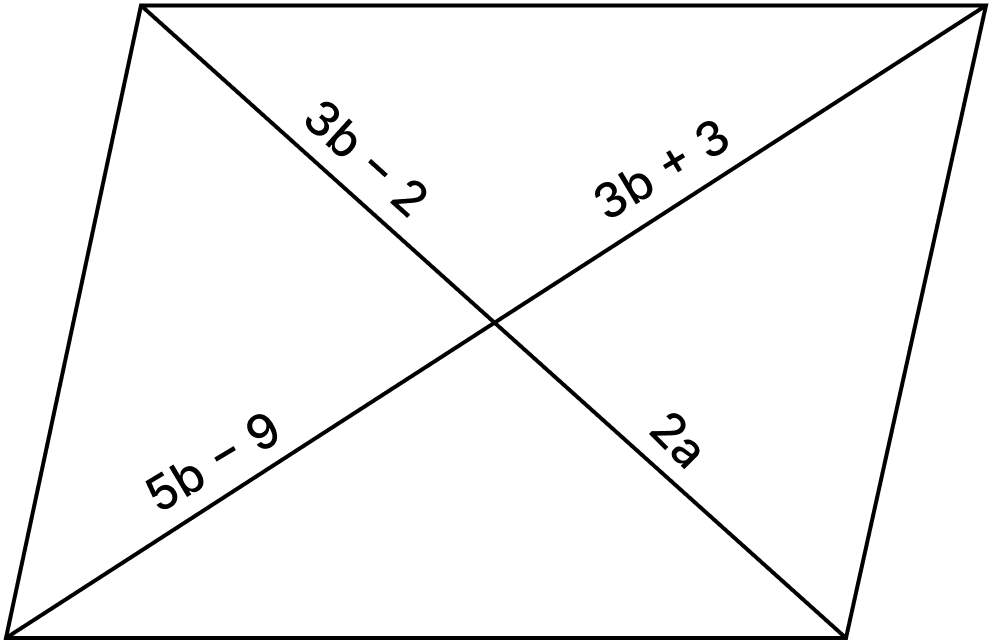
What value of would make the given quadrilateral a parallelogram?
4
5
6
8
Answer
The diagonals of the given quadrilateral are divided into the parts and at their point of intersection.
The given quadrilateral will be a parallelogram only when its diagonals bisect each other.
Also,
Hence, option 4 is the correct option.
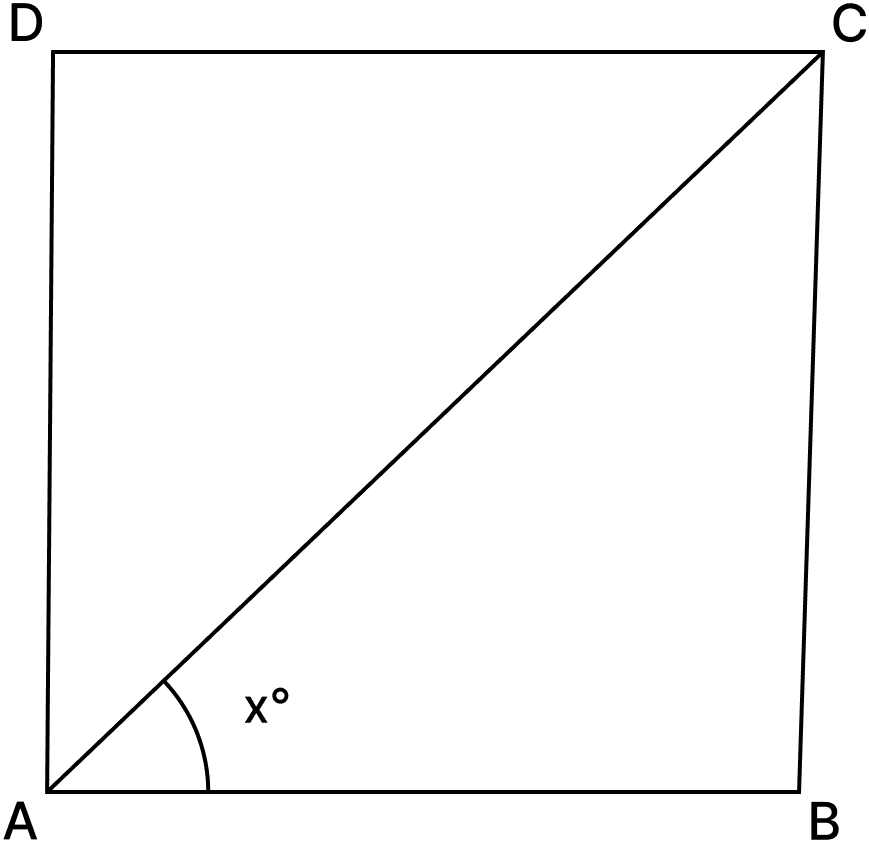
Which expression below represents the measure of ∠B in rhombus ABCD?
Answer
Given,
ABCD is a rhombus in which ∠BAC = .
We know that the diagonals of a rhombus bisect its angles, so AC bisects ∠A.
⇒ ∠A = 2∠BAC =
As AD ∥ BC and AB cuts them, we have :
⇒ ∠A + ∠B = 180° [Co-interior angles]
⇒ + ∠B = 180°
⇒ ∠B =
Hence, option 4 is the correct option.
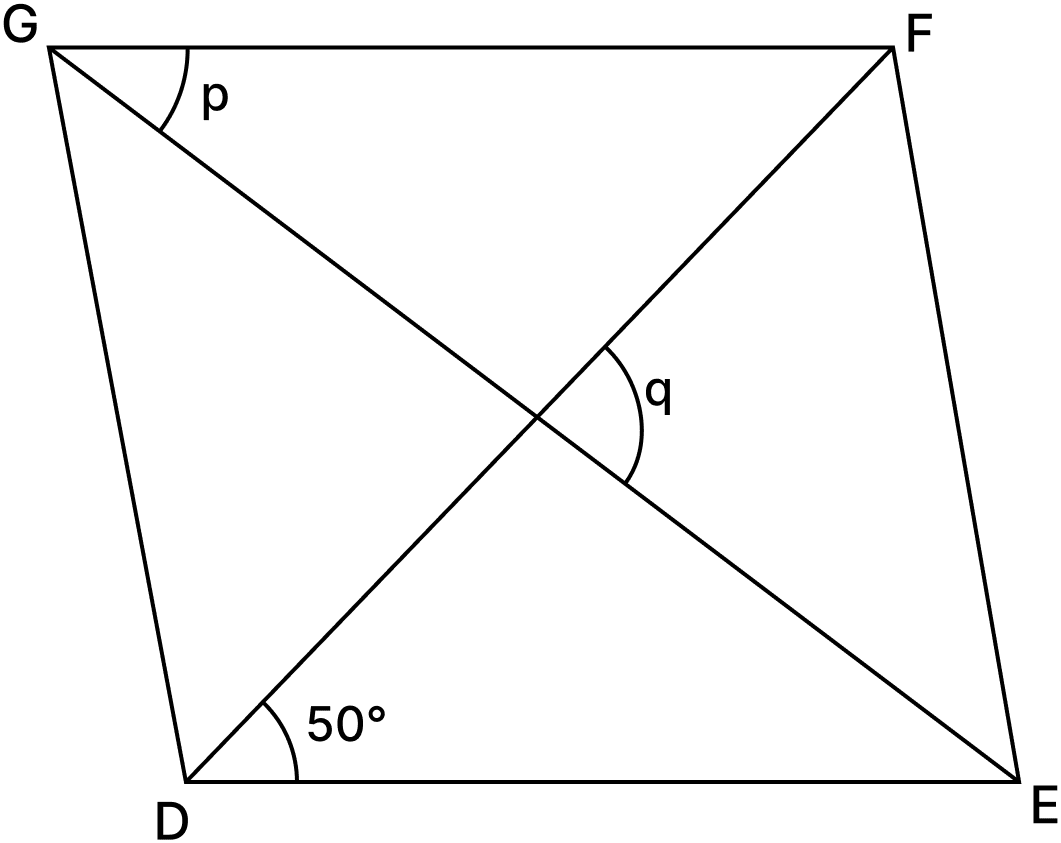
In the adjoining figure, DEFG is a rhombus. Then, is equal to
20°
30°
40°
50°
Answer
Given,
DEFG is a rhombus in which ∠FDE = 50°.
We know that the diagonals of a rhombus bisect its angles, so DF bisects ∠GDE.
⇒ ∠GDE = 2∠FDE = (2 × 50°) = 100°
As GF ∥ DE and GD cuts them, we have :
⇒ ∠DGF + ∠GDE = 180° [Co-interior angles]
⇒ ∠DGF + 100° = 180°
⇒ ∠DGF = (180° − 100°) = 80°
The diagonal GE bisects ∠DGF.
⇒ = ∠FGE = × 80° = 40°
Also, the diagonals of a rhombus bisect each other at right angles.
⇒ = 90°
∴ = (90° − 40°) = 50°
Hence, option 4 is the correct option.
In a ∥gm PQRS, ∠P + ∠Q = and ∠P − ∠R = . Then, and are respectively.
90°, 90°
120°, 60°
180°, 0°
180°, 90°
Answer
In ∥gm PQRS, ∠P and ∠Q are adjacent angles, so they are supplementary.
⇒ ∠P + ∠Q = 180°
⇒ = 180°, i.e.,
Also, ∠P and ∠R are opposite angles of the parallelogram, so they are equal.
⇒ ∠P − ∠R = 0°
⇒ = 0°, i.e.,
∴ and are 180° and 0° respectively.
Hence, option 3 is the correct option.
Fill in the blanks :
(i) A rectangle whose adjacent sides are equal becomes a ..........
(ii) The adjacent angles of a parallelogram are ..........
(iii) In a square ABCD, AB = cm and BC = cm. Then the value of is ..........
(iv) If a parallelogram is both, a rectangle and a rhombus, it is a ..........
(v) In a rhombus .......... angles are equal.
(vi) A quadrilateral that is not a parallelogram but has exactly two opposite angles of equal measures is a ..........
Answer
(i) A rectangle whose adjacent sides are equal becomes a square.
(ii) The adjacent angles of a parallelogram are supplementary.
(iii) As all the sides of a square are equal, we have AB = BC.
Hence, in a square ABCD, AB = cm and BC = cm. Then the value of is 8.
(iv) A rectangle is a parallelogram each of whose angles measures 90°.
A rhombus is a parallelogram having all its sides equal.
So, a parallelogram which is both a rectangle and a rhombus has each of its angles equal to 90° and all its sides equal, i.e., it is a square.
Hence, if a parallelogram is both, a rectangle and a rhombus, it is a square.
(v) In a rhombus opposite angles are equal.
(vi) A quadrilateral that is not a parallelogram but has exactly two opposite angles of equal measures is a kite.
Write true (T) or false (F) :
(i) Every square is a rhombus. ..........
(ii) Diagonals of a rectangle are perpendicular to each other. ..........
(iii) Diagonals of a rhombus are equal and perpendicular to each other. ..........
(iv) Every rhombus is a square. ..........
(v) If the diagonals of a quadrilateral bisect each other, it must be a parallelogram. ..........
(vi) If one pair of opposite angles of a quadrilateral are equal, it must be a parallelogram. ..........
(vii) If the diagonals of a quadrilateral are perpendicular to each other, it is definitely a rhombus. ..........
Answer
(i) Every square is a rhombus.
A square is a parallelogram having all its sides equal, so it is a rhombus.
⇒ The statement is true.
(ii) Diagonals of a rectangle are perpendicular to each other.
The diagonals of a rectangle are equal and bisect each other, but they need not be perpendicular to each other.
⇒ The statement is false.
(iii) Diagonals of a rhombus are equal and perpendicular to each other.
The diagonals of a rhombus bisect each other at right angles, but they need not be equal.
⇒ The statement is false.
(iv) Every rhombus is a square.
The angles of a rhombus need not measure 90°, whereas each angle of a square measures 90°.
⇒ The statement is false.
(v) If the diagonals of a quadrilateral bisect each other, it must be a parallelogram.
A quadrilateral whose diagonals bisect each other is a parallelogram.
⇒ The statement is true.
(vi) If one pair of opposite angles of a quadrilateral are equal, it must be a parallelogram.
In a kite, one pair of opposite angles is equal, but a kite need not be a parallelogram.
⇒ The statement is false.
(vii) If the diagonals of a quadrilateral are perpendicular to each other, it is definitely a rhombus.
The diagonals of a kite are also perpendicular to each other, but a kite need not be a rhombus.
⇒ The statement is false.
Assertion (A) : Every kite is a trapezium.
Reason (R) : In a trapezium, a pair of opposite sides is parallel.
Both Assertion (A) and Reason (R) are true and Reason (R) is the correct explanation of Assertion (A).
Both Assertion (A) and Reason (R) are true and Reason (R) is not the correct explanation of Assertion (A).
Assertion (A) is true but Reason (R) is false.
Assertion (A) is false but Reason (R) is true.
Answer
A trapezium is a quadrilateral in which one pair of opposite sides is parallel.
In a kite, two pairs of adjacent sides are equal, but no pair of opposite sides is parallel. So, a kite is not a trapezium.
⇒ Assertion (A) is false.
By definition, a trapezium is a quadrilateral in which a pair of opposite sides is parallel.
⇒ Reason (R) is true.
Hence, option 4 is the correct option.
Assertion (A) : Quadrilateral is a polygon sum of whose exterior angles is equal to the sum of its interior angles.
Reason (R) : The sum of exterior angles taken in order of a polygon is 360°.
Both Assertion (A) and Reason (R) are true and Reason (R) is the correct explanation of Assertion (A).
Both Assertion (A) and Reason (R) are true and Reason (R) is not the correct explanation of Assertion (A).
Assertion (A) is true but Reason (R) is false.
Assertion (A) is false but Reason (R) is true.
Answer
The sum of the interior angles of a quadrilateral is 360° and the sum of its exterior angles taken in order is also 360°.
So, for a quadrilateral, the sum of the exterior angles is equal to the sum of the interior angles.
⇒ Assertion (A) is true.
The sum of the exterior angles of a polygon taken in order is 360°.
⇒ Reason (R) is true.
The interior angles of a quadrilateral add up to 360°, and Reason (R) states that its exterior angles also add up to 360°. This is exactly why the two sums are equal.
So, Reason (R) is the correct explanation of Assertion (A).
Hence, option 1 is the correct option.
Assertion (A) : If the diagonals of a quadrilateral bisect each other, it must be a parallelogram.
Reason (R) : The diagonals of a parallelogram are equal.
Both Assertion (A) and Reason (R) are true and Reason (R) is the correct explanation of Assertion (A).
Both Assertion (A) and Reason (R) are true and Reason (R) is not the correct explanation of Assertion (A).
Assertion (A) is true but Reason (R) is false.
Assertion (A) is false but Reason (R) is true.
Answer
If the diagonals of a quadrilateral bisect each other, then the quadrilateral is a parallelogram.
⇒ Assertion (A) is true.
The diagonals of a parallelogram bisect each other, but they need not be equal. They are equal only when the parallelogram is a rectangle or a square.
⇒ Reason (R) is false.
Hence, option 3 is the correct option.
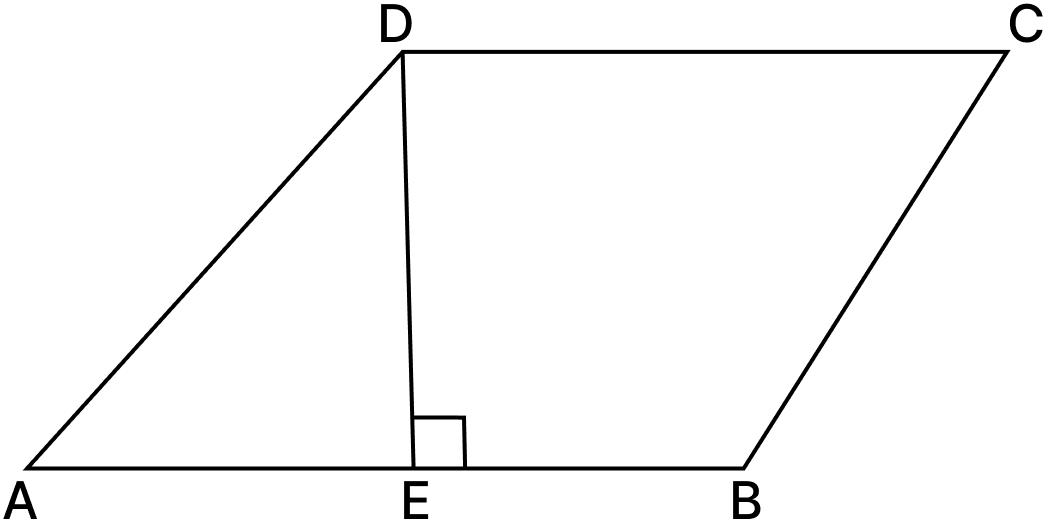
In the figure, ABCD is a rhombus, DE ⊥ AB and E is the mid-point of AB. Measure of ∠A is:
50°
60°
75°
80°
Answer
Given,
ABCD is a rhombus, DE ⊥ AB and E is the mid-point of AB.
Join DB.
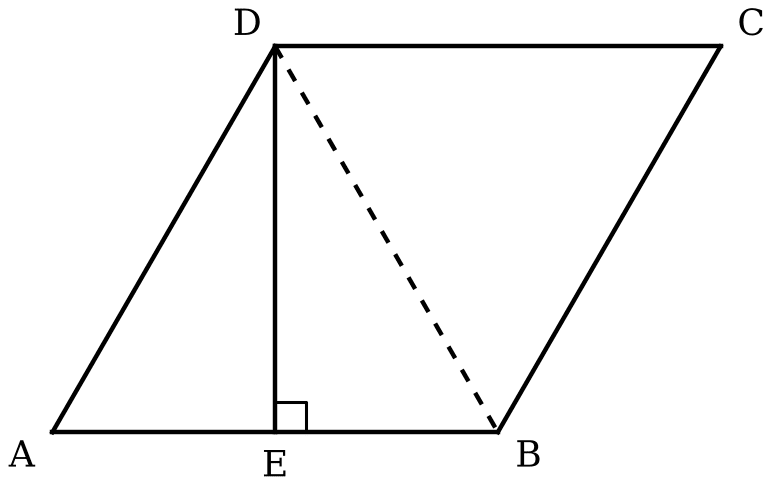
In ΔAED and ΔBED, we have :
AE = BE [∵ E is the mid-point of AB]
∠AED = ∠BED [Each equal to 90°]
DE = DE [Common]
∴ ΔAED ≅ ΔBED [S.A.S. axiom]
⇒ AD = BD [c.p.c.t.]
Also, AD = AB [Sides of a rhombus]
⇒ AD = AB = BD
So, ΔABD is an equilateral triangle.
⇒ ∠A = 60°
Hence, option 2 is the correct option.
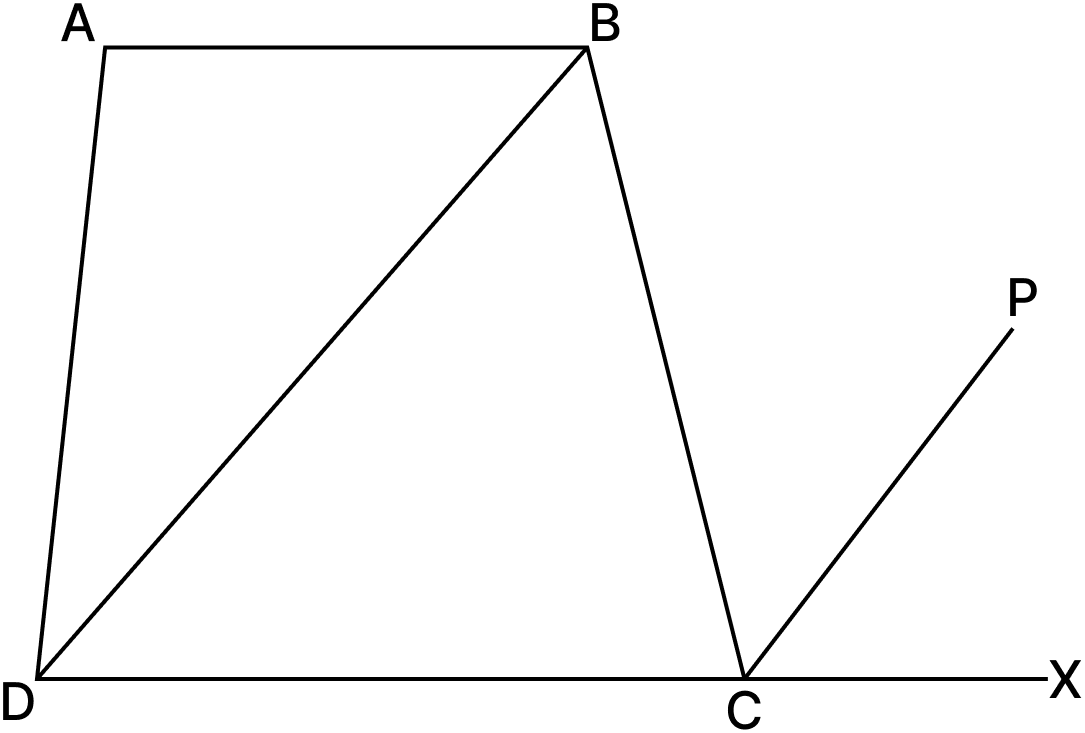
In the given figure, CP ∥ DB. If ∠DAB = 100°, ∠ABD = 40°, ∠ADC = 85° and ∠BCD = 70°, then ∠PCB is:
65°
70°
85°
90°
Answer
Given,
CP ∥ DB, ∠DAB = 100°, ∠ABD = 40°, ∠ADC = 85° and ∠BCD = 70°.
In quadrilateral ABCD, we have :
⇒ ∠DAB + ∠ABC + ∠BCD + ∠ADC = 360° [Sum of the angles of a quadrilateral is 360°]
⇒ 100° + ∠ABC + 70° + 85° = 360°
⇒ 255° + ∠ABC = 360°
⇒ ∠ABC = (360° − 255°) = 105°
Now, ∠DBC = ∠ABC − ∠ABD = (105° − 40°) = 65°
As CP ∥ DB and BC is a transversal, we have :
⇒ ∠PCB = ∠DBC = 65° [Alternate angles]
Hence, option 1 is the correct option.
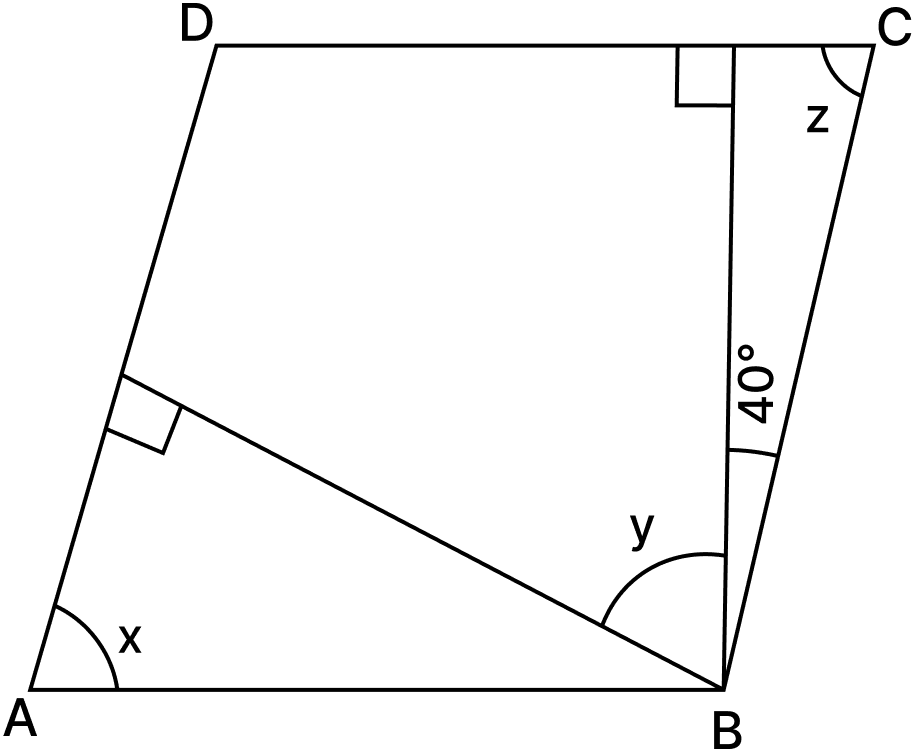
In the given figure, ABCD is a parallelogram. The value of is:
100°
120°
150°
160°
Answer
Given,
ABCD is a parallelogram in which BM ⊥ DC and BN ⊥ AD, where M lies on DC and N lies on AD, and ∠MBC = 40°.
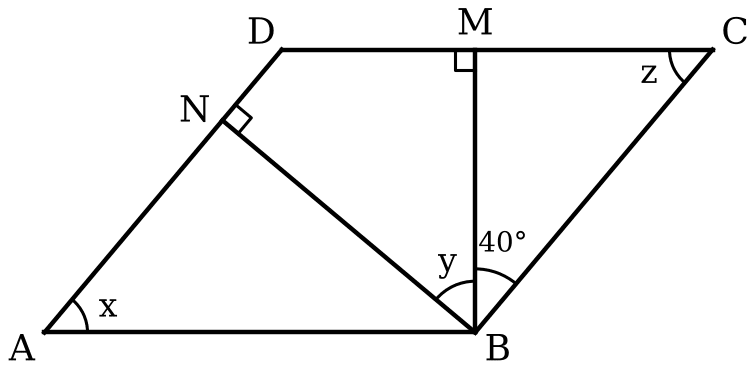
Here, = ∠BCM, = ∠NBM and = ∠DAB.
In right angled ΔBMC, we have :
⇒ ∠BMC + ∠MBC + ∠BCM = 180° [Sum of the angles of a triangle is 180°]
⇒ 90° + 40° + = 180°
⇒ 130° + = 180°
⇒ = (180° − 130°) = 50°
Since the opposite angles of a parallelogram are equal, we have :
⇒ = ∠DAB = ∠BCD = = 50°
In right angled ΔANB, we have :
⇒ ∠ANB + ∠NAB + ∠ABN = 180° [Sum of the angles of a triangle is 180°]
⇒ 90° + 50° + ∠ABN = 180°
⇒ 140° + ∠ABN = 180°
⇒ ∠ABN = (180° − 140°) = 40°
As AD ∥ BC and AB cuts them, we have :
⇒ ∠DAB + ∠ABC = 180° [Co-interior angles]
⇒ 50° + ∠ABC = 180°
⇒ ∠ABC = (180° − 50°) = 130°
Now, ∠ABC = ∠ABN + + ∠MBC
⇒ 130° = 40° + + 40°
⇒ 130° = 80° +
⇒ = (130° − 80°) = 50°
∴ = (50° + 50° + 50°) = 150°
Hence, option 3 is the correct option.
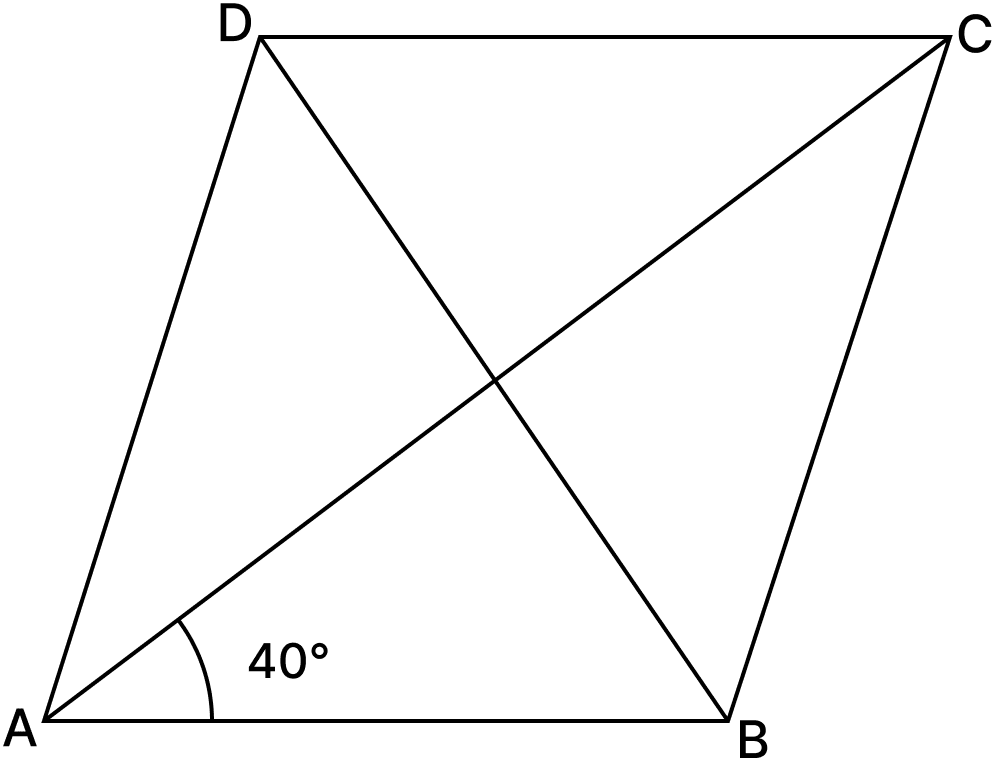
In the figure, ABCD is a rhombus. Two adjacent angles of the rhombus are:
100°, 80°
60°, 120°
40°, 140°
70°, 110°
Answer
Given,
ABCD is a rhombus in which ∠BAC = 40°.
We know that the diagonals of a rhombus bisect its angles, so AC bisects ∠BAD.
⇒ ∠BAD = 2∠BAC = (2 × 40°) = 80°
As AD ∥ BC and AB cuts them, we have :
⇒ ∠BAD + ∠ABC = 180° [Co-interior angles]
⇒ 80° + ∠ABC = 180°
⇒ ∠ABC = (180° − 80°) = 100°
∴ The two adjacent angles of the rhombus are 100° and 80°.
Hence, option 1 is the correct option.
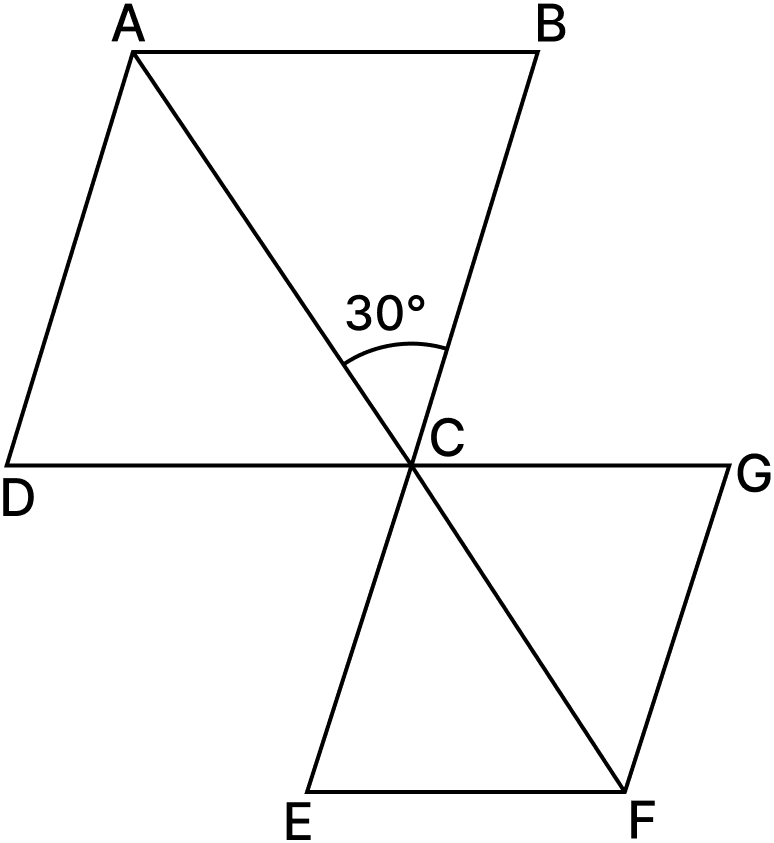
In the figure, ABCD is a rhombus. Diagonal AC is extended such that it acts as a diagonal of parallelogram CEFG. If ∠ACB = 30°, then CEFG is a:
rectangle
square
rhombus
none of these
Answer
Given,
ABCD is a rhombus in which ∠ACB = 30° and the diagonal AC is extended to F so that CF is a diagonal of parallelogram CEFG.
We know that the diagonals of a rhombus bisect its angles, so CA bisects ∠BCD.
⇒ ∠ACD = ∠ACB = 30°
As B, C, E are collinear and A, C, F are collinear, we have :
⇒ ∠ECF = ∠ACB = 30° [Vertically opposite angles]
As D, C, G are collinear and A, C, F are collinear, we have :
⇒ ∠GCF = ∠ACD = 30° [Vertically opposite angles]
⇒ ∠ECF = ∠GCF = 30°
As EF ∥ CG and CF is a transversal, we have :
⇒ ∠EFC = ∠GCF = 30° [Alternate angles]
In ΔCEF, ∠ECF = ∠EFC = 30°.
⇒ CE = EF [Sides opposite to equal angles are equal]
Also, CE = FG and EF = CG [Opposite sides of a parallelogram]
⇒ CE = EF = FG = CG
So, CEFG is a parallelogram having all its sides equal, i.e., it is a rhombus.
Also, ∠ECG = ∠ECF + ∠GCF = (30° + 30°) = 60° ≠ 90°, so CEFG is not a square.
Hence, option 3 is the correct option.
Two students Divya and Kavya were discussing about kite shape:
Divya says: Opposite sides are equal and parallel. Both diagonals bisect each other. Diagonals are perpendicular to each other.
Kavya says: Two pairs of equal consecutive sides. One of the diagonals bisects the other. Diagonals are perpendicular to each other.
Who is completely correct?
Only Divya
Only Kavya
Both are correct
Both are wrong
Answer
In a kite, two pairs of adjacent sides are equal, one of the diagonals is bisected by the other and the diagonals are perpendicular to each other.
Divya describes a quadrilateral whose opposite sides are equal and parallel, whose diagonals bisect each other and are perpendicular to each other. This is the description of a rhombus, not of a kite.
Kavya describes a quadrilateral having two pairs of equal consecutive sides, in which one of the diagonals bisects the other and the diagonals are perpendicular to each other. This is the correct description of a kite.
Hence, option 2 is the correct option.
A quadrilateral windowframe has one of its diagonals longer than the other. What would be the shape of this windowframe?
Square
Rectangle
Parallelogram
All the above
Answer
The diagonals of a square are equal in length and the diagonals of a rectangle are also equal in length.
The diagonals of a parallelogram bisect each other, but they need not be equal in length.
So, a quadrilateral windowframe having one of its diagonals longer than the other can only be a parallelogram.
Hence, option 3 is the correct option.
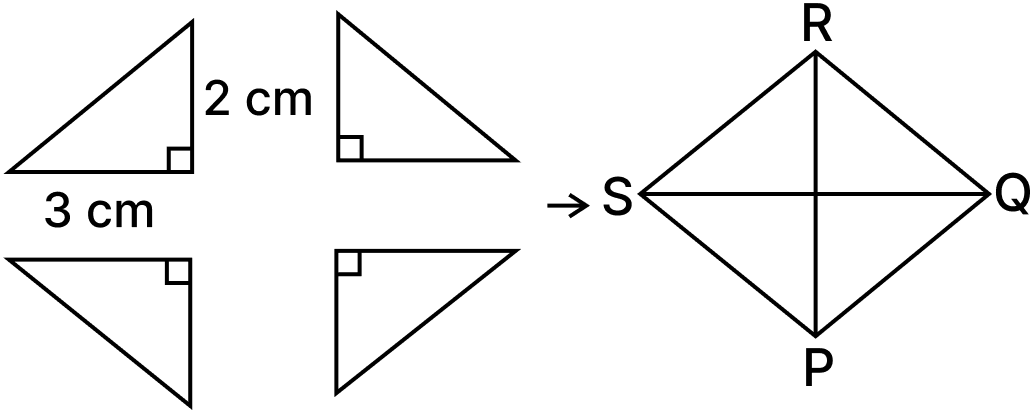
Mahima joined four similar right triangles to get a quadrilateral PQRS, as shown. Quadrilateral PQRS may be:
a rectangle
square and rhombus both
rhombus but not a square
a parallelogram, which is not a rhombus, square or rectangle
Answer
Given,
Four similar right triangles with legs 3 cm and 2 cm are joined at their right angled vertices to form quadrilateral PQRS.
Then, the two diagonals of PQRS meet at right angles at the common vertex and we have :
⇒ SQ = (3 + 3) cm = 6 cm and RP = (2 + 2) cm = 4 cm
So, the diagonals of PQRS bisect each other at right angles, but they are not equal.
∴ PQRS is a rhombus, but it is not a square.
Hence, option 3 is the correct option.
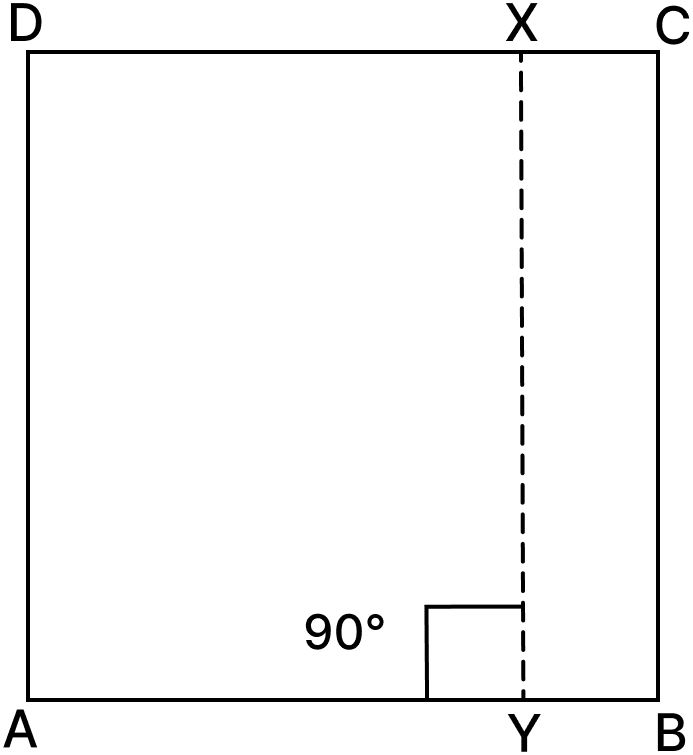
In the figure, ABCD is a square. It is cut along XY to get two pieces ADXY and BCXY. For the quadrilateral ADXY:
(i) the lengths of diagonals are equal
(ii) the diagonals are perpendicular to each other.
only (i) is correct
only (ii) is correct
both are correct
we cannot comment anything from the given information
Answer
Given,
ABCD is a square which is cut along XY, where X lies on DC and Y lies on AB with XY ⊥ AB.
In quadrilateral ADXY, we have DX ∥ AY and ∠A = ∠D = ∠AYX = ∠DXY = 90°.
So, ADXY is a rectangle.
(i) The diagonals of a rectangle are equal, so the lengths of the diagonals of ADXY are equal. This statement is correct.
(ii) The diagonals of a rectangle are perpendicular to each other only when the rectangle is a square. Since Y lies between A and B, AY < AB = AD, i.e., AD ≠ AY. So, ADXY is not a square and its diagonals are not perpendicular to each other. This statement is not correct.
Hence, option 1 is the correct option.