
The length of a rectangle is 2 cm more than its breadth. If the perimeter of the rectangle is 48 cm, then its area (in cm2) is
96
128
143
144
Answer
Let the breadth of the rectangle be b cm.
Then, length of the rectangle = (b + 2) cm
By formula,
Perimeter of a rectangle = 2 x (length + breadth)
⇒ 2 x (b + 2 + b) = 48
⇒ 2b + 2 =
⇒ 2b + 2 = 24
⇒ 2b = 22
⇒ b = 11 cm
So, length of the rectangle = (11 + 2) cm = 13 cm
Now, area of the rectangle = length x breadth
= 13 x 11 cm2
= 143 cm2
Hence, option 3 is the correct option.
The length of a hall is times its breadth. If the area of the hall be 300 m2, the difference between the length and the breadth is
3 m
4 m
5 m
8 m
Answer
Let the breadth of the hall be b m.
Then, length of the hall = b m
By formula,
Area of a rectangle = length x breadth
⇒ b x b = 300
⇒ = 300
⇒ 4b2 = 900
⇒ b2 = 225
⇒ b =
⇒ b = 15 m
So, length of the hall = x 15 m = 20 m
∴ Difference between the length and the breadth = (20 - 15) m
= 5 m
Hence, option 3 is the correct option.
If the perimeter of a rectangular field is 200 m and its breadth is 40 m, then its area is
1200 m2
2400 m2
4800 m2
6000 m2
Answer
Given:
Perimeter of the rectangular field = 200 m
Breadth of the field = 40 m
By formula,
Perimeter of a rectangle = 2 x (length + breadth)
⇒ 2 x (length + 40) = 200
⇒ length + 40 = 100
⇒ length = 60 m
Now, area of the field = length x breadth
= 60 x 40 m2
= 2400 m2
Hence, option 2 is the correct option.
A park is 10 metres long and 8 metres broad. The length of the longest pole that can be placed in the park is
6 m
12.8 m
13.4 m
18 m
Answer
The longest pole that can be placed in the park will be along its diagonal.
By formula,
Diagonal of a rectangle =
Hence, option 2 is the correct option.
Around a rectangular garden of length 10 m and width 5 m, a road 1 m wide is laid. The cost of cementing the road at ₹ 200 per m2 is
₹ 3,400
₹ 6,000
₹ 6,800
₹ 13,200
Answer
Given:
Length of the garden = 10 m and width of the garden = 5 m
Width of the road = 1 m (all around the outside)
Rate of cementing = ₹ 200 per m2
Area of the garden = length x width
= 10 x 5 m2
= 50 m2
Length of the garden including the road = (10 + 1 + 1) m = 12 m
Width of the garden including the road = (5 + 1 + 1) m = 7 m
Area of the garden including the road = length x width
= 12 x 7 m2
= 84 m2
∴ Area of the road = (84 - 50) m2
= 34 m2
Cost of cementing the road = 34 x ₹ 200
= ₹ 6,800
Hence, option 3 is the correct option.
A hall 40 m long and 15 m broad is to be paved with stones, each measuring 6 dm by 5 dm. The number of stones required is
1000
2000
2500
3000
Answer
Area of the hall = length x breadth
= 40 x 15 m2
= 600 m2
Length of each stone = 6 dm = 0.6 m
Breadth of each stone = 5 dm = 0.5 m
Area of 1 stone = length x breadth
= 0.6 x 0.5 m2
= 0.3 m2
∴ Number of stones required =
=
= 2000
Hence, option 2 is the correct option.
A rectangular lawn 60 metres by 40 metres has two roads each 5 metres wide running in the middle of it, one parallel to length and the other parallel to breadth. The cost of gravelling the roads at ₹ 60 per sq metre is
₹ 25,000
₹ 28,000
₹ 28,500
₹ 30,000
Answer
Area of the road parallel to the length = length of the lawn x width of the road
= 60 x 5 m2
= 300 m2
Area of the road parallel to the breadth = breadth of the lawn x width of the road
= 40 x 5 m2
= 200 m2
Area of the common portion = side x side
= 5 x 5 m2
= 25 m2
∴ Total area of the roads = (300 + 200 - 25) m2
= 475 m2
Cost of gravelling the roads = 475 x ₹ 60
= ₹ 28,500
Hence, option 3 is the correct option.
A 5 m wide lawn is cultivated all along the outside of a rectangular plot measuring 90 m × 40 m. The total area of the lawn is
1200 m2
1300 m2
1350 m2
1400 m2
Answer
Area of the plot = length x breadth
= 90 x 40 m2
= 3600 m2
Length of the plot including the lawn = (90 + 5 + 5) m = 100 m
Breadth of the plot including the lawn = (40 + 5 + 5) m = 50 m
Area of the plot including the lawn = length x breadth
= 100 x 50 m2
= 5000 m2
∴ Total area of the lawn = (5000 - 3600) m2
= 1400 m2
Hence, option 4 is the correct option.
A rectangle has 15 cm as its length and 150 cm2 as its area. Its area is increased to times the original area by increasing only its length. Its new perimeter is
50 cm
60 cm
70 cm
80 cm
Answer
Breadth of the rectangle =
= cm
= 10 cm
New area of the rectangle = x 150 cm2
= x 150 cm2
= 200 cm2
Since only the length is increased, the breadth remains 10 cm.
∴ New length = cm
= 20 cm
Now, new perimeter = 2 x (length + breadth)
= 2 x (20 + 10) cm
= 2 x 30 cm
= 60 cm
Hence, option 2 is the correct option.
The dimensions of the floor of a rectangular hall are 4 m × 3 m. The floor of the hall is to be tiled fully with 8 cm × 6 cm rectangular tiles without breaking tiles to smaller size. The number of tiles required is
2400
2500
2600
2800
Answer
Dimensions of the floor = 4 m x 3 m = 400 cm x 300 cm
Area of the floor = length x breadth
= 400 x 300 cm2
= 120000 cm2
Area of 1 tile = length x breadth
= 8 x 6 cm2
= 48 cm2
∴ Number of tiles required =
= 2500
Number of tiles along the length = = 50
Number of tiles along the breadth = = 50
Since both divisions are exact, 50 x 50 = 2500 tiles cover the floor fully without breaking any tile.
Hence, option 2 is the correct option.
The length and breadth of a rectangular field are 120 m and 80 m respectively. Inside the field, a park of 12 m width is made around the field. The area of the park is
2256 m2
3224 m2
4224 m2
7344 m2
Answer
Area of the field = length x breadth
= 120 x 80 m2
= 9600 m2
Since the park of width 12 m is made all around inside the field,
Length of the field excluding the park = [120 - (12 + 12)] m = 96 m
Breadth of the field excluding the park = [80 - (12 + 12)] m = 56 m
Area of the field excluding the park = length x breadth
= 96 x 56 m2
= 5376 m2
∴ Area of the park = (9600 - 5376) m2
= 4224 m2
Hence, option 3 is the correct option.
The area of a rectangle 144 m long is the same as that of a square having a side 84 m long. The width of the rectangle is
7 m
14 m
49 m
cannot be determined
Answer
Area of the square = side2
= (84)2 m2
= 7056 m2
Since the area of the rectangle is the same as the area of the square,
Area of the rectangle = 7056 m2
∴ Width of the rectangle =
= m
= 49 m
Hence, option 3 is the correct option.
If the side of a square is doubled, then the ratio of the area of the resulting square to that of the given square is
1 : 2
2 : 1
3 : 1
4 : 1
Answer
Let the side of the given square be a.
Then, the side of the resulting square = 2a
Area of the given square = a2
Area of the resulting square = (2a)2 = 4a2
∴ Required ratio =
=
= 4 : 1
Hence, option 4 is the correct option.
A coloured cloth 1.75 m long and 105 cm wide is made into square handkerchiefs of side 35 cm. The number of handkerchiefs made is
10
15
25
35
Answer
Length of the cloth = 1.75 m = 175 cm
Width of the cloth = 105 cm
Area of the cloth = length x width
= 175 x 105 cm2
= 18375 cm2
Area of 1 handkerchief = side2
= (35)2 cm2
= 1225 cm2
∴ Number of handkerchiefs made =
= 15
Hence, option 2 is the correct option.
If the ratio of areas of two squares is 9 : 1, the ratio of their perimeters is
1 : 3
3 : 1
3 : 4
9 : 1
Answer
Let the sides of the two squares be a and b.
Then,
⇒
⇒
Now, ratio of their perimeters =
=
= 3 : 1
Hence, option 2 is the correct option.
If the circumference of a circle is 352 m, then its area is
5986 m2
6589 m2
8956 m2
9856 m2
Answer
Let the radius of the circle be r m.
By formula,
Circumference of a circle = 2πr
⇒ 2 x x r = 352
⇒ r = 352 x
⇒ r = 56 m
Now, area of the circle = πr2
= m2
= 22 x 8 x 56 m2
= 9856 m2
Hence, option 4 is the correct option.
The area of a circle is 38.5 sq. cm. Its circumference is
6 cm
11 cm
22 cm
121 cm
Answer
Let the radius of the circle be r cm.
By formula,
Area of a circle = πr2
Now, circumference of the circle = 2πr
= cm
= 22 cm
Hence, option 3 is the correct option.
The area of the largest circle that can be drawn inside a square of side 14 cm, is
84 cm2
154 cm2
204 cm2
None of these
Answer
For the largest circle drawn inside a square,
Diameter of the circle = Side of the square = 14 cm
∴ Radius of the circle (r) = cm = 7 cm
Now, area of the circle = πr2
= cm2
= 154 cm2
Hence, option 2 is the correct option.
The area of the largest circle that can be drawn inside a rectangle of sides 7 m by 6 m, is
m2
m2
m2
None of these
Answer
For the largest circle drawn inside a rectangle,
Diameter of the circle = Breadth of the rectangle = 6 m
∴ Radius of the circle (r) = m = 3 m
Now, area of the circle = πr2
= x 3 x 3 m2
= m2
= m2
Hence, option 1 is the correct option.
A circular wire of radius 42 cm is cut and bent in the form of a rectangle whose sides are in the ratio of 6 : 5. The smaller side of the rectangle is
30 cm
60 cm
72 cm
132 cm
Answer
Length of the wire = Circumference of the circle
= 2πr
= cm
= 264 cm
When the wire is bent in the form of a rectangle, its perimeter = 264 cm.
Let the sides of the rectangle be 6x centimetres and 5x centimetres.
By formula,
Perimeter of a rectangle = 2 x (length + breadth)
∴ 2 x (6x + 5x) = 264
⇒ 2 x 11x = 264
⇒ 22x = 264
⇒ x = 12
So, the smaller side of the rectangle = 5x
= 5 x 12 cm
= 60 cm
Hence, option 2 is the correct option.
The length of a rope by which a cow must be tethered in order that it may be able to graze an area of 9856 sq. m, is
56 m
64 m
88 m
168 m
Answer
The cow grazes a circular region whose radius is the length of the rope.
Let the length of the rope be r m.
By formula,
Area of a circle = πr2
Hence, option 1 is the correct option.
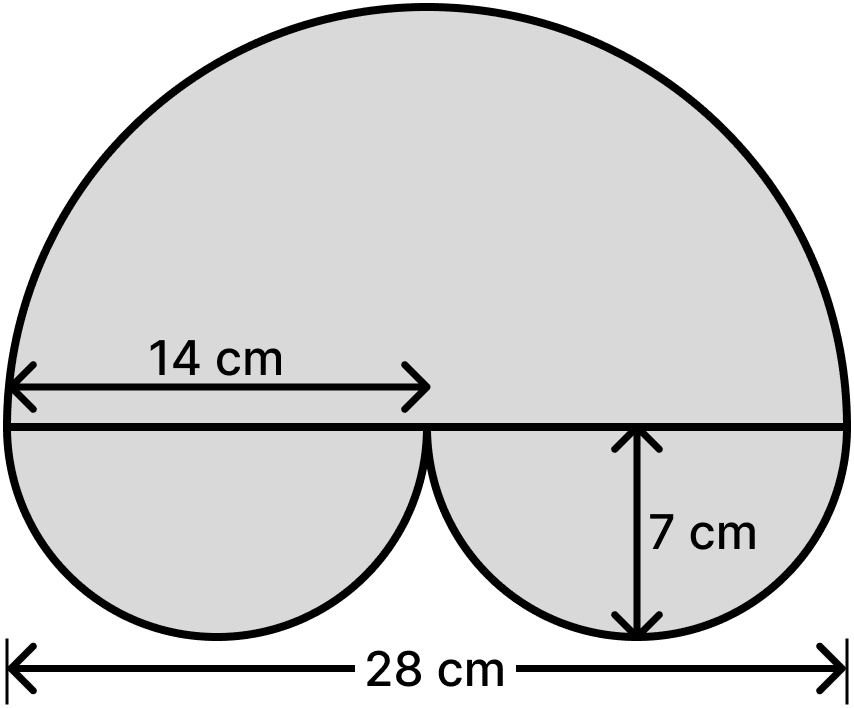
In the adjoining figure, the area of the shaded region (in cm2) is
324
428
462
492
Answer
The shaded region consists of a bigger semi-circle of diameter 28 cm and two smaller semi-circles, each of diameter 14 cm.
Radius of the bigger semi-circle (R) = cm = 14 cm
Area of the bigger semi-circle = πR2
= cm2
= 308 cm2
Radius of each smaller semi-circle (r) = cm = 7 cm
Area of the two smaller semi-circles = πr2
= cm2
= 154 cm2
∴ Area of the shaded region = (308 + 154) cm2
= 462 cm2
Hence, option 3 is the correct option.
The length of a side of a rhombus is 5 m and one of its diagonals is of length 8 m. The length of the other diagonal is
5 m
6 m
7 m
8 m
Answer
Let ABCD be the rhombus with AB = 5 m and diagonal AC = 8 m, and let its diagonals intersect at O.
We know that the diagonals of a rhombus bisect each other at right angles.
∴ AO = x 8 m = 4 m and ∠AOB = 90°
Using Pythagoras theorem in right triangle AOB,
AB2 = AO2 + OB2
⇒ OB2 = AB2 - AO2
⇒ OB2 = (5)2 - (4)2
⇒ OB2 = 25 - 16
⇒ OB2 = 9
⇒ OB = 3 m
∴ BD = 2 x OB = 2 x 3 m = 6 m
Hence, option 2 is the correct option.
In a rhombus, whose area is 144 sq. cm, one of the diagonals is twice as long as the other. The lengths of its diagonals are
6 cm, 12 cm
12 cm, 24 cm
cm, cm
24 cm, 48 cm
Answer
Let the shorter diagonal of the rhombus be d cm.
Then, the longer diagonal = 2d cm
By formula,
Area of a rhombus = x (product of diagonals)
⇒ x d x 2d = 144
⇒ d2 = 144
⇒ d =
⇒ d = 12 cm
So, the longer diagonal = 2 x 12 cm = 24 cm
Hence, option 2 is the correct option.
The length of the diagonal of a rhombus is 80% of the length of the other diagonal. Then, the area of the rhombus is how many times the square of the length of the longer diagonal?
Answer
Let the longer diagonal of the rhombus be d.
Then, the other diagonal = 80% of d = d = d
By formula,
Area of a rhombus = x (product of diagonals)
= x d x d
= d2
∴ Area of the rhombus = x (square of the length of the longer diagonal)
Hence, option 3 is the correct option.
The distance of 14 cm long side of a parallelogram from the opposite side is 16 cm. The area of the parallelogram is
112 cm2
224 cm2
56 π cm2
210 cm2
Answer
By formula,
Area of a parallelogram = base x height
Here, base = 14 cm and height = 16 cm
∴ Area of the parallelogram = 14 x 16 cm2
= 224 cm2
Hence, option 2 is the correct option.
The lengths of two parallel sides of a trapezium are 20 cm and 30 cm and its height is 6 cm. Its area (in sq. cm) is
100
150
200
300
Answer
By formula,
Area of a trapezium = x (sum of parallel sides) x (distance between them)
= x (20 + 30) x 6 cm2
= x 50 x 6 cm2
= 150 cm2
Hence, option 2 is the correct option.
The area of a trapezium is 384 cm2. If its parallel sides are in the ratio 3 : 5 and the perpendicular distance between them be 12 cm, the smaller of the parallel sides is
16 cm
24 cm
32 cm
40 cm
Answer
Let the parallel sides of the trapezium be 3x centimetres and 5x centimetres.
By formula,
Area of a trapezium = x (sum of parallel sides) x (distance between them)
So, the smaller of the parallel sides = 3x
= 3 x 8 cm
= 24 cm
Hence, option 2 is the correct option.
The cross-section of a canal is trapezium in shape. If the canal is 10 metres wide at the top and 6 metres wide at the bottom and the area of cross section is 640 sq. metres, the length of canal is
40 m
80 m
160 m
384 m
Answer
The cross-section of the canal is a trapezium whose parallel sides are 10 m and 6 m.
Let the required length be l m.
By formula,
Area of a trapezium = x (sum of parallel sides) x (distance between them)
⇒ x (10 + 6) x l = 640
⇒ x 16 x l = 640
⇒ 8l = 640
⇒ l =
⇒ l = 80 m
Hence, option 2 is the correct option.
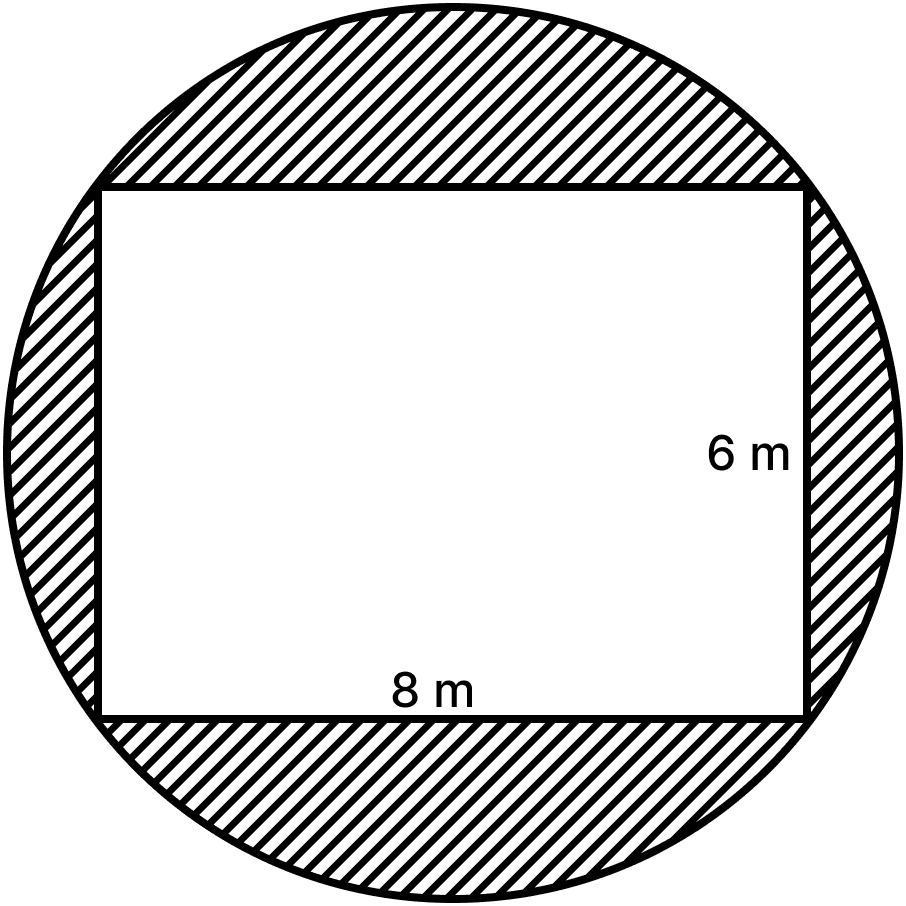
In the adjoining figure, the area of the shaded portion is
30.6 m2
39 m2
42.4 m2
65.3 m2
Answer
The rectangle is inscribed in the circle, so the diagonal of the rectangle is the diameter of the circle.
By formula,
Diagonal of a rectangle =
∴ Diameter of the circle = m
= m
= m
= 10 m
∴ Radius of the circle (r) = m = 5 m
Area of the circle = πr2
= x 5 x 5 m2
= m2
= 78.57 m2
Area of the rectangle = length x breadth
= 8 x 6 m2
= 48 m2
∴ Area of the shaded portion = (78.57 - 48) m2
= 30.57 m2
= 30.6 m2 (approx.)
Hence, option 1 is the correct option.
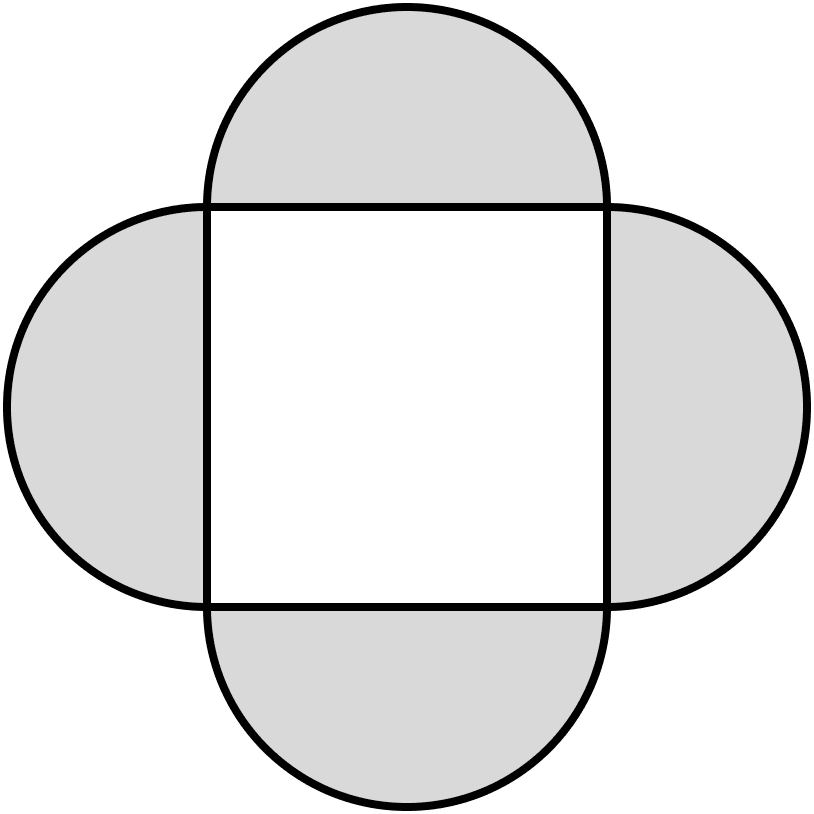
A bed of roses is as shown in the adjoining diagram. In the centre, is a square and on each side there is a semi-circle. The side of the square is 21 m. If each rose plant needs 6 m2 of space the number of plants is
163
168
176
189
Answer
Given:
Side of the square = 21 m
A semi-circle is described on each side of the square.
∴ Radius of each semi-circle (r) = m = 10.5 m
Area of the square = side2
= (21)2 m2
= 441 m2
Area of the four semi-circles = πr2
= m2
= 2 x 22 x 1.5 x 10.5 m2
= 693 m2
∴ Total area of the bed of roses = (441 + 693) m2
= 1134 m2
Since each rose plant needs 6 m2 of space,
Number of plants =
= 189
Hence, option 4 is the correct option.
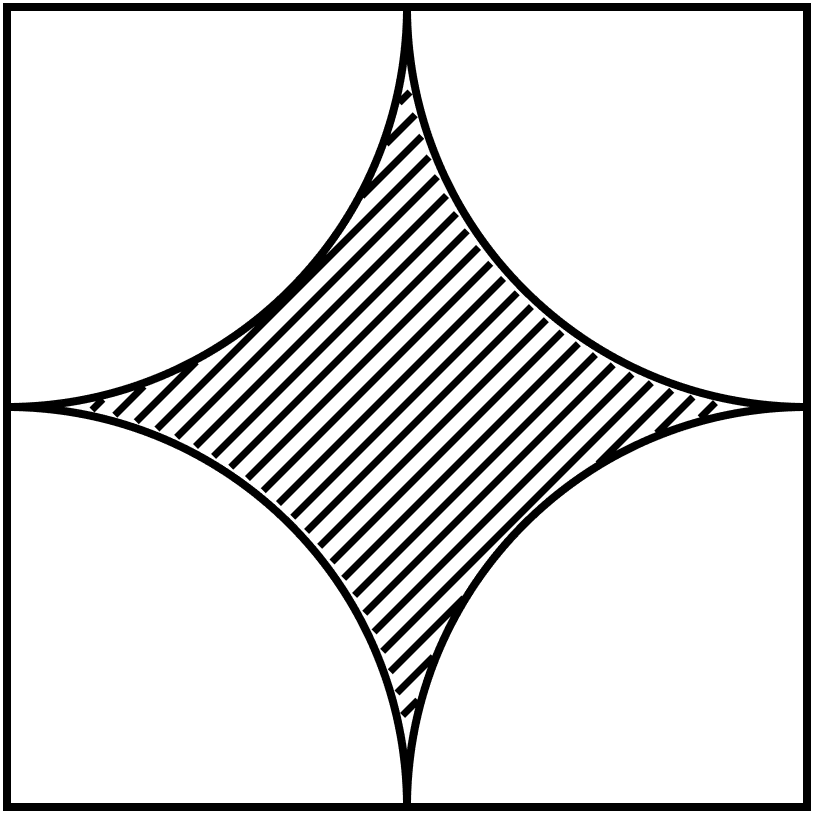
Four horses are tethered at four corners of a square plot of side 63 m, so that they just cannot reach one another. The area left ungrazed is
675.5 m2
780.6 m2
785.8 m2
850.5 m2
Answer
Since the four horses are tethered at the four corners of the square plot so that they just cannot reach one another,
Radius of each grazed region (r) = x side of the square
= m
= 31.5 m
Area of the square plot = side2
= (63)2 m2
= 3969 m2
Each horse grazes a quadrant of a circle of radius 31.5 m.
∴ Total grazed area = πr2
= m2
= 22 x 4.5 x 31.5 m2
= 3118.5 m2
∴ Area left ungrazed = (3969 - 3118.5) m2
= 850.5 m2
Hence, option 4 is the correct option.
Fill in the blanks:
(i) 100 m2 = ______ cm2
(ii) 5000 cm2 = ______ dm2
(iii) 1 hectare = ______ m2
(iv) The area of a rhombus is half the product of its ______
(v) If the perimeter and area of a square are numerically equal then, the length of its side is ______
(vi) The ratio of the lengths and breadth of a rectangle is 3 : 2 and its area is 96 cm2. Then its length is ______
Answer
(i) As we know, 1 m = 100 cm
∴ 1 m2 = (100 x 100) cm2 = 10000 cm2
So, 100 m2 = (100 x 10000) cm2
= 1000000 cm2
Hence, 100 m2 = 1000000 cm2.
(ii) As we know, 1 dm = 10 cm
∴ 1 dm2 = (10 x 10) cm2 = 100 cm2
So, 5000 cm2 = dm2
= 50 dm2
Hence, 5000 cm2 = 50 dm2.
(iii) As we know, 1 hectare = 10000 m2
Hence, 1 hectare = 10000 m2.
(iv) The area of a rhombus = x (product of its diagonals)
Hence, the area of a rhombus is half the product of its diagonals.
(v) Let the side of the square be a units.
Perimeter of the square = 4a units and area of the square = a2 sq. units
Since the perimeter and the area are numerically equal,
⇒ a2 = 4a
⇒ a2 - 4a = 0
⇒ a(a - 4) = 0
⇒ a = 0 or a = 4
Since the side of a square cannot be 0, a = 4.
Hence, the length of its side is 4 units.
(vi) Let the length of the rectangle be 3x centimetres and its breadth be 2x centimetres.
By formula,
Area of a rectangle = length x breadth
⇒ 3x x 2x = 96
⇒ 6x2 = 96
⇒ x2 = 16
⇒ x = 4
So, length of the rectangle = 3x
= 3 x 4 cm
= 12 cm
Hence, its length is 12 cm.
Assertion (A): A trapezium with 3 equal sides and one side double the equal side can be divided into three equilateral triangles of equal area.
Reason (R): Area of a trapezium = (sum of parallel sides) × distance between them.
Both Assertion (A) and Reason (R) are true and Reason (R) is the correct explanation of Assertion (A).
Both Assertion (A) and Reason (R) are true and Reason (R) is not the correct explanation of Assertion (A).
Assertion (A) is true but Reason (R) is false.
Assertion (A) is false but Reason (R) is true.
Answer
Let the trapezium be ABCD in which AB = 2a units and DC = AD = BC = a units.
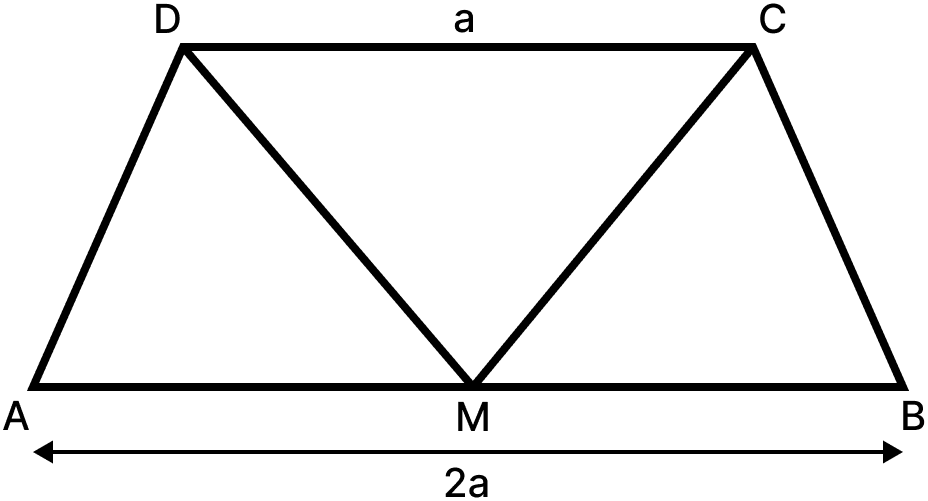
Join the vertices D and C to the mid-point M of AB.
Then, AM = MB = a
Since AM = AD = a and DC = AM with DC ∥ AM, AMCD is a rhombus, so DM = a.
Similarly, MB = BC = a and DC = MB with DC ∥ MB, so CM = a.
∴ ΔADM, ΔDMC and ΔCMB all have each side equal to a, that is, the trapezium is divided into three equilateral triangles of equal area.
So, Assertion (A) is true.
The area of a trapezium = (sum of parallel sides) x distance between them.
So, Reason (R) is true.
But Reason (R) is a formula for the area of a trapezium and it does not explain how the trapezium is divided into three equilateral triangles. So, Reason (R) is not the correct explanation of Assertion (A).
Hence, option 2 is the correct option.
Assertion (A): If the perimeter of a semi-circle is 18 cm, then its radius is 3.5 cm.
Reason (R): The perimeter of a semi-circle of radius r is r (π + 2).
Both Assertion (A) and Reason (R) are true and Reason (R) is the correct explanation of Assertion (A).
Both Assertion (A) and Reason (R) are true and Reason (R) is not the correct explanation of Assertion (A).
Assertion (A) is true but Reason (R) is false.
Assertion (A) is false but Reason (R) is true.
Answer
The perimeter of a semi-circle of radius r is r (π + 2).
So, Reason (R) is true.
Let the radius of the semi-circle be r cm.
Then, perimeter = r (π + 2)
So, Assertion (A) is true and Reason (R) is the correct explanation of Assertion (A).
Hence, option 1 is the correct option.
Assertion (A): The side of a rhombus is 10 cm. If its one diagonal is 12 cm long, then its area is 96 cm2.
Reason (R): Area of a rhombus is given by product of its diagonals.
Both Assertion (A) and Reason (R) are true and Reason (R) is the correct explanation of Assertion (A).
Both Assertion (A) and Reason (R) are true and Reason (R) is not the correct explanation of Assertion (A).
Assertion (A) is true but Reason (R) is false.
Assertion (A) is false but Reason (R) is true.
Answer
The area of a rhombus = x (product of its diagonals) and not the product of its diagonals.
So, Reason (R) is false.
Let ABCD be the rhombus with AB = 10 cm and diagonal AC = 12 cm, and let its diagonals intersect at O.
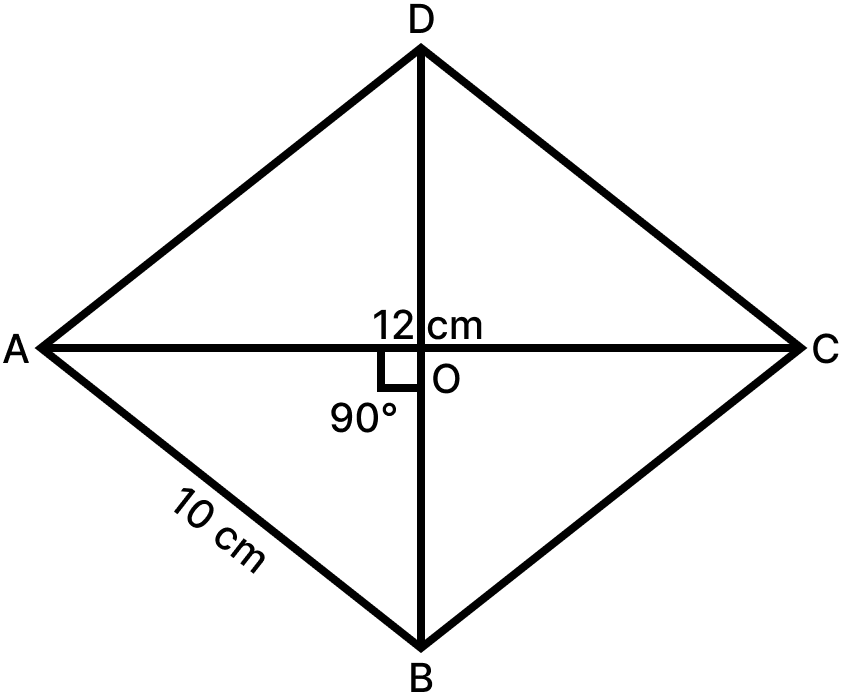
We know that the diagonals of a rhombus bisect each other at right angles.
∴ AO = x 12 cm = 6 cm and ∠AOB = 90°
Using Pythagoras theorem in right triangle AOB,
AB2 = AO2 + OB2
⇒ OB2 = AB2 - AO2
⇒ OB2 = (10)2 - (6)2
⇒ OB2 = 100 - 36
⇒ OB2 = 64
⇒ OB = 8 cm
∴ BD = 2 x OB = 2 x 8 cm = 16 cm
Now, area of the rhombus = x AC x BD
= x 12 x 16 cm2
= 96 cm2
So, Assertion (A) is true.
∴ Assertion (A) is true but Reason (R) is false.
Hence, option 3 is the correct option.
The length of a hall is times its breadth. If the area of the hall be 300 m2, the difference between length and breadth is:
4 m
5 m
8 m
9 m
Answer
Let the breadth of the hall be b m.
Then, length of the hall = b m
By formula,
Area of a rectangle = length x breadth
⇒ b x b = 300
⇒ = 300
⇒ 4b2 = 900
⇒ b2 = 225
⇒ b =
⇒ b = 15 m
So, length of the hall = x 15 m = 20 m
∴ Difference between length and breadth = (20 - 15) m
= 5 m
Hence, option 2 is the correct option.
The base of a triangle is doubled while its height is halved. What is the percentage change in area?
50%
60%
75%
no change
Answer
Let the base of the triangle be b and its height be h.
∴ Original area of the triangle = x b x h
Now, the base is doubled and the height is halved.
New base = 2b and new height =
∴ New area of the triangle =
= x b x h
Since the new area is equal to the original area, there is no change in the area.
Hence, option 4 is the correct option.
If the diagonal of a square is doubled, how does the area of the square change?
becomes 2 fold
becomes 3 fold
becomes 4 fold
none of these
Answer
Let the diagonal of the square be d.
By formula,
Area of a square = x (diagonal)2
∴ Original area = d2
When the diagonal is doubled, the new diagonal = 2d.
∴ New area = x (2d)2
= x 4d2
= 4 x d2
So, the area becomes 4 times the original area.
Hence, option 3 is the correct option.
The length of a diagonal of a rhombus is 80% of the length of the other diagonal. Area of the rhombus is how many times the square of the length of the longer diagonal?
Answer
Let the longer diagonal of the rhombus be d.
Then, the other diagonal = 80% of d = d = d
By formula,
Area of a rhombus = x (product of diagonals)
= x d x d
= d2
∴ Area of the rhombus = x (square of the length of the longer diagonal)
Hence, option 4 is the correct option.
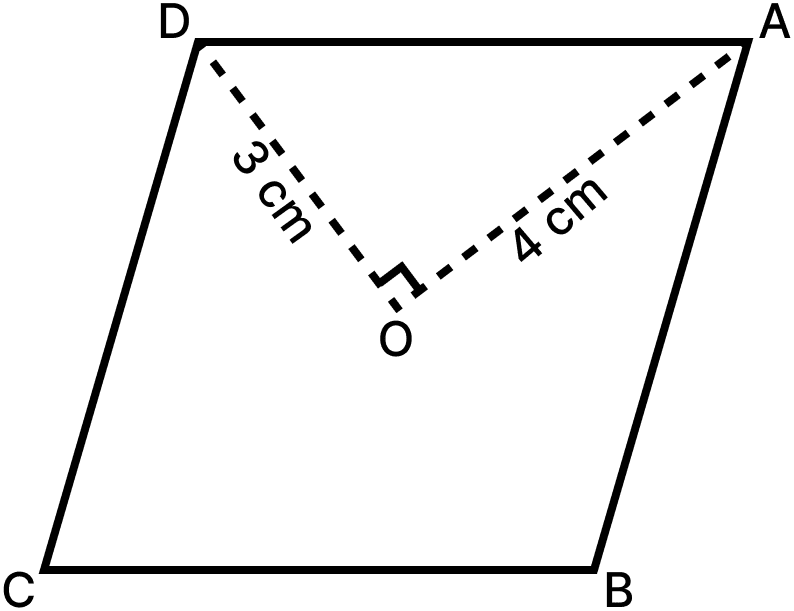
In the figure, ABCD is a rhombus. Area of ABCD is:
12 cm2
24 cm2
40 cm2
48 cm2
Answer
From the figure, the diagonals of the rhombus ABCD meet at O, where OA = 4 cm and OD = 3 cm.
We know that the diagonals of a rhombus bisect each other.
∴ AC = 2 x OA = 2 x 4 cm = 8 cm
And, BD = 2 x OD = 2 x 3 cm = 6 cm
Now, area of rhombus ABCD = x (product of diagonals)
= x 8 x 6 cm2
= 24 cm2
Hence, option 2 is the correct option.
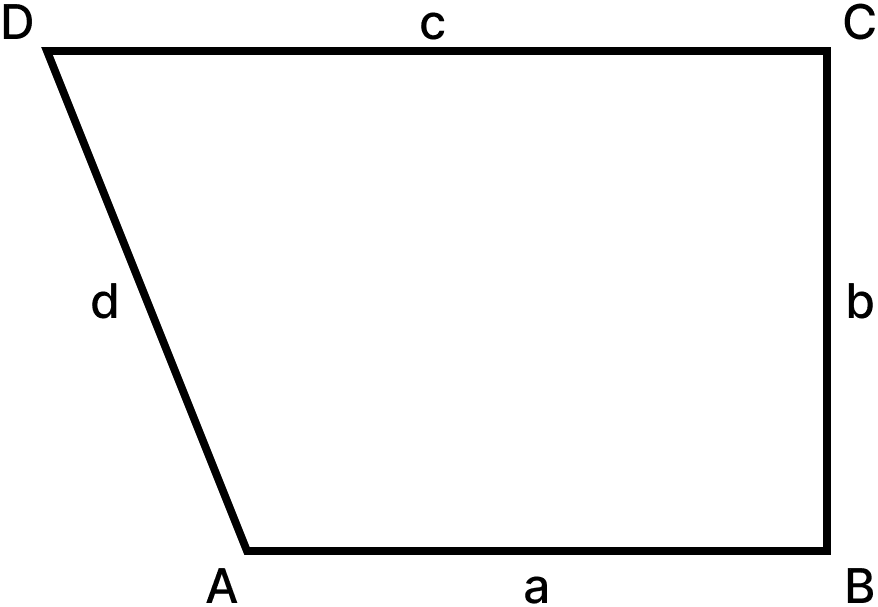
In the figure, ABCD is a trapezium. Area of the trapezium is given by:
Answer
From the figure, ABCD is a trapezium in which AB ∥ DC.
The parallel sides are AB = a and DC = c.
Since ∠B = ∠C = 90°, BC = b is the distance between the parallel sides.
By formula,
Area of a trapezium = x (sum of parallel sides) x (distance between them)
= x (a + c) x b
=
Hence, option 3 is the correct option.
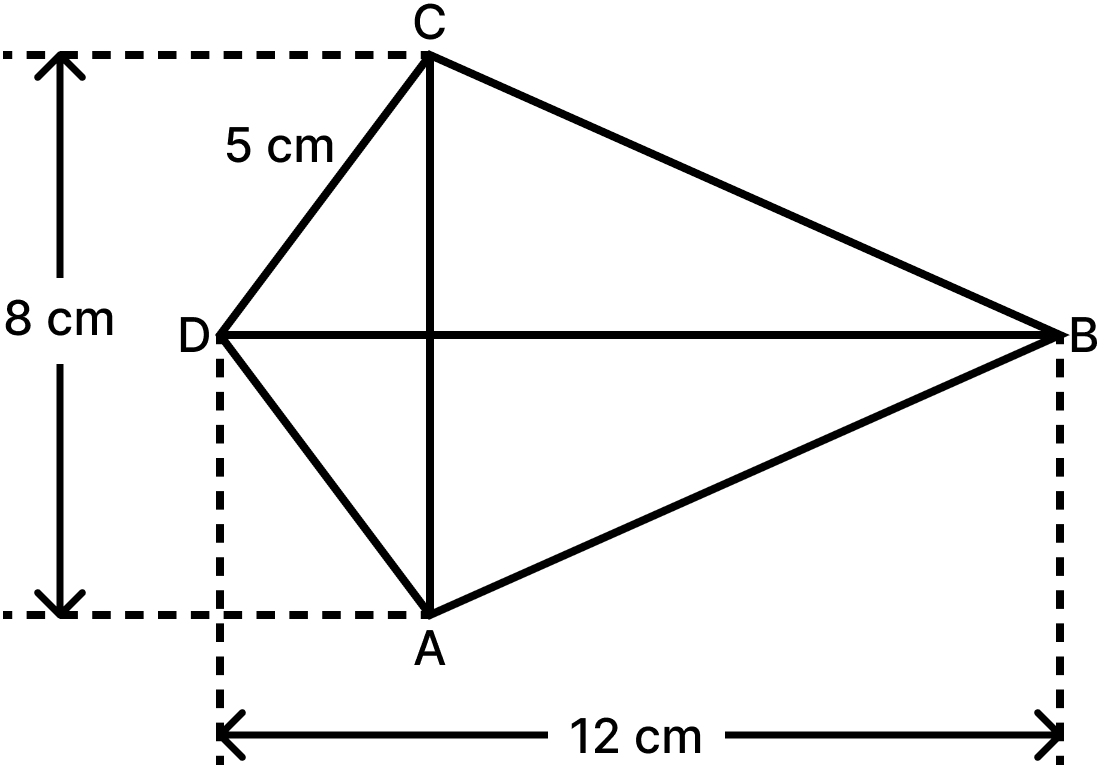
In the figure, area of the kite ABCD is:
48 cm2
64 cm2
72 cm2
80 cm2
Answer
From the figure, the diagonals of the kite ABCD are DB = 12 cm and CA = 8 cm, and they cut each other at right angles.
By formula,
Area of a kite = x (product of diagonals)
= x 12 x 8 cm2
= 48 cm2
Hence, option 1 is the correct option.
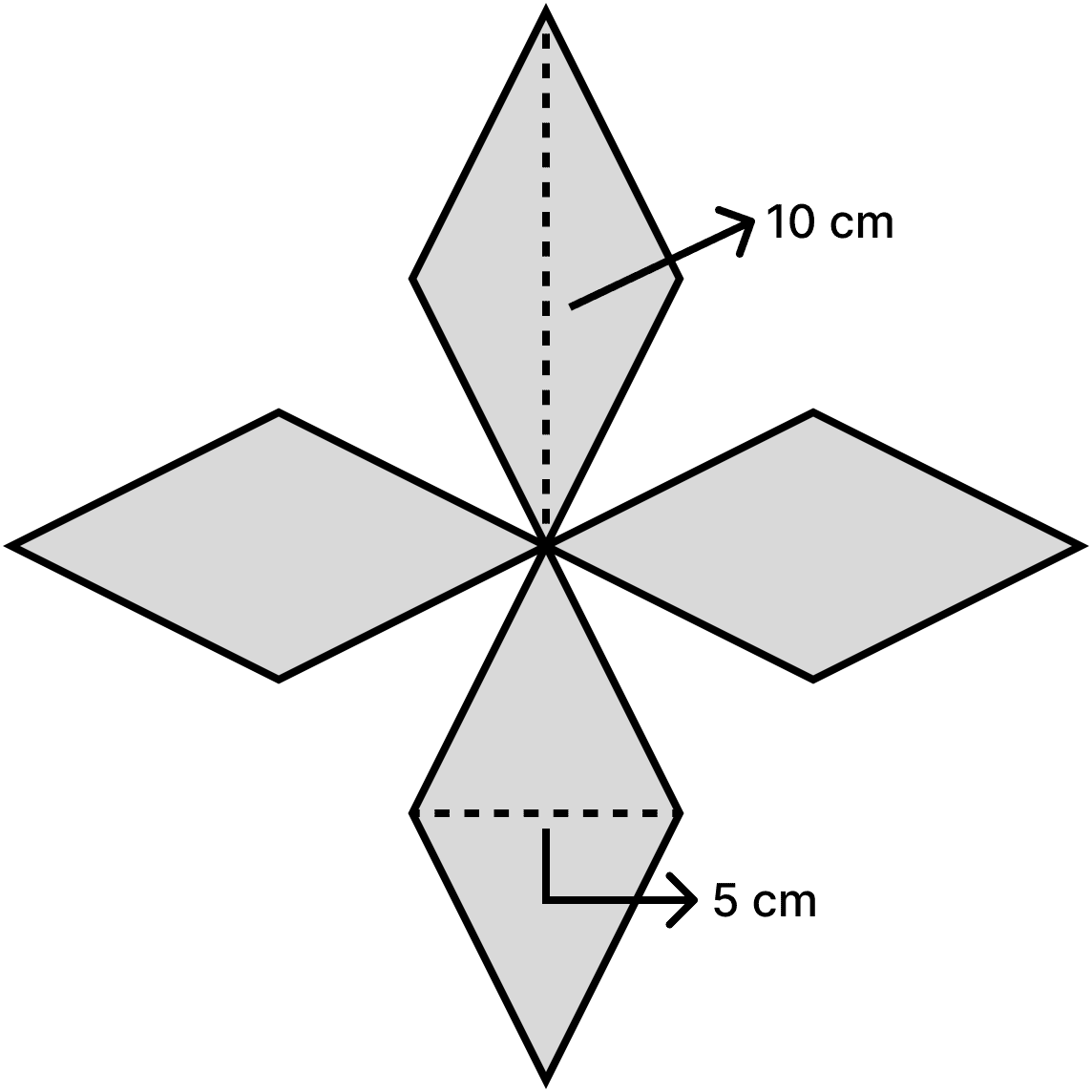
A wall decoration is in the shape given below:
Decoration is made of four congruent mirrors. The sides of a mirror are of the same length. What is the area occupied by the decoration on the wall?
25 cm2
30 cm2
100 cm2
200 cm2
Answer
Since the sides of a mirror are of the same length, each mirror is a rhombus.
From the figure, the diagonals of each rhombus are 10 cm and 5 cm.
Area of 1 mirror = x (product of diagonals)
= x 10 x 5 cm2
= 25 cm2
Since the decoration is made of four congruent mirrors,
Area occupied by the decoration = 4 x 25 cm2
= 100 cm2
Hence, option 3 is the correct option.
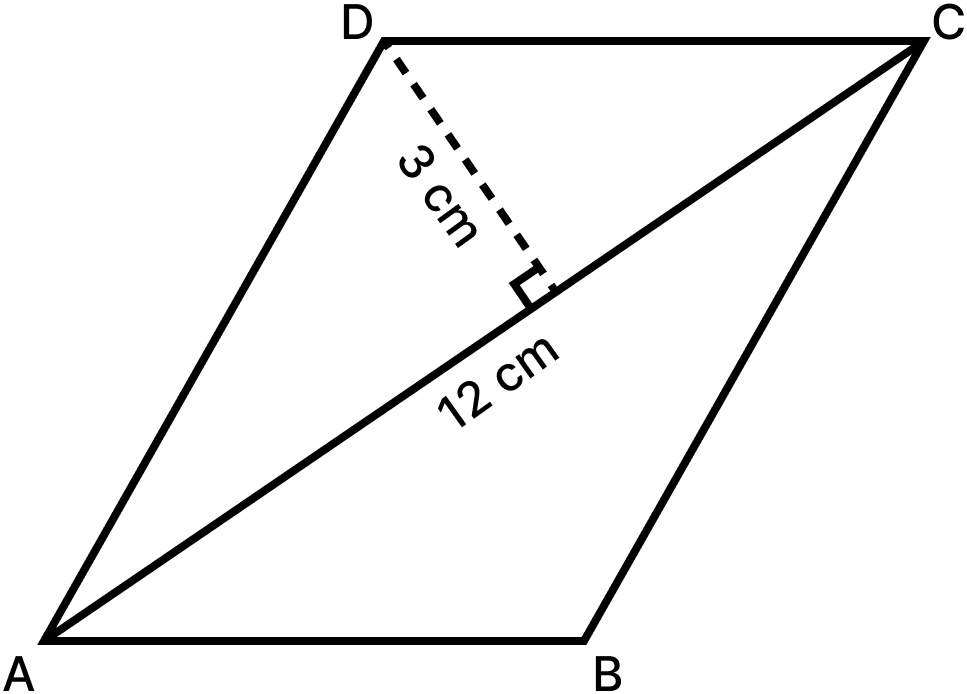
In the figure, ABCD is a quadrilateral in which AB = CD and BC = AD. Its area is:
12 cm2
24 cm2
30 cm2
36 cm2
Answer
Since AB = CD and BC = AD, ABCD is a parallelogram.
From the figure, AC = 12 cm is a diagonal and the distance of D from AC is 3 cm.
By formula,
Area of a triangle = x base x height
Area of ΔACD = x AC x 3
= x 12 x 3 cm2
= 18 cm2
We know that a diagonal of a parallelogram divides it into two triangles equal in area.
∴ Area of quadrilateral ABCD = 2 x (area of ΔACD)
= 2 x 18 cm2
= 36 cm2
Hence, option 4 is the correct option.
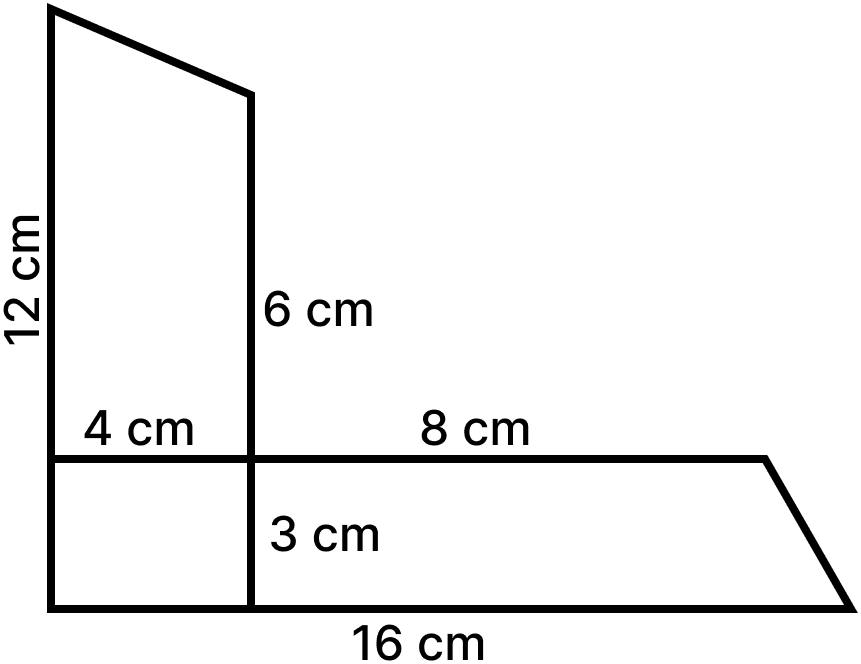
Area of the given figure is:
60 cm2
70 cm2
72 cm2
84 cm2
Answer
The given figure can be divided into two trapeziums.
Upper trapezium:
Since the total height of the left side is 12 cm and the lower part is 3 cm high,
Length of the left parallel side = (12 - 3) cm = 9 cm
Length of the right parallel side = 6 cm
Distance between them = 4 cm
Area of the upper trapezium = x (sum of parallel sides) x (distance between them)
= x (9 + 6) x 4 cm2
= x 15 x 4 cm2
= 30 cm2
Lower trapezium:
Length of the lower parallel side = 16 cm
Length of the upper parallel side = (4 + 8) cm = 12 cm
Distance between them = 3 cm
Area of the lower trapezium = x (sum of parallel sides) x (distance between them)
= x (16 + 12) x 3 cm2
= x 28 x 3 cm2
= 42 cm2
∴ Area of the given figure = (30 + 42) cm2
= 72 cm2
Hence, option 3 is the correct option.