
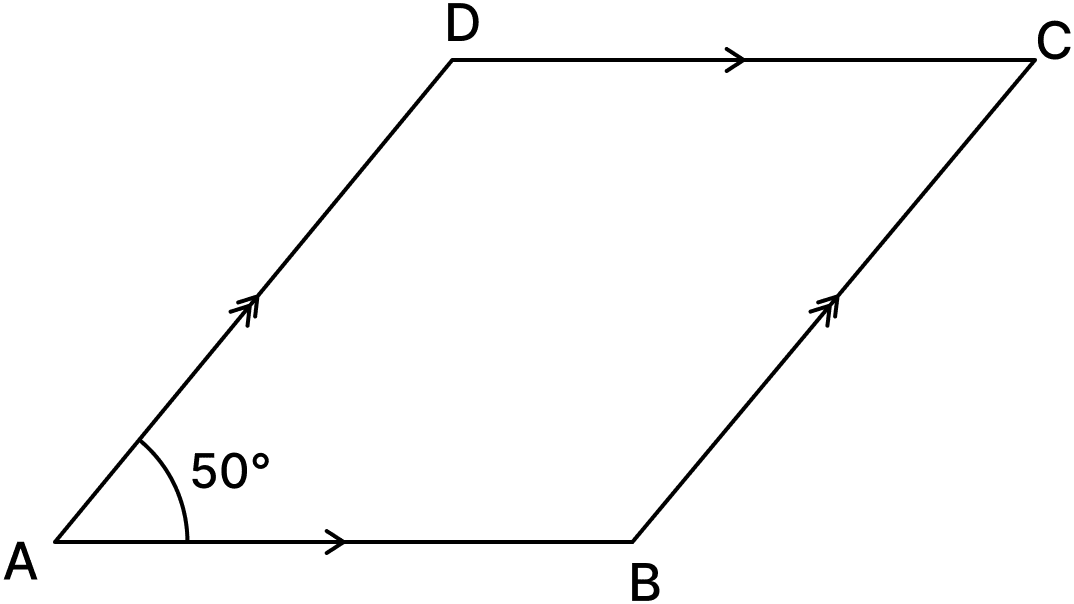
In the adjoining figure, ABCD is a parallelogram in which ∠A = 50°. Find the measure of each of the remaining angles of the parallelogram.
Answer
Given,
ABCD is a parallelogram in which ∠A = 50°.
As AD ∥ BC and AB cuts them, ∠A and ∠B are co-interior angles.
⇒ ∠A + ∠B = 180° [Co-interior angles]
⇒ 50° + ∠B = 180°
⇒ ∠B = (180° − 50°) = 130°
Since the opposite angles of a parallelogram are equal, we have :
⇒ ∠C = ∠A = 50° and ∠D = ∠B = 130°
Hence, ∠B = 130°, ∠C = 50° and ∠D = 130°.
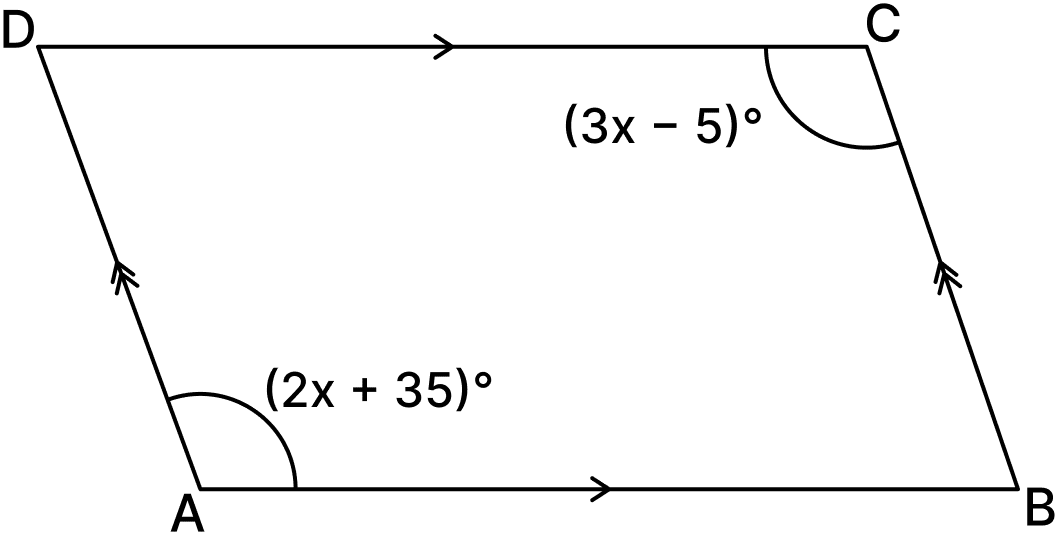
In a parallelogram ABCD, if ∠A = and ∠C = . Find : (i) the value of (ii) measure of each angle of ABCD.
Answer
Given,
In parallelogram ABCD, ∠A = and ∠C = .
(i) Since the opposite angles of a parallelogram are equal, we have :
⇒ ∠A = ∠C
Hence, .
(ii) ∠A = (2 × 40 + 35)° = (80 + 35)° = 115° and ∠C = (3 × 40 − 5)° = (120 − 5)° = 115°
We know that ∠B = ∠D [Opposite angles of a parallelogram]
Now, ∠A + ∠B + ∠C + ∠D = 360° [Sum of the angles of a quadrilateral is 360°]
⇒ 115° + ∠B + 115° + ∠B = 360°
⇒ 230° + 2∠B = 360°
⇒ 2∠B = (360° − 230°) = 130°
⇒ ∠B = = 65°
∴ ∠D = ∠B = 65°
Hence, ∠A = 115°, ∠B = 65°, ∠C = 115°, ∠D = 65°.
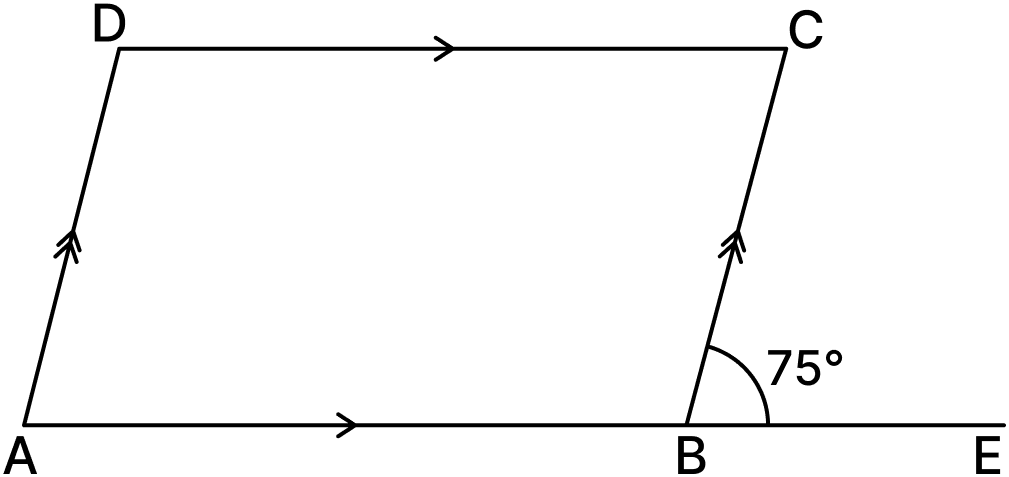
In the adjoining figure, side AB of parallelogram ABCD has been produced to E. If ∠CBE = 75°, find the measure of each angle of the parallelogram.
Answer
Given,
ABCD is a parallelogram in which the side AB has been produced to E and ∠CBE = 75°.
As AB is produced to E, ∠ABC and ∠CBE form a linear pair.
⇒ ∠ABC + ∠CBE = 180°
⇒ ∠ABC + 75° = 180°
⇒ ∠ABC = (180° − 75°) = 105°
Since the opposite angles of a parallelogram are equal, we have :
⇒ ∠ADC = ∠ABC = 105°
As AB ∥ DC and BC cuts them, ∠ABC and ∠BCD are co-interior angles.
⇒ ∠ABC + ∠BCD = 180° [Co-interior angles]
⇒ 105° + ∠BCD = 180°
⇒ ∠BCD = (180° − 105°) = 75°
∴ ∠BAD = ∠BCD = 75° [Opposite angles of a parallelogram]
Hence, ∠ABC = 105°, ∠ADC = 105°, ∠BCD = 75° and ∠BAD = 75°.
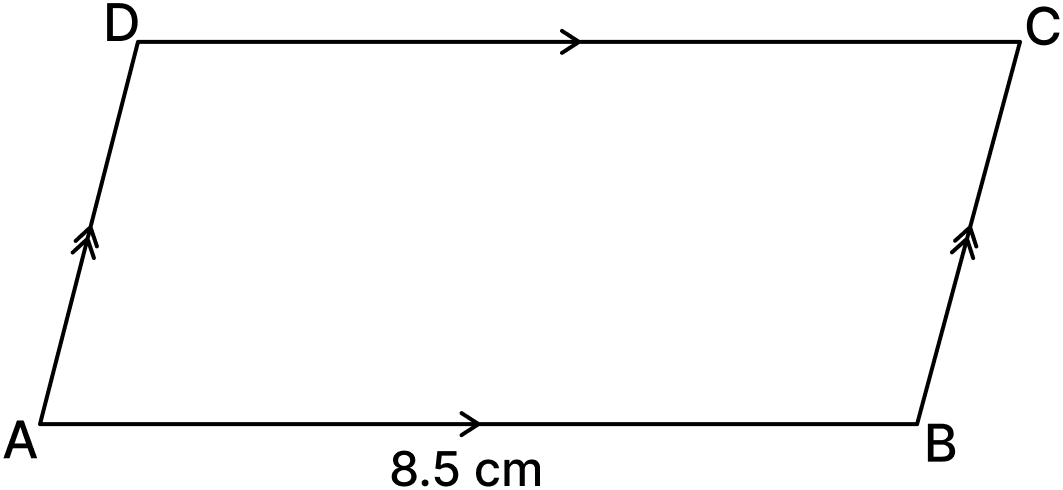
In the given figure, ABCD is a parallelogram in which AB = 8.5 cm and its perimeter is 24 cm. Find the length of each of its remaining sides.
Answer
Given,
ABCD is a parallelogram in which AB = 8.5 cm and its perimeter is 24 cm.
Since the opposite sides of a parallelogram are equal, we have :
⇒ CD = AB and AD = BC
Now, perimeter of parallelogram ABCD = AB + BC + CD + AD
⇒ 24 = AB + BC + AB + BC
⇒ 24 = 2(AB + BC)
⇒ AB + BC = 12
⇒ 8.5 + BC = 12
⇒ BC = (12 − 8.5) = 3.5 cm
∴ CD = AB = 8.5 cm and AD = BC = 3.5 cm
Hence, BC = 3.5 cm, CD = 8.5 cm and AD = 3.5 cm.
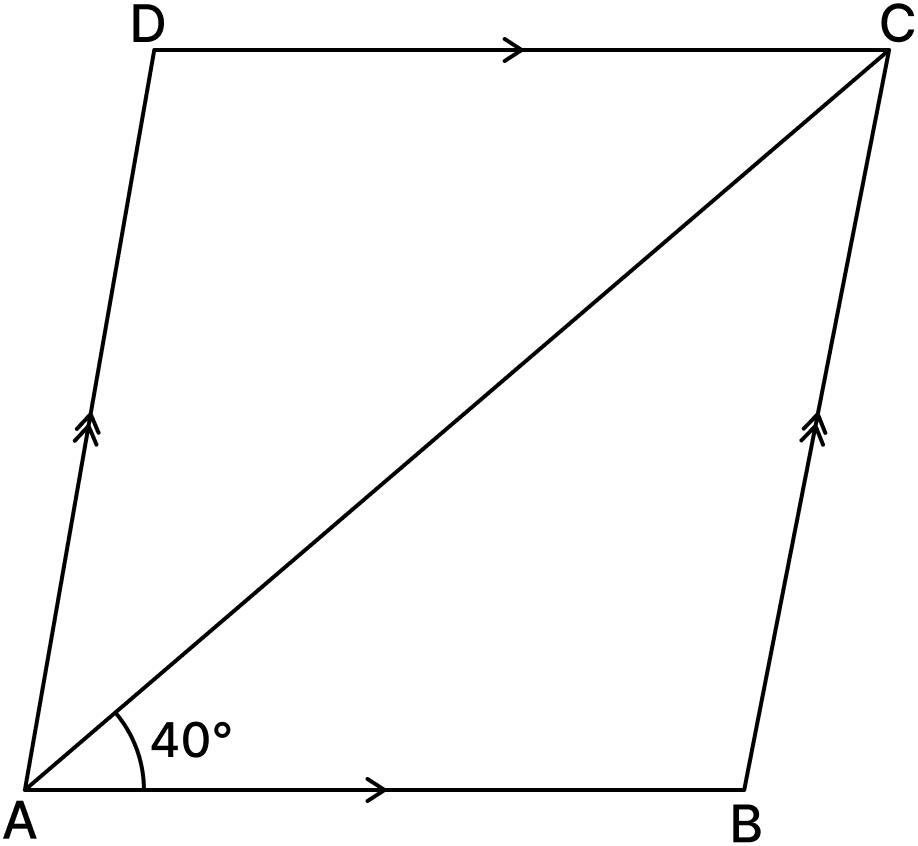
In the adjoining figure, ABCD is a rhombus in which ∠BAC = 40°. Find the measures of :
(i) ∠ACB
(ii) ∠ABC
(iii) ∠ADC
(iv) ∠ACD
(v) ∠CAD
Answer
Given,
ABCD is a rhombus in which ∠BAC = 40°.
(i) Since all the sides of a rhombus are equal, in ΔABC we have AB = BC.
⇒ ∠ACB = ∠BAC = 40° [Angles opposite to equal sides are equal]
Hence, ∠ACB = 40°.
(ii) In ΔABC, we have :
⇒ ∠BAC + ∠ACB + ∠ABC = 180° [Sum of the angles of a triangle is 180°]
⇒ 40° + 40° + ∠ABC = 180°
⇒ 80° + ∠ABC = 180°
⇒ ∠ABC = (180° − 80°) = 100°
Hence, ∠ABC = 100°.
(iii) ∠ADC = ∠ABC = 100° [Opposite angles of a parallelogram]
Hence, ∠ADC = 100°.
(iv) As AB ∥ DC and BC cuts them, ∠ABC and ∠BCD are co-interior angles.
⇒ ∠ABC + ∠BCD = 180° [Co-interior angles]
⇒ 100° + ∠BCD = 180°
⇒ ∠BCD = (180° − 100°) = 80°
The diagonals of a rhombus bisect its angles, so AC bisects ∠BCD.
⇒ ∠ACD = ∠BCD
⇒ ∠ACD = × 80° = 40°
Hence, ∠ACD = 40°.
(v) ∠BAD = ∠BCD = 80° [Opposite angles of a parallelogram]
The diagonal AC bisects ∠BAD.
⇒ ∠CAD = ∠BAD
⇒ ∠CAD = × 80° = 40°
Hence, ∠CAD = 40°.
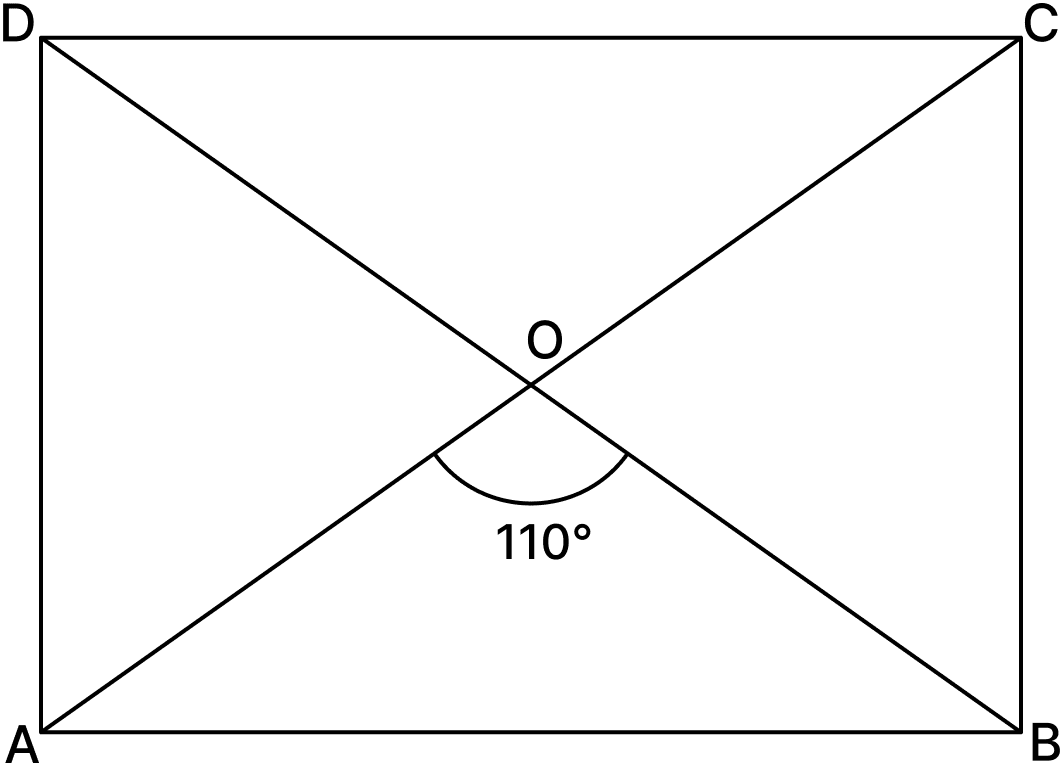
In the adjoining figure, ABCD is a rectangle whose diagonals AC and BD intersect at O. If ∠AOB = 110°, find the measure of :
(i) ∠ODA and (ii) ∠OCD.
Answer
Given,
ABCD is a rectangle whose diagonals AC and BD intersect at O and ∠AOB = 110°.
(i) As ∠AOD and ∠AOB form a linear pair, we have :
⇒ ∠AOD + ∠AOB = 180°
⇒ ∠AOD + 110° = 180°
⇒ ∠AOD = (180° − 110°) = 70°
We know that the diagonals of a rectangle are equal and bisect each other. Then, OA = AC and OD = BD.
We have,
⇒ AC = BD
⇒ AC = BD
⇒ OA = OD
In ΔOAD, OA = OD, so ∠OAD = ∠ODA [Angles opposite to equal sides are equal]
Now, ∠OAD + ∠ODA + ∠AOD = 180° [Sum of the angles of a triangle is 180°]
⇒ ∠ODA + ∠ODA + 70° = 180° [∵ ∠OAD = ∠ODA]
⇒ 2∠ODA + 70° = 180°
⇒ 2∠ODA = (180° − 70°) = 110°
⇒ ∠ODA = = 55°
Hence, ∠ODA = 55°.
(ii) ∠COD = ∠AOB = 110° [Vertically opposite angles]
We know that the diagonals of a rectangle are equal and bisect each other. Then, OC = AC and OD = BD.
We have,
⇒ AC = BD
⇒ AC = BD
⇒ OC = OD
In ΔOCD, OC = OD, so ∠OCD = ∠ODC [Angles opposite to equal sides are equal]
Now, ∠OCD + ∠ODC + ∠COD = 180° [Sum of the angles of a triangle is 180°]
⇒ ∠OCD + ∠OCD + 110° = 180° [∵ ∠ODC = ∠OCD]
⇒ 2∠OCD + 110° = 180°
⇒ 2∠OCD = (180° − 110°) = 70°
⇒ ∠OCD = = 35°
Hence, ∠OCD = 35°.
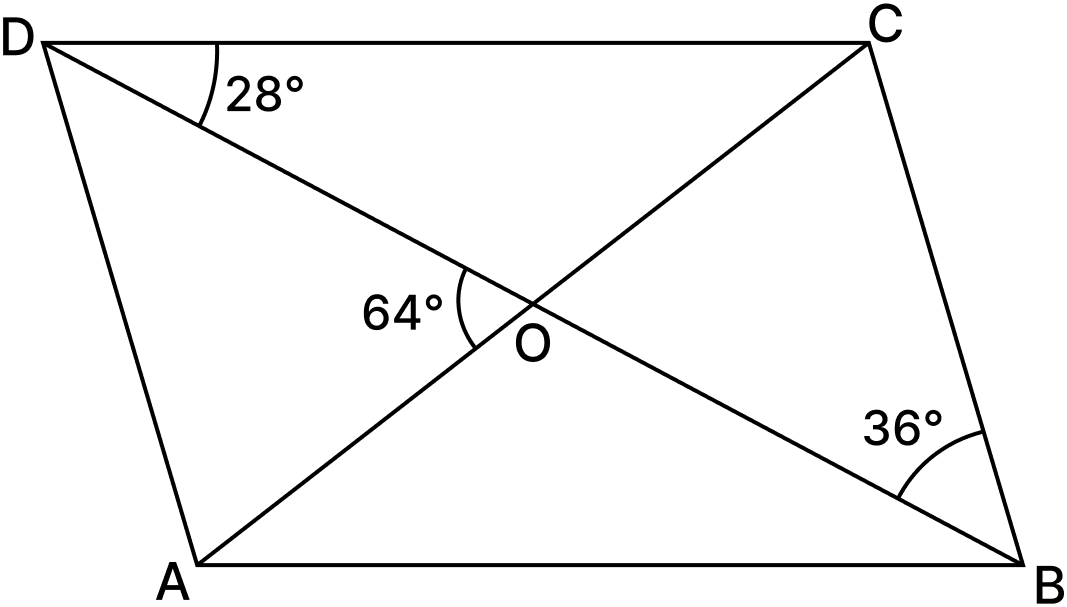
In the adjoining figure, the diagonals AC and BD of parallelogram ABCD intersect at O. If ∠OBC = 36°, ∠ODC = 28° and ∠AOD = 64°; find the measure of
(i) ∠OAD
(ii) ∠OCD.
Answer
Given,
The diagonals AC and BD of parallelogram ABCD intersect at O, ∠OBC = 36°, ∠ODC = 28° and ∠AOD = 64°.
(i) As AD ∥ BC and BD cuts them, we have :
⇒ ∠ADB = ∠DBC = 36° [Alternate angles]
i.e., ∠ODA = 36°
In ΔAOD, we have :
⇒ ∠OAD + ∠ODA + ∠AOD = 180° [Sum of the angles of a triangle is 180°]
⇒ ∠OAD + 36° + 64° = 180°
⇒ ∠OAD + 100° = 180°
⇒ ∠OAD = (180° − 100°) = 80°
Hence, ∠OAD = 80°.
(ii) As ∠DOC and ∠AOD form a linear pair, we have :
⇒ ∠DOC + ∠AOD = 180°
⇒ ∠DOC + 64° = 180°
⇒ ∠DOC = (180° − 64°) = 116°
In ΔDOC, we have :
⇒ ∠OCD + ∠ODC + ∠DOC = 180° [Sum of the angles of a triangle is 180°]
⇒ ∠OCD + 28° + 116° = 180°
⇒ ∠OCD + 144° = 180°
⇒ ∠OCD = (180° − 144°) = 36°
Hence, ∠OCD = 36°.
In a square ABCD, if AB = cm and BC = cm, find the value of . Also, find the length of each side of the square.
Answer
Given,
In square ABCD, AB = cm and BC = cm.
Since all the sides of a square are equal, we have :
∴ Each side of the square = AB = (3 × 7 − 8) cm = (21 − 8) cm = 13 cm
Hence, and the length of each side of the square is 13 cm.
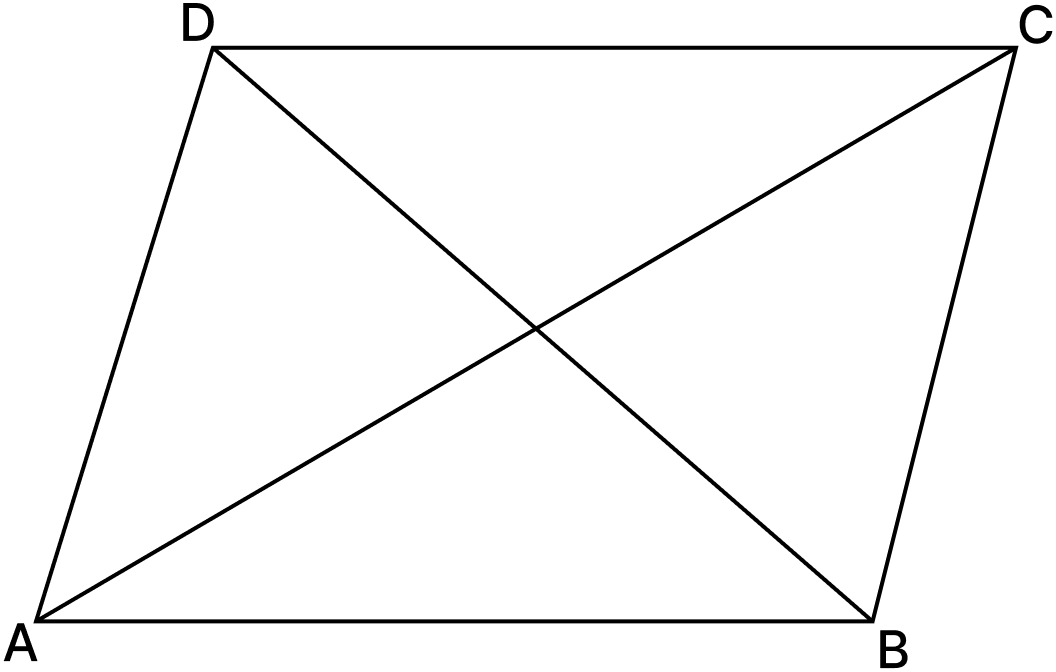
If the diagonals of a parallelogram are equal in length, show that the parallelogram is a rectangle.
Answer
Given,
ABCD is a parallelogram in which the diagonals AC and BD are equal, i.e., AC = BD.
In ΔABC and ΔBAD, we have :
AC = BD [Given]
BC = AD [Opposite sides of a parallelogram]
AB = BA [Common]
∴ ΔABC ≅ ΔBAD [S.S.S. axiom]
⇒ ∠ABC = ∠BAD [c.p.c.t.]
i.e., ∠B = ∠A
But, AD ∥ BC and AB cuts them, so we have :
⇒ ∠A + ∠B = 180° [Co-interior angles]
⇒ ∠A + ∠A = 180°
⇒ 2∠A = 180°
⇒ ∠A = = 90°
∴ ∠B = ∠A = 90°
Also, ∠C = ∠A = 90° and ∠D = ∠B = 90° [Opposite angles of a parallelogram]
Thus, ABCD is a parallelogram each of whose angles measures 90°.
Hence, the parallelogram is a rectangle.
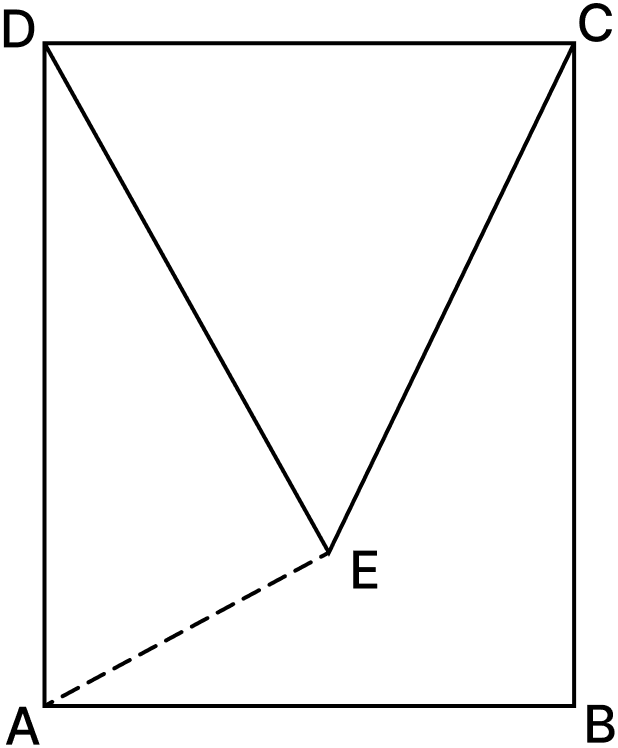
In the adjoining figure, ABCD is a square and CDE is an equilateral triangle. Find
(i) ∠AED
(ii) ∠EAB
(iii) reflex ∠AEC
Answer
Given,
ABCD is a square and CDE is an equilateral triangle.
(i) AD = DC [Sides of a square] and DC = DE [Sides of an equilateral triangle]
⇒ AD = DE
Also, ∠ADC = 90° [Each angle of a square = 90°] and ∠EDC = 60° [Each angle of an equilateral triangle = 60°]
⇒ ∠ADE = ∠ADC − ∠EDC = (90° − 60°) = 30°
In ΔADE, AD = DE, so ∠AED = ∠DAE [Angles opposite to equal sides are equal]
Now, ∠ADE + ∠AED + ∠DAE = 180° [Sum of the angles of a triangle is 180°]
⇒ 30° + ∠AED + ∠AED = 180° [∵ ∠DAE = ∠AED]
⇒ 30° + 2∠AED = 180°
⇒ 2∠AED = (180° − 30°) = 150°
⇒ ∠AED = = 75°
Hence, ∠AED = 75°.
(ii) ∠DAE = ∠AED = 75°
Also, ∠DAB = 90° [Each angle of a square = 90°]
⇒ ∠EAB = ∠DAB − ∠DAE = (90° − 75°) = 15°
Hence, ∠EAB = 15°.
(iii) ∠AEC = ∠AED + ∠DEC = (75° + 60°) = 135°
⇒ reflex ∠AEC = (360° − 135°) = 225°
Hence, reflex ∠AEC = 225°.
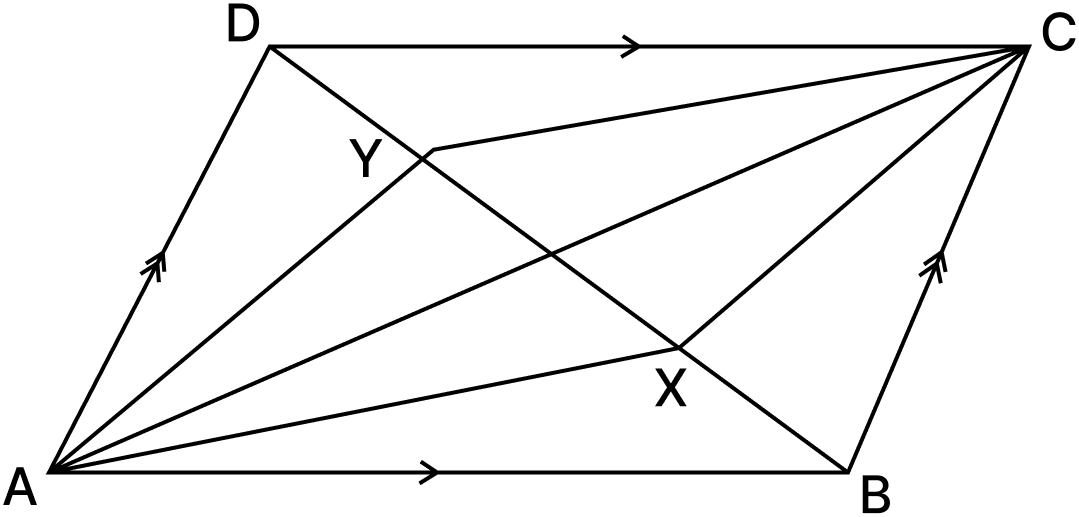
In the adjoining figure, ABCD is a parallelogram and AX ∥ CY. Prove that:
(i) AX = CY
(ii) AXCY is a parallelogram.
Answer
Given,
ABCD is a parallelogram in which X and Y are points on the diagonal BD such that AX ∥ CY.
(i) In ΔABX and ΔCDY, we have :
∠ABX = ∠CDY [Alternate angles, as AB ∥ DC and BD is a transversal]
∠AXB = ∠CYD [Alternate angles, as AX ∥ CY and BD is a transversal]
AB = CD [Opposite sides of a parallelogram]
∴ ΔABX ≅ ΔCDY [A.A.S. axiom]
⇒ AX = CY [c.p.c.t.]
Hence, AX = CY.
(ii) AX ∥ CY [Given]
and AX = CY [Proved above]
Thus, in quadrilateral AXCY, one pair of opposite sides is equal and parallel.
Hence, AXCY is a parallelogram.
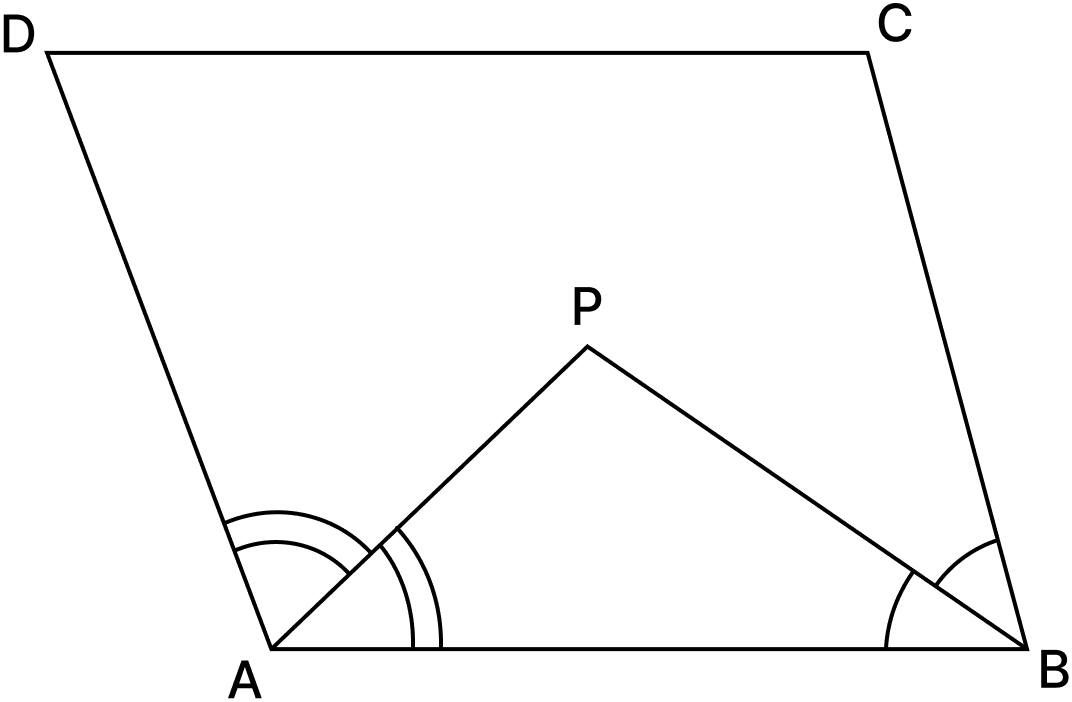
In the adjoining figure, ABCD is a parallelogram and ∠A = 120°. If the bisectors of ∠A and ∠B meet at a point P, show that ∠APB is a right angle.
Answer
Given,
ABCD is a parallelogram in which ∠A = 120° and the bisectors of ∠A and ∠B meet at P.
As AD ∥ BC and AB cuts them, we have :
⇒ ∠A + ∠B = 180° [Co-interior angles]
⇒ 120° + ∠B = 180°
⇒ ∠B = (180° − 120°) = 60°
As AP bisects ∠A, we have :
⇒ ∠PAB = × 120° = 60°
As BP bisects ∠B, we have :
⇒ ∠ABP = × 60° = 30°
In ΔAPB, we have :
⇒ ∠PAB + ∠ABP + ∠APB = 180° [Sum of the angles of a triangle is 180°]
⇒ 60° + 30° + ∠APB = 180°
⇒ 90° + ∠APB = 180°
⇒ ∠APB = (180° − 90°) = 90°
Hence, ∠APB is a right angle.
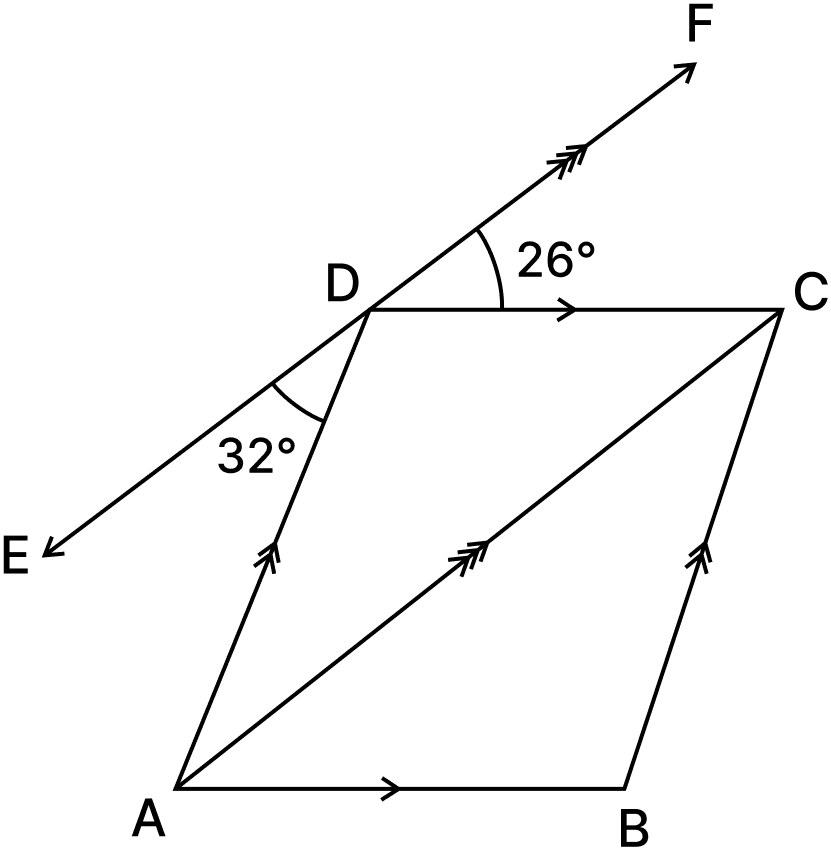
In the adjoining figure, ABCD is a parallelogram and EF is a line segment such that EF ∥ AC.
If ∠ADE = 32° and ∠CDF = 26°, find the measure of ∠ABC.
Answer
Given,
ABCD is a parallelogram and EF is a line segment through D such that EF ∥ AC, ∠ADE = 32° and ∠CDF = 26°.
As EF ∥ AC and AD is a transversal, we have :
⇒ ∠DAC = ∠ADE = 32° [Alternate angles are equal]
As EF ∥ AC and DC is a transversal, we have :
⇒ ∠DCA = ∠CDF = 26° [Alternate angles are equal]
In ΔADC, we have :
⇒ ∠DAC + ∠DCA + ∠ADC = 180° [Sum of the angles of a triangle is 180°]
⇒ 32° + 26° + ∠ADC = 180°
⇒ 58° + ∠ADC = 180°
⇒ ∠ADC = (180° − 58°) = 122°
∴ ∠ABC = ∠ADC = 122° [Opposite angles of a parallelogram]
Hence, ∠ABC = 122°.
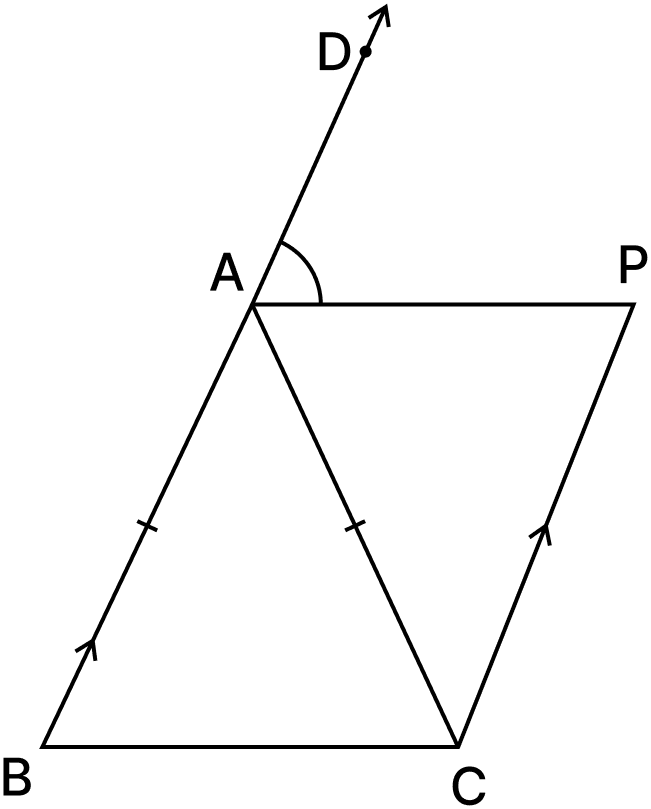
In the adjoining figure, AB = AC, CP ∥ BA and AP is the bisector of ∠CAD.
Prove that :
(i) ∠PAC = ∠BCA
(ii) ABCP is a parallelogram.
Answer
Given,
AB = AC, CP ∥ BA and AP is the bisector of ∠CAD.
(i) In ΔABC, AB = AC.
⇒ ∠ABC = ∠ACB [Angles opposite to equal sides are equal]
As ∠CAD is the exterior angle of ΔABC at A, we have :
⇒ ∠CAD = ∠ABC + ∠ACB [Exterior angle property of a triangle]
⇒ ∠CAD = ∠ACB + ∠ACB = 2∠ACB
As AP bisects ∠CAD, we have :
⇒ ∠PAC = ∠CAD = × 2∠ACB = ∠ACB = ∠BCA
Hence, ∠PAC = ∠BCA.
(ii) ∠PAC and ∠BCA are the alternate angles formed when AP and BC are cut by the transversal AC.
⇒ AP ∥ BC
Also, CP ∥ BA [Given]
Thus, in quadrilateral ABCP, both the pairs of opposite sides are parallel.
Hence, ABCP is a parallelogram.
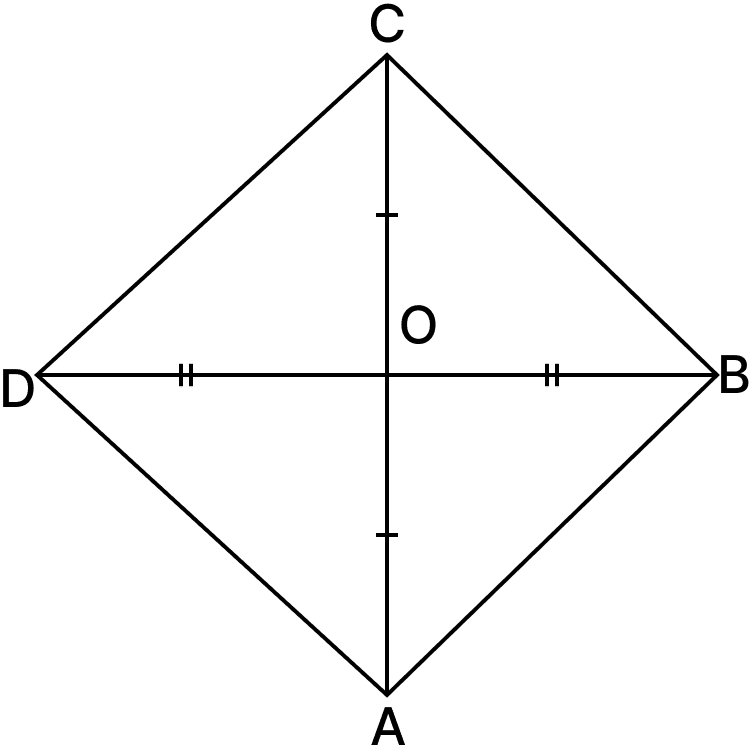
The diagonals AC and BD of a rhombus intersect each other at O. Prove that:
AB2 + BC2 + CD2 + DA2 = 4(OA2 + OB2)
Answer
Given,
The diagonals AC and BD of a rhombus ABCD intersect each other at O.
We know that the diagonals of a rhombus bisect each other at right angles.
⇒ OA = OC, OB = OD and ∠AOB = ∠BOC = ∠COD = ∠DOA = 90°
In right angled ΔAOB, by Pythagoras theorem, we have :
⇒ AB2 = OA2 + OB2
Similarly, in right angled ΔBOC, ΔCOD and ΔDOA, we have :
⇒ BC2 = OB2 + OC2 = OB2 + OA2 [∵ OC = OA]
⇒ CD2 = OC2 + OD2 = OA2 + OB2 [∵ OC = OA and OD = OB]
⇒ DA2 = OD2 + OA2 = OB2 + OA2 [∵ OD = OB]
Adding all of them, we get :
⇒ AB2 + BC2 + CD2 + DA2 = (OA2 + OB2) + (OB2 + OA2) + (OA2 + OB2) + (OB2 + OA2)
⇒ AB2 + BC2 + CD2 + DA2 = 4OA2 + 4OB2
⇒ AB2 + BC2 + CD2 + DA2 = 4(OA2 + OB2)
Hence, AB2 + BC2 + CD2 + DA2 = 4(OA2 + OB2).
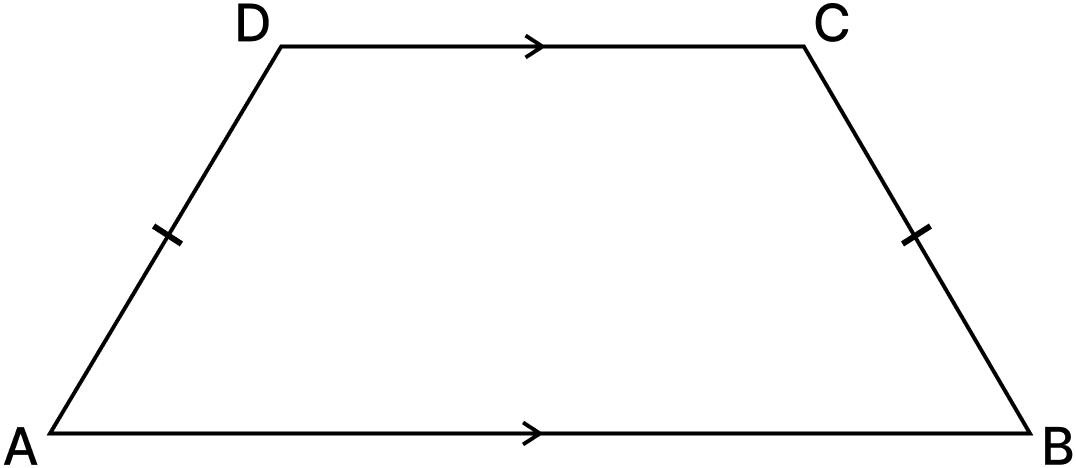
In an isosceles trapezium, prove that the opposite angles are supplementary.
Answer
Let ABCD be an isosceles trapezium in which AB ∥ DC and AD = BC.
We know that the angles on the same base of an isosceles trapezium are equal.
⇒ ∠A = ∠B and ∠C = ∠D
As AB ∥ DC and AD cuts them, we have :
⇒ ∠A + ∠D = 180° [Co-interior angles]
As AB ∥ DC and BC cuts them, we have :
⇒ ∠B + ∠C = 180° [Co-interior angles]
Now, ∠A + ∠C = ∠B + ∠C [∵ ∠A = ∠B]
⇒ ∠A + ∠C = 180° [∵ ∠B + ∠C = 180°]
Also, ∠B + ∠D = ∠A + ∠D [∵ ∠B = ∠A]
⇒ ∠B + ∠D = 180° [∵ ∠A + ∠D = 180°]
Here, (∠A, ∠C) and (∠B, ∠D) are the two pairs of opposite angles of the trapezium.
Hence, in an isosceles trapezium the opposite angles are supplementary.
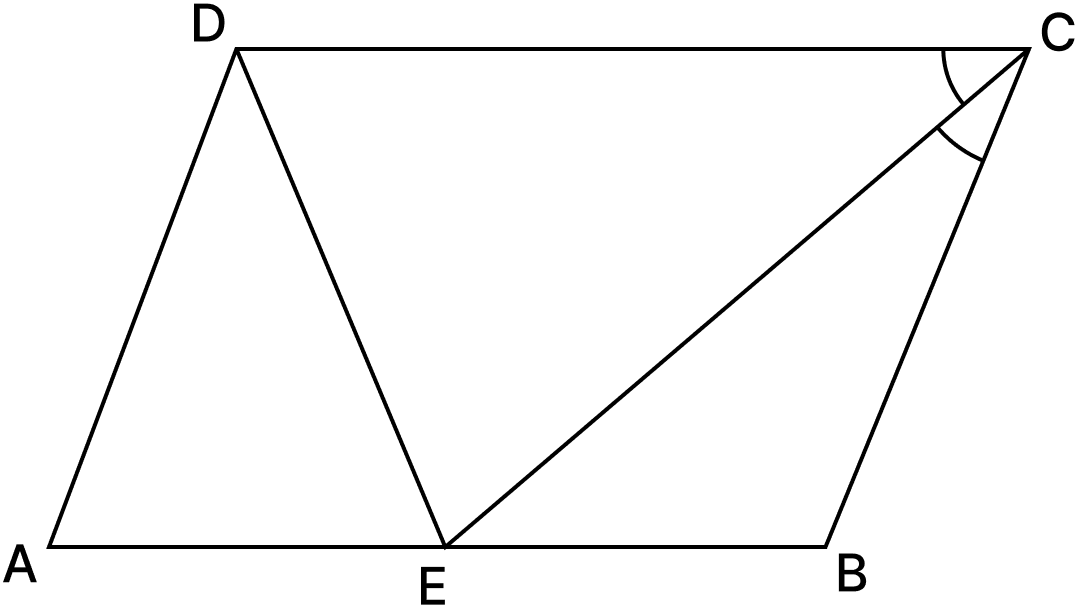
In the adjoining figure, ABCD is a parallelogram, E is the mid-point of AB and CE bisects ∠BCD. Prove that :
(i) AE = AD
(ii) DE bisects ∠ADC
(iii) ∠DEC = 90°.
Answer
Given,
ABCD is a parallelogram, E is the mid-point of AB and CE bisects ∠BCD.
(i) As AB ∥ DC and CE cuts them, we have :
⇒ ∠BEC = ∠ECD [Alternate angles are equal]
As CE bisects ∠BCD, we have :
⇒ ∠ECD = ∠ECB
⇒ ∠BEC = ∠ECB
In ΔBEC, ∠BEC = ∠ECB.
⇒ EB = BC [Sides opposite to equal angles are equal]
As E is the mid-point of AB, we have AE = EB.
Also, AD = BC [Opposite sides of a parallelogram]
⇒ AE = EB = BC = AD
Hence, AE = AD.
(ii) In ΔADE, AE = AD.
⇒ ∠ADE = ∠AED [Angles opposite to equal sides are equal]
As AB ∥ DC and DE cuts them, we have :
⇒ ∠AED = ∠EDC [Alternate angles are equal]
⇒ ∠ADE = ∠EDC
Hence, DE bisects ∠ADC.
(iii) As AD ∥ BC and DC cuts them, we have :
⇒ ∠ADC + ∠BCD = 180° [Co-interior angles]
⇒ (∠ADC) + (∠BCD) = 90°
⇒ ∠EDC + ∠DCE = 90°
In ΔDEC, we have :
⇒ ∠EDC + ∠DCE + ∠DEC = 180° [Sum of the angles of a triangle is 180°]
⇒ 90° + ∠DEC = 180°
⇒ ∠DEC = 180° - 90° = 90°
Hence, ∠DEC = 90°.
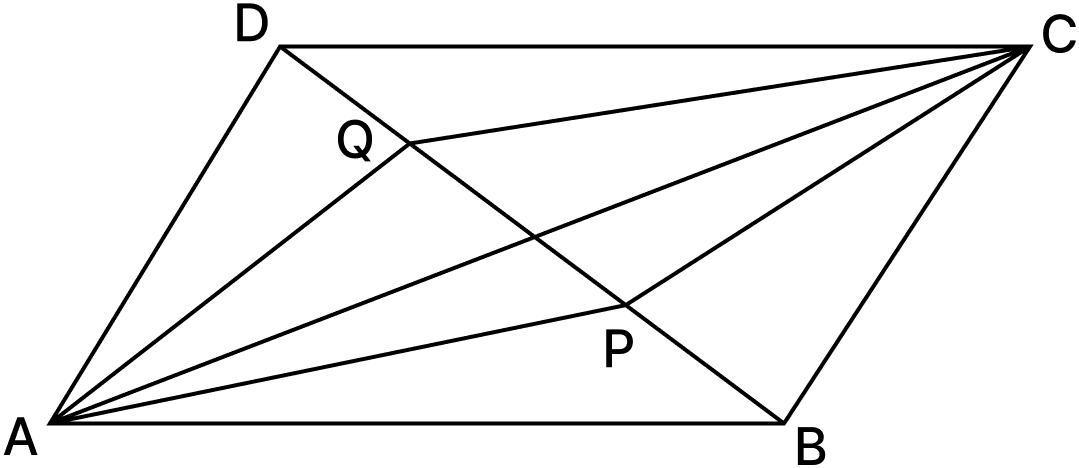
P and Q are points of trisection of the diagonal BD of a parallelogram ABCD. Prove that CQ ∥ AP.
Answer
Given,
P and Q are the points of trisection of the diagonal BD of a parallelogram ABCD.
In the given figure, let the diagonals AC and BD intersect at O.
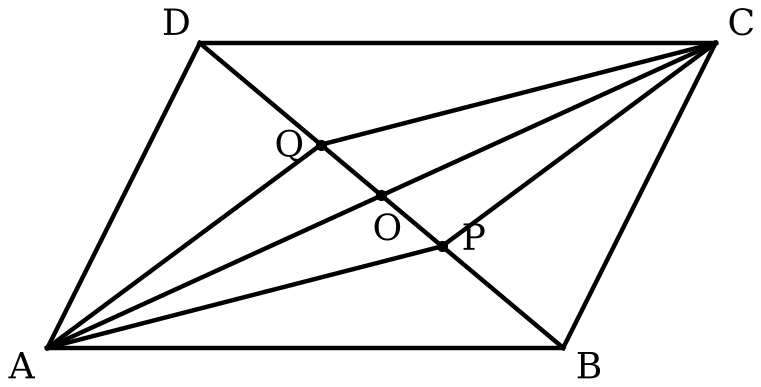
We know that the diagonals of a parallelogram bisect each other.
⇒ OA = OC and OB = OD .....(1)
As P and Q are the points of trisection of BD, we have :
⇒ BP = PQ = QD = (BD)
⇒ BP = DQ .....(2)
Now, OP = OB − BP and OQ = OD − DQ
From (1) and (2), OB = OD and BP = DQ.
⇒ OB − BP = OD − DQ
⇒ OP = OQ .....(3)
In quadrilateral APCQ, the diagonals AC and PQ intersect at O.
From (1), OA = OC, so O is the mid-point of AC.
From (3), OP = OQ, so O is the mid-point of PQ.
Thus, the diagonals AC and PQ of quadrilateral APCQ bisect each other.
⇒ APCQ is a parallelogram [A quadrilateral whose diagonals bisect each other is a parallelogram]
⇒ CQ ∥ AP [Opposite sides of a parallelogram are parallel]
Hence, CQ ∥ AP.
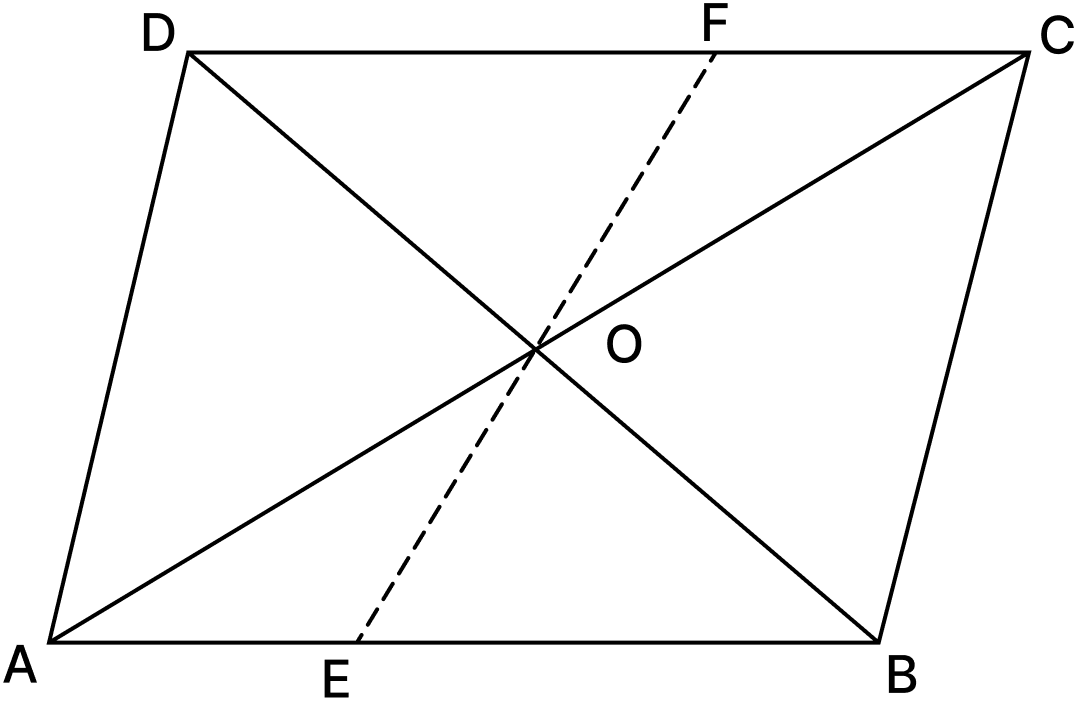
In the adjoining figure, ABCD is a parallelogram whose diagonals intersect at O. A line segment EOF is drawn to meet AB at E and DC at F. Prove that OE = OF.
Answer
Given,
ABCD is a parallelogram whose diagonals intersect at O and EOF is a line segment meeting AB at E and DC at F.
In ΔOAE and ΔOCF, we have :
∠OAE = ∠OCF [Alternate angles, as AB ∥ DC and AC is a transversal]
OA = OC [Diagonals of a parallelogram bisect each other]
∠AOE = ∠COF [Vertically opposite angles]
∴ ΔOAE ≅ ΔOCF [A.S.A. axiom]
⇒ OE = OF [c.p.c.t.]
Hence, OE = OF.
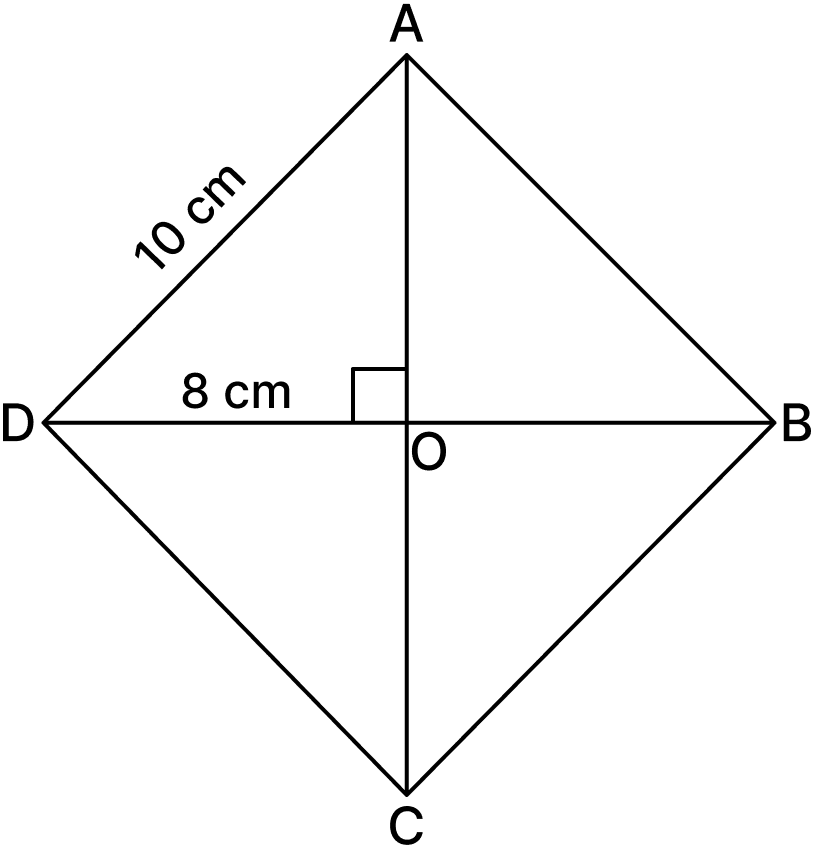
Each side of a rhombus is 10 cm long and one of its diagonals measures 16 cm. Find the length of the other diagonal.
Answer
Let ABCD be a rhombus whose diagonals AC and BD intersect at O.
Then, AB = 10 cm and BD = 16 cm.
We know that the diagonals of a rhombus bisect each other at right angles.
⇒ OB = OD = = 8 cm and ∠AOB = 90°
In right angled ΔAOB, by Pythagoras theorem, we have :
⇒ AB2 = OA2 + OB2
⇒ (10)2 = OA2 + (8)2
⇒ 100 = OA2 + 64
⇒ OA2 = (100 − 64) = 36
⇒ OA = = 6 cm
∴ AC = 2 × OA = (2 × 6) cm = 12 cm
Hence, the length of the other diagonal is 12 cm.
Which of the following statements are true?
(i) Every square is a rectangle.
(ii) Every square is a rhombus.
(iii) Every rectangle is a parallelogram.
(iv) Every parallelogram is a rhombus.
(v) Every rhombus is a square.
(vi) The diagonals of a parallelogram are equal.
(vii) The diagonals of a parallelogram bisect each other at right angles.
Answer
(i) Every square is a rectangle.
A square is a parallelogram each of whose angles measures 90°, which is exactly the definition of a rectangle.
⇒ The statement is true.
(ii) Every square is a rhombus.
A square is a parallelogram having all its sides equal, which is exactly the definition of a rhombus.
⇒ The statement is true.
(iii) Every rectangle is a parallelogram.
In a rectangle, each angle measures 90°, so both the pairs of opposite angles are equal.
A quadrilateral in which both the pairs of opposite angles are equal is a parallelogram. So, every rectangle is a parallelogram.
⇒ The statement is true.
(iv) Every parallelogram is a rhombus.
In a parallelogram, the opposite sides are equal, but the adjacent sides need not be equal, whereas in a rhombus all the four sides are equal.
So, a parallelogram is a rhombus only when its adjacent sides are equal. Thus, every parallelogram need not be a rhombus.
⇒ The statement is false.
(v) Every rhombus is a square.
In a rhombus the angles need not measure 90°, whereas in a square each angle measures 90°.
⇒ The statement is false.
(vi) The diagonals of a parallelogram are equal.
The diagonals of a parallelogram bisect each other but they are not equal, except when the parallelogram is a rectangle or a square.
⇒ The statement is false.
(vii) The diagonals of a parallelogram bisect each other at right angles.
The diagonals of a parallelogram bisect each other, but not at right angles, except when the parallelogram is a rhombus or a square.
⇒ The statement is false.
Hence, the statements (i), (ii) and (iii) are true.