Three angles of a quadrilateral measure 68°, 74° and 108° respectively. Find the measure of the fourth angle.
Answer
Let the measure of the fourth angle be x°.
We know that the sum of the angles of a quadrilateral is 360°. Then,
⇒68°+74°+108°+x°=360°⇒250°+x°=360°⇒x°=360°−250°⇒x°=110°
Hence, the measure of the fourth angle is 110°.
The angles of a quadrilateral are in the ratio 4 : 3 : 2 : 6. Find the measure of each angle.
Answer
Let the measures of the angles of the given quadrilateral be (4x)°,(3x)°,(2x)° and (6x)° respectively.
We know that the sum of the angles of a quadrilateral is 360°. Then,
⇒(4x)°+(3x)°+(2x)°+(6x)°=360°⇒(15x)°=360°⇒x°=15360°⇒x°=24°
∴ First angle = (4x)° = (4 × 24)° = 96°
Second angle = (3x)° = (3 × 24)° = 72°
Third angle = (2x)° = (2 × 24)° = 48°
Fourth angle = (6x)° = (6 × 24)° = 144°
Hence, the angles of the quadrilateral are 96°, 72°, 48° and 144°.
Three angles of a quadrilateral are in the ratio 2 : 5 : 6. If the fourth angle measures 100°, find the other three angles of the quadrilateral.
Answer
Let the measures of the three angles of the given quadrilateral be (2x)°,(5x)° and (6x)° respectively, and the fourth angle measures 100°.
We know that the sum of the angles of a quadrilateral is 360°. Then,
⇒(2x)°+(5x)°+(6x)°+100°=360°⇒(13x)°+100°=360°⇒(13x)°=360°−100°⇒(13x)°=260°⇒x°=13260°⇒x°=20°
∴ First angle = (2x)° = (2 × 20)° = 40°
Second angle = (5x)° = (5 × 20)° = 100°
Third angle = (6x)° = (6 × 20)° = 120°
Hence, the other three angles of the quadrilateral are 40°, 100° and 120°.
Two angles of a quadrilateral are 72° and 56° respectively and the remaining two angles are in the ratio 3 : 5. Find the measure of each angle of the quadrilateral.
Answer
Let the measures of the remaining two angles of the given quadrilateral be (3x)° and (5x)° respectively.
We know that the sum of the angles of a quadrilateral is 360°. Then,
⇒72°+56°+(3x)°+(5x)°=360°⇒(8x)°+128°=360°⇒(8x)°=360°−128°⇒(8x)°=232°⇒x°=8232°⇒x°=29°
∴ Third angle = (3x)° = (3 × 29)° = 87°
Fourth angle = (5x)° = (5 × 29)° = 145°
Hence, the angles of the quadrilateral are 72°, 56°, 87° and 145°.
Two angles of a quadrilateral are 116° and 84° and the remaining two angles are equal. What is the measure of each of the equal angles?
Answer
Let the measure of each of the equal angles be x°.
We know that the sum of the angles of a quadrilateral is 360°. Then,
⇒116°+84°+x°+x°=360°⇒(2x)°+200°=360°⇒(2x)°=360°−200°⇒(2x)°=160°⇒x°=2160°⇒x°=80°
Hence, the measure of each of the equal angles is 80°.
Three angles of a quadrilateral are equal and the fourth angle measures 75°. What is the measure of each of the equal angles?
Answer
Let the measure of each of the three equal angles be x°.
We know that the sum of the angles of a quadrilateral is 360°. Then,
⇒x°+x°+x°+75°=360°⇒(3x)°+75°=360°⇒(3x)°=360°−75°⇒(3x)°=285°⇒x°=3285°⇒x°=95°
Hence, the measure of each of the equal angles is 95°.
The angles of a quadrilateral are (5x)°,(3x+10)°,(6x−20)° and (x+25)°. Find (i) the value of x and (ii) the measure of each angle of the quadrilateral.
Answer
(i) We know that the sum of the angles of a quadrilateral is 360°.
⇒(5x)°+(3x+10)°+(6x−20)°+(x+25)°=360°⇒(5x+3x+10+6x−20+x+25)°=360°⇒(15x+15)°=360°⇒(15x)°=360°−15°⇒(15x)°=345°⇒x°=15345°⇒x°=23°
Hence, x=23.
(ii) First angle = (5x)° = (5 × 23)° = 115°
Second angle = (3x+10)° = (3 × 23 + 10)° = (69 + 10)° = 79°
Third angle = (6x−20)° = (6 × 23 − 20)° = (138 − 20)° = 118°
Fourth angle = (x+25)° = (23 + 25)° = 48°
Hence, the angles of the quadrilateral are 115°, 79°, 118° and 48°.
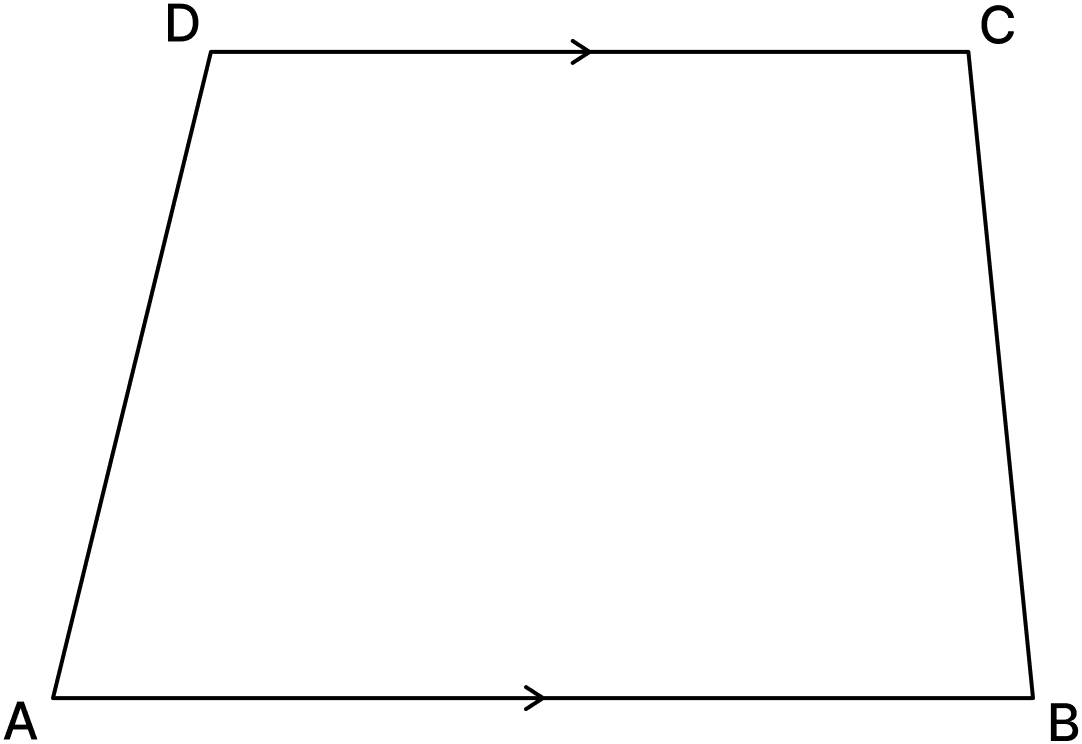
In a quadrilateral ABCD, it is being given that AB ∥ DC. ∠A : ∠D = 2 : 3 and ∠B : ∠C = 4 : 5. Find the measure of each angle of quadrilateral ABCD.
Answer
Given,
In quadrilateral ABCD, AB ∥ DC, ∠A : ∠D = 2 : 3 and ∠B : ∠C = 4 : 5.
Let ∠A = (2x)° and ∠D = (3x)°.
As AB ∥ DC and AD is a transversal, ∠A and ∠D are co-interior angles.
⇒ ∠A + ∠D = 180°
⇒(2x)°+(3x)°=180°⇒(5x)°=180°⇒x°=5180°⇒x°=36°
∴ ∠A = (2 × 36)° = 72° and ∠D = (3 × 36)° = 108°
Again, let ∠B = (4y)° and ∠C = (5y)°.
As AB ∥ DC and BC is a transversal, ∠B and ∠C are co-interior angles.
⇒ ∠B + ∠C = 180°
⇒(4y)°+(5y)°=180°⇒(9y)°=180°⇒y°=9180°⇒y°=20°
∴ ∠B = (4 × 20)° = 80° and ∠C = (5 × 20)° = 100°
Hence, ∠A = 72°, ∠B = 80°, ∠C = 100° and ∠D = 108°.
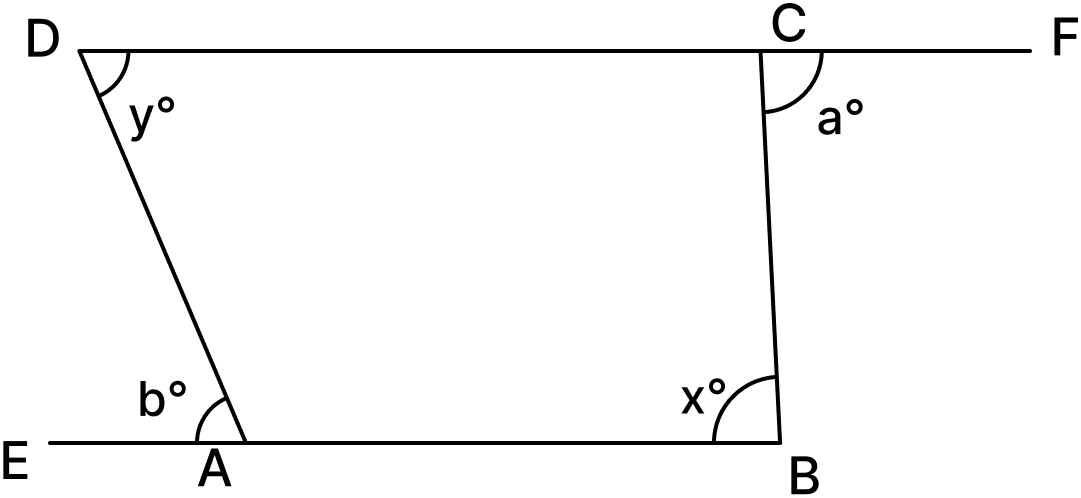
In the adjoining figure, the sides BA and DC of a quadrilateral ABCD have been produced to E and F respectively.
Prove that : a+b=x+y.
Answer
Given,
In quadrilateral ABCD, the side BA is produced to E and the side DC is produced to F.
As BA is produced to E, ∠DAE and ∠DAB form a linear pair.
⇒ b° + ∠A = 180° .....(1)
As DC is produced to F, ∠BCF and ∠BCD form a linear pair.
⇒ a° + ∠C = 180° .....(2)
Adding (1) and (2), we get :
⇒ a°+b° + ∠A + ∠C = 360° .....(3)
Also, in quadrilateral ABCD,
⇒ x°+y° + ∠A + ∠C = 360° [Sum of the angles of a quadrilateral is 360°] .....(4)
From (3) and (4), we get :
⇒ a°+b° + ∠A + ∠C = x°+y° + ∠A + ∠C
⇒ a°+b°=x°+y°
Hence, a+b=x+y.
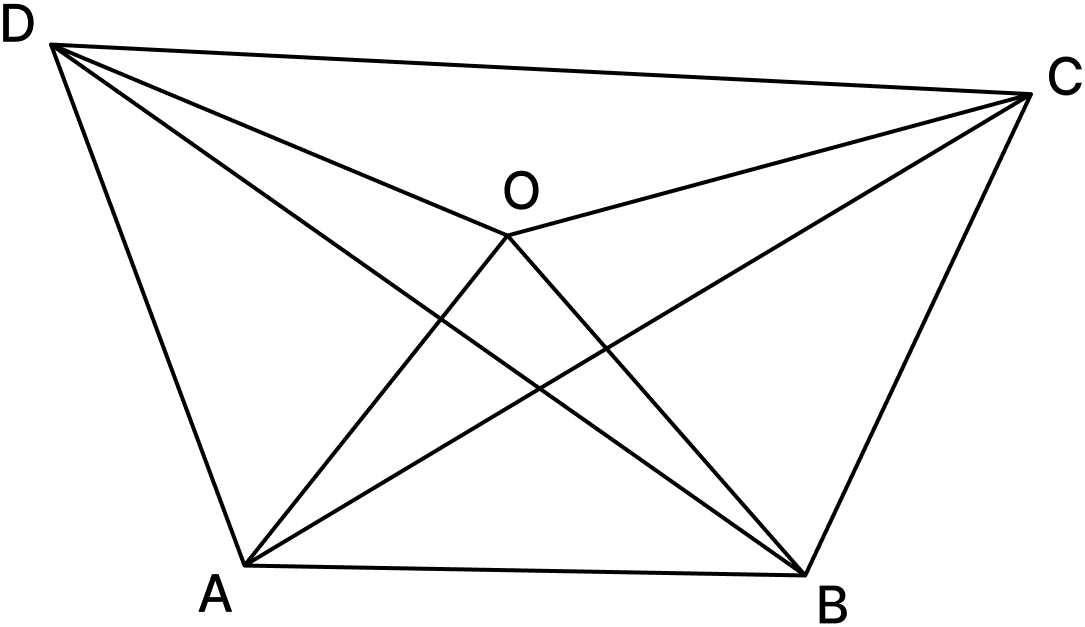
If O is a point within a quadrilateral ABCD, prove that : OA + OB + OC + OD > AC + BD.
Answer
Given,
O is a point within quadrilateral ABCD and AC, BD are its diagonals.
We know that the sum of any two sides of a triangle is greater than the third side.
In ΔOAC, we have :
⇒ OA + OC > AC .....(1)
In ΔOBD, we have :
⇒ OB + OD > BD .....(2)
Adding (1) and (2), we get :
⇒ OA + OC + OB + OD > AC + BD
Hence, OA + OB + OC + OD > AC + BD.