
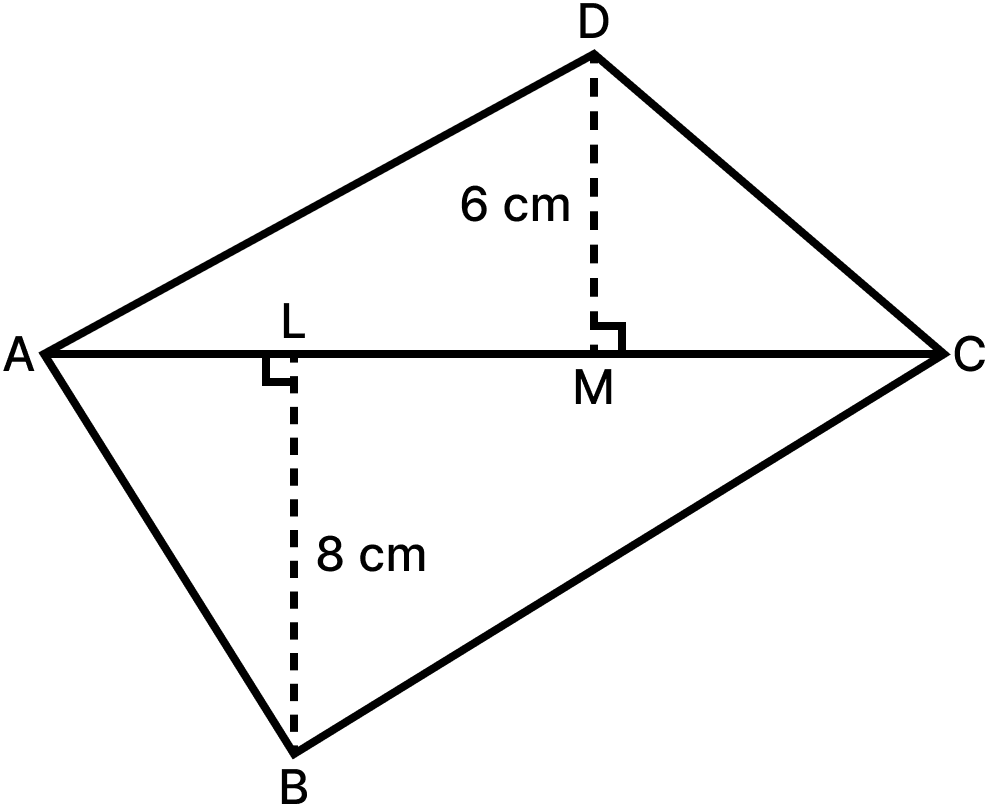
In the given figure, ABCD is a quadrilateral in which AC = 14 cm, BL ⊥ AC, DM ⊥ AC such that BL = 8 cm, DM = 6 cm. Find the area of quad. ABCD
Answer
Given:
AC = 14 cm, BL ⊥ AC, DM ⊥ AC, BL = 8 cm and DM = 6 cm
By formula,
Area of triangle =
Area of quad. ABCD = area (ΔADC) + area (ΔABC)
Substituting values we get:
Area of quad. ABCD = ( x 14 x 6 + x 14 x 8) cm2
= (42 + 56) cm2
= 98 cm2
Hence, the area of quad. ABCD is 98 cm2.
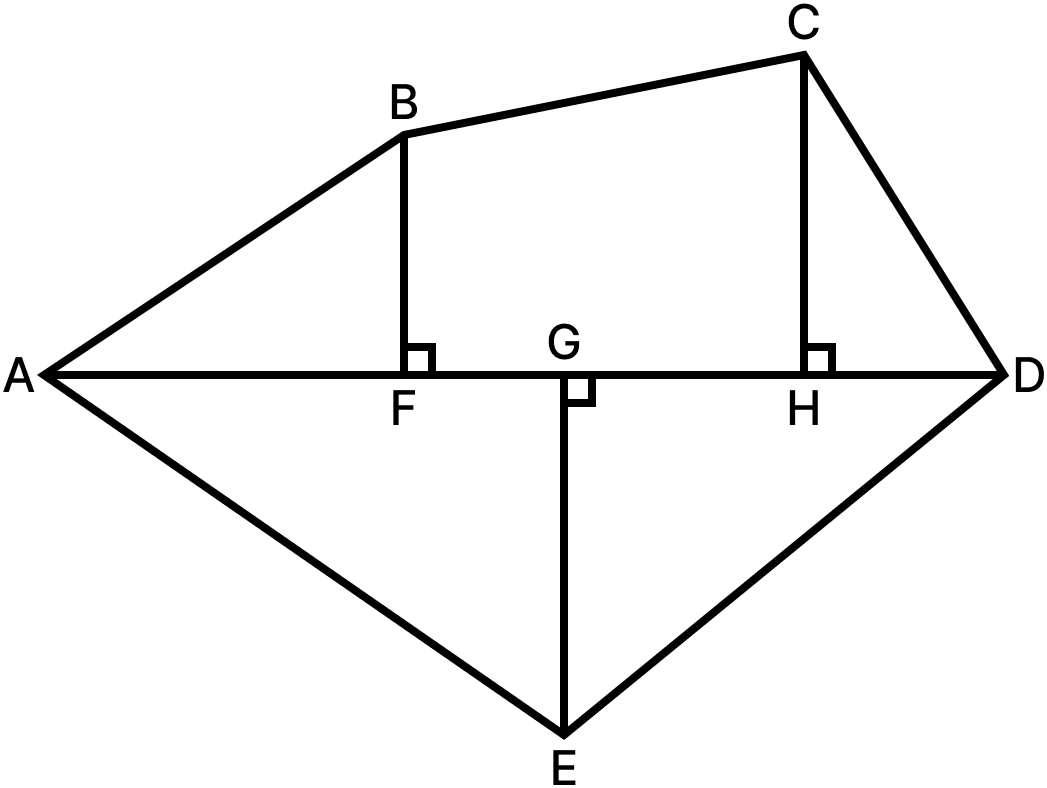
Find the area of the pentagon ABCDE shown in the adjoining figure, it being given that BF ⊥ AD, CH ⊥ AD and EG ⊥ AD such that AF = 9 cm, AG = 13 cm, AH = 19 cm, AD = 24 cm, BF = 6 cm, CH = 8 cm and EG = 9 cm.
Answer
Given:
AF = 9 cm, AG = 13 cm, AH = 19 cm, AD = 24 cm, BF = 6 cm, CH = 8 cm and EG = 9 cm
From the figure,
FH = AH - AF = (19 - 9) cm = 10 cm
HD = AD - AH = (24 - 19) cm = 5 cm
Area of the pentagon ABCDE
= area (ΔABF) + area (trap. FBCH) + area (ΔHCD) + area (ΔAED)
Area of ΔABF = x AF x BF
= x 9 x 6 cm2
= 27 cm2
Area of trap. FBCH = x (BF + CH) x FH
= x (6 + 8) x 10 cm2
= x 14 x 10 cm2
= 70 cm2
Area of ΔHCD = x HD x CH
= x 5 x 8 cm2
= 20 cm2
Area of ΔAED = x AD x EG
= x 24 x 9 cm2
= 108 cm2
∴ Area of the pentagon ABCDE = (27 + 70 + 20 + 108) cm2
= 225 cm2
Hence, the area of the pentagon ABCDE is 225 cm2.
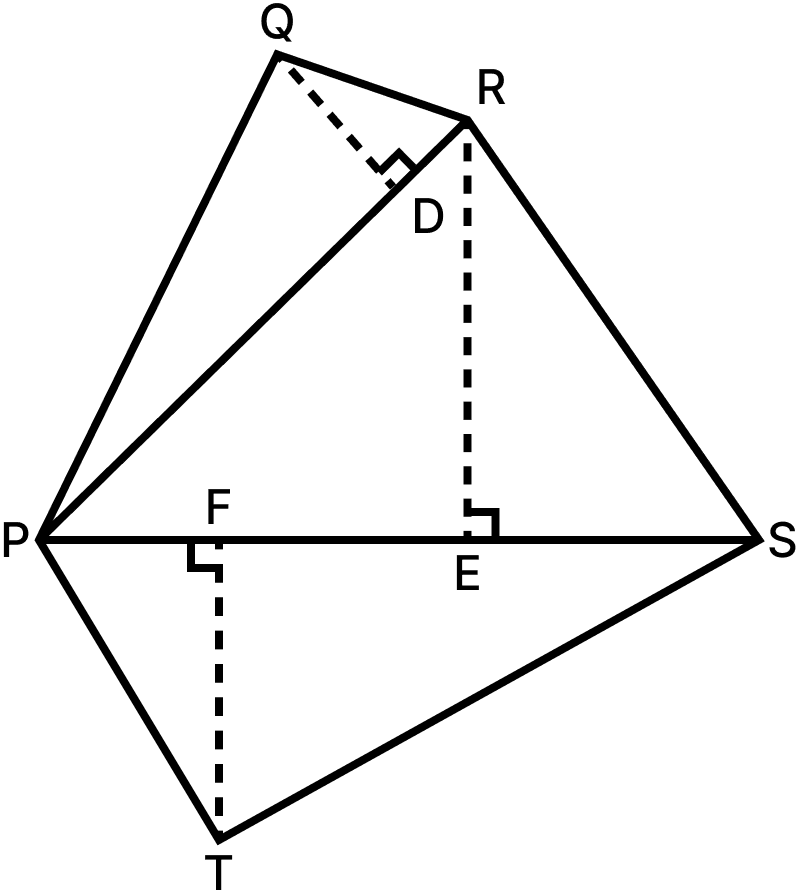
Find the area of pentagon PQRST in which QD ⊥ PR, RE ⊥ PS and TF ⊥ PS such that PR = 10 cm, PS = 12 cm, QD = 3 cm, RE = 7 cm and TF = 5 cm.
Answer
Given:
PR = 10 cm, PS = 12 cm, QD = 3 cm, RE = 7 cm and TF = 5 cm
Area of the pentagon PQRST
= area (ΔPQR) + area (ΔPRS) + area (ΔPTS)
Area of ΔPQR = x PR x QD
= x 10 x 3 cm2
= 15 cm2
Area of ΔPRS = x PS x RE
= x 12 x 7 cm2
= 42 cm2
Area of ΔPTS = x PS x TF
= x 12 x 5 cm2
= 30 cm2
∴ Area of the pentagon PQRST = (15 + 42 + 30) cm2
= 87 cm2
Hence, the area of the pentagon PQRST is 87 cm2.
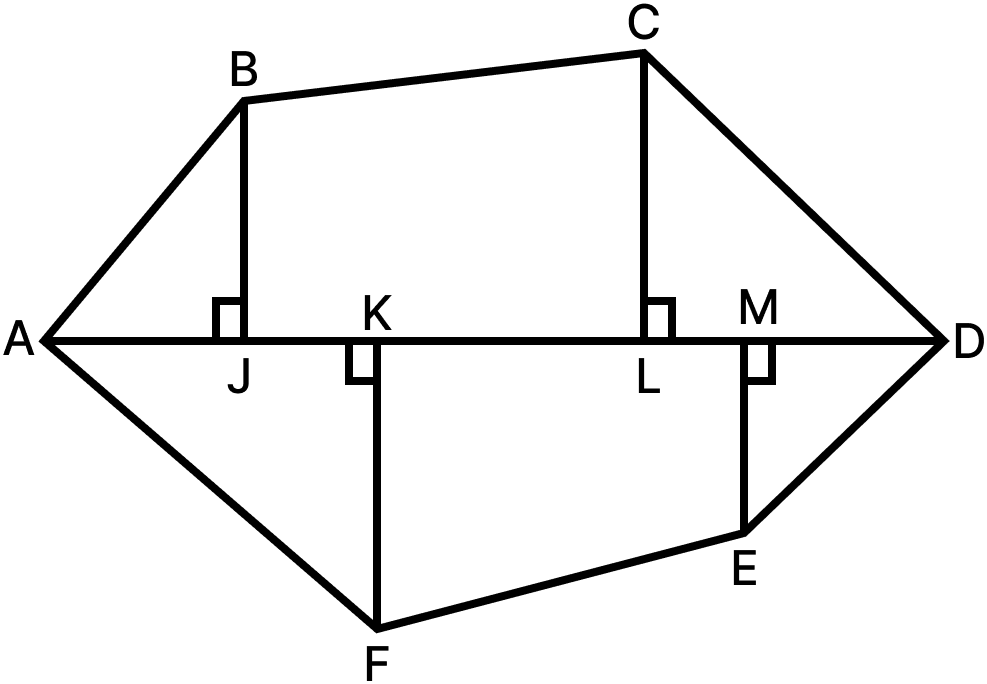
Find the area of the given hexagon ABCDEF in which each one of BJ, CL, EM and FK is perpendicular to AD and it is being given that AJ = 6 cm, AK = 10 cm, AL = 18 cm, AM = 21 cm, AD = 27 cm, BJ = 5 cm, CL = 6 cm, EM = 4 cm and FK = 6 cm.
Answer
Given:
AJ = 6 cm, AK = 10 cm, AL = 18 cm, AM = 21 cm, AD = 27 cm, BJ = 5 cm, CL = 6 cm, EM = 4 cm and FK = 6 cm
From the figure,
JL = AL - AJ = (18 - 6) cm = 12 cm
LD = AD - AL = (27 - 18) cm = 9 cm
KM = AM - AK = (21 - 10) cm = 11 cm
MD = AD - AM = (27 - 21) cm = 6 cm
Area of the hexagon ABCDEF
= area (ΔABJ) + area (trap. JBCL) + area (ΔLCD) + area (ΔAFK) + area (trap. KFEM) + area (ΔMED)
Area of ΔABJ = x AJ x BJ
= x 6 x 5 cm2
= 15 cm2
Area of trap. JBCL = x (BJ + CL) x JL
= x (5 + 6) x 12 cm2
= x 11 x 12 cm2
= 66 cm2
Area of ΔLCD = x LD x CL
= x 9 x 6 cm2
= 27 cm2
Area of ΔAFK = x AK x FK
= x 10 x 6 cm2
= 30 cm2
Area of trap. KFEM = x (FK + EM) x KM
= x (6 + 4) x 11 cm2
= x 10 x 11 cm2
= 55 cm2
Area of ΔMED = x MD x EM
= x 6 x 4 cm2
= 12 cm2
∴ Area of the hexagon ABCDEF = (15 + 66 + 27 + 30 + 55 + 12) cm2
= 205 cm2
Hence, the area of the hexagon ABCDEF is 205 cm2.
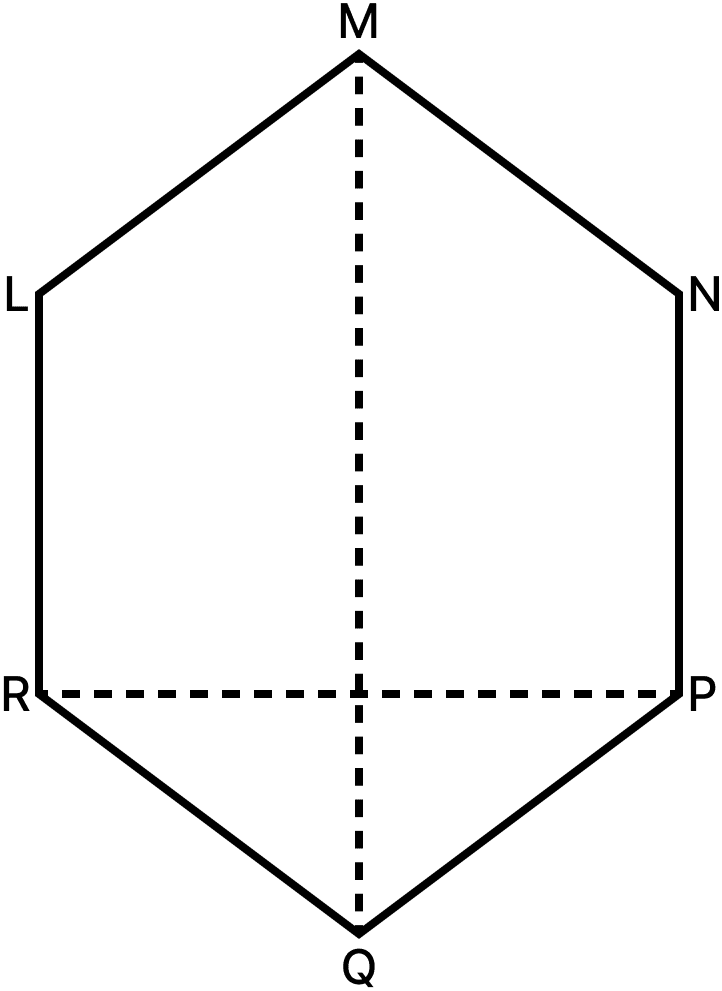
Find the area of the given hexagon LMNPQR in which each side measures 5 cm, height MQ = 11 cm and width RP = 8 cm.
Answer
Given:
Each side of the hexagon LMNPQR = 5 cm
Height MQ = 11 cm and width RP = 8 cm
The diagonal MQ divides the hexagon LMNPQR into two equal trapeziums MNPQ and MQRL.
∴ Area of the hexagon LMNPQR = 2 x (area of trapezium MNPQ)
In trapezium MNPQ, the parallel sides are MQ = 11 cm and NP = 5 cm.
Since RP ⊥ MQ and MQ passes through the mid-point of RP,
Distance between MQ and NP = x RP
= x 8 cm
= 4 cm
Area of trapezium MNPQ = x (MQ + NP) x 4
= x (11 + 5) x 4 cm2
= x 16 x 4 cm2
= 32 cm2
∴ Area of the hexagon LMNPQR = 2 x 32 cm2
= 64 cm2
Hence, the area of the hexagon LMNPQR is 64 cm2.
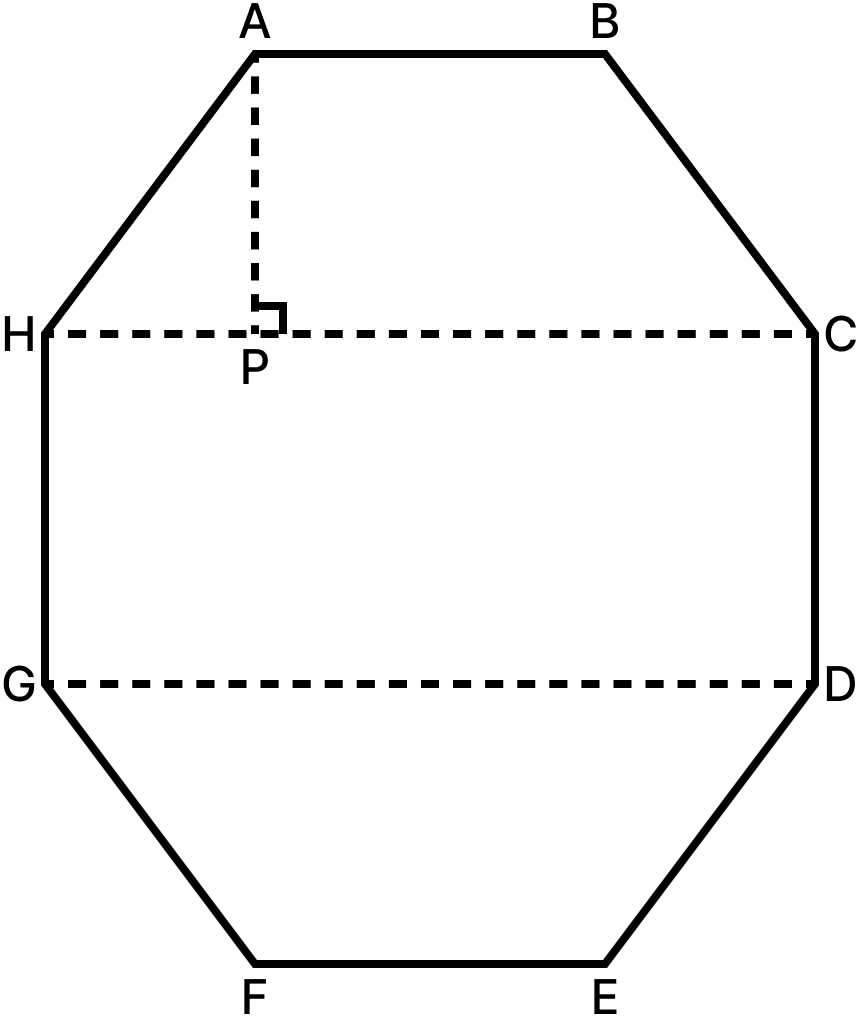
Find the area of an octagon ABCDEFGH having each side equal to 5 cm, HC = 11 cm and AP ⊥ HC such that AP = 4 cm.
Answer
Given:
Each side of the octagon ABCDEFGH = 5 cm
HC = 11 cm, AP ⊥ HC and AP = 4 cm
The octagon ABCDEFGH is divided by HC and GD into two equal trapeziums ABCH and DEFG and a rectangle CDGH.
Trapezium ABCH:
Parallel sides are AB = 5 cm and HC = 11 cm and the distance between them is AP = 4 cm.
Area of trapezium ABCH = x (AB + HC) x AP
= x (5 + 11) x 4 cm2
= x 16 x 4 cm2
= 32 cm2
∴ Area of trapezium DEFG = Area of trapezium ABCH = 32 cm2
Rectangle CDGH:
Length HC = 11 cm and breadth CD = 5 cm
Area of rectangle CDGH = HC x CD
= 11 x 5 cm2
= 55 cm2
∴ Area of the octagon ABCDEFGH = 2 x (area of trapezium DEFG) + area of rectangle CDGH
= (2 x 32 + 55) cm2
= (64 + 55) cm2
= 119 cm2
Hence, the area of the octagon ABCDEFGH is 119 cm2.
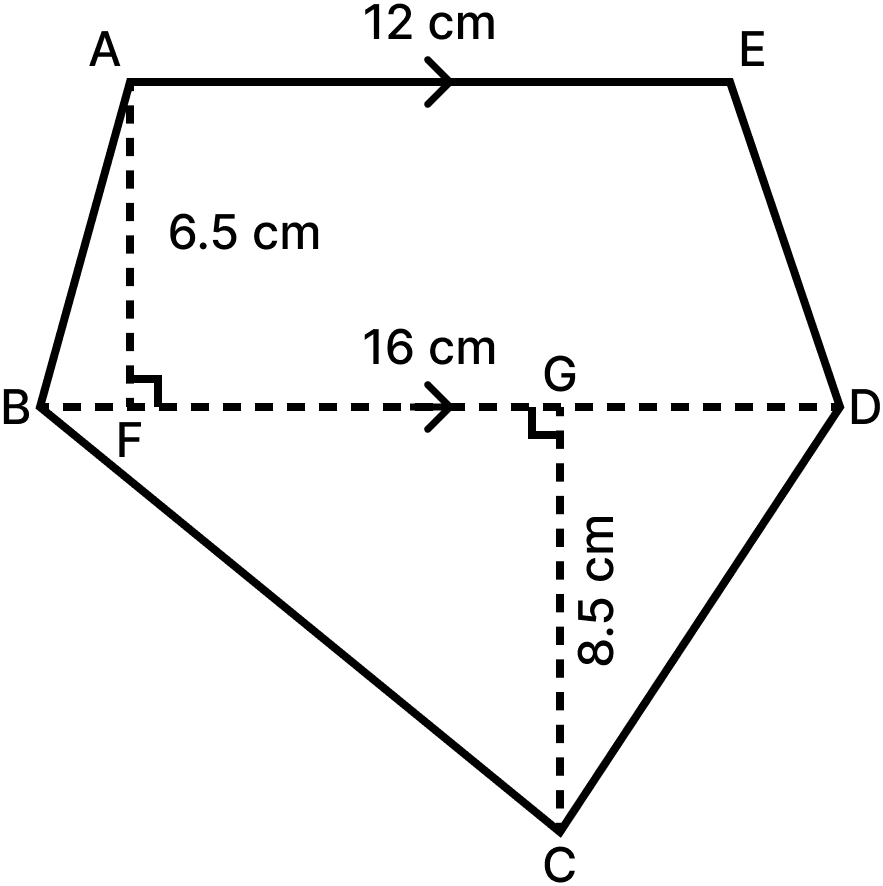
Find the area of the figure ABCDE, it being given that: AE ∥ BD, AF ⊥ BD, CG ⊥ BD, AE = 12 cm, BD = 16 cm, AF = 6.5 cm and CG = 8.5 cm.
Answer
Given:
AE ∥ BD, AF ⊥ BD, CG ⊥ BD, AE = 12 cm, BD = 16 cm, AF = 6.5 cm and CG = 8.5 cm
Area of the figure ABCDE = area (trap. ABDE) + area (ΔBCD)
Trapezium ABDE:
Parallel sides are AE = 12 cm and BD = 16 cm and the distance between them is AF = 6.5 cm.
Area of trap. ABDE = x (AE + BD) x AF
Triangle BCD:
Base BD = 16 cm and height CG = 8.5 cm
Area of ΔBCD = x BD x CG
= x 16 x 8.5 cm2
= 8 x 8.5 cm2
= 68 cm2
∴ Area of the figure ABCDE = (91 + 68) cm2
= 159 cm2
Hence, the area of the figure ABCDE is 159 cm2.
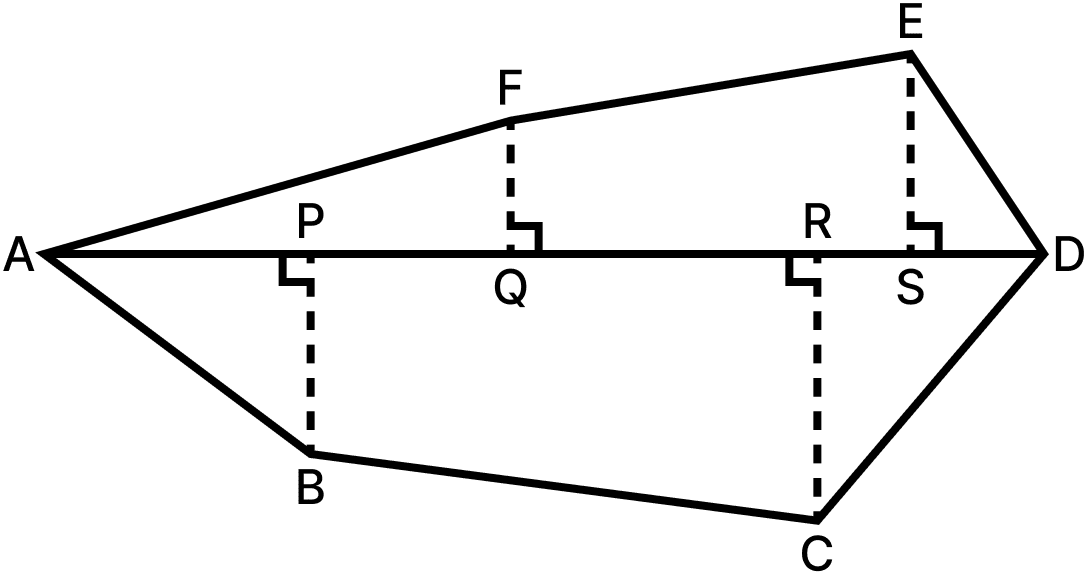
Find the area of the field ABCDEFA, in which BP ⊥ AD, CR ⊥ AD, FQ ⊥ AD, ES ⊥ AD and AP = 20 m, AQ = 35 m, AR = 58 m, AS = 65 m, AD = 75 m, BP = 15 m, CR = 20 m, ES = 15 m and FQ = 10 m.
Answer
Given:
AP = 20 m, AQ = 35 m, AR = 58 m, AS = 65 m, AD = 75 m, BP = 15 m, CR = 20 m, ES = 15 m and FQ = 10 m
From the figure,
QS = AS - AQ = (65 - 35) m = 30 m
SD = AD - AS = (75 - 65) m = 10 m
PR = AR - AP = (58 - 20) m = 38 m
RD = AD - AR = (75 - 58) m = 17 m
Area of the field ABCDEFA
= area (ΔAFQ) + area (trap. QFES) + area (ΔSED) + area (ΔABP) + area (trap. PBCR) + area (ΔRCD)
Area of ΔAFQ = x AQ x FQ
= x 35 x 10 m2
= 175 m2
Area of trap. QFES = x (FQ + ES) x QS
= x (10 + 15) x 30 m2
= x 25 x 30 m2
= 375 m2
Area of ΔSED = x SD x ES
= x 10 x 15 m2
= 75 m2
Area of ΔABP = x AP x BP
= x 20 x 15 m2
= 150 m2
Area of trap. PBCR = x (BP + CR) x PR
= x (15 + 20) x 38 m2
= x 35 x 38 m2
= 665 m2
Area of ΔRCD = x RD x CR
= x 17 x 20 m2
= 170 m2
∴ Area of the field ABCDEFA = (175 + 375 + 75 + 150 + 665 + 170) m2
= 1610 m2
Hence, the area of the field ABCDEFA is 1610 m2.