
If the length, breadth and height of a cuboid are 2 m, 2 m, and 1 m, respectively, then its surface area (in m2) is
8
12
16
24
Answer
Given:
Length of the cuboid (l) = 2 m
Breadth of the cuboid (b) = 2 m
Height of the cuboid (h) = 1 m
As we know, the total surface area of the cuboid = 2(l × b + b × h + h × l)
= 2(2 × 2 + 2 × 1 + 1 × 2) m2
= 2(4 + 2 + 2) m2
= 2 × 8 m2
= 16 m2
Hence, option 3 is the correct option.
If the length, breadth and height of a cuboid are in the ratio 6 : 5 : 4 and the total surface area of the cuboid is 33300 cm2, then the breadth of the cuboid is
85 cm
75 cm
65 cm
cannot be determined
Answer
Given:
The length, breadth and height of the cuboid are in the ratio 6 : 5 : 4.
Total surface area of the cuboid = 33300 cm2
Let the length, breadth and height of the cuboid be and .
As we know, the total surface area of the cuboid = 2(l × b + b × h + h × l)
Breadth of the cuboid = = 5 × 15 cm = 75 cm
Hence, option 2 is the correct option.
A rectangular sand box is 5 m wide and 2 m long. How many cubic metres of sand is needed to fill the box upto a depth of 10 cm?
1
10
100
1000
Answer
Given:
Width of the sand box (b) = 5 m
Length of the sand box (l) = 2 m
Depth upto which it is to be filled (h) = 10 cm = 0.1 m
Volume of sand needed = l × b × h
= 2 × 5 × 0.1 m3
= 1 m3
Hence, option 1 is the correct option.
A beam 9 m long, 40 cm wide and 20 cm deep is made up of iron which weighs 50 kg per cubic metre. The weight of the beam is
27 kg
36 kg
48 kg
56 kg
Answer
Given:
Length of the beam (l) = 9 m
Width of the beam (b) = 40 cm = 0.4 m
Depth of the beam (h) = 20 cm = 0.2 m
Volume of a cuboid = l × b × h
= 9 × 0.4 × 0.2 m3
= 0.72 m3
Weight of 1 m3 of iron = 50 kg
Weight of the beam = Volume of the beam × Weight of 1 m3 of iron
= 0.72 × 50 kg
= 36 kg
Hence, option 2 is the correct option.
The length of the longest rod that can be placed in a room 30 m long, 24 m broad and 18 m high, is
30 m
m
m
60 m
Answer
Given:
Length of the room () = 30 m
Breadth of the room () = 24 m
Height of the room () = 18 m
Length of the longest rod = Length of the diagonal of the room
The diagonal of the floor, the height of the room and the diagonal of the room form a right-angled triangle.
By Pythagoras' theorem,
(Diagonal of the floor)2 =
(Diagonal of the room)2 = (Diagonal of the floor)2 +
Length of the diagonal of the room (d) =
Hence, option 3 is the correct option.
How many bricks, each measuring 25 cm × 12.5 cm × 7.5 cm will be needed to construct a wall 15 m long, 1.8 m high and 37.5 cm thick?
4320
4400
4575
4660
Answer
Given:
Length of the wall = 15 m = 1500 cm
Height of the wall = 1.8 m = 180 cm
Thickness of the wall = 37.5 cm
Volume of the wall = length × thickness × height
= 1500 × 37.5 × 180 cm3
= 10125000 cm3
Volume of one brick = length × width × height
= 25 × 12.5 × 7.5 cm3
= 2343.75 cm3
Number of bricks =
=
= 4320
Hence, option 1 is the correct option.
A wooden box of dimensions 8 m × 7 m × 6 m is to carry rectangular boxes of dimensions 8 cm × 7 cm × 6 cm. The maximum number of boxes that can be carried in the wooden box, is
1000000
1200000
7500000
9800000
Answer
Given:
Dimensions of the wooden box = 8 m × 7 m × 6 m = 800 cm × 700 cm × 600 cm
Dimensions of each rectangular box = 8 cm × 7 cm × 6 cm
Volume of the wooden box = length × breadth × height
= 800 × 700 × 600 cm3
= 336000000 cm3
Volume of one rectangular box = length × breadth × height
= 8 × 7 × 6 cm3
= 336 cm3
Maximum number of boxes =
=
= 1000000
The boxes fit exactly, without any unused space, because
Number of boxes along the length = = 100
Number of boxes along the breadth = = 100
Number of boxes along the height = = 100
Total number of boxes = 100 × 100 × 100 = 1000000
Hence, option 1 is the correct option.
The number of bricks, each measuring 25 cm × 12.5 cm × 7.5 cm required to construct a wall 6 m long, 5 m high and 0.5 m thick, while the mortar occupies 5% of the volume of the wall, is
3040
5740
6080
8120
Answer
Given:
Length of the wall = 6 m = 600 cm
Height of the wall = 5 m = 500 cm
Thickness of the wall = 0.5 m = 50 cm
Volume of the wall = length × thickness × height
= 600 × 50 × 500 cm3
= 15000000 cm3
Volume occupied by the mortar = 5% of 15000000 cm3
= × 15000000 cm3
= 750000 cm3
Volume occupied by the bricks = 15000000 - 750000 cm3
= 14250000 cm3
Volume of one brick = length × width × height
= 25 × 12.5 × 7.5 cm3
= 2343.75 cm3
Number of bricks =
=
= 6080
Hence, option 3 is the correct option.
The surface area of a cube of side 27 cm is
729 cm2
2916 cm2
4374 cm2
19683 cm2
Answer
Given:
Side of the cube = 27 cm
Surface area of a cube = 6 × (side)2
= 6 × (27)2 cm2
= 6 × 729 cm2
= 4374 cm2
Hence, option 3 is the correct option.
The perimeter of one face of a cube is 40 cm. The volume of the cube (in cm3) is
160
800
1000
1600
Answer
Given:
Perimeter of one face of the cube = 40 cm
Each face of a cube is a square.
Let be the side of the cube.
Perimeter of one face = 4 × side
Volume of a cube = (side)3
= 103 cm3
= 1000 cm3
Hence, option 3 is the correct option.
The volume of a cube with surface area 384 sq. cm, is
216 cm3
256 cm3
484 cm3
512 cm3
Answer
Given:
Surface area of the cube = 384 cm2
Let be the side of the cube.
Surface area of a cube = 6 × (side)2
Volume of a cube = (side)3
= 83 cm3
= 512 cm3
Hence, option 4 is the correct option.
The volume of a cube is 2744 cu.cm. Its surface area is
196 cm2
588 cm2
784 cm2
1176 cm2
Answer
Given:
Volume of the cube = 2744 cm3
Let be the side of the cube.
Volume of a cube = (side)3
Surface area of a cube = 6 × (side)2
= 6 × (14)2 cm2
= 6 × 196 cm2
= 1176 cm2
Hence, option 4 is the correct option.
If the length of diagonal of a cube is cm, then the length of its edge is
2 cm
4 cm
6 cm
8 cm
Answer
Given:
Length of the diagonal of the cube = cm
Let be the edge of the cube.
Diagonal of a cube = × side
Hence, option 2 is the correct option.
The length of longest pole that can be placed on the floor of a room is 10 m and the length of longest pole that can be placed in the room is m. The height of the room is
6 m
7.5 m
8 m
10 m
Answer
Given:
Length of the longest pole that can be placed on the floor of the room = 10 m
Length of the longest pole that can be placed in the room = m
Let and be the length, breadth and height of the room.
The longest pole that can be placed on the floor is the diagonal of the floor.
By Pythagoras' theorem, diagonal of the floor =
The longest pole that can be placed in the room is the diagonal of the room.
The diagonal of the floor, the height of the room and the diagonal of the room form a right-angled triangle. By Pythagoras' theorem, diagonal of the room =
Putting the value of from equation (1), we get
Hence, option 4 is the correct option.
The volume of a wall, 5 times as high as it is broad and 8 times as long as it is high, is 12.8 m3. The breadth of the wall is
22.5 cm
25 cm
30 cm
40 cm
Answer
Given:
Volume of the wall = 12.8 m3
Let be the breadth of the wall.
The wall is 5 times as high as it is broad.
⇒ Height of the wall
The wall is 8 times as long as it is high.
⇒ Length of the wall () = 8 ×
Volume of a cuboid =
Hence, option 4 is the correct option.
Two cubes each with 8 cm edge are joined end to end. The surface area of the resulting cuboid is
560 cm2
640 cm2
830 cm2
1440 cm2
Answer
Given:
Edge of each cube = 8 cm
When two cubes of edge 8 cm each are joined end to end, a cuboid is formed whose
Length (l) = (8 + 8) cm = 16 cm
Breadth (b) = 8 cm
Height (h) = 8 cm
As we know, the total surface area of the cuboid = 2(l × b + b × h + h × l)
= 2(16 × 8 + 8 × 8 + 8 × 16) cm2
= 2(128 + 64 + 128) cm2
= 2 × 320 cm2
= 640 cm2
Hence, option 2 is the correct option.
If three cubes of metal whose edges are 6 cm, 8 cm and 10 cm are melted and made into a single cube, then the edge of the new cube so formed will be
6 cm
8 cm
12 cm
24 cm
Answer
Given:
The edges of the three cubes are 6 cm, 8 cm and 10 cm.
The three cubes are melted to make a single cube, i.e., the sum of the volumes of the three cubes is equal to the volume of the new cube.
Let be the edge of the new cube.
Sum of the volumes of the three cubes = Volume of the new cube
Hence, option 3 is the correct option.
A cube of side 6 cm is cut into a number of cubes each of side 2 cm. The number of cubes formed will be
6
9
12
27
Answer
Given:
Side of the bigger cube = 6 cm
Side of each smaller cube = 2 cm
Volume of a cube = (side)3
Volume of the bigger cube = 63 cm3 = 216 cm3
Volume of each smaller cube = 23 cm3 = 8 cm3
Number of cubes formed =
=
= 27
Hence, option 4 is the correct option.
A 4 cm cube is cut into 1 cm cubes. The total surface area of all the small cubes is
24 cm2
96 cm2
256 cm2
384 cm2
Answer
Given:
Side of the bigger cube = 4 cm
Side of each smaller cube = 1 cm
Volume of a cube = (side)3
Volume of the bigger cube = 43 cm3 = 64 cm3
Volume of each smaller cube = 13 cm3 = 1 cm3
Number of smaller cubes = = 64
Surface area of a cube = 6 × (side)2
Surface area of each smaller cube = 6 × 12 cm2 = 6 cm2
Total surface area of all the small cubes = 64 × 6 cm2
= 384 cm2
Hence, option 4 is the correct option.
If each side of a cube is doubled, its volume
is doubled
becomes 4 times
becomes 6 times
becomes 8 times
Answer
Let be the side of the cube.
So, side of the new cube =
Volume of a cube = (side)3
Original volume =
New volume =
So, the volume becomes 8 times the original volume.
Hence, option 4 is the correct option.
Two cubes have their volumes in the ratio 1 : 27. The ratio of their surface areas is
1 : 3
1 : 8
1 : 9
1 : 18
Answer
Given:
The volumes of the two cubes are in the ratio 1 : 27.
Let and be the sides of the two cubes.
Volume of a cube = (side)3
Surface area of a cube = 6 × (side)2
Hence, option 3 is the correct option.
The volume of the cylinder whose height is 14 cm and diameter of base is 4 cm, is
176 cm3
196 cm3
276 cm3
352 cm3
Answer
Given:
Height of the cylinder (h) = 14 cm
Diameter of the base = 4 cm
Radius of the base (r) = cm = 2 cm
Volume of a cylinder = πr2h
Hence, option 1 is the correct option.
If the diameter of a cylinder is 28 cm and its height is 20 cm, then total surface area (in cm2) is
2229
2292
2992
2993
Answer
Given:
Diameter of the cylinder = 28 cm
Radius of the cylinder (r) = cm = 14 cm
Height of the cylinder (h) = 20 cm
Total surface area of a cylinder = 2πr(r + h)
Hence, option 3 is the correct option.
If the curved surface area of a cylinder is 1760 sq. cm and its base radius is 14 cm, then its height is
10 cm
15 cm
20 cm
40 cm
Answer
Given:
Curved surface area of the cylinder = 1760 cm2
Base radius of the cylinder () = 14 cm
Let be the height of the cylinder.
Curved surface area of a cylinder =
Hence, option 3 is the correct option.
The height of a cylinder is 14 cm and its curved surface are is 264 sq. cm. The volume of the cylinder is
308 cm3
396 cm3
1232 cm3
1848 cm3
Answer
Given:
Height of the cylinder () = 14 cm
Curved surface area of the cylinder = 264 cm2
Let be the radius of the cylinder.
Curved surface area of a cylinder =
Radius of the cylinder () = 3 cm
Volume of a cylinder =
Hence, option 2 is the correct option.
The ratio of total surface area to the lateral surface area of a cylinder with base radius 80 cm and height 20 cm, is
2 : 1
3 : 1
4 : 1
5 : 1
Answer
Given:
Base radius of the cylinder () = 80 cm
Height of the cylinder () = 20 cm
As we know, the total surface area of cylinder = and the lateral surface area of cylinder =
Hence, option 4 is the correct option.
The ratio between the radius of the base and the height of a cylinder is 2 : 3. If its volume is 1617 cm3, the total surface area of the cylinder is
308 cm2
462 cm2
540 cm2
770 cm2
Answer
Given:
The ratio between the radius of the base and the height of the cylinder is 2 : 3.
Volume of the cylinder = 1617 cm3
Let the radius of the base and the height of the cylinder be and .
Volume of a cylinder =
Radius of the base () = = 2 × 3.5 cm = 7 cm
Height of the cylinder () = = 3 × 3.5 cm = 10.5 cm
Total surface area of a cylinder =
Hence, option 4 is the correct option.
The number of coins 1.5 cm in diameter and 0.2 cm thick to be melted to form a right circular cylinder of height 10 cm and diameter 4.5 cm, is
380
450
472
540
Answer
Given:
Diameter of each coin = 1.5 cm
Radius of each coin, r = cm = 0.75 cm
Thickness of each coin, h = 0.2 cm
Diameter of the cylinder = 4.5 cm
Radius of the cylinder, R = cm = 2.25 cm
Height of the cylinder, H = 10 cm
Each coin is in the shape of a cylinder.
Volume of each coin = πr2h
Volume of the required cylinder = πR2H
Let be the required number of coins.
Number of coins =
Hence, option 2 is the correct option.
Fill in the blanks :
(i) 1 m3 = ______ cm3.
(ii) 1 cm3 = ______ dm3.
(iii) If the surface area of a cube is numerically equal to its volume, then the edge of the cube is ______
(iv) To calculate the area of the road paved by a road roller, we need to find the ______ of the roller
(v) A ______ when rolled along its length or breadth forms a cylinder.
(vi) If the volume of a cylinder is numerically equal to its curved surface area, then the radius of its base is ______
Answer
(i) As we know, 1 m = 100 cm
⇒ 1 m3 = (100 × 100 × 100) cm3 = 1000000 cm3
Hence, 1 m3 = 1000000 cm3.
(ii) As we know, 1 dm = 10 cm
⇒ 1 dm3 = (10 × 10 × 10) cm3 = 1000 cm3
⇒ 1 cm3 = dm3 = 0.001 dm3
Hence, 1 cm3 = 0.001 dm3.
(iii) Let be the edge of the cube.
Surface area of the cube = and volume of the cube =
It is given that the surface area of the cube is numerically equal to its volume.
Hence, the edge of the cube is 6 units.
(iv) A road roller is cylindrical in shape. The area of the road paved by it in one revolution is equal to the curved surface area of the roller.
Hence, to calculate the area of the road paved by a road roller, we need to find the curved surface area of the roller.
(v) When a rectangle is rolled along its length or its breadth, the side along which it is rolled forms the circumference of the circular base and the other side gives the height of the cylinder.
Hence, a rectangle when rolled along its length or breadth forms a cylinder.
(vi) Let be the radius and be the height of the cylinder.
Volume of the cylinder = and curved surface area of the cylinder =
It is given that the volume of the cylinder is numerically equal to its curved surface area.
Hence, the radius of its base is 2 units.
Assertion (A): Two cylinders with equal volume will always have equal surfaces areas.
Reason (R): Volume of a cylinder is given by πr2h.
Both Assertion (A) and Reason (R) are true and Reason (R) is the correct explanation of Assertion (A).
Both Assertion (A) and Reason (R) are true and Reason (R) is not the correct explanation of Assertion (A).
Assertion (A) is true but Reason (R) is false.
Assertion (A) is false but Reason (R) is true.
Answer
The volume of a cylinder with radius r and height h is πr2h.
So, Reason (R) is true.
Two cylinders can have the same volume with different radii and heights.
For example, consider a cylinder with r = 2 units and h = 9 units.
Volume = π × 22 × 9 = 36π cubic units
Total surface area = 2π × 2 × (2 + 9) = 44π square units
Now, consider another cylinder with r = 3 units and h = 4 units.
Volume = π × 32 × 4 = 36π cubic units
Total surface area = 2π × 3 × (3 + 4) = 42π square units
Both the cylinders have equal volumes but their surface areas are not equal.
So, Assertion (A) is false.
∴ Assertion (A) is false but Reason (R) is true.
Hence, option 4 is the correct option.
Assertion (A): Lateral surface area of a cuboid is equal to area of four walls of a room.
Reason (R): Lateral surface area of a cuboid = 2h (l + b).
Both Assertion (A) and Reason (R) are true and Reason (R) is the correct explanation of Assertion (A).
Both Assertion (A) and Reason (R) are true and Reason (R) is not the correct explanation of Assertion (A).
Assertion (A) is true but Reason (R) is false.
Assertion (A) is false but Reason (R) is true.
Answer
The lateral surface area of a cuboid is the sum of the areas of its four side faces, excluding the top and the bottom faces.
Lateral surface area of a cuboid = 2h(l + b)
So, Reason (R) is true.
A room is a cuboid whose four walls are its four side faces, while the floor and the ceiling are its bottom and top faces.
Area of 4 walls of a room = 2h(l + b) = Lateral surface area of the cuboid
So, Assertion (A) is true and Reason (R) correctly explains assertion (A).
Hence, option 1 is the correct option.
The sum of length, breadth and depth of a cuboid is 19 cm and its diagonal is cm. Surface area of the cuboid is:
200 cm2
236 cm2
252 cm2
274 cm2
Answer
Given:
Sum of the length, breadth and depth of the cuboid = 19 cm
Diagonal of the cuboid = cm
Let and be the length, breadth and depth of the cuboid.
So, = 19
By Pythagoras' theorem (applied first to the diagonal of the base and then to the diagonal of the cuboid), the diagonal of the cuboid =
Squaring both the sides of = 19, we get
As we know, the surface area of the cuboid =
= 236 cm2
Hence, option 2 is the correct option.
The radius of a wire is decreased to one-third. If volume remains the same, length will increase:
2 times
3 times
6 times
9 times
Answer
A wire is cylindrical in shape.
Let be the radius and be the length of the wire.
Volume of a cylinder =
Volume of the wire =
Radius of the new wire =
Let be the length of the new wire.
It is given that the volume remains the same.
So, the new length of the wire is 9 times the original length (i.e., the length increases by 8 times the original length).
Hence, option 4 is the correct option.
Two friends Kabir and Manjeet were solving a problem on cylinder. Kabir calculated its volume and Manjeet calculated its curved surface area. Interestingly, their answers were numerically same. It is possible:
for any radius and any length of the cylinder.
for any height of the cylinder, but its radius should be 2 units.
for any radius of the cylinder, but its height should be 2 units.
only when radius of the cylinder as well as its height is equal to 2 units.
Answer
Let be the radius and be the height of the cylinder.
Volume of the cylinder =
Curved surface area of the cylinder =
It is given that the volume and the curved surface area are numerically same.
The height gets cancelled, so the equality holds for any height of the cylinder provided its radius is 2 units.
Hence, option 2 is the correct option.
A swimming pool is 200 m by 50 m and has an average depth of 2 m. By the end of a summer day, the water level drops by 2 cm. Volume of water used on that day is:
200 m3
180 m3
175 m3
160 m3
Answer
Given:
Length of the swimming pool (l) = 200 m
Breadth of the swimming pool (b) = 50 m
Drop in the water level (h) = 2 cm = 0.02 m
The water used forms a cuboid of length 200 m, breadth 50 m and height equal to the drop in the water level.
Volume of water used = l × b × h
= 200 × 50 × 0.02 m3
= 200 m3
Hence, option 1 is the correct option.
From the pipe of inner radius 0.75 cm, water flows at the rate of 7 m per second. The volume of water delivered by the pipe in 1 hour is:
4000 litres
4250 litres
4350 litres
4455 litres
Answer
Given:
Inner radius of the pipe (r) = 0.75 cm
Rate of flow of water = 7 m per second = 700 cm per second
The water delivered by the pipe in 1 second forms a cylinder of radius r = 0.75 cm and height h = 700 cm.
Volume of water delivered in 1 second = πr2h
Volume of water delivered in 1 second = 1237.5 cm3
As we know, 1 hour = 3600 seconds
Volume of water delivered in 1 hour = 1237.5 × 3600 cm3
= 4455000 cm3
As we know, 1 litre = 1000 cm3
Volume of water delivered in 1 hour = litres
= 4455 litres
Hence, option 4 is the correct option.
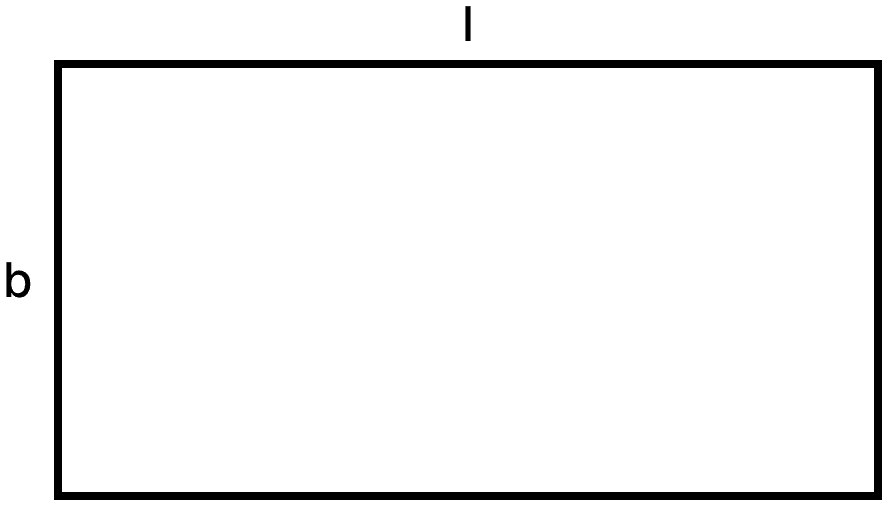
A sheet of paper of dimensions is folded along its length to get a hollow cylinder. Lateral surface area of the cylinder so formed is:
Answer
The sheet of paper is folded along its length .
So, the length of the sheet forms the circumference of the base of the cylinder and the breadth of the sheet becomes the height of the cylinder.
Let be the radius of the base of the cylinder.
⇒
Height of the cylinder,
Lateral surface area of a cylinder =
Hence, option 3 is the correct option.
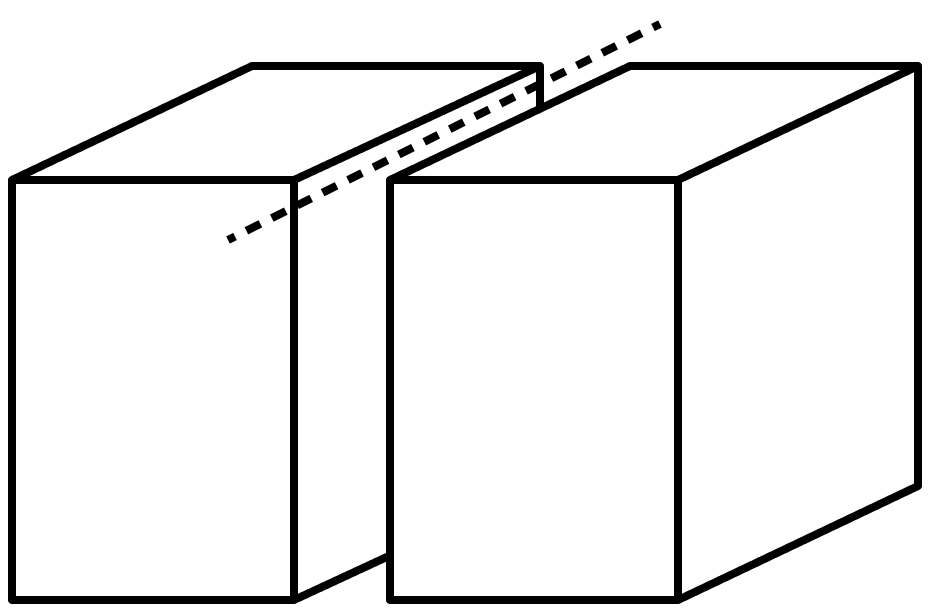
A cube of side length is cut into equal halves as shown. What will be the total surface area of each half when compared with the original cube?
Surface area of each cut part will be half of the original cube
Surface area of each part will be less than half of the original cube
Surface area of each part will be more than half of the original cube
None of these
Answer
Given:
Side of the original cube =
Surface area of a cube = 6 × (side)2
Surface area of the original cube =
Half of the surface area of the original cube =
When the cube is cut into two equal halves, each half is a cuboid whose
Length (l) = , Breadth (b) = and Height (h) =
As we know, the total surface area of the cuboid = 2(l × b + b × h + h × l)
As , the surface area of each part is more than half of the surface area of the original cube.
This happens because cutting the cube creates two new faces, each of area .
Hence, option 3 is the correct option.
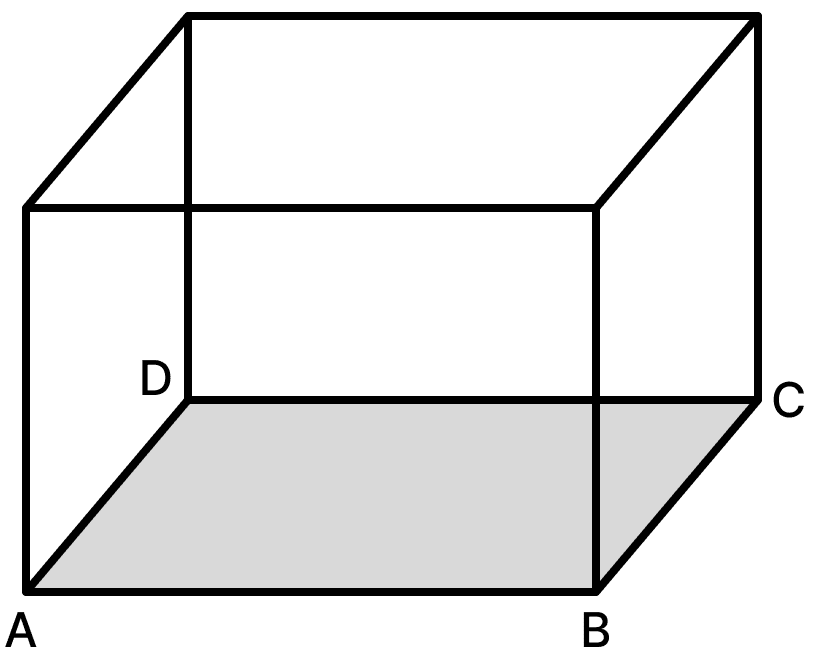
A cuboid is shown in the figure. The area of the rectangle ABCD is given as square units. The surface area of the cuboid in terms of is:
Data not sufficient
Answer
Let l, b and h be the length, breadth and height of the cuboid.
ABCD is the base of the cuboid.
Area of the rectangle ABCD = l × b = square units
As we know, the total surface area of the cuboid = 2(l × b + b × h + h × l)
= 2( + bh + hl) square units
The height h of the cuboid is not known, so the terms bh and hl cannot be found in terms of .
Therefore, the surface area of the cuboid cannot be determined from the area of the rectangle ABCD alone.
Hence, option 4 is the correct option.