Express 112−64 as a rational number with denominator 7.
Answer
To get the denominator 7, divide both the numerator and the denominator of the given rational number by the same number.
Note that 112 ÷ 7 = 16;
112−64=112÷16−64÷16=7−4
Hence, 112−64=7−4.
Express 60−48 as a rational number with denominator 25.
Answer
First reduce the given rational number to its lowest terms, then multiply both the numerator and the denominator by the same number to get the denominator 25.
HCF of 48 and 60 = 12.
⇒60−48=60÷12−48÷12=5−4[5×5=25]⇒5−4=5×5−4×5⇒25−20
Hence, 60−48=25−20.
Express the following rational number in standard form:
30−12
Answer
A rational number qp is in standard form if q>0 and p,q have no common divisor other than 1.
Here the denominator 30 is already positive.
The greatest common divisor of 12 and 30 is 6.
Now,
30−12=30÷6−12÷6=5−2
Hence, the standard form of 30−12 is 5−2.
Express the following rational number in standard form:
49−14
Answer
A rational number qp is in standard form if q>0 and p,q have no common divisor other than 1.
Here the denominator 49 is already positive.
The greatest common divisor of 14 and 49 is 7.
Now,
49−14=49÷7−14÷7=7−2
Hence, the standard form of 49−14 is 7−2.
Express the following rational number in standard form:
−6424
Answer
A rational number qp is in standard form if q>0 and p,q have no common divisor other than 1.
Here the denominator -64 is negative, so first express the rational number with a positive denominator.
−6424=−64×(−1)24×(−1)=64−24
The greatest common divisor of 24 and 64 is 8.
Now,
64−24=64÷8−24÷8=8−3
Hence, the standard form of −6424 is 8−3.
Express the following rational number in standard form:
−63−36
Answer
A rational number qp is in standard form if q>0 and p,q have no common divisor other than 1.
Here the denominator -63 is negative, so first express the rational number with a positive denominator.
−63−36=−63×(−1)−36×(−1)=6336
The greatest common divisor of 36 and 63 is 9.
Now,
6336=63÷936÷9=74
Hence, the standard form of −63−36 is 74.
Compare the following pair of rational numbers:
3215 and 2417
Answer
Write both the rational numbers with the LCM of their denominators as the common denominator and compare the numerators.
L.C.M. of 32 and 24 = 96
⇒3215=32×315×3=9645⇒2417=24×417×4=9668
As 45 < 68, so 9645<9668.
Hence, 3215<2417.
Compare the following pair of rational numbers:
1110 and 1817
Answer
Write both the rational numbers with the LCM of their denominators as the common denominator and compare the numerators.
L.C.M. of 11 and 18 = 198
⇒1110=11×1810×18=198180⇒1817=18×1117×11=198187
As 180 < 187, so 198180<198187
Hence, 1110<1817.
Compare the following pair of rational numbers:
12−5 and 4−3
Answer
Write both the rational numbers with the LCM of their denominators as the common denominator and compare the numerators.
L.C.M. of 12 and 4 = 12
⇒12−5=12−5⇒4−3=4×3(−3)×3=12−9
As -9 < -5, so 12−9<12−5.
Hence, 12−5>4−3.
Compare the following pair of rational numbers:
24−7 and −209
Answer
Write both the rational numbers with the LCM of their denominators as the common denominator and compare the numerators.
First express −209 with a positive denominator.
−209=−20×(−1)9×(−1)=20−9
L.C.M. of 24 and 20 = 120
⇒24−7=24×5(−7)×5=120−35⇒20−9=20×6(−9)×6=120−54
As -54 < -35, so 120−54<120−35.
Hence, 24−7>−209.
Arrange in ascending order:
65,97,1211 and 1813
Answer
All the denominators are already positive, so write each rational number with the LCM of the denominators as the common denominator and arrange the numerators in an increasing order.
LCM of 6, 9, 12 and 18 = 36
⇒65=6×65×6=3630⇒97=9×47×4=3628⇒1211=12×311×3=3633⇒1813=18×213×2=3626
As 26 < 28 < 30 < 33
So, 3626<3628<3630<3633
⇒1813<97<65<1211
Hence, the given rational numbers in ascending order are 1813,97,65 and 1211.
Arrange in ascending order:
−75,14−9,6−5 and −127
Answer
First write each rational number with a positive denominator, then write each of them with the LCM of the denominators as the common denominator and arrange the numerators in increasing order.
⇒−75=−7×(−1)5×(−1)=7−5⇒−127=−12×(−1)7×(−1)=12−7
So, the given rational numbers are 7−5,14−9,6−5 and 12−7.
Now write each rational number with the LCM of the denominators as the common denominator.
LCM of 7, 14, 6 and 12 = 84
⇒7−5=7×12(−5)×12=84−60⇒14−9=14×6(−9)×6=84−54⇒6−5=6×14(−5)×14=84−70⇒12−7=12×7(−7)×7=84−49
As -70 < -60 < -54 < -49,
So 84−70<84−60<84−54<84−49
⇒6−5<7−5<14−9<12−7
Hence, the given rational numbers in ascending order are 6−5,−75,14−9 and −127.
Arrange in ascending order:
−2,31,6−13 and −38
Answer
First write each rational number with a positive denominator, then write each of them with the LCM of the denominators as the common denominator and arrange the numerators in increasing order.
⇒−2=1−2⇒−38=−3×(−1)8×(−1)=3−8
So, the given rational numbers are 1−2,31,6−13 and 3−8.
Now write each rational number with the LCM of the denominators as the common denominator.
LCM of 1, 3, 6 and 3 = 6
⇒1−2=1×6(−2)×6=6−12⇒31=3×21×2=62⇒6−13=6−13⇒3−8=3×2(−8)×2=6−16
As -16 < -13 < -12 < 2,
so 6−16<6−13<6−12<62
⇒3−8<6−13<−2<31
Hence, the given rational numbers in ascending order are −38,6−13,−2 and 31.
Arrange in ascending order:
−2813,42−23,7−4 and 14−9
Answer
First write each rational number with a positive denominator, then write each of them with the LCM of the denominators as the common denominator and arrange the numerators in increasing order.
−2813=−28×(−1)13×(−1)=28−13
So, the given rational numbers are 28−13,42−23,7−4 and 14−9.
Now write each rational number with the LCM of the denominators as the common denominator.
LCM of 28, 42, 7 and 14 = 84
⇒28−13=28×3(−13)×3=84−39⇒42−23=42×2(−23)×2=84−46⇒7−4=7×12(−4)×12=84−48⇒14−9=14×6(−9)×6=84−54
As -54 < -48 < -46 < -39
so 84−54<84−48<84−46<84−39
⇒14−9<7−4<42−23<28−13
Hence, the given rational numbers in ascending order are 14−9,7−4,42−23 and −2813.
Represent the following number on the number line:
65
Answer
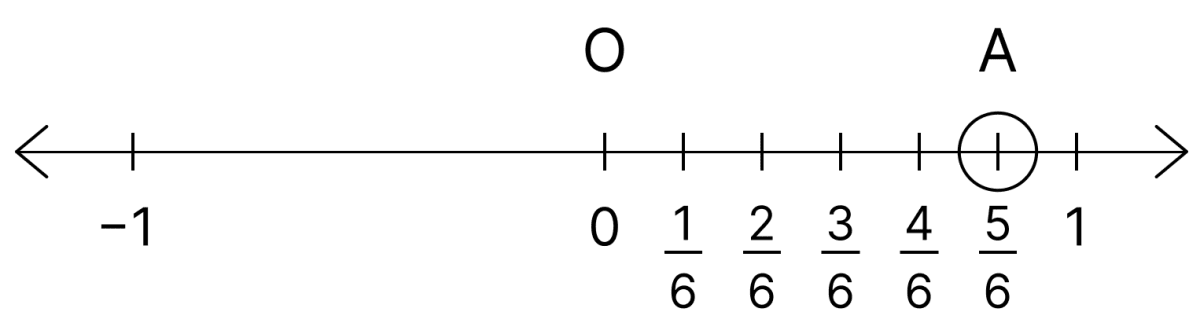
Draw a number line and mark a point O on it, representing the integer 0. Each point of division represents an integer and each length between two successive integers is a unit length.
As 65 is a positive proper fraction, it lies between 0 and 1.
Divide the unit length between 0 and 1 into 6 equal segments by making 5 equally spaced marks. Starting from 0, count forward 5 segments to the right. Label this specific position as point A, representing 65 on the number line, as shown below :
Hence, the point A on the number line represents 65.
Represent the following number on the number line:
314
Answer
Draw a number line and mark a point O on it, representing the integer 0. Each point of division represents an integer and each length between two successive integers is a unit length.
Convert the improper fraction into a mixed fraction to find the two integers between which it lies.
314=432
So, 314 lies between 4 and 5.
Divide the unit length between 4 and 5 into 3 equal segments by making 2 equally spaced marks. Starting from the integer 4, count forward (to the right) 2 segments. Label this specific position as point B, representing 432 i.e. 314, as shown below :
Hence, the point B on the number line represents 314.
Represent the following number on the number line:
7−3
Answer
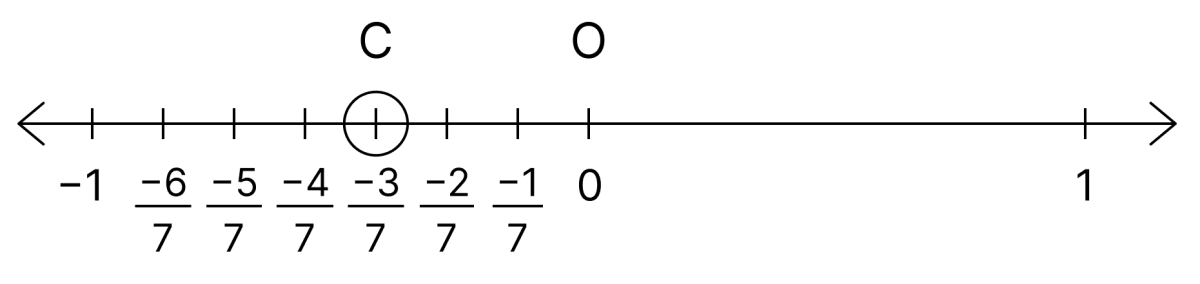
Draw a number line and mark a point O on it, representing the integer 0. Each point of division represents an integer and each length between two successive integers is a unit length.
As 7−3 is a negative proper fraction, it lies between -1 and 0.
Divide the unit length between 0 and -1 into 7 equal segments by making 6 equally spaced marks. Starting from 0, count backward (to the left) 3 segments. Label this specific position as point C, representing 7−3, as shown below :
Hence, the point C on the number line represents 7−3.
Represent the following number on the number line:
5−17
Answer
Draw a number line and mark a point O on it, representing the integer 0. Each point of division represents an integer and each length between two successive integers is a unit length.
Convert the improper fraction into a mixed fraction to find the two integers between which it lies.
5−17=−352
So, 5−17 lies between -3 and -4.
Divide the unit length between -3 and -4 into 5 equal segments by making 4 equally spaced marks. Starting from the integer -3, count backward (to the left) 2 segments. Label this specific position as point D, representing −352 i.e. 5−17, as shown below :
Hence, the point D on the number line represents 5−17.
Represent the following number on the number line:
−272
Answer
Draw a number line and mark a point O on it, representing the integer 0. Each point of division represents an integer and each length between two successive integers is a unit length.
The given number is already a mixed fraction, so we can directly find the two integers between which it lies.
−272=7−16
So, −272 lies between -2 and -3.
Divide the unit length between -2 and -3 into 7 equal segments by making 6 equally spaced marks. Starting from the integer -2, count backward (to the left) 2 segments. Label this specific position as point E, representing −272 i.e. 7−16, as shown below :
Hence, the point E on the number line represents −272.
State whether each of the following statements is true or false:
(i) Every whole number is a rational number.
(ii) Every integer is a rational number.
(iii) 32=3+42+4
(iv) 6−5<5−6
(v) −4−3 is a negative rational number.
(vi) 0 is a whole number but it is not a rational number.
Answer
(i) Every whole number p can be written as 1p, which is of the form qp where p,q are integers and q=0. For example, 0=10 and 7=17
Hence, the given statement is true.
(ii) Every integer p can be written as 1p, which is of the form qp where p,q are integers and q=0. For example, −5=1−5 and 5=15.
Hence, the given statement is true.
(iii) An equivalent rational number is obtained by multiplying (or dividing) both the numerator and the denominator by the same non-zero number, not by adding the same number to both.
⇒3+42+4=76⇒32=76[as 2×7=3×6]
Hence, the given statement is false.
(iv) Write both the rational numbers with the LCM of their denominators as the common denominator.
L.C.M. of 6 and 5 = 30
⇒6−5=6×5(−5)×5=30−25⇒5−6=5×6(−6)×6=30−36
As -36 < -25, so 5−6<6−5.
Hence, the given statement is false.
(v) A rational number is positive if its numerator and denominator are either both positive or both negative.
−4−3=−4×(−1)−3×(−1)=43, which is a positive rational number.
Hence, the given statement is false.
(vi) 0 is a whole number and it can also be written as 10, which is of the form qp where q=0, so 0 is a rational number as well.
Hence, the given statement is false.
Represent 513 and 5−13 on the number line.
Answer
Draw a number line and mark a point O on it, representing the integer 0. Mark the integers to the right (1, 2, 3) and to the left (-1, -2, -3).
Convert each of the given improper fractions into a mixed fraction to find the two integers between which it lies.
⇒513=253⇒5−13=−253
So, 513 lies between 2 and 3, and 5−13 lies between -2 and -3.
Divide the unit length between 2 and 3, as well as the unit length between -2 and -3, into 5 equal segments by making 4 equally spaced marks in each interval.
For 513 : Starting from the integer 2, count forward (to the right) 3 segments. Label this specific position as point A, representing 253 i.e. 513.
For 5−13 : Starting from the integer -2, count backward (to the left) 3 segments. Label this specific position as point B, representing −253 i.e. 5−13, as shown below :
Hence, the points A and B on the number line represent 513 and 5−13.