
How many perfect squares lie between 120 and 300?
5
6
7
8
Answer
We know that 112 = 121 and 172 = 289, which lie between 120 and 300.
Also, 102 = 100 < 120 and 182 = 324 > 300.
So, the perfect squares lying between 120 and 300 are :
121, 144, 169, 196, 225, 256 and 289
These are 7 in number.
Hence, option 3 is the correct option.
= ?
3
5
6
6.4
Answer
Evaluating,
Hence, option 3 is the correct option.
The value of is
2.03
2.1
2.11
2.23
Answer
Evaluating,
⇒
⇒ 0.1 + 0.9 + 1.2 + 0.03
⇒ 2.23
Hence, option 4 is the correct option.
If , then the value of is
52
58
62
68
Answer
Solving,
Hence, option 4 is the correct option.
? ÷ = 25
12.5
25
50
125
Answer
Let the required number be .
Hence, option 1 is the correct option.
For what value of the statement is true?
15
25
35
45
Answer
Let the value of be .
Hence, option 4 is the correct option.
What percentage of the numbers from 1 to 50 have squares that end in the digit 1?
10
5
11
20
Answer
We know that 12 = 1 and 92 = 81, so the square of a number ends in 1 only when the number ends in 1 or 9.
The numbers from 1 to 50 ending in 1 are 1, 11, 21, 31 and 41.
The numbers from 1 to 50 ending in 9 are 9, 19, 29, 39 and 49.
∴ Number of such numbers = 5 + 5 = 10
Required percentage = x 100%
Required percentage = 20%
Hence, option 4 is the correct option.
Which of the following cannot be the unit digit of a perfect square number?
1
6
8
9
Answer
According to the property of perfect squares, a number ending in 2, 3, 7 or 8 is never a perfect square.
So, 8 cannot be the unit digit of a perfect square number.
Hence, option 3 is the correct option.
= ?
1.49
Answer
Solving,
Hence, option 3 is the correct option.
= ?
42
64
74
84
Answer
Solving,
Hence, option 4 is the correct option.
The least number by which 294 must be multiplied to make it a perfect square, is
2
3
6
24
Answer
Resolving 294 into prime factors, we get :
294 = (7 × 7) × 2 × 3
Since the prime factors 2 and 3 are left unpaired, so 294 should be multiplied by 2 × 3, i.e., 6.
Hence, option 3 is the correct option.
The least number by which 1470 must be divided to get a number which is a perfect square, is
5
6
15
30
Answer
Resolving 1470 into prime factors, we get :
1470 = (7 × 7) × 2 × 3 × 5
Since the prime factors 2, 3 and 5 are left unpaired, so 1470 should be divided by 2 × 3 × 5, i.e., 30.
Hence, option 4 is the correct option.
What is the least number to be added to 7700 to make it a perfect square?
44
77
98
131
Answer
Let us try to find the square root of 7700.
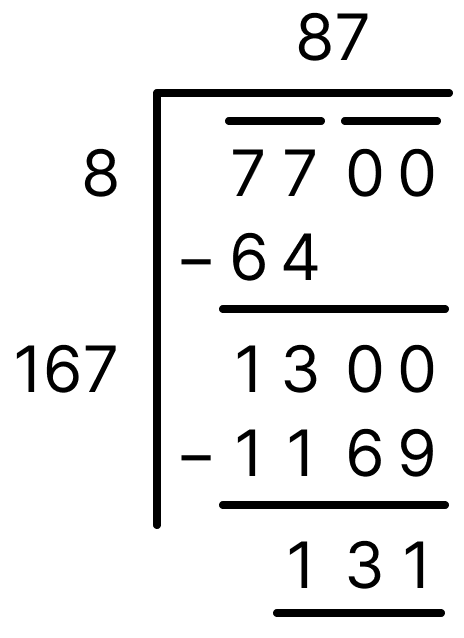
Clearly, (87)2 < 7700 < (88)2.
∴ Required number to be added = (88)2 - 7700 = 7744 - 7700 = 44.
Hence, option 1 is the correct option.
equals
0.50
0.64
0.73
0.75
Answer
Solving,
⇒
⇒ 10.5 × 0.1 ÷ 0.05 - 20.5
⇒ 1.05 ÷ 0.05 - 20.5
⇒ 21 - 20.5
⇒ 0.5
Hence, option 1 is the correct option.
The greatest four digit perfect square number is
9000
9801
9900
9981
Answer
Greatest number of four digits = 9999.
Let us try to find the square root of 9999.
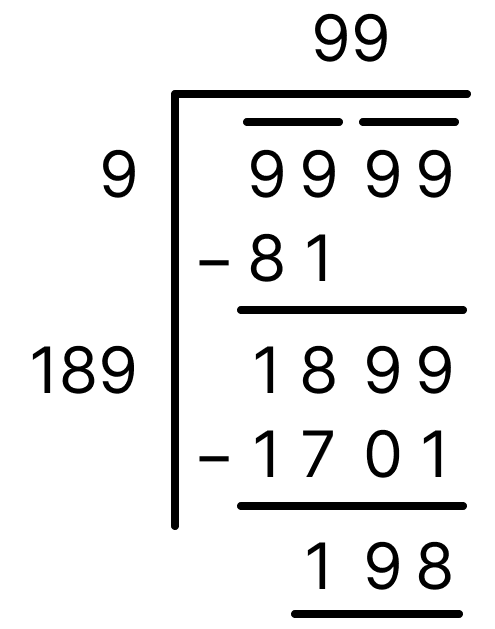
Clearly, (99)2 is less than 9999 by 198.
So, the least number to be subtracted is 198.
Required number = 9999 - 198 = 9801
Hence, option 2 is the correct option.
A gardener plants 17956 trees in such a way that there are as many rows as there are trees in a row. The number of trees in a row is
134
136
144
154
Answer
Let the number of rows be .
Then, the number of trees in each row = number of rows = .
∴ Total number of trees = .
But, total number of trees = 17956 (given).
Marking periods and using the division method, we have :
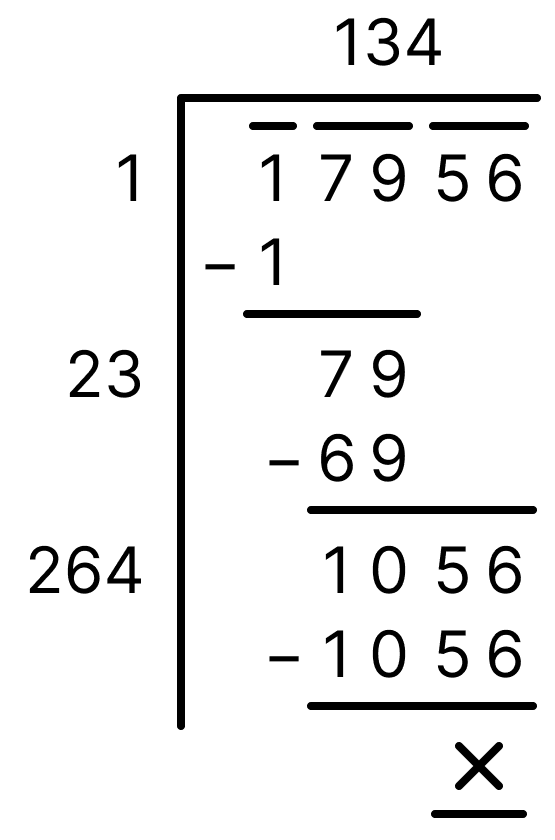
⇒
Hence, option 1 is the correct option.
= ?
Answer
Solving,
Hence, option 2 is the correct option.
By what least number must 21600 be multiplied so as to make it a perfect cube?
6
10
20
30
Answer
Resolving 21600 into prime factors, we get :
21600 = (2 × 2 × 2) × (3 × 3 × 3) × 2 × 2 × 5 × 5
Since 2 × 2 and 5 × 5 are left after grouping the prime factors in triplets, so 21600 must be multiplied by 2 × 5, i.e., 10.
⇒ 21600 x 10 = 216000
⇒ 216000 = (2 x 2 x 2) x (2 x 2 x 2) x (3 x 3 x 3) x (5 x 5 x 5), which is a perfect cube.
Hence, option 2 is the correct option.
What is the smallest number by which 3600 be divided to make it a perfect cube?
9
50
300
450
Answer
Resolving 3600 into prime factors, we get :
3600 = (2 × 2 × 2) × 2 × 3 × 3 × 5 × 5
Since 2, 3 × 3 and 5 × 5 are left after grouping the prime factors in triplets, so 3600 must be divided by 2 × 3 × 3 × 5 × 5, i.e., 450.
⇒ 3600 ÷ 450 = 8
⇒ 8 = (2 × 2 × 2), which is a perfect cube.
Hence, option 4 is the correct option.
Fill in the blanks:
(i) There are ............ perfect squares between 1 and 100.
(ii) There are ............ perfect cubes between 1 and 100.
(iii) A perfect square number cannot have ......., ......., ....... and ....... as the unit digit.
(iv) The cube of a number ending in 7 will end in the digit ............
(v) 1 m2 = ............ cm2 and 1 m3 = ............ cm3.
(vi) (100)3 has ............ zeroes.
Answer
(i) The perfect squares lying between 1 and 100 are 4, 9, 16, 25, 36, 49, 64 and 81, which are 8 in number.
Hence, there are 8 perfect squares between 1 and 100.
(ii) The perfect cubes lying between 1 and 100 are 8, 27 and 64, which are 3 in number.
Hence, there are 3 perfect cubes between 1 and 100.
(iii) According to the property of perfect squares, a number ending in 2, 3, 7 or 8 is never a perfect square.
Hence, a perfect square number cannot have 2, 3, 7 and 8 as the unit digit.
(iv) We know that 73 = 343, which ends in the digit 3.
For example, 173 = 4913 and 273 = 19683, which end in the digit 3.
Hence, the cube of a number ending in 7 will end in the digit 3.
(v) 1 m = 100 cm
Hence, 1 m2 = 10000 cm2 and 1 m3 = 1000000 cm3.
(vi) (100)3 = 100 × 100 × 100 = 1000000
The number 1000000 has 6 zeroes.
Hence, (100)3 has 6 zeroes.
Write true (T) or false (F):
(i) The sum of two perfect squares is a perfect square.
(ii) The product of two perfect squares is a perfect square.
(iii) The square of every natural number is always greater than the number itself.
(iv) There exists no natural number whose square is equal to its cube.
(v) The cube root of 80000 is 200.
Answer
(i) False
Reason — The numbers 4 and 9 are perfect squares but 4 + 9 = 13, which is not a perfect square.
(ii) True
Reason — Let the two perfect squares be and . Then, , which is a perfect square. For example, 4 × 9 = 36 = 62.
(iii) False
Reason — For the natural number 1, 12 = 1, which is equal to the number itself and not greater than it.
(iv) False
Reason — For the natural number 1, 12 = 1 and 13 = 1. So, the square of 1 is equal to its cube.
(v) False
Reason — (200)3 = 200 × 200 × 200 = 8000000 and not 80000. Also, 80000 = (2 × 2 × 2) × (2 × 2 × 2) × 2 × (5 × 5 × 5) × 5 is not a perfect cube, so its cube root is not a whole number.
Assertion (A): There are 42 natural numbers between 212 and 222.
Reason (R): There are non-perfect square numbers between the squares of the numbers and .
Both Assertion (A) and Reason (R) are true and Reason (R) is the correct explanation of Assertion (A).
Both Assertion (A) and Reason (R) are true and Reason (R) is not the correct explanation of Assertion (A).
Assertion (A) is true but Reason (R) is false.
Assertion (A) is false but Reason (R) is true.
Answer
We know that there are non-perfect square numbers between the squares of two consecutive numbers and .
So, Reason (R) is true.
Here,
Natural numbers between 212 and 222 = 2 × 21 = 42
So, Assertion (A) is true and Reason (R) is the correct explanation of Assertion (A).
Hence, option 1 is the correct option.
Assertion (A): For an integer is always greater than .
Reason (R): Square of a negative integer is positive and cube of a negative integer is negative.
Both Assertion (A) and Reason (R) are true and Reason (R) is the correct explanation of Assertion (A).
Both Assertion (A) and Reason (R) are true and Reason (R) is not the correct explanation of Assertion (A).
Assertion (A) is true but Reason (R) is false.
Assertion (A) is false but Reason (R) is true.
Answer
Let .
Here, is less than .
So, Assertion (A) is false.
The square of a negative integer is positive as the product of two negative integers is positive and the cube of a negative integer is negative as the product of three negative integers is negative.
So, Reason (R) is true.
Hence, option 4 is the correct option.
Assertion (A): The value of is 3.6.
Reason (R): We cannot find the cube roots of negative numbers.
Both Assertion (A) and Reason (R) are true and Reason (R) is the correct explanation of Assertion (A).
Both Assertion (A) and Reason (R) are true and Reason (R) is not the correct explanation of Assertion (A).
Assertion (A) is true but Reason (R) is false.
Assertion (A) is false but Reason (R) is true.
Answer
Evaluating,
So, Assertion (A) is true.
The cube of a negative number is negative, so every negative number has a cube root which is negative.
For example, .
So, Reason (R) is false.
Hence, option 3 is the correct option.
If = 4.578, then, the value of is:
0.654
6.54
1.526
none of these
Answer
Solving,
Hence, option 1 is the correct option.
If , then the value of is:
8
64
32
16
Answer
Solving,
Hence, option 2 is the correct option.
is equal to:
8
12
16
20
Answer
Evaluating,
Hence, option 3 is the correct option.
For integers and , if , then .
True
False
Cannot say anything
None of these
Answer
Let .
Here, but = 5.
So, is not equal to when is a negative integer.
Hence, option 2 is the correct option.
There are 24 non square numbers between two consecutive perfect squares. The sum of these two consecutive perfect squares is:
300
305
310
313
Answer
We know that there are non-perfect square numbers between the squares of two consecutive numbers and .
⇒
⇒
So, the two consecutive perfect squares are 122 and 132.
⇒ 122 + 132
⇒ 144 + 169
⇒ 313
Hence, option 4 is the correct option.
The cube of a given number can be smaller than the number itself. Is it true?
Yes
No
Can't say anything
None of these
Answer
Let the number be 0.5.
⇒ (0.5)3 = 0.5 × 0.5 × 0.5 = 0.125
Here, 0.125 < 0.5, so the cube is smaller than the number itself.
Again, let the number be -2.
⇒ (-2)3 = -8
Here, -8 < -2, so the cube is smaller than the number itself.
Hence, option 1 is the correct option.
Product of three distinct non-cube numbers can't be a perfect cube. This statement is:
True
False
Can't say anything
None of these
Answer
Let the three distinct numbers be 4, 6 and 9.
None of the numbers 4, 6 and 9 is a perfect cube.
⇒ 4 x 6 x 9 = 216
⇒ 216 = (2 x 2 x 2) x (3 x 3 x 3) = 63, which is a perfect cube.
So, the product of three distinct non-cube numbers can be a perfect cube.
Hence, option 2 is the correct option.
If and are distinct positive rational numbers such that and , then will be:
positive
negative
neither positive nor negative
none of these
Answer
Given, is a positive rational number such that .
So, .
Given, is a positive rational number such that .
So, > 1.
Since and , so .
∴ is negative.
Hence, option 2 is the correct option.
If , then is equal to:
8
1728
12
144
Answer
Solving,
Resolving each number into prime factors,
4 = 22, 27 = 33, 108 = 22 × 33 and 256 = 28
Now, finding the cube root of 1728,
Hence, option 3 is the correct option.
and are two numbers ( ≠ 1) such that is a perfect cube and is a perfect square. Which of the following numbers is a perfect cube?
(i)
(ii)
(iii)
(iv)
only (ii)
only (i) and (ii)
only (iv)
only (i), (ii) and (iii)
Answer
Since is a perfect cube, let .
Since is a perfect square, let .
Taking and ,
(i) , which is not a perfect cube.
(ii) , which is not a perfect cube.
(iii) , which is not a perfect cube.
(iv) , which is a perfect cube.
For example, , which is a perfect cube.
Hence, option 3 is the correct option.