
17 less than four times a number is 11. Find the number.
Answer
Let the number be .
Given,
17 less than four times a number is 11.
Hence, the required number = 7.
If 10 be added to four times a certain number, the result is 5 less than five times the number. Find the number.
Answer
Let the number be .
Given,
If 10 be added to four times a certain number, the result is 5 less than five times the number.
Hence, the required number = 15.
of a number is 20 less than the original number. Find the original number.
Answer
Let the original number be .
Given,
of a number is 20 less than the original number.
Multiplying both sides by 3, we get:
Hence, the original number = 60.
A number is 25 more than its th part. Find the number.
Answer
Let the number be .
Given,
A number is 25 more than its th part.
Multiplying both sides by 6, we get:
Hence, the required number = 150.
A number is as much greater than 21 as is less than 71. Find the number.
Answer
Let the number be .
Given,
A number is as much greater than 21 as is less than 71.
Hence, the required number = 46.
6 more than one-fourth of a number is two-fifths of the number. Find the number.
Answer
Let the number be .
Given,
6 more than one-fourth of a number is two-fifths of the number.
L.C.M. of 4 and 5 = 20
Multiplying both sides by 20, we get:
Hence, the required number = 40.
One-third of a number exceeds one-fourth of the number by 15. Find the number.
Answer
Let the number be .
Given,
One-third of a number exceeds one-fourth of the number by 15.
L.C.M. of 3 and 4 = 12
Multiplying both sides by 12, we get:
Hence, the required number = 180.
If one-fifth of a number decreased by 5 is 16, find the number.
Answer
Let the number be .
Given,
One-fifth of a number decreased by 5 is 16.
Multiplying both sides by 5, we get:
Hence, the required number = 105.
A number when divided by 6 is diminished by 40. Find the number.
Answer
Let the number be .
Given,
A number when divided by 6 is diminished by 40.
Multiplying both sides by 6, we get:
Hence, the required number = 48.
Four-fifths of a number exceeds two-thirds of the number by 10. Find the number.
Answer
Let the number be .
Given,
Four-fifths of a number exceeds two-thirds of the number by 10.
L.C.M. of 5 and 3 = 15
Multiplying both sides by 15, we get:
Hence, the required number = 75.
Two numbers are in the ratio 3 : 4 and their sum is 84. Find the numbers.
Answer
Given,
Two numbers are in the ratio 3 : 4.
Let the two numbers be and .
Given,
The sum of the two numbers is 84.
So, the numbers are 3 × 12 = 36 and 4 × 12 = 48.
Hence, the required numbers are 36 and 48.
Three numbers are in the ratio 4 : 5 : 6 and their sum is 135. Find the numbers.
Answer
Given,
Three numbers are in the ratio 4 : 5 : 6.
Let the three numbers be and .
Given,
The sum of the three numbers is 135.
So, the numbers are 4 × 9 = 36, 5 × 9 = 45 and 6 × 9 = 54.
Hence, the required numbers are 36, 45 and 54.
Two numbers are in the ratio 3 : 5. If each is increased by 10, the ratio between the new numbers so formed is 5 : 7. Find the original numbers.
Answer
Given,
Two numbers are in the ratio 3 : 5.
Let the two numbers be and .
Given,
If each number is increased by 10, the ratio between the new numbers so formed is 5 : 7.
So, the original numbers are 3 × 5 = 15 and 5 × 5 = 25.
Hence, the original numbers are 15 and 25.
The sum of three consecutive odd numbers is 75. Find the numbers.
Answer
Let the three consecutive odd numbers be and .
Given,
The sum of three consecutive odd numbers is 75.
So, the numbers are 23, 23 + 2 = 25 and 23 + 4 = 27.
Hence, the required numbers are 23, 25 and 27.
Divide 25 into two parts such that 7 times the first part added to 5 times the second part makes 139.
Answer
Given,
25 is divided into two parts.
Let the first part be and the second part be .
Given,
7 times the first part added to 5 times the second part makes 139.
So, the second part = 25 - 7 = 18
Hence, the two parts are 7 and 18.
Divide 180 into two parts such that the first part is 12 less than twice the second part.
Answer
Given,
180 is divided into two parts.
Let the second part be and the first part be .
Given,
The first part is 12 less than twice the second part.
So, the first part = 180 - 64 = 116
Hence, the two parts are 116 and 64.
The denominator of a fraction is 4 more than its numerator. On subtracting 1 from each numerator and the denominator, the fraction becomes . Find the original fraction.
Answer
Given,
The denominator of a fraction is 4 more than its numerator.
Let the numerator of the fraction be and its denominator be .
Given,
On subtracting 1 from each of the numerator and the denominator, the fraction becomes .
So, the denominator = 5 + 4 = 9
Hence, the original fraction = .
The denominator of a fraction is 1 more than double the numerator. On adding 2 to the numerator and subtracting 3 from the denominator, we obtain 1. Find the original fraction.
Answer
Given,
The denominator of a fraction is 1 more than double the numerator.
Let the numerator of the fraction be and its denominator be .
Given,
On adding 2 to the numerator and subtracting 3 from the denominator, we obtain 1.
So, the denominator = 2 × 4 + 1 = 9
Hence, the original fraction = .
The sum of the digits of a two-digit number is 5. On adding 27 to the number, its digits are reversed. Find the original number.
Answer
Given,
The sum of the digits of a two-digit number is 5.
Let the digit at unit's place be and the digit at ten's place be .
So, the original number =
On reversing the digits, the new number =
Given,
On adding 27 to the number, its digits are reversed.
So, the digit at ten's place = 5 - 4 = 1
and the original number = 10 × 1 + 4 = 14
Hence, the original number = 14.
What same number should be added to each one of the numbers 15, 23, 29, 44 to obtain numbers which are in proportion?
Answer
Let the number to be added be .
Given,
On adding the same number to each one of the numbers 15, 23, 29 and 44, the numbers obtained are in proportion.
Hence, the required number to be added = 1.
The sum of two numbers is 110. One-fifth of the larger number is 8 more than one-ninths of the smaller number. Find the numbers.
Answer
Given,
The sum of two numbers is 110.
Let the larger number be and the smaller number be .
Given,
One-fifth of the larger number is 8 more than one-ninth of the smaller number.
L.C.M. of 5 and 9 = 45
Multiplying both sides by 45, we get:
So, the smaller number = 110 - 65 = 45
Hence, the required numbers are 65 and 45.
A number is subtracted from the numerator of the fraction and six times that number is added to the denominator. If the new fraction is , then find the number.
Answer
Let the number be .
Given,
When the number is subtracted from the numerator of the fraction and six times that number is added to the denominator, the new fraction is .
Hence, the required number = 7.
A right angled triangle having perimeter 120 cm has its two perpendicular sides in the ratio 5 : 12. Find the lengths of its sides.
Answer
Given,
The two perpendicular sides of the right angled triangle are in the ratio 5 : 12.
Let the two perpendicular sides of the right angled triangle be cm and cm.
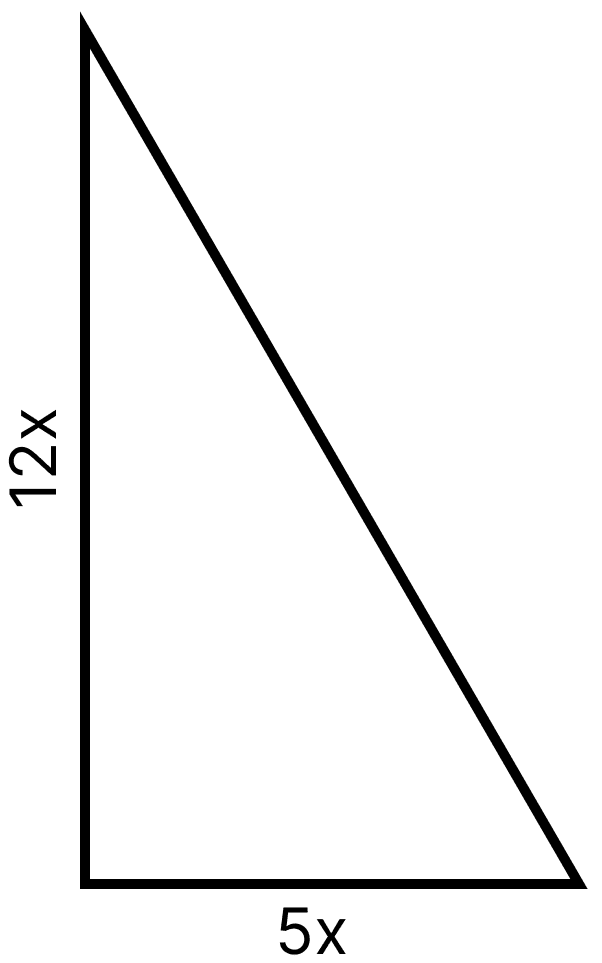
By Pythagoras Theorem,
Given,
The perimeter of the right angled triangle is 120 cm.
Perimeter of the triangle = Sum of all the sides
So, the sides are 5 × 4 = 20 cm, 12 × 4 = 48 cm and 13 × 4 = 52 cm.
Hence, the lengths of the sides of the triangle are 20 cm, 48 cm and 52 cm.
The sum of the digits of a two-digit number is 9. If 9 is added to the number formed by reversing the digits, then the result is thrice the original number. Find the original number.
Answer
Given,
The sum of the digits of a two-digit number is 9.
Let the digit at unit's place be and the digit at ten's place be .
So, the original number =
On reversing the digits, the new number =
Given,
If 9 is added to the number formed by reversing the digits, then the result is thrice the original number.
So, the digit at ten's place = 9 - 7 = 2
and the original number = 10 × 2 + 7 = 27
Hence, the original number = 27.
The length of a rectangular plot of land exceeds its breadth by 23 m. If the length is decreased by 15 m and the breadth is increased by 7 m, the area is reduced by 360 m2. Find the length and breadth of the plot.
Answer
Given,
The length of a rectangular plot of land exceeds its breadth by 23 m.
Let the breadth of the plot be m and its length be m.
Given,
If the length is decreased by 15 m and the breadth is increased by 7 m, the area is reduced by 360 m2.
We know that,
Area of a rectangle = length × breadth
So, the breadth of the plot = 52 m
and the length of the plot = 52 + 23 = 75 m
Hence, the length and breadth of the plot are 75 m and 52 m respectively.
The length of a rectangular park is twice its breadth. If the perimeter of the park is 186 m, find its length and breadth.
Answer
Given,
The length of a rectangular park is twice its breadth.
Let the breadth of the park be m and its length be m.
Given,
The perimeter of the park is 186 m.
We know that,
Perimeter of a rectangle = 2(length + breadth)
So, the breadth of the park = 31 m
and the length of the park = 2 × 31 = 62 m
Hence, the length and breadth of the park are 62 m and 31 m respectively.
The length of a rectangle is 7 cm more than its breadth. If the perimeter of the rectangle is 90 cm, find its length and breadth.
Answer
Given,
The length of a rectangle is 7 cm more than its breadth.
Let the breadth of the rectangle be cm and its length be cm.
Given,
The perimeter of the rectangle is 90 cm.
We know that,
Perimeter of a rectangle = 2(length + breadth)
So, the breadth of the rectangle = 19 cm
and the length of the rectangle = 19 + 7 = 26 cm
Hence, the length and breadth of the rectangle are 26 cm and 19 cm respectively.
The length of a rectangle is 7 cm less than twice its breadth. If the length is decreased by 2 cm and breadth increased by 3 cm, the perimeter of the resulting rectangle is 66 cm. Find the length and breadth of the original rectangle.
Answer
Given,
The length of a rectangle is 7 cm less than twice its breadth.
Let the breadth of the original rectangle be cm and its length be cm.
Given,
If the length is decreased by 2 cm and breadth increased by 3 cm, the perimeter of the resulting rectangle is 66 cm.
We know that,
Perimeter of a rectangle = 2(length + breadth)
So, the breadth of the original rectangle = 13 cm
and the length of the original rectangle = 2 × 13 - 7 = 19 cm
Hence, the length and breadth of the original rectangle are 19 cm and 13 cm respectively.
A man is five times as old as his son. In two years time, he will be four times as old as his son. Find their present ages.
Answer
Given,
A man is five times as old as his son.
Let the present age of the son be years and the present age of the man be years.
Given,
In two years time, the man will be four times as old as his son.
So, the present age of the man = 5 × 6 = 30 years
Hence, the present ages of the man and his son are 30 years and 6 years respectively.
A man is twice as old as his son. Twelve years ago, the man was thrice as old as his son. Find their present ages.
Answer
Given,
A man is twice as old as his son.
Let the present age of the son be years and the present age of the man be years.
Given,
Twelve years ago, the man was thrice as old as his son.
So, the present age of the man = 2 × 24 = 48 years
Hence, the present ages of the man and his son are 48 years and 24 years respectively.
Seema is 10 years elder than Rekha. The ratio of their ages is 5 : 3. Find their ages.
Answer
Given,
The ratio of the ages of Seema and Rekha is 5 : 3.
Let the ages of Seema and Rekha be years and years respectively.
Given,
Seema is 10 years elder than Rekha.
So, Seema's age = 5 × 5 = 25 years
and Rekha's age = 3 × 5 = 15 years
Hence, the ages of Seema and Rekha are 25 years and 15 years respectively.
5 years ago, the age of Parvathi was 4 times the age of her son. The sum of their present ages is 55 years. Find Parvathi's present age.
Answer
Given,
The sum of the present ages of Parvathi and her son is 55 years.
Let Parvathi's present age be years and her son's present age be years.
Given,
5 years ago, the age of Parvathi was 4 times the age of her son.
Hence, Parvathi's present age = 41 years.
A man is 56 years old and his son is 24 years old. In how many years, the father will be twice as old as his son at that time?
Answer
Let after years the father become twice as old as his son.
Given,
The man is 56 years old and his son is 24 years old.
Hence, after 8 years the father will be twice as old as his son.
9 years hence, a girl will be 3 times as old as she was 9 years ago. How old is she now?
Answer
Let the present age of the girl be years.
Given,
9 years hence, the girl will be 3 times as old as she was 9 years ago.
Hence, the present age of the girl = 18 years.
A man made a trip of 480 km in 9 hours. Some part of the trip was covered at 45 km/hr and the remaining at 60 km/hr. Find the part of the trip covered by him at 60 km/hr.
Answer
Given,
The man made a trip of 480 km.
Let the part of the trip covered at 60 km/hr be km and the part of the trip covered at 45 km/hr be km.
Given,
The trip was made in 9 hours.
We know that,
Time =
L.C.M. of 45 and 60 = 180
Multiplying both sides by 180, we get:
Hence, the part of the trip covered at 60 km/hr = 300 km.
A motorist travelled from town A to town B at an average speed of 54 km/hr. On his return journey, his average speed was 60 kmph. If the total time taken is hours, find the distance between the two towns.
Answer
Let the distance between the two towns be km.
Given,
The motorist travelled from town A to town B at 54 km/hr and returned at 60 km/hr, and the total time taken is hours.
We know that,
Time =
L.C.M. of 54, 60 and 2 = 540
Multiplying both sides by 540, we get:
Hence, the distance between the two towns = 270 km.
The distance between two stations is 300 km. Two motor-cyclists start simultaneously from these stations and move towards each other. The speed of one of them is 7 km/hr faster than that of the other. If the distance between them after 2 hours of their start is 34 km, find the speed of each motor-cyclist.
Answer
Given,
The speed of one of the motor-cyclists is 7 km/hr faster than that of the other.
Let the speed of the slower motor-cyclist be km/hr and the speed of the faster motor-cyclist be km/hr.
Let the slower motor-cyclist start from station A and the faster motor-cyclist start from station B.
Let C and D be their positions after 2 hours.

We know that,
Distance = Speed × Time
AC = km, BD = km and CD = 34 km
Given,
The distance between the two stations is 300 km.
So, the speed of the faster motor-cyclist = 63 + 7 = 70 km/hr
Hence, the speeds of the two motor-cyclists are 63 km/hr and 70 km/hr.
A boat travels 30 km upstream in a river in the same period of time as it takes to travel 50 km downstream. If the rate of stream be 5 kmph, find the speed of the boat in still water.
Answer
Given,
The rate of stream is 5 kmph.
Let the speed of the boat in still water be kmph.
So, speed of the boat upstream = kmph
and speed of the boat downstream = kmph
Given,
The boat travels 30 km upstream in the same period of time as it takes to travel 50 km downstream.
We know that,
Time =
Hence, the speed of the boat in still water = 20 kmph.
The length of each of the equal sides of an isosceles triangle is 4 cm longer than the base. If the perimeter of the triangle is 62 cm, find the lengths of the sides of the triangle.
Answer
Given,
The length of each of the equal sides of an isosceles triangle is 4 cm longer than the base.
Let the length of the base of the isosceles triangle be cm and the length of each of the equal sides be cm.
Given,
The perimeter of the triangle is 62 cm.
Perimeter of the triangle = Sum of all the sides
So, the base = 18 cm
and each of the equal sides = 18 + 4 = 22 cm
Hence, the lengths of the sides of the triangle are 22 cm, 22 cm and 18 cm.
A certain number of candidates appeared for an examination in which one-fifth of the whole plus 16 secured first division, one-fourth plus 15 secured second division and one-fourth minus 25 secured third division. If the remaining 60 candidates failed, find the total number of candidates appeared.
Answer
Let the total number of candidates appeared be .
Given,
One-fifth of the whole plus 16 secured first division, one-fourth plus 15 secured second division, one-fourth minus 25 secured third division and the remaining 60 candidates failed.
L.C.M. of 5 and 4 = 20
Multiplying both sides by 20, we get:
Hence, the total number of candidates appeared = 220.
Raman has three times as much money as Kamal. If Raman gives ₹ 750 to Kamal, then Kamal will have twice as much as left with Raman. How much had each originally?
Answer
Given,
Raman has three times as much money as Kamal.
Let the money Kamal had originally be ₹ and the money Raman had originally be ₹ .
Given,
If Raman gives ₹ 750 to Kamal, then Kamal will have twice as much as left with Raman.
So, the money Raman had originally = 3 × 450 = ₹ 1,350
Hence, originally Kamal had ₹ 450 and Raman had ₹ 1,350.
The angles of a triangle are in the ratio 2 : 3 : 4. Find the angles.
Answer
Given,
The angles of a triangle are in the ratio 2 : 3 : 4.
Let the angles of the triangle be and .
We know that,
The sum of the angles of a triangle is 180°.
So, the angles are and .
Hence, the angles of the triangle are 40°, 60° and 80°.
A certain number of men can finish a piece of work in 50 days. If there are 7 more men, the work can be completed 10 days earlier. How many men were originally there?
Answer
Given,
A certain number of men can finish a piece of work in 50 days.
Let the number of men originally there be .
⇒ 1 man completes the work in days.
Given,
If there are 7 more men, the work can be completed 10 days earlier.
⇒ men complete the work in (50 - 10) days = 40 days.
⇒ 1 man completes the work in days.
As the work is the same in both the cases,
Hence, originally there were 28 men.
Divide 600 in two parts such that 40% of one exceeds 60% of the other by 120.
Answer
Given,
600 is divided into two parts.
Let the first part be and the second part be .
Given,
40% of the first part exceeds 60% of the second part by 120.
Multiplying both sides by 5, we get:
So, the second part = 600 - 480 = 120
Hence, the two parts are 480 and 120.
A workman is paid ₹ 150 for each day he works and is fined ₹ 50 for each day he is absent. In a month of 30 days he earned ₹ 2,100. For how many days did he remain absent?
Answer
Let the number of days for which the workman remained absent be and the number of days for which he worked be .
Given,
The workman is paid ₹ 150 for each day he works and is fined ₹ 50 for each day he is absent. In a month of 30 days he earned ₹ 2,100.
Hence, the workman remained absent for 12 days.