
The study of static electricity began with the Greeks, but major contributions came later. William Gilbert coined the term 'electricus', Charles du Fay discovered two types of charges, and Benjamin Franklin explained conservation of charge and studied lightning. Luigi Galvani and Alessandro Volta explored electric currents, while Michael Faraday advanced understanding of conductors and insulators. Stephen Gray distinguished between conductors and insulators, and Pieter van Musschenbroek invented the electroscope. These discoveries led to the safe use of electricity at home, prompting Thomas Edison and Nikola Tesla to pioneer power systems. Today, conserving electricity is essential for a sustainable world.
Answer
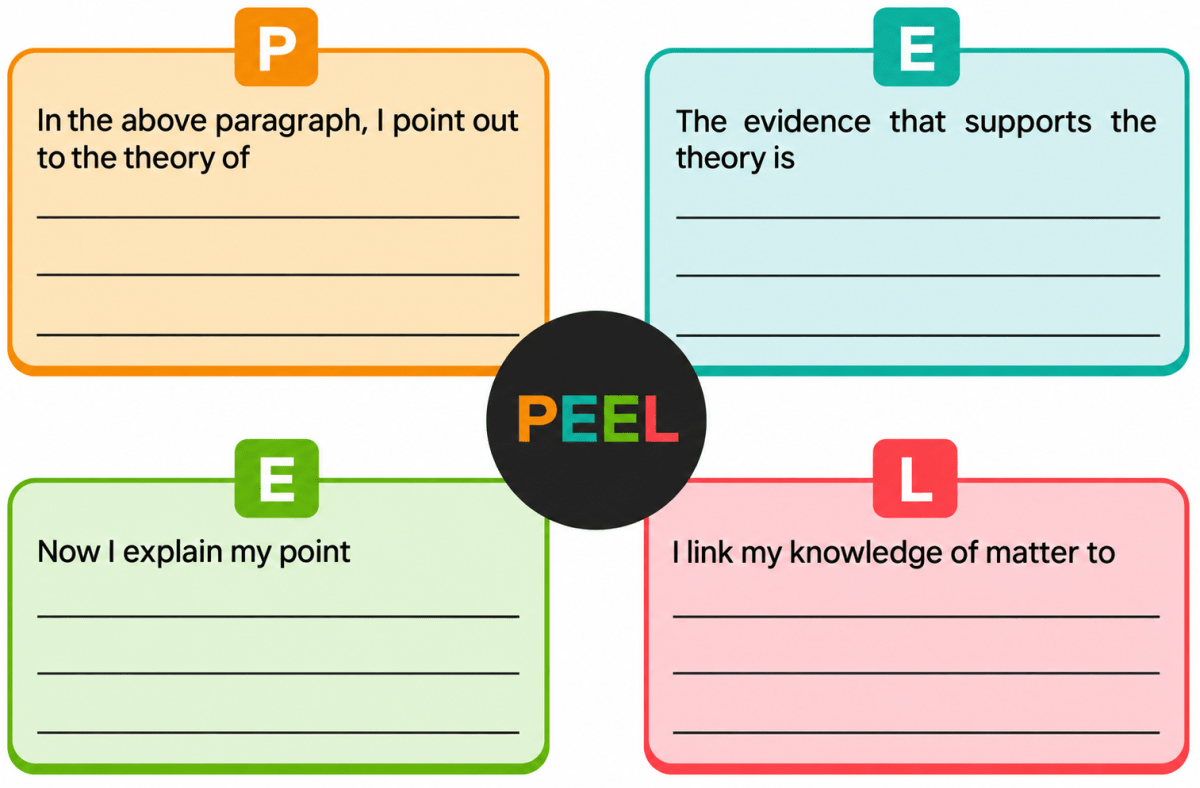
P – Point → In the above paragraph, I point out to the theory of: The historical evolution and scientific development of electricity through chronological discoveries.
E – Evidence → The evidence that supports the theory is: William Gilbert first coined the term 'electricus'. Later, Benjamin Franklin explained how electric charges work. Alessandro Volta and Luigi Galvani discovered electric currents. Finally, Thomas Edison and Nikola Tesla created modern power systems to bring electricity into our homes.
E – Explanation → Now I explain my point: Each scientist built upon previous findings. They transformed static electricity concepts into functional currents. This progressive understanding enabled the creation of safe commercial power grids.
L – Link → I link my knowledge of electricity to: The practical use of electricity in our daily lives and the modern urgency to conserve energy for a sustainable future.
Read the given paragraph and answer the questions that follow.
Sara was an eighth-grader who loved exploring science around her. One winter morning, she touched the metal doorknob and felt a sudden zap! "Ouch!" she said, surprised. Her science teacher had just taught them about static electricity. She recalled that rubbing two objects like wool and plastic, can cause them to gain or lose electric charges.
Curious, Sara rubbed a plastic comb on her dry hair and brought it near tiny paper bits. They leaped towards the comb! She learnt this happened due to charging by friction, where electrons are transferred, but the total charge is conserved.
That evening, there was a thunderstorm. Bright lightning flashed across the sky, followed by loud thunder. Her father explained how clouds carry static charges and when opposite charges in the cloud and earth meet, it results in lightning. He showed her the lightning conductor on their roof that safely directs the charge into the ground.

- Why did Sara feel a shock when she touched the metal doorknob? What principle of static electricity does this demonstrate?
- How does an electroscope work, and what did it show when Sara brought a charged balloon near it?
- Describe how lightning occurs in the atmosphere using the concept of static charges.
Answer
Static charge had accumulated on Sara's body due to friction. When she touched the metal doorknob, which is a conductor, the accumulated charge suddenly discharged through the metal, producing a small electric shock. This demonstrates electrostatic discharge.
An electroscope is used to detect electric charge. When a charged balloon is brought near the metal disc of a neutral gold-leaf electroscope, charges in the electroscope redistribute by induction. The two leaves acquire like charges and diverge. Thus, the divergence of the leaves shows that the balloon is charged.
Lightning occurs when opposite static charges build up in clouds and on the Earth. When these charges suddenly move through the air, a bright flash of lightning is produced.
Circle the word that does not belong to other words given alongside it.
- Lightning, Electroscope, Comb, Thunder
- Fuse, MCB, Insulator, Electric power
- Charging by friction, Charging by conduction, Charging by induction, Lightning rod
- Copper, Aluminium, Plastic, Iron
- Static electricity, Electric charges, Conservation of charges, Electric motor
Answer
- Thunder
Reason — Lightning, electroscope and comb are all associated with electric charges, whereas thunder is only a sound produced by the rapid expansion of heated air. - Electric power
Reason — Fuse, MCB and insulator are all related to electrical safety, whereas electric power is a physical quantity (the electrical energy consumed per unit time). - Lightning rod
Reason — Charging by friction, conduction and induction are all methods of charging an object, whereas a lightning rod is a device used to protect tall buildings from lightning. - Plastic
Reason — Copper, aluminium and iron are conductors of electricity, whereas plastic is an insulator. - Electric motor
Reason — Static electricity, electric charges and conservation of charges are all concepts of electrostatics, whereas an electric motor is a device.
Answer in one or a few word(s).
- How many kinds of electricity are there?
- Name the force with which the comb attracts the water stream or bits of paper.
- What are valence electrons?
- When is the charge on the body negative?
- List the various sources of electrical energy.
Answer
- Two kinds — static electricity and current electricity.
- Electrostatic force.
- Valence electrons are the electrons present in the outermost orbit of an atom.
- The charge on the body is negative when the number of protons is less than the number of electrons.
- Power plants, cells and batteries.
Match the columns.
| Column A | Column B |
|---|---|
| 1. Electroscope | (a) Protects buildings from lightning |
| 2. Charging by friction | (b) Detects electric charge |
| 3. Lightning conductor | (c) Rubbed objects gain or lose electrons |
| 4. Fuse | (d) Turning off appliances when not in use |
| 5. Conservation of electricity | (e) Melts and breaks the circuit when overloaded |
Answer
| Column A | Column B |
|---|---|
| 1. Electroscope | (b) Detects electric charge |
| 2. Charging by friction | (c) Rubbed objects gain or lose electrons |
| 3. Lightning conductor | (a) Protects buildings from lightning |
| 4. Fuse | (e) Melts and breaks the circuit when overloaded |
| 5. Conservation of electricity | (d) Turning off appliances when not in use |
Write the correct word(s) in the given blanks.
- ............... electricity is the flow of electric charge through a conductor.
- ............... revolve around the nucleus along circular paths in orbits.
- ............... are the materials that allow electrons to flow through them.
- A/An ............... is a device that is used for detection of small amount of charge on a body.
- ............... is a high energy electric discharge that takes place in the atmosphere.
Answer
- Current electricity is the flow of electric charge through a conductor.
- Electrons revolve around the nucleus along circular paths in orbits.
- Conductors are the materials that allow electrons to flow through them.
- A/An electroscope is a device that is used for detection of small amount of charge on a body.
- Lightning is a high energy electric discharge that takes place in the atmosphere.
Write True or False for the following statements.
- The earth wire completes the circuit by returning the electricity to the source (transformer) after it has passed through the appliance.
- Batteries which are designed to be recharged and used a number of times are primary batteries.
- Overloading occurs when the live wire touches the neutral wire, providing an alternate path for the current to flow through.
- The current rating of the fuse wire determines its thickness.
- The death of a person caused by electric shock when electric current passes through the body is called electrocution.
Answer
- False
Corrected Statement — The neutral wire completes the circuit by returning the electricity to the source (transformer) after it has passed through the appliance. - False
Corrected Statement — Batteries which are designed to be recharged and used a number of times are secondary batteries. - False
Corrected Statement — A short circuit occurs when the live wire touches the neutral wire, providing an alternate path for the current to flow through. - True
- True
Find errors in the given sentences and correct them.
- Fuse wire has no resistance and in case of overloading its temperature falls much faster than the connecting copper wire.
- The live wire has no current flowing through it. One end of the live wire is connected to the appliance and the other end is grounded.
- Conduction is a method of charging an uncharged conductor just by bringing a charged body in close vicinity but not making any physical contact with the uncharged body.
- Insulators are the materials that allow electrons to flow through them.
- Static electricity is caused by the continuous flow of electric current.
Answer
- Fuse wire has a higher resistance and in case of overloading its temperature rises much faster than the connecting copper wire.
- The earth wire has no current flowing through it. One end of the earth wire is connected to the appliance and the other end is grounded.
- Induction is a method of charging an uncharged conductor just by bringing a charged body in close vicinity but not making any physical contact with the uncharged body.
- Insulators are the materials that do not allow electrons to flow through them.
- Static electricity is caused by the build-up of charges on the surface of an object.
Give reason — When you walk across a carpet and touch a metal doorknob, you may experience a light electric jerk.
Answer
Carpets are usually made of nylon or wool, which give away their electrons and become positively charged. As we walk, our feet rub against the carpet, so a large amount of charge builds up and these electrons stay on the surface of our body. When we touch a conductor like a metal doorknob, the electrons flow from our body to the doorknob, and we experience a light electric jerk.
Give reason — When we rub a balloon against our hair, both of them become charged and attract each other.
Answer
When a balloon is rubbed against hair, free electrons are transferred between the two. The rubber balloon has a greater affinity for free electrons than hair, so it pulls electrons from the hair and becomes negatively charged, leaving the hair positively charged. Since the two acquire equal and opposite (unlike) charges, and unlike charges attract each other, the balloon and the hair attract each other.
Give reason — The neutral object acquires the same nature of charge as the object used for charging by conduction.
Answer
In charging by conduction, the charged object is brought in direct contact with the neutral object, and some charge is transferred between them. For example, when a negatively charged rod touches a neutral sphere, electrons flow from the rod to the sphere and the sphere also becomes negatively charged. Thus, the neutral object acquires the same nature of charge as the object used for charging.
Give reason — If you switch off the lights and fans of your room, the other electric equipment in the house do not turn off or disturb other appliances in the house.
Answer
In houses, the wiring is done in such a way that all the devices are connected in parallel. In a parallel connection, each appliance has its own independent path for current. So, switching off the lights and fans of one room does not turn off or disturb the other appliances in the house.
Give reason — All the electrical appliances like ovens, heaters and electric irons are provided with an earth wire.
Answer
The earth wire is a safety wire. If the insulation of an appliance gets damaged and the bare live wire touches its metal casing, the earth wire carries the leakage current safely into the earth. As a result, a person touching the appliance does not receive a severe electric shock. That is why such appliances are provided with an earth wire.
What is current electricity?
Answer
Current electricity is the flow of electric charge through a conductor in a closed circuit.
Write the characteristics of a fuse.
Answer
The characteristics of a fuse are:
- It is made of a thin wire of an alloy with a low melting point.
- It has high resistance compared to ordinary wires.
- It melts and breaks the circuit when excess current flows.
- It protects electrical appliances and wiring from overloading and short-circuiting.
What is lightning?
Answer
Lightning is a high energy electric discharge that takes place in the atmosphere. It is caused by the accumulation of static charges in the clouds. When a large amount of charge accumulates, the insulating property of the air breaks down, and an electric discharge takes place between two oppositely charged clouds or between a charged cloud and the ground.
Why are lightning conductors fixed on the roofs of tall buildings?
Answer
Lightning conductors are fixed on the roofs of tall buildings to protect them from lightning. They provide a safe, low-resistance path for the electric charge to flow into the Earth, preventing damage to the building and reducing the risk of fire.
How can we conserve electricity?
Answer
We can conserve electricity by:
- Using energy efficient appliances like LED bulbs and compact fluorescent lamps (CFLs).
- Turning off appliances, lights and fans when they are not in use.
- Closing doors when the air conditioner is on.
- Switching off devices at the plug point and not just by the remote.
Explain the nature of charges with the help of an activity.
Answer
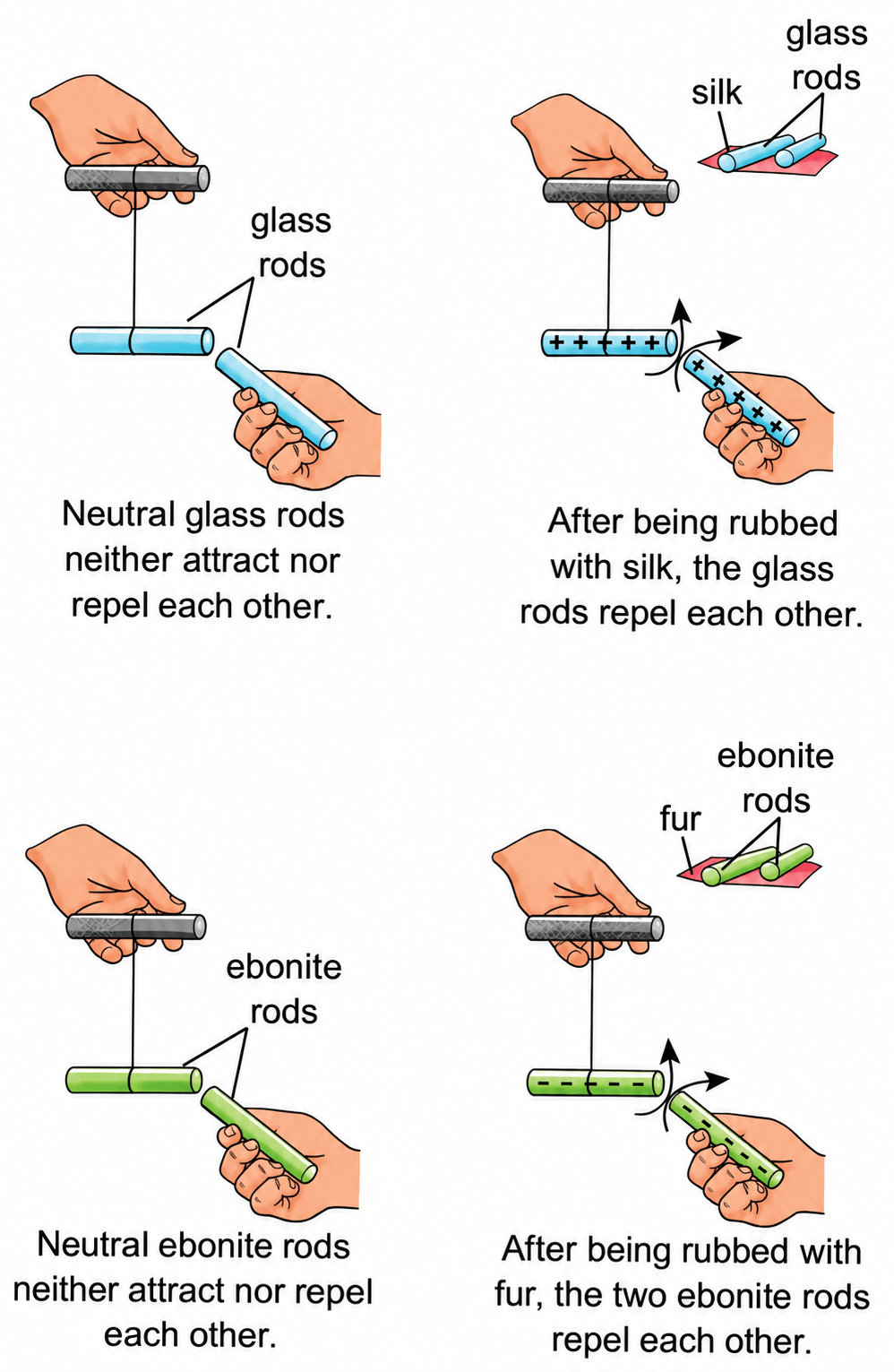
Aim: To study the nature of charges.
Materials required: Two ebonite rods, fur, two glass rods, silk cloth and thread.
Procedure and observation:
- Rub a glass rod with silk cloth and suspend it freely with a thread. Rub another glass rod with silk and bring it near. The two glass rods repel each other.
- Rub two ebonite rods with fur and bring them near each other. The two ebonite rods also repel each other.
- Now bring the silk-rubbed glass rod near the suspended fur-rubbed ebonite rod. The two rods attract each other.
Conclusion: There are two types of charges — positive and negative. Like charges repel each other, while unlike charges attract each other.
"Charges can neither be created nor destroyed, they can only be transferred from one body to another." Explain this statement.
Answer
This statement is the law of conservation of charge. Before rubbing, a glass rod and a silk cloth are both neutral and neither attract nor repel each other. When the glass rod is rubbed with the silk cloth, some electrons (negative charge) are transferred from the glass rod to the silk. The glass rod loses electrons and becomes positively charged, while the silk gains the same number of electrons and develops an equal negative charge.
Similarly, when an ebonite rod is rubbed with fur, the ebonite rod gains electrons and becomes negatively charged, while the fur loses an equal number of electrons and becomes positively charged. Thus, the two bodies always acquire equal and opposite charges by rubbing. The charge is not created or destroyed; it is only transferred from one body to another. This is called the law of conservation of charge.
Differentiate between charging by conduction and charging by induction.
Answer
| Charging by Conduction | Charging by Induction |
|---|---|
| The charged body makes contact with the uncharged body. | The charged body never makes any contact with the uncharged body. |
| The uncharged body acquires the charge of the same nature as that on the charged body. | The uncharged body acquires the charge of the opposite nature to that on the charged body. |
| Electrons flow between the two bodies. | No electrons flow between the two bodies. |
| The body retains its charge for a longer duration even after the removal of the charging body. | The charge is induced temporarily, unless the body is earthed. |
What is electroscope? Explain the most widely used electroscopes.
Answer
An electroscope is a device that is used for the detection of a small amount of charge on a body. It also gives information about the nature of the charge, that is, whether it is positive or negative.
The two most widely used electroscopes are:
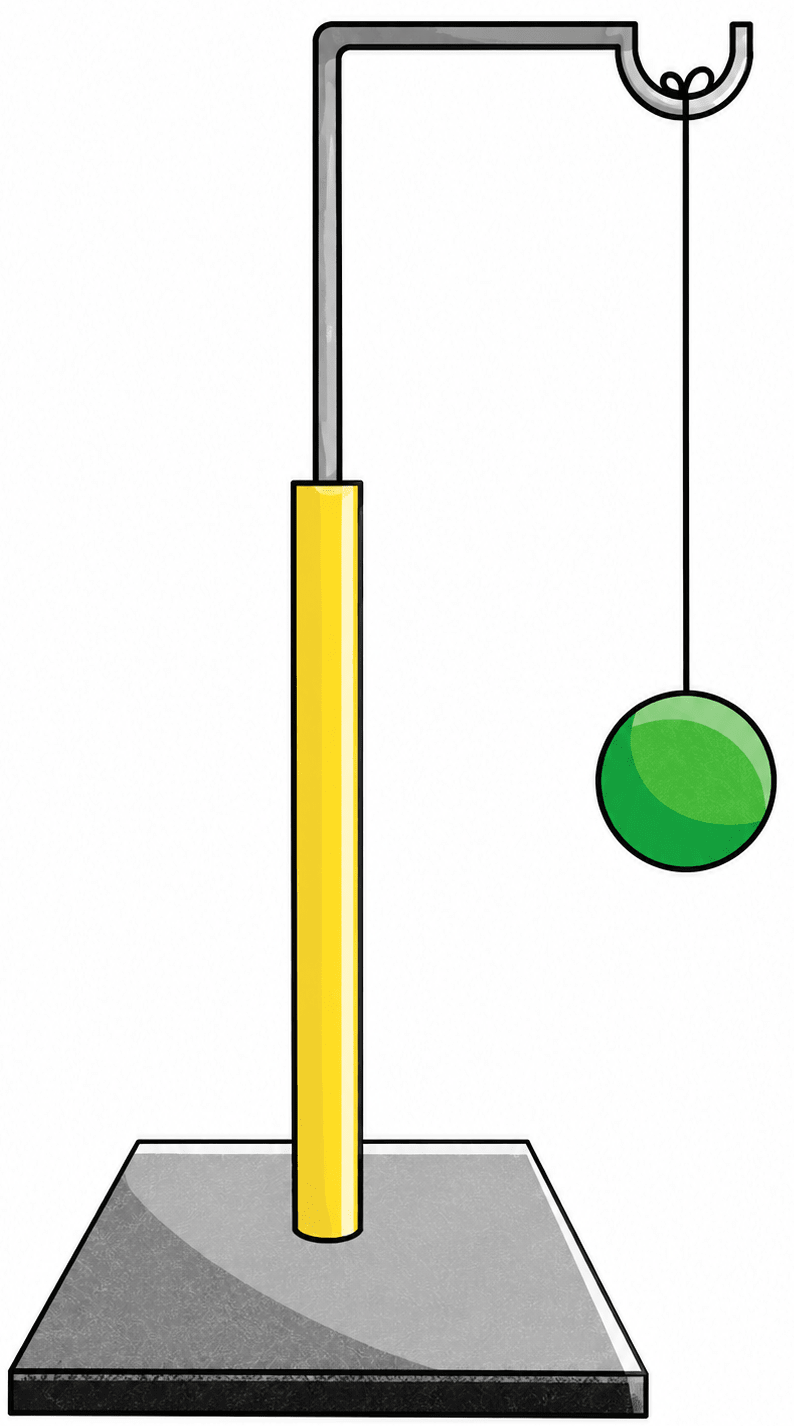
- Pith-ball electroscope: It consists of a pith-ball suspended with a silk thread from an insulating stand. The body to be tested is brought close to the pith-ball without touching it. If the ball shows any movement, the body is charged; if the ball remains stationary, the body is uncharged.
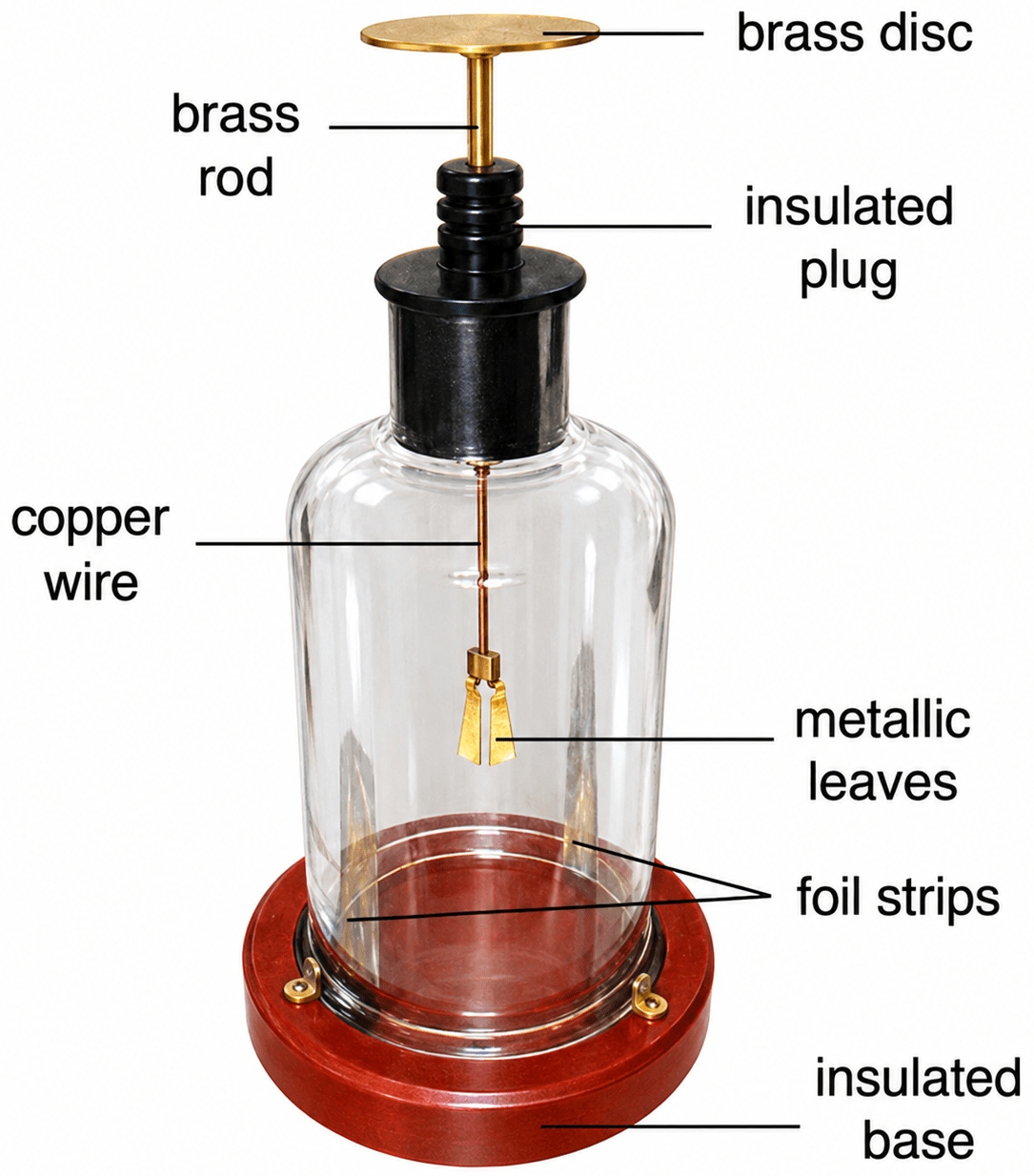
- Gold-leaf electroscope: It consists of a glass bell jar fitted with an insulated plug, through which a brass rod passes. The upper end of the rod carries a brass disc, and the lower end inside the jar carries two thin metallic leaves. When a charged body touches the brass disc, the charge passes to the leaves, which acquire the same charge and diverge due to repulsion.
Write the safety measures to be followed during lightning.
Answer
The safety measures to be followed during lightning are:
Out of the house:
- If you are in an open ground with no shelter, squat down with your feet together.
- Do not go on the terrace or roof of any tall building.
- Stay away from water bodies such as rivers, ponds, lakes and swimming pools.
- Do not carry an umbrella in an open ground and do not stand under a tree.
- Take shelter inside a building or a parked vehicle with all its doors and windows closed, without touching the metallic frame of the vehicle.
Inside the house:
- Stay away from doors and windows and keep them shut.
- Do not take a shower or make contact with running water or a metallic tap.
- Do not operate electrical appliances like televisions and computers.
- Do not use a corded telephone.
Read the given case study and answer the questions that follow.
One evening, Naman and his sister Preet were playing indoors. Suddenly, dark clouds gathered, and it started thundering. A flash of lightning lit up the sky followed by a loud roar. Preet got scared. Their father calmly said, "Don't worry. The house has a lightning conductor that safely carries the electric charges into the ground."
Just then, Naman rubbed a balloon on his hair and brought it close to Preet's arm. The hair on her arm stood up! "That's static electricity, just like our teacher showed in the class," Naman laughed.
Later, power went off due to storm. Their parents lit LED bulbs connected to a backup inverter. Their father said, "Always unplug devices during storms. It protects them from damage and saves electricity too." He also showed them a fuse that melted earlier and prevented a short circuit.

- What is the role of a lightning conductor in the house during a thunderstorm?
- Why did the hair on Preet's arm stand up when Naman brought the balloon near it?
- Why is it advised to unplug appliances during a thunderstorm?
- How does a fuse help in electrical safety?
- Give one example each of a conductor and an insulator mentioned in the story.
Answer
During a thunderstorm, the lightning conductor protects the house by safely discharging the electric charges from the cloud into the ground. This prevents the building from being damaged by lightning.
When Naman rubbed the balloon on his hair, the balloon became charged by friction. When he brought the charged balloon close to Preet's arm, it exerted an electrostatic force on the hair, so the hair was attracted towards the balloon and stood up.
During a thunderstorm, lightning can cause a sudden surge of high voltage in the wiring, which can damage the appliances. Unplugging the appliances protects them from this damage and also helps save electricity.
A fuse is the weakest part of the circuit. In case of overloading or a short circuit, excess current flows through it, so the fuse wire gets heated and melts. This breaks the circuit and stops the current, preventing fire and damage to the appliances.
Conductor — the lightning conductor (made of metal). Insulator — the rubber balloon.
Read the given information carefully and answer the questions that follow.
Static electricity was discovered in ancient times, and around 600 BC, the Greek natural philosopher Thales described the attractive power of amber when it is rubbed with fur. In 1600, Gilbert found that apart from amber, various substances possess similar attractive force, and these substances were collectively named 'electrica'. Cabeo discovered that the rubbed electrica also had the effect of repelling or attracting the material. In 1733, du Fay discovered that charged objects of identical type repel each other, and charged objects of different type attract each other, assuming that there are two types of electricity, positive and negative. In 1750, Franklin considered that every object contains an electric fluid in their respective portion, pointing out that its excess or deficiency is the 'charged state'; this led to the discovery of polarity classified as positive (excessive) and negative (deficient). In 1836, Faraday demonstrated that the measurement of a charge depends on the observer's electrical state and developed the Faraday cage to measure static electricity quantitatively for the first time.
Source: https://www.nature.com/articles/s41598-022-12704-5
- What is static electricity?
- How is it different from current electricity?
- Who discovered it?
- What did Faraday demonstrate about static electricity?
Answer
Static electricity is the electricity caused by the build-up of charges on the surface of an object. The word 'static' is used because the charges are at rest.
Static electricity is the build-up of charges that are at rest on the surface of an object, whereas current electricity is the flow of electric charge through a conductor.
According to the passage, static electricity was first described in ancient times by the Greek philosopher Thales (around 600 BC), who observed the attractive power of amber when rubbed with fur.
In 1836, Faraday demonstrated that the measurement of a charge depends on the observer's electrical state, and he developed the Faraday cage to measure static electricity quantitatively for the first time.
Ravi observed that after rubbing a plastic pen on his dry sweater, small paper bits jumped towards the pen. Why did this happen? Analyse the reason using the concept of electric charges.

Answer
When the plastic pen is rubbed against the dry sweater, electrons are transferred between the two and the pen becomes charged by friction. The charged pen now sets up an electrostatic force around it. When it is brought near the tiny paper bits, this electrostatic force attracts them, so the small paper bits jump towards the pen.
During a thunderstorm, why do electricians advise not to use electrical appliances like TV or refrigerator? Analyse the risks involved.
Answer
During a thunderstorm, lightning may strike the power lines and send a sudden surge of very high voltage and current into the household wiring. If appliances like a TV or refrigerator are switched on, this surge can flow through them and damage them, or even cause an electric shock or fire. To avoid this risk, electricians advise not to use such appliances during a thunderstorm.
A 1000 W iron is used for 2 hours every day for 10 days. If the cost of 1 unit of electricity is ₹6, calculate the total bill.
Answer
Power of the iron = 1000 W = 1 kW
Total time of usage = 2 h × 10 = 20 h
Energy consumed = Power × Time = 1 kW × 20 h = 20 kWh = 20 units
Total cost = Total units × Cost of each unit = 20 × ₹6 = ₹120
∴ The total electricity bill is ₹120.
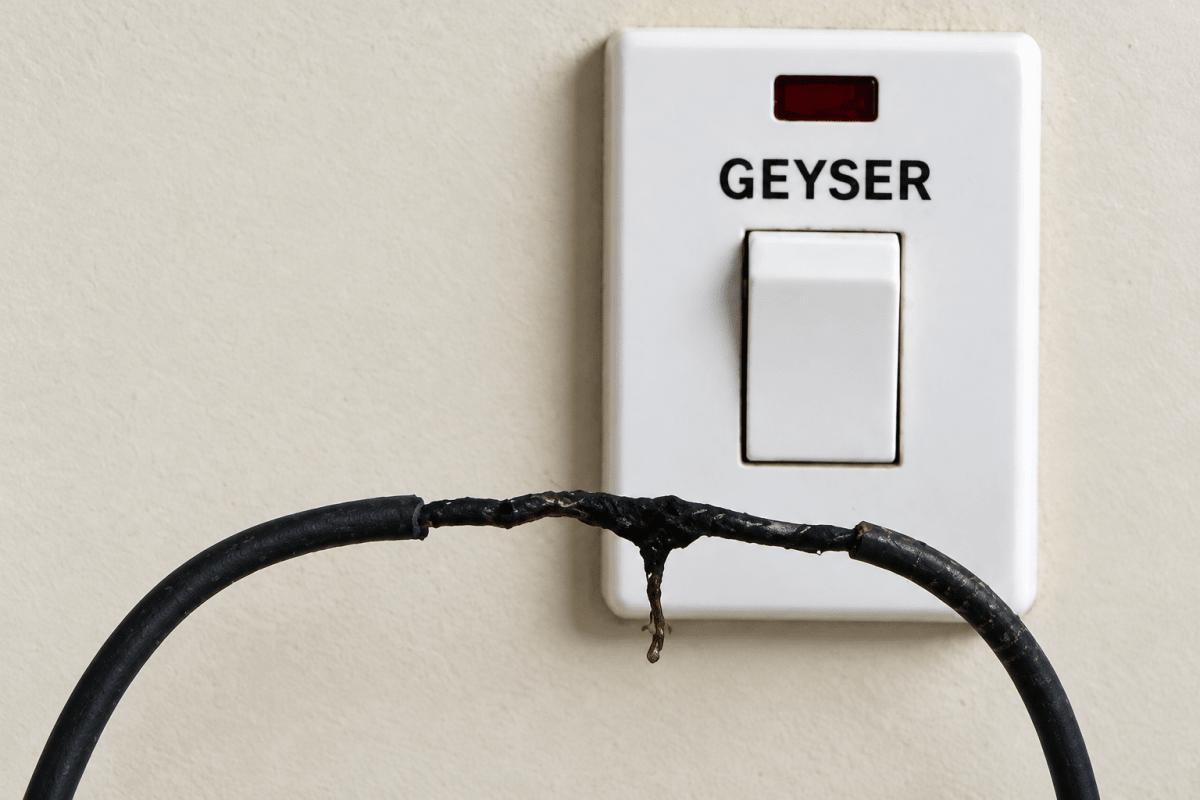
A fuse wire melted when a geyser was switched on. If the geyser was of 3000 W and the fuse was rated for 5 A, was the fuse appropriate? (Use V = 220 V) Hint:
Answer
Power of the geyser, P = 3000 W
Voltage, V = 220 V
Current drawn by the geyser, A (approximately)
The geyser draws a current of about 13.64 A, which is much more than the fuse rating of 5 A. So the current exceeded the safety limit and the fuse melted.
∴ No, the fuse was not appropriate. A fuse of a higher rating (more than 13.64 A, for example 15 A) should have been used for the geyser.
Design a simple experiment using objects at home (like balloon, comb, paper bits) to show static electricity. Describe the steps and what you expect to observe.
Answer
Materials required: A balloon (or a plastic comb), small bits of paper and a woollen cloth (or dry hair).
Steps:
- Inflate a balloon and tie its end (or take a dry plastic comb).
- Rub the balloon with the woollen cloth (or rub the comb through dry hair) for about 20–30 seconds.
- Bring the rubbed balloon or comb close to the small bits of paper kept on a table.
Expected observation: The small paper bits get attracted to the balloon (or comb) and may stick to it. This happens because the balloon or comb acquires a static charge by friction and exerts an electrostatic force on the paper bits. This shows the presence of static electricity.
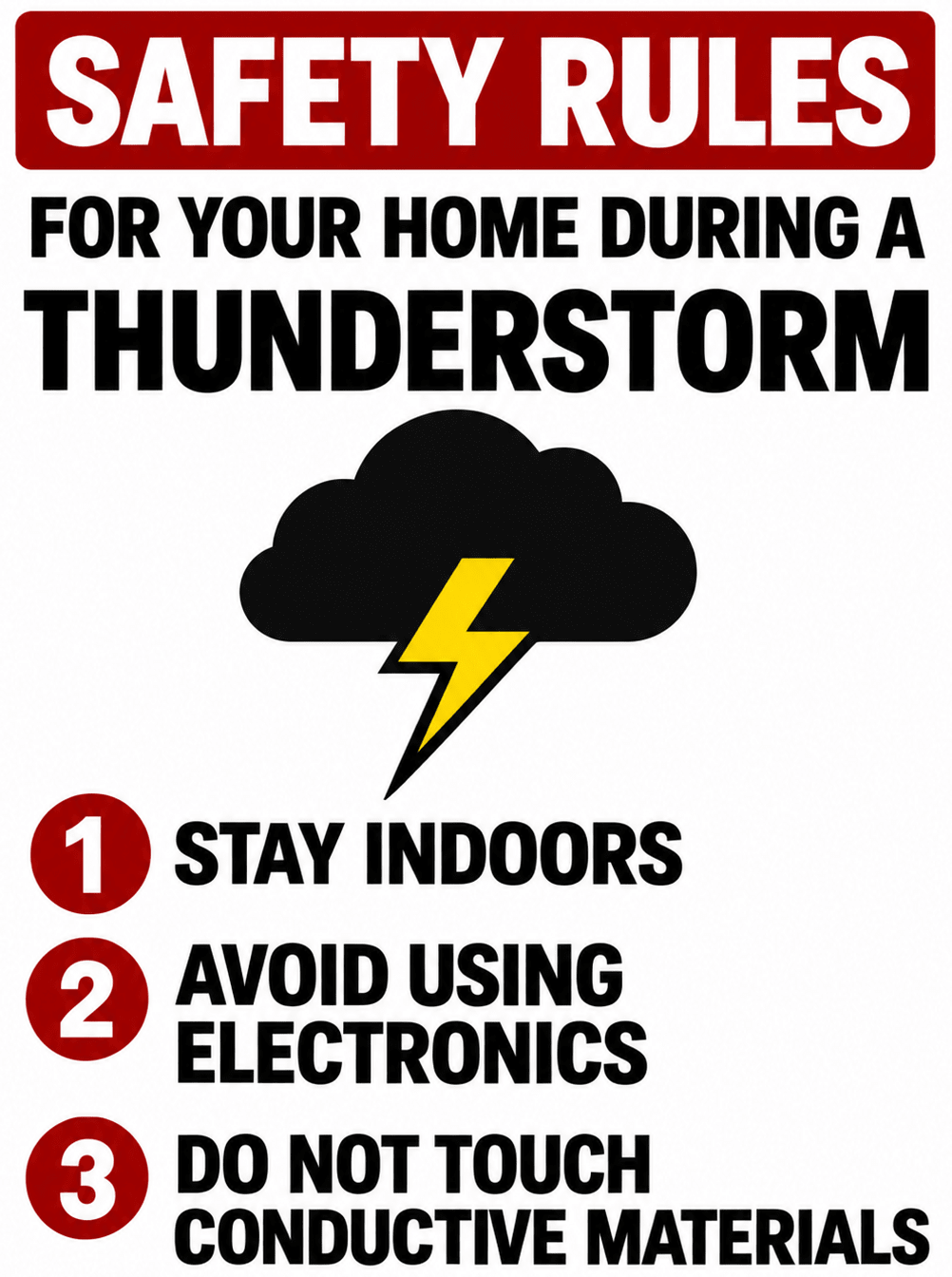
Make a list of three safety rules for your home during a thunderstorm and design a small poster to spread awareness about electrical hazards.
Answer
Three safety rules for the home during a thunderstorm:
- Stay indoors and keep all doors and windows shut.
- Do not operate or use electrical appliances like the TV and computer, and avoid using a corded telephone.
- Do not touch running water, metal taps or any conductive (metal) objects.
Poster:
Laxmi rubbed a plastic scale on her hair and then brought it near bits of paper. To her surprise, the scale attracted the paper pieces. She also noticed that during thunderstorms, her hair would sometimes stand up when she touched metal objects.

- What kind of electricity is generated when two objects are rubbed together?
- What are electric charges?
- What happens to the electric charge during rubbing — does it get created or transferred?
- What does the law of conservation of charge state?
- Why does your hair sometimes stand up during storms?
Answer
Static electricity is generated when two objects are rubbed together.
Electric charges arise due to an imbalance of protons and electrons in a body. There are two kinds of charges — positive charge (when the number of protons is more than the number of electrons) and negative charge (when the number of electrons is more than the number of protons).
During rubbing, the electric charge is not created; it is only transferred. Electrons are transferred from one body to the other, so the two bodies acquire equal and opposite charges.
The law of conservation of charge states that charge can neither be created nor destroyed; it can only be transferred from one body to another.
During storms, the air around becomes charged and the strands of hair acquire the same (like) charge. Since like charges repel each other, the hair strands push away from one another and stand up.
In the lab, Kartik observed that when a charged rod was brought near a hanging ball, it attracted or repelled it. He also tested different materials like copper, plastic and wood to see which one allowed electric charges to pass. His teacher used an electroscope to detect charge.
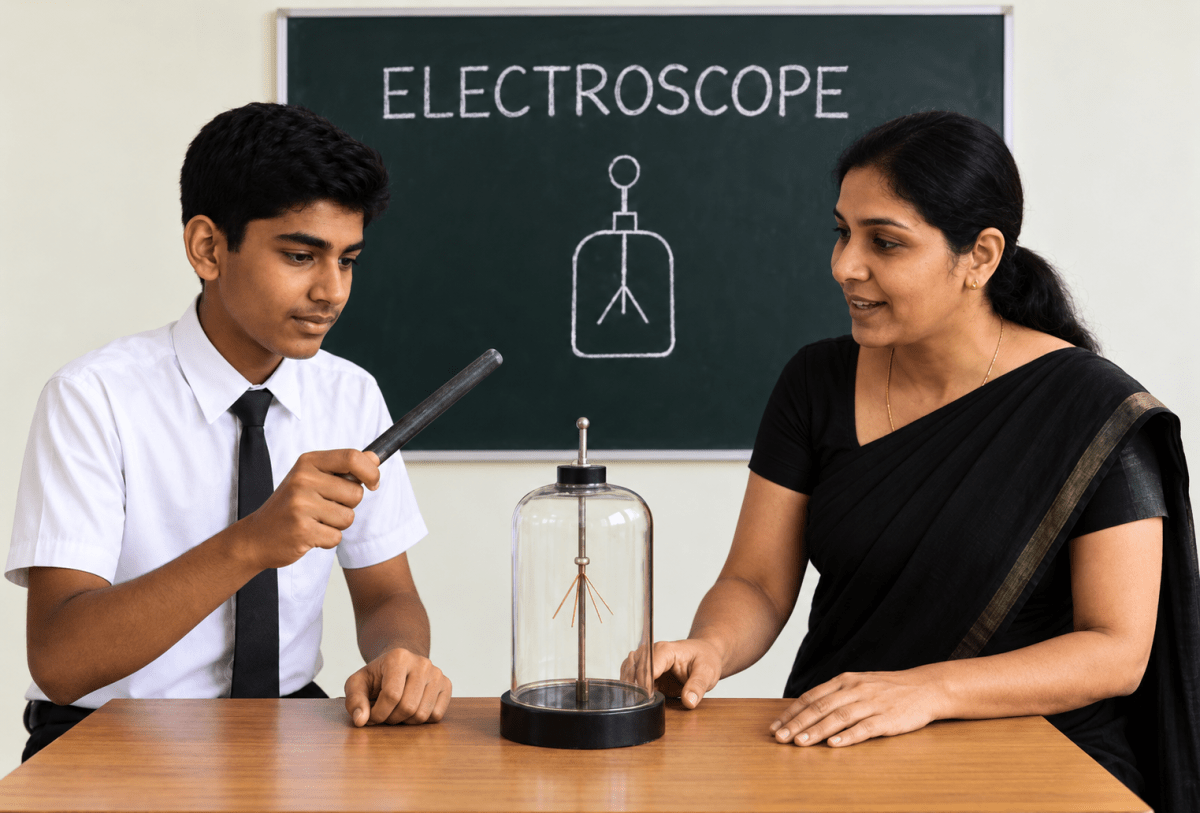
- What are conductors and insulators?
- Which materials allow electric charge to flow freely?
- What is the purpose of an electroscope?
- What does it mean to 'charge' an object?
- Why does a charged rod attract or repel other objects?
Answer
Conductors are materials that allow electrons (electric charge) to flow through them, as they have a large number of free electrons, for example, metals. Insulators are materials that do not allow electrons to flow through them, as they have very few free electrons, for example, plastic and wood.
Conductors allow electric charge to flow freely. All metals, such as copper, aluminium and iron, are good conductors.
The purpose of an electroscope is to detect a small amount of charge on a body and to find the nature of the charge, that is, whether it is positive or negative.
To 'charge' an object means to create an imbalance of charges on it (an excess or deficiency of electrons). An object can be charged by friction, conduction or induction.
A charged rod has an electrostatic force around it. It repels objects carrying like charges and attracts objects carrying unlike charges (or light uncharged objects), because like charges repel and unlike charges attract each other.
At home, Palak used many electrical appliances at once and suddenly all the lights went out. Her father showed her a tripped circuit breaker and explained it had shut off to prevent overloading. He also talked about fuses and earthing wires in the circuit box.

- What is electrical power and how is it related to energy?
- What is overloading in a household circuit?
- How does a fuse protect us from electrical hazards?
- What is the role of earthing in electric circuits?
- Why do appliances stop working when the circuit is overloaded?
Answer
Electrical power is the electrical energy consumed per unit time by an electrical appliance. It is related to energy by the formula Power = , that is, . Its SI unit is the watt (W).
Overloading is the situation when many appliances are connected to a single socket, so that the circuit draws a large amount of current from the mains. This causes excessive heating of the connecting wires and the circuit, and can lead to a short circuit.
A fuse is the weakest part of the circuit. When excess current flows through it due to overloading or a short circuit, the fuse wire gets hot and melts. This breaks the circuit and stops the flow of current, protecting us from fire and damage.
In earthing, the metallic body of the appliance is connected to a thick copper wire whose other end is buried deep in the earth. If the live wire touches the metal casing, the leakage current flows safely into the earth, so the person touching the appliance does not get a severe electric shock.
When the circuit is overloaded, the excess current causes the fuse to melt (or the circuit breaker to trip), which breaks the circuit. As the circuit is broken, no current flows, so the appliances stop working.
Vansh's school celebrated Energy Conservation Day. Students made posters and pledged to save electricity by turning off fans and lights when not needed. His science teacher explained how small steps can reduce energy consumption and prevent accidents at home.
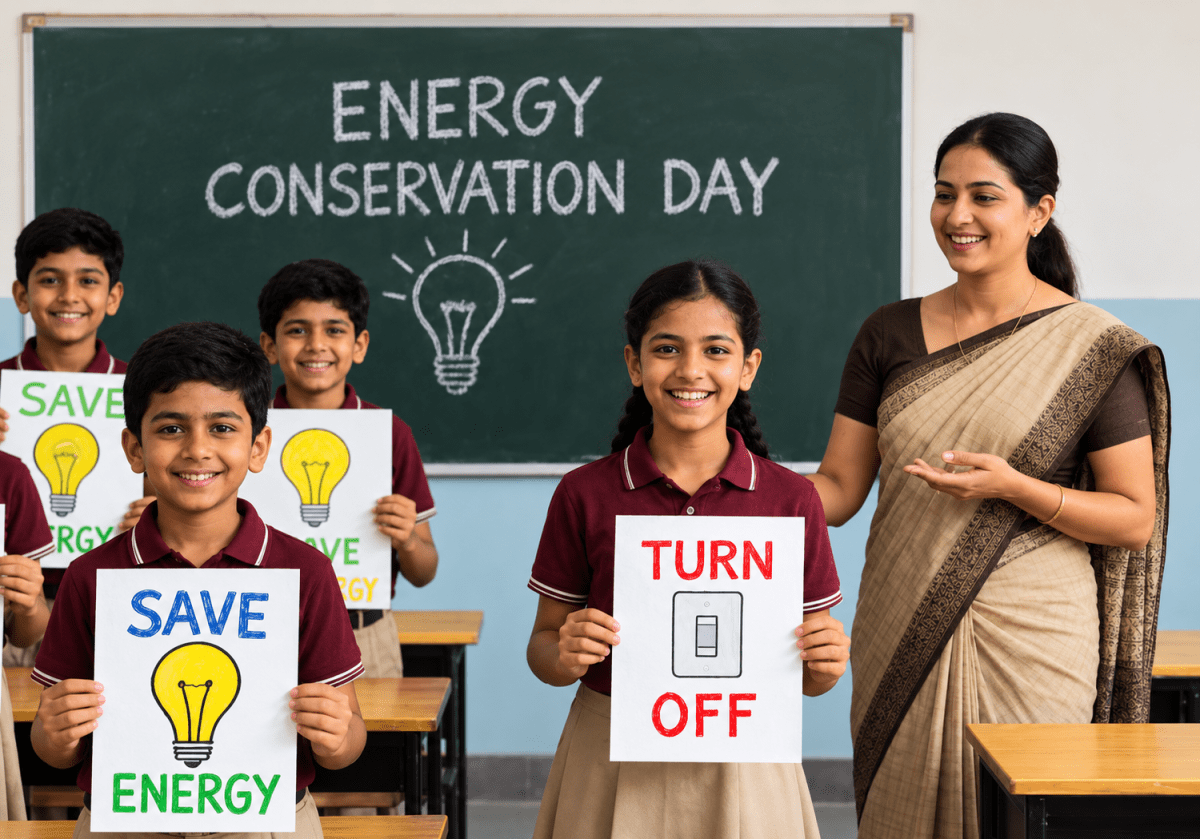
- What is meant by conservation of electricity?
- How can we reduce electrical energy use at home or school?
- Why is it important to follow electrical safety rules?
- What safety components should every home have in its electrical setup?
- How does conserving electricity benefit both the environment and our safety?
Answer
Conservation of electricity means using electricity carefully and avoiding its wastage, so that we do not run short of it.
We can reduce electrical energy use by using energy efficient bulbs like LEDs and CFLs, turning off lights, fans and appliances when not in use, closing doors when the air conditioner is on, switching off computer monitors when leaving the room, and switching off devices at the plug point.
It is important to follow electrical safety rules because electricity can be dangerous if not used safely. Following these rules helps prevent electric shocks, electrocution, short circuits, overloading and fires.
Every home should have safety components such as fuses, miniature circuit breakers (MCBs) and earthing (earth wire) in its electrical setup.
Conserving electricity reduces the demand on power plants, which saves fuel and natural resources and reduces pollution, benefiting the environment. Using less electricity also reduces overloading and the chance of electrical accidents, improving our safety.
Fill in the blanks.
- The origin of electric charges is due to transfer of ............... between bodies.
- A device used to detect the presence of charge on a body is called an ............... .
- The SI unit of electrical energy is the ..............., while in households it is measured in ............... .
- One kilowatt-hour (kWh) is equal to ............... joules.
- ............... is the process of connecting electrical appliances to the ground to prevent electric shocks.
Answer
- The origin of electric charges is due to transfer of electrons between bodies.
- A device used to detect the presence of charge on a body is called an electroscope.
- The SI unit of electrical energy is the joule, while in households it is measured in kilowatt-hour (kWh).
- One kilowatt-hour (kWh) is equal to 3.6 × 10⁶ joules.
- Earthing is the process of connecting electrical appliances to the ground to prevent electric shocks.
Write True or False.
- Static electricity is produced due to the continuous flow of electrons in a circuit.
- A charged body always attracts an uncharged body.
- The gold-leaf electroscope is more sensitive than the pith-ball electroscope.
- Lightning is a large-scale example of static discharge in the atmosphere.
- Earthing prevents appliances from being damaged during leakage of current.
Answer
- False
Corrected Statement — Static electricity is produced due to the build-up of charges on the surface of an object. - True
- True
- True
- False
Corrected Statement — Earthing prevents a person from getting a severe electric shock during leakage of current in an appliance.
Match the columns.
| Column A | Column B |
|---|---|
| 1. Charging by friction | (a) Kilowatt-hour |
| 2. Electroscope | (b) Safety in household wiring |
| 3. Lightning rod | (c) Rubbing of two bodies |
| 4. Commercial unit of energy | (d) Detect presence of charges |
| 5. Fuse/MCB | (e) Protects buildings from lightning |
Answer
| Column A | Column B |
|---|---|
| 1. Charging by friction | (c) Rubbing of two bodies |
| 2. Electroscope | (d) Detect presence of charges |
| 3. Lightning rod | (e) Protects buildings from lightning |
| 4. Commercial unit of energy | (a) Kilowatt-hour |
| 5. Fuse/MCB | (b) Safety in household wiring |
Differentiate between static electricity and current electricity.
Answer
| Static electricity | Current electricity |
|---|---|
| It is the build-up of charges on the surface of an object. | It is the flow of electric charge through a conductor. |
| The charges are at rest. | The charges are in motion. |
| It is generally produced on insulators (non-conductors). | It flows through conductors. |
State two differences between conductors and insulators with one example each.
Answer
| Conductors | Insulators |
|---|---|
| They allow electrons (electric current) to flow through them. | They do not allow electrons (electric current) to flow through them. |
| They have a large number of free electrons. | They have a very small number of free electrons. |
| Example: copper | Example: rubber |
Write any two uses of an electroscope.
Answer
Two uses of an electroscope are:
- It is used to detect whether a body is charged or uncharged.
- It is used to find the nature of the charge (positive or negative) on a body.
What safety measures should be taken during lightning?
Answer
Some safety measures to be taken during lightning are:
- Stay indoors and keep all doors and windows shut.
- Do not operate electrical appliances and do not use a corded telephone.
- Avoid water bodies, running water and metallic taps.
- Do not stand under a tree or remain in an open ground; instead take shelter inside a building or a closed vehicle.
Define one kilowatt-hour. How is it related to joules?
Answer
One kilowatt-hour (kWh) is the electrical energy consumed when an appliance of power one kilowatt is used for one hour. It is the commercial unit of electricity and is also known as one unit.
It is related to joules as: 1 kWh = 3.6 × 10⁶ J.
Explain the methods of charging a body: friction, conduction and induction with suitable examples.
Answer
A neutral body can be charged by the following three methods:
- Charging by friction: When two neutral bodies are rubbed together, free electrons are transferred from one body to the other, so they acquire equal and opposite charges. For example, when a balloon is rubbed against hair, the balloon becomes negatively charged and the hair becomes positively charged.

- Charging by conduction: When a charged body is brought in contact with a neutral conductor, some charge is transferred to it, and the neutral body acquires the same nature of charge. For example, when a negatively charged rod is touched to a neutral metal sphere, the sphere also becomes negatively charged.
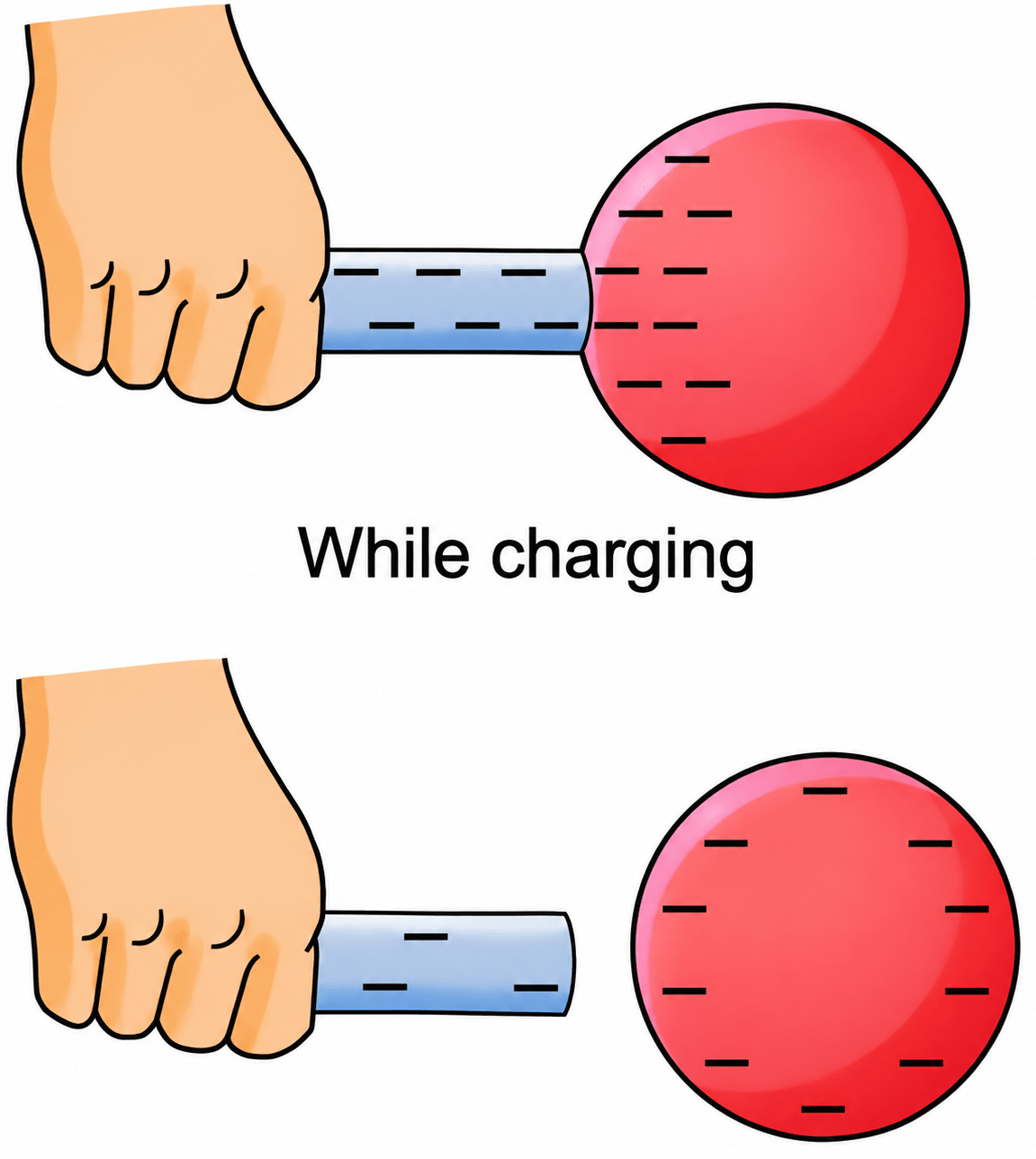
- Charging by induction: When a charged body is brought close to (but does not touch) a neutral conductor, the charges in the conductor separate. For example, if a negatively charged rod is brought near a neutral conducting sphere, electrons in the sphere are repelled to the far side, leaving the near side positively charged. While the rod is still held near the sphere, the sphere is earthed so that excess electrons flow to the ground. The earth connection is removed first and then the charged rod is taken away. The sphere is left with a positive charge, opposite in nature to the charge on the rod.

Describe the construction and working of a gold-leaf electroscope.
Answer
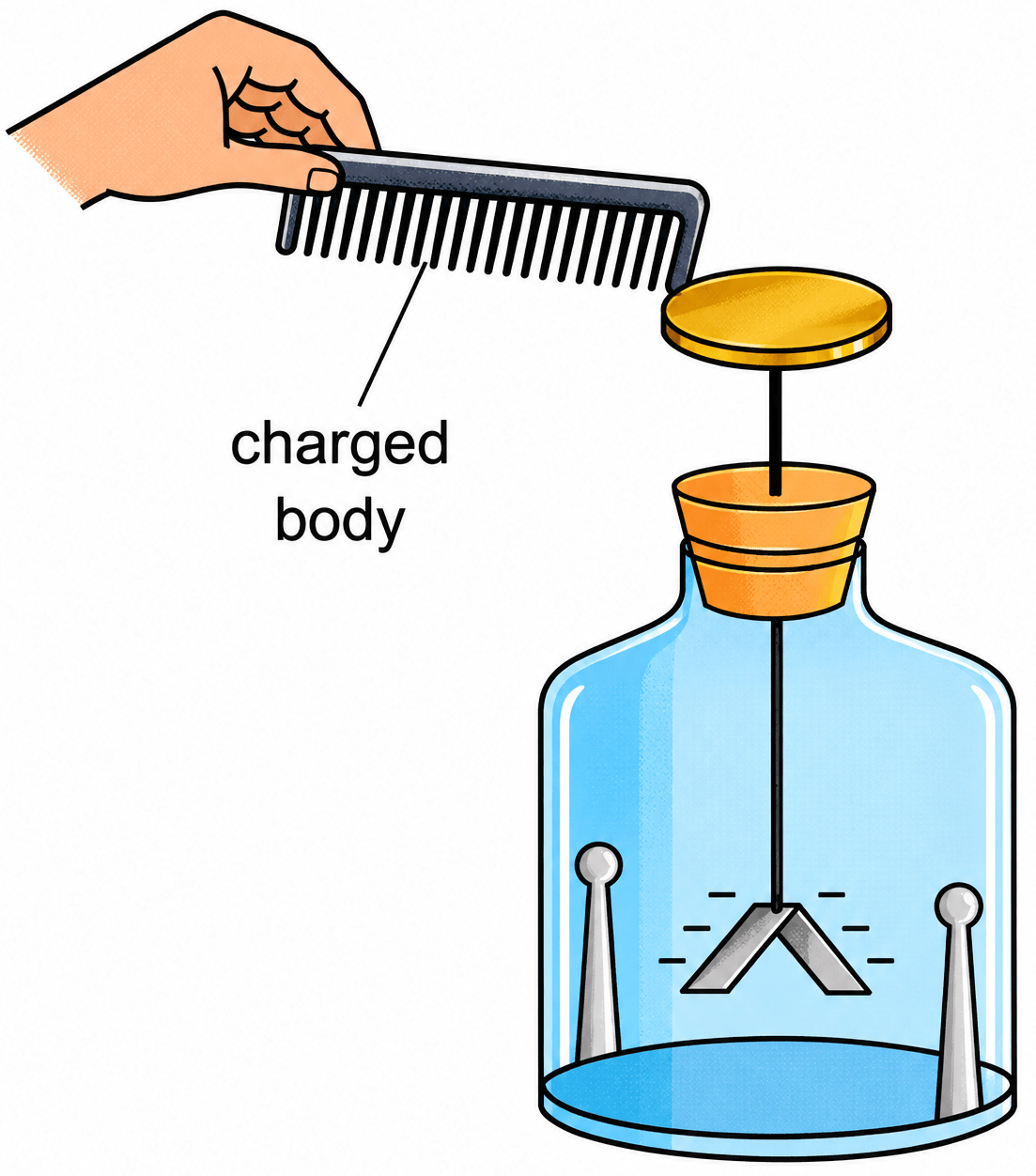
Construction: The gold-leaf electroscope was developed by Abraham Bennet. It consists of a glass bell jar fitted with an insulated plug made of cork at its mouth. A thin brass rod passes through the cork into the jar. The upper end of the rod, which lies outside the jar, carries a small brass disc, while the lower end inside the jar carries two thin metallic leaves hanging parallel to each other. The whole arrangement rests on an insulated base.
Working: When a charged body is brought in contact with the brass disc, charge passes through the brass rod to the two metallic leaves. Since both leaves acquire the same kind of charge, they repel each other and diverge. Thus, the electroscope detects the presence of charge, and the amount of divergence gives a rough qualitative idea of the amount of charge. To identify the nature of an unknown charge, the electroscope is first given a known charge. If the leaves diverge further when the test body is brought into contact with the disc, the test body has the same kind of charge; if the leaves come closer or collapse, the test body has the opposite kind of charge.
Explain how household wiring is protected using fuses, MCBs and earthing.
Answer
Household wiring is protected using the following safety components:
- Fuse: A fuse is the weakest part of the circuit and is placed in the live wire in series. In case of overloading, a short circuit or voltage fluctuation, excess current flows and the fuse wire melts, breaking the circuit and stopping the current.
- MCB (Miniature Circuit Breaker): An MCB is a switch that automatically turns off when the current in the circuit exceeds the safety limit. It is more reliable than a fuse, as it can simply be switched on again to restore the circuit and does not need to be replaced.
- Earthing: In earthing, the metal casing of an appliance is connected to a thick copper wire buried deep in the earth. If the live wire touches the metal casing, the leakage current flows safely into the earth, protecting the person from a severe electric shock.
Together, fuses, MCBs and earthing protect the wiring, the appliances and the people from electrical hazards.
A geyser of 2 kW is used for 3 hours daily. Calculate the energy consumed in kWh and its cost if 1 unit = ₹6.
Answer
Power of the geyser = 2 kW
Time of usage = 3 h
Energy consumed = Power × Time = 2 kW × 3 h = 6 kWh = 6 units
Cost = Total units × Cost of each unit
= 6 × ₹6
= ₹36
∴ The energy consumed is 6 kWh and its cost is ₹36.
Discuss the importance of conserving electricity. Suggest five practical ways to save electricity at home and in school.
Answer
Importance of conserving electricity: The generation and transmission of electricity is an expensive affair, and it also uses up natural resources. If we keep wasting electricity, a time might come when we would not get enough of it. Therefore, it is very important that everyone learns to conserve electricity, as it saves money and resources, protects the environment and reduces the risk of electrical accidents.
Five practical ways to save electricity:
- Use energy efficient bulbs like LED bulbs and CFLs and energy efficient appliances.
- Turn off the lights, fans and appliances when they are not in use.
- Close the doors when going out of the room while the air conditioner is on.
- Make sure that computer monitors are turned off when leaving the computer room.
- Switch off devices at the plug point and not just by the remote.