
Statement 1: If two sides of a triangle are equal, then the angles opposite the equal sides are equal.
Statement 2: If two angles of a triangle are equal, then the sides opposite the equal angles have equal lengths.
We have proved the first statement in an earlier grade. Is the second statement true? Can you prove it?
(Hint: Draw the altitude from the vertex containing the third angle.)
Answer
Yes, Statement 2 is true.
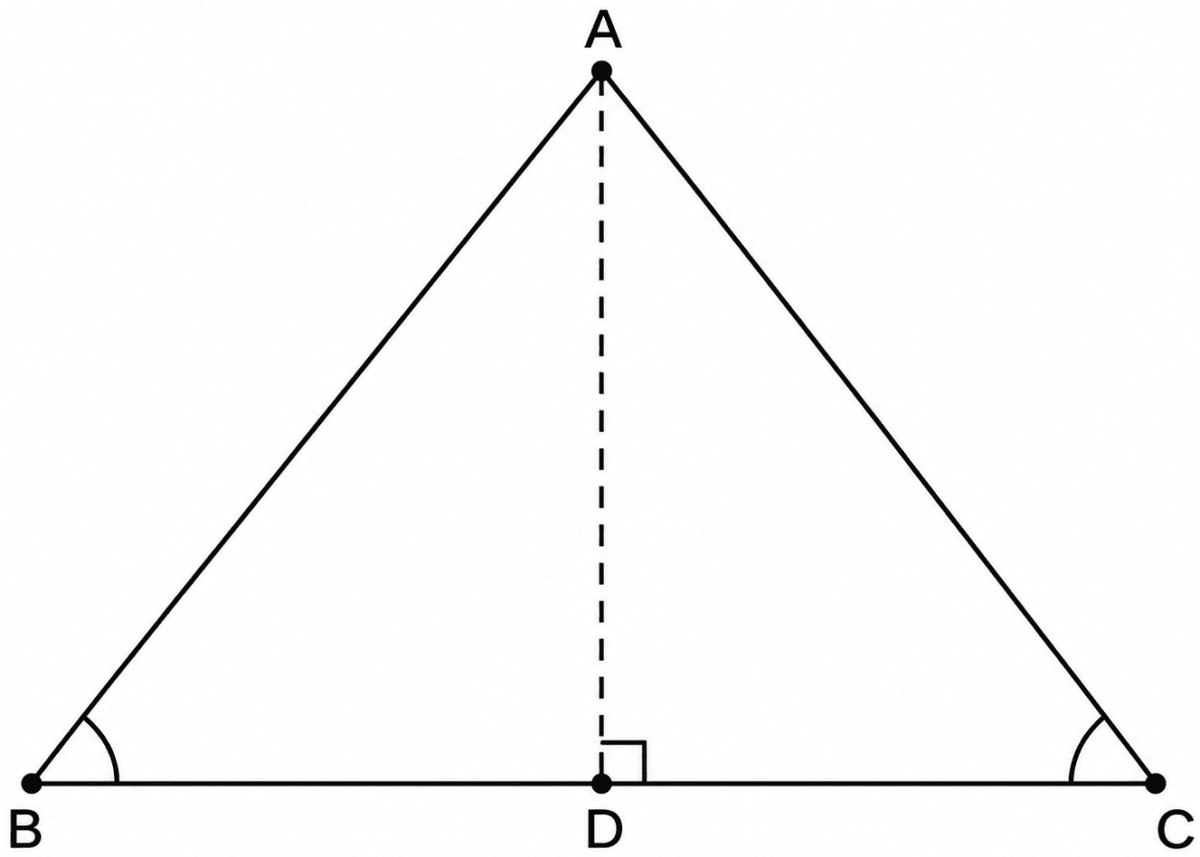
Given: ∆ABC in which ∠B = ∠C.
To prove: AB = AC.
Construction: Draw the altitude AD from A, the vertex containing the third angle, so that AD ⊥ BC.
Proof:
Since ∠B = ∠C and ∠B + ∠C < 180°, each of ∠B and ∠C is less than 90°. So the foot D of the altitude lies on BC.
In ∆ABD, ∠BAD = 180° - (90° + ∠B) = 90° - ∠B.
In ∆ACD, ∠CAD = 180° - (90° + ∠C) = 90° - ∠C.
Since ∠B = ∠C, we get ∠BAD = ∠CAD.
In ∆ABD and ∆ACD:
∠BAD = ∠CAD [Proved above]
AD = AD [Common side]
∠ADB = ∠ADC = 90° [AD ⊥ BC]
∆ABD ≅ ∆ACD [By ASA condition of congruence]
∴ AB = AC [Corresponding Parts of Congruent Triangles]
Hence proved.
It can also happen that both the proposition and converse are false! Can you give an example?
Answer
Yes. Consider the following example.
Proposition: If a number is a multiple of 3, then it is even.
This proposition is false.
Counter example: 9 is a multiple of 3 (9 = 3 × 3), but 9 is not even.
Converse: If a number is even, then it is a multiple of 3.
This converse is also false.
Counter example: 4 is even, but 4 is not a multiple of 3.
Hence, both the proposition and its converse are false.
(Note: Many other examples are also possible, such as 'If a quadrilateral is a rhombus, then it is a rectangle' and its converse.)
Identify real-life examples in which a proposition is true but not the converse. Give nice counterexamples!
Answer
Three such real-life examples are given below.
Example 1
Proposition: If a person lives in Mumbai, then the person lives in Maharashtra. (True)
Converse: If a person lives in Maharashtra, then the person lives in Mumbai. (False)
Counterexample: A person living in Pune lives in Maharashtra but not in Mumbai.
Example 2
Proposition: If an animal is a cow, then it has four legs. (True)
Converse: If an animal has four legs, then it is a cow. (False)
Counterexample: A dog has four legs but it is not a cow.
Example 3
Proposition: If it is raining, then there are clouds in the sky. (True)
Converse: If there are clouds in the sky, then it is raining. (False)
Counterexample: On many cloudy days, it does not rain at all.
Give more examples from geometry as well as number theory in which a proposition is true but not its converse. Give appropriate counterexamples.
Answer
Examples from geometry
(a) Proposition: If a quadrilateral is a square, then its diagonals are equal. (True)
Converse: If the diagonals of a quadrilateral are equal, then it is a square. (False)
Counterexample: A rectangle with sides 4 cm and 3 cm has both diagonals equal to 5 cm, but it is not a square.
(b) Proposition: If two triangles are congruent, then their perimeters are equal. (True)
Converse: If two triangles have equal perimeters, then they are congruent. (False)
Counterexample: A triangle with sides 3 cm, 4 cm, 5 cm and a triangle with sides 4 cm, 4 cm, 4 cm both have perimeter 12 cm, but their sides are different, so they are not congruent.
Examples from number theory
(c) Proposition: If a number is a multiple of 4, then it is even. (True)
Converse: If a number is even, then it is a multiple of 4. (False)
Counterexample: 6 is even, but 6 is not a multiple of 4.
(d) Proposition: If a number is a prime greater than 2, then it is odd. (True)
Converse: If a number is odd, then it is a prime greater than 2. (False)
Counterexample: 9 is odd, but 9 = 3 × 3 is not a prime.
Frame the converse of the propositions given below. Then, determine if each of the two statements is true or not. Justify the true statements and give a counterexample for each false statement.
If two lines are parallel, then the corresponding angles formed by a transversal are equal.
Answer
Proposition: If two lines are parallel, then the corresponding angles formed by a transversal are equal.
This proposition is true.
This is the corresponding angles property of parallel lines, learnt in an earlier grade: when a transversal cuts two parallel lines, each pair of corresponding angles is equal.
Converse: If the corresponding angles formed by a transversal of two lines are equal, then the two lines are parallel.
This converse is also true.
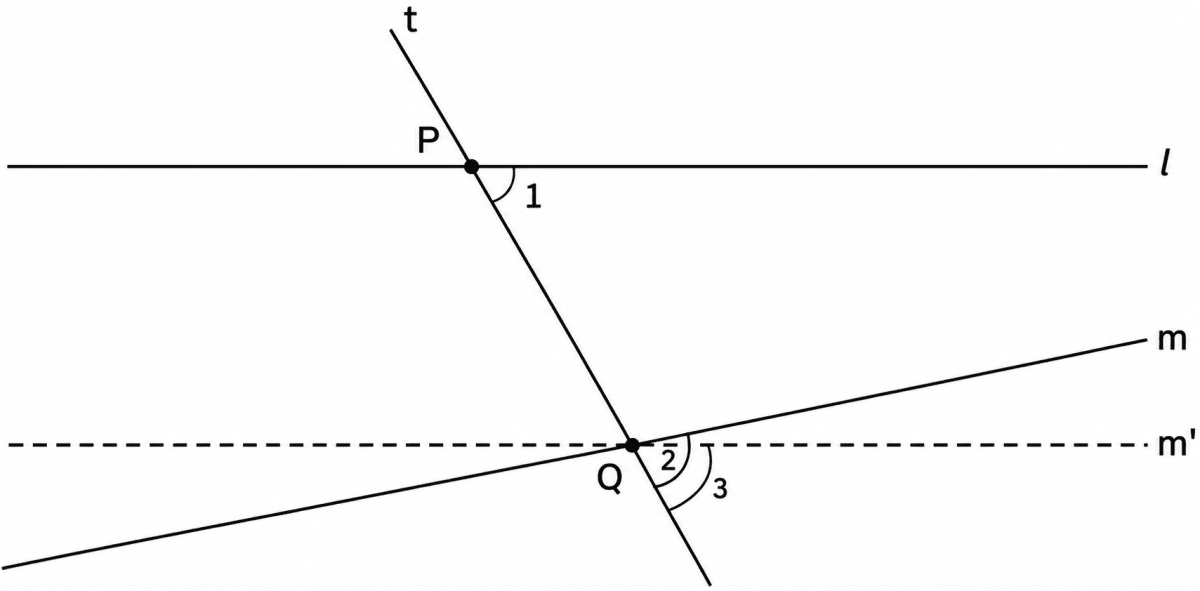
Given: A transversal t cuts the lines l and m at P and Q respectively, such that the corresponding angles ∠1 and ∠2 are equal.
To prove: l ∥ m.
Proof:
Suppose l is not parallel to m.
Through Q, draw the line m' parallel to l. [Through a point outside a line, exactly one line parallel to it can be drawn]
Let ∠3 be the angle that m' makes with t at Q, corresponding to ∠1.
∠3 = ∠1 [Corresponding angles, l ∥ m']
∠1 = ∠2 [Given]
⇒ ∠3 = ∠2
So, m and m' pass through the same point Q and make equal angles with t on the same side of t. Hence, m' coincides with m.
⇒ m ∥ l, which contradicts our supposition.
∴ l ∥ m.
Hence, both the proposition and its converse are true.
Frame the converse of the propositions given below. Then, determine if each of the two statements is true or not. Justify the true statements and give a counterexample for each false statement.
If a quadrilateral is a square, then all its angles are equal.
Answer
Proposition: If a quadrilateral is a square, then all its angles are equal.
This proposition is true.
Each angle of a square is 90°.
∴ All four angles of a square are equal.
Converse: If all the angles of a quadrilateral are equal, then it is a square.
This converse is false.
Counterexample: Consider a rectangle with length 4 cm and breadth 2 cm.
Each angle of this rectangle is 90°, so all its angles are equal.
But its sides are not all equal (4 cm ≠ 2 cm), so it is not a square.
Hence, the proposition is true but its converse is false.
Frame the converse of the propositions given below. Then, determine if each of the two statements is true or not. Justify the true statements and give a counterexample for each false statement.
Given any ∆ABC, let us bisect the angles at B and C. The bisectors meet at the incentre I of the triangle.
Now extend the bisectors beyond I till they meet the opposite sides at E and F respectively, as shown.
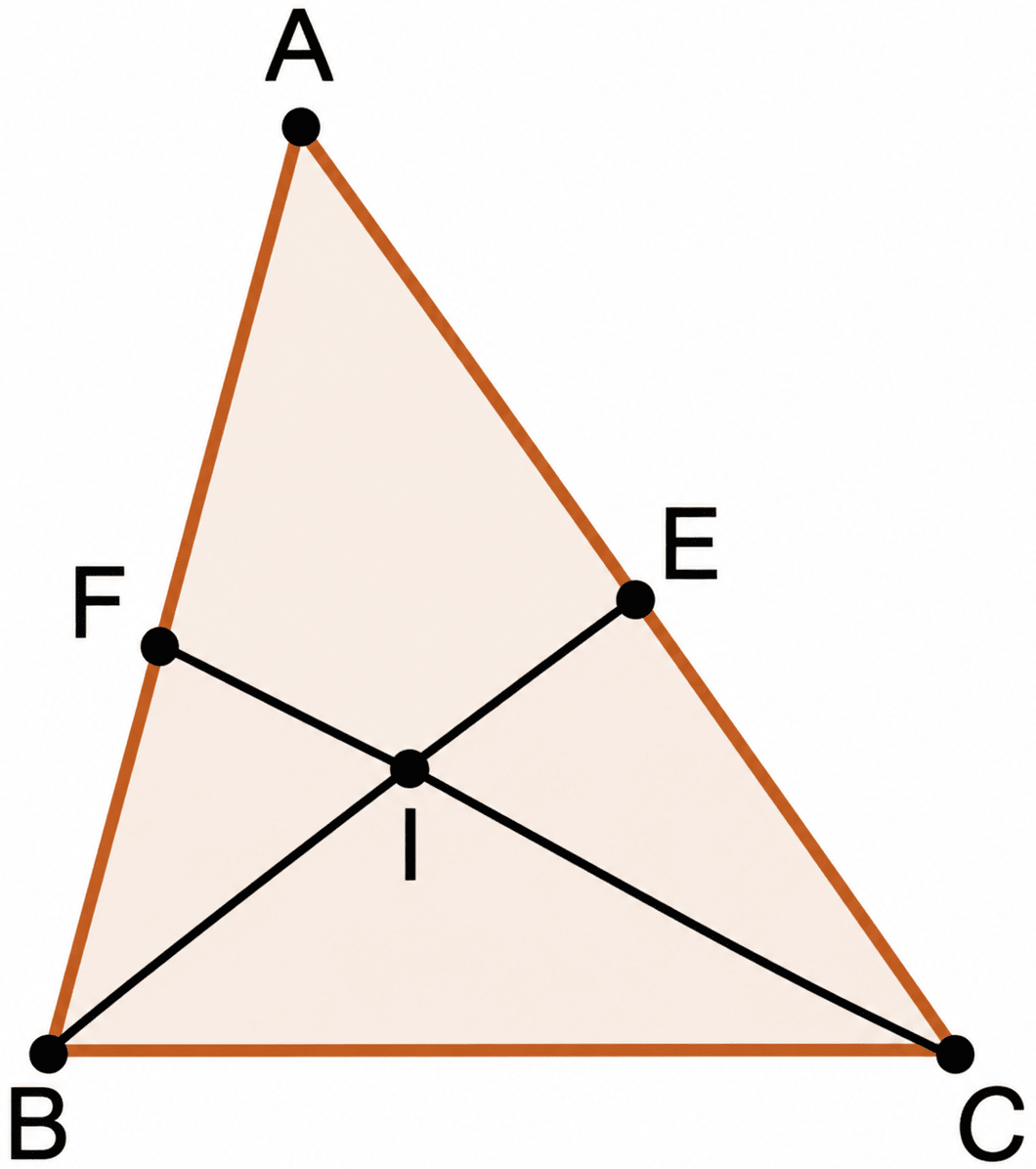
Proposition: If AB = AC, then IE = IF.
Answer
Proposition: If AB = AC, then IE = IF.
This proposition is true.
Given: In ∆ABC, AB = AC; BE and CF bisect ∠B and ∠C and meet at I.
To prove: IE = IF.
Proof:
∠ABC = ∠ACB [Angles opposite equal sides AB and AC]
⇒ ∠ABC = ∠ACB
⇒ ∠IBC = ∠ICB and ∠FBI = ∠ECI [BE and CF are angle bisectors]
In ∆IBC, ∠IBC = ∠ICB.
∴ IB = IC [Sides opposite equal angles]
In ∆IBF and ∆ICE:
∠FBI = ∠ECI [Proved above]
IB = IC [Proved above]
∠BIF = ∠CIE [Vertically opposite angles]
∆IBF ≅ ∆ICE [By ASA condition of congruence]
∴ IF = IE [Corresponding Parts of Congruent Triangles]
Converse: If IE = IF, then AB = AC.
This converse is false.
Counterexample: Consider ∆ABC with ∠A = 60°, ∠B = 80° and ∠C = 40°.
Since ∠B ≠ ∠C, AB ≠ AC. [If AB = AC, then ∠C = ∠B]
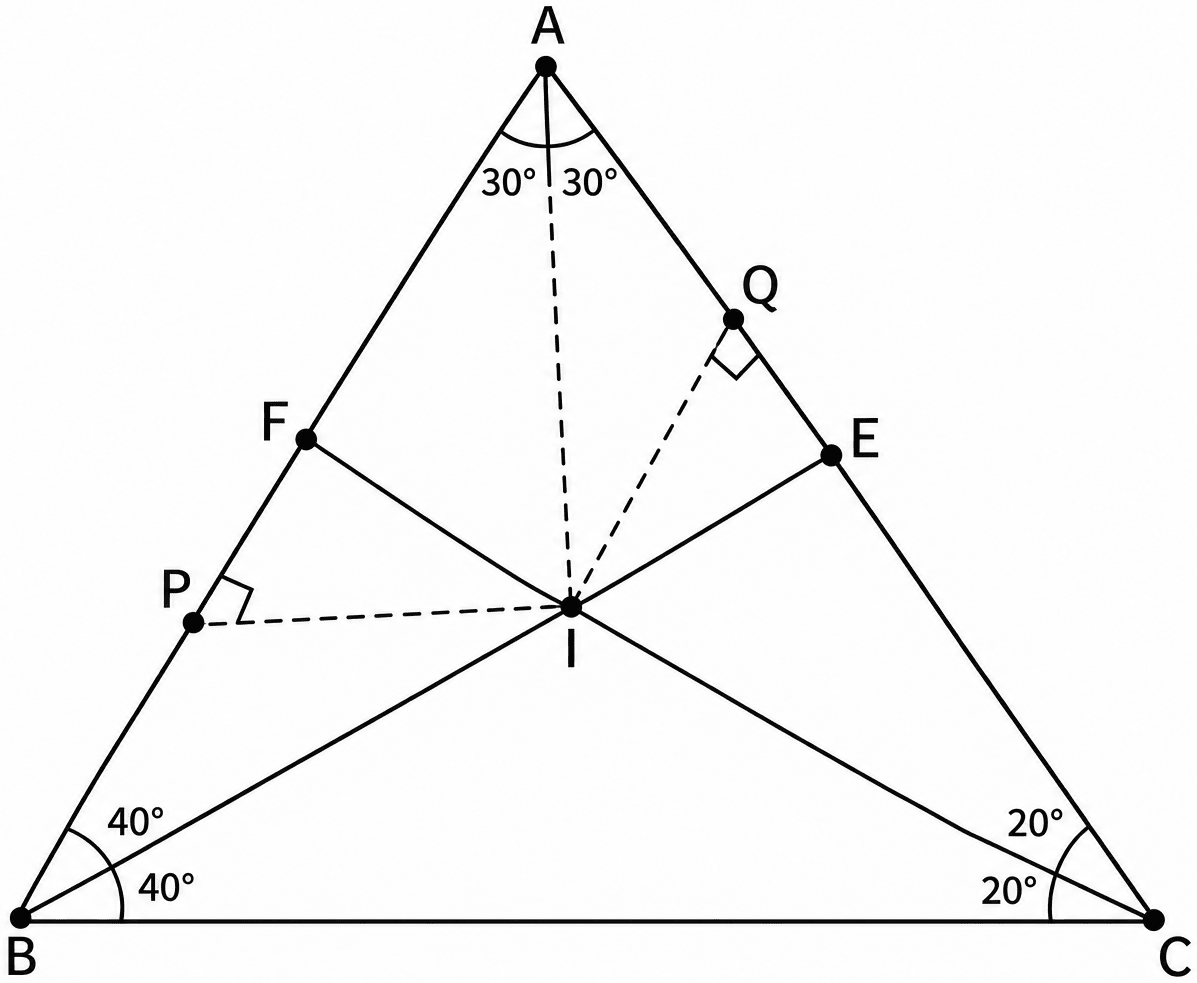
BE and CF bisect ∠B and ∠C.
⇒ ∠ABE = = 40° and ∠ACF = = 20°
All three angle bisectors pass through the incentre I, so AI bisects ∠A.
⇒ ∠PAI = ∠QAI = = 30°
In ∆ABE:
⇒ ∠AEB = 180° - (∠BAE + ∠ABE)
⇒ ∠AEB = 180° - (60° + 40°)
⇒ ∠AEB = 80°
In ∆ACF:
⇒ ∠AFC = 180° - (∠FAC + ∠ACF)
⇒ ∠AFC = 180° - (60° + 20°)
⇒ ∠AFC = 100°
⇒ ∠BFC = 180° - 100° = 80° [Linear pair]
So, ∠IEA = ∠AEB = 80° and ∠IFB = ∠BFC = 80°.
Construction: Draw IP ⊥ AB and IQ ⊥ AC.
Since ∠IFB = 80° < 90°, the foot P lies on the side of F towards B, so ∠IFP = 80°.
Since ∠IEA = 80° < 90°, the foot Q lies on the side of E towards A, so ∠IEQ = 80°.
In ∆API and ∆AQI:
∠PAI = ∠QAI = 30° [AI bisects ∠A]
AI = AI [Common side]
∠AIP = 180° - (90° + 30°) = 60° = ∠AIQ [Angle sum property]
∆API ≅ ∆AQI [By ASA condition of congruence]
∴ IP = IQ [Corresponding Parts of Congruent Triangles]
In ∆IPF and ∆IQE:
∠IPF = ∠IQE = 90° [IP ⊥ AB and IQ ⊥ AC]
IP = IQ [Proved above]
∠PIF = 180° - (90° + 80°) = 10° = ∠QIE [Angle sum property]
∆IPF ≅ ∆IQE [By ASA condition of congruence]
∴ IF = IE [Corresponding Parts of Congruent Triangles]
So, in this triangle IE = IF, but AB ≠ AC.
(In fact, IE = IF in every triangle with ∠A = 60°, even when AB ≠ AC.)
Hence, the proposition is true but its converse is false.
Frame the converse of the propositions given below. Then, determine if each of the two statements is true or not. Justify the true statements and give a counterexample for each false statement.
If x = y, then a + x = a + y, where x, y and a are any three numbers.
This proposition and its converse are routinely used while solving equations.
Answer
Proposition: If x = y, then a + x = a + y.
This proposition is true.
Let x = y.
Adding a to both sides:
⇒ a + x = a + y
Converse: If a + x = a + y, then x = y.
This converse is also true.
Let a + x = a + y.
Subtracting a from both sides:
⇒ a + x - a = a + y - a
⇒ x = y
Hence, both the proposition and its converse are true.
Frame the converse of the propositions given below. Then, determine if each of the two statements is true or not. Justify the true statements and give a counterexample for each false statement.
If a and b are perfect squares, then ab is a perfect square.
Answer
Proposition: If a and b are perfect squares, then ab is a perfect square.
This proposition is true.
Let a = m2 and b = k2, where m and k are whole numbers.
⇒ ab = m2 × k2
⇒ ab = (mk)2
Since mk is a whole number, ab is a perfect square.
Converse: If ab is a perfect square, then a and b are perfect squares.
This converse is false.
Counterexample: Let a = 2 and b = 8.
⇒ ab = 2 × 8 = 16 = 42, which is a perfect square.
But neither 2 nor 8 is a perfect square.
Hence, the proposition is true but its converse is false.
Frame the converse of the propositions given below. Then, determine if each of the two statements is true or not. Justify the true statements and give a counterexample for each false statement.
If x = y, then x2 = y2 (x and y are real numbers)
Answer
Proposition: If x = y, then x2 = y2.
This proposition is true.
Let x = y.
⇒ x2 = x × x
⇒ x2 = y × y [∵ x = y]
⇒ x2 = y2
Converse: If x2 = y2, then x = y.
This converse is false.
Counterexample: Let x = 3 and y = -3.
⇒ x2 = 32 = 9 and y2 = (-3)2 = 9
So, x2 = y2, but x ≠ y.
Hence, the proposition is true but its converse is false.
Frame the converse of the propositions given below. Then, determine if each of the two statements is true or not. Justify the true statements and give a counterexample for each false statement.
If x = y, then x3 = y3 (x and y are real numbers)
Answer
Proposition: If x = y, then x3 = y3.
This proposition is true.
Let x = y.
⇒ x3 = x × x × x
⇒ x3 = y × y × y [∵ x = y]
⇒ x3 = y3
Converse: If x3 = y3, then x = y.
This converse is also true.
Let x3 = y3.
⇒ x3 - y3 = 0
⇒ (x - y)(x2 + xy + y2) = 0 [∵ a3 - b3 = (a - b)(a2 + ab + b2)]
So, either x - y = 0 or x2 + xy + y2 = 0.
Now, rewriting x2 + xy + y2:
Both terms on the right are squares multiplied by positive numbers, so neither is negative.
Their sum is 0 only when both are 0, that is, when y = 0 and , which gives x = 0 = y.
So, in both cases, x = y.
Hence, both the proposition and its converse are true.
Frame the converse of the propositions given below. Then, determine if each of the two statements is true or not. Justify the true statements and give a counterexample for each false statement.
If n is divisible by 24, then it is divisible by both 4 and 6 (n is a positive integer)
Answer
Proposition: If n is divisible by 24, then it is divisible by both 4 and 6.
This proposition is true.
Let n = 24k, where k is a positive integer.
⇒ n = 4 × (6k), so n is divisible by 4.
⇒ n = 6 × (4k), so n is divisible by 6.
Converse: If n is divisible by both 4 and 6, then it is divisible by 24.
This converse is false.
Counterexample: Let n = 12.
12 = 4 × 3 and 12 = 6 × 2, so 12 is divisible by both 4 and 6.
But 12 is not divisible by 24.
Hence, the proposition is true but its converse is false.
Frame the converse of the propositions given below. Then, determine if each of the two statements is true or not. Justify the true statements and give a counterexample for each false statement.
If n is divisible by 60, then it is divisible by both 5 and 12 (n is a positive integer)
Answer
Proposition: If n is divisible by 60, then it is divisible by both 5 and 12.
This proposition is true.
Let n = 60k, where k is a positive integer.
⇒ n = 5 × (12k), so n is divisible by 5.
⇒ n = 12 × (5k), so n is divisible by 12.
Converse: If n is divisible by both 5 and 12, then it is divisible by 60.
This converse is also true.
Since n is divisible by 12, let n = 12k, where k is a positive integer.
⇒ n = 2 × 2 × 3 × k
Since n is divisible by 5, the prime 5 must appear in the prime factorisation of n.
The prime 5 is not a factor of 2 × 2 × 3, so 5 must be a factor of k.
Let k = 5m, where m is a positive integer.
⇒ n = 12 × 5m
⇒ n = 60m, so n is divisible by 60.
This works because 5 and 12 have no common factor other than 1. In Question 8, 4 and 6 have the common factor 2, which is why that converse fails.
Hence, both the proposition and its converse are true.
Frame the converse of the propositions given below. Then, determine if each of the two statements is true or not. Justify the true statements and give a counterexample for each false statement.
If n is the square of a prime number, then it has exactly 3 factors (n is a positive integer)
Answer
Proposition: If n is the square of a prime number, then it has exactly 3 factors.
This proposition is true.
Let n = p2 = p × p, where p is a prime.
The only prime in the prime factorisation of n is p, used twice. So every factor of n is a product of at most two p's.
∴ The factors of n are 1, p and p2.
Since p ≥ 2, the numbers 1, p and p2 are all different, so n has exactly 3 factors.
Converse: If n has exactly 3 factors, then n is the square of a prime number.
This converse is also true.
Since 3 is odd, n has an odd number of factors. So n is a perfect square. [Proved in Example 3]
Let n = m2, where m is a positive integer.
Since n = 1 has only 1 factor, n ≠ 1, so m > 1.
Then 1, m and m2 are three different factors of n, so these are all the factors of n.
If m were not a prime, m would have a factor d with 1 < d < m. Then d would be a fourth factor of n, which is not possible.
∴ m is a prime, and n = m2 is the square of a prime.
Hence, both the proposition and its converse are true.
Frame the converse of the propositions given below. Then, determine if each of the two statements is true or not. Justify the true statements and give a counterexample for each false statement.
If n is a product of two unequal prime numbers, then it has exactly 4 divisors (n is a positive integer)
Answer
Proposition: If n is a product of two unequal prime numbers, then it has exactly 4 divisors.
This proposition is true.
Let n = p × q, where p and q are primes and p ≠ q.
Every divisor of n is a product of some of the primes in its prime factorisation p × q.
∴ The divisors of n are 1, p, q and pq.
Since p ≠ q and both are greater than 1, these four divisors are all different. So n has exactly 4 divisors.
Converse: If n has exactly 4 divisors, then n is a product of two unequal prime numbers.
This converse is false.
Counterexample: Let n = 8.
The divisors of 8 are 1, 2, 4 and 8, so 8 has exactly 4 divisors.
But 8 = 2 × 2 × 2 is not a product of two unequal primes.
Hence, the proposition is true but its converse is false.
Frame the converse of the propositions given below. Then, determine if each of the two statements is true or not. Justify the true statements and give a counterexample for each false statement.
If n and n + 3 have no factors in common, then n is not a multiple of 3 (n is a positive integer)
Answer
Here, 'no factors in common' means no common factor other than 1, since 1 is a factor of every number.
Proposition: If n and n + 3 have no factors in common, then n is not a multiple of 3.
This proposition is true.
Suppose n is a multiple of 3. Let n = 3k, where k is a positive integer.
⇒ n + 3 = 3k + 3
⇒ n + 3 = 3(k + 1)
So, 3 is a factor of both n and n + 3, which is not possible since they have no factors in common.
∴ n is not a multiple of 3.
Converse: If n is not a multiple of 3, then n and n + 3 have no factors in common.
This converse is also true.
Let d be a common factor of n and n + 3. Let n = dr and n + 3 = ds, where r and s are positive integers.
⇒ (n + 3) - n = ds - dr
⇒ 3 = d(s - r)
So, d is a factor of 3, that is, d = 1 or d = 3.
But d ≠ 3, because 3 is not a factor of n.
∴ d = 1, so n and n + 3 have no common factor other than 1.
Hence, both the proposition and its converse are true.
There are no known ‘neat’ expressions that generate only primes! Find counterexamples to the following claim.
All numbers of the form 4n2 + 1 are prime.
Answer
Taking n = 1, 2, 3, we get 4n2 + 1 = 5, 17, 37, which are all prime.
Taking n = 4:
⇒ 4n2 + 1 = 4 × 42 + 1
⇒ 4n2 + 1 = 4 × 16 + 1
⇒ 4n2 + 1 = 65
But 65 = 5 × 13, so 65 is not a prime.
Hence, n = 4 is a counterexample, since 4 × 42 + 1 = 65 is not prime.
There are no known ‘neat’ expressions that generate only primes! Find counterexamples to the following claim.
All numbers of the form n2 + n + 11 are prime.
Answer
Taking n = 1, 2, 3, …, 9, we get n2 + n + 11 = 13, 17, 23, 31, 41, 53, 67, 83, 101, which are all prime.
Taking n = 10:
⇒ n2 + n + 11 = 102 + 10 + 11
⇒ n2 + n + 11 = 100 + 10 + 11
⇒ n2 + n + 11 = 121
But 121 = 11 × 11, so 121 is not a prime.
Hence, n = 10 is a counterexample, since 102 + 10 + 11 = 121 is not prime.
There are no known ‘neat’ expressions that generate only primes! Find counterexamples to the following claim.
All numbers of the form 4n + 3 are prime.
Answer
Taking n = 1, 2, 3, we get 4n + 3 = 7, 19, 67, which are all prime.
Taking n = 4:
⇒ 4n + 3 = 44 + 3
⇒ 4n + 3 = 256 + 3
⇒ 4n + 3 = 259
But 259 = 7 × 37, so 259 is not a prime.
Hence, n = 4 is a counterexample, since 44 + 3 = 259 is not prime.
Find counterexamples to the following statement.
If n is a prime number, then 2n – 1 is a prime number.
Answer
Taking the primes n = 2, 3, 5, 7, we get 2n - 1 = 3, 7, 31, 127, which are all prime.
Taking the prime n = 11:
⇒ 2n - 1 = 211 - 1
⇒ 2n - 1 = 2048 - 1
⇒ 2n - 1 = 2047
But 2047 = 23 × 89, so 2047 is not a prime.
Hence, n = 11 is a counterexample, since 11 is prime but 211 - 1 = 2047 is not prime.
Find counterexamples to the following statement.
If n is an even number, then 2n + 1 is a prime number.
Answer
Taking n = 2, 4, we get 2n + 1 = 5, 17, which are both prime.
Taking the even number n = 6:
⇒ 2n + 1 = 26 + 1
⇒ 2n + 1 = 64 + 1
⇒ 2n + 1 = 65
But 65 = 5 × 13, so 65 is not a prime.
Hence, n = 6 is a counterexample, since 6 is even but 26 + 1 = 65 is not prime.
Consider the statement: ‘If a number is divisible by 8, then it is divisible by both 2 and 4’.
(i) Justify the statement.
(ii) Recall the divisibility shortcuts that we have studied for different numbers. To check whether a given number is divisible by 8, is it enough to check whether it is divisible by 2 and 4? Why or why not?
Answer
(i) Let the number be n, divisible by 8. Let n = 8k, where k is a whole number.
⇒ n = 2 × (4k), so n is divisible by 2.
⇒ n = 4 × (2k), so n is divisible by 4.
Hence, a number divisible by 8 is divisible by both 2 and 4.
(ii) No, it is not enough.
Checking divisibility by 2 and 4 is the same as checking the converse: 'If a number is divisible by both 2 and 4, then it is divisible by 8.' This converse is false.
Counterexample: 12 = 2 × 6 and 12 = 4 × 3, so 12 is divisible by both 2 and 4.
But 12 = 8 × 1 + 4, so 12 is not divisible by 8.
In fact, every number divisible by 4 is already divisible by 2, so checking 2 and 4 is only a check for divisibility by 4. To check divisibility by 8, we use its own shortcut: the number formed by the last three digits must be divisible by 8.
Hence, checking divisibility by 2 and 4 is not enough to decide divisibility by 8.
Recall that a shortcut to check whether a given number is divisible by 3 is to add the digits of the number and check if the sum is a multiple of 3. Express the relationship between ‘a number is divisible by 3’ and ‘sum of the digits is a multiple of 3’ using ‘If-then’ sentences.
Answer
The relationship can be expressed by the following two 'If-then' sentences, each the converse of the other:
(1) If a number is divisible by 3, then the sum of its digits is a multiple of 3.
(2) If the sum of the digits of a number is a multiple of 3, then the number is divisible by 3.
Both statements are true. For example, for a 3-digit number with digits a, b, c:
⇒ 100a + 10b + c = (99a + 9b) + (a + b + c)
⇒ 100a + 10b + c = 3(33a + 3b) + (a + b + c)
So, the number and the sum of its digits differ by a multiple of 3. Hence, if one of them is a multiple of 3, so is the other. The same reasoning works for any number of digits, since 10, 100, 1000, … are each 1 more than a multiple of 3.
Hence, 'a number is divisible by 3' and 'the sum of its digits is a multiple of 3' imply each other.
We have identified different types of quadrilaterals — squares, rectangles, parallelograms, rhombi, kites and trapezia. One can identify more types (e.g., we could create a category of quadrilaterals that have equal-length opposite sides).
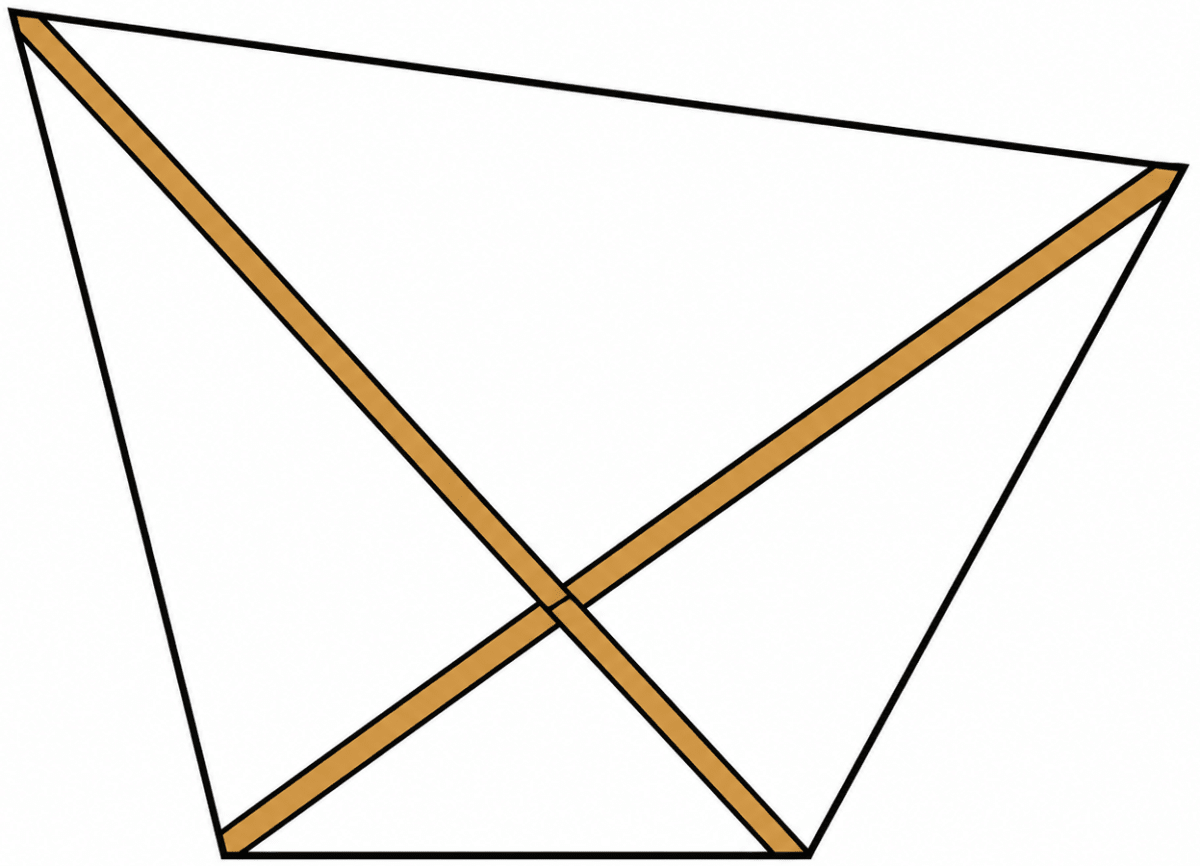
Suppose we have identified a category of quadrilaterals called Q, and we have to construct a quadrilateral of this type. For this, we are to use two thin sticks, put them together as diagonals so that the quadrilateral obtained by joining their endpoints is of type Q (see the Fig. 9.2).
(i) Suppose Q satisfies the following property.
If a quadrilateral is of type Q, then it has equal-length diagonals.
(a) Should the two sticks be of equal length? Why or why not?
(b) Will it matter how the two sticks are put together?
(ii) Instead of the property mentioned above, suppose Q satisfies the following property.
If a quadrilateral has equal diagonals, then it is of type Q.
What will be your answers to (a) and (b) now?
Answer
(i) Here, the property is: type Q ⇒ equal diagonals.
(a) Yes, the two sticks must be of equal length.
Every quadrilateral of type Q has equal diagonals. If the sticks are of unequal lengths, the quadrilateral formed has unequal diagonals, so it cannot be of type Q.
(b) Yes, it may matter.
The property does not say the converse, that every quadrilateral with equal diagonals is of type Q. So equal sticks are necessary, but they may not be enough; the sticks may also have to be placed in a particular way.
For example, if Q is the category of rectangles, the two equal sticks must also bisect each other; if Q is the category of squares, they must also bisect each other at right angles.
Hence, in (i), the sticks must be equal, and how they are put together may matter.
(ii) Here, the property is: equal diagonals ⇒ type Q.
(a) Two sticks of equal length are enough: the quadrilateral formed has equal diagonals, so it is of type Q.
However, the property says nothing about quadrilaterals with unequal diagonals, so we cannot say that equal sticks are necessary; a quadrilateral with unequal diagonals may also be of type Q.
(b) No, it does not matter how the two equal sticks are put together. In every arrangement, the quadrilateral formed has equal diagonals, so it is of type Q.
Hence, in (ii), equal sticks always give a quadrilateral of type Q, however they are put together.