
Departmentation is the process of grouping tasks into jobs, ............... .
- combining of jobs into work groups
- combining of groups into departments
- both (a) and (b)
- none of these
Answer
both (a) and (b)
Reason — Departmentation is the process of grouping tasks into jobs, the combining of jobs into work groups and the combining of groups into departments. It involves horizontal differentiation of activities of an organisation into departments.
Departments are necessary and important in a firm because
- Each department performs one type of work in which its employees are trained and experienced.
- Departments work to destroy the business organisation.
- The people working in a department clearly know their roles and responsibilities.
- both (a) and (c)
Answer
both (a) and (c)
Reason — Departments are necessary and important in a firm because of specialisation — each department performs one type of work in which its employees are trained and experienced, which helps to increase the quantity and quality of work and to reduce costs. Departments also provide clarity of role — the people working in a department clearly know their roles and responsibilities. Statement (b) is incorrect because departments support, not destroy, the business organisation.
The main functions of marketing and sales department in a large firm are
- to assess the total demand and the strength of competitors.
- to determine most appropriate method of selling.
- to formulate policies relating to price, discounts, credits etc.
- all of these
Answer
all of these
Reason — The Marketing and Sales Department conducts marketing research to assess the total demand and the strength of competitors, to determine the most appropriate method of selling goods, and to formulate policies relating to price, discounts, credit, etc. All three are recognised functions of the Marketing and Sales Department.
Which of the following is not a function of the Finance and Accounts department?
- Financial Planning
- Deprivation of Funds
- Investment of Funds
- Dividend Policy
Answer
Deprivation of Funds
Reason — "Deprivation of Funds" is not a function of the Finance and Accounts Department. The actual functions of the Finance and Accounts Department include Financial Planning, Sources of Funds, Investment of Funds, Dividend Policy and certain miscellaneous functions like supplying information to investors and assisting in valuation of takeovers and mergers.
Statement I: The department analyses different sources of required manpower and stimulates people to apply for jobs in the organisation.
Statement II: The above statement is a function of Human Resource Development.
- Both I and II are correct
- Both I and II are wrong
- Only I is wrong
- Only I is correct
Answer
Both I and II are correct
Reason — Statement I describes Recruitment, which is a function of the Human Resources Department — the department analyses different sources of required manpower and stimulates people to apply for jobs in the organisation. Statement II is also correct as recruitment and selection of employees falls under the broad ambit of Human Resource Development activities concerned with employees of the firm.
An employee reports a safety hazard in the production line, which could lead to accidents. What should the Human Resources and Production Departments do?
- Temporarily close the production line for safety inspections.
- Train employees on handling safety hazards and repair the issue.
- Ignore the issue unless it leads to an actual accident.
- Replace the employee reporting the hazard.
Answer
Train employees on handling safety hazards and repair the issue.
Reason — The Human Resources Department is responsible for employee health and safety — it arranges safety programmes and seeks to maintain proper working conditions. The Production Department is responsible for repairs and maintenance of all machines and equipment to avoid interruptions due to breakdown. Hence the appropriate joint response is to train employees on handling safety hazards (HR's role) and repair the issue (Production's role).
Which of the following is a function of works department?
- Designing the Product
- Records and Research
- Industrial Relations
- Employee Benefits and Services
Answer
Designing the Product
Reason — Designing the Product is a function of the Production or Works Department — the department selects and designs the products to be produced in consultation with the Marketing and Sales Department. Records and Research, Industrial Relations and Employee Benefits and Services are functions of the Human Resources Department.
Which of the following is not a function of Purchasing Department?
- Preparing Purchase Budget
- Placing Purchase Order
- Production Planning
- Determining Sources of Supply
Answer
Production Planning
Reason — Production Planning is a function of the Production or Works Department, which involves determining the inputs (raw materials, workers, machines, power, etc.) required for production. Preparing Purchase Budget, Placing Purchase Order and Determining Sources of Supply are all functions of the Purchasing Department.
Statement I: General Administration and Legal Department maintains coordination between different departments.
Statement II: General Administration and Legal Department is not responsible for information needed by various departments.
- Only I is correct
- Only II is correct
- Both I and II are correct
- Both I and II are wrong
Answer
Only I is correct
Reason — Statement I is correct because the General Administration and Legal Department maintains coordination between different departments and helps the top management in planning and controlling all the activities of the firm. Statement II is wrong because this department also serves as an information centre and supplies information needed by various departments.
Statement I: The purchase department always maintains a list of approved suppliers.
Statement II: The purchase department maintains proper records of all purchases.
- Only I is correct
- Only II is correct
- Both I and II are correct
- Both I and II are wrong
Answer
Both I and II are correct
Reason — Both statements describe genuine functions of the Purchase Department. The Purchase Department always maintains a list of approved suppliers (to ensure regular and efficient supplies) and also keeps proper records of all purchases — providing information about sources, prices, quality specifications, terms of delivery, etc.
General Office Functions does not consist of
- Receiving, recording, compiling and supplying information.
- Arrangement of telephones, teleprinters, fax etc.
- Controlling all other departments.
- Control of stationery and office forms.
Answer
Controlling all other departments.
Reason — General Office Functions include receiving, recording, compiling and supplying information; managing office correspondence; arrangement of telephones, teleprinters, fax, etc.; deciding office systems, procedures and routines; maintenance of office equipment; control of stationery and office forms; and safeguarding documents and assets. Controlling all other departments is not a function of the General Administration Department — each department functions under its own departmental head and is coordinated by top management.
Which of the following statements is wrong?
- Different departments are interrelated and interdependent.
- The activities of every department support all other departments.
- Departments function independently and are not related to one another.
- Human Resource Department performs all the tasks concerned with employees of the firm.
Answer
Departments function independently and are not related to one another.
Reason — This statement is wrong because the different departments of a commercial organisation are interrelated and interdependent. The activities and operations of every department provide support and assistance to all other departments. For example, unless the Purchasing and Stores Department ensures supply of materials, the Production Department cannot produce goods, and the Marketing Department cannot sell goods.
Statement I: The Human Resources Department arranges medical and insurance facilities, as well as safety programmes.
Statement II: The Human Resource Department maintains attendance and other records of employees.
- Only I is correct
- Only II is correct
- Both I and II are correct
- Both I and II are wrong
Answer
Both I and II are correct
Reason — Statement I is correct — under "Employee Health and Safety", the Human Resources Department arranges medical and insurance facilities and safety programmes. Statement II is also correct — under "Records and Research", the Human Resources Department maintains attendance and other records of employees.
What would be the most effective response if the Production Department reports repeated delays due to machinery breakdown?
- Increasing raw material supply.
- Introducing quality control measures.
- Allocating a higher budget for repairs and maintenance.
- Shifting responsibilities to the Marketing Department.
Answer
Allocating a higher budget for repairs and maintenance.
Reason — Repairs and Maintenance is a recognised function of the Production Department — it arranges for repairs and maintenance of all machines and equipment to keep them in proper working conditions and to avoid interruptions due to sudden breakdown of plant. If machinery breakdown is causing repeated delays, the most effective response is to allocate a higher budget for repairs and maintenance.
If the Finance Department delays fund allocation, the Production Department may fail to meet its production targets, affecting the Marketing Department's ability to meet sales demands.
- True
- False
Answer
True
Reason — All departments of a commercial organisation are interrelated and interdependent. Without adequate funds from the Finance Department, the Production Department cannot purchase raw materials, pay workers or maintain machinery, which would delay production. This in turn would prevent the Marketing and Sales Department from meeting customer demand and sales targets.
If the Marketing Department sets unrealistic sales targets, which department will face the most pressure to deliver?
- Purchasing Department.
- Production Department.
- General Administration Department.
- Finance Department.
Answer
Production Department.
Reason — The Production Department is responsible for producing the right product, at the right cost, at the right time and in the right quantity. If the Marketing Department sets unrealistic sales targets, the Production Department will be under the greatest pressure to scale up output and deliver the required quantity within the deadline.
A delay in raw material delivery risks halting production. What should the Production Department prioritize?
- Postpone all current projects.
- Use existing inventory to continue operations temporarily.
- Cancel agreements with the current supplier.
- Switch to alternative product lines immediately.
Answer
Use existing inventory to continue operations temporarily.
Reason — When raw material delivery is delayed, the most practical response is to use existing inventory of materials maintained by the Stores Department to continue operations temporarily. This avoids interruption of production while the Purchase Department follows up with the supplier or arranges supply from alternative approved suppliers.
If the Production Department ignores quality control measures, what could be the consequence for the Marketing Department?
- Increased demand for employee recruitment.
- Difficulty in building customer trust and satisfaction.
- Inefficiency in managing stock records.
- Higher cost of raw materials.
Answer
Difficulty in building customer trust and satisfaction.
Reason — Quality Control is an essential function of the Production Department to ensure uniform quality of goods. If quality control measures are ignored, defective or substandard products will reach the market. This will damage customer trust and satisfaction, making it very difficult for the Marketing Department to retain customers, build brand loyalty and meet sales targets.
The Finance Department should conduct a risk analysis before approving funds for large-scale purchases to minimise financial losses.
- True
- False
Answer
True
Reason — Investment of Funds is a function of the Finance and Accounts Department, which decides judicious investment of funds keeping in mind the principles of safety, liquidity and profitability. Conducting a risk analysis before approving large-scale purchases ensures the safety of funds, maximises return on investment and minimises potential financial losses.
How can the General Administration Department contribute to reducing conflicts between the Marketing and Production Departments?
- By drafting legal contracts.
- By facilitating effective communication and coordination.
- By implementing stricter quality control measures.
- By reallocating financial resources.
Answer
By facilitating effective communication and coordination.
Reason — The General Administration and Legal Department maintains coordination between different departments and serves as an information centre supplying information needed by various departments. By facilitating effective communication and coordination between the Marketing and Production Departments, it can resolve misunderstandings about targets, schedules and product quality, thereby reducing conflicts.
A company can save costs by allowing the Purchasing Department to make procurement decisions without involving the Stores Department.
- True
- False
Answer
False
Reason — The Purchasing and Stores Department functions together. The Stores Department controls inventory by laying down minimum, maximum and reorder levels and informs the Purchase Department when stock reaches the reorder level. Without involving the Stores Department, the Purchase Department may end up overstocking (blocking funds) or understocking (halting production). Coordination between the two is essential to ensure cost efficiency.
The Marketing Department discovers that customers expect faster delivery times, but current logistics can't meet those expectations.
What competency should the Marketing Department demonstrate?
- Coordinate with Logistics to improve delivery speed.
- Adjust marketing campaigns to downplay delivery times.
- Reduce marketing efforts to avoid overpromising.
- Penalize logistics providers for delays.
Answer
Coordinate with Logistics to improve delivery speed.
Reason — Distribution is a key function of the Marketing and Sales Department, which involves managing relations with dealers, distributors and agents, and physical distribution of goods. When customer expectations of delivery speed are not being met, the Marketing Department should coordinate with the Logistics/Distribution function to improve delivery speed rather than mislead customers or cut back on marketing efforts.
Define selling.
Answer
Selling is an important function of the Marketing and Sales Department. It involves making sales of the firm's goods and services to customers.
What is human resource planning?
Answer
Human Resource Planning is the first function of the Human Resources Department. It means estimating the future manpower needs of an organisation.
It involves forecasting vacancies, analysing jobs, deciding the number and qualifications of employees required, and preparing policies and procedures to meet future manpower requirements.
Why is orientation important for new employees?
Answer
Importance of orientation lies in the following:
- Familiarisation — It helps new employees become familiar with the organisation's policies, rules, procedures and culture.
- Confidence Building — It reduces anxiety and builds confidence among new employees, helping them settle quickly into their roles.
- Faster Adjustment — It enables new employees to adjust to their colleagues, superiors and the work environment quickly.
- Clarity of Role — It clarifies the roles, responsibilities and expectations from the new employee.
- Higher Productivity — Properly oriented employees become productive faster, contributing to the organisation's efficiency.
How does the production process transform raw materials into finished goods to meet consumer demands?
Answer
The Production Department is responsible for producing the right product, in the right quantity, at the right time and at the right cost.
Its main functions are:
Product Design — Designing the product according to market needs.
Selection of Plant and Machinery — Choosing suitable machines and equipment for production.
Plant Layout — Arranging machines and tools properly for efficient work.
Production Planning — Deciding the materials, labour, machines and time required.
Manufacturing — Converting raw materials into finished goods.
Quality Control — Ensuring that the finished products meet the required quality standards.
What is production planning?
Answer
Production Planning means deciding the inputs required for production, such as raw materials, workers, machines and power.
It also includes deciding the sequence of operations and the time schedule for completing them. Route sheets show the order of operations, while work schedules show the starting and finishing dates of different jobs.
Why is production control essential for maintaining quality and meeting deadlines in manufacturing?
Answer
Production control is essential for maintaining quality and meeting deadlines in manufacturing for the following reasons:
- Coordination of Activities — Production control ensures coordination between various manufacturing activities, preventing delays and mismatches between different stages of production.
- Setting and Monitoring Targets — It sets production targets and monitors progress towards these targets.
- Corrective Actions — It enables corrective actions to be taken whenever necessary.
- Inventory Control — Production control ensures effective control over inventory (stock).
- Quality and Cost Control — It ensures that the quality of goods produced and the cost of production remain within acceptable limits.
Thus, production control is the backbone of efficient manufacturing.
What is plant layout?
Answer
Plant layout refers to the physical arrangement of the selected machines, equipment and tools in the factory buildings so as to ensure efficient and economical production.
What is storage?
Answer
Storage means keeping materials and goods safely until they are required or issued. In a business firm, the Stores Department stores materials in proper bins, racks or warehouses and protects them from theft, fire, damage and deterioration.
Define general administration.
Answer
General Administration means managing the day-to-day activities of an organisation.
The General Administration and Legal Department maintains coordination between departments, helps top management in planning and control, handles correspondence and records, provides information to different departments, fulfils legal obligations and protects the firm’s interests through legal action.
"Ensuring compliance with regulations is the sole responsibility of the Legal Department." Justify this statement for or against.
Answer
Against the statement.
Ensuring compliance with regulations is not only the responsibility of the Legal Department. The Legal Department guides the firm on laws, handles legal matters and protects the firm in legal cases. However, other departments are also responsible for compliance. The Finance Department follows tax and accounting rules, the Human Resources Department follows labour laws, and the Production Department follows safety, quality and pollution-control rules.
Thus, compliance is a shared responsibility of all departments, while the Legal Department mainly provides legal guidance and support.
What is marketing? Distinguish between marketing and selling.
Answer
Marketing — Marketing involves a number of interrelated activities like marketing research, product planning and development, pricing, promotion, selling and distribution.
Distinction between Marketing and Selling:
| S.No. | Basis | Marketing | Selling |
|---|---|---|---|
| 1. | Meaning | Marketing is a total system of business activities designed to plan, price, promote and distribute products to satisfy customer needs. | Selling is the act of transferring goods or services from the seller to the buyer in exchange for money. |
| 2. | Scope | Broader concept — includes marketing research, product planning, pricing, promotion, selling and distribution. | Narrower concept — only one part of marketing, i.e., making sales. |
| 3. | Focus | Customer-oriented — focuses on satisfying customer needs and wants. | Product-oriented — focuses on disposing of products already produced. |
| 4. | Starting Point | Starts before production with marketing research about customer needs. | Starts after production when goods are ready to be sold. |
| 5. | Objective | To satisfy customer needs and earn profit through customer satisfaction. | To convert goods into cash and earn profit through sales volume. |
| 6. | Duration | A continuous and long-term process. | A short-term activity that ends with delivery of goods. |
Thus, selling is only one function within the larger marketing process.
What do you understand by Human Resources Management?
Answer
Human Resources Management refers to the procurement, development, compensation, integration and maintenance of people required to achieve the objectives of an organisation and the society.
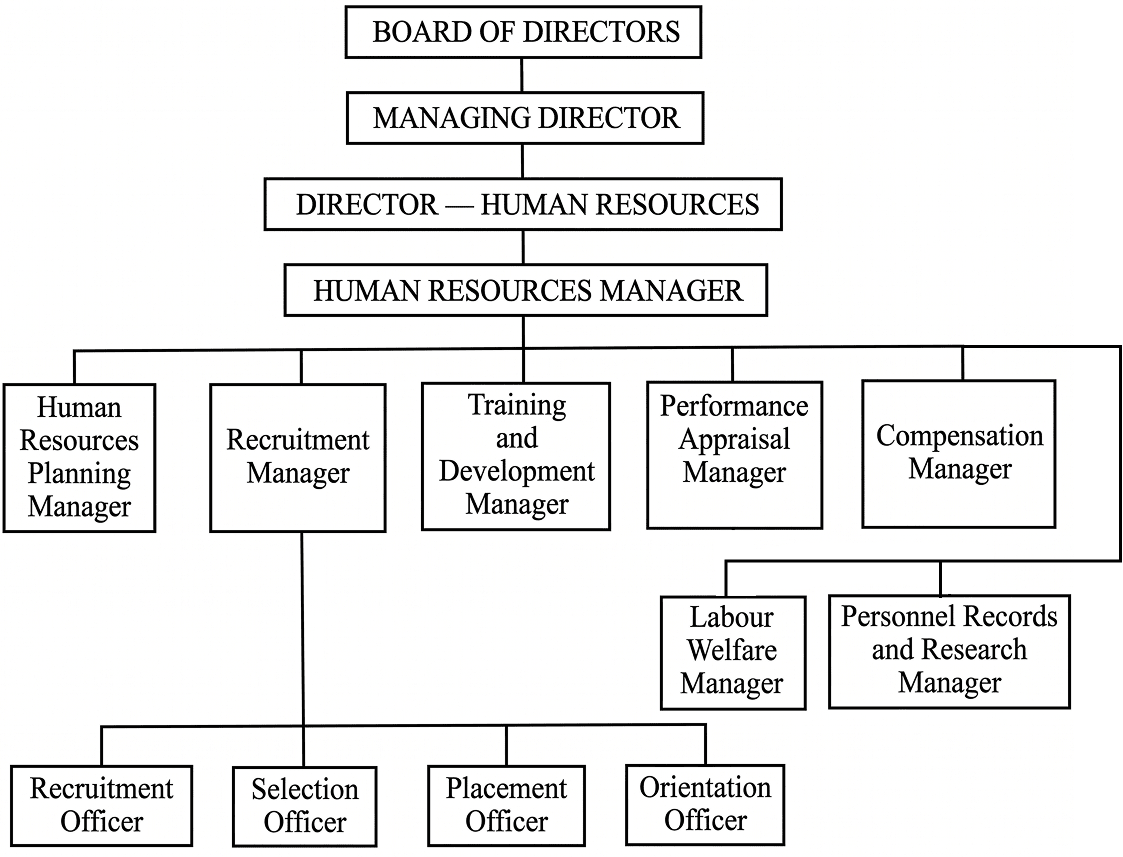
The Human Resources Department in a company performs the functions of acquiring, developing, compensating, maintaining and integrating its human resources.
How does effective placement of employees contribute to the overall productivity of an organisation?
Answer
Placement means putting the selected candidates on their respective jobs in the organisation. Effective placement of employees contributes to the overall productivity of an organisation in the following ways:
- Right Person for the Right Job — Effective placement ensures that the skills, qualifications and experience of an employee match the requirements of the job.
- Higher Efficiency — When employees are placed in jobs suited to their abilities, they perform with greater efficiency and produce better quality work.
- Job Satisfaction — Proper placement increases job satisfaction because employees feel competent and confident.
- Reduced Training Costs — When employees are placed in jobs matching their skills, less time and money is required to train them.
- Lower Employee Turnover — Satisfied employees are less likely to leave the organisation.
- Achievement of Organisational Goals — When every position is filled by a capable person, the organisation can achieve its goals more effectively.
Thus, effective placement of employees acts as the foundation of a productive workforce and is crucial for the success of any organisation.
What do you understand by Production Management?
Answer
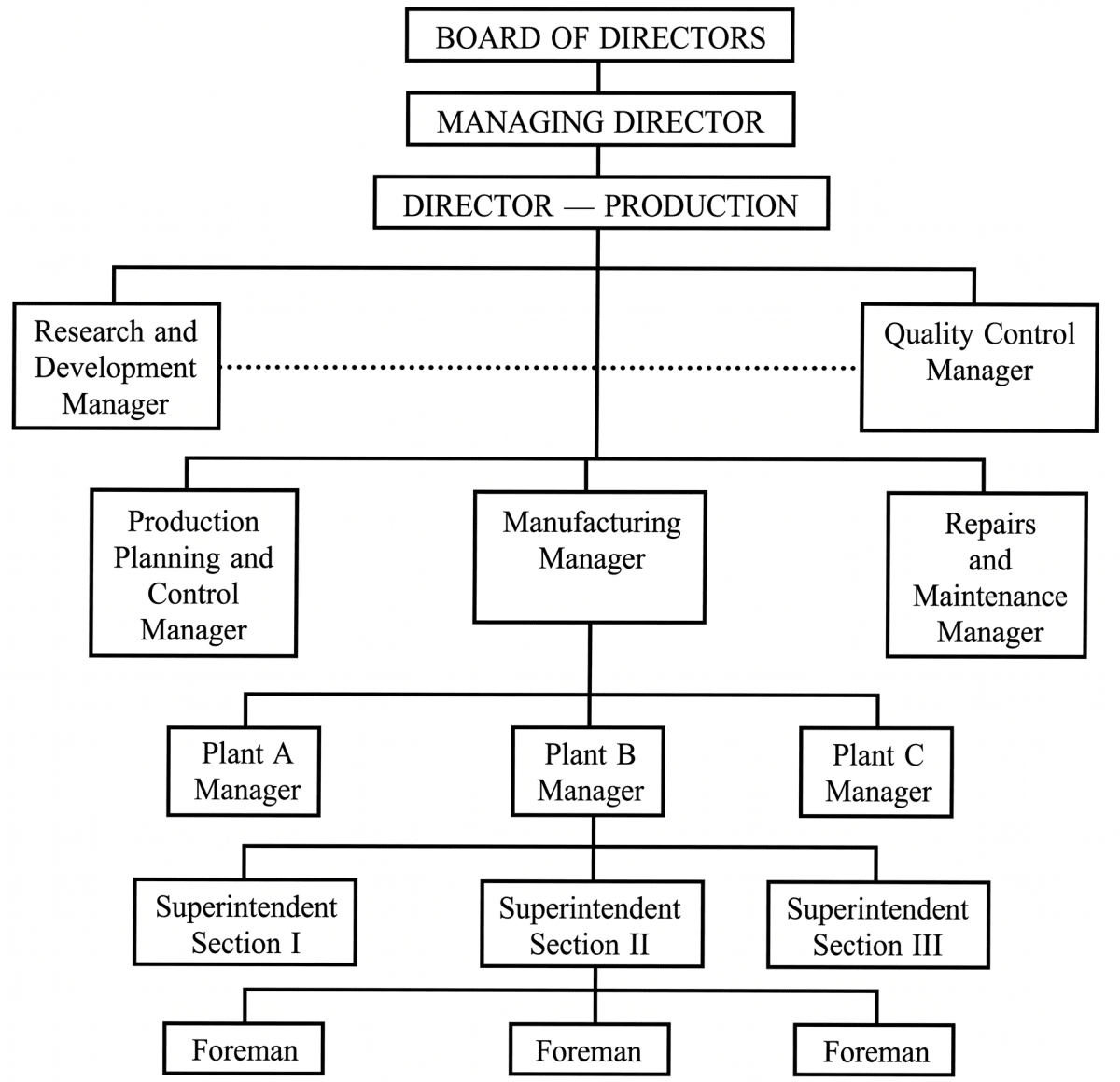
Production Management means managing the manufacturing activities of an organisation. The Production Department is responsible for producing the right product, in the right quantity, at the right time and at the right cost.
Its main functions are:
- Product Design — Deciding the shape, size and features of the product.
- Choice of Plant and Equipment — Selecting suitable machines and equipment.
- Plant Layout — Arranging machines and tools properly for efficient production.
- Production Planning — Deciding raw materials, workers, machines, sequence of work and time schedule.
- Production Control — Coordinating activities and ensuring production targets are achieved.
- Repairs and Maintenance — Keeping machines and equipment in working condition.
- Research and Development — Improving products, processes and methods of production.
- Record Keeping — Maintaining production records and supplying information to other departments.
Explain the procedure involved in purchase of materials and goods.
Answer
In order to purchase materials in an efficient manner, the Purchase Department frames a proper sequence of steps. The main steps involved in the purchase procedure are as follows:
- Receiving Purchase Requisition — The Purchase Department receives a written and authorised purchase requisition from the department that needs materials. It mentions the quantity, quality, specifications and the date by which the materials are required.
- Inviting Quotations — The Purchase Department invites quotations from suppliers to know their prices, quality, terms of delivery and terms of payment.
- Selecting Supplier — The quotations are compared and the most suitable supplier is selected on the basis of price, quality, delivery time, payment terms and reliability.
- Placing Purchase Order — A written purchase order is sent to the selected supplier. It contains details such as quantity, quality, price, delivery date and terms of payment.
- Follow-up of Purchase Order — The Purchase Department follows up with the supplier to ensure that the materials are delivered on time.
- Payment to Supplier — After the bill and related documents are checked and verified, payment is made to the supplier through the Finance and Accounts Department.
Thus, the purchase procedure helps the organisation obtain the right materials, in the right quantity and quality, at the right time and at the right cost.
Discuss the functions of the Purchasing and Stores Department.
Answer
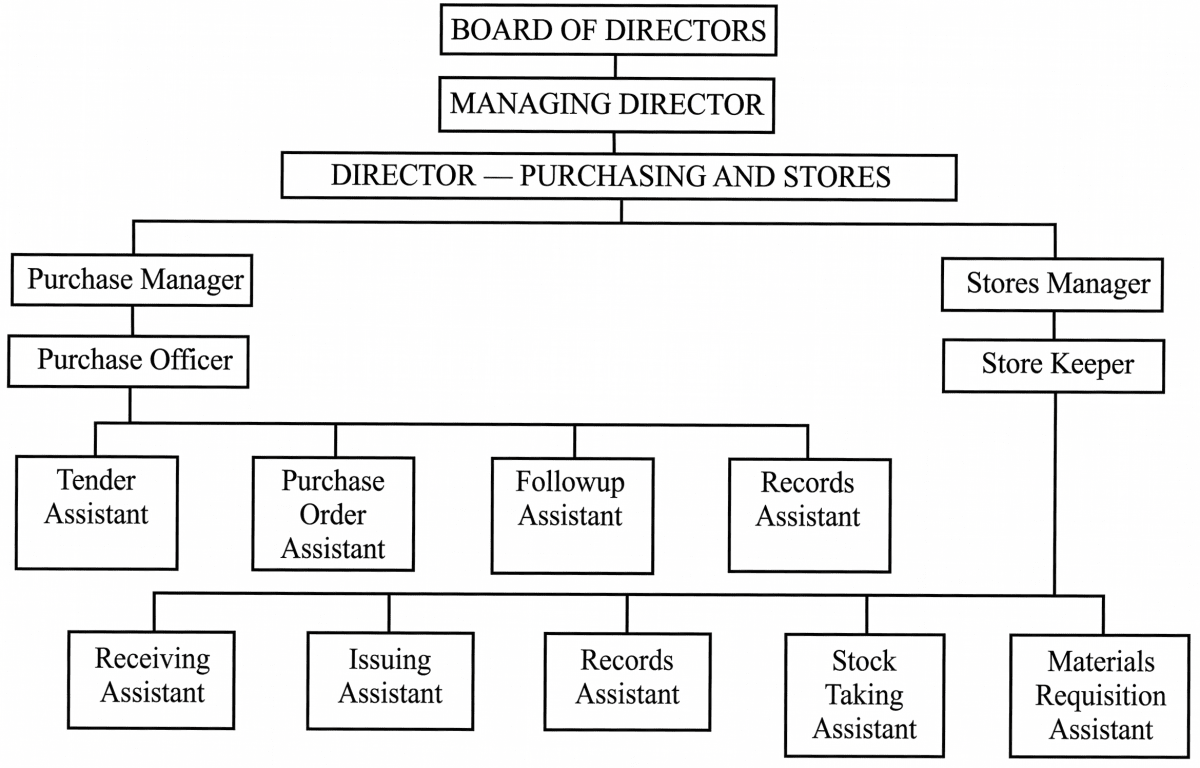
The Purchasing and Stores Department performs various activities involved in procurement and storage of materials required by the firm.
Answer
The Purchasing Department and the Stores Department perform important but different functions.
Preparing Purchase Budget — It prepares a budget showing the quantity, quality, time and estimated cost of materials to be purchased.
Developing Purchase Procedure — It frames a proper procedure for purchasing materials, such as receiving requisitions, inviting quotations and placing orders.
Receiving Purchase Requisitions — It purchases materials only after receiving authorised written requests from different departments.
Selecting Suppliers — It invites quotations from suppliers and selects the most suitable supplier after comparing price, quality and terms of delivery.
Placing Purchase Order — It sends a written purchase order to the selected supplier, mentioning quantity, quality, price, delivery and payment terms.
Follow-up of Orders — It follows up with suppliers to ensure timely delivery of materials.
Maintaining Supplier Records — It keeps a list of approved suppliers and develops alternative sources of supply.
Keeping Purchase Records — It maintains records of purchases, prices, suppliers, quality specifications and delivery terms.
Receiving and Inspecting Materials — It receives, counts, weighs and checks the materials supplied. Any defect or shortage is reported to the Purchase Department.
Storing Materials — It stores materials safely in proper bins or racks with suitable identification cards.
Issuing Materials — It issues materials to departments only on the basis of authorised requisitions.
Safe Keeping of Materials — It protects materials from theft, fire, damage and deterioration.
Inventory Control — It maintains minimum, maximum and reorder levels of stock to avoid overstocking or shortage.
Stock Taking — It compares physical stock with records at regular intervals.
Record Keeping — It keeps proper records of all receipts, issues and balances of materials.
Thus, the Purchasing Department ensures proper buying of materials, while the Stores Department ensures proper receiving, storing, issuing and control of materials.
"General Administration Department serves as an information centre." Comment.
Answer
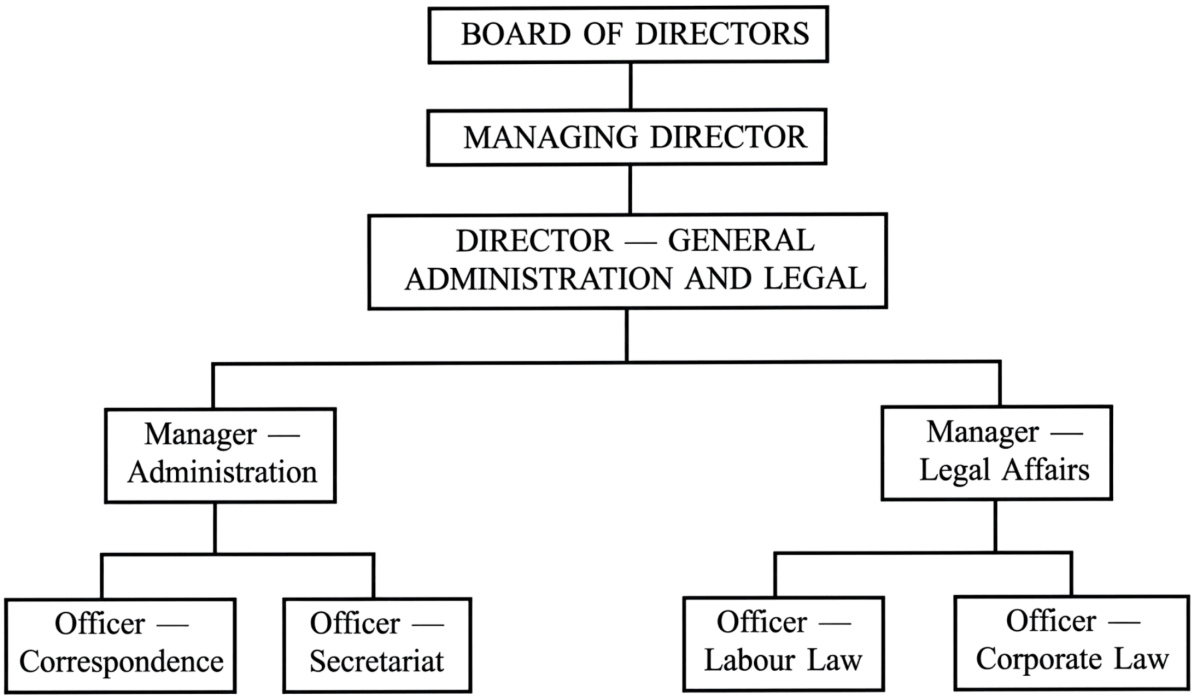
The statement is correct. The General Administration Department serves as an information centre of the organisation because it collects, records, compiles and supplies information needed for smooth working.
It performs this role in the following ways:
Receiving and Recording Information — It receives information from different departments and outside sources and records it properly for future use.
Managing Correspondence — It handles inward and outward mail, letters, notices and other official communication.
Coordination between Departments — It supplies information needed by different departments and helps maintain coordination among them.
Communication Infrastructure — It manages communication facilities such as telephone, internet, fax and other systems for smooth flow of information.
Safeguarding Records and Documents — It maintains and protects important files, records, reports, agreements and documents of the firm.
Supplying Information for Decision-making — It provides useful information to top management and departments for planning, decision-making and control.
Supplying Statutory Information — It may supply required information to government authorities, investors and other stakeholders.
Office Systems and Procedures — It frames office systems, procedures and routines for efficient handling of information.
Thus, the General Administration Department acts as an information centre by ensuring that the right information is collected, preserved and supplied to the right people at the right time.
Explain the functions of the Human Resources Department in a large business firm.
Answer
The main functions of the Human Resources Department are as follows:
Human Resource Planning — It forecasts future vacancies and decides the number and qualifications of employees required for different jobs.
Recruitment and Selection — It attracts suitable candidates and selects qualified persons through tests, interviews, group discussions, etc.
Placement and Orientation — It places selected candidates on suitable jobs and makes new employees familiar with the organisation and work environment.
Training and Executive Development — It arranges training programmes for workers and managers to improve their knowledge, skills and efficiency.
Performance Appraisal — It prepares systems for evaluating the performance and future potential of employees.
Promotions and Transfers — It helps different departments in taking decisions regarding promotion and transfer of employees.
Wages and Salary Administration — It prepares and administers a fair wage and salary system for different categories of employees.
Employee Benefits and Services — It manages benefits such as provident fund, pension, housing, group insurance, leave travel concession, etc.
Employee Health and Safety — It provides medical, insurance and safety facilities and maintains proper working conditions.
Industrial Relations — It maintains good relations between employers and employees and helps in resolving disputes through proper methods.
Records and Research — It maintains employee records and conducts research to improve personnel policies and procedures.
Evaluate the importance of human resource planning in addressing the challenges of workforce shortages during peak business seasons.
Answer
Human Resource Planning means forecasting future vacancies and deciding the number and qualifications of employees required for different jobs.
Its importance in solving workforce shortages during peak seasons is as follows:
Anticipating Manpower Needs — It helps the organisation estimate the extra workers required during busy seasons.
Timely Recruitment — Recruitment can be started early so that sufficient workers are available at the right time.
Right Mix of Staff — It helps decide the number of permanent, temporary and part-time employees needed.
Training and Skill Readiness — Employees can be trained in advance to handle peak-season work efficiently.
Avoiding Overwork — It prevents existing employees from being overburdened, reducing stress and mistakes.
Cost Control — It avoids emergency hiring, excessive overtime and loss due to shortage of workers.
Customer Satisfaction — Adequate trained staff helps in quick service and better quality during busy periods.
Smooth Operations — It ensures that production, sales and distribution continue without interruption.
Thus, human resource planning helps an organisation meet seasonal demand efficiently and economically.
How would you use marketing research to launch a new product in a highly competitive market? Provide examples.
Answer
Marketing Research means collecting and analysing information about customers, competitors and market conditions. It helps in launching a new product successfully in a competitive market.
It can be used in the following ways:
Identifying Customer Needs and Preferences — It helps to know the needs, tastes, buying habits and expectations of consumers through surveys, questionnaires and interviews. Example: A smartphone company may find whether customers prefer better camera quality, battery life or gaming features.
Assessing Demand and Competition — It helps to estimate the total demand for the product and study the strength, prices and strategies of competitors. Example: A new soft drink company may study the market share and pricing of existing brands before launch.
Exploring New Markets — It helps to identify profitable customer groups or areas where competition is less. Example: An electric vehicle company may first launch in cities where demand is growing but choices are limited.
Fixing Price and Discounts — It helps the firm decide a suitable price by studying customer paying capacity and competitor prices. Example: A snack brand may launch a small pack at ₹5 or ₹10 for price-sensitive customers.
Choosing Selling and Promotion Methods — It helps decide whether the product should be sold through shops, online platforms, direct selling or other channels. Example: A fashion brand may sell mainly online if young customers prefer e-commerce.
Product Planning and Development — It helps in deciding product features, packaging, brand name, label and varieties according to customer needs. Example: A shampoo company may launch anti-dandruff or anti-hair-fall varieties based on consumer demand.
Test Marketing — The product may be launched in a limited area first to study customer response before full-scale launch. Example: A biscuit brand may test launch in a few cities and improve the product before national launch.
Thus, marketing research reduces risk and helps the firm launch the right product, at the right price, through the right channel in a competitive market.