
Which of the following statements is/are correct?
(i) Economic activities are undertaken with the purpose of earning money and acquiring wealth.
(ii) Profession is an occupation involving rendering of expert services for a fee.
(iii) Economic activities involve production and distribution of goods and services.
(iv) Employment does not mean working under an employer for wage or salary.
- Only (i) is correct
- Only (i), (ii) are correct
- (i), (ii) and (iii) are correct
- None of these
Answer
(i), (ii) and (iii) are correct
Reason — Statements (i), (ii) and (iii) correctly describe economic activities. Statement (iv) is wrong because employment actually means working under an employer for wage or salary (there is an employer-employee relationship and the employee renders services as per the employment agreement). Therefore, option 3 is the correct choice.
Which of the following is/are characteristics of economic activities?
(i) Economic activities we undertake to earn money income.
(ii) Economics activities help to create wealth.
(iii) Economic activities satisfy basic human needs such as food, clothing and shelter.
(iv) Economic activities serve as the basis for economic development.
- Only (ii)
- (i) and (iii)
- (iv), (ii), (iii)
- All of these
Answer
All of these
Reason — All four statements describe the characteristics of economic activities. Economic activities are undertaken to earn money income, help create wealth, satisfy basic human needs such as food, clothing and shelter, and serve as the basis for the economic development of a country.
What is the purpose of economic activities?
- These activities are performed only for wage or salary.
- These activities are not expected to create money income.
- These activities are undertaken to earn a living through production and sale of goods and services.
- These activities do not result in creation of wealth.
Answer
These activities are undertaken to earn a living through production and sale of goods and services.
Reason — Economic activities are undertaken with the purpose of earning a living through production and sale of goods and services. They are based on the economic motive of earning money and creating wealth. Options 1, 2 and 4 are incorrect — economic activities are not limited to wage/salary, they do create money income, and they do result in creation of wealth.
Statement I: Non-economic activities are undertaken not for earning money but for personal satisfaction.
Statement II: Non-economic activities involve social, religious, patriotic and non-financial motives.
- Statements I and II are wrong
- Statement II is correct but I is wrong
- Statements I and II are correct but II is not an explanation of I
- Statements I and II are correct and II is an explanation of I
Answer
Statements I and II are correct but II is not an explanation of I
Reason — Both statements are correct descriptions of non-economic activities. Statement I tells us the purpose of non-economic activities (personal satisfaction, not money). Statement II tells us the types of motives involved (social, religious, patriotic, etc.). However, Statement II merely lists parallel characteristics — it does not explain why such activities are undertaken for personal satisfaction. Both are independent facts about non-economic activities.
Which of the following statements is/are correct?
- All business activities involve sale or exchange of goods and services for some consideration.
- Every business enterprise produces or buys goods and services for selling them to others.
- The primary objective of a business is to earn money and acquire wealth.
- All of these
Answer
All of these
Reason — All three statements correctly describe business. Business involves sale or exchange of goods and services for consideration (price), every business enterprise produces or buys goods to sell them to others, and the primary objective of business is to earn money and acquire wealth through profits.
Statement I: Business is regarded as an economic activity.
Statement II: The objective of business activities is to sell the goods and services for profit.
- Both I and II are wrong
- I is correct and II is wrong
- Both I and II are correct but II is not an explanation of I
- Both I and II are correct and II is an explanation of I
Answer
Both I and II are correct and II is an explanation of I
Reason — Both statements are correct. Statement II explains Statement I — business is regarded as an economic activity because its objective is to sell goods and services for profit. The profit motive, along with the use of scarce resources, makes business an economic activity, distinguishing it from non-economic activities like social or religious work.
Which of the following statements is wrong regarding industry?
(i) Industry includes all those business activities which involve extracting, multiplying, growing, processing, assembling and constructing useful products.
(ii) The term 'industry' refers to a group of firms producing similar or related goods.
(iii) The business enterprises which undertake industrial activities are known as industrial enterprises.
(iv) People who own and control industries are called manufacturers.
- Only (i) is wrong
- Only (ii) is wrong
- (iv) is wrong
- All of them are wrong
Answer
(iv) is wrong
Reason — Statements (i), (ii) and (iii) are correct. Statement (iv) is wrong because people who own and control industries are called industrialists, not manufacturers. As the textbook clearly states, "People who own and control industries are called industrialists."
Which of the following statements is wrong regarding industry?
(i) Extractive industries are those industries which are concerned with the discovery and extraction of natural resources.
(ii) Genetic industries are those industries which are concerned with reproducing and multiplying plants and animals.
(iii) Manufacturing industries are those industries which are concerned with providing commercial services.
(iv) Industries which employ complex technology and long production cycles are called heavy industries.
- (i) is wrong
- Only (iii) is wrong
- (i), (ii), (iv) are wrong
- None of them
Answer
Only (iii) is wrong
Reason — Statement (iii) is wrong because manufacturing industries are concerned with the conversion of raw materials and semi-finished products into finished products, not with providing commercial services. Providing commercial services is the function of tertiary industries (banks, airlines, advertising agencies, etc.). The other statements correctly define extractive, genetic, and heavy industries.
Which of the following hindrances does not arise in the exchange of goods and services?
- Hindrance of production
- Hindrance of time
- Hindrance of risk
- Hindrance of finance
Answer
Hindrance of production
Reason — Commerce removes the hindrances of person, place, time, risk, finance, and knowledge that arise in the exchange of goods and services. 'Hindrance of production' is not a hindrance in the exchange — production is an industrial activity, not an exchange activity. The hindrances of time, risk, and finance are removed by warehousing, insurance, and banking respectively.
Statement I: Trade means the sale, transfer or exchange of goods may be for cash or credit.
Statement II: Traders serve as link between producers and consumers.
- Statement I is wrong
- Statement II is wrong
- Both I and II are correct but II is not an explanation of I
- Both I and II are correct and statement I is an explanation of II
Answer
Both I and II are correct but II is not an explanation of I
Reason — Both statements are correct. Statement I defines what trade is — the sale, transfer or exchange of goods for cash or credit. Statement II describes the role of traders as a link between producers and consumers. These are two separate, parallel facts about trade — one defines trade itself and the other describes the role of traders. Statement II does not explain Statement I; they stand independently as two correct facts.
Entrepot Trade means
- Importing goods from one or more countries with the purpose of exporting them to some other country or countries.
- Purchasing goods and services from other countries.
- Selling goods and services to other countries.
- None of these
Answer
Importing goods from one or more countries with the purpose of exporting them to some other country or countries.
Reason — Entrepot trade (also known as 're-export trade') means importing goods from one or more countries with the purpose of exporting them to some other country or countries. For example, Indian companies import latex from Thailand and export it to Japan. Option 2 refers to import trade, and option 3 refers to export trade.
What is the meaning of 'Organisation'?
- An institutional arrangement to carry on some business activity.
- It is an incorporated association of persons created by law.
- A group of persons who join together to achieve some common objectives.
- None of these
Answer
A group of persons who join together to achieve some common objectives.
Reason — According to the textbook, "The term 'organisation' means a group of persons who join together to achieve some common objectives." Option 1 — "An institutional arrangement to carry on some business activity" — is actually the definition of a firm, not an organisation. Option 2 — "an incorporated association of persons created by law" — is the definition of a company. An organisation is a wider concept than firm and company.
What is the nature of activity of banking and finance companies?
- These organisations are engaged in designing and preparing advertisements.
- These organisations are engaged in accepting deposits and lending money.
- These organisations are engaged in storing and preserving goods on hire.
- These organisations are engaged in buying and selling of goods.
Answer
These organisations are engaged in accepting deposits and lending money.
Reason — Banking and finance companies (like SBI, ICICI Bank, HDFC Bank, Citibank, Paytm Payments Bank) are engaged in accepting deposits from the public and lending money to borrowers. They remove the hindrance of finance in commerce. Option 1 refers to advertising agencies, option 3 to warehousing organisations, and option 4 to trading organisations.
These organisations are engaged in buying and selling of goods.
- Banking and Finance Companies
- Trading Organisations
- Transport Organisations
- Manufacturing Organisations
Answer
Trading Organisations
Reason — Trading organisations are engaged in the buying and selling of goods. They include wholesalers, retailers, importers, and exporters who act as intermediaries between producers and consumers. Manufacturing organisations produce goods, transport organisations carry passengers and goods from one place to another, and banking organisations deal in money.
Firms producing biscuits, breads, noodles, jam, soup powder, spices etc.
- Food Industry
- Beverages Industry
- Personal care products Industry
- Home care products Industry
Answer
Food Industry
Reason — As per the textbook, the food industry consists of firms producing biscuits, breads, noodles, jam, soup powder, spices, wheat flour, chocolates, ice cream, tomato products, etc. The beverages industry produces soft drinks, tea, coffee, etc.; the personal care products industry produces shampoo, soaps, toothpaste, etc.; and the home care products industry produces cleaners, washing liquids, mosquito repellents, etc.
What is the meaning of Public Accountability?
- Money invested in public enterprises is public money and public sector enterprises are answerable to the public through the Parliament.
- Ultimate control of a public sector undertaking lies with the government.
- Public sector undertakings are fully owned by government or some public authority.
- None of these
Answer
Money invested in public enterprises is public money and public sector enterprises are answerable to the public through the Parliament.
Reason — Public accountability means that since the money invested in public sector enterprises is public money (raised through taxes), these enterprises are answerable to the public through their elected representatives in Parliament. Option 2 refers to 'government control' and option 3 refers to 'state ownership' — these are separate characteristics of public sector undertakings.
Assertion (A): The agricultural sector is a primary industry.
Reasoning (R): It involves the extraction and production of raw materials directly from natural resources.
- A is true but R is false
- A is false but R is true
- Both A and R are true and R explains A
- Both A and R are true but R does not explain A
Answer
A is true but R is false
Reason — Assertion A is true — the agricultural sector is indeed a primary industry. However, Reason R is false because agriculture specifically falls under genetic industries (which are concerned with reproducing and multiplying plants and animals), not extractive industries. The term 'extraction' applies to industries like mining, fishing, oil drilling, and lumbering — not to agriculture. Since R inaccurately describes agriculture as 'extraction' of raw materials, R is false even though A is true.
Assertion (A): Private sector enterprises focus primarily on profit maximization.
Reasoning (R): Profit motive is the driving force behind the decisions and operations of private businesses.
- A is true but R is false
- A is false but R is true
- Both A and R are true and R explains A
- Both A and R are true but R does not explain A
Answer
Both A and R are true and R explains A
Reason — Both A and R are true. Private sector enterprises focus on profit maximisation because their owners (private businessmen) invest capital to earn returns. The profit motive is the main objective of private sector undertakings — profits provide the reward for the risk assumed and the required return on capital. Hence R correctly explains why private enterprises focus on profit.
Statement I: A retailer delaying the purchase of seasonal goods for sale is addressing the hindrance of time in commerce.
Statement II: Warehousing solves the problem of storing goods until they are sold.
- Both I and II are correct
- Both I and II are wrong
- Only I is correct
- Only II is correct
Answer
Only II is correct
Reason — Statement I is wrong because the hindrance of time is not addressed by a retailer 'delaying' the purchase of seasonal goods — it is addressed by storing goods in warehouses until they are demanded. Statement II is correct — warehousing holds and preserves goods from the time of production until they are sold, thereby creating time utility and removing the hindrance of time.
Which of the following correctly distinguishes between commerce and trade?
- Commerce involves production, while trade deals with distribution.
- Commerce involves distribution and auxiliary services, while trade focuses on buying and selling goods.
- Trade creates time utility, while commerce creates form utility.
- Commerce is a subset of trade.
Answer
Commerce involves distribution and auxiliary services, while trade focuses on buying and selling goods.
Reason — Commerce is a wider concept that includes trade (buying and selling of goods) as well as auxiliaries to trade — transport, warehousing, insurance, banking, advertising, etc. Trade is therefore a part of commerce. Option 1 is wrong because production is industry's role; option 3 is wrong because form utility is created by industry; option 4 is wrong because trade is a subset of commerce, not the other way around.
If an organisation is funded entirely by private individuals and operates solely for earning profits, it would be classified under public sector enterprises.
- True
- False
Answer
False
Reason — An organisation funded entirely by private individuals and operating solely for earning profits would be classified under the private sector, not the public sector. Public sector enterprises are owned and operated by the government or its agencies, with capital arranged by the government and the primary motive being service to the public. Private ownership and a profit motive are characteristics of private sector enterprises.
Identify the type of industry shown in the given image.
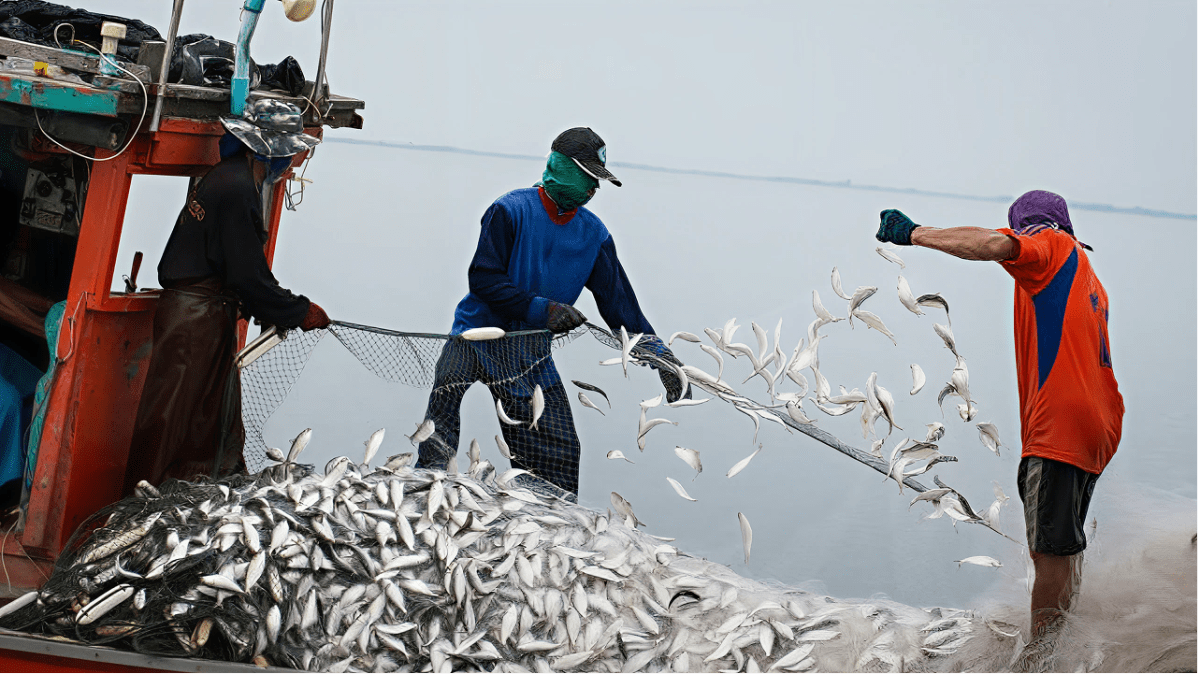
- Genetic Industry
- Extractive Industry
- Analytical Industry
- Synthetical Industry
Answer
Extractive Industry
Reason — The image shows fishing — men catching fish from water. Fishing is an example of an extractive industry. Extractive industries are concerned with the discovery and extraction of natural resources from land, water, or air. Other examples include mining (coal, iron ore), oil drilling by ONGC, lumbering from forests, and quarrying. The products are either directly consumed (like fish as food) or used as raw materials in other industries.
A textile company produces cotton fabrics and sells them to wholesalers who distribute the goods to retailers across the country. The company also advertises its products to create brand awareness. What hindrance does advertising primarily aim to remove in this case?
- Hindrance of place
- Hindrance of knowledge
- Hindrance of finance
- Hindrance of risk
Answer
Hindrance of knowledge
Reason — Advertising removes the hindrance of knowledge. Producers and merchants often find it difficult to sell goods because consumers are not aware of their existence, benefits and uses. Advertising and sales promotion remove this hindrance by bringing goods and services to the knowledge of consumers and persuading them to buy. The hindrance of place is removed by transport, finance by banking, and risk by insurance.
An entrepreneur faces financial losses due to a natural disaster that damages their inventory. Which auxiliary to trade could have mitigated this loss?
- Transportation
- Warehousing
- Insurance
- Banking
Answer
Insurance
Reason — Insurance is the auxiliary to trade that protects businesses against the risk of loss due to theft, fire, accidents, floods, earthquake, storm, etc. By taking an appropriate insurance policy and paying a small premium, the entrepreneur could have transferred the risk to an insurance company and received compensation for the damaged inventory. This removes the hindrance of risk.
An insurance company compensating a trader for loss due to fire is an example of removing the hindrance of finance.
- True
- False
Answer
False
Reason — An insurance company compensating a trader for loss due to fire is an example of removing the hindrance of risk, not finance. Insurance covers risks of uncertain losses such as fire, theft, accidents, and natural calamities. The hindrance of finance is removed by banking, which provides loans, credit, and payment services to traders.
Identify the type of industry shown in the given image.
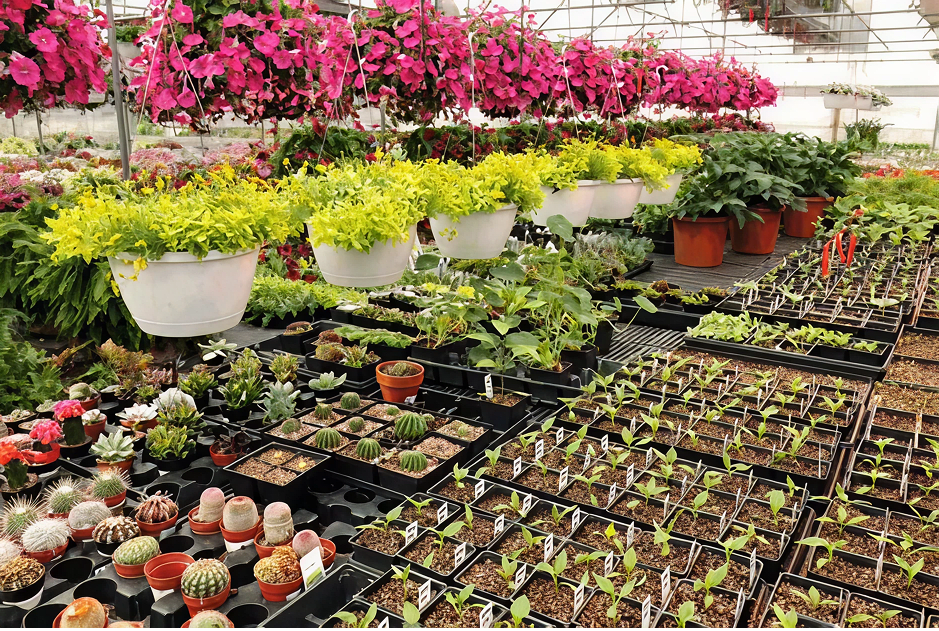
- Genetic Industry
- Extractive Industry
- Analytical Industry
- Synthetical Industry
Answer
Genetic Industry
Reason — The image shows a plant nursery with rows of potted plants — this is an example of a genetic industry. Genetic industries are concerned with reproducing and multiplying plants and animals with the purpose of earning profit from their sale. Other examples include agriculture (growing crops), dairy farming, poultry farming, animal husbandry, pisciculture (fish farming), and orchards.
Which of the following correctly represents the interdependence of industry, commerce, and trade?
- Commerce is independent of industry, while trade depends on industry.
- Industry creates goods, commerce distributes them, and trade facilitates their exchange.
- Trade relies on commerce, but industry operates independently.
- Industry creates form utility, while trade creates time utility and commerce creates possession utility.
Answer
Industry creates goods, commerce distributes them, and trade facilitates their exchange.
Reason — Industry, commerce and trade are interdependent. Industry produces the goods (creating form utility), commerce takes care of distribution to consumers through trade and auxiliary activities, and trade specifically facilitates the buying and selling (exchange) of goods. Without industry, there would be nothing for commerce to distribute; without commerce and trade, goods produced cannot reach the consumers.
Statement I: A non-profit organisation providing free educational services generates income by selling goods.
Statement II: Non-profit organisations focus on serving society rather than earning profits.
- Both I and II are correct
- Both I and II are wrong
- Only I is correct
- Only II is correct
Answer
Only II is correct
Reason — Statement I is wrong because non-profit organisations providing free educational services do not generate income by selling goods — they raise funds through donations, government grants, membership fees, and nominal service charges. Statement II is correct — non-profit organisations are formed for social service, public welfare, and promotion of art, culture, religion or charity, not for earning profits.
A hospital that provides free services to the needy but charges nominal fees from others is classified as a non-profit organisation.
- True
- False
Answer
True
Reason — A hospital that provides free services to the needy and charges only nominal fees from others is a non-profit (charitable) organisation. As the textbook notes, non-profit organisations "may charge nominal or reasonable prices for their services in order to raise funds" while still pursuing their main motive of service rather than profit.
A farmer grows organic vegetables and supplies them to local markets. To increase profits, the farmer sets up a cold storage unit to store surplus vegetables during the off-season and sells them when prices are higher. Which type of industry does the farmer's activity represent?
- Extractive Industry
- Genetic Industry
- Manufacturing Industry
- Construction Industry
Answer
Genetic Industry
Reason — The farmer is engaged in cultivating organic vegetables, which involves multiplying plants — this is the work of a genetic industry. Genetic industries are concerned with reproducing and multiplying plants and animals (agriculture, nurseries, dairy farming, poultry, etc.). The cold storage activity is merely an auxiliary (warehousing) — the farmer's primary industrial activity remains genetic.
Give two characteristics of business.
Answer
Two characteristics of business are:
- Sale, Transfer or Exchange — All business activities involve sale or exchange of goods and services for some consideration (price). If there is no sale, transfer or exchange for a price, it will not be a business activity.
- Profit Motive — The primary objective of business is to earn money and acquire wealth. A business is not charity. Profits are essential for the survival, growth, and expansion of business.
Define commerce.
Answer
According to James Stephenson, "Commerce is the sum total of those processes which are engaged in the removal of hindrances of persons (trade), places (transport and insurance) and time (warehousing) in the exchange (banking) of commodities."
In simple terms, Commerce = Trade + Auxiliaries to Trade (transport, warehousing, insurance, banking, advertising, etc.).
List any two differences between industry and commerce.
Answer
| S.No. | Basis | Industry | Commerce |
|---|---|---|---|
| 1. | Activities involved | It includes all those business activities which are concerned with production of goods. | It includes trade and auxiliaries to business activities. |
| 2. | Creation of utility | It creates form utility by extracting, multiplying, processing resources into useful products. | It creates utilities of person, time, place, risk, finance and information. |
| 3. | Capital required | Large capital is required for large-scale industry. | Less capital is required as compared to industry. |
| 4. | Examples | Sugar industry, steel industry, car industry. | Commercial banks, public warehouses, advertising agencies. |
What are aids to trade?
Answer
Aids to trade are services that assist and support trade and industry by removing the various hindrances faced during the production and distribution of goods. The main aids to trade are:
Transportation — Moves goods from places of production to places of consumption, removing the hindrance of place and creating place utility.
Warehousing — Holds and preserves goods after production until they are sold, removing the hindrance of time and creating time utility.
Insurance — Protects businessmen against risk of loss due to fire, theft, accidents, floods, etc. by taking an insurance policy at a small premium.
How does trade differ from commerce in terms of their objectives and scope within the economy?
Answer
Trade refers specifically to the buying and selling of goods and services. Its objective is to facilitate the direct sale, transfer, or exchange of goods between sellers and buyers for cash or credit. Trade creates person utility.
Commerce, on the other hand, has a much wider scope. Its objective is to facilitate the entire process of exchange and distribution of goods by removing all the hindrances that arise between producers and consumers.
Define the term 'organisation'.
Answer
The term 'organisation' means a group of persons who join together to achieve some common objectives. It refers to two or more people working together in a coordinated manner to achieve some common goals.
What is a profit making organisation?
Answer
A profit-making organisation refers to an organisation which is formed for the purpose of earning profits. Such organisations are engaged in business activities — they produce, buy, or sell goods and services and aim to earn profits.
A government-owned public transport company and a privately-owned cab service both aim to provide affordable transportation in a city. Which type of organisation would be better for ensuring affordable and accessible transportation, and why?
Answer
A government-owned public transport company would be better for ensuring affordable and accessible transportation. The reasons are:
Service Motive — The primary objective of a public sector undertaking is to render service to the public at large, not profit maximisation.
Wider Coverage — Government-owned transport companies serve all routes, including loss-making rural and remote routes.
Subsidised Fares — The government can subsidise public transport.
What is a public sector enterprise?
Answer
Public sector enterprises are business enterprises owned and operated by the government or any of its agencies. The public sector consists of all those undertakings which are owned and controlled by the Central Government, State Governments, or municipal bodies.
How does the private sector drive innovation and economic growth in a competitive environment?
Answer
The private sector drives innovation and economic growth in a competitive environment in the following ways:
Profit Motive Encourages Innovation — The desire to earn higher profits motivates private firms to develop new products, technologies.
Competition Forces Improvement — Intense competition in the private sector forces firms to continuously improve and innovate.
Independent Management — Private sector undertakings are managed by their owners or professional managers without government interference.
Investment in Research and Development — To stay ahead of competitors, private firms invest heavily in R&D, leading to new inventions.
What is a joint sector enterprise?
Answer
A joint sector enterprise is an enterprise owned partly by the government and partly by private businessmen. The ownership, management and control are shared jointly by the government and private parties. The general public may also invest in joint sector enterprises by purchasing shares.
Define a non-profit making organisation.
Answer
A non-profit making organisation refers to an organisation which does not aim at earning profits. Its purpose is social service and public welfare. Such organisations are formed for the purpose of promoting art, culture, religion, charity, education, health, sports, or any other social purpose.
State any two differences between primary, secondary and tertiary sectors.
Answer
Any two differences are:
| S.No. | Basis | Primary Sector | Secondary Sector | Tertiary Sector |
|---|---|---|---|---|
| 1. | Meaning | Industries concerned with extraction and multiplication of natural resources. | Industries concerned with transforming materials provided by primary industries into finished or semi-finished goods. | Business units which provide commercial services. |
| 2. | Examples | Coal mining, fishing, agriculture, dairy farming. | Steel industry, cement industry, textile industry. | Airlines, hotels, banks, advertising agencies. |
A garment manufacturer in Gujarat produces T-shirts but faces challenges in selling the products due to a lack of transport and insufficient market knowledge. What commercial activities can resolve the hindrances faced by the manufacturer?
Answer
The garment manufacturer in Gujarat is facing two specific hindrances — the hindrance of place and the hindrance of knowledge . The following commercial activities can resolve these hindrances:
Transportation — Modern means of transport can carry T-shirts safely and quickly from the Gujarat factory to distant markets .
Advertising — Advertising in newspapers, television, radio, internet and social media can inform potential customers across the country.
Warehousing — Warehouses at strategic locations can store T-shirts until they are demanded by retailers in different cities.
What is business? Describe the nature of business activities.
Answer
Business — According to L.H. Haney, "Business may be defined as a human activity directed towards producing or acquiring wealth through buying and selling of goods." Nature/Characteristics of Business Activities:
Sale, Transfer or Exchange — All business activities involve sale or exchange of goods and services.
Dealings in Goods and Services — Every business enterprise produces or buys goods and services for selling them to others.
Regular Dealings — Business involves a series of dealings.
Profit Motive — The primary objective of business is to earn money and acquire wealth.
Creation of Utilities — In the words of Roger, "A business exists to create and deliver value satisfaction to customers at a profit."
Element of Risk — Business always involves some risk.
Business is an Economic Activity — Its objective is to sell goods and services for profit.
"Commercial activities deal with buying and selling of goods, the exchange of commodities and the distribution of finished goods." Explain.
Answer
The statement, given by Evlyn Thomas, highlights the essential nature of commercial activities. It can be explained as follows:
Buying and Selling of Goods (Trade) — The core commercial activity is trade, which involves the buying and selling of goods between sellers and buyers.
Exchange of Commodities — Commerce facilitates the exchange of commodities between persons living in different places.
Distribution of Finished Goods — Once goods are manufactured by industries, they need to be distributed to consumers across various locations.
Removal of Hindrances — Commercial activities remove the various hindrances in the exchange of goods — hindrance of person , place , time, risk , finance , and knowledge .
Link Between Producers and Consumers — Commerce establishes a vital link between producers (industries) and consumers.
"Commerce consists of all those activities which are involved in the removal of hindrances of person, place and time". Explain.
Answer
Commerce is the system of activities that removes the various hindrances arising in the exchange of goods and services between producers and consumers.
Hindrance of Person — This refers to the lack of contact between producers and consumers. Commerce removes this hindrance through trade.
Hindrance of Place — Goods are produced in one place but consumed in different places.Commerce removes this hindrance through transport, creating place utility.
Hindrance of Time — There is usually a time gap between production and consumption. Commerce removes this hindrance through warehousing — creating time utility.
Discuss the importance of commerce.
Answer
Importance of commerce can be explained as follows:
Link Between Producers and Consumers — Commerce establishes a link between producers and consumers.
Removal of Hindrances — Commerce removes the various hindrances in the exchange of goods — person (through trade), place (transport), time (warehousing), risk (insurance), finance (banking), and knowledge (advertising).
Supply of Goods and Services — Commerce ensures the supply of goods at the right time, at the right place and in the proper quantity.
Encourages Industrial Development — Industries can produce on a large scale only when commerce supplies raw materials and distributes finished goods.
Generation of Employment — Commerce generates large-scale employment in trade, transport, banking, insurance, advertising, warehousing, etc.
Promotes International Trade — Commerce promotes trade between countries through import, export and entrepot trade.
Creates Utilities — Commerce creates place utility (transport), time utility (warehousing), and possession utility (trade), adding value to goods.
Contributes to Economic Growth — Commerce significantly contributes to the Gross Domestic Product (GDP) of a country.
Describe aids to trade.
Answer
Aids to trade are services that assist and support trade and industry.
The main aids to trade are:
Transportation — Transportation removes the hindrance of place by moving goods from places of production to places of consumption. place utility.
Warehousing — Warehousing removes the hindrance of time by holding goods after production and until distribution. . Warehousing creates time utility.
Insurance — Insurance removes the hindrance of risk by allowing businessmen to protect themselves against these risks.
Banking — Businessmen need finance and credit to carry on their activities. Banks remove the hindrance of finance by providing funds.
Advertising — Advertising removes the hindrance of knowledge by communicating information about goods and services to prospective consumers.
Packaging — Packaging means designing and producing packages for different products to protect them during transportation, storage, and use.
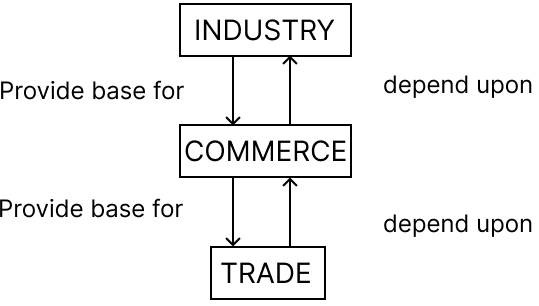
Explain the interrelationship between trade, commerce and industry.
Answer
Industry, commerce and trade are closely interrelated and interdependent.It can be explained as follows:
1. Industry Provides the Base for Commerce:
- Unless goods are produced by industry, there can be no distribution by commerce.
2. Industry Depends on Commerce:
- Commerce provides essential support to industry by distributing goods among consumers and supplying raw materials to producers.
3. Industry and Commerce Provide the Base for Trade:
- Trade depends upon industry for the goods.
- Trade also depends on commerce — the auxiliaries to trade.
- At the same time, trade provides support to industry by maintaining a link between producers and consumers.
4. Commerce Depends on Trade:
- Commerce includes trade as its main component. Without trade, commerce cannot exist.
Distinguish between profit and non-profit making organisations.
Answer
| S.No. | Basis of Distinction | Profit Making Organisation | Non-Profit Making Organisation |
|---|---|---|---|
| 1. | Primary motive | To earn profit. | To render service. |
| 2. | Main function | Production and distribution of goods and services. | Providing services to members and the public. |
| 3. | Risk | High. | Low. |
| 4. | Government control | High. | Low. |
| 5. | Government grant | Not available. | Available. |
| 6. | Net result of operations | Profit or loss. | Surplus or deficit. |
| 7. | Payment of tax | Liable to pay tax. | Not liable to pay tax. |
| 8. | Accounting system | (a) Manufacturing A/c (b) Trading A/c (c) Profit & Loss A/c (d) Balance sheet | (a) Receipts and Payments A/c (b) Income and Expenditure A/c (c) Balance sheet |
| 9. | Examples | Reliance Industries, Bajaj Auto, Dabur, Raymonds. | Akshaya Patra, SEWA, Ramakrishna Mission, Missionaries of Charity, CRY, Helpage. |
Explain in brief the features of non-profit organisations.
Answer
The main features of non-profit organisations are as follows:
Registration — These organisations may be registered under some law (e.g., the Trusts Act, The Society's Act).
Variety of Fields — These organisations work in different fields and their working depends upon the nature of the organisation.
Democratic Management — These organisations are managed by Trusts, Executive Committees, etc. The office-bearers are elected by the members and, therefore, the organisations work in a democratic manner.
Service Motive — The motive is to provide service and not to earn profits.
Source of Funds — Funds are raised from members, donations from the public and grants by the Government.
Nominal Charges — The organisation may charge nominal or reasonable prices for its services.
Promotion of Social Welfare — These organisations are formed for promoting art, culture, religion, charity, or any other social purpose.
Tax Exemption — They are generally not liable to pay tax on their income, as their purpose is social service.
Examples — Akshaya Patra Foundation, Teach For India.
Explain different types of non-profit making organisations.
Answer
Non-profit making organisations are formed for various social, religious, educational, charitable, political and welfare purposes. They are of the following types:
Common Weal Organisations — These organisations are formed for the benefit of the society as a whole. Police service, fire service, and defence services are examples.
Municipal Organisations — These organisations are formed for providing water, electricity, sanitation and other essential services to the public.
Political Organisations — These organisations are formed for protecting and promoting the political interests of their members. Indian National Congress and Bharatiya Janata Party are examples.
Mutual Benefit Organisations — These organisations are formed for the benefit of their members and the public. Clubs, trade unions, consumer associations, chambers of commerce are examples .
Charitable Organisations — These organisations are formed to provide financial and other facilities in kind to the poor and needy people. Examples include Missionaries of Charity and HelpAge India.
Religious Organisations — These organisations are formed for providing facilities for religious activities. Temples, masjids, gurudwaras and churches are examples.
Health Organisations — These organisations are formed for providing medical facilities free of charge or at subsidised rates. Charitable hospitals, dispensaries and government hospitals are examples.
Educational Organisations — These organisations are formed for providing educational facilities free of charge or at subsidised rates. IITs, IIMs, the Institute of Chartered Accountants of India, and universities are examples.
Discuss the nature and types of charitable organisations.
Answer
Charitable organisations are non-profit bodies formed to serve the poor, needy, and disadvantaged. Their main aim is service, not profit. They raise funds through donations, grants, membership fees, charity events, and voluntary contributions. Any surplus is used for charitable activities and not distributed among members.
The main types include religious, educational, medical, disaster relief, orphan care, old-age care, women and child welfare organisations, and blood or eye donation groups. They support social welfare by providing education, healthcare, shelter, relief, and other essential services.
Write notes on:
(a) Mutual benefit organisations
(b) Common weal organisations
Answer
(a) Mutual Benefit Organisations:
Mutual benefit organisations are non-profit organisations formed for the benefit of their members and the public.
Key Features:
- Benefit to Members — The primary aim is to benefit the members of the organisation through cooperative effort.
- Member Contribution — Members contribute through membership fees, subscriptions, or shares to create a common fund.
- Democratic Management — Such organisations are managed democratically with elected office-bearers and committees.
- Service Motive — The motive is service to members, not profit.
- Self-Help Principle — Members help each other through pooled resources and collective action.
(b) Common Weal Organisations:
Common weal organisations are non-profit organisations formed for the benefit of the society as a whole. The term "common weal" means "common good" or "general welfare." Key Features:
- Service to Society — These organisations work for the welfare of the whole society, not just specific groups.
- Essential Services — They provide essential services that benefit the community broadly.
- Government or Public Funding — Often funded by the government or through public contributions.
- No Profit Motive — Their motive is service, not profit.
- Wide Reach — Their services are available to anyone in society.
Give a comparison between public sector, private sector and joint sector enterprises.
Answer
| S.No. | Basis of Distinction | Private Sector Enterprises | Public Sector Enterprises | Joint Sector Enterprises |
|---|---|---|---|---|
| 1. | Ownership | Private businessmen. | Government. | Mixed (Government, private businessmen, public). |
| 2. | Management | Private owners and professional managers. | Government. | Combined (representatives of government, private businessmen and public). |
| 3. | Main Objective | Profit. | Social objectives / service to public. | Profit and social objectives both. |
| 4. | Accountability | To the owners. | To the public (through Parliament). | Both to private owners and the public. |
| 5. | Source of Capital | Arranged by private owners. | Provided by the government. | Government, private businessmen and public (typically 26%, 25%, 49% respectively). |
| 6. | Government Participation | No state participation in ownership and control. | Fully owned and controlled by government. | Partial — shared with private parties. |
| 7. | Risk | Borne entirely by private owners. | Borne by the government. | Shared between government and private parties. |
| 8. | Examples | Reliance Industries, Hindustan Unilever, Century Textiles, Tata Iron and Steel Company. | Indian Railways, Reserve Bank of India, Food Corporation of India, Posts and Telegraphs. | Cochin Refineries, Gujarat State Fertiliser Company, Pragya Tools Corporation, India Rare Earths Limited. |
Explain the characteristics of public sector enterprises.
Answer
The Main Characteristics of public sector enterprises:
State Ownership — Public sector undertakings are fully owned by the government or some public authority. For example, the Reserve Bank of India is owned by the Central Government.
Government Control — The ultimate control of a public sector undertaking lies with the government.
Service Motive — The primary objective of public sector undertakings is to render service to the public at large.
Public Accountability — The money invested in public enterprises is public money. Therefore, these enterprises are answerable to the public through the Parliament.
Organisational Forms — Public enterprises are organised as departmental undertakings, statutory or public corporations, and government companies.
Capital from Government — The capital is provided by the government.
Operation in Strategic Sectors — Public sector enterprises typically operate in strategic and essential sectors such as defence, railways, atomic energy, banking, and infrastructure.
Welfare Orientation — They contribute to balanced regional development, generate employment in backward areas.
Describe the characteristics of private sector enterprises.
Answer
Private sector enterprises are business undertakings owned and controlled by persons other than the government. Main Characteristics:
Private Ownership and Control — A private sector undertaking is fully owned and controlled by one or more private businessmen.
Profit Motive — The main objective of private sector undertakings is earning profits.
No State Participation — There is no participation by the central or state governments in the ownership and control of a private sector undertaking.
Private Finance — The capital of a private sector undertaking is arranged by its owners.
Independent Management — A private sector undertaking is managed by its owners. The owners may manage the enterprise themselves or through their elected representatives.
Risk-Bearing — All business risks are borne by the private owners.
Explain the characteristics of joint sector enterprises.
Answer
The Main Characteristics of Joint Sector Enterprises are:
Mixed Ownership — The government, private entrepreneurs and the investing public jointly own a joint sector enterprise.
Combined Management — The management and control of a joint sector enterprise lies with the nominees or representatives of the government, private businessmen, and the public. Company form of business organisation is adopted.
Share Capital Pattern — The share of the government, private businessmen, and the public in the capital are typically 26 per cent, 25 per cent, and 49 per cent respectively.
What is a commercial organisation? State its characteristics. Distinguish between commercial and non-commercial organisations.
Answer
Commercial Organisation
According to Adams, "Commercial organisation is any organisation which is involved in production, trading of goods and services and is owned by an individual or group of people and has a profit motive."
Main Characteristics of a Commercial Organisation:
- It is an organisation — A formally structured group of persons.
- Engaged in industrial or commercial activity — Activities like manufacturing, trading, banking, transportation, etc.
- Owned and controlled by a single person or a group of persons — Ownership may be individual or collective.
- Based on a formal or informal agreement — Among the persons forming the organisation.
- Separate ownership and management — Owners may or may not be managers.
- Profit motive — Its primary motive is to earn profits.
- Exposed to various risks — Such as market risk, financial risk, and operational risk.
- Ownership by businessmen or government or both — Can be private, public, or joint sector.
Distinction Between Commercial and Non-Commercial Organisations:
| S.No. | Basis of Distinction | Commercial Organisation | Non-Commercial Organisation |
|---|---|---|---|
| 1. | Main objective | The main objective of commercial organisations is to earn profits for the owners. | The main objective of non-commercial organisations is to render services to society. |
| 2. | Types of activities | Buying and selling of goods. | Social, religious, patriotic and other similar activities. |
| 3. | Forms of organisation | Proprietorship, partnership and company. | Clubs, Cooperatives, NGOs, etc. |
| 4. | Examples | Trade, transport, banking, insurance, etc. | Temple, university, trust, etc. |
Distinguish between an organisation, a firm and a company.
Answer
| S.No. | Basis of Distinction | Organisation | Firm | Company |
|---|---|---|---|---|
| 1. | Meaning | A group of persons jointly undertaking some activity. | An individual or group undertaking some business. | A group of persons registered as a legal entity. |
| 2. | Registration | May or may not be registered. | May or may not be registered. | Always registered (under the Companies Act). |
| 3. | Nature of work | Can be commercial or non-commercial. | Always commercial. | Can be commercial or non-commercial. |
| 4. | Legal entity | May or may not be a separate legal entity. | Generally not a separate legal entity from owners. | Has a separate legal entity distinct from its members. |
| 5. | Scope | Widest term — covers all institutional arrangements. | Narrower than organisation — refers to business units. | A specific type of organisation, incorporated by law. |
| 6. | Examples | (a) Government of India (b) University of Delhi (c) Big Bazaar (d) Board of Cricket Control of India | (a) Birla Bros. (b) Aggarwal & Sons (c) Goyal Brothers Prakashan | (a) Coca Cola Corporation (b) ICICI Bank (c) LIC of India Ltd. (d) Air India Ltd. (e) Colgate India Ltd. |
How do non-profit organisations contribute to society? Provide examples to illustrate their roles and functions.
Answer
Non-profit organisations contribute significantly to society.Their key roles and functions are as follows:
Provide Education to the Underprivileged — NPOs run free or subsidised schools, colleges, and training programmes for the poor and disadvantaged.
Example: Teach For India works to provide quality education to underprivileged children.
Provide Healthcare Services — Many NPOs run charitable hospitals, dispensaries, free medical camps, and health awareness programmes for the needy.
Example: Akshaya Patra Foundation charitable hospitals provide healthcare and nutrition.
Disaster Relief and Humanitarian Aid — NPOs provide relief during natural disasters by supplying food, shelter, medicines, and rehabilitation.
Example: Indian Red Cross Society provides relief during floods, earthquakes and pandemics.
Welfare of Vulnerable Groups — NPOs run old-age homes, orphanages, and centres for the disabled.
Example: HelpAge India works for the welfare of the elderly. *
Women and Child Welfare — Many NPOs work for the empowerment of women and welfare of children.
Example: CRY (Child Rights and You) works for child rights.
Promotion of Art and Culture — Cultural NPOs promote traditional arts, music, dance, and heritage.
Example: Bharat Sevashram Sangha promotes cultural and spiritual values.
Identify the type of industry given in the picture below and explain its features.

Answer
Based on the picture, the industry shown is a Construction Industry. The image depicts a construction site with cranes, scaffolding and a building under construction.
Features of Construction Industries:
- Use Products of Other Industries — Construction industries use products from both manufacturing industries and extractive industries
- Immovable Products — The products of construction industries are immovable as they are erected, built or fabricated at a fixed place.
- Part of Secondary Sector — Construction is classified as a secondary industry along with manufacturing.
- Capital and Labour Intensive — Construction projects require large workforce of skilled and unskilled labour is needed.
- Long Gestation Period — Construction projects often take months or years to complete.
- Project-Based Operations — Each construction project is unique with specific requirements, locations, designs and timelines.
- Subject to Government Regulation — Heavily regulated by building codes, environmental laws, labour laws, and safety standards.
Mr. Sharma, a farmer, grows wheat and sells it to a local flour mill. The flour mill processes the wheat into flour and sells it to a grocery store. The store sells the flour to customers in the neighbourhood.
(i) Identify the different types of industries involved in this case and explain their interdependence.
(ii) How does commerce facilitate the exchange of goods in this scenario?
(iii) Discuss how trade creates utilities in this example.
Answer
(i) Types of industries involved and their interdependence
The following activities are involved in this case:
Genetic Industry — Mr. Sharma grows wheat on his farm.
Manufacturing Industry — The flour mill converts wheat into flour.
Trade / Retail Trade — The grocery store buys flour from the mill and sells it to customers.
These activities are interdependent. The flour mill depends on the farmer for wheat, the grocery store depends on the flour mill for flour, and customers depend on the grocery store for supply.
(ii) How commerce facilitates the exchange of goods
In this case, trade enables the buying and selling of wheat by the farmer, flour by the flour mill, and flour to the final consumers through the grocery store.
Transport helps in carrying wheat from the farm to the flour mill and flour from the mill to the grocery store. Warehousing helps in storing wheat and flour until they are required.
Thus, commerce ensures the smooth flow of goods from the producer to the final consumer.
(iii) Utilities Created by Trade in this Example:
Trade creates person utility in this example by transferring ownership of goods from the farmer to the flour mill and to the grocery store, and finally to customers. Transport and warehousing, help create place and time utilities, while the flour mill creates form utility by converting wheat into flour.