
The inclination of a line is 60°. The slope of the line is :
Answer
The inclination of a line is 60°, then θ = 60°.
The slope of the line = m = tan 60° =
Hence, option 3 is the correct option.
For the equation 2x - 5y = 8; slope is :
5
8
Answer
⇒ 2x - 5y = 8
⇒ - 5y = 8 - 2x
⇒ 5y = 2x - 8
⇒ y =
∴ Slope = coefficient of x =
Hence, option 4 is the correct option.
For the equation 5x - 6y = 9, the y-intercept is :
Answer
⇒ 5x - 6y = 9
⇒ -6y = 9 - 5x
⇒ 6y = 5x - 9
⇒ y =
∴ y-intercept = constant term = -
Hence, option 4 is the correct option.
If the slope of a line is -2 and its y-intercept is -7, the equation of the line is:
2x + y + 7 = 0
2x - y + 7 = 0
2x - y - 7 = 0
2x + y - 7 = 0
Answer
slope = -2 ⇒ m = -2
y-intercept = -7 ⇒ c = -7
∴ Equation is : y = mx + c
⇒ y = (-2)x + (-7)
⇒ y = -2x - 7
⇒ 2x + y + 7 = 0
Hence, option 1 is the correct option.
For the equation x - y + 1 = 0; the values of slope (m) and y-intercept (c) are :
m = 1, c = 1
m = -1, c = 1
m = 1, c = -1
m = -1, c = -1
Answer
The given equation : x - y + 1 = 0
⇒ y = x + 1
General form of equation: y = mx + c
m = 1, c = 1
Hence, option 1 is the correct option.
In the following, find the inclination of line AB :
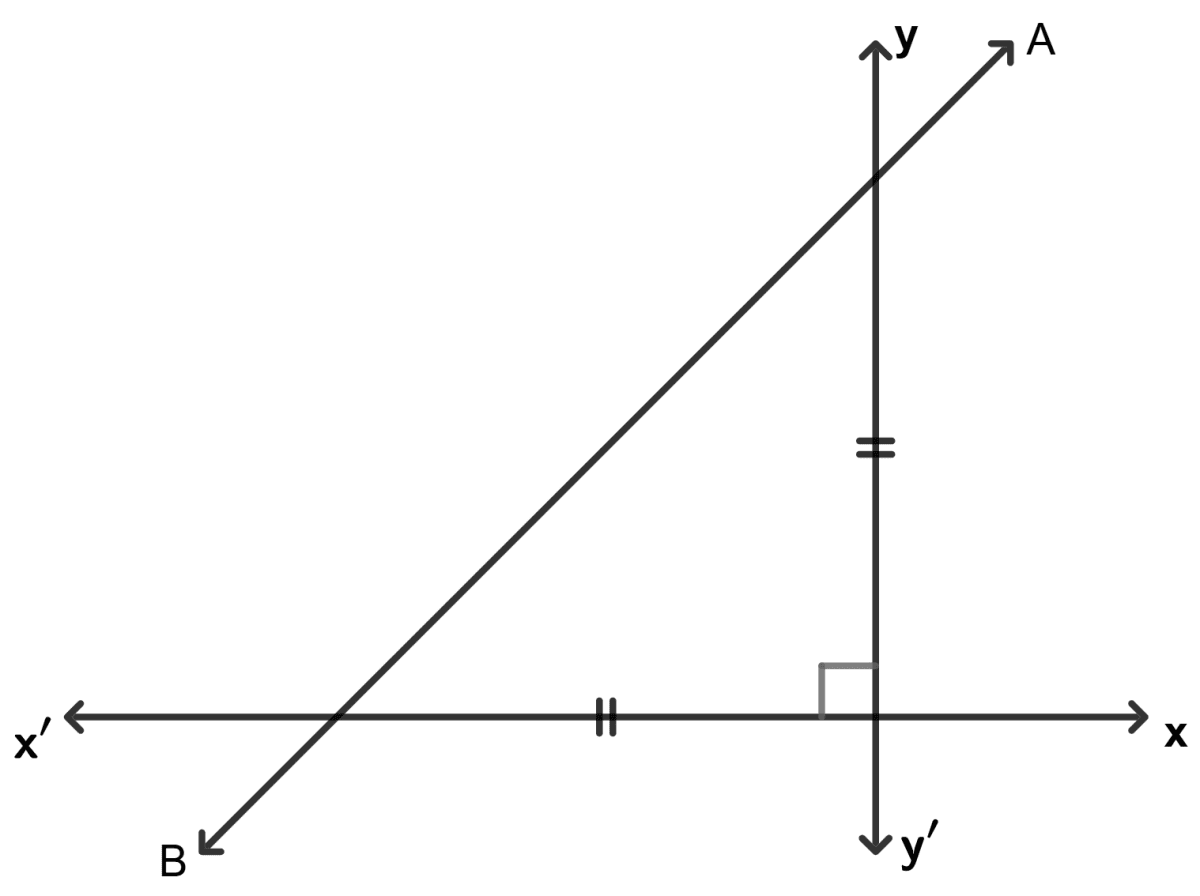
Answer
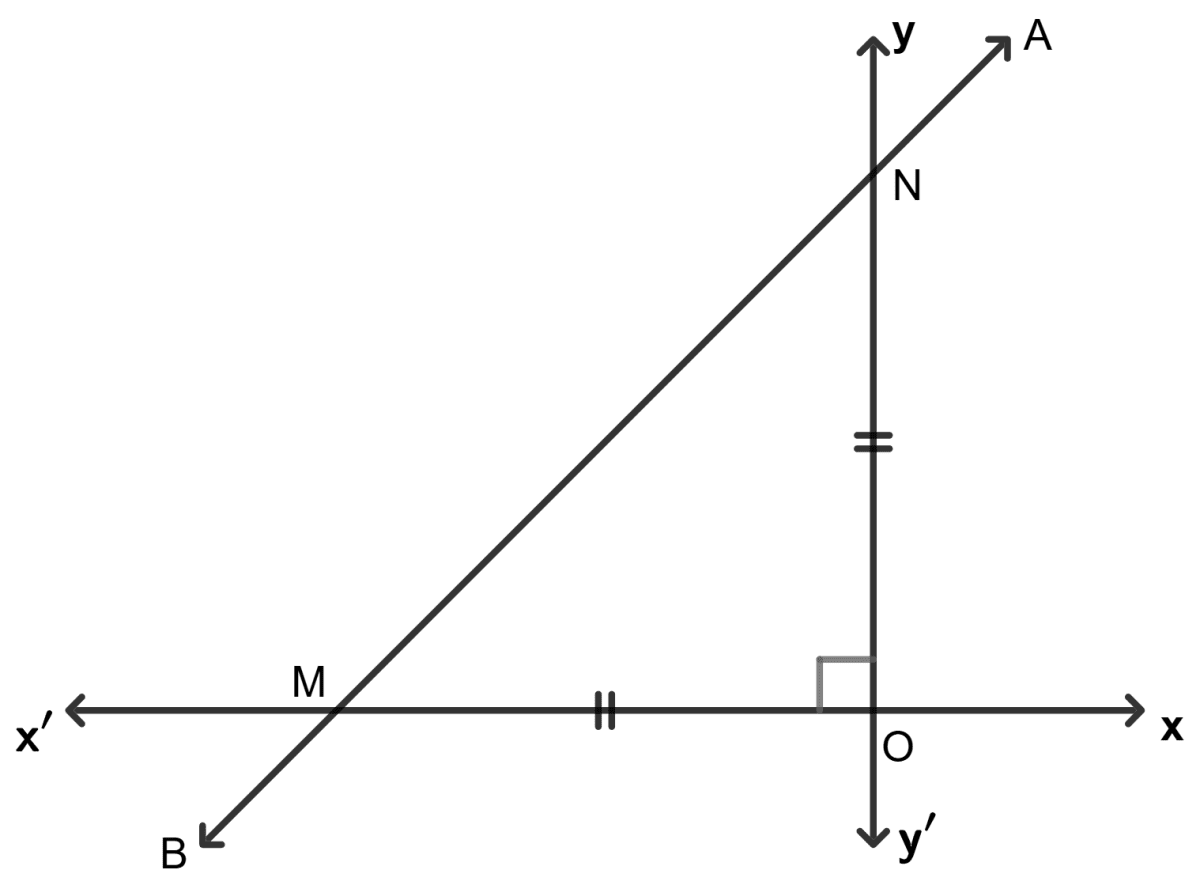
MO = NO
∠ NMO = ∠ MNO
∠ MON = 90°
Let ∠ MNO = ∠ NMO = x.
As we know that sum of all angles of triangle = 180°
⇒ ∠ NMO + ∠ MNO + ∠ MON = 180°
⇒ x + x + 90° = 180°
⇒ 2x = 180° - 90°
⇒ x =
⇒ x = 45°
Hence, the inclination = 45°.
In the following, find the inclination of line AB :
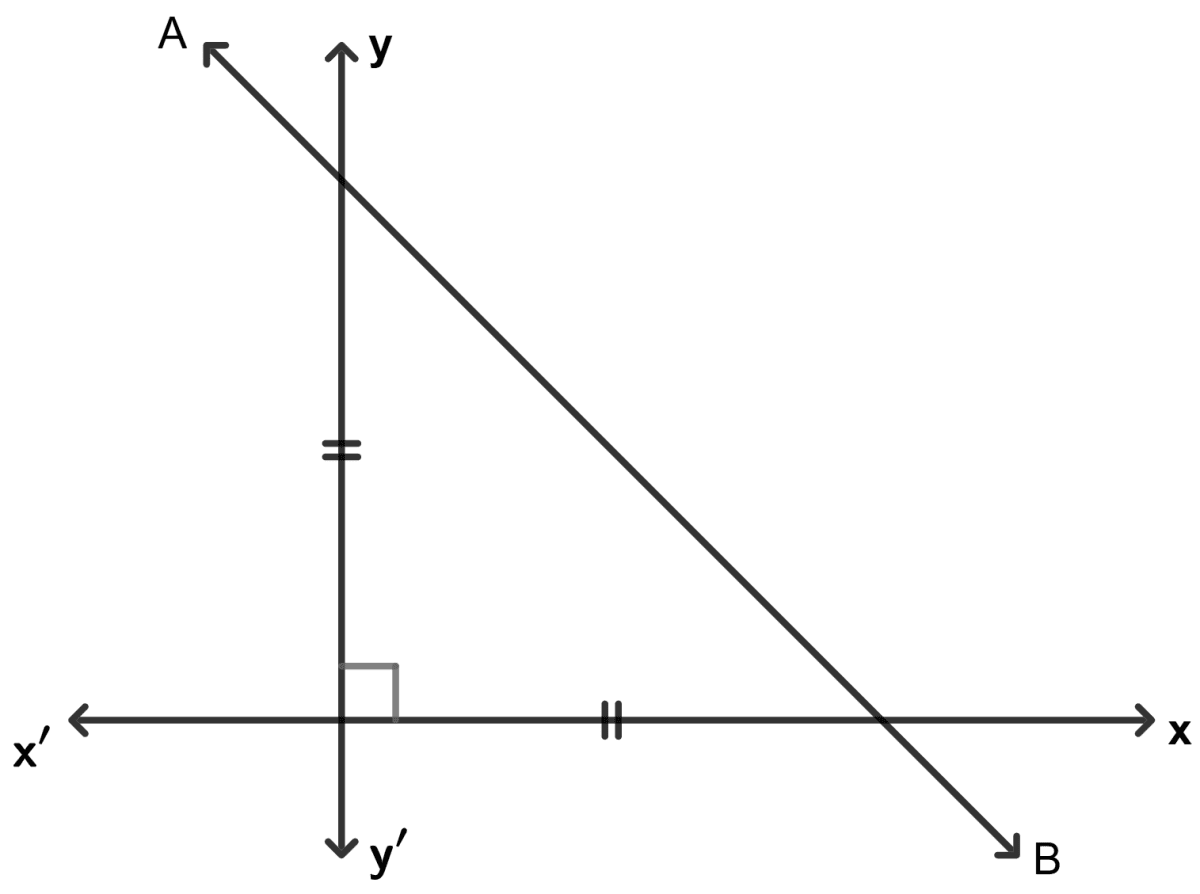
Answer
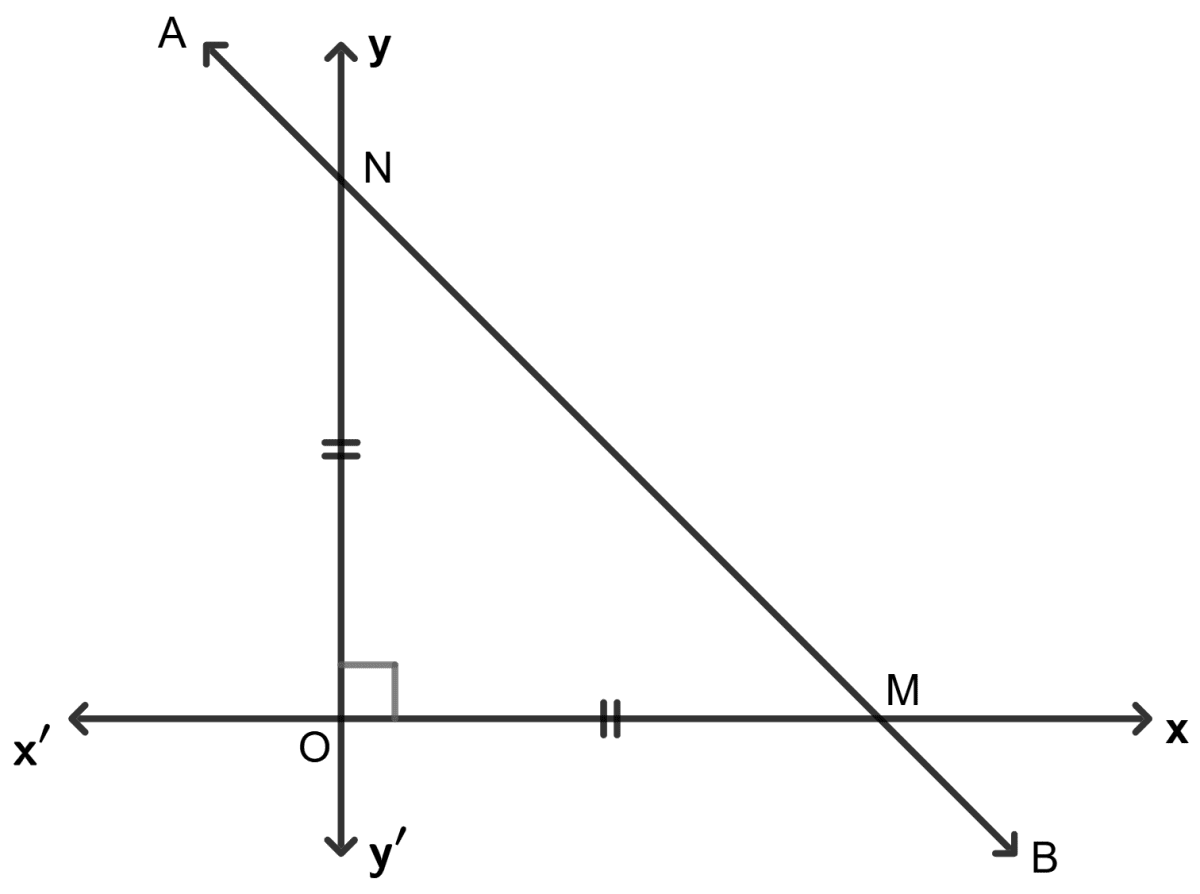
MO = NO
∠ NMO = ∠ MNO
∠ MON = 90°
Let ∠ MNO = ∠ NMO = x.
As we know that sum of all angles of triangle = 180°
⇒ ∠ NMO + ∠ MNO + ∠ MON = 180°
⇒ x + x + 90° = 180°
⇒ 2x = 180° - 90°
⇒ x =
⇒ x = 45°
Inclination = 180° - 45° = 135°
Hence, the inclination = 135°.
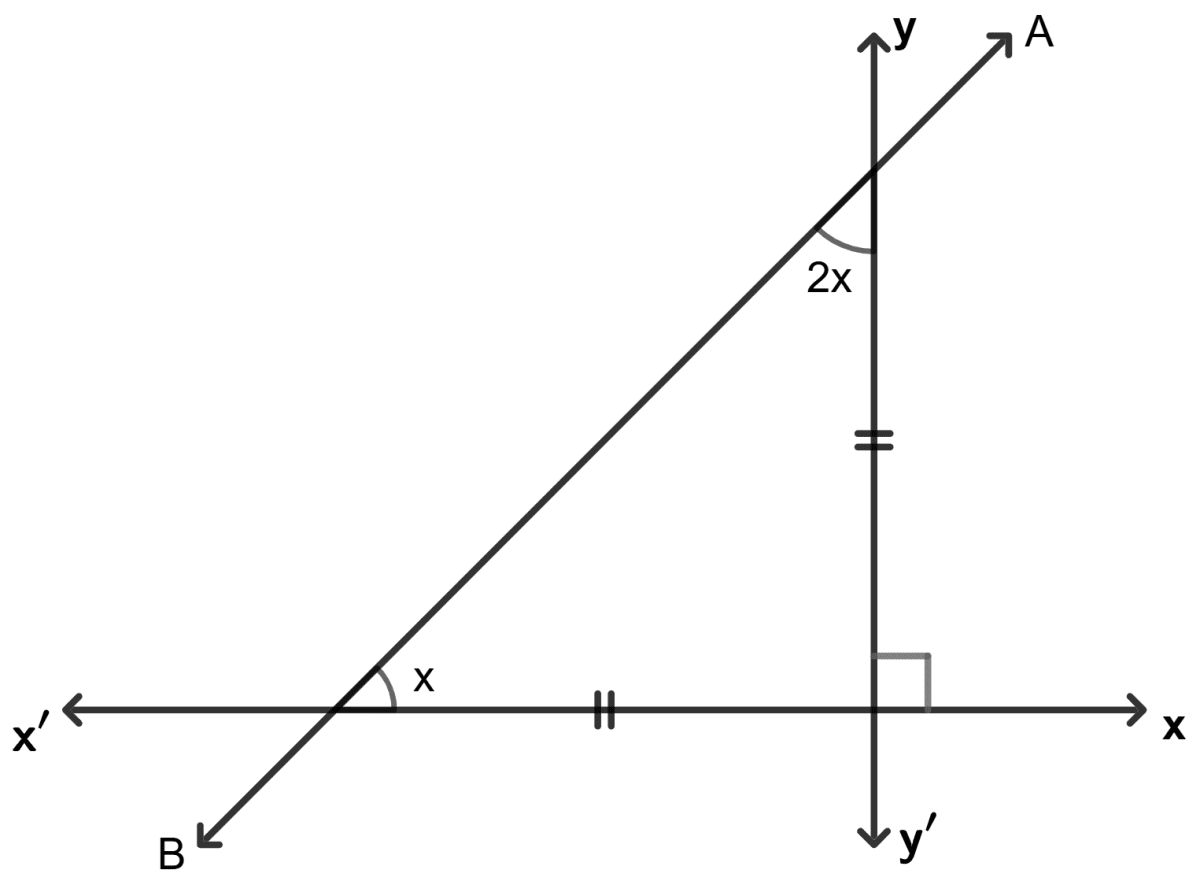
In the following, find the inclination of line AB :
Answer

∠ NMO = 2x
∠ MNO = x
∠ MON = 90°
As we know that sum of all angles of triangle = 180°
⇒ ∠ NMO + ∠ MNO + ∠ MON = 180°
⇒ 2x + x + 90° = 180°
⇒ 3x = 180° - 90°
⇒ x =
⇒ x = 30°
Hence, the inclination = 30°.
Write the inclination of a line which is :
(i) parallel to x-axis.
(ii) perpendicular to x-axis.
(iii) parallel to y-axis.
(iv) perpendicular to y-axis.
Answer
(i) A line parallel to the x-axis has an inclination of 0°, as it does not make an angle with the x-axis.
Hence, the inclination of the line = 0°.
(ii) A line perpendicular to the x-axis is parallel to the y-axis and makes a 90° angle with the x-axis.
Hence, the inclination of the line = 90°.
(iii) A line parallel to the y-axis is perpendicular to the x-axis, so its inclination is 90°.
Hence, the inclination of the line = 90°.
(iv) A line perpendicular to the y-axis is parallel to the x-axis, so its inclination is 0°.
Hence, the inclination of the line = 0°.
Write the slope of the line whose inclination is:
(i) 0°
(ii) 30°
(iii) 45°
(iv) 60°
Answer
(i) 0°
The inclination of a line is 0°, then θ = 0°.
The slope of the line = m = tan 0° = 0
Hence, the slope of the line whose inclination is 0° is 0.
(ii) 30°
The inclination of a line is 30°, then θ = 30°.
The slope of the line = m = tan 30° =
Hence, the slope of the line whose inclination is 30° is .
(iii) 45°
The inclination of a line is 45°, then θ = 45°.
The slope of the line = m = tan 45° = 1
Hence, the slope of the line whose inclination is 45° is 1.
(iv) 60°
The inclination of a line is 60°, then θ = 60°.
The slope of the line = m = tan 60° =
Hence, the slope of the line whose inclination is 60° is .
Find the inclination of the line whose slope is:
(i) 0
(ii) 1
(iii)
(iv)
Answer
(i) The slope of the line = m = 0 ⇒ tan θ = 0
⇒ tan θ = tan 0°
⇒ θ = 0°
Hence, the inclination is 0°.
(ii) The slope of the line = m = 1 ⇒ tan θ = 1
⇒ tan θ = tan 45°
⇒ θ = 45°
Hence, the inclination is 45°.
(iii) The slope of the line = m = ⇒ tan θ = .
⇒ tan θ = tan 60°
⇒ θ = 60°
Hence, the inclination is 60°.
(iv) The slope of the line = m = ⇒ tan θ =
⇒ tan θ = tan 30°
⇒ θ = 30°
Hence, the inclination is 30°.
Write the slope of the line which is :
(i) parallel to x-axis.
(ii) perpendicular to x-axis.
(iii) parallel to y-axis.
(iv) perpendicular to y-axis.
Answer
(i) A line parallel to the x-axis has an inclination of 0°, as it does not make an angle with the x-axis.
Therefore, the inclination of the line is 0°.
The slope of the line = m = tan θ = tan 0° = 0
Hence, the slope of the line is 0.
(ii) A line perpendicular to the x-axis is parallel to the y-axis and makes a 90° angle with the x-axis.
Therefore, the inclination of the line is 90°.
The slope of the line = m = tan θ = tan 90° = not defined
Hence, the slope of the line is not defined.
(iii) A line parallel to the y-axis is perpendicular to the x-axis, so its inclination is 90°.
Therefore, the inclination of the line is 90°.
The slope of the line = m = tan θ = tan 90° = not defined
Hence, the slope of the line is not defined.
(iv) A line perpendicular to the y-axis is parallel to the x-axis, so its inclination is 0°.
Therefore, the inclination of the line is 0°.
The slope of the line = m = tan θ = tan 0° = 0
Hence, the slope of the line is 0.
For each of the equations given below, find the slope and the y-intercept :
(i) x + 3y + 5 = 0
(ii) 3x - y - 8 = 0
(iii) 5x = 4y + 7
(iv) x = 5y - 4
(v) y = 7x - 2
(vi) 3y = 7
(vii) 4y + 9 = 0
Answer
(i) x + 3y + 5 = 0
⇒ 3y = -x - 5
⇒ y = -
∴ Slope = coefficient of x =
And, y-intercept = constant term =
Hence, the slope = and y-intercept = .
(ii) 3x - y - 8 = 0
⇒ y = 3x - 8
∴ Slope = coefficient of x = 3
And, y-intercept = constant term = -8
Hence, the slope = 3 and y-intercept = -8.
(iii) 5x = 4y + 7
⇒ 4y = 5x - 7
⇒ y = x -
∴ Slope = coefficient of x =
And, y-intercept = constant term =
Hence, the slope = and y-intercept = .
(iv) x = 5y - 4
⇒ 5y = x + 4
⇒ y = x +
∴ Slope = coefficient of x =
And, y-intercept = constant term =
Hence, the slope = and y-intercept = .
(v) y = 7x - 2
∴ Slope = coefficient of x = 7
And, y-intercept = constant term = -2
Hence, the slope = 7 and y-intercept = -2.
(vi) 3y = 7
⇒ 3y = 0 x + 7
⇒ y = 0 x +
∴ Slope = coefficient of x = 0
And, y-intercept = constant term =
Hence, the slope = 0 and y-intercept = .
(vii) 4y + 9 = 0
⇒ 4y = 0 x - 9
⇒ y = 0 x -
∴ Slope = coefficient of x = 0
And, y-intercept = constant term =
Hence, the slope = 0 and y-intercept = .
Find the equation of the line, whose :
(i) slope = 2 and y-intercept = 3
(ii) slope = 5 and y-intercept = - 8
(iii) slope = - 4 and y-intercept = 2
(iv) slope = - 3 and y-intercept = - 1
(v) slope = 0 and y-intercept = - 5
(vi) slope = 0 and y-intercept = 0
Answer
(i) slope = 2 ⇒ m = 2
y-intercept = 3 ⇒ c = 3
∴ Equation is : y = mx + c
⇒ y = 2x + 3
Hence, the equation of the line is y = 2x + 3.
(ii) slope = 5 ⇒ m = 5
y-intercept = -8 ⇒ c = -8
∴ Equation is : y = mx + c
⇒ y = 5x - 8
Hence, the equation of the line is y = 5x - 8.
(iii) slope = -4 ⇒ m = -4
y-intercept = 2 ⇒ c = 2
∴ Equation is : y = mx + c
⇒ y = -4x + 2
⇒ 4x + y = 2
Hence, the equation of the line is 4x + y = 2.
(iv) slope = -3 ⇒ m = -3
y-intercept = -1 ⇒ c = -1
∴ Equation is : y = mx + c
⇒ y = -3x - 1
⇒ 3x + y + 1 = 0
Hence, the equation of the line is 3x + y + 1 = 0.
(v) slope = 0 ⇒ m = 0
y-intercept = - 5 ⇒ c = - 5
∴ Equation is : y = mx + c
⇒ y = 0 x - 5
⇒ y + 5 = 0
Hence, the equation of the line is y + 5 = 0.
(vi) slope = 0 ⇒ m = 0
y-intercept = 0 ⇒ c = 0
∴ Equation is : y = mx + c
⇒ y = 0 x + 0
⇒ y = 0
Hence, the equation of the line is y = 0.
Draw the line 3x + 4y = 12 on a graph paper. From the graph paper, read the y-intercept of the line.
Answer
Step 1:
Give at least three suitable values to the variable x and find the corresponding values of y.
Let x = 0, then 3 0 + 4y = 12 ⇒ y = 3
Let x = 1, then 3 1 + 4y = 12 ⇒ y = 2.2
Let x = 4, then 3 4 + 4y = 12 ⇒ y = 0
Step 2:
Make a table (as given below) for the different pairs of the values of x and y:
| x | 0 | 1 | 4 |
|---|---|---|---|
| y | 3 | 2.2 | 0 |
Step 3:
Plot the points, from the table, on a graph paper and then draw a straight line passing through the points plotted on the graph.
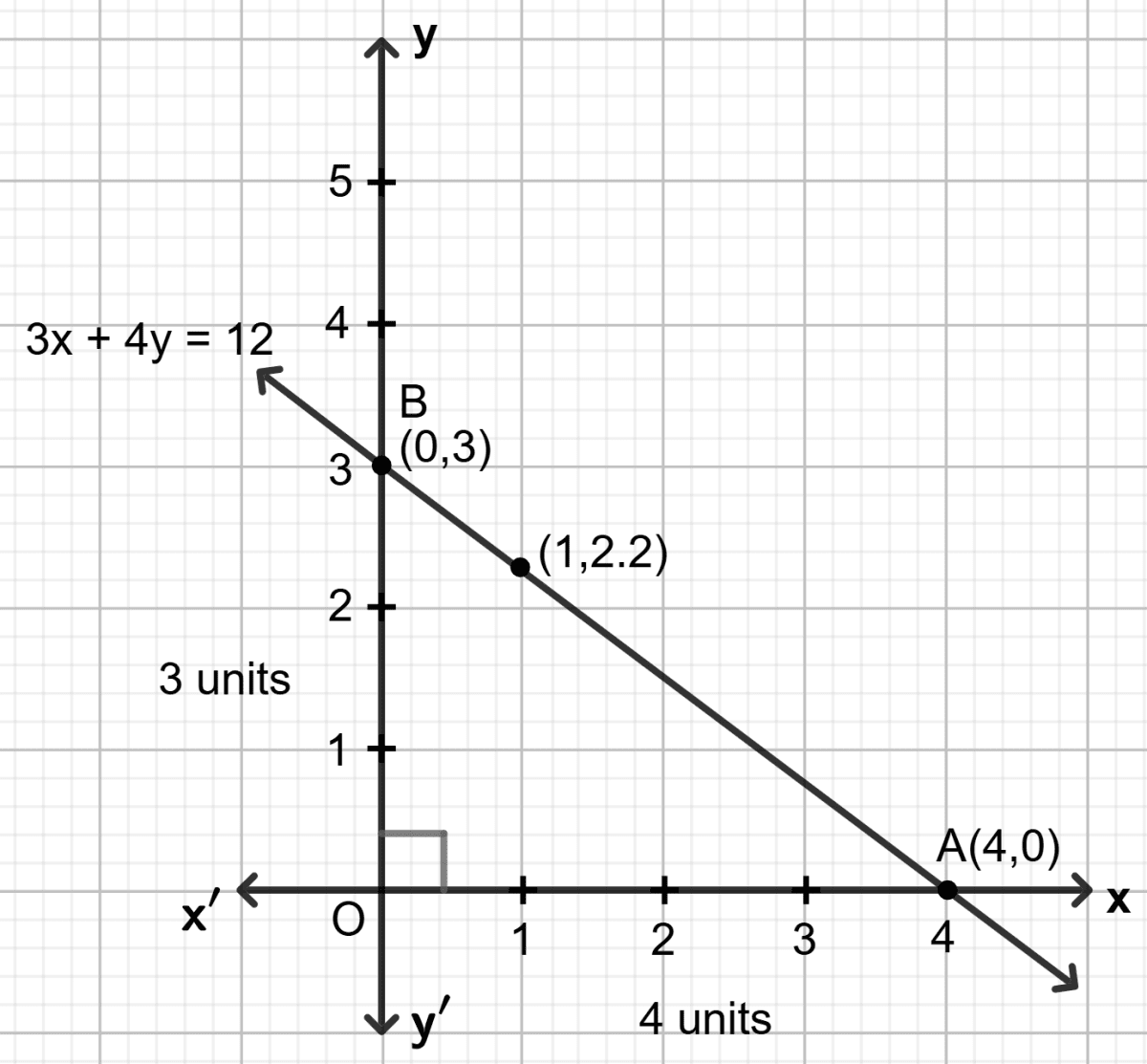
From the graph, y-intercept of the line = OB = 3.
Hence, y-intercept of the line = 3.
Draw the line 2x - 3y - 18 = 0 on a graph paper. From the graph paper, read the y-intercept of the line.
Answer
Step 1:
Give at least three suitable values to the variable x and find the corresponding values of y.
Let x = 0, then 2 0 - 3y - 18 = 0 ⇒ y = -6
Let x = 3, then 2 3 - 3y - 18 = 0 ⇒ y = -4
Let x = 6, then 2 6 - 3y - 18 = 0 ⇒ y = -2
Let x = 9, then 2 9 - 3y - 18 = 0 ⇒ y = 0
Step 2:
Make a table (as given below) for the different pairs of the values of x and y:
| x | 0 | 3 | 6 | 9 |
|---|---|---|---|---|
| y | -6 | -4 | -2 | 0 |
Step 3:
Plot the points, from the table, on a graph paper and then draw a straight line passing through the points plotted on the graph.
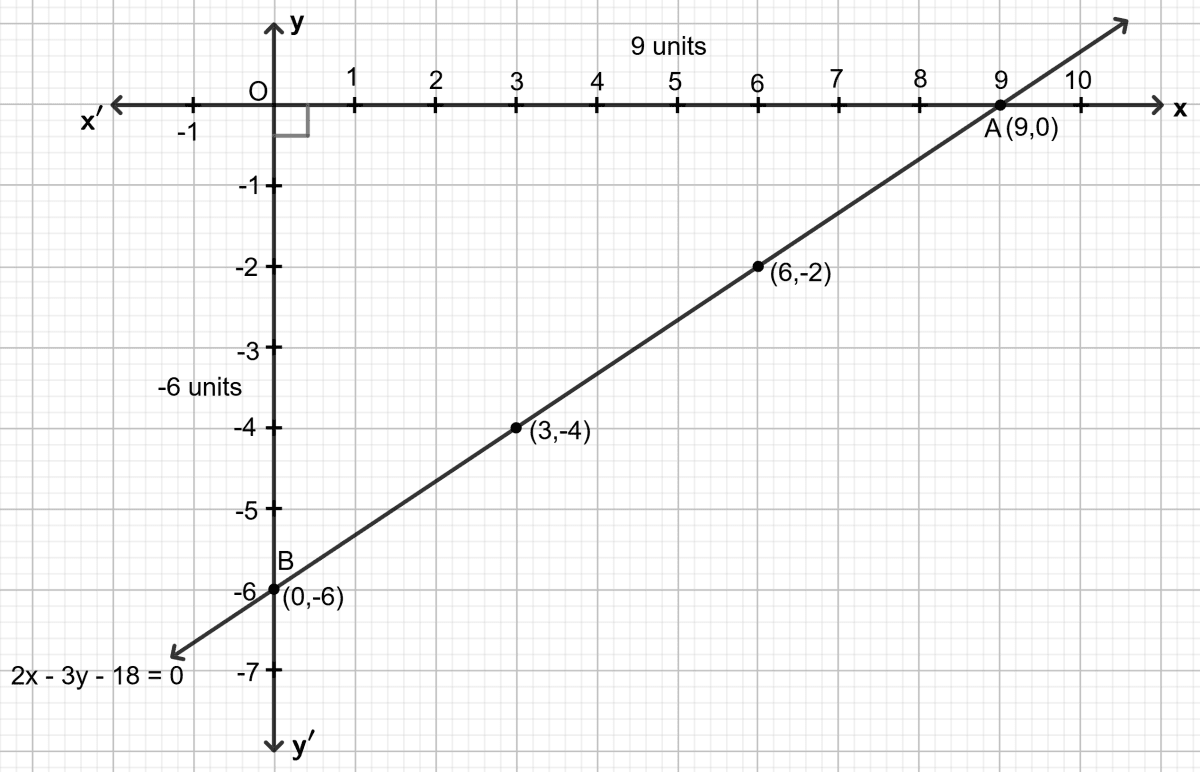
From the graph, y-intercept of the line = OB = -6.
Hence, y-intercept of the line = -6.