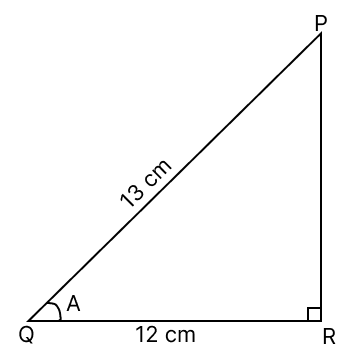
The value of tan A is :
5 12 \dfrac{5}{12} 12 5
12 13 \dfrac{12}{13} 13 12
5 13 \dfrac{5}{13} 13 5
13 12 \dfrac{13}{12} 12 13
Answer
Since ΔPQR is a right angled triangle, using pythagoras theorem,
⇒ Hypotenuse2 = Base2 + Height2
⇒ PQ2 = QR2 + PR2
⇒ 132 = PR2 + 122
⇒ 169 = PR2 + 144
⇒ PR2 = 169 - 144
⇒ PR2 = 25
⇒ PR = 25 \sqrt{25} 25
⇒ PR = 5 cm.
By formula, tan A = Height Base \dfrac{\text{Height}}{\text{Base}} Base Height
From figure,
tan A = P R R Q = 5 12 . \text{tan A} = \dfrac{PR}{RQ} \\[1em] = \dfrac{5}{12}. tan A = RQ PR = 12 5 .
Hence, option 1 is the correct option.
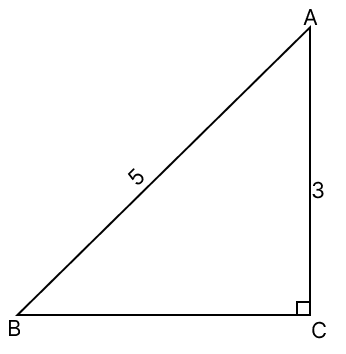
The value of sin B - cos A is;
1 2 \dfrac{1}{2} 2 1
1
0
none of these
Answer
Since ΔABC is a right angled triangle.
By formula,
sin θ = Perpendicular Hypotenuse \dfrac{\text{Perpendicular}}{\text{Hypotenuse}} Hypotenuse Perpendicular Base Hypotenuse \dfrac{\text{Base}}{\text{Hypotenuse}} Hypotenuse Base
So, sin B = AC AB = 3 5 \dfrac{\text{AC}}{\text{AB}} = \dfrac{3}{5} AB AC = 5 3
cos A = AC AB = 3 5 \dfrac{\text{AC}}{\text{AB}} = \dfrac{3}{5} AB AC = 5 3
The value of sin B - cos A = 3 5 − 3 5 \dfrac{3}{5} - \dfrac{3}{5} 5 3 − 5 3
Hence, option 3 is the correct option.
The value of cos 60° - sin 90° + 2 cos 0° is :
1 2 \dfrac{1}{2} 2 1
− 1 2 -\dfrac{1}{2} − 2 1
− 1 1 2 -1\dfrac{1}{2} − 1 2 1
1 1 2 1\dfrac{1}{2} 1 2 1
Answer
Solving,
⇒ cos 60° - sin 90° + 2 cos 0° = 1 2 − 1 + 2 × 1 = 1 2 − 1 + 2 = 1 2 + 1 = 1 + 2 2 = 3 2 = 1 1 2 . \Rightarrow \text{cos 60° - sin 90° + 2 cos 0° } = \dfrac{1}{2} - 1 + 2 \times 1\\[1em] = \dfrac{1}{2} - 1 + 2\\[1em] = \dfrac{1}{2} + 1\\[1em] = \dfrac{1 + 2}{2}\\[1em] = \dfrac{3}{2}\\[1em] = 1\dfrac{1}{2}. ⇒ cos 60° - sin 90° + 2 cos 0° = 2 1 − 1 + 2 × 1 = 2 1 − 1 + 2 = 2 1 + 1 = 2 1 + 2 = 2 3 = 1 2 1 .
Hence, option 4 is the correct option.
The value of sin 23° - cos 67° is :
1
0
cos 44°
-cos 44°
Answer
Given,
⇒ sin 23° - cos 67°
⇒ sin 23° - cos (90° - 23°)
⇒ sin 23° - sin 23°
⇒ 0.
Hence, option 2 is the correct option.
Statement 1: The angle C of a right angled triangle is 90°, then tan A = cot B.
Statement 2: Since, angle C of triangle ABC = 90°.
∴ ∠A + ∠B = 90° ⇒ ∠A = 90° - ∠B
Both the statements are true.
Both the statements are false.
Statement 1 is true, and statement 2 is false.
Statement 1 is false, and statement 2 is true.
Answer
Given, ∠C = 90°.
By angle sum property of triangle,
⇒ ∠A + ∠B + ∠C = 180°
⇒ ∠A + ∠B + 90° = 180°
⇒ ∠A + ∠B = 180° - 90°
⇒ ∠A + ∠B = 90°
⇒ ∠A = 90° - ∠B
So, statement 2 is true.
⇒ tan A = tan (90° - ∠B)
⇒ tan A = cot B
So, statement 1 is true.
∴ Both the statements are true.
Hence, option 1 is the correct option.
Statement 1: If 4 cos A = 3, sec A = 4 3 \dfrac{4}{3} 3 4
Statement 2: 4 cos A = 3 ⇒ cos A = 3 4 \dfrac{3}{4} 4 3 1 cos A = 4 3 \dfrac{1}{\text{cos A}} = \dfrac{4}{3} cos A 1 = 3 4
Both the statements are true.
Both the statements are false.
Statement 1 is true, and statement 2 is false.
Statement 1 is false, and statement 2 is true.
Answer
Given,
⇒ 4 cos A = 3
⇒ cos A = 3 4 \dfrac{3}{4} 4 3
⇒ 1 cos A = 1 3 4 \dfrac{1}{\text{cos A}} = \dfrac{1}{\dfrac{3}{4}} cos A 1 = 4 3 1
⇒ sec A = 4 3 \dfrac{4}{3} 3 4
∴ Both the statements are true.
Hence, option 1 is the correct option.
Assertion (A): The value of sin2 30° - 2 cos3 60° + 2 tan4 45° is 2.
Reason (R): sin 30° = 1 2 \dfrac{1}{2} 2 1 1 2 \dfrac{1}{2} 2 1
A is true, but R is false.
A is false, but R is true.
Both A and R are true, and R is the correct reason for A.
Both A and R are true, and R is the incorrect reason for A.
Answer
We know that,
sin 30° = 1 2 \dfrac{1}{2} 2 1 1 2 \dfrac{1}{2} 2 1
So, reason (R) is true.
sin 2 30 ° − 2 cos 3 60 ° + 2 tan 4 45 ° = ( 1 2 ) 2 − 2 × ( 1 2 ) 3 + 2 × 1 4 = 1 4 − 2 × 1 8 + 2 = 1 4 − 1 4 + 2 = 2. \text{sin}^2 30° - \text{2 cos}^3 60° + \text{2 tan}^4 45° = \Big(\dfrac{1}{2}\Big)^2 - 2 \times \Big(\dfrac{1}{2}\Big)^3 + 2 \times 1^4\\[1em] = \dfrac{1}{4} - 2 \times \dfrac{1}{8} + 2\\[1em] = \dfrac{1}{4} - \dfrac{1}{4} + 2\\[1em] = 2. sin 2 30° − 2 cos 3 60° + 2 tan 4 45° = ( 2 1 ) 2 − 2 × ( 2 1 ) 3 + 2 × 1 4 = 4 1 − 2 × 8 1 + 2 = 4 1 − 4 1 + 2 = 2.
So, assertion (A) is true.
∴ Both A and R are true, and R is the correct reason for A.
Hence, option 3 is the correct option.
Assertion (A): If A = 30°, the value of 4 sin A sin (60° - A) sin (60° + A) = 1.
Reason (R): 60° - A = 30° and 60° + A = 90°.
A is true, but R is false.
A is false, but R is true.
Both A and R are true, and R is the correct reason for A.
Both A and R are true, and R is the incorrect reason for A.
Answer
If A = 30°,
60° - A = 60° - 30° = 30° and 60° + A = 60° + 30° = 90°.
So, reason (R) is true.
sin A = sin 30° = 1 2 \dfrac{1}{2} 2 1
sin (60° - A) = sin 30° = 1 2 \dfrac{1}{2} 2 1
sin (60° + A) = sin 90° = 1
Substituting values in 4 sin A sin (60° - A) sin (60° + A), we get :
⇒ 4 × 1 2 × 1 2 × 1 ⇒ 4 × 1 4 ⇒ 1. \Rightarrow 4 \times \dfrac{1}{2} \times \dfrac{1}{2} \times 1\\[1em] \Rightarrow 4 \times \dfrac{1}{4}\\[1em] \Rightarrow 1. ⇒ 4 × 2 1 × 2 1 × 1 ⇒ 4 × 4 1 ⇒ 1.
∴ Both A and R are true, and R is the correct reason for A.
Hence, option 3 is the correct option.
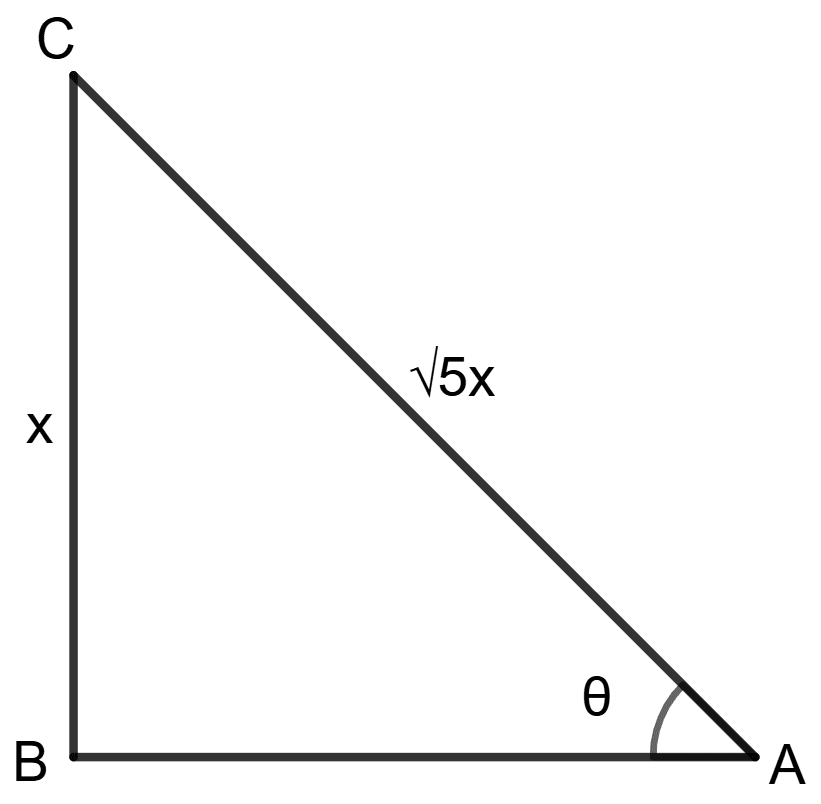
If cosec θ = 5 \text{cosec θ} = {\sqrt5} cosec θ = 5
(i) 2 - sin2 θ - cos2 θ
(ii) 2 + 1 sin 2 θ − cos 2 θ sin 2 θ 2 + \dfrac{1}{\text{sin}^2 \text{ θ}} - \dfrac{\text{cos}^2 \text{ θ}}{\text{sin}^2 \text{ θ}} 2 + sin 2 θ 1 − sin 2 θ cos 2 θ
Answer
Given:
cosec θ = 5 \text{cosec θ} = {\sqrt5} cosec θ = 5
⇒ cosec θ = H y p o t e n u s e P e r p e n d i c u l a r = 5 ⇒ \text{cosec θ} = \dfrac{Hypotenuse}{Perpendicular} = {\sqrt5}\\[1em] ⇒ cosec θ = P er p e n d i c u l a r Hy p o t e n u se = 5
∴ If length of AC = 5 \sqrt{5} 5
In Δ ABC,
⇒ AC2 = BC2 + AB2 (∵ AC is hypotenuse)
⇒ (5 \sqrt{5} 5 2 = (x)2 + AB2
⇒ 5x2 = x2 + AB2
⇒ AB2 = 5x2 - x2
⇒ AB2 = 4x2
⇒ AB = 4 x 2 \sqrt{4 \text{x}^2} 4 x 2
⇒ AB = 2x
(i) sin θ = P e r p e n d i c u l a r H y p o t e n u s e \dfrac{Perpendicular}{Hypotenuse} Hy p o t e n u se P er p e n d i c u l a r
= B C C A = x 5 x = 1 5 = \dfrac{BC}{CA} = \dfrac{x}{\sqrt{5}x} = \dfrac{1}{\sqrt{5}} = C A BC = 5 x x = 5 1
cos θ = B a s e H y p o t e n u s e \dfrac{Base}{Hypotenuse} Hy p o t e n u se B a se
= A B A C = 2 x 5 x = 2 5 = \dfrac{AB}{AC} = \dfrac{2x}{\sqrt{5}x} = \dfrac{2}{\sqrt{5}} = A C A B = 5 x 2 x = 5 2
Now,
2 - sin2 θ - cos2 θ
= 2 − ( 1 5 ) 2 − ( 2 5 ) 2 = 2 − 1 5 − 4 5 = 2 + − 1 − 4 5 = 2 + − 5 5 = 2 − 1 = 1 = 2 - \Big(\dfrac{1}{\sqrt{5}}\Big)^2 - \Big(\dfrac{2}{\sqrt{5}}\Big)^2\\[1em] = 2 - \dfrac{1}{5} - \dfrac{4}{5}\\[1em] = 2 + \dfrac{-1 - 4}{5}\\[1em] = 2 + \dfrac{-5}{5}\\[1em] = 2 - 1\\[1em] = 1 = 2 − ( 5 1 ) 2 − ( 5 2 ) 2 = 2 − 5 1 − 5 4 = 2 + 5 − 1 − 4 = 2 + 5 − 5 = 2 − 1 = 1
Hence, 2 - sin2 θ - cos2 θ = 1.
(ii) 2 + 1 sin 2 θ − cos 2 θ sin 2 θ 2 + \dfrac{1}{\text{sin}^2 \text{ θ}} - \dfrac{\text{cos}^2 \text{ θ}}{\text{sin}^2 \text{ θ}} 2 + sin 2 θ 1 − sin 2 θ cos 2 θ
= 2 + 1 ( 1 5 ) 2 − ( 2 5 ) 2 ( 1 5 ) 2 = 2 + 1 1 5 − 4 5 1 5 = 2 + 5 1 − 4 5 1 5 = 2 + 5 − 4 1 = 7 − 4 = 3 = 2 + \dfrac{1}{\Big(\dfrac{1}{\sqrt{5}}\Big)^2} - \dfrac{\Big(\dfrac{2}{\sqrt{5}}\Big)^2}{\Big(\dfrac{1}{\sqrt{5}}\Big)^2}\\[1em] = 2 + \dfrac{1}{\dfrac{1}{5}} - \dfrac{\dfrac{4}{5}}{\dfrac{1}{5}}\\[1em] = 2 + \dfrac{5}{1} - \dfrac{\dfrac{4}{\cancel{5}}}{\dfrac{1}{\cancel{5}}}\\[1em] = 2 + 5 - \dfrac{4}{1}\\[1em] = 7 - 4\\[1em] = 3 = 2 + ( 5 1 ) 2 1 − ( 5 1 ) 2 ( 5 2 ) 2 = 2 + 5 1 1 − 5 1 5 4 = 2 + 1 5 − 5 1 5 4 = 2 + 5 − 1 4 = 7 − 4 = 3
Hence, 2 + 1 sin 2 θ − cos 2 θ sin 2 θ 2 + \dfrac{1}{\text{sin}^2 \text{ θ}} - \dfrac{\text{cos}^2 \text{ θ}}{\text{sin}^2 \text{ θ}} 2 + sin 2 θ 1 − sin 2 θ cos 2 θ
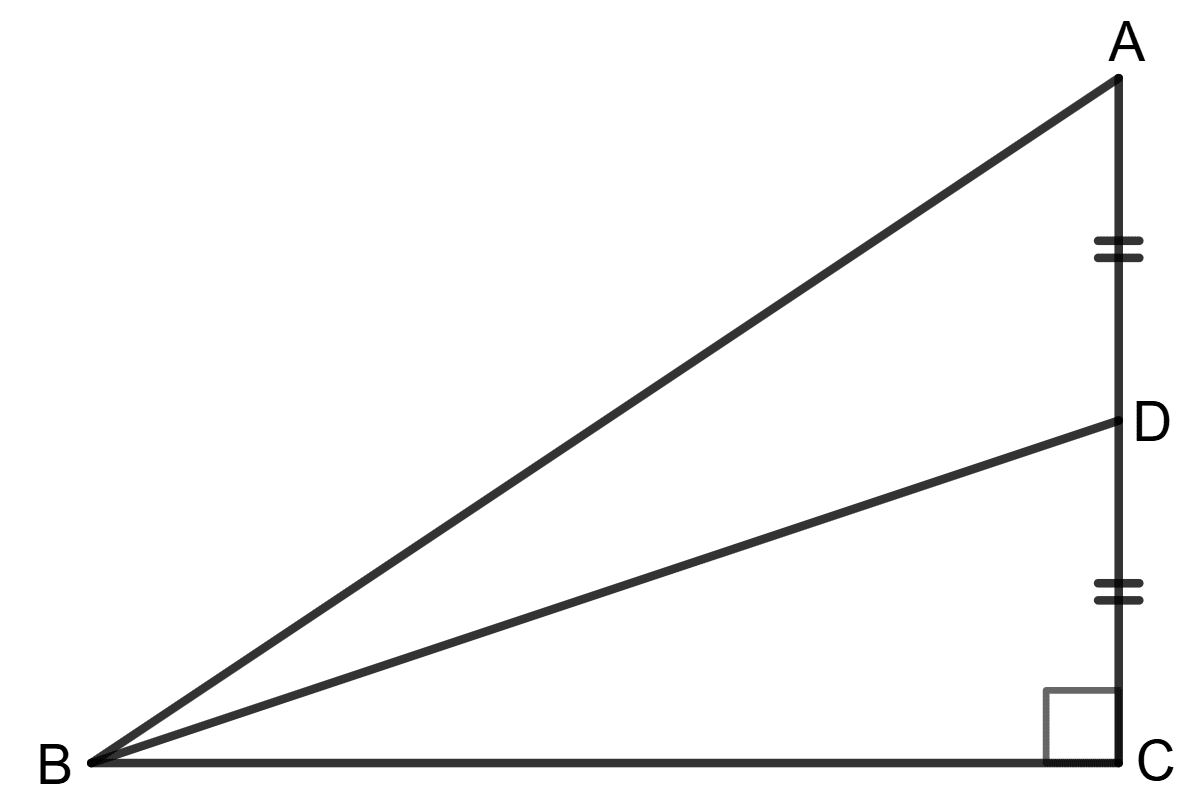
In the given figure; ∠C = 90° and D is mid-point of AC. Find :
(i) tan ∠CAB tan ∠CDB \dfrac{\text{tan ∠CAB}}{\text{tan ∠CDB}} tan ∠CDB tan ∠CAB
(ii) tan ∠ABC tan ∠DBC \dfrac{\text {tan ∠ABC}}{\text {tan ∠DBC}} tan ∠DBC tan ∠ABC
Answer
Since D is the mid-point of A. So, AC = 2DC
(i) tan ∠CAB = P e r p e n d i c u l a r B a s e = B C A C \text{tan ∠CAB} = \dfrac{Perpendicular}{Base} = \dfrac{BC}{AC} tan ∠CAB = B a se P er p e n d i c u l a r = A C BC
tan ∠CDB = P e r p e n d i c u l a r B a s e = B C D C \text{tan ∠CDB} = \dfrac{Perpendicular}{Base} = \dfrac{BC}{DC} tan ∠CDB = B a se P er p e n d i c u l a r = D C BC
Now,
tan ∠CAB tan ∠CDB = B C A C B C D C = B C × D C A C × B C = B C × D C A C × B C = D C A C = D C 2 × D C = D C 2 × D C = 1 2 \dfrac{\text{tan ∠CAB}}{\text{tan ∠CDB}}\\[1em] = \dfrac{\dfrac{BC}{AC}}{\dfrac{BC}{DC}}\\[1em] = \dfrac{BC \times DC}{AC \times BC}\\[1em] = \dfrac{\cancel{BC} \times DC}{AC \times \cancel{BC}}\\[1em] = \dfrac{DC}{AC}\\[1em] = \dfrac{DC}{2 \times DC}\\[1em] = \dfrac{\cancel{DC}}{2 \times \cancel{DC}}\\[1em] = \dfrac{1}{2} tan ∠CDB tan ∠CAB = D C BC A C BC = A C × BC BC × D C = A C × BC BC × D C = A C D C = 2 × D C D C = 2 × D C D C = 2 1
Hence, tan ∠CAB tan ∠CDB = 1 2 \dfrac{\text{tan ∠CAB}}{\text{tan ∠CDB}} = \dfrac{1}{2} tan ∠CDB tan ∠CAB = 2 1
(ii) tan ∠ABC = P e r p e n d i c u l a r B a s e = A C B C \text{tan ∠ABC} = \dfrac{Perpendicular}{Base} = \dfrac{AC}{BC} tan ∠ABC = B a se P er p e n d i c u l a r = BC A C
tan ∠DBC = P e r p e n d i c u l a r B a s e = D C B C \text{tan ∠DBC} = \dfrac{Perpendicular}{Base} = \dfrac{DC}{BC} tan ∠DBC = B a se P er p e n d i c u l a r = BC D C
Now,
tan ∠ABC tan ∠DBC = A C B C D C B C = A C × B C B C × D C = A C × B C B C × D C = A C D C = 2 × D C D C = 2 × D C D C = 2 \dfrac{\text {tan ∠ABC}}{\text {tan ∠DBC}}\\[1em] = \dfrac{\dfrac{AC}{BC}}{\dfrac{DC}{BC}}\\[1em] = \dfrac{AC \times BC}{BC \times DC}\\[1em] = \dfrac{AC \times \cancel{BC}}{\cancel{BC} \times DC}\\[1em] = \dfrac{AC}{DC}\\[1em] = \dfrac{2 \times DC}{DC}\\[1em] = \dfrac{2 \times \cancel{DC}}{\cancel{DC}}\\[1em] = 2 tan ∠DBC tan ∠ABC = BC D C BC A C = BC × D C A C × BC = BC × D C A C × BC = D C A C = D C 2 × D C = D C 2 × D C = 2
Hence, tan ∠ABC tan ∠DBC = 2 \dfrac{\text {tan ∠ABC}}{\text {tan ∠DBC}} = 2 tan ∠DBC tan ∠ABC = 2
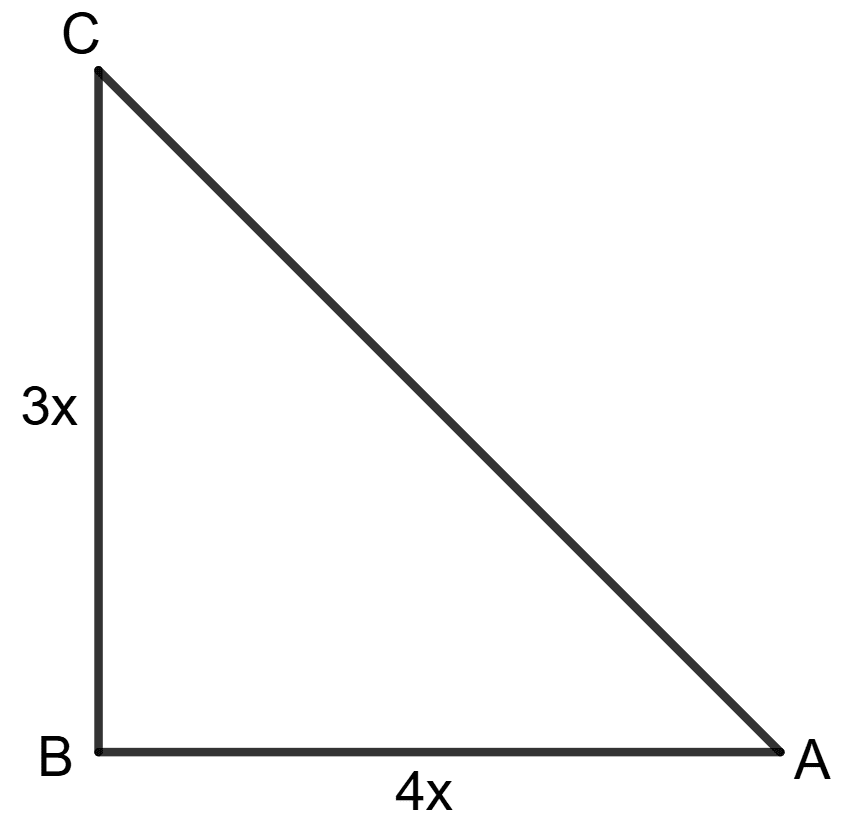
If 3 cos A = 4 sin A, find the value of :
(i) cos A
(ii) 3 - cot2 A + cosec2 A
Answer
Given:
3 cos A = 4 sin A
cos A sin A = 4 3 \dfrac{\text{cos A}}{\text{sin A}} = \dfrac{4}{3} sin A cos A = 3 4
cot A = 4 3 \text{cot A} = \dfrac{4}{3} cot A = 3 4
cot A = B a s e P e r p e n d i c u l a r = 4 3 \text{cot A} = \dfrac{Base}{Perpendicular} = \dfrac{4}{3} cot A = P er p e n d i c u l a r B a se = 3 4
∴ If length of AB = 4x unit, length of BC = 3x unit.
In Δ ABC,
⇒ AC2 = AB2 + BC2 (∵ AC is hypotenuse)
⇒ AC2 = (4x)2 + (3x)2
⇒ AC2 = 16x2 + 9x2
⇒ AC2 = 25x2
⇒ AC = 25 x 2 \sqrt{25\text{x}^2} 25 x 2
⇒ AC = 5x
(i) cos A = B a s e H y p o t e n u s e A = \dfrac{Base}{Hypotenuse} A = Hy p o t e n u se B a se
= A B A C = 4 x 5 x = 4 5 = \dfrac{AB}{AC} = \dfrac{4x}{5x} = \dfrac{4}{5} = A C A B = 5 x 4 x = 5 4
Hence, cos A = 4 5 A = \dfrac{4}{5} A = 5 4
(ii) 3 - cot2 A + cosec2 A
cot A = B a s e P e r p e n d i c u l a r A = \dfrac{Base}{Perpendicular} A = P er p e n d i c u l a r B a se
= A B B C = 4 x 3 x = 4 3 = \dfrac{AB}{BC} = \dfrac{4x}{3x} = \dfrac{4}{3} = BC A B = 3 x 4 x = 3 4
cosec A = H y p o t e n u s e P e r p e n d i c u l a r A = \dfrac{Hypotenuse}{Perpendicular} A = P er p e n d i c u l a r Hy p o t e n u se
= A C B C = 5 x 3 x = 5 3 = \dfrac{AC}{BC} = \dfrac{5x}{3x} = \dfrac{5}{3} = BC A C = 3 x 5 x = 3 5
Now,
3 - cot2 A + cosec2 A
= 3 − ( 4 3 ) 2 + ( 5 3 ) 2 = 3 − 16 9 + 25 9 = 3 + − 16 + 25 9 = 3 + 9 9 = 3 + 1 = 4 = 3 - \Big(\dfrac{4}{3}\Big)^2 + \Big(\dfrac{5}{3}\Big)^2\\[1em] = 3 - \dfrac{16}{9} + \dfrac{25}{9}\\[1em] = 3 + \dfrac{-16 + 25}{9}\\[1em] = 3 + \dfrac{9}{9}\\[1em] = 3 + 1\\[1em] = 4 = 3 − ( 3 4 ) 2 + ( 3 5 ) 2 = 3 − 9 16 + 9 25 = 3 + 9 − 16 + 25 = 3 + 9 9 = 3 + 1 = 4
Hence, 3 - cot2 A + cosec2 A = 4.
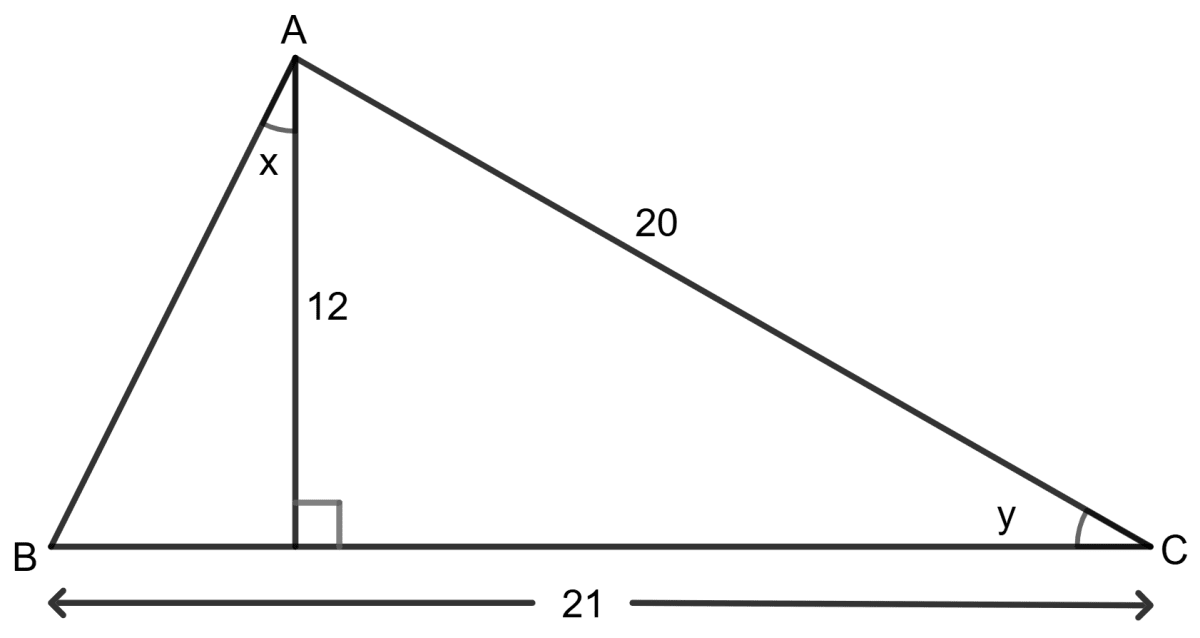
Use the information given in the following figure to evaluate :
10 sin x + 6 sin y − 6 cot y \dfrac{10}{\text{sin x}} + \dfrac{6}{\text{sin y}} - \text{6 cot y} sin x 10 + sin y 6 − 6 cot y
Answer
From the figure, in Δ ADC,
⇒ AC2 = DC2 + AD2 (∵ AC is hypotenuse)
⇒ 202 = DC2 + 122
⇒ 400 = DC2 + 144
⇒ DC2 = 400 - 144
⇒ DC2 = 256
⇒ DC = 256 \sqrt{256} 256
⇒ DC = 16
BD = BC - DC
= 21 - 16 = 5
In Δ ABD,
⇒ AB2 = AD2 + BD2 (∵ AB is hypotenuse)
⇒ AB2 = 122 + 52
⇒ AB2 = 144 + 25
⇒ AB2 = 169
⇒ AB = 169 \sqrt{169} 169
⇒ AB = 13
sin x = P e r p e n d i c u l a r H y p o t e n u s e \dfrac{Perpendicular}{Hypotenuse} Hy p o t e n u se P er p e n d i c u l a r
= B D A B = 5 13 = \dfrac{BD}{AB} = \dfrac{5}{13} = A B B D = 13 5
sin y = P e r p e n d i c u l a r H y p o t e n u s e \dfrac{Perpendicular}{Hypotenuse} Hy p o t e n u se P er p e n d i c u l a r
= A D A C = 12 20 = 3 5 = \dfrac{AD}{AC} = \dfrac{12}{20} = \dfrac{3}{5} = A C A D = 20 12 = 5 3
cot y = B a s e P e r p e n d i c u l a r \dfrac{Base}{Perpendicular} P er p e n d i c u l a r B a se
= D C A D = 16 12 = 4 3 = \dfrac{DC}{AD} = \dfrac{16}{12} = \dfrac{4}{3} = A D D C = 12 16 = 3 4
Now,
10 sin x + 6 sin y − 6 cot y = 10 5 13 + 6 3 5 − 6 × 4 3 = 10 × 13 5 + 6 × 5 3 − 24 3 = 130 5 + 30 3 − 24 3 = 26 + 10 − 8 = 28 \dfrac{10}{\text{sin x}} + \dfrac{6}{\text{sin y}} - \text{6 cot y}\\[1em] = \dfrac{10}{\dfrac{5}{13}} + \dfrac{6}{\dfrac{3}{5}} - 6 \times \dfrac{4}{3}\\[1em] = \dfrac{10 \times 13}{5} + \dfrac{6 \times 5}{3} - \dfrac{24}{3}\\[1em] = \dfrac{130}{5} + \dfrac{30}{3} - \dfrac{24}{3}\\[1em] = 26 + 10 - 8\\[1em] = 28 sin x 10 + sin y 6 − 6 cot y = 13 5 10 + 5 3 6 − 6 × 3 4 = 5 10 × 13 + 3 6 × 5 − 3 24 = 5 130 + 3 30 − 3 24 = 26 + 10 − 8 = 28
Hence, 10 sin x + 6 sin y − 6 cot y = 28. \dfrac{10}{\text{sin x}} + \dfrac{6}{\text{sin y}} - \text{6 cot y} = 28. sin x 10 + sin y 6 − 6 cot y = 28.
Evaluate :
cos 3 A - 2 cos 4 A sin 3 A + 2 sin 4 A \dfrac{\text{cos 3 A - 2 cos 4 A}}{\text{sin 3 A + 2 sin 4 A}} sin 3 A + 2 sin 4 A cos 3 A - 2 cos 4 A
Answer
cos 3 A - 2 cos 4 A sin 3 A + 2 sin 4 A = cos (3 x 15°) - 2 cos (4 x 15°) sin (3 x 15°) + 2 sin (4 x 15°) = cos 45° - 2 cos 60° sin 45° + 2 sin 60° = ( 1 2 ) − 2 × ( 1 2 ) ( 1 2 ) + 2 × ( 3 2 ) = 1 2 − 1 1 2 + 3 = 1 2 − 1 × 2 2 1 2 + 3 × 2 2 = 1 2 − 2 2 1 2 + 6 2 = 1 − 2 2 1 + 6 2 = 1 − 2 2 1 + 6 2 = 1 − 2 1 + 6 = ( 1 − 2 ) × ( 1 − 6 ) ( 1 + 6 ) × ( 1 − 6 ) = 1 − 2 − 6 + 12 1 − 6 = 1 − 2 − 6 + 2 3 − 5 = 1 5 ( − 1 + 2 + 6 − 2 3 ) \dfrac{\text{cos 3 A - 2 cos 4 A}}{\text{sin 3 A + 2 sin 4 A}}\\[1em] = \dfrac{\text{cos (3 x 15°) - 2 cos (4 x 15°)}}{\text{sin (3 x 15°) + 2 sin (4 x 15°)}}\\[1em] = \dfrac{\text{cos 45° - 2 cos 60°}}{\text{sin 45° + 2 sin 60°}}\\[1em] = \dfrac{\Big(\dfrac{1}{\sqrt2}\Big) - 2 \times \Big(\dfrac{1}{2}\Big)}{\Big(\dfrac{1}{\sqrt2}\Big) + 2 \times \Big(\dfrac{\sqrt3}{2}\Big)}\\[1em] = \dfrac{\dfrac{1}{\sqrt2} - 1}{\dfrac{1}{\sqrt2} + \sqrt3}\\[1em] = \dfrac{\dfrac{1}{\sqrt2} - \dfrac{1 \times \sqrt2}{\sqrt2}}{\dfrac{1}{\sqrt2} + \dfrac{\sqrt3 \times \sqrt2}{\sqrt2}}\\[1em] = \dfrac{\dfrac{1}{\sqrt2} - \dfrac{\sqrt2}{\sqrt2}}{\dfrac{1}{\sqrt2} + \dfrac{\sqrt6}{\sqrt2}}\\[1em] = \dfrac{\dfrac{1 - \sqrt2}{\sqrt2}}{\dfrac{1 + \sqrt6}{\sqrt2}}\\[1em] = \dfrac{\dfrac{1 - \sqrt2}{\cancel{\sqrt2}}}{\dfrac{1 + \sqrt6}{\cancel{\sqrt2}}}\\[1em] = \dfrac{1 - \sqrt2}{1 + \sqrt6}\\[1em] = \dfrac{(1 - \sqrt2) \times (1 - \sqrt6)}{(1 + \sqrt6) \times (1 - \sqrt6)}\\[1em] = \dfrac{1 - \sqrt2 - \sqrt6 + \sqrt{12}}{1 - 6}\\[1em] = \dfrac{1 - \sqrt2 - \sqrt6 + 2\sqrt3}{-5}\\[1em] = \dfrac{1}{5}(- 1 + \sqrt2 + \sqrt6 - 2\sqrt3) sin 3 A + 2 sin 4 A cos 3 A - 2 cos 4 A = sin (3 x 15°) + 2 sin (4 x 15°) cos (3 x 15°) - 2 cos (4 x 15°) = sin 45° + 2 sin 60° cos 45° - 2 cos 60° = ( 2 1 ) + 2 × ( 2 3 ) ( 2 1 ) − 2 × ( 2 1 ) = 2 1 + 3 2 1 − 1 = 2 1 + 2 3 × 2 2 1 − 2 1 × 2 = 2 1 + 2 6 2 1 − 2 2 = 2 1 + 6 2 1 − 2 = 2 1 + 6 2 1 − 2 = 1 + 6 1 − 2 = ( 1 + 6 ) × ( 1 − 6 ) ( 1 − 2 ) × ( 1 − 6 ) = 1 − 6 1 − 2 − 6 + 12 = − 5 1 − 2 − 6 + 2 3 = 5 1 ( − 1 + 2 + 6 − 2 3 )
Hence, cos 3 A - 2 cos 4 A sin 3 A + 2 sin 4 A = 1 5 ( − 1 + 2 + 6 − 2 3 ) \dfrac{\text{cos 3 A - 2 cos 4 A}}{\text{sin 3 A + 2 sin 4 A}} = \dfrac{1}{5}(- 1 + \sqrt2 + \sqrt6 - 2\sqrt3) sin 3 A + 2 sin 4 A cos 3 A - 2 cos 4 A = 5 1 ( − 1 + 2 + 6 − 2 3 )
Evaluate :
3 sin 3 B + 2 cos(2 B + 5°) 2 cos 3 B - sin(2 B - 10°) \dfrac{\text{3 sin 3 B + 2 cos(2 B + 5°)}}{\text{2 cos 3 B - sin(2 B - 10°)}} 2 cos 3 B - sin(2 B - 10°) 3 sin 3 B + 2 cos(2 B + 5°)
Answer
3 sin 3 B + 2 cos(2 B + 5°) 2 cos 3 B - sin(2 B - 10°) = 3 sin (3 x 20°) + 2 cos((2 x 20°) + 5°) 2 cos (3 x 20°) - sin((2 x 20°) - 10°) = 3 sin 60° + 2 cos(40° + 5°) 2 cos 60° - sin(40° - 10°) = 3 sin 60° + 2 cos 45° 2 cos 60° - sin 30° = 3 × 3 2 + 2 × 1 2 2 × 1 2 − 1 2 = 3 3 2 + 2 2 2 2 − 1 2 = 3 3 2 + 2 × 2 2 × 2 2 − 1 2 = 3 3 2 + 2 2 2 1 2 = 3 3 + 2 2 2 1 2 = 3 3 + 2 2 2 1 2 = 3 3 + 2 2 \dfrac{\text{3 sin 3 B + 2 cos(2 B + 5°)}}{\text{2 cos 3 B - sin(2 B - 10°)}}\\[1em] = \dfrac{\text{3 sin (3 x 20°) + 2 cos((2 x 20°) + 5°)}}{\text{2 cos (3 x 20°) - sin((2 x 20°) - 10°)}}\\[1em] = \dfrac{\text{3 sin 60° + 2 cos(40° + 5°)}}{\text{2 cos 60° - sin(40° - 10°)}}\\[1em] = \dfrac{\text{3 sin 60° + 2 cos 45°}}{\text{2 cos 60° - sin 30°}}\\[1em] = \dfrac{3 \times \dfrac{\sqrt3}{2} + 2 \times \dfrac{1}{\sqrt2}}{2 \times \dfrac{1}{2} - \dfrac{1}{2}}\\[1em] = \dfrac{\dfrac{3\sqrt3}{2} + \dfrac{2}{\sqrt2}}{\dfrac{2}{2} - \dfrac{1}{2}}\\[1em] = \dfrac{\dfrac{3\sqrt3}{2} + \dfrac{2 \times \sqrt2}{\sqrt2 \times \sqrt2}}{\dfrac{2 - 1}{2}}\\[1em] = \dfrac{\dfrac{3\sqrt3}{2} + \dfrac{2\sqrt2}{2}}{\dfrac{1}{2}}\\[1em] = \dfrac{\dfrac{3\sqrt3 + 2\sqrt2}{2}}{\dfrac{1}{2}}\\[1em] = \dfrac{\dfrac{3\sqrt3 + 2\sqrt2}{\cancel2}}{\dfrac{1}{\cancel2}}\\[1em] = 3\sqrt3 + 2\sqrt2 2 cos 3 B - sin(2 B - 10°) 3 sin 3 B + 2 cos(2 B + 5°) = 2 cos (3 x 20°) - sin((2 x 20°) - 10°) 3 sin (3 x 20°) + 2 cos((2 x 20°) + 5°) = 2 cos 60° - sin(40° - 10°) 3 sin 60° + 2 cos(40° + 5°) = 2 cos 60° - sin 30° 3 sin 60° + 2 cos 45° = 2 × 2 1 − 2 1 3 × 2 3 + 2 × 2 1 = 2 2 − 2 1 2 3 3 + 2 2 = 2 2 − 1 2 3 3 + 2 × 2 2 × 2 = 2 1 2 3 3 + 2 2 2 = 2 1 2 3 3 + 2 2 = 2 1 2 3 3 + 2 2 = 3 3 + 2 2
Hence, 3 sin 3 B + 2 cos(2 B + 5°) 2 cos 3 B - sin(2 B - 10°) = 3 3 + 2 2 . \dfrac{\text{3 sin 3 B + 2 cos(2 B + 5°)}}{\text{2 cos 3 B - sin(2 B - 10°)}} = 3\sqrt3 + 2\sqrt2. 2 cos 3 B - sin(2 B - 10°) 3 sin 3 B + 2 cos(2 B + 5°) = 3 3 + 2 2 .
Solve for x :
2 cos 3x - 1 = 0
Answer
2 cos 3x - 1 = 0
⇒ 2 cos 3x = 1
⇒ cos 3x = 1 2 \dfrac{1}{2} 2 1
⇒ cos 3x = cos 60°
So, 3x = 60°
⇒ x = 60 ° 3 = 20 ° \dfrac{60°}{3} = 20° 3 60° = 20°
Hence, x = 20°.
Solve for x :
cos x 3 − 1 = 0 \dfrac{x}{3} - 1 = 0 3 x − 1 = 0
Answer
cos x 3 − 1 = 0 \text{cos }\dfrac{x}{3} - 1 = 0 cos 3 x − 1 = 0
⇒ cos x 3 = 1 ⇒ cos x 3 = cos 0° ⇒ \text{cos } \dfrac{x}{3} = 1\\[1em] ⇒ \text{cos } \dfrac{x}{3} = \text{cos 0°} ⇒ cos 3 x = 1 ⇒ cos 3 x = cos 0°
So,
⇒ x 3 = 0 ° ⇒ x = 3 × 0 ° ⇒ x = 0 ° ⇒ \dfrac{x}{3} = 0°\\[1em] ⇒ x = 3 \times 0°\\[1em] ⇒ x = 0°\\[1em] ⇒ 3 x = 0° ⇒ x = 3 × 0° ⇒ x = 0°
Hence, x = 0°.
Solve for x :
sin (x + 10°) = 1 2 \dfrac{1}{2} 2 1
Answer
sin (x + 10°) = 1 2 \dfrac{1}{2} 2 1
⇒ sin (x + 10°) = sin 30°
So, x + 10° = 30°
⇒ x = 30° - 10° = 20°
Hence, x = 20°.
Solve for x :
cos (2x - 30°) = 0
Answer
cos (2x - 30°) = 0
⇒ cos (2x - 30°) = cos 90°
So, 2x - 30° = 90°
⇒ 2x = 90° + 30°
⇒ x = 120 ° 2 \dfrac{120°}{2} 2 120°
⇒ x = 60°
Hence, x = 60°.
Solve for x :
2 cos (3x - 15°) = 1
Answer
2 cos (3x - 15°) = 1
⇒ cos (3x - 15°) = 1 2 \dfrac{1}{2} 2 1
⇒ cos (3x - 15°) = cos 60°
So, 3x - 15° = 60°
⇒ 3x = 60° + 15°
⇒ x = 75 ° 3 \dfrac{75°}{3} 3 75°
⇒ x = 25°
Hence, x = 25°.
Solve for x :
tan2 (x - 5°) = 3
Answer
tan2 (x - 5°) = 3
⇒ tan (x - 5°) = 3 \sqrt3 3
⇒ tan (x - 5°) = tan 60°
So, x - 5° = 60°
⇒ x = 60° + 5°
⇒ x = 65°
Hence, x = 65°.
Solve for x :
3 tan2 (2x - 20°) = 1
Answer
3 tan2 (2x - 20°) = 1
⇒ tan2 (2x - 20°) = 1 3 \dfrac{1}{3} 3 1
⇒ tan (2x - 20°) = 1 3 \sqrt\dfrac{1}{3} 3 1
⇒ tan (2x - 20°) = 1 3 \dfrac{1}{\sqrt3} 3 1
⇒ tan (2x - 20°) = tan 30°
So, 2x - 20° = 30°
⇒ 2x = 30° + 20°
⇒ 2x = 50°
⇒ x = 50 ° 2 \dfrac{50°}{2} 2 50°
⇒ x = 25°
Hence, x = 25°.
Solve for x :
c o s ( x 2 + 10 ° ) cos\Big(\dfrac{x}{2} + 10°\Big) cos ( 2 x + 10° ) 3 2 \dfrac{\sqrt3}{2} 2 3
Answer
cos ( x 2 + 10 ° ) \text{cos}\Big(\dfrac{x}{2} + 10°\Big) cos ( 2 x + 10° ) 3 2 \dfrac{\sqrt3}{2} 2 3
⇒ cos ( x 2 + 10 ° ) = cos 30° ⇒ \text{cos } \Big(\dfrac{x}{2} + 10°\Big) = \text{cos 30°} ⇒ cos ( 2 x + 10° ) = cos 30°
So,
⇒ ( x 2 + 10 ° ) = 30 ° ⇒ x 2 = 30 ° − 10 ° ⇒ x = 20 ° × 2 ⇒ x = 40 ° ⇒ \Big(\dfrac{x}{2} + 10°\Big) = 30°\\[1em] ⇒ \dfrac{x}{2} = 30° - 10°\\[1em] ⇒ x = 20° \times 2\\[1em] ⇒ x = 40° \\[1em] ⇒ ( 2 x + 10° ) = 30° ⇒ 2 x = 30° − 10° ⇒ x = 20° × 2 ⇒ x = 40°
Hence, x = 40°.
Solve for x :
sin2 x + sin2 30° = 1
Answer
sin2 x + sin2 30° = 1
⇒ sin 2 x + ( 1 2 ) 2 = 1 ⇒ sin 2 x + ( 1 4 ) = 1 ⇒ sin 2 x = 1 − ( 1 4 ) ⇒ sin 2 x = 4 4 − 1 4 ⇒ sin 2 x = 4 − 1 4 ⇒ sin 2 x = 3 4 ⇒ sin x = 3 4 ⇒ sin x = 3 2 ⇒ sin x = sin 60 ° ⇒ \text{sin }^2 x + \Big(\dfrac{1}{2}\Big)^2 = 1\\[1em] ⇒ \text{sin }^2 x + \Big(\dfrac{1}{4}\Big) = 1\\[1em] ⇒ \text{sin }^2 x = 1 - \Big(\dfrac{1}{4}\Big)\\[1em] ⇒ \text{sin }^2 x = \dfrac{4}{4} - \dfrac{1}{4}\\[1em] ⇒ \text{sin }^2 x = \dfrac{4 - 1}{4}\\[1em] ⇒ \text{sin }^2 x = \dfrac{3}{4}\\[1em] ⇒ \text{sin } x = \sqrt\dfrac{3}{4}\\[1em] ⇒ \text{sin } x = \dfrac{\sqrt3}{2}\\[1em] ⇒ \text{sin } x = \text{sin } 60°\\[1em] ⇒ sin 2 x + ( 2 1 ) 2 = 1 ⇒ sin 2 x + ( 4 1 ) = 1 ⇒ sin 2 x = 1 − ( 4 1 ) ⇒ sin 2 x = 4 4 − 4 1 ⇒ sin 2 x = 4 4 − 1 ⇒ sin 2 x = 4 3 ⇒ sin x = 4 3 ⇒ sin x = 2 3 ⇒ sin x = sin 60°
So, x = 60°
Hence, x = 60°.
Solve for x :
cos2 30° + cos2 x = 1
Answer
cos2 30° + cos2 x = 1
⇒ ( 3 2 ) 2 + cos 2 x = 1 ⇒ ( 3 4 ) + cos 2 x = 1 ⇒ cos 2 x = 1 − ( 3 4 ) ⇒ cos 2 x = 4 4 − 3 4 ⇒ cos 2 x = 4 − 3 4 ⇒ cos 2 x = 1 4 ⇒ cos x = 1 4 ⇒ cos x = 1 2 ⇒ cos x = cos 60° ⇒ \Big(\dfrac{\sqrt{3}}{2}\Big)^2 + \text{cos }^2 x = 1\\[1em] ⇒ \Big(\dfrac{3}{4}\Big) + \text{cos }^2 x = 1\\[1em] ⇒ \text{cos }^2 x = 1 - \Big(\dfrac{3}{4}\Big)\\[1em] ⇒ \text{cos }^2 x = \dfrac{4}{4} - \dfrac{3}{4}\\[1em] ⇒ \text{cos }^2 x = \dfrac{4 - 3}{4}\\[1em] ⇒ \text{cos }^2 x = \dfrac{1}{4}\\[1em] ⇒ \text{cos } x = \sqrt\dfrac{1}{4}\\[1em] ⇒ \text{cos } x = \dfrac{1}{2}\\[1em] ⇒ \text{cos } x = \text{cos 60°} \\[1em] ⇒ ( 2 3 ) 2 + cos 2 x = 1 ⇒ ( 4 3 ) + cos 2 x = 1 ⇒ cos 2 x = 1 − ( 4 3 ) ⇒ cos 2 x = 4 4 − 4 3 ⇒ cos 2 x = 4 4 − 3 ⇒ cos 2 x = 4 1 ⇒ cos x = 4 1 ⇒ cos x = 2 1 ⇒ cos x = cos 60°
So, x = 60°
Hence, x = 60°.
Solve for x :
cos2 30° + sin2 2x = 1
Answer
cos2 30° + sin2 2x = 1
⇒ ( 3 2 ) 2 + sin 2 2 x = 1 ⇒ ( 3 4 ) + sin 2 2 x = 1 ⇒ sin 2 2 x = 1 − 3 4 ⇒ sin 2 2 x = 4 4 − 3 4 ⇒ sin 2 2 x = 4 − 3 4 ⇒ sin 2 2 x = 1 4 ⇒ sin 2 x = 1 4 ⇒ sin 2 x = 1 2 ⇒ sin 2 x = sin 30 ° ⇒ \Big(\dfrac{\sqrt3}{2}\Big)^2 + \text{sin }^2 2x = 1\\[1em] ⇒ \Big(\dfrac{3}{4}\Big) + \text{sin }^2 2x = 1\\[1em] ⇒ \text{sin}^2 2x = 1 - \dfrac{3}{4}\\[1em] ⇒ \text{sin}^2 2x = \dfrac{4}{4} - \dfrac{3}{4}\\[1em] ⇒ \text{sin}^2 2x = \dfrac{4 - 3}{4}\\[1em] ⇒ \text{sin}^2 2x = \dfrac{1}{4}\\[1em] ⇒ \text{sin} 2x = \sqrt\dfrac{1}{4}\\[1em] ⇒ \text{sin} 2x = \dfrac{1}{2}\\[1em] ⇒ \text{sin} 2x = \text{sin }30° ⇒ ( 2 3 ) 2 + sin 2 2 x = 1 ⇒ ( 4 3 ) + sin 2 2 x = 1 ⇒ sin 2 2 x = 1 − 4 3 ⇒ sin 2 2 x = 4 4 − 4 3 ⇒ sin 2 2 x = 4 4 − 3 ⇒ sin 2 2 x = 4 1 ⇒ sin 2 x = 4 1 ⇒ sin 2 x = 2 1 ⇒ sin 2 x = sin 30°
So, 2x = 30°
⇒ x = 30 ° 2 \dfrac{30°}{2} 2 30°
⇒ x = 15°
Hence, x = 15°.
Solve for x :
sin2 60° + cos2 (3x - 9°) = 1
Answer
sin2 60° + cos2 (3x - 9°) = 1
⇒ ( 3 2 ) 2 + cos 2 ( 3 x − 9 ° ) = 1 ⇒ ( 3 4 ) + cos 2 ( 3 x − 9 ° ) = 1 ⇒ cos 2 ( 3 x − 9 ° ) = 1 − 3 4 ⇒ cos 2 ( 3 x − 9 ° ) = 4 4 − 3 4 ⇒ cos 2 ( 3 x − 9 ° ) = 4 − 3 4 ⇒ cos 2 ( 3 x − 9 ° ) = 1 4 ⇒ cos ( 3 x − 9 ° ) = 1 4 ⇒ cos ( 3 x − 9 ° ) = 1 2 ⇒ cos ( 3 x − 9 ° ) = cos 60 ° ⇒ \Big(\dfrac{\sqrt3}{2}\Big)^2 + \text{cos }^2 (3x - 9°) = 1\\[1em] ⇒ \Big(\dfrac{3}{4}\Big) + \text{cos }^2 (3x - 9°) = 1\\[1em] ⇒ \text{cos}^2 (3x - 9°) = 1 - \dfrac{3}{4}\\[1em] ⇒ \text{cos}^2 (3x - 9°) = \dfrac{4}{4} - \dfrac{3}{4}\\[1em] ⇒ \text{cos}^2 (3x - 9°) = \dfrac{4 - 3}{4} \\[1em] ⇒ \text{cos}^2 (3x - 9°) = \dfrac{1}{4} \\[1em] ⇒ \text{cos} (3x - 9°) = \sqrt\dfrac{1}{4} \\[1em] ⇒ \text{cos} (3x - 9°) = \dfrac{1}{2} \\[1em] ⇒ \text{cos} (3x - 9°) = \text{cos } 60° ⇒ ( 2 3 ) 2 + cos 2 ( 3 x − 9° ) = 1 ⇒ ( 4 3 ) + cos 2 ( 3 x − 9° ) = 1 ⇒ cos 2 ( 3 x − 9° ) = 1 − 4 3 ⇒ cos 2 ( 3 x − 9° ) = 4 4 − 4 3 ⇒ cos 2 ( 3 x − 9° ) = 4 4 − 3 ⇒ cos 2 ( 3 x − 9° ) = 4 1 ⇒ cos ( 3 x − 9° ) = 4 1 ⇒ cos ( 3 x − 9° ) = 2 1 ⇒ cos ( 3 x − 9° ) = cos 60°
So, 3x - 9° = 60°
⇒ 3x = 60° + 9°
⇒ 3x = 69°
⇒ x = 69 ° 3 \dfrac{69°}{3} 3 69°
⇒ x = 23°
Hence, x = 23°.
If 2 cos (A + B) = 2 sin (A - B) = 1; find the values of A and B.
Answer
2 cos (A + B) = 1
⇒ cos (A + B) = 1 2 \dfrac{1}{2} 2 1
⇒ cos (A + B) = cos 60°
So, A + B = 60° ...............(1)
2 sin (A - B) = 1
⇒ sin (A - B) = 1 2 \dfrac{1}{2} 2 1
⇒ sin (A - B) = sin 30°
So, A - B = 30° ...............(2)
Adding equation (1) and (2), we get
(A + B) + (A - B) = 60° + 30°
⇒ A + B + A - B = 90°
⇒ 2A = 90°
⇒ A = 90 ° 2 \dfrac{90°}{2} 2 90°
⇒ A = 45°
From equation (2), A - B = 30°
⇒ 45° - B = 30°
⇒ B = 45° - 30°
⇒ B = 15°
Hence, A = 45° and B = 15°.
For the triangle ABC, show that
sin 2 A 2 \text{sin}^2\dfrac{A}{2} sin 2 2 A sin 2 B + C 2 \text{sin}^2\dfrac{B+C}{2} sin 2 2 B + C
Answer
For triangle ABC,
∠ A + ∠ B + ∠ C = 180°
⇒ ∠ B + ∠ C = 180° - ∠ A
⇒ B + C 2 = 180 ° − A 2 \dfrac{B + C}{2} = \dfrac{180° - A}{2} 2 B + C = 2 180° − A
⇒ B + C 2 = 90 ° − A 2 \dfrac{B + C}{2} = 90° - \dfrac{A}{2} 2 B + C = 90° − 2 A
L.H.S. = sin 2 A 2 + sin 2 B + C 2 = sin 2 A 2 + sin 2 ( 90 ° − A 2 ) = sin 2 A 2 + cos 2 A 2 = 1 \text{L.H.S.} = \text{sin}^2\dfrac{A}{2} + \text{sin}^2\dfrac{B+C}{2}\\[1em] = \text{sin}^2\dfrac{A}{2} + \text{sin}^2\Big(90° - \dfrac{A}{2}\Big)\\[1em] = \text{sin}^2\dfrac{A}{2} + \text{cos}^2\dfrac{A}{2}\\[1em] = 1 L.H.S. = sin 2 2 A + sin 2 2 B + C = sin 2 2 A + sin 2 ( 90° − 2 A ) = sin 2 2 A + cos 2 2 A = 1
R.H.S. = 1
∴ L.H.S. = R.H.S.
Hence, sin 2 A 2 \text{sin}^2\dfrac{A}{2} sin 2 2 A sin 2 B + C 2 \text{sin}^2\dfrac{B+C}{2} sin 2 2 B + C
If sec (90° - 3A).cos 48° = 1 and 0 ≤ 3A ≤ 90°; find the value of angle A.
Answer
Given:
sec (90° - 3A) . cos 48° = 1
⇒ cosec 3A . cos 48° = 1
⇒ 1 sin 3A \dfrac{1}{\text{sin 3A}} sin 3A 1
⇒ sin 3A = cos 48°
⇒ sin 3A = cos (90° - 42°)
⇒ sin 3A = sin 42°
So, 3A = 42°
⇒ A = 42 ° 3 \dfrac{42°}{3} 3 42°
⇒ A = 14°
Hence, A = 14°.
In △ABC, angle C is 90° then find the value of sin (A + B).
Answer
In △ ABC,
∠ A + ∠ B + ∠ C = 180°
⇒ ∠ A + ∠ B + 90° = 180°
⇒ ∠ A + ∠ B = 180° - 90°
⇒ ∠ A + ∠ B = 90°
⇒ sin(A + B) = sin 90°
⇒ sin(A + B) = 1
Hence, sin (A + B) = 1.
If sec A sin A = 0, find the value of cos A.
Answer
sec A sin A = 0
⇒ 1 cos A \dfrac{1}{\text{cos A}} cos A 1
⇒ tan A = 0
⇒ tan A = tan 0°
Thus, A = 0°.
Now, cos A = cos 0° = 1
Hence, cos A = 1.
Find angle A, if sec 2A = cosec (A + 48°).
Answer
We know that,
sec θ = cosec (90° - θ)
Solving,
⇒ sec 2A = cosec (A + 48°)
⇒ cosec (90° - 2A) = cosec (A + 48°)
⇒ 90° - 2A = A + 48°
⇒ A + 2A = 90° - 48°
⇒ 3A = 42°
⇒ A = 42 ° 3 \dfrac{42°}{3} 3 42°
Hence, A = 14°.