
For the line 2x - y = 7 and for x = 3 the value of y is :
1
-1
5
-5
Answer
Given, equation of lines 2x - y = 7 and x = 3
Substituting x = 3 in 2x - y = 7, we get :
⇒ 2 x 3 - y = 7
⇒ 6 - y = 7
⇒ y = 6 - 7
⇒ y = -1.
Hence, option 2 is the correct option.
The line x + 3y + 2 = 0 passes through the point (4, k); then the value of k is;
2
1
-1
-2
Answer
If the line x + 3y + 2 = 0 passes through the point (4, k), then substituting x = 4 and y = k into the equation of the line,
⇒ 4 + 3 x k + 2 = 0
⇒ 6 + 3k = 0
⇒ 3k = -6
⇒ k =
⇒ k = -2.
Hence, option 4 is the correct option.
Line x - 5 = 0 and y + 3 = 0 intersect each other at point:
(5, 3)
(5, -3)
(-5, 3)
(-5, -3)
Answer
⇒ x - 5 = 0
⇒ x = 5
This line represents a vertical line parallel to y-axis.
⇒ y + 3 = 0
⇒ y = -3
This represents a horizontal line parallel to x-axis.
Point of intersection of lines x = 5 and y = -3 is (5, -3).
Hence, option 2 is the correct option.
For the line 4x - 7y + 6 = 0 if x = 2; the value of y is :
2
-2
1
-1
Answer
Given,
equation of line 4x - 7y + 6 = 0
Substitute the given value of x (which is 2) into the equation:
⇒ 4 x 2 - 7y + 6 = 0
⇒ 8 - 7y + 6 = 0
⇒ 14 - 7y = 0
⇒ 7y = 14
⇒ y =
⇒ y = 2.
Hence, option 1 is the correct option.
Statement 1: The graph of 2x - 5 = 0 is a line parallel to y-axis.
Statement 2: When the equations of line are of the form x = ± k (a constant), the lines are parallel to y-axis.
Both the statements are true.
Both the statements are false.
Statement 1 is true, and statement 2 is false.
Statement 1 is false, and statement 2 is true.
Answer
Given,
⇒ 2x - 5 = 0
⇒ 2x = 5
⇒ x =
This represents a vertical line (parallel to the y-axis) at a distance of units.
This line is at a distance of units to the right of the y-axis because the x-coordinate of every point on the line is .
∴ Statement 1 is true.
For equations of the form x = ± k.
These represent vertical lines (parallel to the y-axis) because the value of x remains constant at k or -k for all values of y.
∴ Statement 2 is true.
∴ Both the statements are true.
Hence, option 1 is the correct option.
Statement 1: The lines of the form ax ± by = 0 always pass through the origin.
Statement 2: On substituting x = 0 and y = 0; we get a x 0 ± b x 0 = 0.
Both the statements are true.
Both the statements are false.
Statement 1 is true, and statement 2 is false.
Statement 1 is false, and statement 2 is true.
Answer
A line passes through the origin (0, 0) if the coordinates of the origin satisfy the equation of the line.
Substituting x = 0 and y = 0 in L.H.S. of the equation ax ± by = 0, we get :
⇒ a(0) ± b(0)
⇒ 0, which is equal to R.H.S.
Since, (0, 0) satisfies the equation ax ± by = 0, thus lines of the form ax ± by = 0 always pass through the origin.
∴ Both the statements are true.
Hence, option 1 is the correct option.
Assertion (A): y + 5 = 0 is the equation of line parallel to x-axis and at the distance of 5 unit in the negative direction from it.
Reason (R): For all the points on the y = a (a constant), the value of abscissa is a.
A is true, but R is false.
A is false, but R is true.
Both A and R are true, and R is the correct reason for A.
Both A and R are true, and R is the incorrect reason for A.
Answer
⇒ y + 5 = 0
⇒ y = -5
This represents a horizontal line (parallel to the x-axis) because the y-coordinate remains constant at -5 for all values of x. The line is 5 units below the x-axis since the y-coordinate of every point is −5, which is 5 units in the negative direction from the x-axis.
∴ Assertion (R) is true.
For all points on the line y = a, the value of ordinate (y-coordinate) = a.
∴ Reason (R) is false.
∴ A is true, but R is false.
Hence, option 1 is the correct option.
Assertion (A): For the line 3x + 4y = 7, the abscissa is .
Reason (R): For abscissa of a point, y = 0 and 3x + 4y = 7
⇒ 3x = 7 and x = .
A is true, but R is false.
A is false, but R is true.
Both A and R are true, and R is the correct reason for A.
Both A and R are true, and R is the incorrect reason for A.
Answer
Given, equation of line : 3x + 4y = 7
When, y = 0
⇒ 3x + 4 x 0 = 7
⇒ 3x = 7
⇒ x =
∴ Reason (R) is true.
So, the abscissa is .
∴ Assertion (A) is false.
∴ A is false, but R is true.
Hence, option 2 is the correct option.
Find the distance of point (8, -4) from y-axis.
Answer
Plot the point (8, -4) on the graph paper.
Draw a perpendicular line from the point (8, -4) to the y-axis.
From graph it is clear that the distance between the point (8,−4) and the y-axis is 8 units.
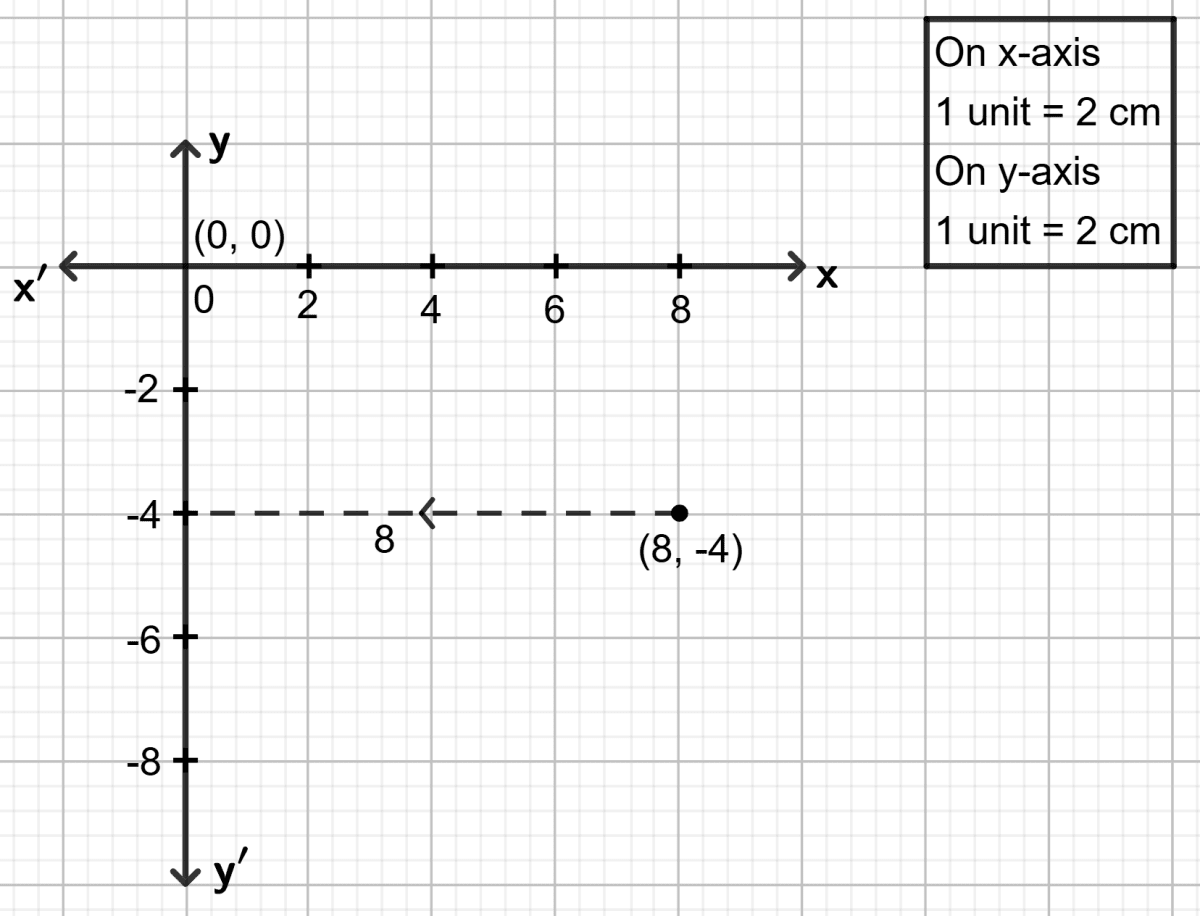
Hence, the distance of point (8, -4) from y-axis is 8 units.
Three vertices of parallelogram ABCD are A(-5, -1), B(3, -1) and C(1, -6). Use graphical method to find the co-ordinates of fourth vertex D.
Answer
Plot the points A(-5, -1), B(3, -1) and C(1, -6) on the graph paper. Join point A with B and B with C.
From the graph, it is clear that the horizontal distance between the points A (-5, -1) and B (3, -1) is 8 units and the vertical distance between the points B (3, -1) and C (1, -6) is 5 units. Therefore, the vertical distance between the points A (-5, -1) and D must be 5 units and the horizontal distance between the points C (1, -6) and D must be 8 units.
Now, complete the parallelogram ABCD and read the coordinates of point D. As shown on the graph, D = (-7, -6).
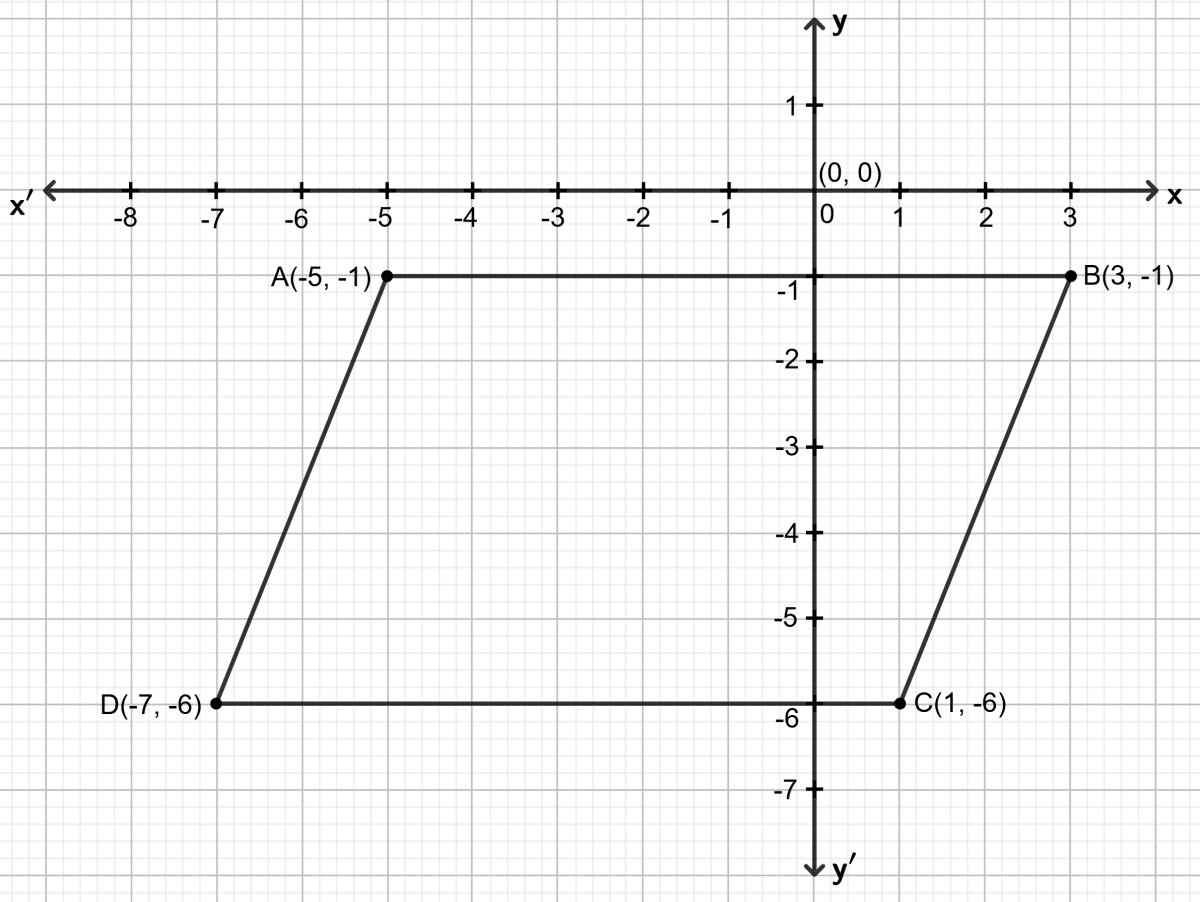
Hence, the co-ordinates of fourth vertex D are (-7, -6).
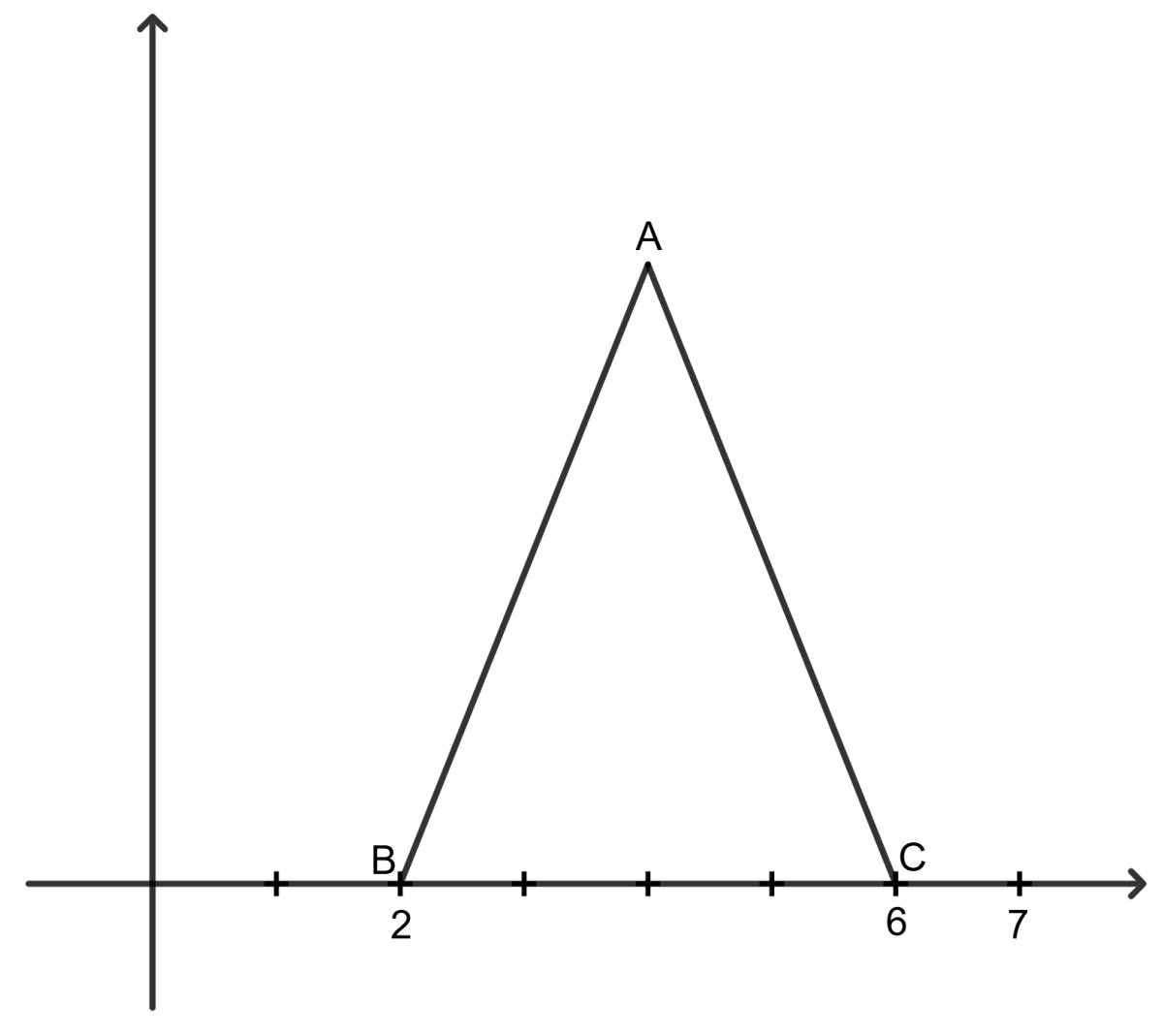
In the given figure, ABC is an equilateral triangle. Find the co-ordinates of A.
Answer
Given:
The co-ordinates of B = (2, 0)
The co-ordinates of C = (6, 0)
So, the length of BC = 6 - 2 = 4 units
Since ABC is an equilateral triangle,
The height of the triangle =
=
= 2 units
The mid-point of BC =
= (4, 0)
Since Δ ABC is equilateral, and BC lies on the x-axis:
The abscissa (x-coordinate) of A is the same as the midpoint of BC, i.e., x=4.
The ordinate (y-coordinate) of A is the height of the triangle, .
Hence, the co-ordinates of A are (4, 2 ).
Draw the graph of 3x + 2y = 6. Use the graph drawn to find the area of triangle formed by the line drawn and the co-ordinate axes.
Answer
Step 1:
Give at least three suitable values to the variable x and find the corresponding values of y.
Let x = 0, then 3 0 + 2y = 6 ⇒ y = 3
Let x = 2, then 3 2 + 2y = 6 ⇒ y = 0
Let x = 4, then 3 4 + 2y = 6 ⇒ y = -3
Step 2:
Make a table (as given below) for the different pairs of the values of x and y:
| x | 0 | 2 | 4 |
|---|---|---|---|
| y | 3 | 0 | -3 |
Step 3:
Plot the points, from the table, on a graph paper and then draw a straight line passing through the points plotted on the graph.
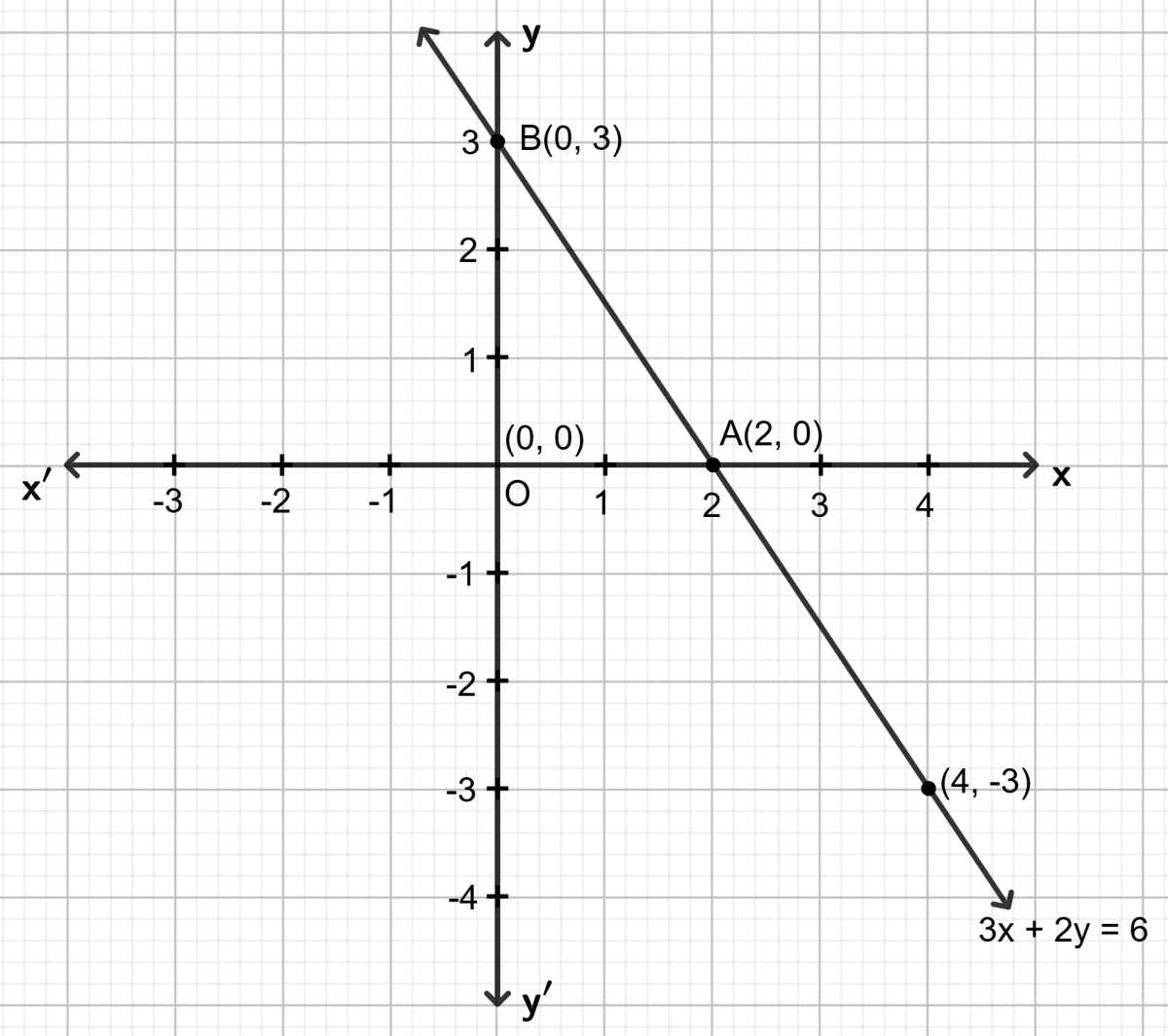
The area of the triangle = x base x height
= x OA x OB
= x 2 x 3
= sq. units
= 3 sq. units
Hence, the area of triangle formed by the line drawn and the co-ordinate axes is 3 sq. units.
Use the graphical method to find the value of k, if :
(i) (k, -3) lies on the straight line 2x + 3y = 1
(ii) (5, k - 2) lies on the straight line x - 2y + 1 = 0
Answer
(i) 2x + 3y = 1
Step 1:
Give at least three suitable values to the variable x and find the corresponding values of y.
Let x = 0, then 2 0 + 3y = 1 ⇒ y = 0.3
Let x = 2, then 2 2 + 3y = 1 ⇒ y = -1
Let x = 4, then 2 4 + 3y = 1 ⇒ y = -2.3
Step 2:
Make a table (as given below) for the different pairs of the values of x and y:
| x | 0 | 2 | 4 |
|---|---|---|---|
| y | 0.3 | -1 | -2.3 |
Step 3:
Plot the points, from the table, on a graph paper and then draw a straight line passing through the points plotted on the graph.
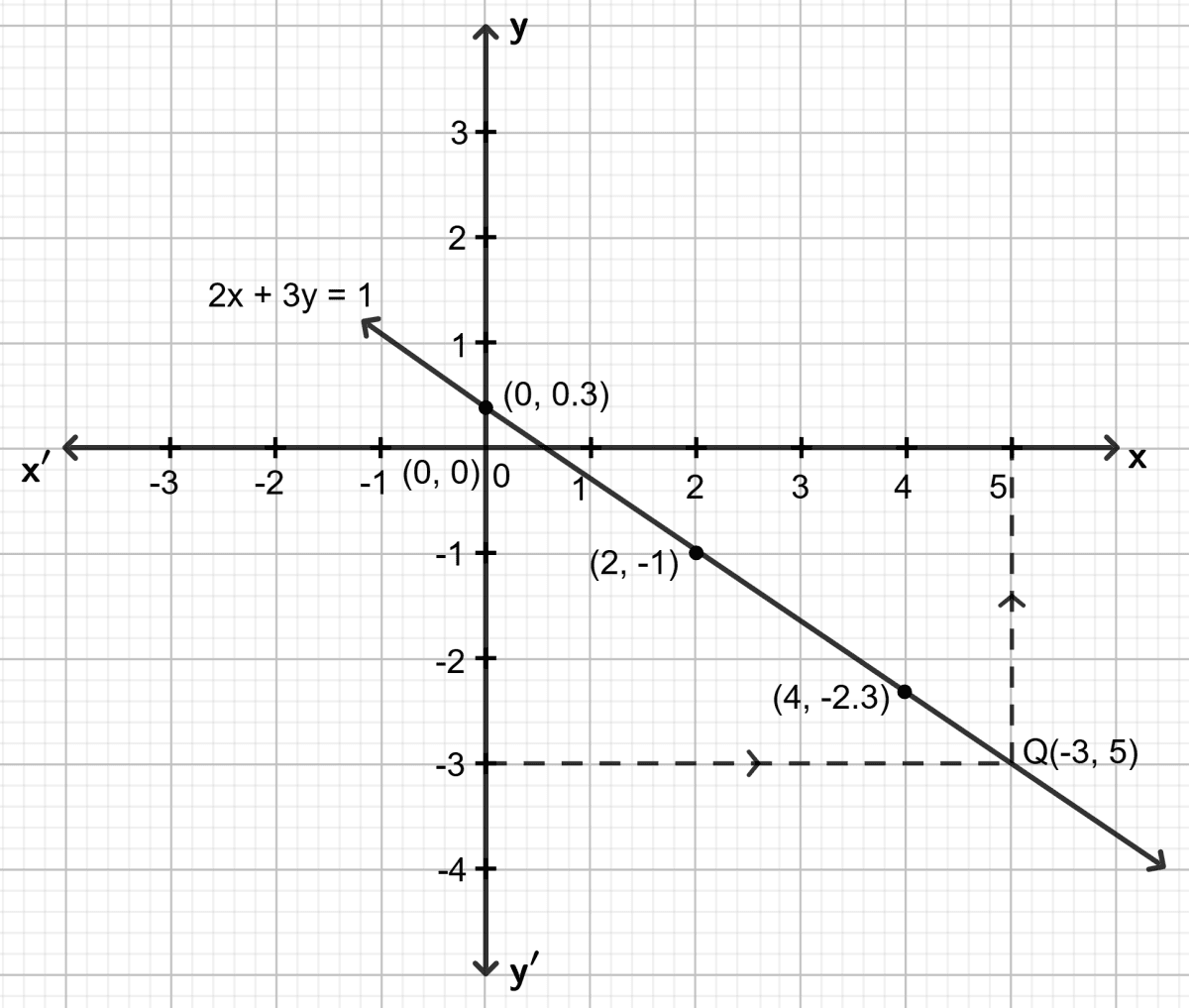
Since, point (k, -3) lies on the straight line drawn, through y = -3, draw a horizontal line which meets the straight line at point, say Q. Through point Q, draw a vertical line which meets the x-axis at 5.
Hence, the value of k = 5.
(ii) x - 2y + 1 = 0
Step 1:
Give at least three suitable values to the variable x and find the corresponding values of y.
Let x = -1, then -1 - 2y + 1 = 0 ⇒ y = 0
Let x = 0, then 0 - 2y + 1 = 0 ⇒ y = 0.5
Let x = 1, then 1 - 2y + 1 = 0 ⇒ y = 1
Step 2:
Make a table (as given below) for the different pairs of the values of x and y:
| x | -1 | 0 | 1 |
|---|---|---|---|
| y | 0 | 0.5 | 1 |
Step 3:
Plot the points, from the table, on a graph paper and then draw a straight line passing through the points plotted on the graph.
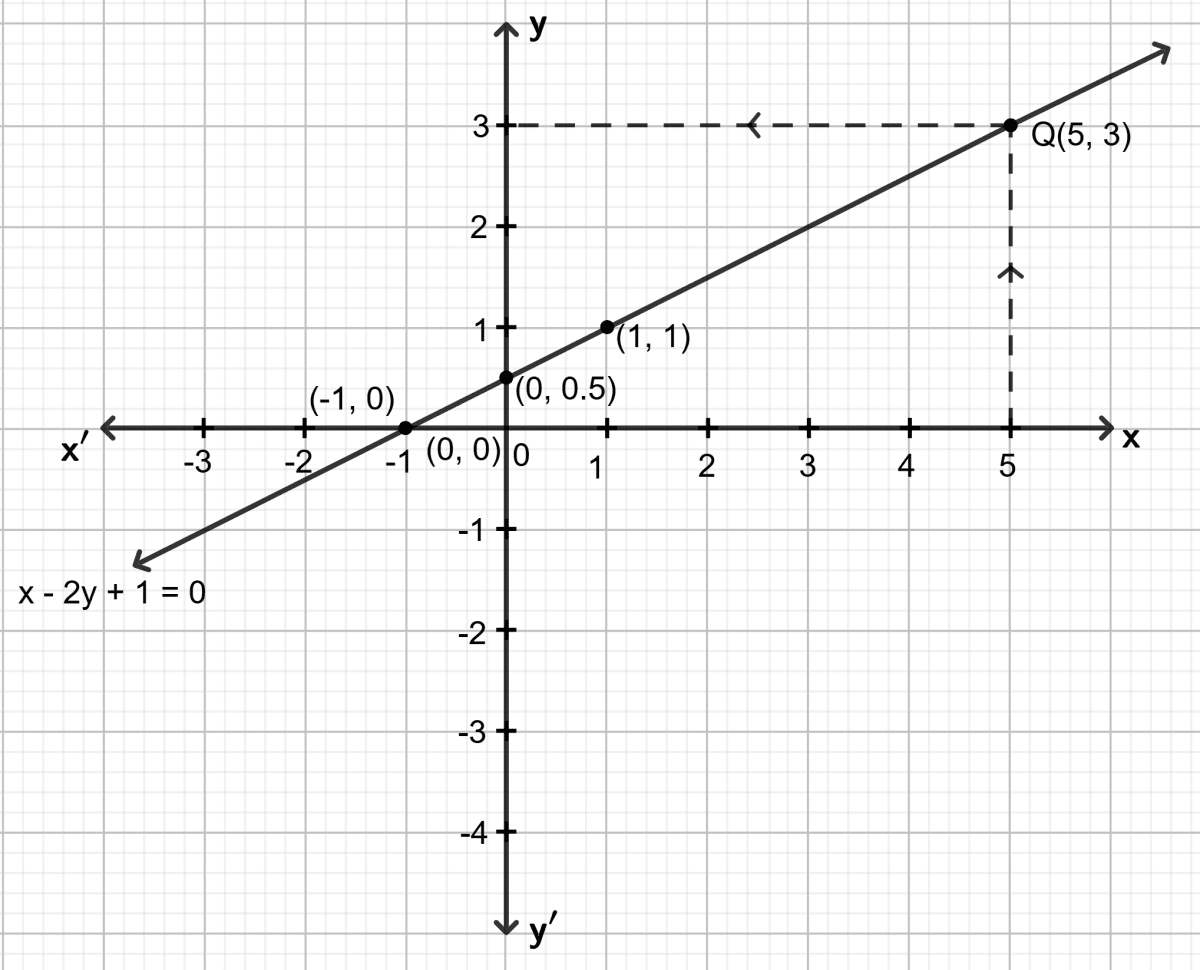
Since, point (5, k - 2) lies on the straight line drawn, through x = 5, draw a vertical line which meets the graph at a point, say Q. Through point Q, draw a horizontal line which meets the y-axis at point 3.
k - 2 = 3
⇒ k = 3 + 2
⇒ k = 5
Hence, the value of k = 5.
Find graphically, the vertices of the triangle whose sides have the equations 2y - x = 8; 5y - x = 14 and y - 2x = 1 respectively.
Take 1 cm = 1 unit on both the axes.
Answer
First equation: 2y - x = 8
Step 1:
Give at least three suitable values to the variable x and find the corresponding values of y.
Let x = -4, then 2y - (-4) = 8 ⇒ y = 2
Let x = -2, then 2y - (-2) = 8 ⇒ y = 3
Let x = 0, then 2y - 0 = 8 ⇒ y = 4
Let x = 2, then 2y - 2 = 8 ⇒ y = 5
Step 2:
Make a table (as given below) for the different pairs of the values of x and y:
| x | -4 | -2 | 0 | 2 |
|---|---|---|---|---|
| y | 2 | 3 | 4 | 5 |
Step 3:
Plot the points, from the table, on a graph paper and then draw a straight line passing through the points plotted on the graph.
Second equation: 5y - x = 14
Step 1:
Give at least three suitable values to the variable x and find the corresponding values of y.
Let x = -4, then 5y - (-4) = 14 ⇒ y = 2
Let x = 0, then 5y - 0 = 14 ⇒ y = 2.8
Let x = 2, then 5y - 2 = 14 ⇒ y = 3.2
Let x = 4, then 5y - 4 = 14 ⇒ y = 3.6
Step 2:
Make a table (as given below) for the different pairs of the values of x and y:
| x | -4 | 0 | 2 | 4 |
|---|---|---|---|---|
| y | 2 | 2.8 | 3.2 | 3.6 |
Step 3:
Plot the points, from the table, on a graph paper and then draw a straight line passing through the points plotted on the graph.
Third equation: y - 2x = 1
Step 1:
Give at least three suitable values to the variable x and find the corresponding values of y.
Let x = 0, then y - 2 0 = 1 ⇒ y = 1
Let x = 2, then y - 2 2 = 1 ⇒ y = 5
Let x = 4, then y - 2 4 = 1 ⇒ y = 9
Step 2:
Make a table (as given below) for the different pairs of the values of x and y:
| x | 0 | 2 | 4 |
|---|---|---|---|
| y | 1 | 5 | 9 |
Step 3:
Plot the points, from the table, on a graph paper and then draw a straight line passing through the points plotted on the graph.
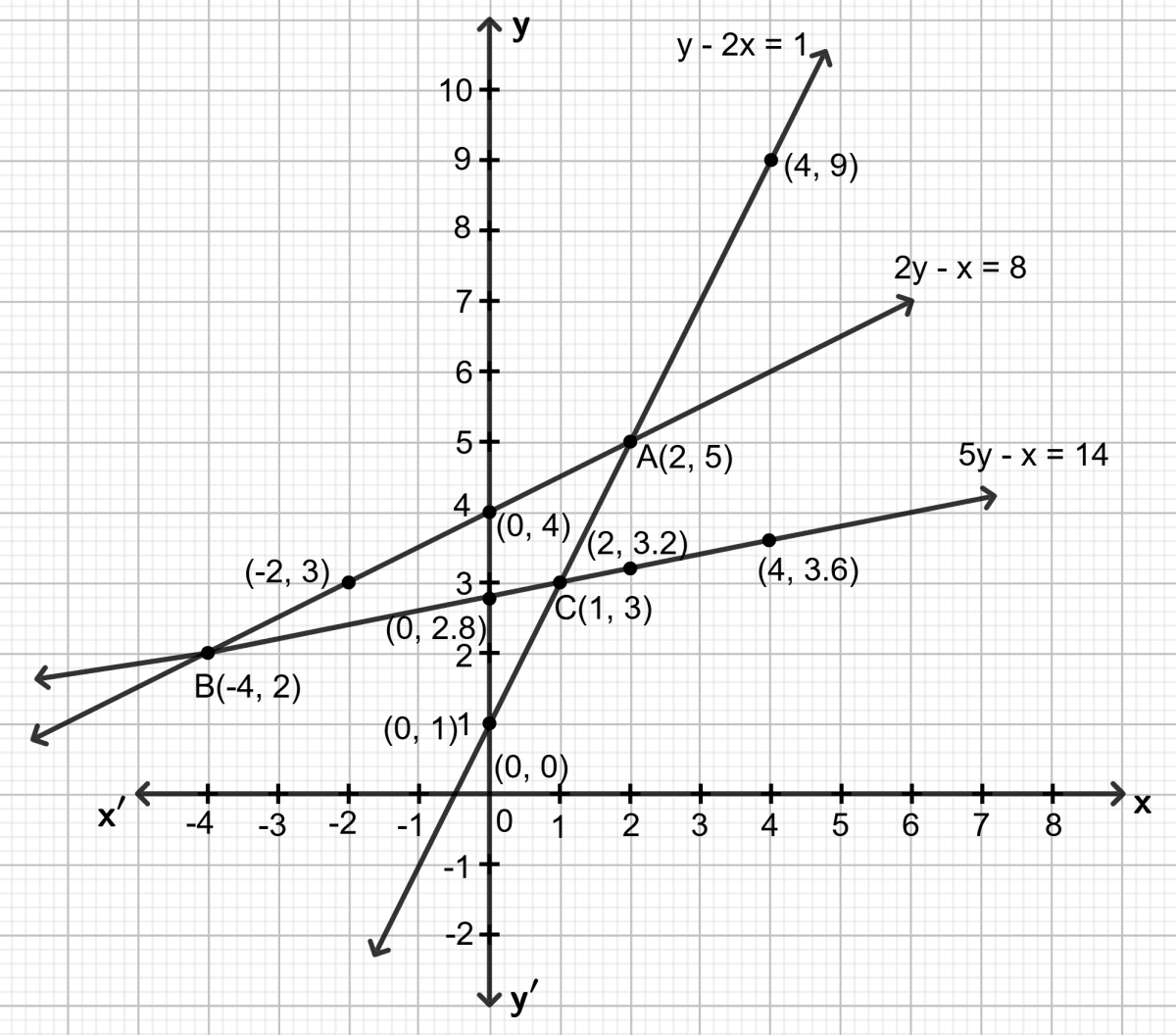
The vertices of the triangle are:
The coordinate of A = (2, 5)
The coordinate of B = (-4, 2)
The coordinate of C = (1, 3)
Hence, the coordinates of the vertices of triangle = (1, 3), (-4, 2) and (2, 5).
Using the same axes of co-ordinates and the same unit, solve graphically :
x + y = 0 and 3x - 2y = 10.
(Take at least 3 points for each line drawn).
Answer
First equation: x + y = 0
Step 1:
Give at least three suitable values to the variable x and find the corresponding values of y.
Let x = 0, then 0 + y = 0 ⇒ y = 0
Let x = 1, then 1 + y = 0 ⇒ y = -1
Let x = 2, then 2 + y = 0 ⇒ y = -2
Step 2:
Make a table (as given below) for the different pairs of the values of x and y:
| x | 0 | 1 | 2 |
|---|---|---|---|
| y | 0 | -1 | -2 |
Step 3:
Plot the points, from the table, on a graph paper and then draw a straight line passing through the points plotted on the graph.
Second equation: 3x - 2y = 10
Step 1:
Give at least three suitable values to the variable x and find the corresponding values of y.
Let x = 0, then 3 0 - 2y = 10 ⇒ y = -5
Let x = 1, then 3 1 - 2y = 10 ⇒ y = -3.5
Let x = 2, then 3 2 - 2y = 10 ⇒ y = -2
Step 2:
Make a table (as given below) for the different pairs of the values of x and y:
| x | 0 | 1 | 2 |
|---|---|---|---|
| y | -5 | -3.5 | -2 |
Step 3:
Plot the points, from the table, on a graph paper and then draw a straight line passing through the points plotted on the graph.
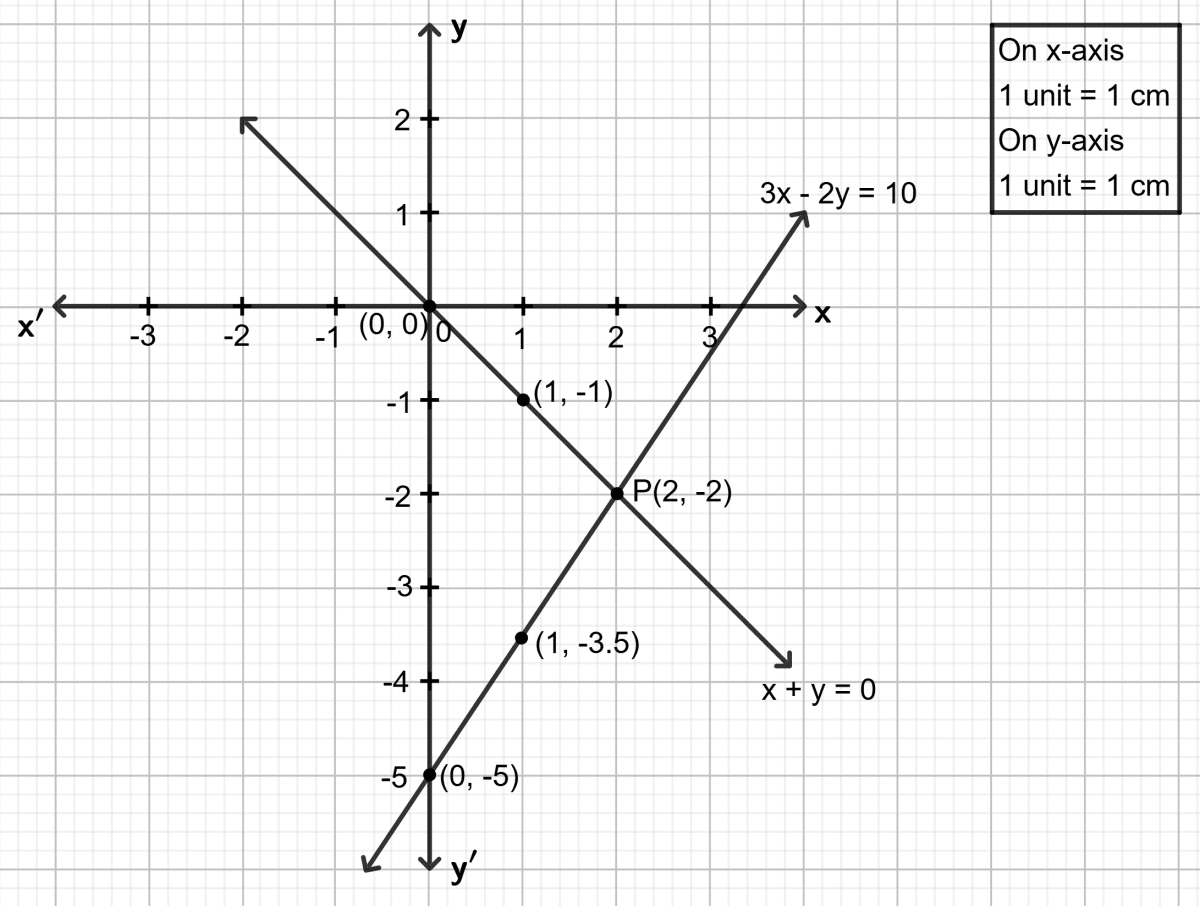
Both the straight line drawn meet the point P. As it is clear from the graph, co-ordinates of the common point P are (2, -2).
Solution of the given equation x = 2 and y = -2.
Solve graphically, the following equations.
x + 2y = 4; 3x - 2y = 4.
Take 2 cm = 1 unit on each axis.
Also, find the area of the triangle formed by the lines and the x-axis.
Answer
First equation: x + 2y = 4
Step 1:
Give at least three suitable values to the variable x and find the corresponding values of y.
Let x = 0, then 0 + 2y = 4 ⇒ y = 2
Let x = 2, then 2 + 2y = 4 ⇒ y = 1
Let x = 4, then 4 + 2y = 4 ⇒ y = 0
Step 2:
Make a table (as given below) for the different pairs of the values of x and y:
| x | 0 | 2 | 4 |
|---|---|---|---|
| y | 2 | 1 | 0 |
Step 3:
Plot the points, from the table, on a graph paper and then draw a straight line passing through the points plotted on the graph.
Second equation: 3x - 2y = 4
Step 1:
Give at least three suitable values to the variable x and find the corresponding values of y.
Let x = 0, then 3 0 - 2y = 4 ⇒ y = -2
Let x = 2, then 3 2 - 2y = 4 ⇒ y = 1
Let x = 4, then 3 4 - 2y = 4 ⇒ y = 4
Step 2:
Make a table (as given below) for the different pairs of the values of x and y:
| x | 0 | 2 | 4 |
|---|---|---|---|
| y | -2 | 1 | 4 |
Step 3:
Plot the points, from the table, on a graph paper and then draw a straight line passing through the points plotted on the graph.

Both the straight line drawn meet the point A. As it is clear from the graph, co-ordinates of the common point A are (2, 1).
Solution of the given equation x = 2 and y = 1.
The area of the triangle = x base x height
= x BC x AD
= x 2.6 x 1
= 1.3 sq. units
Hence, the area of the triangle formed between the lines and the x-axis = 1.3 sq. units.
Use the graphical method to find the value of 'x' for which the expressions and are equal.
Answer
First equation: y =
Step 1:
Give at least three suitable values to the variable x and find the corresponding values of y.
Let x = -4, then y = ⇒ y = -5
Let x = -2, then y = ⇒ y = -2
Let x = 2, then y = ⇒ y = 4
Step 2:
Make a table (as given below) for the different pairs of the values of x and y:
| x | -4 | -2 | 2 |
|---|---|---|---|
| y | -5 | -2 | 4 |
Step 3:
Plot the points, from the table, on a graph paper and then draw a straight line passing through the points plotted on the graph.
Second equation: y =
Step 1:
Give at least three suitable values to the variable x and find the corresponding values of y.
Let x = -4, then y = ⇒ y = -5
Let x = 4, then y = ⇒ y = 1
Let x = 8, then y = ⇒ y = 4
Step 2:
Make a table (as given below) for the different pairs of the values of x and y:
| x | -4 | 4 | 8 |
|---|---|---|---|
| y | -5 | 1 | 4 |
Step 3:
Plot the points, from the table, on a graph paper and then draw a straight line passing through the points plotted on the graph.
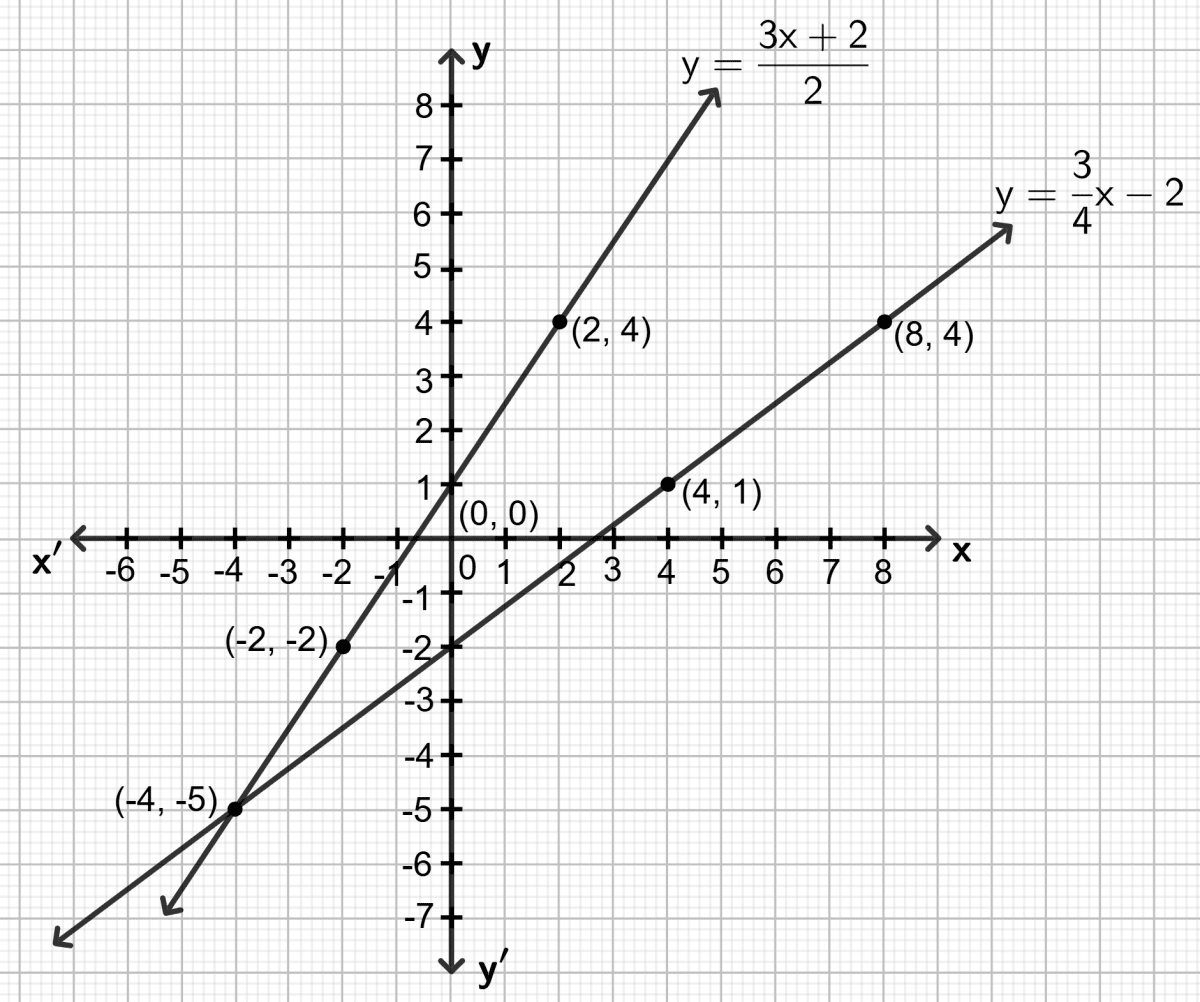
After plotting both lines on the graph, observe where the two lines intersect. The intersection point represents the value of x where both equations are equal.
From the graph, we see that the lines intersect at x = -4.
Hence, the value of x for which the two equations are equal is -4.
The course of an enemy submarine, as plotted on rectangular co-ordinate axes, gives the equation 2x + 3y = 4. On the same axes, a destroyer's course is indicated by the graph x - y = 7. Use the graphical method to find the point at which the paths of the submarine and the destroyer intersect.
Answer
Enemy equation: 2x + 3y = 4
Step 1:
Give at least three suitable values to the variable x and find the corresponding values of y.
Let x = -4, then 2 (-4) + 3y = 4 ⇒ y = 4
Let x = -1, then 2 (-1) + 3y = 4 ⇒ y = 2
Let x = 5, then 2 5 + 3y = 4 ⇒ y = -2
Step 2:
Make a table (as given below) for the different pairs of the values of x and y:
| x | -4 | -1 | 5 |
|---|---|---|---|
| y | 4 | 2 | -2 |
Step 3:
Plot the points, from the table, on a graph paper and then draw a straight line passing through the points plotted on the graph.
Destroyer equation: x - y = 7
Step 1:
Give at least three suitable values to the variable x and find the corresponding values of y.
Let x = 5, then 5 - y = 7 ⇒ y = -2
Let x = 9, then 9 - y = 7 ⇒ y = 2
Let x = 11, then 11 - y = 7 ⇒ y = 4
Step 2:
Make a table (as given below) for the different pairs of the values of x and y:
| x | 5 | 9 | 11 |
|---|---|---|---|
| y | -2 | 2 | 4 |
Step 3:
Plot the points, from the table, on a graph paper and then draw a straight line passing through the points plotted on the graph.
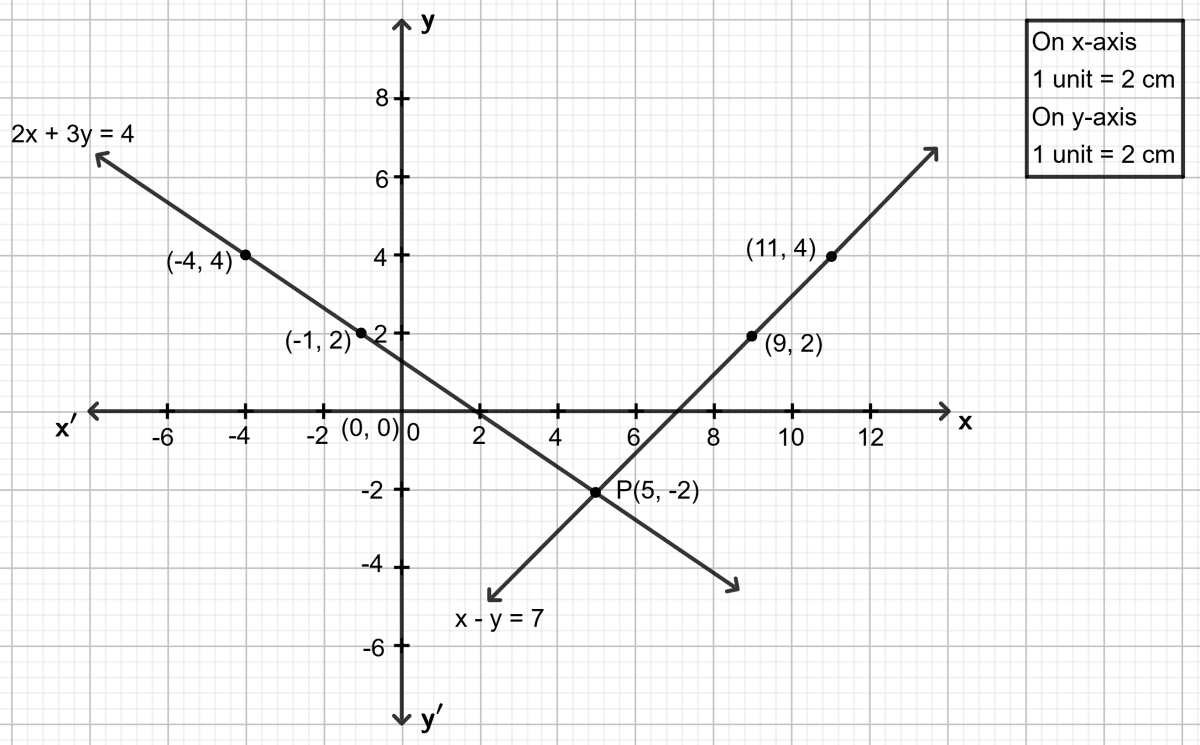
Both the straight lines intersect at point P. As it is clear from the graph, co-ordinates of point P are (-2, -1).
Hence, (5, -2) is the point at which the paths of the submarine and the destroyer intersect.