
Give an example of an endothermic reaction.
Answer
N2 + O2 2NO - ΔT
Explain : 'Silver nitrate solution is kept in coloured reagent bottles in the laboratory.'
Answer
Silver nitrate decomposes in the presence of sunlight, forming silver, nitrogen dioxide and oxygen. Hence, it is kept in coloured reagent bottles.
Reactions can be classified as : Direct combination, decomposition, simple displacement, double decomposition, Redox reactions. State which of the following types, takes place in the reactions given below
(i) Cl2 + 2KI ⟶ 2KCl + I2
(ii) 2Mg + O2 ⟶ 2MgO
(iii) SO2 + 2H2O + Cl2 ⟶ 2HCl + H2SO4
(iv) AgNO3 + HCl ⟶ AgCl + HNO3
(v) 4HNO3 ⟶ 4NO2 + 2H2O + O2
Answer
(i) Cl2 + 2KI ⟶ 2KCl + I2 — Simple displacement
(ii) 2Mg + O2 ⟶ 2MgO — Direct combination
(iii) SO2 + 2H2O + Cl2 ⟶ 2HCl + H2SO4 — Redox reaction
(iv) AgNO3 + HCl ⟶ AgCl + HNO3 — Double decomposition
(v) 4HNO3 ⟶ 4NO2 + 2H2O + O2 — Decomposition reaction
Give an example of a photochemical decomposition reaction.
Answer
An example of photochemical decomposition reaction is the decomposition of silver salts in the presence of light:
2AgCl 2Ag + Cl2
Name a metallic oxide which on thermal decomposition is reduced to a metal.
Answer
HgO is a metallic oxide which reduces to a metal on thermal decomposition as per the equation below:
2HgO 2Hg + O2
Explain the term chemical reaction with special reference to reactants and products.
Answer
A chemical reaction is a change, in which matter changes into a new substance or substances. In a chemical reaction the substance or substances taking part in the reaction called reactants are transformed into one or more new substances called the products.
Give a suitable example with equation to show the representation of a chemical reaction.
Answer
Silver nitrate reacts with hydrochloric acid to form silver chloride and nitric acid.
AgNO3 + HCl ⟶ AgCl + HNO3
Give two examples where a chemical reaction is accompanied by a change in colour of the reactants & products on completion of the reaction.
Answer
The two examples are —
- Heat on Copper [II] Nitrate:
2Cu(NO3)2 2CuO + 4NO2 + O2
Blue copper [II] nitrate changes to black coloured copper [II] oxide. - Heat on Lead [II] Nitrate:
2Pb(NO3)2 2PbO + 4NO2 + O2
White lead [II] nitrate changes to yellow litharge.
Give balanced equations for reactions involving evolution of a gas on addition of dilute acid to :
(a) sodium sulphite
(b) calcium carbonate
Answer
(a) Na2SO3 + H2SO4 [dil.] ⟶ Na2SO4 + H2O + SO2 [g]
Sulphur dioxide gas is evolved.
(b) CaCO3 + 2HCl [dil.] ⟶ CaCl2 + H2O + CO2 [g]
Carbon dioxide gas is evolved.
Give a balanced equation for conversion of:
(a) an ammonium salt to a basic gas
(b) a soluble lead salt to an insoluble lead salt – formed as a white precipitate.
Answer
(a) Ammonium salt [NH4Cl] on reaction with calcium hydroxide produces NH3(g) which is a basic gas.
2NH4Cl + Ca(OH)2 ⟶ CaCl2 + 2H2O + 2NH3 [g]
(b) When lead nitrate reacts with sodium chloride, an insoluble white precipitate of lead chloride is formed.
Pb(NO3)2 + 2NaCl ⟶ 2NaNO3 + PbCl2 ↓
Chemical reactions may proceed with evolution or absorption of heat. Give an example of each.
Answer
Chemical reaction which proceed with evolution of heat [Exothermic] —
- Nitrogen and hydrogen:
N2 + 3H2 2NH3 + ΔT
Chemical reaction which proceed by absorption of heat [Endothermic] —
- Nitrogen and oxygen :
N2 + O2 2NO - ΔT
Define the following types of chemical changes or reactions with a suitable example of each.
(a) Direct combination reaction or synthesis
(b) Decomposition reaction
(c) Displacement reaction or substitution reaction
(d) Double decomposition reaction
Answer
(a) A chemical reaction in which two or more elements or compounds react to form one new compound is called a Direct combination reaction or synthesis.
For example,
Hydrogen burns in air to give water:
2H2 [g] + O2 [g] ⟶ 2H2O [l]
(b) A chemical reaction in which a chemical compound decomposes into two or more simpler substances (elements and/or compounds) is called a Decomposition reaction.
For example,
Calcium carbonate on heating decomposes to Calcium Oxide and Carbon dioxide:
CaCO3 CaO + CO2
(c) A chemical reaction in which an element or radical has replaced another element in a compound is known as Displacement reaction or Substitution reaction.
For example,
Magnesium displaces Copper from Copper [II] sulphate solution:
Mg + CuSO4 ⟶ MgSO4 + Cu
(d) A chemical reaction in which both reactants [compounds] are decomposed to give two new compounds by exchanging their radicals is known as Double decomposition reaction.
For example,
Silver nitrate + Potassium chloride ⟶ Silver chloride + Potassium nitrate
AgNO3 + KCl ⟶ AgCl + KNO3
Give balanced equations for the following:
(a) An acid – from sulphur dioxide gas
(b) An alkali – from a basic oxide – sodium oxide
(c) A salt – from a trivalent metal and a coloured gas.
Answer
(a) SO2 + H2O ⟶ H2SO3
(b) Na2O + H2O ⟶ 2NaOH
(c) 2Al + 3Cl2 ⟶ 2AlCl3
Convert — (a) nitrogen to ammonia (b) hydrogen to hydrogen chloride – by a direct combination reaction.
Answer
(a) Nitrogen reacts with hydrogen under specific conditions to form ammonia
N2 + 3H2 ⇌ 2NH3 + Δ
Conditions :
Temperature : 450-500°C [Optimum temperature]
Pressure : 200 to 900 atmospheres [Optimum pressure]
Catalyst : Finely divided iron [Fe]
(b) Moist hydrogen gas combines with chlorine in presence of diffused sunlight.
H2 + Cl2 ⟶ 2HCl [g]
Conditions — Diffused Sunlight, reaction is explosive in direct sunlight. Moisture acts as a catalyst.
Give balanced equations for thermal decomposition of :
(a) lead carbonate
(b) lead nitrate
(c) ammonium dichromate
(d) mercury [II] oxide
(e) calcium hydroxide
Answer
(a) PbCO3 PbO + CO2
(b) 2Pb(NO3)2 2PbO + 4NO2 + O2
(c) (NH4)2Cr2O7 Cr2O3 + 4H2O + N2
(d) 2HgO 2Hg + O2
(e) Ca(OH)2 CaO + H2O
Define a thermal dissociation reaction with a suitable example.
Answer
Thermal dissociation reaction is a decomposition reaction in which a substance dissociates into two or more simpler substances on application of heat.
For example, on application of heat, ammonium chloride decomposes into Ammonia and HCl:
NH4Cl NH3 + HCl
Define a displacement reaction with example. State why Zn displaces H2 from dil. H2SO4 but Cu does not.
Answer
A chemical reaction which takes place when an element [or radical] has replaced another element in a compound is known as Displacement reaction
It is represented as :
X + YZ ⟶ Y + XZ
e.g.,
Magnesium + Copper [II] sulphate ⟶ Magnesium sulphate + Copper
Mg + CuSO4 ⟶ MgSO4 + Cu
A more electropositive metal displaces a less electropositive metal from its aqueous solution. Therefore, zinc, being more electropositive, is placed above [H] in the activity series and displaces hydrogen from dilute sulphuric acid. Copper, being less electropositive, is placed below [H] in the electrochemical series and cannot displace hydrogen from sulphuric acid.
Explain the term double decomposition precipitation reaction. Give a balanced equation for the preparation of two different insoluble lead salts from their salt solutions by double decomposition precipitation.
Answer
Reaction between two compounds in aqueous solution state to give two new compounds one of which is insoluble is called double decomposition precipitation reaction.
Balanced equations for the preparation of two different insoluble lead salts are given below:
With the help of balanced equations - show how precipitation reactions are used for identifying the positive radicals in three different salts, each having a different cation [positive ion].
Answer
Precipitation reactions are used in analytical chemistry for identifying the positive radical in a salt by analysing the colour of the precipitate.
(i) FeSO4 + 2NaOH ⟶ Na2SO4 + Fe(OH)2 ↓
Identified ion: Fe2+; a dirty green precipitate of iron [II] hydroxide is obtained. Hence, it can be identified.
(ii) CuSO4 + 2NaOH ⟶ Na2SO4 + Cu(OH)2 ↓
Identified ion: Cu2+; a pale blue precipitate of copper [II] hydroxide is obtained. Hence, it can be identified.
(iii) Pb(NO3)2 + 2NaOH ⟶ 2NaNO3 + Pb(OH)2 ↓
Identified ion: Pb2+; a chalky white precipitate of lead [II] hydroxide is obtained. Hence, it can be identified.
Define the term – double decomposition – neutralization reaction with a suitable representation.
Convert :
(a) an insoluble base (b) a soluble base
to their respective soluble salts by neutralization reaction.
Answer
Reaction between a base and an acid to give two new compounds — salt & water — by interchange of radicals is termed double decomposition neutralization reaction.
It is represented as :
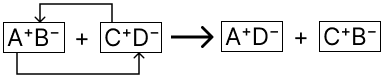
For example,
NaOH [Base] + HCl [Acid] ⟶ NaCl [Salt] + H2O [Water]
(a) Insoluble base [oxide] — Copper [II] oxide reacts with sulphuric acid and forms Copper sulphate :
CuO + H2SO4 ⟶ CuSO4 + H2O
(b) A soluble base — Sodium hydroxide reacts with HCl and forms soluble salt (sodium chloride) and water:
NaOH + HCl ⟶ NaCl + H2O
Explain the term energy changes in a chemical change. Give an example with a balanced equation, for each of the following reactions:
(a) exothermic reaction
(b) endothermic reaction
(c) photochemical reaction
(d) electrochemical reaction.
Answer
The difference between the chemical energy of the reactants and the products is known as the energy changes in a chemical change or reaction.
Example of :
(a) exothermic reaction:
2H2 + O2 2H2O + ΔT
(b) endothermic reaction:
N2 + O2 2NO - ΔT
(c) photochemical reaction:
H2 + Cl2 2HCl
Slow reaction in diffused light
Explosive reaction in direct sunlight
(d) electrochemical reaction:
Choose the reaction which is not a chemical change under prevalent condition.
- Fe + CuSO4 ⟶
- FeCO3
- Fe
- Fe + S
Answer
Fe
Reason — Heating iron alone, under prevalent conditions, does not produce a new substance; hence it is not a chemical change. A chemical reaction is a chemical change in which reactants are transformed into new substances called products.
The other reactions are chemical changes:
- Fe + CuSO4 → FeSO4 + Cu — displacement reaction
- FeCO3 FeO + CO2 — thermal decomposition
- Fe + S FeS — direct combination reaction
Choose the reaction which is not a precipitation reaction under prevalent conditions.
- Pb(NO3)2 + NaOH ⟶
- Pb(NO3)2 + Na2SO4
- Pb(NO3)2
- Pb(NO3)2 + NaCl
Answer
Pb(NO3)2
Reason — A precipitation reaction is a double decomposition reaction in which two compounds in aqueous solution react to form two new compounds, one of which is an insoluble precipitate. On heating, Pb(NO3)2 undergoes thermal decomposition, not precipitation.
Pb(NO3)2 PbO + NO2 + O2
The other reactions form insoluble lead salts or lead hydroxide as precipitates:
- Pb(OH)2
- PbSO4
- PbCl2
Choose the conversion reaction which is exothermic & takes place by supply of catalytic energy.
- Hydrogen to HCl
- Ammonia to nitric acid
- Nitrogen to nitric oxide
- Oxygen to ozone.
Answer
Ammonia to nitric acid
Reason — The conversion of ammonia to nitric acid involves the catalytic oxidation of ammonia. In this reaction, ammonia reacts with oxygen in the presence of a platinum catalyst and the reaction is exothermic, as heat is evolved.
4NH3 + 5O2 4NO + 6H2O + heat
Hydrogen to HCl :
H2 + Cl2 2HCl
In this reaction, light is required for initiation of the reaction.
Nitrogen to nitric oxide :
N2 + O2 2NO -
This is endothermic reaction and needs very high temperature.
Oxygen to ozone :
3O2 2O3
This is endothermic and requires electrical discharge.
Give a balanced equation for a direct combination reaction involving :
(a) Two elements — one of which is a neutral gas and the other a yellow non-metal
(b) Two elements — one of which is a neutral gas and the other a monovalent metal
(c) Two compounds — resulting in formation of a weak acid
Answer
(a) Direct Combination of two elements one of which is a neutral gas and the other a yellow non-metal:
S + O2 [g] ⟶ SO2
(b) Direct Combination of two elements one of which is a neutral gas and the other a monovalent metal
4Na + O2 [g] ⟶ 2Na2O
(c) Formation of a weak acid:
CO2 [g] + H2O ⟶ H2CO3
Match the conversion in Column A with correct type of chemical change or reaction .
| Column A | Column B |
|---|---|
| (a) A trivalent metal — to its metal nitride | i) Displacement |
| (b) Hydrous CuSO4 — to anhydrous CuSO4 | ii) Direct combination |
| (c) Iron to iron chloride — using dilute acid | iii) Precipitation |
| (d) Sodium hydroxide to sodium chloride — using a dilute acid | iv) Decomposition |
| (e) Iron [III] chloride to iron [III] hydroxide | v) Neutralization |
Answer
| Column A | Column B |
|---|---|
| (a) A trivalent metal — to its metal nitride | ii) Direct combination |
| (b) Hydrous CuSO4 — to anhydrous CuSO4 | iv) Decomposition |
| (c) Iron to iron chloride — using dilute acid | i) Displacement |
| (d) Sodium hydroxide to sodium chloride — using a dilute acid | v) Neutralization |
| (e) Iron [III] chloride to iron [III] hydroxide | iii) Precipitation |
Complete the statements by filling in the blank with the correct word/s :
- Direct combination reaction of sulphur dioxide with water gives ............... [H2SO4/H2SO3/H2S2O7].
- Formation of hydrogen chloride from hydrogen and chlorine is an example of ............... [photochemical reaction / electrochemical reaction].
- The reaction of hydrogen burning in oxygen to give a neutral liquid is an example of ............... [exothermic/endothermic] reaction.
- The neutral gas evolved when lead nitrate undergoes thermal decomposition is ............... [nitrogen dioxide/oxygen/nitrogen].
- The reddish brown precipitate obtained during a double decomposition - precipitation reaction between an iron salt and an alkali is ............... [iron [II] hydroxide / iron [III] hydroxide]
Answer
- Direct combination reaction of sulphur dioxide with water gives H2SO3
- Formation of hydrogen chloride from hydrogen and chlorine is an example of photochemical reaction.
- The reaction of hydrogen burning in oxygen to give a neutral liquid is an example of exothermic reaction.
- The neutral gas evolved when lead nitrate undergoes thermal decomposition is oxygen.
- The reddish brown precipitate obtained during a double decomposition precipitation reaction between an iron salt and an alkali is iron [III] hydroxide.
Select the correct answer from A, B, C, D and E for each statement given below :
A : Ammonia
B : Hydrogen chloride
C : Hydrogen
D : Nitrogen dioxide
E : Nitric oxide
State the gaseous product formed, when -
- An active metal reacts with dilute sulphuric acid.
- A metallic nitrate undergoes thermal decomposition giving a coloured gas.
- Two gases one of them neutral, combines by absorption of light energy.
- An ammonium salt reacts with an alkali.
- An exothermic reaction takes place between ammonia and a neutral gas.
Answer
- An active metal reacts with dilute sulphuric acid — C : Hydrogen
- A metallic nitrate undergoes thermal decomposition giving a coloured gas — D : Nitrogen dioxide
- Two gases one of them neutral, combines by absorption of light energy — B : Hydrogen chloride
- An ammonium salt reacts with an alkali — A: Ammonia
- An exothermic reaction takes place between ammonia and a neutral gas — E : Nitric oxide
Give a balanced equation for each of the following types of reactions :
- A direct combination reaction between phosphorus and a neutral gas.
- A soluble salt of lead formed from an insoluble base by double decomposition – neutralization.
- A thermal decomposition reaction of a salt – which results in the formation of nitrogen gas.
- A synthesis reaction between a metal and a non-metal resulting in formation of an insoluble salt of iron.
- A decomposition reaction of a salt which leaves behind a silvery metal.
Answer
- 4P + 5O2 ⟶ 2P2O5
- PbO + 2HNO3 ⟶ Pb(NO3)2 + H2O
- (NH4)2Cr2O7 Cr2O3 + 4H2O + N2
- Fe + S ⟶ FeS
- 2AgCl 2Ag + Cl2
Differentiate between the following :
Synthesis reaction & a substitution reaction.
Answer
| Synthesis Reaction | Substitution Reaction |
|---|---|
| A chemical reaction in which two or more elements or compounds react to form one new compound is called a Direct Combination Reaction or Synthesis Reaction. | A chemical reaction in which an element or radical has replaced another element in a compound is called Displacement or Substitution Reaction. |
| For example: hydrogen + oxygen ⟶ water 2H2 [g] + O2 [g] ⟶ 2H2O [l] | For example: Magnesium + Copper [II] sulphate ⟶ Magnesium sulphate + Copper Mg + CuSO4 ⟶ MgSO4 + Cu |
Differentiate between the following :
Electrolytic decomposition & photochemical decomposition
Answer
| Electrolytic decomposition | Photochemical decomposition |
|---|---|
| A decomposition reaction which is brought about by passage of electric current is known as Electrolytic decomposition. | A decomposition reaction which occurs in the presence of light is known as Photochemical decomposition. |
| For example: 2H2O ⟶ 2H2 + O2 (On Passage of Electric Current) | For example: 2AgCl ⟶ 2Ag + Cl |
Differentiate between the following :
Thermal decomposition & thermal dissociation.
Answer
| Thermal decomposition | Thermal dissociation |
|---|---|
| A chemical reaction in which a compound decomposes to give two new elements / a new compound & an element / two new compounds on application of heat is called a Thermal decomposition reaction. | A decomposition reaction in which a substance dissociates into two or more simpler substances on application of heat is called a Thermal dissociation reaction. |
| For example: 2Ca(NO3)2 ⟶ 2CaO + 4NO2 + O2 | For example: NH4Cl ⇌ NH3 + HCl |
Differentiate between the following :
Decomposition reaction & a double decomposition reaction
Answer
| Decomposition reaction | Double decomposition reaction |
|---|---|
| A chemical reaction in which a compound decomposes to give two new elements / a new compound & an element / two new compounds is called a Decomposition reaction. | A chemical reaction in which both reactants [compounds] are decomposed to give two new compounds by exchanging their radicals is called a Double decomposition reaction. It is represented as XY + AB ⟶ XB + AY |
| For example: 2HgO ⟶ 2Hg + O2 | For example: CaCl2 + Na2CO3 ⟶ 2NaCl + CaCO3 ↓ |
Differentiate between the following :
Neutralization reaction & a precipitation reaction.
Answer
| Neutralization reaction | Precipitation reaction |
|---|---|
| A reaction between two compounds — base and acid — to give two new compounds — salt and water — by interchange of radicals is called a Neutralization reaction. | A reaction between two compounds in aqueous solution state to give two new compounds, one of which is insoluble (precipitate), is called a Precipitation reaction. |
| For example: NaOH + HCl ⟶ NaCl + H2O | For example: Pb(NO3)2 + 2NaCl ⟶ 2NaNO3 + PbCl2 |
Match the chemical reactions in List I with the appropriate answer in List II.
| List I | List II |
|---|---|
| AB ⇌ A + B (on heating) | A : Double decomposition |
| AB ⟶ A + B | B : Thermal dissociation |
| X+Y- + A+B- ⟶ X+B- + A+Y- | C : Endothermic reaction |
| X + YZ ⟶ XZ + Y | D : Displacement reaction |
| X + Y ⟶ XY - Δ (on heating) | E : Decomposition reaction |
Answer
| List I | List II |
|---|---|
| AB ⇌ A + B (on heating) | B : Thermal dissociation |
| AB ⟶ A + B | E : Decomposition reaction |
| X+Y- + A+B- ⟶ X+B- + A+Y- | A : Double decomposition |
| X + YZ ⟶ XZ + Y | D : Displacement reaction |
| X + Y ⟶ XY - Δ (on heating) | C : Endothermic reaction |
Name the solid residual product formed in each reaction and state it's colour during – thermal decomposition of the following substances.
- Copper nitrate.
- Ammonium dichromate.
- Zinc carbonate.
- Lead nitrate.
- Calcium hydroxide.
Answer
Below table lists the solid residual product formed along with it's colour for the given substances:
| Sl. No. | Substance | Residual Product | Colour |
|---|---|---|---|
| 1 | Copper nitrate | Copper [II] oxide | Black |
| 2 | Ammonium dichromate | Chromic oxide | Green |
| 3 | Zinc carbonate | Zinc oxide | White |
| 4 | Lead nitrate | Lead oxide | Yellow |
| 5 | Calcium hydroxide | Calcium oxide | White |