
Name the application of NLP depicted in the given picture.

- Language translation
- Language generation
- Question answering
- Classification of text
Answer
Language translation
Reason — The picture shown depicts text being translated from one language to another, which is an application of Natural Language Processing (NLP). Language translation is an NLP application that enables computers to understand text in one language and convert it into another language, such as translating English text into Hindi or other languages.
A person is searching for the brands of an electronic item. On an e-commerce website, a chatbot recommends a specific product to him. Which ethical issue is related to this scenario?
- Transparency
- Interpretability
- Explainability
- Accountability
Answer
Explainability
Reason — Explainability refers to the ability of an AI system to explain or justify the decisions or recommendations it makes. In this scenario, when a chatbot recommends a specific product on an e-commerce website, it is important to understand why that particular product was suggested. Hence, the ethical issue related here is explainability, as users should be able to know the reasoning behind AI-based recommendations.
NLP is the processing of natural language through computers. Which of the following is an example of NLP?
- Voice search on Google
- Image search on Google
- Image generation on Canva
- Product recommendation on Amazon
Answer
Voice search on Google
Reason — Natural Language Processing (NLP) enables computers to understand and process human language in written or spoken form. Voice search on Google is an example of NLP because it involves speech recognition and language understanding, where the system interprets spoken queries and provides relevant results.
............... enables systems to learn from experience by identifying patterns in large datasets, often using algorithms and computational techniques.
- Deep learning
- Machine learning
- Data science
- Neural networks
Answer
Machine learning
Reason — Machine learning enables systems to learn from experience by identifying patterns in large datasets using algorithms and computational techniques.
Which of the following is not a category of robots?
- Aerial robots
- Ground robots
- Underwater robots
- Quantum robots
Answer
Quantum robots
Reason — Robots are categorised based on their operating environment, such as ground robots, aerial robots, and underwater robots.
Which of the following is a limitation of using robots?
- Consistency in performance
- High initial cost
- Ability to work in hazardous environments
- Efficiency in repetitive tasks
Answer
High initial cost
Reason — One limitation of using robots is the high initial cost involved in their purchase, installation, and maintenance. Robots offer advantages such as consistency, efficiency in repetitive tasks, and the ability to work in hazardous environments.
............... is one of the applications of human robots.
- Rescue operation
- Fly silently
- Crop pollination
- Inspection of narrow pipes
Answer
Rescue operation
Reason — Humanoid (human) robots are designed to perform tasks in a human-like manner, especially in situations where human assistance is required. One of their applications is rescue operations, where they can help in searching, assisting, and rescuing people in disaster-affected or dangerous areas.
............... help robots interact with the environment.
- Controllers
- Encoders
- Actuators
- Sensors
Answer
Sensors
Reason — Sensors help robots interact with their environment by detecting changes such as temperature, light, sound, pressure, and distance.
............... are designed with a pressure-resistant mechanism to work in extreme depths of oceans.
- Mobile robots
- Humanoid robots
- Underwater robots
- Aerial robot
Answer
Underwater robots
Reason — Underwater robots are designed to work in the extreme depths of oceans and therefore require a pressure-resistant mechanism to withstand high water pressure.
Data plays a vital role in designing an AI-based recommendation system. Platforms such as Netflix, Amazon, Spotify, etc., use it to recommend ............... to users.
- Personalised content
- Tools for NLP
- Review literature
- Tools for fraud detection
Answer
Personalised content
Reason — AI-based recommendation systems use user data, preferences, and behaviour patterns to suggest personalised content. Platforms such as Netflix, Amazon, and Spotify analyse past interactions to provide customised recommendations to users.
In Python programming, a comment is denoted by:
- #
- //
- /*
- ~
Answer
#
Reason — A comment in Python is denoted by the # symbol. Any text written after # on a line is ignored by the Python interpreter and is used to explain the code or make it more readable.
An example of a probabilistic problem is:
- Solving a quadratic equation
- Predicting weather conditions
- Finding the shortest path in a graph
- Sorting a list of numbers
Answer
Predicting weather conditions
Reason — Probabilistic computing is used for problems that involve uncertainty and prediction. Weather forecasting is given as an example where probabilistic algorithms estimate the likelihood of different weather events based on historical data and current conditions. The other options are deterministic problems with predictable outcomes.
Robots in a factory improve their task efficiency by receiving feedback based on their actions and adjusting accordingly. This type of learning is called:
- Supervised learning
- Unsupervised learning
- Reinforcement learning
- Machine learning
Answer
Reinforcement learning
Reason — Reinforcement learning is a type of learning in which a system learns by receiving feedback (rewards or penalties) based on its actions and adjusts its behaviour accordingly. In factory settings, robots improve task efficiency by using this feedback mechanism to optimise their actions over time.
............... actuators are used to create different types of motion in robots.
- Hydraulic
- Electric
- Pneumatic
- Piezoelectric
Answer
Electric
Reason — Electric actuators are used to create different types of motion in robots, such as rotational and linear motion.
The output of the expression print(5 * (3 + 2)) is:
- 15
- 25
- 10
- 20
Answer
25
Reason — According to operator precedence:
= 5 * (3 + 2)
= 5 * 5
= 25
Identify the data types:
i. 5
ii. True
iii. "ICSE"
- i. Boolean ii. String iii. Numeric
- i. String ii. Boolean iii. Numeric
- i. Numeric ii. Boolean iii. String
- i. Float ii. Numeric iii. Boolean
Answer
i. Numeric ii. Boolean iii. String
Reason — According to the Python Programming:
5is a numeric (integer) data type.Truerepresents a Boolean value."ICSE"is enclosed in quotation marks, so it is a String data type.
Assertion (A): AI helps smart machines to think and learn like humans.
Reason (R): AI systems can adapt based on experience.
- Both Assertion (A) and Reason (R) are true, and Reason (R) is not a correct explanation of Assertion (A).
- Both Assertion (A) and Reason (R) are true, and Reason (R) is a correct explanation of Assertion (A).
- Assertion (A) is true, and Reason (R) is false.
- Assertion (A) is false, and Reason (R) is true.
Answer
Both Assertion (A) and Reason (R) are true, and Reason (R) is a correct explanation of Assertion (A).
Reason — Artificial Intelligence enables machines to simulate human intelligence, allowing them to think, learn, and make decisions. AI systems adapt based on experience and data, which explains how smart machines are able to learn in a human-like manner.
Read the following text, and choose the correct answer:
Broad AI, also known as Strong AI or Artificial General Intelligence, refers to artificial intelligence systems that have human-like cognitive abilities and can understand, learn, and accomplish any intellectual work that a human can perform. Broad AI means to imitate human intelligence across multiple domains, allowing the system to adapt and apply its knowledge and skills to a variety of scenarios and contexts.
What abilities do Broad AI systems have?
- Only learning
- Only understanding
- Human-like cognitive abilities
- Only memory
Answer
Human-like cognitive abilities
Reason — Broad AI (Strong AI / Artificial General Intelligence) refers to systems that possess human-like cognitive abilities, enabling them to understand, learn, and perform a variety of intellectual tasks across multiple domains, similar to humans.
Assertion (A): All robots are autonomous.
Reason (R): Some robots require human intervention to operate.
- Both Assertion (A) and Reason (R) are true, and Reason (R) is a correct explanation of Assertion (A).
- Both Assertion (A) and Reason (R) are true, and Reason (R) is not a correct explanation of Assertion (A).
- Assertion (A) is true, and Reason (R) is false.
- Assertion (A) is false, and Reason (R) is true.
Answer
Assertion (A) is false, and Reason (R) is true.
Reason — Not all robots are autonomous. Many robots require human intervention or remote control for their operation. This is especially true in hazardous environments, military applications, and certain industrial tasks, where robots are controlled by humans to ensure safety and accuracy.
The first fully autonomous robot was:
- ASIMO
- Roomba
- Shakey
- Sophia
Answer
Shakey
Reason — Shakey is regarded as the first fully autonomous robot.
Mobile robots should be able to move autonomously in their environment. They may be designed to work in an industry, hospital, shopping complex, or for outdoor tasks. They can be used to perform a wide range of tasks, like transportation and delivery, inspection, surveillance, etc.
What are some of the environments where mobile robots can operate, and what tasks can they perform?
Answer
Mobile robots are designed to move autonomously and can operate in industries, hospitals, shopping complexes, and outdoor environments. They are used to perform tasks such as transportation and delivery of goods, inspection, and surveillance. Their autonomous movement enables them to work efficiently in different environments while carrying out a variety of tasks.
Describe two types of sensors used in robots.
Answer
Two types of sensors used in robots are:
Temperature Sensor – A temperature sensor is used to detect changes in temperature. These sensors help robots to take decisions based on temperature variations, such as fire-control robots detecting a rise in temperature and performing necessary actions.
Ultrasonic Sensor – An ultrasonic sensor is used to detect objects or obstacles using sound waves. It helps robots to navigate from one place to another by detecting obstacles through the transmission and reflection of sound waves.
In the defence field, robots are designed to enhance military capabilities, reduce risks to human soldiers, and improve operational efficiency. With reference to this, mention two advantages of AI.
Answer
Two advantages of AI in the defence field are:
- Better decision-making through fast data analysis: AI can quickly analyse large amounts of battlefield data from drones, satellites, and sensors to identify threats and support commanders in taking timely, accurate decisions.
- Improved surveillance and early warning: AI systems can continuously monitor borders/areas using cameras and sensors, detect suspicious movement, and raise alerts early, helping prevent surprise attacks.
State one difference between narrow AI and broad AI.
Answer
Narrow AI is designed to perform a single task or a set of closely related tasks, whereas Broad AI is designed to mimic human intelligence and perform a variety of intellectual tasks across different domains.
Mention any one example of a robot that moves in one direction only.
Answer
An example of a robot that moves in one direction only is a conveyor belt robot.
A chatbot can conduct a full conversation like a human. True or False?
Answer
False
Reason — A chatbot can simulate conversation using NLP and AI, but it does not actually think like a human. It replies based on programmed rules or the data it has been trained on, so its responses can be limited and may not handle every situation like a real person.
What will be the output from the code given below:
a, b = 3, 5
c = a * 2 + b / 2
print(c * 2)
Answer
17.0
1. a, b = 3, 5 — This line assigns the value 3 to variable a and 5 to variable b using multiple assignment.
2. c = a * 2 + b / 2 — According to operator precedence:
c = a * 2 + b / 2
c = 3 * 2 + 5 / 2
c = 6 + 5 / 2
c = 6 + 2.5
c = 8.5
3. print(c * 2) — This line multiplies the value of c by 2: 8.5 * 2 = 17.0. The print() function displays the result.
A student executes the following program segment and the answer displayed is the wrong output. Name the error. How can the program be modified to get the correct answer?
x = 8, y = 2
    if (x == y)
        print("both are unequal")
    else:
        print("both are equal")
Answer
Type of error: Syntax error
The program gives the wrong output because it contains syntax errors, such as incorrect variable assignment, missing colon (:) in the if statement, and improper indentation.
The corrected program:
x = 8
y = 2
if (x == y):
    print("both are unequal")
else:
print("both are equal")How many times will the following loop execute? What will be the output?
count = 0
while count < 3:
    print("Hello")
    count += 1
Answer
Number of times the loop will execute: 3 times
Hello
Hello
Hello
- The variable
countis initialised to 0. Thewhileloop runs as long ascount < 3is true. - Each time the loop executes,
"Hello"is printed and the value ofcountis increased by 1. - When
countbecomes 3, the conditioncount < 3becomes false and the loop stops.
Predict the output of the following code:
flag = False
if flag:
    print("True")
else:
    print("False")
Answer
False
The variable flag is assigned the value False. Since the condition in the if statement evaluates to False, the control moves to the else block, and "False" is printed as the output.
Write the output of the following code:
nums = [1, 2, 3]
print(nums)
print(type(nums))
Answer
[1, 2, 3]
<class 'list'>
print(nums)displays the contents of the listnums.print(type(nums))displays the data type ofnums, which is a list in Python.
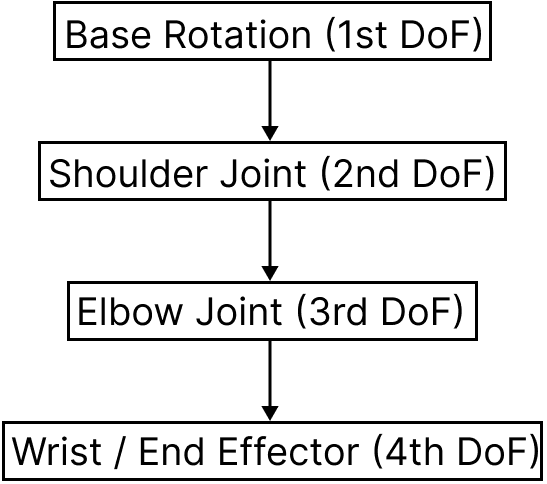
Draw the block diagram showing four degrees of freedom in a robot.
Answer
Block diagram showing four degrees of freedom in a robot is given below:
This branch of Artificial Intelligence allows machines to understand and interpret human language and speech.
a. Name the technology used here.
b. Mention two applications of this technology.
Answer
a. Natural Language Processing (NLP)
b. Two applications of NLP are:
- Language translation
- Chatbots
Write a program in Python that accepts the name and price of a product and calculates the net amount to be paid by a customer, based on the following criteria:
| Product Price | Discount |
|---|---|
| <1000 | 0% |
| 1000-5000 | 2% |
| 5001-15000 | 3% |
| 15001-25000 | 5% |
| 25001-50000 | 10% |
| >50000 | 12% |
name = input("Enter product name: ")
price = float(input("Enter product price: "))

if price < 1000:
    discount = 0
elif price <= 5000:
    discount = 2 / 100
elif price <= 15000:
    discount = 3 / 100
elif price <= 25000:
    discount = 5 / 100
elif price <= 50000:
    discount = 10 / 100
else:
    discount = 12 / 100

discount_amount = price * discount
net_amount = price - discount_amount

print("Product Name:", name)
print("Original Price:", price)
print("Discount Amount:", discount_amount)
print("Net Amount to be Paid:", net_amount)Enter product name: Mobile Phone
Enter product price: 20000
Product Name: Mobile Phone
Original Price: 20000.0
Discount Amount: 1000.0
Net Amount to be Paid: 19000.0
List different types of autonomous vehicles. Explain one type.
Answer
Different types of autonomous vehicles are:
- Autonomous ground vehicles
- Autonomous aerial vehicles
- Autonomous underwater vehicles
Autonomous ground vehicles: Autonomous ground vehicles are vehicles that can operate without human intervention. They use sensors, cameras, and Artificial Intelligence techniques to sense their surroundings, make decisions, and navigate from one place to another. These vehicles are used for tasks such as transportation, inspection, and surveillance, and help in reducing human effort and improving efficiency.
Discuss three benefits of integrating technology in medical and healthcare.
Answer
Three benefits of integrating technology in medical and healthcare are:
- Early disease detection and diagnosis – Technology such as Artificial Intelligence and computer vision is used to analyse medical images like X-rays, CT scans, and MRIs, which helps doctors in detecting diseases at an early stage and making accurate diagnoses.
- Better patient monitoring – Smart devices and sensors are used to monitor patient's health conditions continuously. This helps doctors and healthcare professionals to track vital signs and provide timely treatment.
- Improved efficiency in healthcare services – The use of technology helps in automating medical processes, managing patient data, and supporting decision-making, which reduces human effort and improves the overall efficiency of healthcare systems.
Write a program to accept a symbol from the user and draw the following pattern containing that symbol.
Input: Enter the symbol: *
Output:
*
* *
* * *
* * * *
sym = input("Enter the symbol: ")
for i in range(1, 5):
print((sym + " ") * i)Enter the symbol: *
*
* *
* * *
* * * *
Enter the symbol: #
#
# #
# # #
# # # #
Computer vision enables computers and machines to perceive, analyse, and extract meaningful information from visual data, such as photos and videos. Name any two applications of computer vision. Also, define each type.
Answer
Two applications of Computer Vision are:
- Medical Imaging — Computer vision is used to analyse medical images such as X-rays, CT scans, and MRIs. It helps doctors in detecting diseases and identifying abnormalities accurately.
- Face Recognition — Face recognition is an application of computer vision that enables a system to identify a person by analysing facial features from images or videos. It is commonly used in security and surveillance systems.
Based on the following picture, answer the given questions.
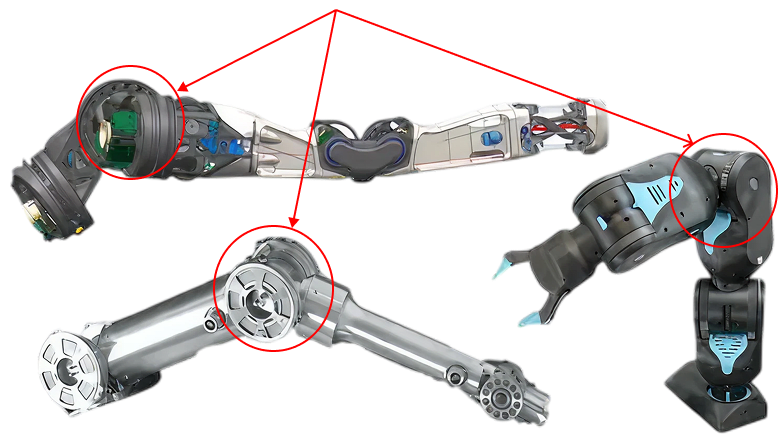
a. Identify the type of joint.
b. Briefly explain this type of joint.
Answer
a. Spherical joint
b. Spherical joints, also known as ball and socket joints, provide the most freedom of movement among all joint types. They allow the links to rotate around multiple axes, enabling the robot to move in multiple directions. Spherical joints are commonly found in the human shoulder and hip joints.
Create a user-defined function that accepts a number as input. Perform the following operations:
- If the number is divisible by 3, it should return "ice".
- If divisible by 5, it should return "water".
- If it is divisible by both 3 and 5, it should return "icewater".
- Otherwise, it should return the same number.
def ice_water(n):
    if n % 3 == 0 and n % 5 == 0:
        return "icewater"
    elif n % 3 == 0:
        return "ice"
    elif n % 5 == 0:
        return "water"
    else:
        return n

num = int(input("Enter a number: "))
result = ice_water(num)
print(result)Enter a number: 15
icewater
Enter a number: 9
ice
Enter a number: 20
water
Motion means the ability to move. A robot can move around in space and change its position or direction. Define linear, angular, and circular motions in robots.
Answer
Linear Motion: Linear motion in robots refers to the movement of a robot in a straight line. The robot in linear motion travels in a straight line and its displacement is proportional to the time elapsed.
Angular Motion: Angular motion is the rotational movement of a robot or its part around a fixed axis. In this motion, the robot changes its direction by rotating through a certain angle.
Circular Motion: Circular motion is the movement of a robot or its part along a circular path. In this type of motion, the robot continuously changes its direction while moving around a fixed centre.
Accountability in AI ethics tells about who is accountable or responsible for AI system's activities and repercussions, including their creators, operators, and organisations. To manage any harm caused by AI technology and guarantee accountability for decisions made by AI systems, clear guidelines of responsibilities and processes must be established. Accountability also includes continuous monitoring and optimisation of AI systems. Discuss the above issue with the 4W canvas.
a. Who is responsible for the activities and impacts of AI systems?
b. What should be established to ensure accountability in AI systems?
c. Why is continuous monitoring important in AI ethics?
d. How can harm caused by AI technology be managed?
Answer
a. The responsibility for the activities and impacts of AI systems lies with the creators, developers, operators, and organisations that design, deploy, and use the AI systems.
b. To ensure accountability in AI systems, clear guidelines of responsibilities and well-defined processes must be established so that accountability for decisions made by AI systems can be clearly identified.
c. Continuous monitoring is important in AI ethics because it helps in tracking the behaviour, performance, and outcomes of AI systems and ensures that they function as intended without causing unintended harm.
d. Harm caused by AI technology can be managed by establishing proper accountability mechanisms, following ethical guidelines, and optimising AI systems regularly to reduce risks and negative impacts.
Write a function for checking the speed of drivers. This function should have one parameter: speed.
- If the speed is less than 70, it should print "OK".
- Otherwise, for every 5 km above the speed limit (70), it should give the driver one demerit point.
Calculate and print the total number of demerit points at the end. For example, if the speed is 80, it should print: "Demerit Points: 2".
def check_speed(speed):
    if speed < 70:
        print("OK")
    else:
        points = (speed - 70) // 5
        print("Demerit Points:", points)
speed = int(input("Enter the speed: "))
check_speed(speed)Enter the speed: 80
Demerit Points: 2
Data plays a very important role in the development and operation of AI. The performances and accuracy of AI models can be considerably impacted by the quantity, quality, and relevance of the data used. Why is data important in AI-based recommendation systems?
Answer
Data is important in AI-based recommendation systems because AI algorithms use large amounts of data to learn user preferences and behaviour. Recommendation systems analyse data such as user choices, past interactions, ratings, and browsing history to identify patterns. The quality, quantity, and relevance of data directly affect the performance and accuracy of the recommendations. Accurate and well-processed data helps the AI system generate personalised and meaningful recommendations, whereas poor or insufficient data can lead to incorrect or less useful suggestions.
Draw the circuit diagram and write the truth table for the NOR gate.
Answer
Circuit Diagram of NOR Gate:

Truth Table of NOR Gate:
| X | Y | Output |
|---|---|---|
| 0 | 0 | 1 |
| 0 | 1 | 0 |
| 1 | 0 | 0 |
| 1 | 1 | 0 |
Write a function in Python that returns the sum of multiples of 3 and 5 between 0 and limit (parameter). For example, if the limit is 20, it should return the sum of 3, 5, 6, 9, 10, 12, 15, 18, 20.
def sum_multiples(limit):
    s = 0
    for i in range(0, limit + 1):
        if i % 3 == 0 or i % 5 == 0:
            s = s + i
    return s

limit = int(input("Enter limit: "))
print(sum_multiples(limit))Enter limit: 20
98
"Robots are flexible mechanical machines." Justify this statement.
Answer
Robots are called flexible mechanical machines because they are designed with links, joints, actuators, and controllers that allow them to perform a wide variety of tasks. Robots can change their position, direction, and movement according to the task requirements. They can be reprogrammed to perform different operations without changing their physical structure. Due to their flexibility, robots can be used in different environments and applications such as manufacturing, medical surgery, transportation, and space exploration. This ability to adapt and perform multiple tasks makes robots flexible mechanical machines.
"All robots are machines, but all machines are not robots." Prepare a write-up on the same.
Answer
All robots are machines because they are electromechanical devices designed to perform specific tasks using mechanical parts, electronic components, and computer programs. Robots are capable of sensing their environment, processing information, and performing actions either autonomously or with minimal human intervention.
However, all machines are not robots. A machine is any device that helps humans perform work more easily, such as a fan, washing machine, or calculator. These machines work only according to fixed instructions and do not have sensors, decision-making ability, or adaptability. They cannot sense the environment or make decisions based on inputs.
Robots, on the other hand, can process sensor data, make decisions, and adapt to changes in their surroundings. Therefore, while every robot is a machine, every machine cannot be called a robot, which justifies the statement.
Write a Python program to input two numbers and find their HCF and LCM.
a = int(input("Enter first number: "))
b = int(input("Enter second number: "))
x = a
y = b
while b != 0:
    r = a % b
    a = b
    b = r
hcf = a
lcm = (x * y) // hcf
print("HCF:", hcf)
print("LCM:", lcm)Enter first number: 12
Enter second number: 18
HCF: 6
LCM: 36