
Write any two tasks that a robot can perform.
Answer
Any two tasks that a robot can perform are:
- A robot can be used for quality control tasks such as inspecting products for defects, measuring dimensions and checking for completeness.
- A robot can perform complex tasks, such as exploring space.
Observe any one robot that you have seen in your environment and write its tasks.
Answer
One robot that I have seen in my environment is the Roomba robot (robot vacuum cleaner).
Tasks of Roomba robot:
- It is used to clean floors autonomously.
- It uses sensors to detect obstacles and navigates around furniture and other objects while cleaning.
- It can be programmed to start cleaning at specific times or controlled using a mobile app.
Today, robots are becoming increasingly prevalent in our daily lives. Some of the tasks that robots can do are shown here.
Explore the internet and find out the names of the robots that are designed to perform these tasks.
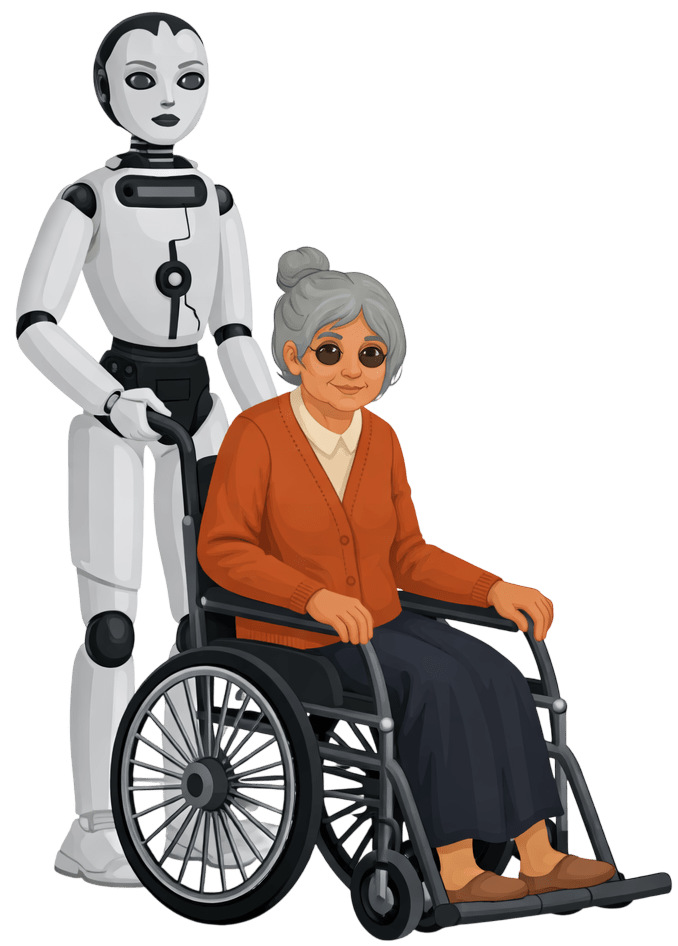
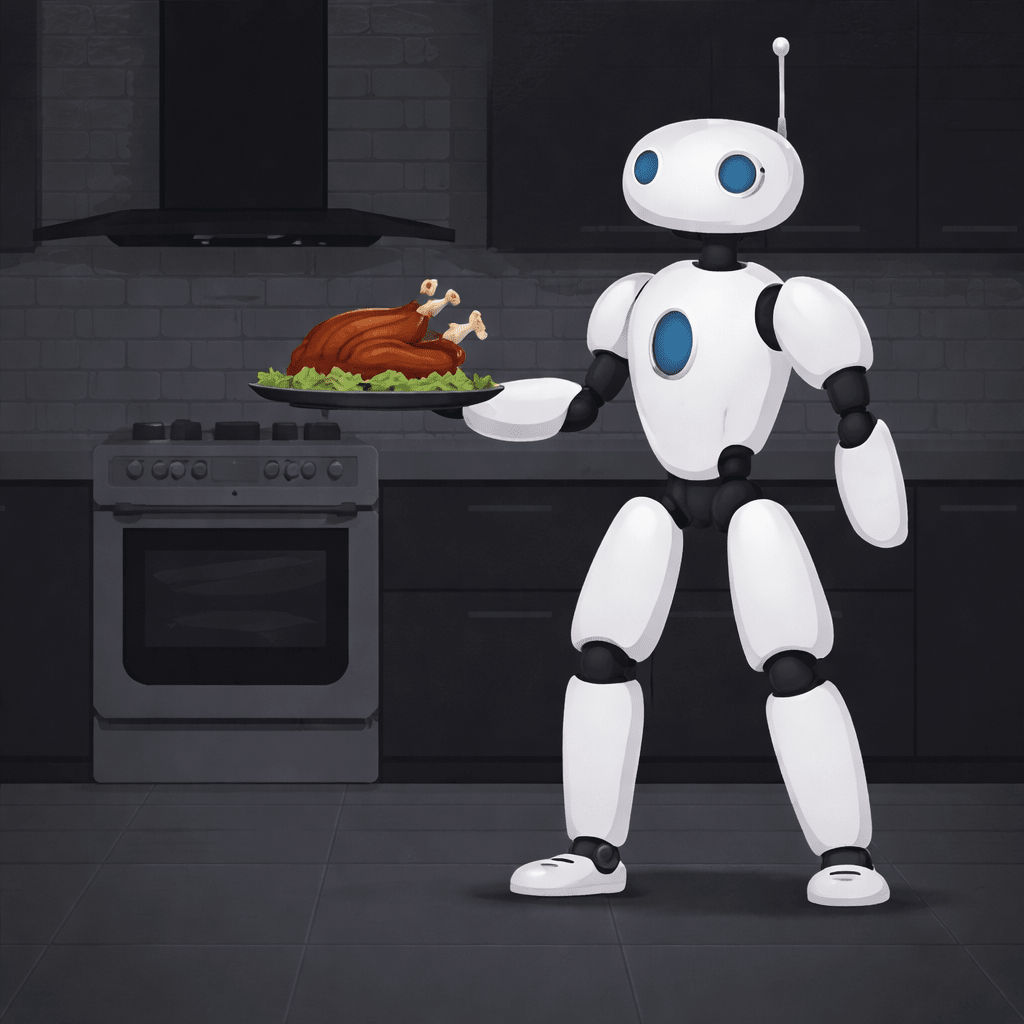
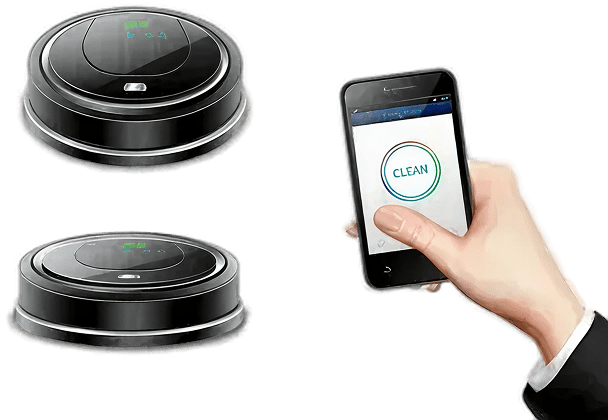
Answer
Abi (or Abby), Care-O-Bot, ElliQ
NEO, INDRO
Roomba
Let us assume the following scenarios:
A fire safety robot is obeying his owner although its temperature tolerance circuit is not working.
A robot was trying to pick up an object. Suddenly, a child came in between the robot and the object. The robot stops working.
A warehouse robot is designed to move packages from one location to another. The robot monitors its own health and reports any issues to its human operator. It also avoids situations that could lead to its destruction, such as moving too close to hazardous materials.
A medical robot is designed to perform surgery. The robot follows the commands of the surgeon and performs the surgery.
In the given table, indicate whether each scenario compiles with the given law or violates it. One has been done for you.
Answer
| Scenario | Law 1 (Obeyed/violated) | Law 2 (Obeyed/violated) | Law 3 (Obeyed/violated) |
|---|---|---|---|
| 1 | Violated | Obeyed | Violated |
| 2 | Obeyed | Obeyed | Obeyed |
| 3 | Obeyed | Obeyed | Obeyed |
| 4 | Obeyed | Obeyed | Obeyed |
Classify robots into autonomous and manual categories. One has been done for you.
| S.No. | Robot | Category |
|---|---|---|
| 1 | A robotic arm used for assembly line tasks in manufacturing plants. | Autonomous |
| 2 | A robot used in medical procedures, like surgery or rehabilitation therapy. | |
| 3 | The drones used for photography and operated by a cameraman. | |
| 4 | A robot (self-driving car) that operates on its own, without human input. | |
| 5 | A self driven robot that is used for sea surveillance. |
Answer
| S.No. | Robot | Category |
|---|---|---|
| 1 | A robotic arm used for assembly line tasks in manufacturing plants. | Autonomous |
| 2 | A robot used in medical procedures, like surgery or rehabilitation therapy. | Manual |
| 3 | The drones used for photography and operated by a cameraman. | Manual |
| 4 | A robot (self-driving car) that operates on its own, without human input. | Autonomous |
| 5 | A self driven robot that is used for sea surveillance. | Autonomous |
Write the names of at least two robots related to each field (except the robots explained in the chapter).
| Domain | Robot Name | Main Task |
|---|---|---|
| Medical | ||
| Agriculture | ||
| Education | ||
| Defence | ||
| Disaster Management | ||
Answer
| Domain | Robot Name | Main Task |
|---|---|---|
| Medical | Mako SmartRobotics | Assisting doctors in knee and hip replacement surgery |
| CorPath GRX | Robotic assistance in heart and vascular procedures | |
| Agriculture | AgXeed | Autonomous field operations such as ploughing and sowing |
| SwarmFarm Robots | Crop monitoring and precision farming | |
| Education | Thymio | Teaching students basic robotics and programming |
| Dash Robot | Interactive learning and coding education | |
| Defence | UGV Gladiator | Military ground surveillance and reconnaissance |
| Skyborg | Autonomous aerial combat support and surveillance | |
| Disaster Management | Quince Rescue Robot | Search and rescue in collapsed buildings |
| FireBot | Firefighting in hazardous and high-temperature areas |
All robots have the ability to sense their environment and make decisions based on that information.
Answer
False
Reason — Only some robots are equipped with sensors and control programs that allow them to sense their surroundings and make decisions, whereas many robots are either manually operated or pre-programmed to perform specific tasks and do not have the ability to sense the environment or take independent decisions.
All robots are designed to work autonomously.
Answer
False
Reason — All robots are not designed to work autonomously because some robots are manually operated and depend completely on human control to perform their tasks, while only certain robots are programmed to work independently without human intervention.
Robots can be designed to perform destructive tasks.
Answer
True
Reason — Robots can be designed to perform destructive tasks as they are used in areas such as defence, where they are employed for activities like handling explosives, bomb disposal, and military operations that may cause destruction.
Robots can be flexible due to their reprogrammable feature.
Answer
True
Reason — Robots can be flexible because they are reprogrammable, which means the same robot can be programmed again and again to perform different tasks as required. By changing the program, a robot can adapt to new jobs without changing its physical structure, making it flexible in nature.
A robot needs to obey all instructions of its owner, irrespective of their motive.
Answer
False
Reason — A robot does not need to obey all instructions of its owner irrespective of their motive because, according to the Three Laws of Robotics, a robot must not harm a human being or allow a human to come to harm, and it should obey human orders only if they do not conflict with the first law. Therefore, if an instruction has a harmful or wrong motive, the robot should not follow it.
The term "robot" was first coined in the 20th century.
Answer
True
Reason — The term "robot" was first introduced in the 20th century.
Robots can not communicate with humans and other machines.
Answer
False
Reason — Robots can communicate with humans and other machines using different forms of communication such as signals, displays, sounds, and programmed instructions, which allow them to interact with users and coordinate with other machines while performing tasks.
The three laws of robotics are only applicable to humanoid robots.
Answer
False
Reason — The Three Laws of Robotics are framed as general rules for robots and are applicable to all types of robots, not only humanoid robots.
The development of nanotechnology has allowed for the creation of microscopic robots.
Answer
True
Reason — The development of nanotechnology has made it possible to create very small or microscopic robots, known as nanorobots, which are designed to perform tasks at a microscopic level, especially in fields such as medicine and research.
The name of first industrial robot is Unimate.
Answer
True
Reason — The first industrial robot was named Unimate, and it was used in industries to perform repetitive and hazardous tasks such as handling hot metal and heavy materials.
A robot is:
- A type of vehicle
- A type of camera
- A type of software
- A machine that can be programmed to perform specific tasks
Answer
A machine that can be programmed to perform specific tasks
Reason — A robot can be defined as an electromechanical machine that performs tasks automatically with or without human assistance.
The three laws of robotics are created by:
- Stephen Hawking
- Victor Scheinman
- Elon Asima
- Isaac Asimov
Answer
Isaac Asimov
Reason — The Three Laws of Robotics are a set of rules created by science fiction writer, Issac Asimov, in his short story "Runaround" and later expanded upon in his novels.
The characteristics of a robot include(s):
- Robots cannot move.
- It can be designed to perform disastrous tasks.
- It can be programmed to perform a variety of ethical tasks.
- Robots are always controlled by humans.
Answer
It can be programmed to perform a variety of ethical tasks.
Reason — One of the characteristics of a robot is that it is programmable, which allows it to perform different tasks as required. Robots are designed to carry out useful and ethical tasks in various fields such as homes, industries, medicine, and education.
A bio-inspired robot is:
- Powered by biological fuel sources.
- Designed to mimic biological structures or processes
- Made entirely of biological material
- Controlled by the human brain
Answer
Designed to mimic biological structures or processes
Reason — A bio-inspired robot is a robot that is designed by taking inspiration from living organisms, and it mimics biological structures or processes such as movement, shape, or behaviour found in nature.
The advantage of designing nature-inspired robots is:
- They are less expensive to produce than traditional robots.
- They are more visually appealing than traditional robots.
- They have better performance in certain environments.
- They are easier to control and program than traditional robots.
Answer
They have better performance in certain environments.
Reason — Nature-inspired or bio-inspired robots are designed by studying living organisms, which helps them adapt better to specific environments such as land, water, or air. Because of this natural inspiration, these robots can perform more efficiently in certain environments compared to traditional robots.
What is the main advantage of designing robots that are inspired by the anatomy and physiology of insects ?
- They are less costly.
- They are simple to design.
- They are able to fly faster.
- They are more flexible and able to navigate through small spaces and crevices more easily.
Answer
They are more flexible and able to navigate through small spaces and crevices more easily.
Reason — Robots inspired by the anatomy and physiology of insects are designed to copy their body structure and movement, which makes them highly flexible and enables them to move through narrow spaces, gaps, and crevices with ease.
Which of the following is an example of a manual robot?
- Roomba vacuum cleaner
- A self-driving car
- A surgical robot used in medical procedures
- None of these
Answer
A surgical robot used in medical procedures
Reason — A manual robot is a robot that is controlled by a human operator and does not work independently. A surgical robot performs actions only as directed by the doctor and works under human control, which makes it an example of a manual robot.
The Roomba vacuum cleaner and a self-driving car are examples of autonomous robots because they can sense their environment and work automatically without continuous human control, so they are not manual robots.
What is the advantage of using a robot in hazardous environment ?
- They are able to operate continuously without any human intervention.
- They are less expensive.
- They provide greater precision and control over tasks.
- They minimise the risk of human exposure to hazardous material.
Answer
They minimise the risk of human exposure to hazardous material.
Reason — One of the main advantages of using robots in hazardous environments is that they can perform dangerous tasks such as handling toxic substances, explosives, or working in unsafe conditions, thereby reducing the risk to human life.
Which of the following is an example of an autonomous robot?
- Mars Rover
- Packbot
- Parrot Bebop 2
- Atlas
Answer
Mars Rover
Reason — An autonomous robot is a robot that can operate on its own without continuous human control by sensing its environment and taking decisions. The Mars Rover works independently on Mars by collecting data, navigating the surface, and performing tasks without direct human intervention, so it is an autonomous robot.
Packbot, Parrot Bebop 2, and Atlas are operated either by remote control or human supervision, and therefore they are manual robots.
The application(s) of an agriculture robot is/are:
- Fruit picking
- Harvesting
- Weed removal
- All of these
Answer
All of these
Reason — Agricultural robots are used for fruit picking, harvesting, and weed removal to assist farmers in performing farming activities more efficiently. These robots help in reducing manual labour and increasing productivity in agriculture.
Give the definition of robot.
Answer
A robot can be defined as an electromechanical machine that performs tasks automatically with or without human assistance.
What do you understand by collaborative robots?
Answer
Collaborative robots are robots that are designed to work along with humans and assist them in performing tasks, especially in industrial environments, instead of working completely independently.
Classify robots on the basis of field.
Answer
On the basis of field, robots are classified into three categories:
- Aerial robots
- Ground robots
- Underwater robots
What is main purpose of ground robots?
Answer
Ground robots are designed to operate on land. They are typically used for exploration, transportation or manufacturing purposes.
Classify robots on the basis of control.
Answer
On the basis of control mechanism, robots are classified into two categories:
- Manual robots
- Automatic robots
Explain the characteristics of robots by considering a medical surgery robot.
Answer
The characteristics of robots can be explained with the help of a medical surgery robot as follows:
Sensing – A medical surgery robot uses sensors and cameras to see the surgical area in high detail. It senses position, pressure, and movement with high precision during a surgical procedure .
Movement – The robotic arms can move up, down, left, right, rotate, and tilt with very fine control. This helps in making tiny, controlled cuts and movements that are difficult to do steadily by hand.
Learning – Some robots use AI/machine learning to improve performance by learning from past surgeries (e.g., better motion planning or recognizing patterns in images).
Autonomy – A medical surgery robot can perform certain actions automatically like stabilizing tools or maintaining a fixed position, though it mainly works under the supervision of a surgeon.
Adaptability – It can be adapted to different surgical procedures like stitching, cutting, holding tissues, assisting in keyhole surgery. It can also use different tools for different steps of the operation.
Durability – The robot is designed to work reliably in hospital conditions and handle repeated use. Parts are made to be strong and long-lasting, and many tools are sterilizable or disposable for hygiene.
Accuracy – It performs surgical tasks with high accuracy and precision, reducing human error.
Safety – Medical surgery robots are designed with safety features to limit the robot’s speed and range of motion to ensure patient safety during surgical procedures.
How can robots be used to improve quality of products in industry ?
Answer
Robots are used for quality control tasks, such as inspecting products for defects, measuring dimensions and checking for completeness. These robots use sensors and cameras to detect errors and can provide real-time feedback to operators.
Write and explain the three laws of robotics with the help of example.
Answer
The three Laws of Robotics are a set of rules created by science fiction writer, Issac Asimov, in his short story "Runaround" and later expanded upon in his novels. They are as follows:
The first law: A robot may not injure a human being or, through inaction, allow a human being to come to harm.
This law prioritises the safety of humans above everything else. It means that a robot must always ensure that its actions do not cause harm to a human and that is must take steps to prevent harm from coming to a human, even if that means sacrificing itself. For example, a robot designed to work in a hazardous environment, like a nuclear power plant, must be programmed to shut down or take other appropriate actions if it detects a risk of injury to a human operator.
The second law: A robot must obey the orders given to it by human beings except where such orders would conflict with the first law.
This law requires a robot to obey the commands of a human as long as those commands do not conflict with the first law. This means that a robot must prioritise the safety of humans over following orders that could potentially harm them. For example, a military robot designed to follow orders must follow the instruction given by its owner but should not engage in actions that could harm innocent civilians, even if those orders were given by a superior officer.
The third law: A robot must protect its own existence as long as such protection does not conflict with the first or second law.
This law ensures that a robot takes actions to protect itself from harm as long as those actions do not conflict with the first or second law. For example, a robot designed to operate in extreme temperatures must be programmed to shut down or take other actions to protect itself if its internal sensors detect that it is at risk of damage or malfunction.
Explain the function of a robot which is inspired by bird.
Answer
One example of a robot inspired by birds is the SmartBird, developed by the German engineering firm, Festo. The SmartBird is an autonomous ornithopter robotic bird that can fly and move in the air like a real bird due to its lightweight design and bio-inspired flight control system. It is designed to mimic the bird's wing motions and tail movements. The robot's wings are made of lightweight foam and are controlled by a complex system of linkages and motors that allow them to flap and adjust their angle of attack. The robot's tail is also controlled by a separate set of motors, which allow it to steer and stabilise the robot during flight.
Write the applications of robots in the medical domain.
Answer
The applications of robots in the medical domain are as follows:
Surgical robots: Robotic surgical systems, such as the da Vinci Surgical System, are used in hospitals to assist surgeons during minimally invasive procedures. These robots provide high precision and magnification, allowing surgeons to perform complex procedures with greater accuracy and control.
Rehabilitation robots: Rehabilitation robots, such as Lokomat, are used for physical therapy and rehabilitation. These robots can assist patients with walking, improve their range of motion, and help them regain strength and mobility.
Telepresence robots: Telepresence robots, such as BeamPro and Double, are used for remote patient care and telemedicine. These robots allow doctors to remotely monitor patients, consult with other medical professionals and provide virtual visits.
Pharmacy robots: Pharmacy robots, such as RoboPharma and Parata, are used for automated medication dispensing and packaging. These robots can fill and dispense medications quickly and accurately, reducing errors and improving efficiency.
Elderly case robots: Elderly care robots, such as Giraff, are used for remote monitoring and assistance for elderly patients. These robots can provide reminders for medication, monitor vital signs and allow caregivers to check in with patients remotely.
List out various facts that ensure that robots are designed to prioritise human safety and ethics.
Answer
The following facts ensure that robots are designed to prioritise human safety and ethical behaviour:
- A robot may not injure a human being or, through inaction, allow a human being to come to harm. This law gives the highest priority to human safety.
- A robot must obey the orders given to it by human beings, except where such orders would conflict with the First Law. This ensures that ethical behaviour is maintained while following human instructions.
- Robots are designed with safety features, such as sensors, which help them detect humans and obstacles and prevent accidents.
- Robots are used to work in hazardous environments, such as nuclear plants and disaster areas, to reduce risk to human life.
- Robots can perform dangerous tasks involving sharp objects or extreme temperatures, thereby ensuring the safety of humans.
What could be the potential risks and benefits of creating autonomous weapons, and how can we ensure that they are designed and used in an ethical and responsible manner ?
Answer
Autonomous weapons are systems that can operate and make decisions without direct human control. Their development can have both benefits and risks, and therefore they must be designed and used in an ethical and responsible manner.
Benefits of autonomous weapons:
- Autonomous weapons can reduce risk to human soldiers by performing dangerous tasks in war zones.
- They can operate in hazardous environments where human presence may be unsafe.
- Such systems can respond quickly and accurately to threats using sensors and programmed instructions.
- They can be used for surveillance and defence operations, improving national security.
Risks of autonomous weapons:
- Autonomous weapons may cause harm to innocent humans if they make incorrect decisions.
- Lack of human judgement may lead to ethical issues, especially in deciding when to use force.
- Technical failures or hacking may result in unintended destruction or misuse.
- Over-dependence on machines may reduce human responsibility and control in critical situations.
Ensuring ethical and responsible use:
- Autonomous weapons should be designed by following the Three Laws of Robotics, giving highest priority to human safety.
- Human supervision and control should always be maintained in critical decision-making.
- Strict rules, regulations, and safety checks should be implemented before deployment.
- Autonomous weapons should be used only for defensive and protective purposes, not for harming innocent people.
How can robots be used to help elderly people? Take a suitable case study and explain.
Answer
Robots can be used to help elderly people by providing assistance, monitoring, and support in their daily lives. These robots help improve the quality of life, ensure safety, and allow elderly people to live more independently.
Role of robots in helping elderly people:
- Robots can monitor the health and daily activities of elderly people.
- They can provide assistance and reminders, such as reminding them to take medicines or attend appointments.
- Robots help elderly people communicate with doctors, caregivers, and family members.
- They can provide support in emergencies by alerting caregivers when help is needed.
Case Study: Giraff – An Elderly Care Robot
Giraff is an elderly care robot. It is designed for remote monitoring and assistance of elderly people.
- Giraff allows caregivers and family members to check on elderly people remotely.
- It helps in video communication between elderly people and doctors or caregivers.
- The robot supports continuous monitoring, ensuring that elderly people receive timely help.
- It reduces the need for constant physical supervision while maintaining safety and care.
List out any five tasks of your daily routine for which you feel that robots can be used to perform.
Answer
Any five tasks of my daily routine for which robots can be used are:
- Cleaning the house, such as sweeping and mopping floors.
- Cooking or assisting in cooking, like chopping vegetables or stirring food.
- Washing utensils or clothes using automated robotic systems.
- Gardening tasks, such as watering plants or mowing the lawn.
- Providing reminders, such as reminding about medicines, schedules, or appointments.
What role can robots play in the education field?
Answer
Robots can play an important role in the education field by supporting teaching and learning processes and making education more interactive and effective.
- Robots can be used as teaching assistants to help teachers explain concepts in an interesting manner.
- Educational robots can help students learn programming, coding, and robotics concepts through hands-on activities.
- Robots can provide interactive learning experiences, which increase student's interest and engagement in classrooms.
- Robots can be used for research and experimentation in schools and educational institutions.
- Robots can support personalised learning, where students can learn at their own pace with guidance from robots.